Last updated: September 8, 2026
Next review: September 2027 or sooner if medical guidance changesQuick answer: If your blood pressure drops after a hot shower, heat may be the reason. Hot water widens blood vessels. Standing also pulls blood toward the legs. Dehydration, some medicines, and orthostatic hypotension can make the drop stronger. Fainting or serious symptoms need medical care.
A lower number after a hot shower can look scary.
Sometimes it is a quick response to heat.
Sometimes the shower exposes a blood pressure problem that was already there.
The number matters.
But your symptoms matter just as much.
I would not judge the situation from one reading taken while you are still hot and standing in the bathroom.
The better approach is simple. Let your body cool. Measure your blood pressure the right way. Look for a pattern. Then know which warning signs should not be ignored.
If you are new to blood pressure readings, first see my complete guide to high blood pressure.
Why does blood pressure fall after a hot shower?
Heat opens blood vessels near your skin.
This process is called vasodilation.
Wider blood vessels create less resistance to blood flow. Your blood pressure can fall as a result.
A hot shower also means you are usually standing.
Gravity moves some blood toward your legs.
Your body normally reacts fast. It tightens some blood vessels and adjusts your heart rate so enough blood reaches your brain.
If that response is slow, you can feel weak or faint.
This is one reason people report hot shower dizziness or feeling lightheaded as they step out of the shower.
Mayo Clinic Press notes that hot showers and baths widen blood vessels and can leave blood pressure lower for about 30 minutes.
That does not mean every person will have the same drop.
Your normal blood pressure, hydration, medicines, health conditions, shower temperature, and time spent in the shower all matter.
Is low blood pressure after a hot shower dangerous?
Not always.
The American Heart Association uses a reading below 90/60 mm Hg as a common definition of low blood pressure.
That number is useful.
It is not a diagnosis by itself.
Some people naturally have blood pressure near this level and feel well.
Other people become dizzy after a sudden fall even when the final number is above 90/60.
So if you notice low blood pressure after hot shower, look at three things:
- Your actual reading
- Your normal blood pressure
- How you feel
A change from 125/80 to 100/65 with strong dizziness means something different from a normal reading of 100/65 in someone who feels fine.
Do not chase a perfect number.
Look at the whole pattern.
Do not trust a rushed blood pressure reading
This is one of the easiest mistakes to make.
You get out of a hot shower.
You feel strange.
You grab the blood pressure monitor.
The number is low.
Now you are worried.
But that is not a proper resting blood pressure test.
Your body is still reacting to heat.
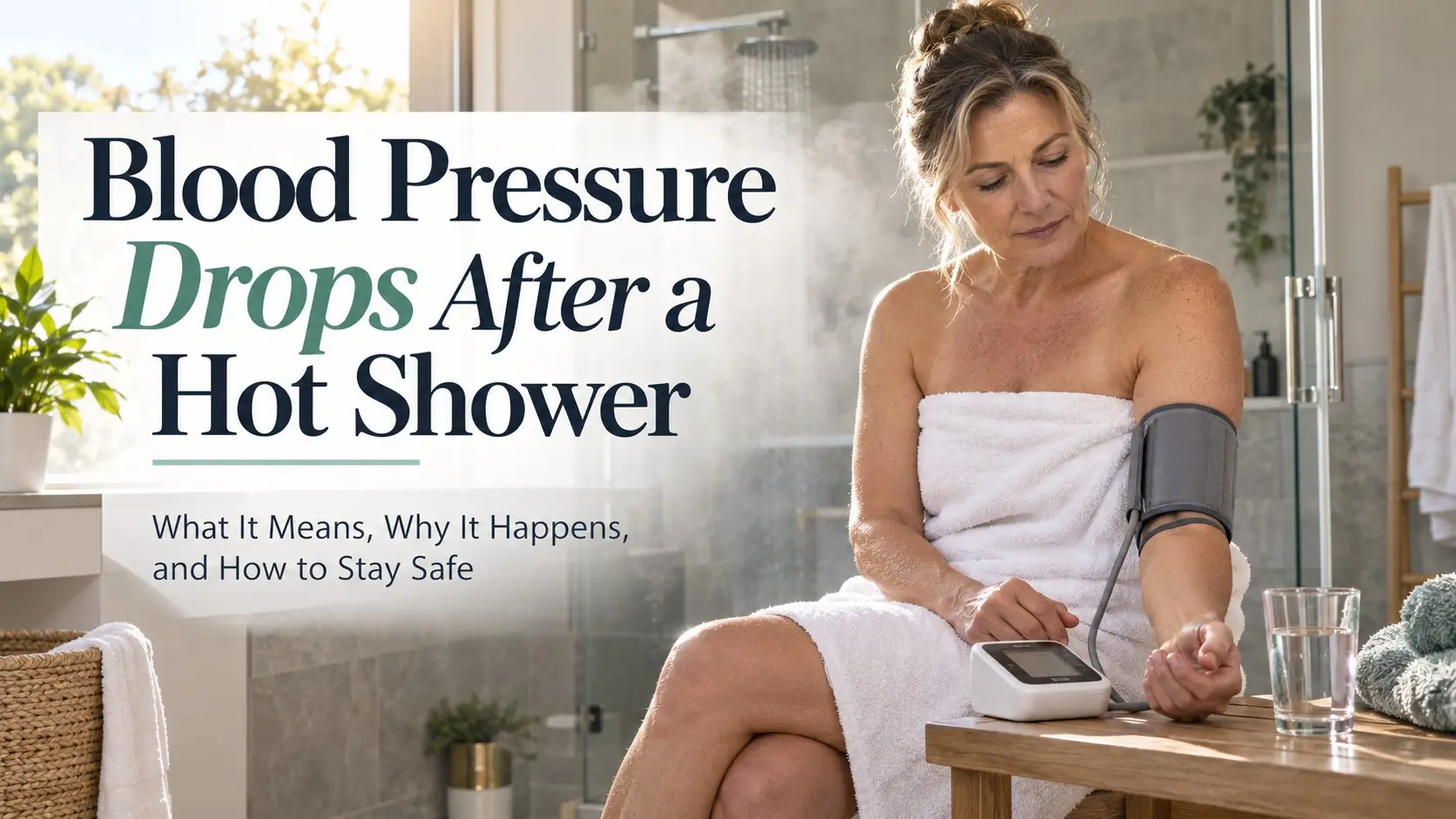
For a better reading, cool down and sit quietly first.
The Centers for Disease Control and Prevention recommends resting quietly for at least five minutes before measuring blood pressure.
Sit with your back supported.
Keep both feet flat on the floor.
Do not cross your legs.
Place the cuff on bare skin.
Support the arm at heart level.
Do not talk while the monitor is running.
Take at least two readings about one or two minutes apart.
This gives you a better idea of your true blood pressure after shower once the immediate heat effect starts to settle.
What should you record when this keeps happening?
A short log can tell you much more than one isolated number.
Write down:
- Your blood pressure before the shower
- Your pulse before the shower
- Whether the water was warm or very hot
- How long you stayed in the shower
- What symptoms you felt
- Your blood pressure when symptoms appeared if it is safe to measure
- Your blood pressure again after cooling and resting
Also describe the feeling.
Do not just write “dizzy.”
Write what actually happened.
For example:
- I felt faint.
- My vision became dark.
- My legs felt weak.
- The room started spinning.
- My heart started racing.
- I felt sick.
Someone who feels lightheaded after shower may be having a different problem from someone who feels true spinning vertigo.
That detail can help your healthcare provider.
Could dehydration be making it worse?
Yes.
Dehydration reduces the amount of fluid in your circulation.
Heat then opens your blood vessels.
The combination can make a blood pressure drop easier to notice.
Think about the hours before the shower.
Did you exercise?
Were you outside in hot weather?
Did you sweat heavily?
Have you had vomiting or diarrhea?
Have you been drinking less than usual?
If yes, dehydration and blood pressure may be part of the problem.
You can learn more in my guide to dehydration and blood pressure.
There is one important exception.
Do not force yourself to drink large amounts of fluid if your doctor has told you to limit fluids because of heart, kidney, liver, or another medical condition.
Can blood pressure medicine make shower dizziness worse?
It can.
Some medicines lower blood pressure on purpose.
Others can make standing related blood pressure changes more noticeable.
These can include some:
- Diuretics
- Blood pressure medicines
- Alpha blockers
- Beta blockers
- Nitrates
- Antidepressants
- Medicines used for Parkinson disease
The timing gives you useful clues.
Ask yourself:
- Did this start after a new medicine?
- Did the dose recently increase?
- Did the time you take the medicine change?
- Did another medicine get added?
Write down the answer.
Do not stop a prescribed medicine because of one low blood pressure reading.
Do not skip doses.
Do not cut a tablet unless your healthcare provider tells you to.
Show the pattern to your doctor or pharmacist instead.
Could it be orthostatic hypotension?
Maybe.
Orthostatic hypotension means blood pressure drops when you move into an upright position.
It is also called postural hypotension.
The usual medical definition is a fall of at least 20 mm Hg in systolic blood pressure or at least 10 mm Hg in diastolic blood pressure within three minutes of standing.
That is different from simply seeing one low number.
How is lying and standing blood pressure checked?
If you can do this safely:
- Lie down and rest for at least five minutes.
- Measure your blood pressure and pulse.
- Stand slowly.
- Measure again at about one minute.
- Measure again at about three minutes.
Do not try to finish the test if you feel like you will faint.
Sit or lie down.
Do not perform this test alone if you have a history of fainting or falling.
A home reading that shows a 20/10 drop is useful information.
It does not tell you why the drop happened.
A healthcare professional may need to review your medicines, hydration, heart rate, health history, and other factors.
Can your heart rate rise after a hot shower?
Yes.
Your heart can beat faster when blood vessels open and blood pressure falls.
Your body is trying to keep blood moving to your brain and other organs.
A small short lived increase that settles after you cool down is different from strong or repeated palpitations.
Get checked if a fast or irregular heartbeat keeps happening with:
- Fainting
- Chest pain
- Severe weakness
- Trouble breathing
- Symptoms away from the shower
Do not assume a racing heart after one hot shower means you have POTS.
Heat can make symptoms worse in people who have problems with automatic blood pressure control.
But one shower episode cannot diagnose that condition.
For more heart health information, visit the NextFitLife Heart and Cardiovascular Health Hub.
6 warning signs you should not ignore
Most mild heat related blood pressure dips settle after you cool down.
These six signs deserve more attention.
1. You faint or almost faint
Fainting after shower is more serious than simply noticing a slightly low number.
There is also a fall risk.
A wet bathroom has hard surfaces.
If you start to feel faint, stop the hot water.
Sit down.
Move to a safe place if you can.
Do not keep standing to finish the shower.
If fainting happens more than once, get medical advice.
2. You have chest pain
Chest pain or pressure with a blood pressure drop needs prompt attention.
Do not assume the shower is the whole cause.
Severe chest pain, especially with sweating, weakness, nausea, or breathing trouble, can be an emergency.
3. You struggle to breathe
Mild lightheadedness after heat is one thing.
Serious breathing trouble is different.
If you cannot breathe normally or feel very unwell, seek emergency care.
4. You become confused or develop stroke signs
New confusion is not a normal shower reaction.
Neither are:
- New weakness on one side
- Face drooping
- Trouble speaking
- Sudden trouble understanding speech
These symptoms need emergency care.
5. Your pressure stays unusually low and you feel ill
A quick dip that improves after cooling is different from blood pressure that stays much lower than your normal level.
Watch for hypotension symptoms such as:
- Weakness
- Blurred vision
- Nausea
- Confusion
- Cold clammy skin
- Fainting
Repeated low readings with symptoms should be assessed by a healthcare professional.
6. The problem keeps happening outside the shower
This is a big clue.
If you also become dizzy when:
- Getting out of bed
- Standing from a chair
- Walking after sitting
- Exercising
- Standing for long periods
The shower may simply be exposing a wider blood pressure problem.
Repeated symptoms deserve a medical review.
What should you do if you feel faint in the shower?
Stop the heat first.
Do not try to be tough and finish the shower.
Sit down if you can do so safely.
Once you are out of the shower, lie down if the faint feeling continues.
Stand again only when you feel stable.
If this happens more than once, consider simple safety changes while you work with your healthcare provider to find the cause.
These can include:
- A nonslip shower surface
- A shower seat
- A secure grab bar
- Warm rather than very hot water
- A shorter shower
Preventing a fall matters.
Will a cooler shower help?
It is worth testing.
Use warm water instead of very hot water.
Keep the shower shorter.
Do not stand up or step out too fast.
Make sure you are not starting the shower already dehydrated.
If the problem stops when you lower the water temperature, heat is likely playing a role.
That still does not rule out medicine effects, dehydration, or orthostatic hypotension.
Is 90/60 dangerous after a shower?
Not by itself.
A blood pressure below 90/60 mm Hg meets the common definition of low blood pressure.
But some people feel completely normal at that level.
Symptoms change the meaning.
A new reading of 90/60 with faintness, weakness, confusion, or blurred vision deserves more attention.
A reading near 90/60 that is normal for you and causes no symptoms may be less concerning.
If you are unsure, keep a proper log and discuss it with your healthcare provider.
When should you make a medical appointment?
Book an appointment if the problem keeps coming back.
I would also get it checked if:
- You repeatedly feel close to fainting
- You have actually fainted
- Your blood pressure remains much lower than your normal level
- You repeatedly see a 20/10 drop when standing
- The problem began after a medicine change
- You have heart disease
- You have diabetes
- You have Parkinson disease
- You have kidney disease
- You get the same symptoms away from the shower
Take your blood pressure log with you.
Bring an up to date medicine list too.
This gives your healthcare provider something useful to work with.
When is it an emergency?
Do not wait for a perfect blood pressure reading when someone looks seriously ill.
Call your local emergency service for:
- Severe chest pain or pressure
- Serious breathing trouble
- Loss of consciousness with poor recovery
- New weakness on one side
- New trouble speaking
- Severe confusion
- Cold, clammy skin with severe weakness
- A weak, fast pulse with other signs of shock
Do not drive yourself if you feel faint, confused, or severely unwell.
Common mistakes to avoid
Do not diagnose yourself from one number.
Do not keep standing if you feel ready to faint.
Do not stop prescription medicine on your own.
Do not assume every case is caused by dehydration.
Do not start taking a lot of salt because you read that salt can raise blood pressure.
Extra salt can be unsafe for some people, especially people with high blood pressure, heart problems, kidney disease, or fluid retention.
Read my high blood pressure guide before making changes that could affect your normal blood pressure.
My practical approach to blood pressure topics
I do not believe one home reading tells the full story.
I look at the trigger.
I look at symptoms.
I look at how the reading was taken.
Then I compare that pattern with guidance from trusted health sources.
This is especially useful with blood pressure because poor measurement technique can create confusing numbers.
The goal of this article is simple.
Help you ask better questions.
Help you measure more carefully.
Help you know when home observation is enough and when medical care is the better next step.
Conclusion
If your blood pressure drops after a hot shower, start with the simple things.
Use less heat.
Sit and rest before measuring.
Check your hydration.
Write down your symptoms.
Compare the result with your usual blood pressure.
One mild drop can be a normal heat response.
A repeated pattern with fainting, chest pain, breathing trouble, confusion, or severe weakness needs more attention.
Your next step: take one proper resting blood pressure reading today. If this keeps happening, start a short blood pressure and symptom log and share it with a qualified healthcare professional.
References and Trusted Sources
American Heart Association: Low Blood Pressure When Blood Pressure Is Too Low
Used for the common definition of low blood pressure and symptoms linked with hypotension.
Centers for Disease Control and Prevention: Measuring Your Blood Pressure
Used for correct home blood pressure measurement technique.
Mayo Clinic Press: Under Pressure How to Lower High Blood Pressure
Used for information about hot showers, blood vessel widening, and temporary blood pressure changes.
National Center for Biotechnology Information: Orthostatic Hypotension
Used for the 20 mm Hg systolic and 10 mm Hg diastolic definition of orthostatic hypotension.
Leeds Teaching Hospitals NHS Trust: Postural Hypotension
Used for practical guidance about heat, standing, hydration, and postural blood pressure symptoms.
Explore More From NextFitLife
Use these guides to learn more about blood pressure, circulation, hydration, and heart health.
Heart and Cardiovascular Health Hub
NextFitLife Health Hub
Understanding High Blood Pressure
How to Lower Blood Pressure
What Causes High Blood Pressure
Dehydration and Blood Pressure
Poor Circulation in Feet
Heart Health After 50
Sleep and Heart Health
About the Author
NextFitLife Health and Wellness Editorial Team
At NextFitLife, I focus on practical health and fitness information that is easy to understand and useful in real life. I compare everyday questions with trusted medical and public health guidance so readers can make better informed choices and know when professional care is needed.
I am not a dermatologist or a doctor, and this content does not replace professional medical advice. What I share comes from real life experience, extensive research, and consultation with healthcare providers. Always consult qualified medical professionals for diagnosis and treatment of any health condition.
Learn more about NextFitLife and our approach
Frequently Asked Questions
Why does my blood pressure drop after a hot shower?
Hot water widens blood vessels. This can reduce resistance to blood flow and lower blood pressure for a short time. Standing, dehydration, medicines, and orthostatic hypotension can make the effect stronger.
Can a hot shower really cause low blood pressure?
Yes. Heat can widen blood vessels and lower blood pressure for a short time. The effect can be more noticeable after a long or very hot shower.
How long can blood pressure stay lower after a hot shower?
Mayo Clinic Press notes that blood pressure can remain lower for about 30 minutes after a hot shower or bath. The exact response differs from person to person.
Is 90/60 dangerous after a hot shower?
Not always. A reading below 90/60 mm Hg is commonly called low blood pressure. Your symptoms and normal blood pressure matter too. Repeated low readings with faintness, weakness, confusion, or blurred vision should be checked.
Can dehydration make blood pressure drop after a shower?
Yes. Dehydration can reduce blood volume. Hot water also widens blood vessels. Together, these effects can make dizziness and weakness more noticeable.
What is orthostatic hypotension?
Orthostatic hypotension is a blood pressure drop after standing. The standard definition includes a fall of at least 20 mm Hg systolic or 10 mm Hg diastolic within three minutes of standing.
Should I stop blood pressure medicine if hot showers make me dizzy?
No. Do not stop or change prescription medicine on your own. Record your blood pressure, symptoms, medicine timing, and shower timing. Share the information with your doctor or pharmacist.
What should I do if I feel faint in the shower?
Stop the hot water. Sit or lie down somewhere safe. Do not continue standing. Seek emergency help if fainting comes with chest pain, serious breathing trouble, severe confusion, stroke signs, or poor recovery.
When should I see a doctor?
Get medical advice if the problem keeps happening, gets worse, causes fainting, occurs outside the shower, starts after a medicine change, or comes with repeated low blood pressure readings and symptoms.

Health & wellness writer with 30+ years of experience in nutrition, fitness, and healthy aging. Founder of NextFitLife.com — evidence-based health guidance.