Published: September 19, 2026
Next Review: September 2027, or sooner if major blood pressure or cardiovascular guidance changes
Written and Source Checked by: Adel Galal, Founder and Lead Writer at NextFitLife
Review Status: This article is educational health content. It has not been medically reviewed by a doctor, cardiologist, vascular specialist, pharmacist, or registered nurse.
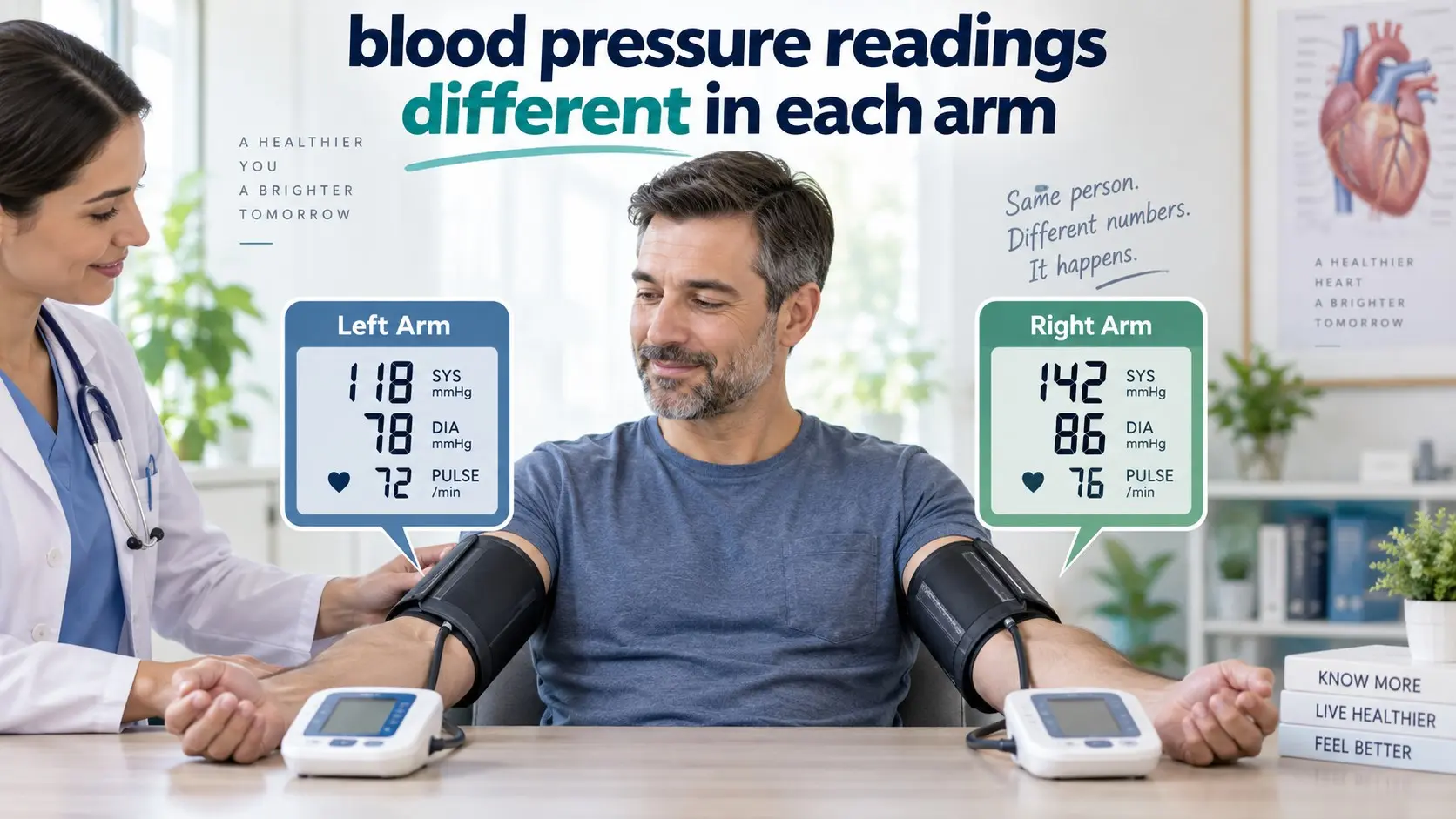
If you get blood pressure readings different in each arm, do not panic over one pair of numbers.
A small difference is common.
A difference that keeps appearing is more useful information.
Current evidence suggests that a persistent difference in the top number deserves attention, especially when it reaches 10 mmHg or more.
NICE uses a practical threshold of more than 15 mmHg.
If that difference remains when both arms are checked again, future blood pressure readings should be taken in the arm with the higher pressure.
Quick Answer
Blood pressure readings different in each arm can happen because blood pressure naturally changes from moment to moment or because the measurement was taken differently. A persistent systolic difference around 10 mmHg deserves attention. If the difference is more than 15 mmHg, current NICE guidance recommends repeating both arms and using the higher arm if the difference remains.
Emergency Warning
A difference between your arms by itself does not mean you have an emergency.
But call your local emergency service immediately if a new or large difference appears with:
- Sudden severe chest pain
- Sudden severe upper back pain
- Shortness of breath
- Fainting
- Sudden weakness or numbness
- Trouble speaking
- Sudden vision change
- A missing or very weak pulse in one arm
These symptoms can occur with serious conditions including aortic dissection, heart attack, stroke, or an acute blood flow problem.
Do not keep checking your blood pressure at home while serious symptoms continue.
Table of Contents
- Fact 1: Small differences between arms are common
- Fact 2: Measurement technique can create a false difference
- Fact 3: A persistent 10 mmHg systolic difference deserves attention
- Fact 4: More than 15 mmHg should be checked again
- Fact 5: Use the arm with the higher reading
- Fact 6: A persistent difference can signal blood vessel disease
- Fact 7: Sudden differences with serious symptoms need urgent care
Also covered:
- How to compare both arms correctly
- Which number matters most
- Why the right arm is not always higher
- Whether arm dominance matters
- When to call a doctor
- When an ultrasound or scan may be needed
- Which arm to use at home
- Common measurement mistakes
- Frequently asked questions
What Does It Mean When Blood Pressure Is Different in Each Arm?
Your blood pressure changes constantly.
It responds to breathing.
Talking.
Stress.
Movement.
Temperature.
Caffeine.
Exercise.
Even the order in which you measure your arms can matter.
Because of this, the number measured in your right arm does not have to match the left arm exactly.
The medical term is an interarm blood pressure difference.
The top number is usually the main focus.
That is your systolic blood pressure.
It measures pressure while the heart contracts.
The lower number is your diastolic blood pressure.
It measures pressure between heartbeats.
Research linking arm differences with future cardiovascular risk is strongest for systolic pressure.
Fact 1: Small Differences Between Arms Are Common
Your two arms are not identical plumbing systems.
The arteries branch from the aorta differently on each side.
Blood pressure also changes from one minute to the next.
That means a difference of a few mmHg can appear even in healthy people.
One reading such as:
Right arm: 126/78
Left arm: 121/77
does not automatically point to disease.
The more useful question is:
Does the difference remain when the measurements are repeated correctly?
One Pair of Readings Is Not Enough
If you measure the right arm first and the left arm two minutes later, your blood pressure may simply have fallen during those two minutes.
This is one reason sequential arm measurements can make the difference look larger than it really is.
The INTERPRESS research specifically notes that measuring one arm after the other can overestimate the size of the difference compared with simultaneous measurements.
That does not make home testing useless.
It means repeated measurements matter.
Fact 2: Measurement Technique Can Create a False Difference
Before assuming something is wrong with your arteries, check the measurement.
This is where a lot of apparent arm differences come from.
Use the Same Cuff Correctly
A wrong cuff size can produce inaccurate readings.
A cuff that is too small can make blood pressure appear higher.
AHA recommends an automatic, validated upper arm monitor.
Wrist and finger monitors are less reliable for routine home use.
Keep Both Arms at Heart Level
An arm hanging below heart level can produce a higher reading.
An arm held too high can produce a lower reading.
Rest your arm on a table or firm support.
Do Not Measure Over Clothing
Place the cuff on bare skin.
Do not wrap it over a shirt or sweater.
Rest First
Before checking:
- Sit quietly for at least 5 minutes
- Keep your back supported
- Keep both feet flat on the floor
- Do not cross your legs
- Empty your bladder
- Do not talk
- Keep your phone aside
Avoid Common Triggers Before the Reading
AHA recommends avoiding:
- Smoking for at least 30 minutes
- Caffeine for at least 30 minutes
- Exercise for at least 30 minutes
Those factors can temporarily raise your blood pressure.
How to Compare Blood Pressure in Both Arms at Home
If you have noticed different readings, use a boring method.
Boring is good here.
Step 1: Sit Quietly
Rest for five minutes.
Step 2: Measure One Arm
Use the correct cuff.
Keep the arm supported at heart level.
Record the result.
Step 3: Measure the Other Arm
Use the same technique.
Record the result.
Step 4: Repeat the Process
After a short quiet interval, repeat both arms.
On another day, consider starting with the opposite arm.
This helps reduce the effect of measurement order.
Step 5: Look for a Pattern
Do not diagnose yourself from the largest difference you ever saw.
Look for a difference that appears repeatedly.
| Systolic Difference | What It Means | What to Do |
|---|---|---|
| Less than 10 mmHg | A small difference is common | Use good technique and continue routine monitoring |
| Around 10 to 15 mmHg | Above the proposed upper normal limit in INTERPRESS research | Repeat correctly and discuss with your healthcare professional if it persists |
| More than 15 mmHg | Meets the NICE threshold for repeat assessment | Repeat both arms. If still present, use the higher arm and discuss the finding with your healthcare professional |
| Large sudden difference with serious symptoms | Could signal an acute vascular problem | Seek emergency assessment |
This table is a guide.
It is not a diagnosis.
Fact 3: A Persistent 10 mmHg Difference Deserves Attention
The most useful research here is the INTERPRESS IPD collaboration.
Researchers combined data from 24 studies involving more than 53,000 people.
They found that larger differences in systolic pressure between the arms were associated with greater cardiovascular and mortality risk.
The authors proposed that a 10 mmHg systolic difference should be treated as the upper limit of normal.
That does not mean:
10 mmHg equals blocked artery.
It does not.
It means a repeated difference around or above this level is worth taking seriously rather than ignoring.
The Pattern Matters More Than One Number
A reading of:
Right arm: 135
Left arm: 124
once is different from seeing a similar gap on repeated correctly performed measurements.
The second situation carries more useful clinical information.
Fact 4: More Than 15 mmHg Should Be Checked Again
Current NICE hypertension guidance gives a very practical rule.
When assessing possible hypertension:
- Measure blood pressure in both arms.
- If the difference is more than 15 mmHg, repeat both measurements.
- If the difference remains more than 15 mmHg, use the arm with the higher reading for future measurements.
This recommendation is important because measuring only the lower arm can make a person's blood pressure look better than it really is.
That could affect whether high blood pressure is recognized or treated appropriately.
Fact 5: Use the Arm With the Higher Reading
This is one of the most useful takeaways.
Once a consistent difference has been confirmed, use the arm with the higher reading for routine measurements.
This applies to:
- Home blood pressure monitoring
- Follow up measurements
- Tracking treatment response
The American Heart Association also supports checking both arms initially and using the higher arm afterward.
There is no rule that says the right arm is always correct.
There is no rule that says the left arm is always correct.
The higher arm is the useful arm once the pattern is established.
Why Using the Lower Arm Can Be a Problem
Imagine your usual readings are:
Right arm: 146/86
Left arm: 132/82
If you always use the left arm, you might underestimate your blood pressure level.
This is why identifying the higher arm matters.
Accurate measurement affects decisions about diagnosis, monitoring, and treatment.
For more on blood pressure friendly nutrition, read DASH Diet: A Safe Guide to Lower Blood Pressure.
Fact 6: A Persistent Difference Can Signal Blood Vessel Disease
This is why a large difference should not simply be dismissed as “my arms are different.”
A persistent gap can sometimes reflect reduced blood flow to one arm.
Subclavian Artery Narrowing
The subclavian arteries carry blood toward the arms.
If one becomes narrowed, pressure in that arm can become lower.
Subclavian artery stenosis can occur because of atherosclerosis.
Cleveland Clinic notes that subclavian steal syndrome can produce a difference of 15 mmHg or more between arms along with a weaker pulse on the affected side.
Peripheral Artery Disease
Peripheral artery disease means arteries outside the heart are narrowed by plaque.
An interarm pressure difference can be one clue to vascular disease, especially in someone who also has:
- Smoking history
- Diabetes
- High cholesterol
- Known artery disease
- Older age
- High blood pressure
Read How to Improve Blood Circulation Safely for more information on circulation symptoms and emergency signs.
Other Causes Exist
Less common causes include structural blood vessel problems and inflammatory artery disease.
The correct cause cannot be identified from a home blood pressure cuff alone.
If a significant difference persists, let a healthcare professional decide whether more testing is appropriate.
Does the Lower Arm Have the Blockage?
Sometimes reduced blood flow causes lower pressure in the affected arm.
But do not use this as a home diagnosis.
A lower number does not automatically prove that an artery is blocked.
Measurement error, natural variation, blood pressure changes over time, anatomy, and other conditions can produce differences.
A clinician may compare:
- Repeated blood pressure readings
- Arm pulses
- Skin temperature or color
- Symptoms during arm exercise
- Other cardiovascular risk factors
Imaging is used when the clinical picture justifies it.
What Tests Might a Doctor Order?
Most people with one different reading do not immediately need a scan.
The first step is usually to confirm that the difference is real.
If an artery problem is suspected, tests can include:
Ultrasound
A vascular ultrasound can assess blood flow in arteries such as the subclavian artery.
CT Angiography
A CT angiogram can show the anatomy of blood vessels in more detail.
MR Angiography
An MR angiogram can also be used to examine blood vessels.
The test depends on the suspected condition.
Do not assume you need advanced imaging simply because two home readings were different.
Fact 7: A Sudden Difference With Serious Symptoms Needs Urgent Care
This is a very different situation from discovering a stable 12 point difference during routine home monitoring.
A sudden large blood pressure difference between the arms can occur in an aortic dissection.
Aortic dissection means a tear develops in the wall of the aorta.
It is uncommon.
It is also a medical emergency.
The American Heart Association lists possible warning signs such as:
- Sudden severe chest or back pain
- Sudden shortness of breath
- Fainting
- Stroke like symptoms
- Weakness or numbness
- Loss of pulse
- Different blood pressures between the arms
Do not read this and assume every arm difference means an aortic tear.
It does not.
The concern is a sudden difference together with acute symptoms.
If severe chest pain is present, see Chest Pain Left Side: What It Means and What to Do.
What if One Arm Reads 20 or 30 Points Higher?
Repeat the readings correctly.
If the difference remains that large, arrange medical assessment.
A persistent difference of that size is well above the thresholds used in common blood pressure guidance.
Do not simply choose the lower number because you prefer it.
Use the higher arm for routine monitoring once the difference has been confirmed.
If the large difference appeared suddenly with serious chest, back, breathing, neurological, or circulation symptoms, seek emergency care.
Does It Matter Which Arm You Measure First?
Yes, sometimes.
Blood pressure frequently falls after a person sits quietly for longer.
If you always measure the right arm first, then the left, the first arm can appear higher simply because more time has passed before the second reading.
This is called an order effect.
Research also shows that sequential measurements can exaggerate an interarm difference compared with measuring both arms at the same time.
A Practical Home Solution
Do not obsess over the order.
Instead:
- Rest properly first
- Measure both arms
- Repeat the comparison
- On another day, start with the other arm
- Look for the consistent higher arm
Does Your Dominant Arm Have Higher Blood Pressure?
Not reliably.
Being right handed does not mean your right arm must have higher pressure.
Being left handed does not make the left arm the correct arm for monitoring.
Arm dominance should not replace actual bilateral measurement.
Check both.
Then use the arm that is consistently higher.
What About the Bottom Number?
People often focus on the top number because most interarm research uses systolic blood pressure.
A repeated difference in diastolic blood pressure should still be recorded and discussed if it is large.
But the best established thresholds for cardiovascular risk and guideline decisions are based mainly on systolic differences.
Do not mix the two numbers together.
Compare systolic with systolic.
Compare diastolic with diastolic.
Blood Pressure Difference Examples
| Right Arm | Left Arm | Systolic Difference | Practical Interpretation |
|---|---|---|---|
| 124/76 | 120/75 | 4 mmHg | Small difference |
| 132/80 | 123/79 | 9 mmHg | Below the proposed 10 mmHg upper normal limit |
| 138/82 | 126/80 | 12 mmHg | Repeat carefully and watch for a persistent pattern |
| 148/86 | 130/82 | 18 mmHg | Repeat both arms and discuss if the difference remains |
These examples explain the arithmetic.
They do not diagnose the cause.
Should You Check Both Arms Every Day?
Usually no.
The purpose of measuring both arms is to establish whether a meaningful difference exists and identify the arm that should be used routinely.
Once your healthcare professional confirms the higher arm, use that arm consistently for home blood pressure monitoring.
Consistency makes your trend easier to interpret.
How Many Home Readings Should You Take?
AHA recommends taking two readings one minute apart during each monitoring session.
NICE guidance for confirming hypertension with home monitoring uses readings over several days rather than relying on one result.
The principle is simple.
Blood pressure is a trend.
Not a single number.
Keep a record that includes:
- Date
- Time
- Arm used
- Reading
- Anything unusual such as exercise, pain, illness, or stress
What Type of Monitor Should You Use?
AHA recommends a validated automatic upper arm device.
Look for:
- A monitor that has been independently validated
- A cuff that fits your arm correctly
- An upper arm cuff rather than a finger monitor
- A memory function if that helps you record readings
Take the monitor to a medical appointment occasionally so the technique and device can be checked.
Common Reasons Two Arms Look Different
| Reason | Typical Clue | Next Step |
|---|---|---|
| Normal variation | Small changing difference | Repeat correctly |
| Wrong cuff size | One arm has a different circumference or cuff fit | Use the correct cuff |
| Arm position | One arm is not at heart level | Support both correctly |
| Order effect | The first arm is repeatedly higher | Repeat and alternate order |
| Subclavian artery disease | Persistent larger difference, sometimes weaker pulse | Medical evaluation |
| Other vascular disease | Persistent difference plus cardiovascular risk factors | Medical evaluation |
| Acute aortic disease | Sudden difference with severe symptoms | Emergency care |
When Should You Make a Routine Medical Appointment?
Arrange an appointment if:
- The systolic difference repeatedly reaches about 10 mmHg or more
- The difference is more than 15 mmHg after repeat measurement
- One arm has a much weaker pulse
- You have arm pain with activity
- You have known peripheral artery disease
- You have diabetes or substantial cardiovascular risk
- Your higher arm shows persistent high blood pressure
Persistent differences are worth recording.
Bring your readings and your monitor if possible.
What if Both Arms Have High Blood Pressure?
The arm difference is only one issue.
If both arms are high, the main problem may be hypertension.
Do not wait for both arms to match before discussing high readings.
High blood pressure usually causes no symptoms.
That is why measurement matters.
For diet information, read DASH Diet: A Safe Guide to Lower Blood Pressure.
What if One Arm Is Normal and the Other Is High?
This is exactly why both arms matter.
Using only the lower arm can hide hypertension.
The higher arm should guide future measurements once the difference is confirmed.
A 2022 analysis reported by the American Heart Association found that using the higher arm improved classification of high blood pressure and cardiovascular risk.
What if My Home Monitor and Doctor's Reading Are Different?
Bring your monitor to an appointment.
A healthcare professional can check:
- Your cuff size
- Your position
- Your measurement technique
- Whether the monitor gives readings close to clinic equipment
Do not assume either device is automatically correct.
Can Anxiety Cause Different Readings in Each Arm?
Anxiety can raise blood pressure.
It can also make readings more variable.
But anxiety alone should not be used to explain a large difference that keeps appearing.
Repeat measurements under calm, standardized conditions.
Can Exercise Cause Different Arm Readings?
Exercise temporarily changes blood pressure.
That is why AHA recommends avoiding exercise for at least 30 minutes before a routine home measurement.
If you measure immediately after exercise, the result should not be compared with a normal resting reading.
For related cardiovascular monitoring, see Heart Rate Recovery After Exercise.
Can Diabetes Affect the Importance of an Arm Difference?
Diabetes raises cardiovascular risk.
That makes accurate blood pressure measurement especially important.
People with diabetes can also have more widespread artery disease.
If you have diabetes and a persistent interarm difference, mention it during your medical review.
Read Diabetes and Heart Diseases for the wider cardiovascular picture.
What About Adults Over 50?
Age increases the chance of atherosclerosis and high blood pressure.
That does not mean every difference between arms in an older adult is abnormal.
It means a persistent large difference deserves proper assessment.
For broader prevention guidance, see Heart Health After 50.
Seven Facts at a Glance
| Fact | What to Remember |
|---|---|
| 1 | A few mmHg difference is common |
| 2 | Bad technique can create a false difference |
| 3 | Research proposes 10 mmHg systolic as an upper normal limit |
| 4 | NICE says more than 15 mmHg should be repeated |
| 5 | Use the higher arm when a persistent difference is confirmed |
| 6 | A persistent large difference can be linked with vascular disease |
| 7 | A sudden difference plus severe symptoms needs emergency care |
Common Mistakes
1. Panicking After One Pair of Readings
Repeat them correctly.
2. Measuring One Arm at Heart Level and Letting the Other Hang
Position can change the result.
3. Using the Wrong Cuff Size
Fit matters.
4. Measuring After Coffee or Exercise
Wait at least 30 minutes.
5. Choosing the Lower Arm Because the Number Looks Better
Use the higher arm when the difference is confirmed.
6. Assuming 10 mmHg Means You Have a Blocked Artery
It does not diagnose a blockage.
7. Ignoring a Persistent 20 Point Difference
A repeated large difference deserves medical assessment.
8. Ignoring Serious Symptoms Because the Blood Pressure Is Not Extremely High
Symptoms can matter more than one number.
How I Approach Blood Pressure Readings Different in Each Arm
I am Adel Galal, founder and lead writer of NextFitLife.
My work focuses on reading current public health guidance and open medical research, comparing claims carefully, and translating technical findings into simple steps readers can use.
With blood pressure readings different in each arm, I think two mistakes are especially common.
The first is panic.
One different pair of readings does not prove artery disease.
The second is dismissal.
A persistent 15 or 20 point gap should not be ignored simply because you feel well.
The practical approach is better.
Measure correctly.
Repeat both arms.
Find the consistent higher arm.
Use that arm afterward.
Discuss persistent differences with a qualified healthcare professional.
And act urgently when a sudden difference appears with serious symptoms.
Conclusion: Take Persistent Arm Differences Seriously, Not Fearfully
Blood pressure readings different in each arm are not automatically a sign of serious disease.
Small differences are common.
Technique can create bigger differences than expected.
But a persistent systolic difference around 10 mmHg deserves attention, and a difference above 15 mmHg should be repeated according to NICE guidance.
If the difference remains, use the arm with the higher reading for routine monitoring.
Your next step: if you have noticed a repeated arm difference, sit quietly, measure both arms correctly, write down the results, and bring the pattern to your healthcare professional instead of relying on one isolated reading.
References and High Authority Sources
- National Institute for Health and Care Excellence.
Hypertension in Adults: Diagnosis and Management.
Current recommendations accessed 2026.
https://www.nice.org.uk/guidance/ng136/chapter/Recommendations
- American Heart Association.
Home Blood Pressure Monitoring.
Last reviewed August 14, 2025.
https://www.heart.org/en/health-topics/high-blood-pressure/understanding-blood-pressure-readings/monitoring-your-blood-pressure-at-home
- Mayo Clinic.
Blood Pressure: Can It Be Higher in One Arm?
Updated November 5, 2024.
https://www.mayoclinic.org/diseases-conditions/high-blood-pressure/expert-answers/blood-pressure/faq-20058230
- Clark CE, Warren FC, Boddy K, et al.
Associations Between Systolic Interarm Differences in Blood Pressure and Cardiovascular Disease Outcomes and Mortality.
Hypertension. 2021.
https://pmc.ncbi.nlm.nih.gov/articles/PMC7803446/
- American Heart Association.
What Is Aortic Dissection? Symptoms, Causes and How to Lower Risk.
Published September 14, 2026.
https://www.heart.org/en/news/2026/09/14/what-is-aortic-dissection-symptoms-causes-and-how-to-lower-risk
Explore More NextFitLife Heart and Health Guides
- DASH Diet and Blood Pressure
- Diabetes and Heart Diseases
- How to Improve Blood Circulation
- Chest Pain Left Side
- Chest Pain After Exercise
- Heart Health After 50
- Sleep and Heart Health
- Heart Rate Recovery After Exercise
Frequently Asked Questions About Different Blood Pressure Readings in Each Arm
Is it normal to have different blood pressure in each arm?
A small difference is common. A persistent larger difference deserves attention, especially when the systolic gap is around 10 mmHg or more.
How much difference between arms is normal?
INTERPRESS research proposed 10 mmHg systolic as the upper limit of normal. Current NICE guidance uses more than 15 mmHg as the threshold that should trigger repeat bilateral measurements.
Is a 5 mmHg difference between arms normal?
A difference of a few mmHg is common and can reflect normal blood pressure variation or measurement order.
Is a 10 mmHg difference dangerous?
It is not automatically dangerous. Research suggests that a persistent systolic difference around 10 mmHg deserves attention and may carry cardiovascular risk information.
Is a 15 mmHg difference between arms concerning?
NICE recommends repeating both arm measurements when the difference is more than 15 mmHg. If it remains above 15 mmHg, future readings should use the higher arm.
What if my arms differ by 20 mmHg?
Repeat the measurements correctly. If the difference remains around 20 mmHg, arrange medical assessment. Seek emergency care if the difference appears suddenly with serious symptoms.
Which arm should I use for blood pressure?
Measure both arms initially. Once a consistent difference is confirmed, use the arm with the higher blood pressure for future readings.
Is the right arm supposed to have higher blood pressure?
No. Either arm can be higher. Arm dominance or handedness does not reliably identify which arm should be used.
Why does one arm have lower blood pressure?
Possible explanations include normal variation, measurement technique, arm position, cuff fit, or reduced blood flow through an artery supplying that arm.
Can a wrong cuff cause different blood pressure readings?
Yes. A cuff that does not fit correctly can produce inaccurate blood pressure measurements.
Can arm position affect blood pressure?
Yes. The arm should be supported at heart level. An unsupported or incorrectly positioned arm can distort the reading.
Should I measure blood pressure over clothing?
No. Place the cuff on bare skin.
Should I measure both arms every day?
Usually not once the higher arm has been identified and confirmed. Routine monitoring can then use the same higher arm consistently.
Why does the arm I measure first read higher?
Blood pressure can fall while you remain seated and resting. Measuring one arm first every time can create an order effect.
Can anxiety create an arm difference?
Anxiety can make blood pressure more variable, but it should not automatically be blamed for a persistent large difference.
Can caffeine affect my readings?
Yes. Avoid caffeine for at least 30 minutes before a routine blood pressure measurement.
Can exercise affect my readings?
Yes. Avoid exercise for at least 30 minutes before routine resting blood pressure measurement.
What is interarm blood pressure difference?
It is the difference between blood pressure measured in the right arm and blood pressure measured in the left arm.
Which number matters most for arm differences?
Most cardiovascular outcome research focuses on the systolic or top number.
Can different blood pressure in each arm mean a blocked artery?
It can sometimes be associated with artery narrowing, but the difference alone does not diagnose a blockage.
What is subclavian artery stenosis?
It is narrowing of an artery that supplies blood toward an arm. It can produce lower pressure and a weaker pulse on the affected side.
Can peripheral artery disease cause different arm readings?
Yes. A persistent interarm difference can be associated with peripheral vascular disease and other atherosclerotic disease.
Can aortic dissection cause different blood pressure in each arm?
Yes, but aortic dissection is uncommon and usually presents as an acute medical emergency. Sudden severe chest or back pain, fainting, shortness of breath, stroke symptoms, pulse differences, or arm pressure differences need emergency assessment.
Does every large arm difference require a scan?
No. Clinicians usually confirm the difference and assess symptoms and pulses first. Imaging is ordered when the clinical findings suggest a vascular cause.
What test checks for a narrowed arm artery?
Vascular ultrasound is commonly used first when subclavian artery narrowing is suspected. CT or MR angiography may be used when more detail is required.
Can high blood pressure be missed by using the wrong arm?
Yes. Measuring only the lower pressure arm can underestimate blood pressure and may affect hypertension diagnosis or treatment decisions.
What if both arms have high readings?
The arm difference is then only part of the issue. Persistent high blood pressure itself needs proper assessment.
What if one arm is normal and the other is high?
Repeat both arms correctly. If the higher arm remains higher, use that arm for future monitoring and discuss the pattern with your healthcare professional.
When should I call emergency services?
Seek emergency help for sudden severe chest or back pain, severe shortness of breath, fainting, stroke symptoms, sudden weakness or numbness, or another serious symptom, especially if a new large arm difference is also present.
What should I do today if my arms are different?
Rest quietly, use a validated upper arm monitor with the correct cuff, measure both arms correctly, repeat the comparison, record the results, and seek professional advice if a significant difference persists.

Health & wellness writer with 30+ years of experience in nutrition, fitness, and healthy aging. Founder of NextFitLife.com — evidence-based health guidance.