Published: September 20, 2026
Last updated: September 20, 2026
Next review: September 2027, or sooner if major blood pressure or resistant hypertension guidance changes.
Written and source-checked by: Adel Galal, Founder and Lead Writer at NextFitLife
Medical review status: This article has not been medically reviewed by a cardiologist, hypertension specialist, nephrologist, endocrinologist, pharmacist, or other licensed healthcare professional.
If your blood pressure stays high despite several medicines, the next step should not automatically be another pill.
First, find out why.
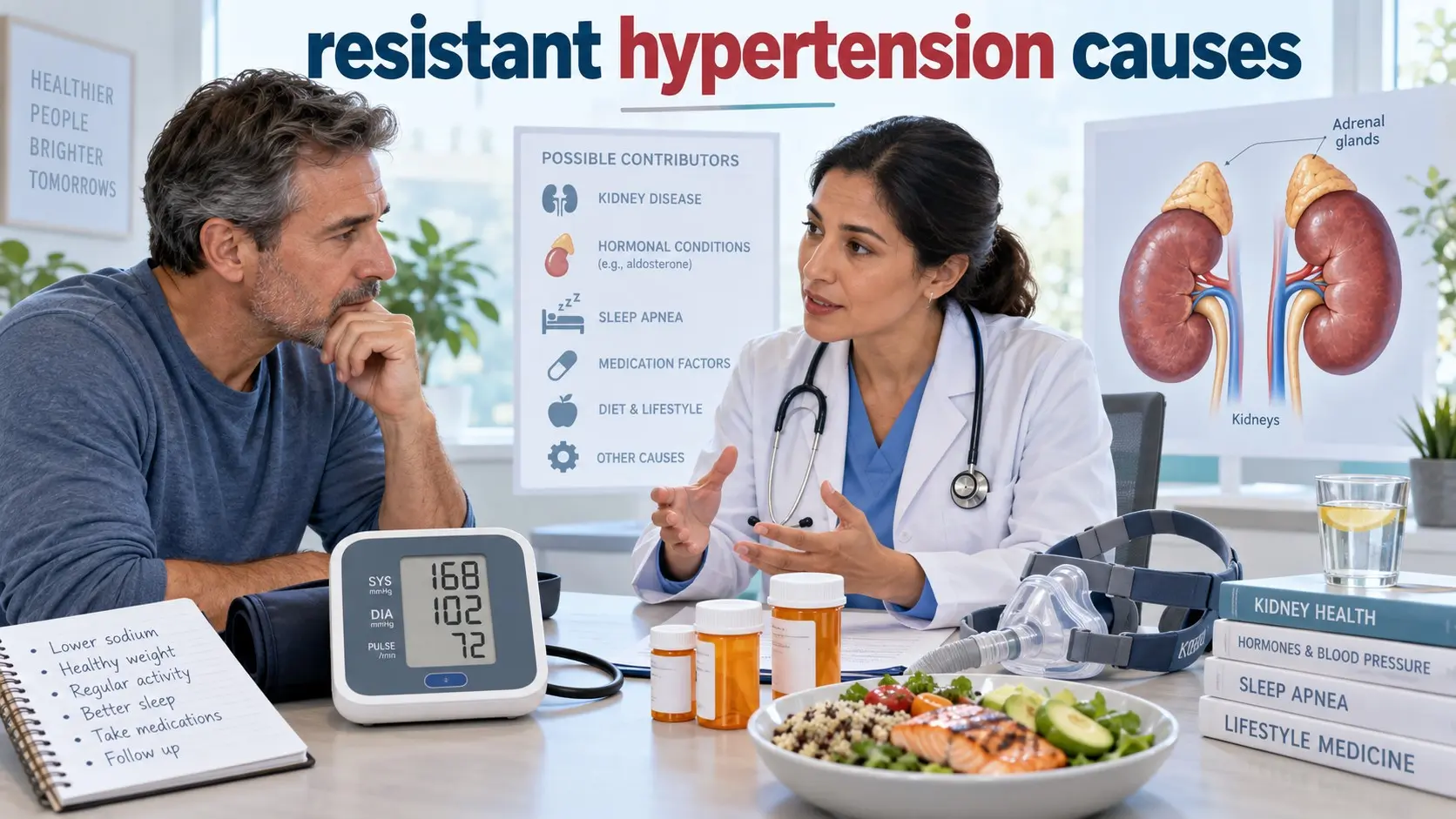
Resistant hypertension causes range from inaccurate blood pressure readings and missed medicine, sleep apnea, kidney disease, excess aldosterone, high sodium intake, and medicines that raise blood pressure.
Sometimes the blood pressure is not truly resistant at all.
That distinction matters.
A wrong cuff size needs a different solution from an adrenal hormone disorder.
A missed evening tablet needs a different solution from kidney disease.
And white coat effect needs a different approach from blood pressure that stays high all day and night.
This guide explains what resistant hypertension may mean, the common reasons clinicians look for, which tests may be useful, and the questions worth taking to an appointment.
For broader cardiovascular guidance, visit the NextFitLife Heart and Cardiovascular Health Hub.
Medical Notice
I am not a dermatologist or A doctor, and this content does not replace professional medical advice. What I share comes from real-life experience, extensive research, and consultation with healthcare providers. Always consult qualified medical professionals for diagnosis and treatment of any health condition.
Do not stop, double, skip, replace, or change a blood pressure medicine because of information in this article.
Do not stop another prescription medicine simply because it appears on a list of products that can raise blood pressure.
A doctor, prescribing clinician, or pharmacist should review possible alternatives and risks.
Quick Answer: What Can Cause Resistant Hypertension?
Resistant hypertension means blood pressure remains above its treatment goal despite an appropriate combination of three blood pressure medicines at suitable or maximally tolerated doses, including a diuretic.
Before confirming the diagnosis, clinicians should rule out pseudoresistance.
That means checking measurement technique, the white coat effect, whether medicine is being taken consistently, and whether treatment has been optimized.
Once true resistance is confirmed, common causes and contributors include excess sodium, blood pressure raising medicines, primary aldosteronism, obstructive sleep apnea, chronic kidney disease, and renovascular disease.
Table of Contents
- What Resistant Hypertension Means
- Why Pseudoresistance Comes First
- 11 Common Causes and Contributors
- Incorrect Blood Pressure Measurement
- White Coat Effect
- Missed or Inconsistent Medicine
- Treatment That Is Not Yet Optimized
- High Sodium Intake and Fluid Retention
- Medicines and Substances That Raise Blood Pressure
- Primary Aldosteronism
- Obstructive Sleep Apnea
- Chronic Kidney Disease
- Renal Artery Disease
- Other Hormonal or Structural Conditions
- Why Several Causes May Occur Together
- Tests a Clinician May Consider
- Why Normal Potassium Does Not Rule Out Aldosterone Excess
- How to Check Blood Pressure Correctly at Home
- What Happens After a Cause Is Found?
- Questions to Ask a Clinician
- When Very High Blood Pressure Is an Emergency
- References and Sources
- Conclusion
- Continue Reading on NextFitLife
- About the Author
- Frequently Asked Questions
What does resistant hypertension mean?
Resistant hypertension is more specific than having one high reading while taking medicine.
Current clinical guidance defines it as blood pressure remaining above goal despite an appropriate three-medicine regimen at optimal or maximally tolerated doses.
A diuretic should be part of that regimen.
A common three-medicine foundation includes:
- An ACE inhibitor or angiotensin receptor blocker
- A long-acting calcium channel blocker
- A thiazide type or thiazide-like diuretic
People whose pressure reaches goal but require four or more medicines are also commonly described as having controlled resistant hypertension.
There is one big condition attached to that label.
The resistance has to be real.
Why Clinicians Check for Pseudo-resistance First
Pseudoresistance means blood pressure looks resistant even though another explanation accounts for the numbers.
This is not wordplay.
It changes treatment.
Common causes include:
- Incorrect blood pressure technique
- The wrong cuff size
- White coat effect
- Missed medicine
- Medicine doses that are too low
- A treatment combination that has not been optimized
Adding a fourth medicine does not fix an inaccurate monitor.
It does not fix a prescription that cannot be afforded.
And it could cause blood pressure to become too low outside the clinic if the main problem is the white coat effect.
That is why confirming true resistance belongs near the beginning of the workup.
11 Common Resistant Hypertension Causes and Contributors
1. Incorrect Blood Pressure Measurement
The number can be wrong before the medical investigation even begins.
Cuff size matters.
Arm position matters.
Body position matters.
Rest time matters.
Talking during the measurement matters.
Recent exercise, nicotine, caffeine, and a full bladder can influence a reading too.
For home monitoring, use a validated automatic upper arm monitor with a cuff that fits your arm.
A series of well-taken measurements tells you far more than one rushed reading.
2. White Coat Effect
Some people have much higher blood pressure in a clinic than they do during ordinary life.
This is called the white coat effect.
Home measurements or ambulatory blood pressure monitoring can help show whether the pressure remains high outside the medical office.
Tell your clinician if home readings are consistently different from office readings.
That difference is useful information.
3. Missed or Inconsistent Medicine
Real life makes complicated treatment difficult.
A dose gets forgotten.
A medicine runs out.
A tablet causes ankle swelling.
A diuretic causes inconvenient urination.
The refill costs too much.
A person working shifts cannot keep the same schedule.
These situations are common.
They can make hypertension look resistant.
Medication adherence should therefore be discussed without blame.
Be honest about missed doses and side effects.
That information can help a clinician simplify treatment rather than blindly adding another medicine.
4. Treatment That Is Not Yet Optimized
Taking three blood pressure medicines does not automatically mean the regimen is complete.
A preferred medicine class may be missing.
A dose may be inadequate.
The diuretic may not suit the person's kidney function or clinical situation.
Side effects may prevent proper dosing.
The schedule may simply be too difficult to follow.
Current resistant hypertension evaluation checks for suboptimal treatment before confirming true resistance.
5. High Sodium Intake and Fluid Retention
Salt can quietly undermine blood pressure treatment.
The salt shaker is only part of the problem.
Large sodium loads can come from:
- Restaurant meals
- Processed meats
- Instant noodles
- Packaged sauces
- Stock cubes
- Ready meals
- Salty snacks
- Some breads and cheeses
Excess sodium encourages sodium retention and fluid retention.
This can make blood pressure harder to control.
The problem can be especially important in people with kidney disease or volume overload.
For practical food guidance, read the NextFitLife DASH Diet guide.
6. Medicines and Substances That Raise Blood Pressure
This is one of the easiest causes to overlook.
A complete medicine review should include more than your hypertension prescriptions.
Products that can contribute to high blood pressure include:
- NSAID pain medicines such as ibuprofen and naproxen
- Some cold and sinus decongestants
- Some hormonal medicines
- Some antidepressants and psychiatric medicines
- Glucocorticoid steroids
- Cyclosporine
- Tacrolimus
- Stimulant medicines
- Cocaine and amphetamines
- Nicotine
- Heavy alcohol use
- Some herbal stimulant products
- Natural licorice containing glycyrrhizin
Even some antacids contain significant sodium.
Bring a complete medicine and supplement list to the appointment.
Better still, bring the bottles or photographs of the labels.
7. Primary Aldosteronism
Primary aldosteronism is one cause I would not want missed.
Aldosterone is made by the adrenal glands.
It helps regulate sodium, fluid, and potassium.
Too much aldosterone causes the kidneys to retain sodium and can drive difficult hypertension.
Older teaching emphasized low potassium.
Current guidance has moved past that shortcut.
The 2025 ACC and AHA guideline recommends screening people with resistant hypertension for primary aldosteronism even if potassium is normal.
Initial testing commonly involves aldosterone and renin measurements interpreted together.
Medicine use and preparation can affect the results.
This is why testing should be planned with a clinician.
8. Obstructive Sleep Apnea
Sleep can be part of the blood pressure problem.
Obstructive sleep apnea repeatedly interrupts breathing during sleep.
It is strongly associated with resistant hypertension.
Clues include:
- Loud snoring
- Witnessed pauses in breathing
- Gasping or choking during sleep
- Morning headaches
- Poor quality sleep
- Daytime sleepiness
Not everyone with sleep apnea feels sleepy during the day.
If the history fits, a clinician may recommend home sleep testing or a formal sleep study.
For more context, read Sleep and Heart Health.
9. Chronic Kidney Disease
Blood pressure and kidney function affect each other.
High blood pressure can damage the kidneys.
Kidney disease can then make hypertension harder to control.
The kidneys help manage sodium, fluid, and blood pressure hormones.
When kidney function falls, these systems can become harder to regulate.
Evaluation may include:
- Serum creatinine
- Estimated GFR
- Electrolytes
- Urinalysis
- Urine albumin
Early kidney disease may cause no symptoms.
Read Kidney Disease Symptoms, Tests, Prevention, and Red Flags for a fuller explanation.
10. Renal Artery Disease
The kidneys need a reliable blood supply.
If an artery supplying a kidney becomes significantly narrowed, the kidney may respond as though blood pressure is too low.
Hormonal signals then push blood pressure higher.
This is called renovascular hypertension.
Atherosclerosis is one cause.
Fibromuscular dysplasia is another.
Not everyone with difficult blood pressure needs renal artery imaging.
Imaging is more useful when the history or examination gives a reason to suspect reduced kidney blood flow.
11. Other Hormonal or Structural Conditions
Less common causes still matter when the clinical clues point toward them.
These include:
- Thyroid disease
- Cushing syndrome
- Pheochromocytoma
- Paraganglioma
- Coarctation of the aorta
- Other adrenal disorders
For example, pheochromocytoma can cause episodes of severe or unstable blood pressure with headache, sweating, and palpitations.
But testing everyone for a rare adrenal tumor before checking medicine adherence, NSAIDs, sodium, sleep apnea, or aldosterone would be the wrong order.
Several Causes Can Be Present at the Same Time
This is one reason resistant hypertension can be frustrating.
The problem is often not one dramatic diagnosis.
Imagine someone who snores heavily, takes ibuprofen most days for knee pain, eats several restaurant meals each week, and sometimes forgets an evening tablet.
All four can push pressure in the wrong direction.
Now add kidney disease or excess aldosterone.
The result is a layered problem.
A systematic review usually makes more sense than hunting immediately for one rare cause.
How Do Obesity, Inactivity, and Alcohol Fit In?
These are not always separate diagnoses, but they can make hypertension harder to control.
Obesity
Obesity can affect blood pressure through changes in the nervous system, hormones, kidney sodium handling, insulin resistance, and sleep apnea.
Weight management can help some people.
It should be approached as medical risk reduction rather than blame.
Physical Inactivity
Regular activity can support blood pressure, cardiovascular fitness, blood sugar, sleep, and weight management.
If blood pressure is severely uncontrolled or exercise causes chest pain, fainting, or unusual shortness of breath, get medical advice before strenuous activity.
Alcohol
Heavy alcohol intake can raise blood pressure and interfere with control.
People who drink heavily every day or may be alcohol dependent should not suddenly stop without medical advice because alcohol withdrawal can be dangerous.
What Tests Might a Clinician Order?
There is no single test called a resistant hypertension panel.
The workup depends on the history.
Possible testing includes:
- Repeat blood pressure with correct technique
- Home blood pressure monitoring
- 24-hour ambulatory blood pressure monitoring
- Blood electrolytes
- Creatinine and estimated GFR
- Urine albumin
- Urinalysis
- An aldosterone-to-renin ratio or related aldosterone and renin testing
- Thyroid blood testing
- Sleep apnea testing
- Renal artery imaging when indicated
- Specific hormone tests when symptoms point to another endocrine disorder
More testing is not automatically better.
A good workup asks the highest value questions first.
For more test education, visit Health Screening 101.
Why Normal Potassium Does Not Rule Out Primary Aldosteronism
This deserves its own section.
For years, people were taught to associate aldosterone excess with hypertension plus low potassium.
Low potassium is a useful clue.
It is not required.
The 2025 ACC and AHA blood pressure guideline recommends screening people with resistant hypertension regardless of whether hypokalemia is present.
This means normal potassium should not end the discussion.
Finding aldosterone excess matters because treatment can become much more specific.
Some people have excess production from one adrenal gland.
Others have excess production involving both glands.
Further evaluation determines the treatment path.
How Should Blood Pressure Be Checked at Home?
Use a validated automatic upper arm monitor.
Make sure the cuff fits.
Before Measuring
- Avoid caffeine for at least 30 minutes
- Avoid smoking or nicotine for at least 30 minutes
- Avoid exercise for at least 30 minutes
- Empty your bladder
- Sit quietly for at least five minutes
During the Measurement
- Sit with your back supported
- Keep both feet flat on the floor
- Do not cross your legs
- Put the cuff on bare skin
- Support the arm at heart level
- Do not talk
Take readings according to the schedule your healthcare professional gives you.
When asked to take more than one reading, leave about one minute between measurements.
Write the results down.
One number is a snapshot.
A consistent home record shows the pattern.
Can Stress Cause Resistant Hypertension?
Stress can raise blood pressure temporarily.
It can also affect sleep, smoking, alcohol use, food choices, physical activity, and medicine routines.
But stress should not become the automatic explanation for difficult hypertension.
Relaxation strategies cannot treat primary aldosteronism.
They cannot open a significantly narrowed renal artery.
And they cannot correct kidney disease.
Manage stress because it affects health.
Still do the medical workup.
What Happens After a Cause Is Found?
Treatment should match the problem.
If blood pressure technique is inaccurate, fix the measurement.
If white coat effect is important, out-of-office monitoring becomes central.
If doses are missed, a simpler schedule may help.
If another medicine is raising blood pressure, the prescriber may consider alternatives.
If sodium and fluid retention are major contributors, diet and diuretic treatment can be reviewed.
If sleep apnea is diagnosed, it should be treated.
If primary aldosteronism is confirmed, treatment can target that condition.
If kidney disease is present, blood pressure and kidney protection should be managed together.
For true resistant hypertension that remains uncontrolled, current clinical reviews support a mineralocorticoid receptor antagonist as a common preferred fourth medicine when appropriate.
Some people remain uncontrolled despite careful treatment.
A hypertension specialist may then consider additional medicines or selected interventional options.
Do not add a fourth medicine yourself.
Questions to Ask a Clinician About Resistant Hypertension
Bring questions.
They can make the appointment much more useful.
- Have we confirmed that this is true resistant hypertension?
- Is my home blood pressure monitor validated?
- Does my cuff fit correctly?
- Could my high office readings be a white coat effect?
- Would ambulatory blood pressure monitoring help?
- Is my three-medicine combination optimized?
- Could one of my other medicines or supplements be raising my pressure?
- Could NSAID pain medicine be contributing?
- Should I be screened for primary aldosteronism?
- Does normal potassium change whether I need aldosterone testing?
- Could sleep apnea be contributing?
- Have my kidney function and urine albumin been checked?
- Do I have any reason to be tested for renal artery disease?
- How much sodium should I aim for?
- Would simplifying my medicine schedule improve adherence?
- What should I do if I miss a dose?
- Do I need to see a hypertension specialist, nephrologist, or endocrinologist?
- What blood pressure reading or symptom should send me for urgent care?
What Should You Bring to the Appointment?
A useful appointment starts with useful information.
Bring:
- Your home blood pressure monitor if possible
- Your recent blood pressure log
- Every prescription medicine
- Over-the-counter medicines
- Vitamins and supplements
- Herbal products
- A list of side effects
- Your usual dosing schedule
- Recent kidney and electrolyte tests if available
- Information from a partner about snoring or breathing pauses
Also be ready to discuss sodium intake, alcohol, nicotine, pain medicines, sleep, and missed doses.
None of those questions are accusations.
They are part of finding the cause.
When Is Very High Blood Pressure an Emergency?
Resistant hypertension is usually a chronic treatment problem.
A hypertensive emergency is different.
If your blood pressure is higher than 180/120 mm Hg, wait at least one minute and check it again.
If it remains that high and you have chest pain, shortness of breath, back pain, numbness, weakness, a major vision change, difficulty speaking, or another new concerning symptom, call emergency services immediately.
Do not wait for it to fall on its own.
If the repeat reading remains above 180/120 mm Hg but you do not have those symptoms, contact your healthcare professional promptly for advice.
References and Sources
- American College of Cardiology and American Heart Association: 2025 High Blood Pressure Guideline
Current guidance covering blood pressure diagnosis, secondary hypertension, primary aldosteronism, resistant hypertension, kidney assessment, and modern treatment.
Read the ACC 2025 hypertension guideline summary - American Family Physician: Resistant Hypertension in Adults, Evaluation and Treatment, 2026
Current clinical review covering definition, pseudoresistance, medication adherence, home monitoring, treatment optimization, lifestyle factors, and fourth line treatment.
Read the 2026 AAFP resistant hypertension review - American Heart Association: Resistant Hypertension, Detection, Evaluation, and Management
Professional guidance covering white coat effect, medication adherence, sodium, alcohol, obesity, sleep apnea, kidney disease, renal artery disease, and drug-induced hypertension.
Read the AHA resistant hypertension guidance - National Institute of Diabetes and Digestive and Kidney Diseases: High Blood Pressure and Kidney Disease
Open NIH guidance explaining the two-way relationship between hypertension and kidney disease and the role of GFR and urine albumin testing.
Read the NIDDK kidney and blood pressure guide - American Heart Association: When to Call Emergency Services About High Blood Pressure
Current public guidance covering blood pressure above 180/120 mm Hg, repeat measurement, emergency symptoms, and when urgent medical care is needed.
Read the AHA severe blood pressure guidance
Conclusion: Treat the Cause, Not Just the Number
Resistant hypertension causes should be investigated in a logical order.
Start by making sure the readings are accurate.
Check for the white coat effect.
Review whether every medicine is actually being taken.
Make sure the treatment plan is optimized.
Then look at sodium, alcohol, NSAIDs, decongestants, stimulants, supplements, and other products that can raise pressure.
After that, take secondary causes seriously.
Primary aldosteronism, sleep apnea, kidney disease, and renovascular disease deserve attention.
And remember the newer guidance.
Normal potassium does not rule out primary aldosteronism in resistant hypertension.
Your next step: If your blood pressure remains above your treatment goal while you are taking three medicines, prepare a home blood pressure log and a complete medicine list. Ask your clinician whether the resistance has been confirmed and whether you need evaluation for secondary causes.
Continue Reading on NextFitLife
Use these NextFitLife resources to learn more about blood pressure, cardiovascular risk, kidney health, sleep, and testing.
- Heart and Cardiovascular Health Hub
- DASH Diet: A Safe Guide to Lower Blood Pressure
- Sleep and Heart Health
- Kidney Disease Symptoms, Tests, Prevention, and Red Flags
- Kidney Health and Disease Hub
- Diabetes and Heart Diseases
- Health Screening 101
- How to Improve Blood Circulation Safely
Frequently Asked Questions About Resistant Hypertension Causes
What is resistant hypertension?
Resistant hypertension means blood pressure remains above its treatment goal despite an appropriate combination of three blood pressure medicines at suitable or maximally tolerated doses, including a diuretic. People who need four or more medicines to achieve control are also commonly included.
What are the most common resistant hypertension causes?
Common reasons include inaccurate measurement, white coat effect, missed medicine, treatment that is not yet optimized, excess sodium, blood pressure-raising medicines, primary aldosteronism, sleep apnea, kidney disease, and renal artery disease.
What does resistant hypertension mean?
It may mean that blood pressure is truly difficult to control, but it can also mean the readings are inaccurate, medicine is not being taken consistently, the regimen needs adjustment, or a secondary medical condition is driving the high pressure.
What is pseudoresistant hypertension?
Pseudoresistance means blood pressure appears resistant, but the high readings are explained by factors such as incorrect measurement, white coat effect, medication nonadherence, or suboptimal treatment.
Can the wrong cuff size cause a high blood pressure reading?
Yes. A cuff that does not fit the arm properly can produce inaccurate results. Correct technique and a validated upper arm monitor are important before confirming resistant hypertension.
Can white coat syndrome look like resistant hypertension?
Yes. Office blood pressure can remain high while home or ambulatory blood pressure is lower. Out-of-office monitoring helps identify this white coat effect.
Can forgetting blood pressure medicine cause apparent resistance?
Yes. Missing doses, running out of medicine, side effects, cost, and complicated schedules can all make blood pressure appear resistant.
Can ibuprofen raise blood pressure?
Yes. NSAID pain medicines such as ibuprofen and naproxen can raise blood pressure in some people and may interfere with blood pressure treatment.
Can decongestants increase blood pressure?
Some decongestants contain stimulant medicines that can raise blood pressure. Ask a healthcare professional or pharmacist which products are appropriate if you have hypertension.
Can too much salt cause resistant hypertension?
High sodium intake can increase fluid retention and make blood pressure harder to control, especially in people with salt sensitivity, kidney disease, or volume excess.
What is primary aldosteronism?
Primary aldosteronism is a disorder in which the adrenal glands produce too much aldosterone. This promotes sodium retention and can cause hypertension that is difficult to control.
Can you have primary aldosteronism with normal potassium?
Yes. Normal potassium does not rule it out. Current 2025 ACC and AHA guidance recommends screening resistant hypertension for primary aldosteronism regardless of whether low potassium is present.
Can sleep apnea cause resistant hypertension?
Obstructive sleep apnea is strongly associated with resistant hypertension. Loud snoring, breathing pauses, gasping during sleep, morning headaches, and daytime sleepiness can be clues.
Can kidney disease cause resistant hypertension?
Yes. Kidney disease can make it harder for the body to regulate sodium, fluid, and blood pressure. High blood pressure can also damage the kidneys.
Can a narrowed kidney artery cause high blood pressure?
Yes. Significant narrowing of an artery supplying a kidney can activate hormonal systems that increase blood pressure. This is called renovascular hypertension.
Can thyroid problems cause difficult blood pressure?
Yes. Both thyroid disorders and several other hormone conditions can affect blood pressure. Testing is selected according to symptoms and clinical findings.
Does stress cause resistant hypertension?
Stress can temporarily raise blood pressure and affect sleep, medication routines, alcohol use, and other habits. It should not be assumed to explain true resistant hypertension without evaluating medical causes.
What tests are used for resistant hypertension?
Testing can include home or ambulatory blood pressure monitoring, kidney function, electrolytes, urine albumin, aldosterone and renin, sleep apnea testing, thyroid tests, and selected imaging or hormonal tests.
Should everyone with resistant hypertension be tested for primary aldosteronism?
Current 2025 ACC and AHA guidance recommends primary aldosteronism screening in people with resistant hypertension, even when potassium is normal.
When should I see a hypertension specialist?
Specialist assessment may be helpful when true resistant hypertension remains uncontrolled, a secondary cause is suspected, kidney disease is present, the diagnosis remains unclear, or advanced treatment is being considered.
When is very high blood pressure an emergency?
If blood pressure stays above 180/120 mm Hg after repeating the reading and you have chest pain, shortness of breath, back pain, weakness, numbness, vision changes, difficulty speaking, or another new serious symptom, call emergency services immediately.

Health & wellness writer with 30+ years of experience in nutrition, fitness, and healthy aging. Founder of NextFitLife.com — evidence-based health guidance.