Published: September 5, 2026
Last Updated: September 5, 2026
Topic: Foods High in Choline
Reading Time: About 13 minutes
Written and Source-Checked by: Adel Galal, Founder and Lead Writer at NextFitLife
Review Status: This article is educational and source-checked. It has not been medically reviewed by a doctor or registered dietitian.
Eggs are one of the easiest ways to add choline to a normal meal.
But they are not your only choice.
Beef liver has much more choline per serving.
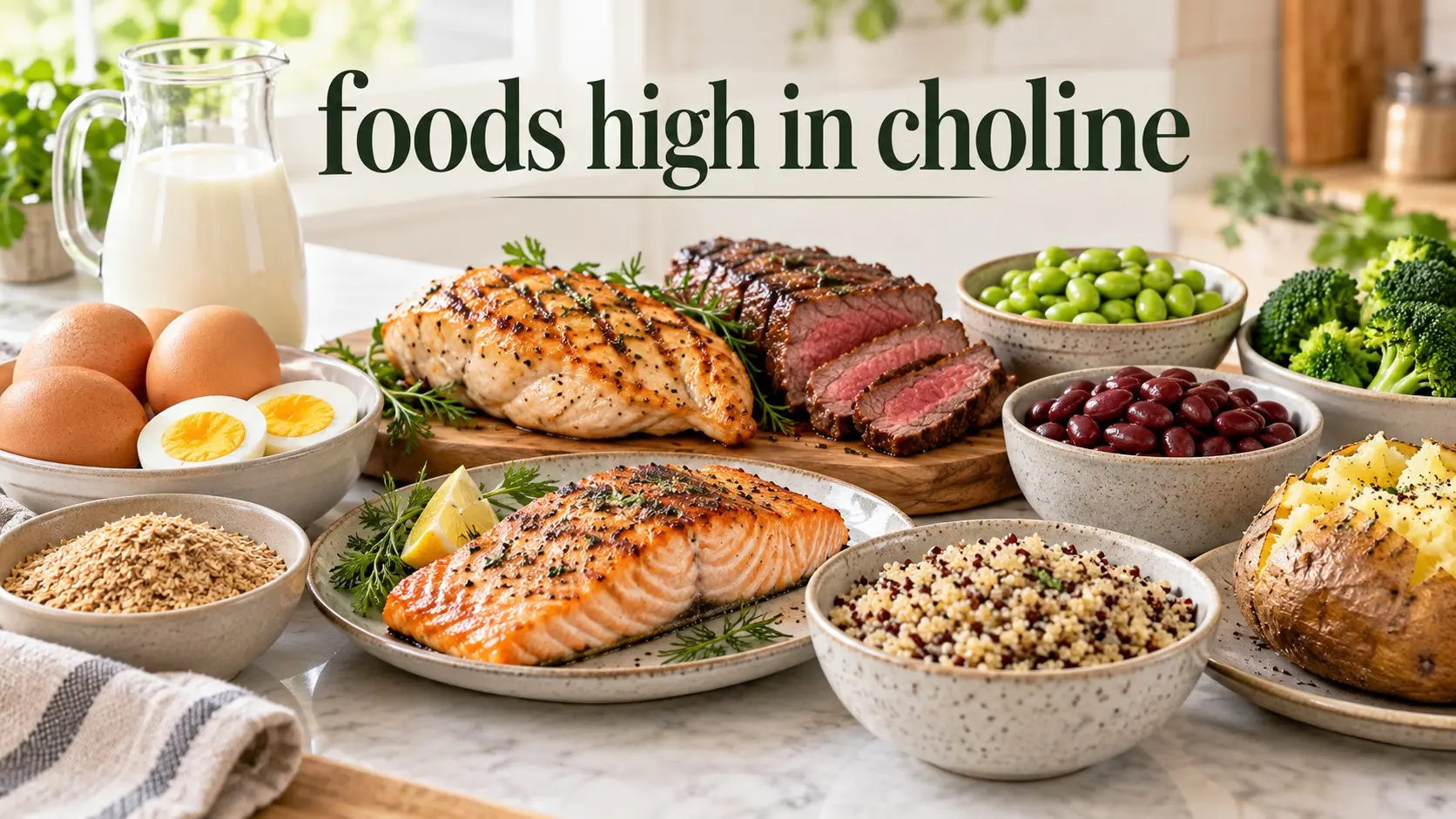
Soybeans, chicken, fish, potatoes, beans, quinoa, milk, and wheat germ also add useful amounts.
Quick answer: The best foods high in choline include beef liver, eggs, lean beef, roasted soybeans, chicken, cod, potatoes, wheat germ, kidney beans, quinoa, and milk. One large hard-boiled egg provides about 147 mg. Adult choline targets are Adequate Intakes, not an RDA.
If you want to learn about other vitamins and nutrients, visit the NextFitLife Nutrition and Vitamins Hub.
What is choline?
Choline is an essential nutrient.
Your liver makes some choline.
It does not make enough to meet all human needs.
Food supplies the rest.
Your body uses choline to make parts of cell membranes.
It also uses choline to make acetylcholine.
Acetylcholine is a chemical messenger used by the brain, nerves, and muscles.
Choline also has roles in fat transport, metabolism, cell signaling, and early brain development.1
This does not mean that eating extra choline will give you a better memory.
That claim goes too far.
The goal is to get enough dietary choline as part of a varied diet.
How much choline do adults need?
Here is a detail many nutrition pages get wrong.
Choline does not have a Recommended Dietary Allowance.
It has an Adequate Intake.
An Adequate Intake is used when there is not enough evidence to set an RDA.1
| Group | Adequate Intake |
|---|---|
| Men age 19 and older | 550 mg per day |
| Women age 19 and older | 425 mg per day |
| Pregnancy | 450 mg per day |
| Breastfeeding | 550 mg per day |
These numbers are useful planning guides.
They are not proof that a person eating less has a choline deficiency.
Needs also vary between people.
Which foods have the most choline?
The NIH lists several useful choline food sources.
The values below use the serving sizes in its current choline fact sheet.1
| Food | Serving | Choline |
|---|---|---|
| Beef liver, pan fried | 3 ounces | 356 mg |
| Egg, hard boiled | 1 large | 147 mg |
| Beef top round, braised | 3 ounces | 117 mg |
| Soybeans, roasted | Half cup | 107 mg |
| Chicken breast, roasted | 3 ounces | 72 mg |
| Ground beef, 93 percent lean | 3 ounces | 72 mg |
| Atlantic cod, cooked | 3 ounces | 71 mg |
| Red potato, baked with skin | 1 large | 57 mg |
| Wheat germ, toasted | 1 ounce | 51 mg |
| Kidney beans, canned | Half cup | 45 mg |
| Quinoa, cooked | 1 cup | 43 mg |
| Milk, 1 percent fat | 1 cup | 43 mg |
Food values can vary with the food, portion, and preparation.
Use the table as a practical guide.
USDA FoodData Central is useful when you want to check a specific food.4
1. Beef liver has the most choline on this list
Three ounces of pan fried beef liver provide 356 mg of choline.
That is a lot in a small serving.
You do not need liver every day.
In fact, variety is a better approach.
Liver also provides high amounts of other nutrients.
People who are pregnant or who have medical conditions should not use large liver servings as a nutrition shortcut without asking a qualified professional about their full diet.
2. Eggs make choline easy to use
One large hard-boiled egg provides about 147 mg.
This is why eggs stand out among common choline-rich foods.
They are easy to add to breakfast.
They also work in salads, sandwiches, rice dishes, and snacks.
Two eggs, based on the NIH table, would provide about 294 mg.
That is a useful amount without building the whole diet around one food.
3. Lean beef adds choline and protein
Three ounces of braised beef top round provides 117 mg.
Lean beef can fit into a mixed meal with vegetables, beans, potatoes, or whole grains.
Use portions that fit your needs.
You do not need large meat servings just to chase one nutrient.
4. Soybeans are one of the best plant sources
This is the plant food I would notice first.
Half a cup of roasted soybeans provides about 107 mg.
That makes soybeans a useful choice for plant-based choline.
Other soy foods also contain choline, but values differ.
Check USDA FoodData Central when you want the number for a specific tofu, soy drink, edamame, or soy product.
For more plant food ideas, visit the NextFitLife Fruits and Vegetables Guide.
5. Chicken is an easy everyday source
Three ounces of roasted chicken breast provide about 72 mg.
Chicken is easy to pair with other choline foods.
Try chicken with a baked potato.
Add beans or vegetables.
One meal can supply choline from several foods instead of relying on one large source.
6. Ground beef also supplies choline
Three ounces of 93 percent lean ground beef provide about 72 mg.
Use it in a meal that fits your normal eating pattern.
Think tacos with beans.
Or a bowl with quinoa and vegetables.
The whole meal matters more than turning one food into a health product.
7. Cod gives you choline from fish
Three ounces of cooked Atlantic cod provide about 71 mg.
Fish can be part of a varied protein pattern.
Other fish also contain choline.
The exact amount changes by species and serving.
8. Potatoes provide more choline than many people expect
A large baked red potato with its skin provides about 57 mg.
Potatoes are not just starch.
They also provide nutrients.
Pair one with chicken, fish, beans, or yogurt to build a more complete meal.
9. Wheat germ is a small but useful source
One ounce of toasted wheat germ provides about 51 mg.
You can add it to oatmeal.
You can mix it into yogurt.
You can also use it in some baked foods.
Check the package if you need help with serving size or allergens.
10. Kidney beans add plant choline
Half a cup of canned kidney beans provides about 45 mg.
Beans also fit many normal meals.
Add them to soup.
Add them to rice.
Add them to salads or bowls.
Rinse canned beans if you want to reduce some of the sodium.
11. Quinoa gives you another plant option
One cup of cooked quinoa provides about 43 mg.
Quinoa is not a huge source by itself.
It does not have to be.
Combine it with soybeans, beans, chicken, or fish.
This is the simple way to think about daily choline intake.
Add food sources across the day.
12. Milk provides a modest amount
One cup of 1 percent milk provides about 43 mg.
Milk is another example of a food that contributes without being the top source.
Yogurt can contribute too.
The NIH table lists one cup of nonfat vanilla yogurt at about 38 mg.
Different products will vary.
Can you get choline from plants?
Yes.
You do not need meat to get every bit of choline.
Useful plant choices include:
- Roasted soybeans
- Potatoes
- Wheat germ
- Kidney beans
- Quinoa
- Brussels sprouts
- Broccoli
- Shiitake mushrooms
- Peanuts
- Cauliflower
- Green peas
- Sunflower seeds
The amounts are spread across foods.
This means a vegetarian or vegan plan needs variety.
For example, using the NIH values, half a cup of roasted soybeans, one large red potato, and one cup of quinoa together provide about 207 mg.
That is an example.
It is not a meal prescription.
What is a simple food first day?
You do not need to count every milligram.
I prefer to build a normal day from foods you already like.
Breakfast
Eggs with vegetables and toast.
Or oatmeal with milk and wheat germ.
Lunch
Chicken with a baked potato and vegetables.
Or a quinoa and soybean bowl.
Dinner
Cod with potatoes and broccoli.
Or beans with quinoa and vegetables.
Snack
A boiled egg.
Roasted soybeans.
Or yogurt if dairy works for you.
This is food first nutrition.
It does not mean food is the only answer for every person.
It means food is the practical place to start for many people.
For more everyday planning, use the Meal Prep and Recipes Hub.
Why does choline matter in pregnancy?
Pregnancy raises the Adequate Intake to 450 mg per day.
Breastfeeding raises it to 550 mg per day.3
Choline has roles in fetal growth and nervous system development.
This makes choline for pregnancy an important topic.
But do not turn this into a reason to buy a high-dose supplement on your own.
Prenatal products vary.
Some contain little or no choline.3
If you are pregnant, planning pregnancy, or breastfeeding, review your diet and prenatal supplement with your obstetric clinician or a registered dietitian.
Does eating below the Adequate Intake mean you are deficient?
No.
This is a very useful distinction.
Many people in the United States consume less choline than the Adequate Intake.
Yet clear choline deficiency is rare in healthy men and nonpregnant women.1
Do not diagnose a choline deficiency from tiredness, memory problems, or another vague symptom.
Those symptoms have many possible causes.
Choline status is not routinely measured in healthy people.1
If you have unexplained symptoms, speak with a qualified healthcare professional instead of guessing which nutrient is low.
Do you need a choline supplement?
Not automatically.
Food is enough for many people.
Supplements can make sense in some situations.
That decision depends on diet, pregnancy, medical needs, and professional advice.
Choline supplements can contain forms such as choline bitartrate, phosphatidylcholine, and lecithin.1
More is not better.
Can you get too much choline?
Yes.
The adult upper limit is 3,500 mg per day from all sources.1
This is a safety limit.
It is not a daily goal.
Very high choline intake can cause problems such as fishy body odor, vomiting, heavy sweating, excess saliva, low blood pressure, and liver toxicity.1
This concern is more relevant when someone is taking large supplement doses.
Do not use the upper limit as a target.
What mistakes should you avoid?
Thinking one food has to meet the full target
No.
Different foods add up.
Calling the Adequate Intake an RDA
They are not the same.
Choline has an Adequate Intake.
Buying a supplement before checking your food
Look at your normal meals first.
Assuming more choline improves memory
Choline is needed to make acetylcholine.
That does not prove that taking extra choline improves memory in healthy adults.
Ignoring pregnancy needs
Pregnancy changes the choline intake target.
Review this with the prenatal care team.
Using liver as a daily nutrient shortcut
Liver is nutrient dense.
It is not the only way to get choline.
Use a varied diet.
How should you use food labels?
The Daily Value for choline is 550 mg for adults and children age 4 and older.1
But most foods do not have to list choline on the Nutrition Facts label unless choline has been added.
So a blank label does not mean the food has no choline.
Use NIH and USDA data when you need a better estimate.
What is my food first rule?
I would not build a diet around choline alone.
That misses the point.
Choose meals that bring several nutrients together.
Eggs give you choline and protein.
Beans add choline, protein, and fibre.
Potatoes add choline with other nutrients.
Fish and chicken add choline and protein.
Soybeans are useful for people who want more plant based options.
Then judge the full eating pattern.
The current Dietary Guidelines also focus on a varied pattern of nutrient dense foods rather than one special nutrient food.5
For broader meal habits, visit the Healthy Eating and Lifestyle Hub.
Conclusion
The best foods high in choline are not hard to find.
Eggs are easy.
Beef liver is very rich.
Soybeans give you a strong plant option.
Chicken, fish, potatoes, beans, quinoa, wheat germ, and milk help add more throughout the day.
Your next step: Look at tomorrow's meals. Pick two or three choline foods you already enjoy. Add them to meals you already eat instead of trying to build a perfect nutrient plan overnight.
References and Sources
These sources are open and accessible to the public.
- National Institutes of Health Office of Dietary SupplementsPage: Choline Fact Sheet for Health Professionals
Use: Choline functions, Adequate Intakes, food values, deficiency, upper limits, and supplement safety.
Website: ODS.NIH.gov
URL: https://ods.od.nih.gov/factsheets/Choline-HealthProfessional/
- National Institutes of Health Office of Dietary SupplementsPage: Choline Fact Sheet for Consumers
Use: Plain-language choline needs, foods, supplements, and safety.
Website: ODS.NIH.gov
- National Institutes of Health Office of Dietary SupplementsPage: Dietary Supplements and Life Stages Pregnancy
Use: Choline needs during pregnancy, fetal development, prenatal supplements, and pregnancy safety limits.
Website: ODS.NIH.gov
URL: https://ods.od.nih.gov/factsheets/Pregnancy-HealthProfessional/
- United States Department of AgriculturePage: FoodData Central
Use: Food composition and nutrient values for specific foods.
Website: FDC.NAL.USDA.gov
- United States Department of Health and Human Services and United States Department of AgriculturePage: Dietary Guidelines for Americans 2025 to 2030
Use: Current healthy eating guidance and food first dietary patterns.
Website: ODPHP.Health.gov
Related NextFitLife Guides and Hubs
- Foods and Nutrition Hub
- Nutrition and Vitamins Hub
- Healthy Eating and Lifestyle Hub
- Meal Prep and Recipes Hub
- Fruits and Vegetables Hub
Author Bio
Adel Galal is the founder and lead writer of NextFitLife.
He has written about health, fitness, nutrition, and wellness for more than 15 years.
His work starts with a real reader question.
He then checks recognized public health, medical, nutrition, government, and academic sources.
The goal is to turn complex health information into simple steps without pretending that general information is personal medical care.
This content is for general educational purposes and does not replace professional medical advice, diagnosis, or treatment. Consult an appropriately qualified healthcare professional for personal medical concerns. This article explains published guidance and does not provide a personal clinical assessment. Always consult qualified medical professionals for diagnosis and treatment of any health condition.
I am also not a registered dietitian or licensed nutrition professional.
Nutrition needs can change with pregnancy, breastfeeding, medical conditions, medicines, allergies, age, and individual diet patterns.
Learn more about NextFitLife, the author, and the editorial approach on the About Us page.
Frequently Asked Questions
What food is highest in choline?
Beef liver is one of the richest foods in the NIH-selected food table. Three ounces of pan-fried beef liver provide about 356 mg of choline.
How much choline is in one egg?
One large hard-boiled egg provides about 147 mg of choline according to the NIH Office of Dietary Supplements.
How much choline do adults need each day?
The Adequate Intake is 550 mg per day for adult men and 425 mg for adult women. Pregnancy raises the value to 450 mg. Breastfeeding raises it to 550 mg.
Can vegans get choline from food?
Yes. Plant sources include soybeans, potatoes, wheat germ, kidney beans, quinoa, Brussels sprouts, broccoli, mushrooms, peanuts, cauliflower, peas, and seeds.
Do I need a choline supplement?
Not automatically. Many people can get choline from food. Pregnancy, restricted diets, or other individual needs can change the picture. Ask a qualified healthcare professional or registered dietitian before using a high-dose supplement.
Is 550 mg of choline and RDA?
No. Choline has an Adequate Intake because there was not enough evidence to establish an Estimated Average Requirement and RDA.
Can too much choline be harmful?
Yes. The adult upper limit is 3,500 mg per day from all sources. Very high intake can cause unwanted effects. The upper limit is a safety boundary, not a target.
Is choline important during pregnancy?
Yes. Choline has roles in fetal growth and nervous system development. The Adequate Intake during pregnancy is 450 mg per day. Pregnant readers should review food and supplement needs with their prenatal care team.

Health & wellness writer with 30+ years of experience in nutrition, fitness, and healthy aging. Founder of NextFitLife.com — evidence-based health guidance.