Published on: October 6, 2026
Written and source-checked by: Adel Galal, Founder and Lead Writer at NextFitLife
Medical review status: This article has not been medically reviewed by a dermatologist or other licensed healthcare professional.
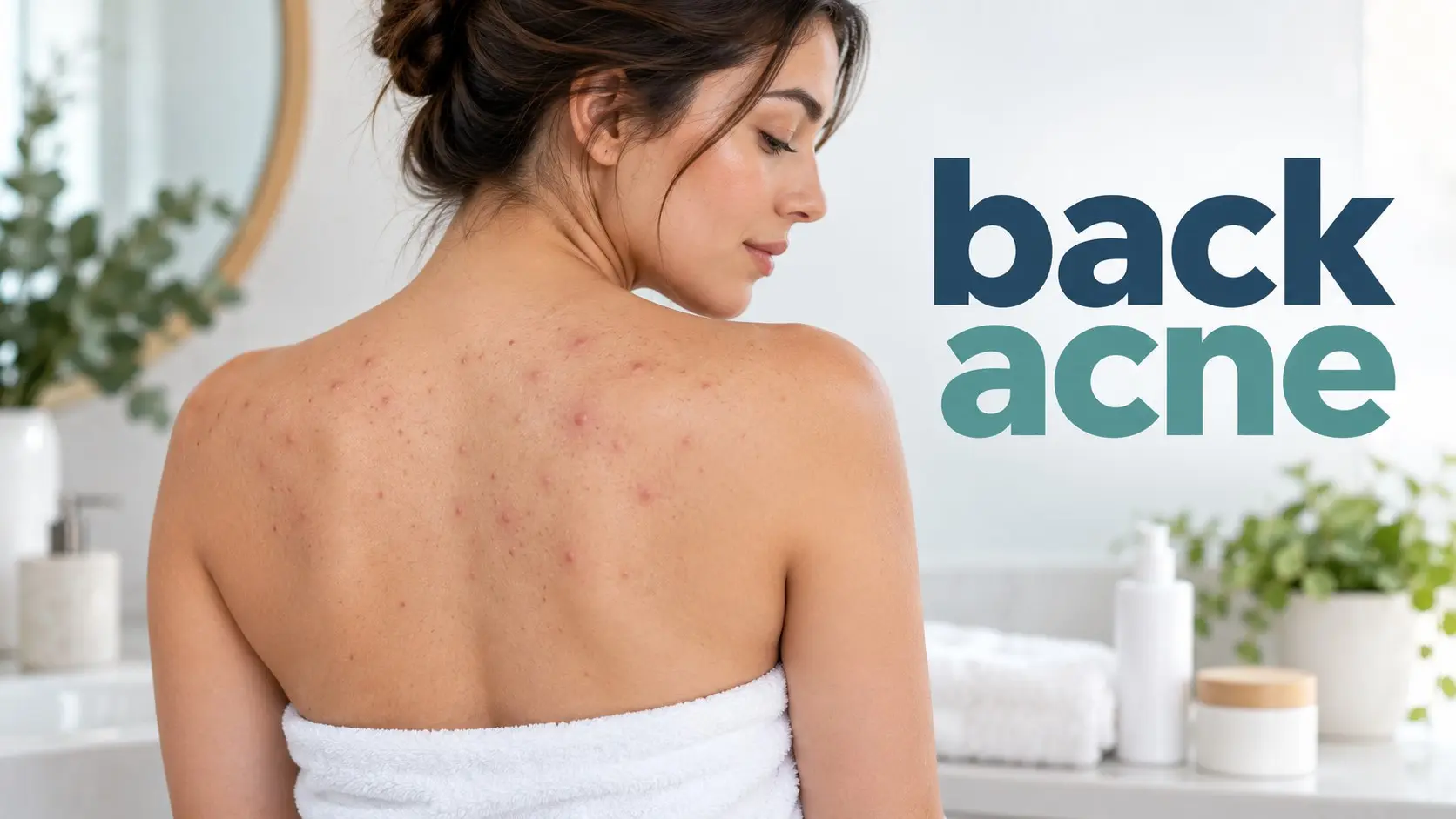
Back acne usually improves when you combine gentle skin care with a proven acne treatment such as benzoyl peroxide, salicylic acid, or adapalene while reducing sweat, friction, and pore-clogging products. But itchy, very similar bumps without blackheads or whiteheads may be folliculitis instead, so getting the condition right matters before adding stronger treatments.
If you are trying to learn how to get rid of back acne, start with the diagnosis and the routine, not the strongest product you can find.
This article is for general information and education. It does not replace medical advice, diagnosis, or treatment.
Table of Contents
- What Back Acne Is
- Acne Versus Folliculitis
- 11 Smart Fixes
- Gentle cleansing
- Benzoyl peroxide
- Salicylic acid
- Adapalene
- Simple routines
- Workout care
- Friction control
- Noncomedogenic products
- Stop picking
- Check medicines and hormones
- Know when to get help
- Simple Back Acne Routine
- Back Acne After Workouts
- Diet and Supplements
- Back Acne Scars
- When to See a Dermatologist
- Frequently Asked Questions
What causes back acne?
Acne vulgaris starts inside a hair follicle.
Oil and dead skin cells can collect in the follicle. Inflammation and acne-associated bacteria then contribute to clogged pores and pimples.
The back, shoulders, face, and chest are common places for acne because these areas contain many oil glands.
Back acne can appear as:
- Blackheads
- Whiteheads
- Small red bumps
- Pustules
- Deep nodules
- Painful cyst-like lesions
Hormones, genetics, some medicines, oily products, pressure, friction, heat, humidity, and picking can all affect acne.
Acne does not mean your back is dirty.
Blackheads are not black because dirt is trapped inside them. The dark color appears when material inside an open clogged follicle is exposed at the skin surface.
For a broader look at healthy skin care, visit the NextFitLife Skin Health Guide.
Is every breakout on the back really acne?
No.
This is one of the most useful things to understand before you start treatment.
Folliculitis can look a lot like acne because it also causes small red bumps or pustules around hair follicles.
One type, called Malassezia folliculitis, often affects the upper back and chest.
Clues that point more toward Malassezia folliculitis include:
- Strong itching
- Many bumps that look almost the same
- Small papules or pustules
- Few or no blackheads
- Few or no whiteheads
True acne is more likely to contain a mixture of blackheads, whiteheads, inflamed pimples, pustules, and deeper lesions.
| Feature | Back Acne | Possible Malassezia Folliculitis |
|---|---|---|
| Bumps | Often mixed sizes and types | Often small and very similar in size |
| Blackheads | Can occur | Usually absent |
| Whiteheads | Can occur | Usually absent |
| Itching | Not usually the main symptom | Often noticeable |
| Treatment | Acne treatment | May need antifungal treatment after correct diagnosis |
Do not diagnose folliculitis from one photo or start oral antifungal medicine on your own.
If the bumps are very itchy, uniform, or not responding to a sensible acne routine, professional assessment is worth more than another exfoliating product.
What is acne mechanica?
Acne mechanica is acne made worse by heat, pressure, sweat, and repeated friction.
It often appears exactly where something keeps rubbing the skin.
Common examples include:
- Backpack straps
- Sports bras
- Shoulder pads
- Tight workout shirts
- Protective equipment
- Weight belts
- Repeated contact with exercise benches
If the breakout follows the shape of a strap, seam, or pad, that pattern is useful information.
1. Wash gently instead of scrubbing harder
The first fix is almost boring.
Stop attacking your back.
Hard scrubbing does not clean acne out of the follicles. It can irritate inflamed skin and make the routine harder to tolerate.
Use:
- Lukewarm water
- A mild cleanser
- Your fingertips or hands
- A clean, soft towel
Avoid aggressive brushes, harsh body scrubs, rough pads, and repeated washing throughout the day.
This same gentle approach is part of the NextFitLife Healthy Skin 101 Guide.
2. Benzoyl peroxide is a useful starting treatment
Benzoyl peroxide is one of the better-supported over-the-counter treatments for mild to moderate inflammatory back acne.
A wash is practical because the back is difficult to reach with leave-on creams.
There is one detail people often miss.
For back acne, the American Academy of Dermatology advises allowing a benzoyl peroxide wash to remain on the skin for about 2 to 5 minutes before rinsing it away.
The skin on the back is thicker than facial skin, so that short contact period can help.
Benzoyl peroxide can cause:
- Dryness
- Peeling
- Redness
- Stinging
It can also bleach towels, sheets, shirts, and other fabrics.
More strength is not automatically better. Start with a tolerable product and use it consistently.
3. Salicylic acid can help clogged pores
Salicylic acid can help loosen material inside clogged follicles and is especially useful when blackheads, whiteheads, and rough clogged pores are part of the problem.
It is available in:
- Body washes
- Sprays
- Pads
- Leave-on lotions
Do not assume that using several salicylic acid products at once will clear acne faster.
Too much can leave the back dry, sore, or peeling.
4. Adapalene can help prevent new clogged follicles
Adapalene is a topical retinoid used for acne.
It helps keep follicles from becoming clogged and also reduces inflammation.
It can be useful when back acne contains blackheads, whiteheads, and repeated inflammatory pimples.
A retinoid works across acne-prone skin, so it is usually applied as a thin layer rather than only placed on individual pimples.
Start slowly if irritation develops.
Moisturizer can make treatment easier to tolerate.
What about pregnancy?
Topical retinoids such as adapalene should not be started during pregnancy without professional guidance.
If you are pregnant, may be pregnant, or are trying to conceive, discuss acne treatment with a qualified healthcare professional.
5. Do not build a six-ingredient routine on day one
This is where good acne care turns into irritated skin.
A person sees back acne and starts:
- Benzoyl peroxide
- Salicylic acid
- Adapalene
- Glycolic acid
- A scrub
- An alcohol toner
Then the back burns.
Now it is hard to tell which product is helping and which one caused the irritation.
Introduce treatments slowly.
Give the routine time.
For mild or moderate back acne, meaningful improvement can take around 6 to 8 weeks, and fuller clearing can take several months.
6. Change out of sweaty workout clothes
Back acne after workouts does not mean exercise itself is causing the skin condition.
The combination around the workout matters.
Heat, sweat, oil, tight clothing, friction, straps, and equipment can all work together.
After exercise:
- Change out of wet clothing.
- Shower when practical.
- Wash the back gently.
- Put on clean dry clothes.
If you cannot shower right away, changing your shirt is still better than staying in soaked fabric for another hour.
7. Reduce friction from clothing and equipment
Look at where the acne actually sits.
If pimples cluster under a shoulder strap, tight seam, sports bra band, backpack, or pad, reduce pressure and rubbing where possible.
Use clean exercise clothing.
Clean equipment that repeatedly touches the back.
During exercise, pat sweat with a clean towel rather than rubbing hard.
This can make a real difference when sweat and friction are driving acne mechanica.
8. Check body lotion, sunscreen, and hair products
A skin product does not need to say “acne product” to affect acne.
Heavy hair oils, conditioners, body creams, and greasy sunscreens can end up on the back.
If you are acne-prone, a noncomedogenic skincare label can be a useful screening clue.
It does not guarantee that a product will never cause a breakout.
The finished formula and your own skin still matter.
Read the NextFitLife Noncomedogenic Skincare Guide for a fuller explanation.
A simple shower trick can help too:
Rinse conditioner from your hair first, then wash your back.
9. Stop picking, squeezing, and scratching
Picking feels productive for a few seconds.
It usually adds more inflammation.
Squeezing or scratching pimples can increase the chance of:
- Dark marks
- Red marks
- Skin damage
- True acne scars
Back acne is difficult to reach.
In this case, that inconvenience can be useful.
10. Review medicines and hormone related products
Some medicines can contribute to acne.
These include certain corticosteroids, lithium, and hormone-containing medicines.
Androgen-related products can also worsen acne in some people.
If your acne started soon after a new medicine, testosterone treatment, or performance product, note the timing and discuss it with your clinician.
Do not stop a prescribed medicine on your own.
11. Know when over the counter treatment is not enough
Nodular acne and deep painful lesions have a greater risk of permanent scarring.
See a dermatologist sooner if the back has:
- Large painful nodules
- Deep cyst-like lesions
- Rapidly increasing scars
- Widespread inflammation
- Raised scars or keloids
- No improvement after a consistent treatment trial
Prescription treatment can include stronger topical medicine, oral antibiotics when appropriate, hormonal therapy for selected patients, or isotretinoin for some severe or resistant acne.
The right option depends on acne severity, health history, pregnancy status, and other medicines.
What is the simplest back acne treatment routine?
| Time | Simple Step | Why |
|---|---|---|
| Shower | Use a gentle cleanser or suitable benzoyl peroxide wash | Cleans without aggressive scrubbing and can treat inflammatory acne |
| After drying | Use a light noncomedogenic moisturizer when needed | Helps reduce treatment dryness and irritation |
| Evening | Use adapalene when appropriate and tolerated | Helps prevent clogged follicles and new acne |
| After exercise | Change clothing and shower when practical | Reduces prolonged heat, moisture, and friction |
This is a general example, not a prescription.
You do not need benzoyl peroxide, salicylic acid, and adapalene all at full strength from the first day.
Can you use benzoyl peroxide and adapalene together?
Yes, these ingredients can be part of the same acne treatment plan.
They work in different ways.
Benzoyl peroxide reduces acne-associated bacteria and inflammation, while adapalene helps prevent clogged follicles.
If your skin becomes very dry or irritated, reduce complexity and get advice.
Does azelaic acid help back acne?
Azelaic acid is another topical acne treatment option.
It can also be useful when acne is leaving flat colour changes behind.
That does not mean everybody with back acne needs it.
If your current routine is working, adding more active ingredients is not automatically an upgrade.
Does diet cause back acne?
Diet is more complicated than many acne posts suggest.
No single food causes acne in every person.
Research continues into dietary patterns, glycemic load, dairy, and acne, but those findings do not justify cutting several food groups from every acne-prone person's diet.
If you suspect a particular food, drink, or supplement:
- Track the timing.
- Change one variable at a time.
- Keep the rest of the routine stable.
- Discuss major diet restrictions with a qualified professional.
Do not create a nutritionally poor diet trying to achieve clear skin.
Does whey protein cause back acne?
I would not state that whey protein causes acne in everyone.
The evidence is not strong enough for that claim.
If your breakout clearly began after adding a new whey product, note the timing and look at the full ingredient list.
Other changes may have happened at the same time, including harder training, tighter clothing, new supplements, androgen-related products, or changes in skin care.
One person may notice a relationship while another does not.
Can the sun clear back acne?
Do not use tanning as acne treatment.
Sun exposure can damage skin, and many acne treatments make skin more sensitive to sunlight.
Sun can also make post-acne discoloration more noticeable.
Use broad-spectrum SPF 30 or higher on exposed skin and choose a product that works comfortably with acne-prone skin.
Are dark spots the same as back acne scars?
No.
This is another place where the words matter.
A flat brown, gray, purple, pink, or red mark after a pimple may be a colour change rather than a true scar.
Brown or gray marks can reflect post-inflammatory hyperpigmentation.
Flat pink or red marks may be post-inflammatory erythema.
Neither automatically means the skin has permanent scar tissue.
Read the NextFitLife Post Inflammatory Erythema Guide if red marks are your main concern.
True acne scars change the skin's texture.
They can be:
- Depressed or sunken
- Raised
- Thickened
- Keloid scars
The shoulders and upper back can develop raised scars in some people.
How are back acne scars treated?
Scar treatment depends on the scar type.
A depressed scar and a raised keloid need very different treatment.
Dermatologists may use options such as:
- Microneedling for selected scars
- Laser treatment
- Chemical procedures
- Fillers for selected depressed scars
- Injections for some raised scars
- Other scar-specific procedures
The first job is usually controlling active acne so new scars stop forming.
How long should you try a back acne treatment?
A few days is not enough.
A sensible benchmark is around 6 to 8 weeks for early improvement.
Full clearing can take longer.
Take photos under similar lighting every week or two if you have trouble judging the trend.
Look for:
- Fewer new pimples
- Less inflammation
- Fewer clogged pores
- Less tenderness
- Fewer deep lesions
If nothing is changing, reconsider the diagnosis instead of automatically buying a stronger scrub.
A practical eight-week reset
Weeks 1 and 2
Stop harsh scrubbing.
Choose clean workout clothing.
Reduce rubbing from straps and equipment.
Start one main acne treatment and watch how your skin tolerates it.
Weeks 3 and 4
Stay consistent.
If you use benzoyl peroxide wash, allow the recommended short contact time before rinsing.
Add moisturizer if dryness appears.
Do not add another strong product every few days.
Weeks 5 to 8
Compare the number and type of new lesions with where you started.
If the trend is better, keep going.
If the bumps remain intensely itchy, uniform, or completely unchanged, the next useful step may be confirming whether you are treating acne at all.
What should you avoid with back acne?
- Hard body scrubs
- Aggressive brushes
- Popping pimples
- Picking at scabs
- Repeated washing
- Sitting for long periods in wet workout clothes
- Heavy products that clearly clog your skin
- Tanning as treatment
- Starting many active ingredients at once
- Assuming every back bump is acne
When should you see a dermatologist?
Professional care makes sense sooner when acne is:
- Deep
- Painful
- Nodular
- Widespread
- Leaving true scars
- Creating raised scars
- Not improving with a consistent over-the-counter plan
- Having a major effect on confidence or daily life
You should also get help when the diagnosis is uncertain.
Very itchy, same-sized bumps may be folliculitis.
Repeated boils, draining lesions, fever, spreading redness, or rapidly worsening painful skin also deserve medical assessment rather than routine acne care.
Conclusion
The best approach to back acne is usually simpler than people expect. Clean gently, choose one proven treatment, reduce friction, change after workouts, avoid picking, and give the routine enough time to work.
Your next step is to look closely at the type of bumps you have. If you see mixed blackheads, whiteheads, and pimples, a simple acne routine makes sense. If the bumps are very itchy, all look alike, or are not improving, stop adding products and get a diagnosis checked.
Internal Links and NextFitLife Skin Hub
Skin Health Guide
for skin barrier care, acne, active ingredients, sunscreen, sensitive skin, pigmentation, and when to see a dermatologist.
Healthy Skin 101
For simple daily cleansing, moisturizing, sunscreen, acne-prone skin care, and workout hygiene.
Noncomedogenic Skincare Meaning
For product labels, clogged pores, acne-prone skin, moisturizers, sunscreen, and realistic product expectations.
How to Get Rid of Whiteheads
For closed comedones, clogged pores, salicylic acid, adapalene, and acne treatment timelines.
Post-Inflammatory Erythema Acne
For flat red and pink marks left after inflamed acne heals.
Best Acne Treatment for Teens
For benzoyl peroxide, adapalene, salicylic acid, body acne, sports friction, and simple treatment routines.
References and Sources
- American Academy of Dermatology. Back Acne: How to See Clearer Skin.
https://www.aad.org/public/diseases/acne/DIY/back-acne
- National Institute of Arthritis and Musculoskeletal and Skin Diseases. Acne.
https://www.niams.nih.gov/health-topics/acne
- National Institute of Arthritis and Musculoskeletal and Skin Diseases. Acne Diagnosis, Treatment, and Steps to Take.
https://www.niams.nih.gov/health-topics/acne/diagnosis-treatment-and-steps-to-take
- DermNet. Malassezia Folliculitis.
https://dermnetnz.org/topics/malassezia-folliculitis
- American Academy of Dermatology. Acne Scars: Signs and Symptoms.
https://www.aad.org/public/diseases/acne/derm-treat/scars/symptoms
About the Author
Adel Galal is the Founder and Lead Writer at NextFitLife. He researches health, fitness, nutrition, beauty, healthy aging, and skin care topics using recognized medical, government, and professional sources.
His approach to acne content is to separate evidence-based treatment from aggressive skin care trends, explain where uncertainty remains, and point out when a condition that looks like acne may need a different diagnosis.
Adel is not a dermatologist, physician, pharmacist, nurse, or other licensed healthcare professional. This article was source-checked editorially and has not been independently medically reviewed by a dermatologist.
Learn more about Adel Galal, NextFitLife, and its editorial approach on the About Us page.
Medical Disclaimer: I am not a dermatologist or A doctor, and this content does not replace professional medical advice. This article explains published guidance and does not provide a personal clinical assessment. Always consult qualified medical professionals for diagnosis and treatment of any health condition.
Frequently Asked Questions
What causes back acne?
Back acne develops when hair follicles become clogged with oil and dead skin cells, and inflammation develops. Hormones, genetics, some medicines, friction, humidity, tight clothing, and pore-clogging products can make it worse.
How do you get rid of back acne?
Start with gentle cleansing, reduce friction, change after sweating, and use one proven acne treatment such as benzoyl peroxide, salicylic acid, or adapalene when appropriate. Give the routine several weeks before judging the result.
Does benzoyl peroxide help back acne?
Yes. Benzoyl peroxide can help mild to moderate inflammatory back acne. AAD advises allowing a benzoyl peroxide wash to sit on the back for about 2 to 5 minutes before rinsing.
Does salicylic acid help back acne?
Salicylic acid can help unclog pores and may be useful for blackheads, whiteheads, and mild clogged pore acne. Using too many exfoliating products at once can irritate the skin.
Can adapalene treat back acne?
Yes. Adapalene is a topical retinoid that helps prevent clogged follicles and reduce acne inflammation. It can irritate when first started and should not be started during pregnancy without professional guidance.
Can workouts cause back acne?
Exercise itself is not the whole cause. Heat, sweat, tight clothing, pressure, straps, and repeated friction can worsen acne and contribute to acne mechanica.
Should I shower after a workout if I have back acne?
Yes. Change out of sweaty clothing and shower when practical. Clean the skin gently rather than scrubbing it.
Is itchy back acne really acne?
Sometimes, but very itchy bumps that are all similar in size and lack blackheads or whiteheads can suggest folliculitis, including Malassezia folliculitis. A healthcare professional can confirm the diagnosis.
How can I tell folliculitis from back acne?
Acne usually includes a mixture of blackheads, whiteheads, pimples, and sometimes deeper lesions. Malassezia folliculitis tends to cause small, uniform itchy bumps without comedones.
How long does back acne treatment take?
Early improvement often takes about 6 to 8 weeks, and fuller clearing can take several months. Strong irritation, worsening deep acne, or no response should prompt a review of the treatment or diagnosis.
Should I pop back acne?
No. Picking and squeezing increase inflammation and can raise the chance of dark marks and true acne scars.
Are dark spots from back acne scars?
Not always. Flat brown, gray, red, pink, or purple marks can be post-inflammatory pigment or redness rather than true scars. True scars change the texture of the skin.
Can back acne cause keloids?
Yes. Some people develop raised scars or keloids after inflammatory acne, especially on areas such as the shoulders and upper back.
Does whey protein cause back acne?
There is not enough evidence to say whey protein causes acne in everyone. If acne clearly worsened after starting a supplement, track the timing and review the product and other changes with a healthcare professional.
When should I see a dermatologist for back acne?
See a dermatologist for deep or painful acne, nodules, widespread inflammation, true scars, raised scars, uncertain diagnosis, or acne that does not improve after a consistent over-the-counter treatment trial.