First published: September 27, 2026
Last updated: September 27, 2026
Written and source- checked by: Adel Galal, Founder and Lead Writer at NextFitLife
Clinical review status: This article has not been medically reviewed by a dermatologist.
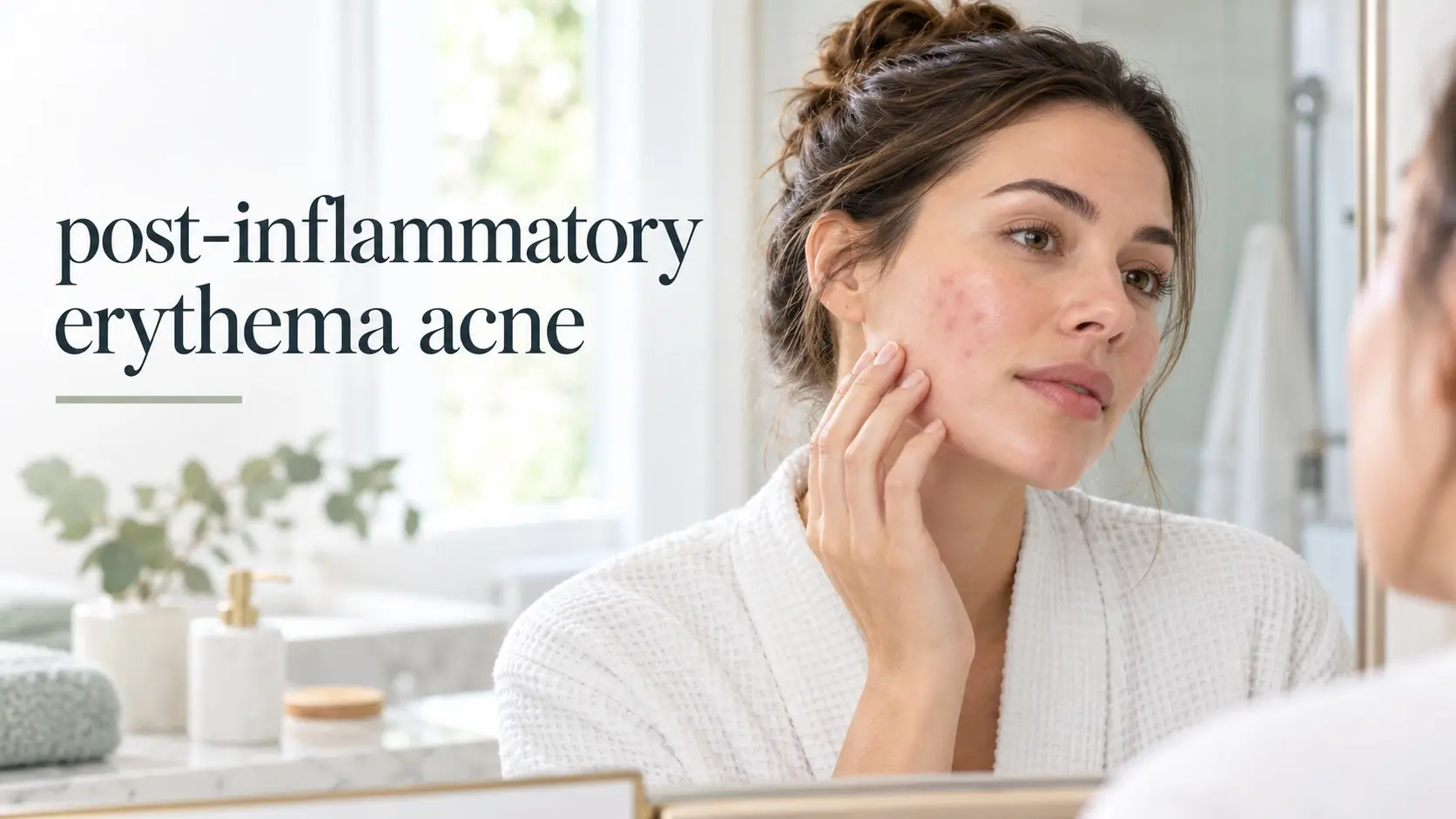
Flat pink or red marks that stay behind after a pimple heals are not automatically acne scars. They may be post-inflammatory erythema acne, usually shortened to PIE, and treating PIE as though it were brown pigmentation can send you toward the wrong products.
The first useful move is to identify what you are looking at. After that, the plan becomes much simpler: prevent new inflammatory acne, protect an irritated skin barrier, consider treatments with direct evidence, and save vascular procedures for persistent redness that genuinely needs them.
Quick answer: Post-inflammatory erythema acne causes flat pink, red, or purplish marks after inflamed acne heals. PIE is mainly linked to lingering vascular changes, not excess melanin or permanent scarring. Many marks improve with time. Preventing new acne, avoiding irritation, using sun protection, and selected treatments such as azelaic acid can help.
Medical notice: This content is for general educational purposes and does not replace professional medical advice, diagnosis, or treatment. Consult an appropriately qualified healthcare professional for personal medical concerns.
Table of Contents
- PIE versus PIH versus acne scars
- Why acne leaves red marks
- How long PIE can last
- Nine smart steps for treating PIE
- Azelaic acid and the newer evidence
- Niacinamide, vitamin C, and retinoids
- Laser and light treatment
- PIE in darker skin tones
- Pregnancy and acne treatment
- Common PIE mistakes
- When to see a dermatologist
- References and Sources
- Related NextFitLife guides
- About the author
- Frequently asked questions
Is It PIE, PIH, or a Real Acne Scar?
This distinction decides almost everything that follows.
Post-inflammatory erythema is mainly a color change. The skin usually stays flat, but an old acne site remains pink, red, or reddish purple after the active pimple has settled.
Post-inflammatory hyperpigmentation, or PIH, is different. The mark looks tan, brown, gray, or darker because inflammation has triggered excess pigment. A real acne scar changes the structure of the skin, leaving a depression, pit, rolling area, or raised scar.
| What You See | Likely Problem | Main Change | Treatment Direction |
|---|---|---|---|
| Flat pink or red mark | Post-inflammatory erythema | Vascular redness and healing changes | Acne control, gentle care, selected topical or vascular treatment |
| Flat brown, gray, or dark mark | Post-inflammatory hyperpigmentation | Extra melanin after inflammation | Pigment focused treatment plus sun protection |
| Dent, pit, or rolling depression | Atrophic acne scar | Structural collagen loss | Scar specific procedures |
| Firm raised area | Hypertrophic scar or keloid | Excess scar tissue | Professional scar treatment |
| Red, swollen, tender bump | Active acne | Ongoing follicle inflammation | Acne treatment |
One face can have all of these at once. A cheek might contain one red PIE mark, one brown PIH mark, two active pimples, and an older indented scar. That is exactly why a single “acne mark serum” does not make sense for every spot.
For a wider explanation of acne types and treatment choices, read the NextFitLife Acne Treatment Guide.
Why Does Acne Leave a Flat Red Mark?
Inflammatory acne affects more than the visible bump. As the lesion heals, tiny blood vessels and the surrounding tissue remain involved in the repair process.
Dermatology literature links post-acne erythema with microvascular changes and changes in the epidermis during wound healing. That explains why the pimple can disappear before the color does.
The mark is therefore not simply “leftover acne.” It is part of the skin's response to inflammation.
DermNet also distinguishes this vascular change from PIH, where melanin becomes the main reason for the lingering color.
What Does PIE Usually Look Like?
PIE commonly appears where an inflammatory pimple used to be. It tends to look flat rather than indented or raised, and the color can range from pale pink through red to a deeper red purple shade.
You may notice it most clearly after papules, pustules, nodules, or other inflamed lesions because those breakouts create more inflammation than a simple whitehead or blackhead.
If you still have clogged pores or active acne, the NextFitLife Whiteheads Guide explains how comedonal acne differs from inflamed lesions and why squeezing makes post acne marks harder to manage.
Can You Diagnose PIE by Pressing the Skin?
Some people use a blanching test. They press a transparent object or fingertip against a red mark and look for temporary fading as blood is pushed out of superficial vessels.
That can provide a clue, but it is not a diagnosis.
Rosacea, dermatitis, active inflammation, visible capillaries, acne, and mixed PIE plus PIH can make self diagnosis unreliable. If the treatment decision matters, especially before a laser or prescription treatment, professional assessment is the better choice.
How Long Does Post-Inflammatory Erythema Last?
There is no reliable countdown that applies to every PIE mark.
Some marks fade gradually without a procedure. Others persist for months, especially when the original acne was deeply inflamed, the same area keeps breaking out, or the skin remains irritated.
Published reviews acknowledge spontaneous improvement, but they do not establish one universal time when every mark should disappear. That is why promises such as “PIE gone in 30 days” should make you skeptical.
A better way to track progress: Take one photograph each month in the same room, at roughly the same time of day, from the same distance, without changing filters. Monthly comparison tells you more than checking a mark in different lighting ten times a day.
9 Smart Steps for Post-Inflammatory Erythema Acne
1. Confirm That the Mark Is Really PIE
Start with color and texture.
A flat red or pink mark after a healed inflammatory pimple fits PIE better than a brown mark or a depressed scar. If the area is still swollen, tender, crusted, itchy, or actively changing, do not automatically label it PIE.
This first step prevents the most expensive mistake: buying treatments for the wrong problem.
2. Control the Acne That Is Creating New Marks
You cannot make meaningful progress if each week brings another inflamed lesion and another red mark.
Current dermatology guidance supports several evidence-based acne treatments, including benzoyl peroxide, topical retinoids, salicylic acid, and azelaic acid. Prescription choices can include additional topical or oral medicines depending on acne type and severity.
The right choice depends on whether you mainly have clogged pores, inflammatory pimples, hormonal acne, nodules, cysts, or a combination.
Deep, painful, or scarring acne deserves professional treatment earlier rather than later. You can also use the NextFitLife Teen Acne Treatment Guide if the person affected is an adolescent.
3. Stop Picking, Squeezing, and Scratching
This step is less glamorous than a serum, but it matters more than many expensive products.
Picking adds another physical injury to skin that is already inflamed. It can increase inflammation, prolong visible marks, and raise the chance of a real scar.
If you repeatedly squeeze a pimple and then spend weeks treating the red mark, you are working against yourself.
4. Calm the Skin Barrier Before Adding More Actives
There is a common PIE routine that goes badly: acid cleanser, vitamin C, niacinamide, retinoid, another acid, spot treatment, then a scrub because the redness has not disappeared by Friday.
The result can be more skin irritation, more burning, and more redness.
A simple base routine is easier to tolerate:
- Cleanse gently.
- Use a moisturizer that suits your skin.
- Apply sunscreen when exposed to daylight.
- Add one evidence based active treatment at a time.
If your face currently burns, stings, flakes, or feels sore, read the NextFitLife Skin Irritation Treatment Guide before adding another active ingredient.
5. Use Broad Spectrum SPF 30 or Higher
Sunscreen is supportive care, not a magic PIE eraser.
Protecting acne prone skin from ultraviolet exposure makes sense while marks heal, especially if you also have PIH or use treatments that make the skin more sun sensitive.
The American Academy of Dermatology recommends broad spectrum, water resistant sunscreen with SPF 30 or higher. Choose a formula you can actually tolerate and use consistently.
If clogged pores are a concern, the NextFitLife Noncomedogenic Skincare Guide explains what that label does and does not mean.
6. Consider Azelaic Acid When It Fits Your Skin
This is one of the more interesting evidence updates for PIE.
A 2024 randomized, double blind, placebo controlled trial studied 72 people with mild to moderate acne. Participants assigned to treatment used 15% azelaic acid gel twice daily for 12 weeks. Sixty people completed the trial.
The study found significant improvement in PIE measurements in the azelaic acid group compared with placebo at weeks 8 and 12. Measured hemoglobin content in PIE lesions was also significantly lower in the treatment group at week 12.
That does not prove every azelaic acid product works the same way. The trial tested a specific 15% gel, frequency, population, and treatment period.
Azelaic acid also has a second advantage: it is an established acne treatment. That makes it particularly interesting for someone dealing with both active acne and post acne marks.
It can still sting, itch, or dry the skin. Start according to product or clinician instructions rather than assuming that more frequent application will work faster.
7. Use Retinoids for the Right Reason
Topical retinoids are strong acne treatments. They help unclog pores and reduce acne formation, which can indirectly reduce the number of new PIE marks you create.
What they are not is a vascular laser in a tube.
If a retinoid leaves your face persistently burning and red, escalating the dose because you want PIE to fade faster can defeat the purpose. Use retinoids because they match your acne treatment needs, not because peeling seems like proof that redness is disappearing.
Pregnancy changes this decision. Topical retinoids should be stopped during pregnancy unless a qualified clinician specifically advises otherwise.
8. Do Not Treat Pure PIE Like Brown Pigmentation
This is where many post acne routines become unfocused.
Hydroquinone and other pigment directed treatments work primarily through melanin pathways. That makes them much more relevant to post-inflammatory hyperpigmentation than to a purely vascular red PIE mark.
If your mark is partly red and partly brown, both processes may be present, so the plan can change.
Do not assume every “brightening” ingredient is automatically a PIE treatment simply because the product page mentions acne marks.
9. Discuss Vascular Treatment for Persistent PIE
If PIE remains obvious despite good acne control and sensible skin care, professional vascular treatment becomes more relevant.
A systematic review of PIE treatments found that lasers and light based devices were the most frequently studied interventions. Pulsed dye laser, often shortened to PDL, was the most frequently studied laser in that review.
Other vascular and light technologies have also been investigated, and newer studies continue to explore different wavelengths and combinations.
There is still no single procedure that is automatically best for every person. Device choice, wavelength, fluence, pulse settings, skin tone, recent tanning, active acne, medications, and the operator's experience all matter.
This is one area where choosing an experienced dermatologist is more useful than choosing a laser because somebody on social media liked its name.
Which PIE Treatments Have the Best Evidence?
| Option | Main Role | PIE Evidence | Practical Take |
|---|---|---|---|
| Time | Natural fading | Some marks improve spontaneously | Reasonable when mild marks are clearly improving |
| Acne control | Prevention | Strong acne evidence | Essential when new inflamed lesions continue |
| Gentle barrier care | Limit added irritation | Supportive rather than a direct vascular treatment | Foundation of a tolerable routine |
| Sunscreen | Photoprotection | Supportive | Useful routine step, especially if PIH is also present |
| 15% azelaic acid gel | Acne plus post acne erythema | Direct randomized clinical evidence | One of the more evidence supported topical choices |
| Niacinamide | Barrier and inflammation support | Limited direct PIE evidence | Supportive rather than a proven PIE eraser |
| Vitamin C | Antioxidant and pigment support | Limited PIE specific evidence | Optional, especially if sensitive skin finds it irritating |
| Topical retinoids | Active acne and prevention | Stronger acne evidence than direct PIE evidence | Useful when ongoing acne is the main problem |
| PDL and vascular lasers | Persistent vascular redness | Among the most studied procedural options | Best discussed with an experienced dermatologist |
Does Niacinamide Fade PIE?
Niacinamide has anti inflammatory properties and can support the skin barrier. Those are useful qualities for acne prone or irritated skin.
The direct clinical evidence for niacinamide as a stand alone PIE treatment, however, is much thinner than online product marketing sometimes suggests.
I would view it as a supportive ingredient rather than the main treatment for persistent vascular redness.
Does Vitamin C Help Post Acne Redness?
Vitamin C is widely used as an antioxidant and for pigmentation concerns, but PIE specific evidence is limited.
If you also have brown post acne marks, uneven pigmentation, or simply tolerate a vitamin C product well, it may still have a place in your routine. That differs from claiming it directly treats all vascular redness.
If a vitamin C serum repeatedly stings and makes an already red face look angrier, stop forcing it into the routine.
What About Chemical Peels?
Chemical peels can help some acne, texture, or pigmentation concerns, depending on the acid, concentration, and skin type.
Pure PIE is a different target.
A peel that irritates your skin can temporarily increase redness, and aggressive treatment can create additional post inflammatory changes. If the problem is only a flat vascular mark, a peel would not be my first treatment choice.
Does Microneedling Treat PIE?
Microneedling makes more biological sense for structural acne scars because controlled injury stimulates a wound healing response and collagen remodeling.
Pure PIE is mainly a color and vascular issue rather than a collagen deficit.
If you have both indented scars and red marks, a dermatologist may build a procedure plan around both problems. That is different from recommending a home dermaroller for flat red marks.
Should You Use Hydrocortisone on PIE?
Do not turn facial hydrocortisone into a routine DIY treatment for old acne redness.
Topical corticosteroids have valid medical uses, but inappropriate facial use can cause problems, including thinning of the skin and steroid related acne or rosacea like eruptions.
If a clinician prescribes a steroid for another diagnosed skin condition, follow that plan. Persistent PIE on its own is not a reason to keep applying steroid cream without medical advice.
A Simple PIE Routine Without Product Overload
If the diagnosis really is PIE and your acne is mild, I would keep the routine short enough that you can tell what is helping.
| Time | Step | Why It Is There? |
|---|---|---|
| Morning | Gentle cleanser or water rinse when appropriate | Cleans without deliberately stripping the barrier |
| Morning | Azelaic acid when suitable | Can treat acne and has direct PIE trial evidence |
| Morning | Moisturizer | Supports comfort and barrier function |
| Morning | Broad spectrum SPF 30 or higher | Photoprotection |
| Evening | Gentle cleanser | Removes sunscreen, makeup, and surface debris |
| Evening | Appropriate acne treatment when needed | Prevents new inflammatory lesions |
| Evening | Moisturizer | Reduces avoidable dryness and irritation |
You do not need all popular skin care ingredients in the same routine.
The NextFitLife Healthy Skin 101 Guide explains why a cleanser, moisturizer, sunscreen, and one targeted active ingredient are enough for many skin concerns.
What If the Marks Are Both Red and Brown?
Mixed marks happen.
You may have PIE and PIH in the same area, or different pimples may heal in different ways. On some skin tones the color can look reddish brown, purple brown, or change under different lighting.
This is another reason not to diagnose post acne marks from a single photograph.
Azelaic acid is particularly interesting in this situation because the 2024 randomized study evaluated acne associated PIE and PIH in the same trial.
Does PIE Look Different on Darker Skin?
PIE is commonly described as easier to see in lighter skin, while post-inflammatory hyperpigmentation tends to be especially prominent in darker skin tones.
That does not mean people with darker skin cannot develop PIE.
Color contrast is different, and mixed vascular plus pigment changes can make identification harder. Professional treatment also deserves care because overly aggressive lasers, light devices, and peels can produce additional pigmentation changes in some skin types.
If you are considering a procedure, look for a dermatologist who routinely treats people with your skin tone rather than simply asking whether a clinic owns a particular machine.
What If Persistent Redness Is Actually Rosacea?
Not every red cheek after acne is PIE.
Rosacea can cause persistent central facial redness, flushing, visible blood vessels, burning, and acne like bumps. Contact dermatitis and irritated skin can also stay red.
Consider another diagnosis when redness spreads beyond old pimple sites, repeatedly flushes with triggers, burns easily, affects the eyes, or appears without a clear history of acne in the same places.
The broader NextFitLife Skin Health Guide covers rosacea, acne, pigmentation, the skin barrier, and dermatologist warning signs.
Post-Inflammatory Erythema During Pregnancy
Pregnancy changes what belongs in an acne routine.
The American Academy of Dermatology advises stopping retinoids such as adapalene and tretinoin during pregnancy. Azelaic acid is considered an option that is thought to be safe, although you should still discuss your individual treatment with your obstetrician or dermatologist.
Do not keep using an old acne routine just because you tolerated it before pregnancy.
9 Common Mistakes That Make PIE Care Harder
- Calling every post acne mark a scar. A flat red mark and a structural scar are different problems.
- Treating red PIE exactly like brown PIH. Vascular change and melanin need different thinking.
- Picking active acne. Each squeeze can add inflammation and tissue injury.
- Starting several active ingredients together. If irritation begins, you will not know which product caused it.
- Scrubbing the mark. PIE is not dirt sitting on the surface.
- Assuming burning means treatment is working. Irritation can simply make the face look redder.
- Using a steroid cream for weeks without medical guidance. Facial corticosteroids can cause complications when misused.
- Buying a procedure before confirming the diagnosis. PIE, PIH, rosacea, and acne scars are not interchangeable.
- Ignoring ongoing acne. Fading one old mark while creating three new ones is a losing strategy.
When Should You See a Dermatologist?
Professional assessment makes sense when the diagnosis is uncertain, the acne is deep or scarring, or the redness is not behaving like ordinary post acne erythema.
Book an assessment if you notice:
- Persistent redness that does not stay limited to former acne sites
- Deep or painful acne
- New indentations or raised scars
- Burning, itching, crusting, or significant scaling
- Repeated flushing
- Eye irritation with facial redness
- A reaction to an acne treatment
- PIE that remains a major cosmetic concern despite a sensible routine
- A desire to use PDL, another laser, or a light based treatment
- Pregnancy with acne that needs treatment
Severe facial swelling, breathing difficulty, blistering, rapidly spreading painful skin changes, or another serious acute reaction needs prompt medical attention rather than another skin care product.
Conclusion
Post-inflammatory erythema acne becomes much easier to manage once you stop treating every post acne mark as the same condition. Confirm that the mark is flat vascular redness, control the acne that created it, protect the skin barrier, and use treatments for a simple reason.
Your next step is simple: take a clear baseline photo, remove any unnecessary irritating products, stop picking active spots, and give one sensible routine time to work. If persistent redness continues to bother you, take those photos to a dermatologist and ask specifically whether you have PIE and whether a vascular treatment is appropriate.
References and Sources
The medical claims in this guide were checked against current dermatology guidance and open medical research. The full URLs are provided below so readers can verify the evidence directly.
- Kalantari Y, Dadkhahfar S, Etesami I, et al.
Post-acne erythema treatment: A systematic review of the literature.
Journal of Cosmetic Dermatology. 2022.
Used for the definition of post acne erythema, the lack of one established gold standard treatment, and the evidence surrounding light and laser therapies.
URL:
https://pubmed.ncbi.nlm.nih.gov/35076997/
- Shucheng H, Zhou X, Du D, et al.
Effects of 15% Azelaic Acid Gel in the Management of Post-Inflammatory Erythema and Post-Inflammatory Hyperpigmentation in Acne Vulgaris.
Dermatology and Therapy. 2024.
Used for the randomized clinical evidence on 15% azelaic acid gel for acne associated PIE and PIH.
URL:
https://pmc.ncbi.nlm.nih.gov/articles/PMC11116308/
- American Academy of Dermatology Association.
Acne: Diagnosis and Treatment.
Used for current acne treatment information, including topical retinoids, salicylic acid, azelaic acid, and other evidence-based acne therapies.
URL:
https://www.aad.org/public/diseases/acne/derm-treat/treat
- DermNet.
Acne Scarring.
Used for the distinction among post-inflammatory erythema, post-inflammatory hyperpigmentation, atrophic scars, hypertrophic scars, and keloids.
URL:
https://dermnetnz.org/topics/acne-scarring
- American Academy of Dermatology Association.
Is Any Acne Treatment Safe to Use During Pregnancy?
Used for pregnancy guidance regarding retinoids, azelaic acid, benzoyl peroxide, and other acne treatments.
URL:
https://www.aad.org/public/diseases/acne/derm-treat/pregnancy
Continue Reading on NextFitLife
These guides build on the acne, redness, skin barrier, and skin care topics covered above.
Skin Health Hubs
Acne and Irritation Guides
About the Author
Adel Galal is the founder and lead writer of NextFitLife. His work focuses on health, fitness, nutrition, healthy aging, skin care, and practical wellness information written in clear language for everyday readers.
His research approach is to compare product and treatment claims with established medical guidance and original research, while making the limits of the evidence clear. For skin topics, that means separating cosmetic marketing from what dermatology sources and clinical studies actually support.
This content is for general educational purposes and does not replace professional medical advice, diagnosis, or treatment. Consult an appropriately qualified healthcare professional for personal medical concerns.
Learn more about Adel Galal, NextFitLife, and the site's editorial approach on the NextFitLife About Us page.
Frequently Asked Questions About Post-Inflammatory Erythema Acne
What is post-inflammatory erythema acne?
Post-inflammatory erythema is a flat pink, red, or purplish mark that can remain after inflammatory acne heals. It is associated mainly with vascular and healing changes rather than the extra melanin responsible for brown post-inflammatory hyperpigmentation.
Is PIE an acne scar?
PIE itself is a color change rather than a structural scar. True acne scars alter skin texture and may appear indented, rolling, pitted, raised, or keloid like. A person can have PIE and acne scars at the same time.
What is the difference between PIE and PIH?
PIE usually appears pink or red and is linked mainly to vascular changes after inflammation. PIH is usually brown, gray, or darker than the surrounding skin because excess melanin remains after inflammation.
Does post-inflammatory erythema go away?
Many PIE marks gradually improve, but there is no fixed timeline that applies to every person. Persistent inflammation, repeated acne, irritation, and individual skin characteristics can affect how long the redness remains.
Does azelaic acid help PIE?
A 2024 randomized placebo controlled trial found improvement in acne associated PIE with 15% azelaic acid gel used for 12 weeks. That evidence applies to the tested formulation and regimen and does not prove every azelaic acid product will produce identical results.
Does niacinamide treat PIE?
Niacinamide can support the skin barrier and has anti inflammatory properties, but direct PIE specific clinical evidence is limited. It is better viewed as a supportive ingredient than a guaranteed treatment for vascular redness.
Does vitamin C fade post acne redness?
Vitamin C has antioxidant and pigmentation related uses, but direct evidence for PIE is limited. It may fit some routines, especially when pigmentation is also present, but it should not be treated as a proven vascular treatment.
Can sunscreen remove PIE?
Sunscreen does not directly erase superficial blood vessels. It provides photoprotection and is useful while acne marks heal, particularly when PIH or sun sensitive acne treatments are also involved.
What laser is used for post acne erythema?
Pulsed dye laser is one of the most studied laser treatments for persistent post acne erythema. Other vascular and light technologies have also been investigated. The best choice depends on skin tone, diagnosis, device settings, and clinician experience.
Can darker skin develop PIE?
Yes. PIE can occur in darker skin, although redness may be less visually obvious and post-inflammatory hyperpigmentation may be more prominent. Professional procedure choice deserves particular care because additional pigmentation can follow irritation or overly aggressive treatment.
Can I use retinol for PIE?
Retinoids are established acne treatments and can help prevent new lesions that create new marks. They are not primarily vascular treatments for PIE and can worsen visible redness when they cause excessive irritation.
When should I see a dermatologist for PIE?
See a dermatologist when the diagnosis is uncertain, acne is painful or scarring, redness spreads beyond old acne sites, the skin burns or scales, marks remain a major concern, or you are considering laser or light treatment.

Health & wellness writer with 30+ years of experience in nutrition, fitness, and healthy aging. Founder of NextFitLife.com — evidence-based health guidance.