
Updated on: October 13, 2026
Written by: Adel Galal, Founder and Lead Writer at NextFitLife
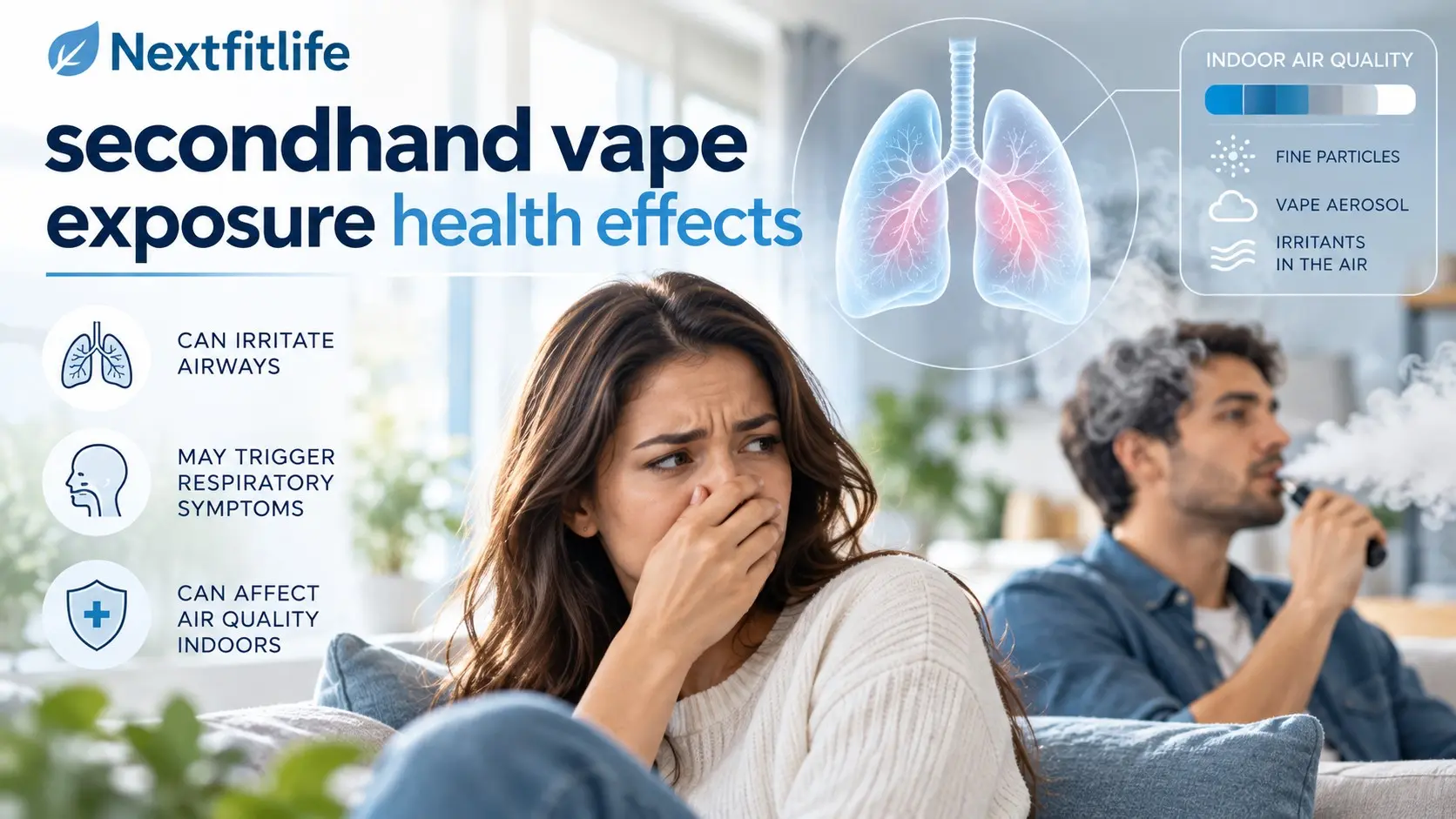
Secondhand vape exposure health effects are serious enough to avoid, but the science is still growing. Vape aerosol can expose nearby people to nicotine, very small particles, metals, formaldehyde, and other chemicals. Human studies have linked repeated exposure with respiratory symptoms, while the exact long term risks are still being studied.
There is also no single blood or urine test that tells you how much lung damage secondhand vaping caused.
Cotinine testing can show recent nicotine exposure. It cannot prove that vaping was the source, measure lung injury, or detect exposure to a nicotine-free aerosol.
This article is for general information and education. It does not replace medical advice, diagnosis, or treatment.
For more respiratory guidance, visit the NextFitLife Lung and Respiratory Health Hub and the Health Hub.
- What secondhand vape exposure means
- 11 critical health and testing facts
- Respiratory symptoms
- Children and asthma
- Pregnancy
- Cotinine testing
- How results are interpreted
- Tests for lung symptoms
- Air purifiers and ventilation
- Questions to ask your doctor
- When to seek urgent care
- References and Sources
- Internal Links + Hub
- Author Bio
- Frequently Asked Questions
What is secondhand vape exposure?
An e cigarette heats a liquid and creates an aerosol.
The person using the device breathes the aerosol in and then exhales part of it into the room. People nearby can breathe some of that secondhand aerosol.
The U.S. Environmental Protection Agency explains that e cigarette aerosol is a mix of tiny particles and droplets. It can contain nicotine, formaldehyde, metals, and other substances that may be harmful.
The amount released is not always the same. It changes with the device, liquid, power, way the device is used, number of users, room size, and ventilation.
So the phrase “water vapor” is misleading.
For more background, read Effects of Vaping on Lungs.
11 critical facts about secondhand vape exposure health effects
1. Vape aerosol is not harmless water vapor
CDC says e cigarette aerosol can contain nicotine, cancer causing chemicals, heavy metals such as nickel, tin, and lead, plus tiny particles that can travel deep into the lungs.
EPA also lists nicotine, formaldehyde, and metals among substances that can be present in secondhand aerosol.
That does not mean every puff contains the same amount of every chemical.
It does mean the aerosol should not be treated as clean indoor air.
2. Secondhand vaping is not the same as secondhand cigarette smoke
These exposures should not be treated as identical.
Cigarettes burn tobacco and create many combustion products. E cigarettes do not burn tobacco in the same way.
A 2024 JAMA Network Open study looked at 1,777 children aged 3 to 11.
Nicotine absorption measured by serum cotinine was much lower in children exposed only to secondhand e cigarette aerosol than in children exposed to secondhand cigarette smoke.
But children exposed to neither had the lowest cotinine levels.
In other words, secondhand vaping produced less nicotine exposure than secondhand smoking in that study, but it did not produce zero exposure.
3. Respiratory effects have the strongest human evidence so far
A 2025 systematic review looked at human research on secondhand e cigarette exposure.
Only 16 studies met the researchers' criteria.
The studies reported respiratory findings that included bronchitic symptoms, shortness of breath, asthma symptoms, and throat irritation.
The researchers also found higher cotinine in exposed nonsmokers and nonvapers in several studies.
However, every study had limits.
So the fair conclusion is that secondhand exposure is not harmless and is linked with respiratory effects, while better long term studies are still needed.
4. Repeated indoor exposure matters more than a brief passing cloud
A few seconds near someone vaping outdoors is different from living with someone who vapes in a bedroom, living room, office, or car every day.
Duration matters.
Frequency matters too.
A prospective study of 2,097 young adults found that secondhand nicotine vaping at home was associated with more bronchitic symptoms and shortness of breath after the researchers adjusted for several other smoking and vaping exposures.
The study still could not prove that vaping caused every reported symptom.
It does show why regular indoor exposure deserves more attention than a one time encounter.
See Indoor Air Pollution and Lung Health for more ways indoor air affects breathing.
5. People with asthma deserve extra protection
Asthma makes the airways more sensitive.
Studies in young people with asthma have found associations between secondhand e cigarette aerosol exposure and asthma symptoms or attacks.
One large study of youth with asthma found higher odds of reporting an asthma attack among those exposed to secondhand electronic nicotine aerosol.
That was an observational study, so it cannot prove that aerosol caused each attack.
Still, someone with asthma should not have to keep breathing indoor vape aerosol to find out whether it triggers symptoms.
For warning signs, see Unusual Asthma Symptoms and Wheezing at Night.
6. Children can absorb nicotine from secondhand vaping
This is one of the clearest measured effects.
The 2024 JAMA study found higher serum cotinine in children exposed to secondhand e cigarette vapor than in children whose families reported neither smoke nor vape exposure.
Cotinine is a product made when the body breaks down nicotine.
It tells us that nicotine entered the child's body.
It does not tell us that a specific disease will develop.
Still, children do not benefit from breathing nicotine aerosol.
A vape free home and car remove that unnecessary exposure.
7. Pregnancy is a good reason to keep indoor air vape free
Nicotine exposure is not considered harmless during pregnancy.
Most strong pregnancy evidence involves direct nicotine use and tobacco smoke rather than carefully measured passive e cigarette exposure.
That means we should not make claims that one brief secondhand exposure has harmed a fetus.
The more useful recommendation is simple.
Avoid repeated indoor vaping during pregnancy because it creates an exposure with no health benefit to the pregnant person or fetus.
8. Long term cancer risk is not yet measured precisely
Secondhand vape aerosol can contain substances that are known to cause cancer, including formaldehyde under some device conditions.
That does not mean scientists already know the exact cancer risk from living with someone who vapes.
They do not.
E cigarettes have not been widely used for as many decades as combustible cigarettes, so long term human data are still limited.
The correct message is that exposure to carcinogenic substances is possible, while the exact long term cancer risk from passive vaping is still uncertain.
9. Chemicals can remain after the visible cloud disappears
The room may look clear after somebody stops vaping.
That does not mean every substance vanished.
EPA explains that chemicals from smoking and vaping can settle on hard and soft surfaces.
They can collect on:
- Furniture
- Floors
- Clothing
- Bedding
- Curtains
- Carpet
This is sometimes called thirdhand exposure.
The simple solution is not endless surface testing. It is preventing repeated indoor vaping in the first place.
10. Cotinine shows nicotine exposure, not lung damage
This is the most important testing fact.
Cotinine is a major metabolite of nicotine. Because it stays in the body longer than nicotine itself, laboratories use it as a marker of recent nicotine exposure.
Cotinine can be measured in:
- Blood or serum
- Urine
- Saliva
A positive cotinine result means nicotine entered the body recently.
It does not automatically tell you where that nicotine came from.
11. A laboratory result cannot tell the whole health story
CDC's 2026 environmental exposure guidance makes this point very clearly.
Finding a chemical or metabolite in blood or urine shows that exposure happened.
It does not by itself tell you:
- Whether the amount is harmful
- Whether it caused a symptom
- Whether disease will develop
- The exact source of exposure
- The route by which it entered the body
This is why lab results need medical context rather than an internet cutoff alone.
What does a cotinine test check?
A cotinine test checks whether the body has recently processed nicotine.
Possible nicotine sources include:
- Cigarettes
- Nicotine containing vapes
- Cigars or other tobacco products
- Nicotine pouches
- Nicotine gum
- Nicotine patches
- Other nicotine replacement products
- Secondhand cigarette smoke
- Secondhand nicotine vape aerosol
That list is why a positive cotinine test does not prove that someone else vaping near you was the source.
What does a cotinine test not check?
Cotinine does not measure lung injury.
It cannot tell you:
- How much your lungs were damaged
- Whether your cough came from vaping
- The exact amount of aerosol you breathed
- Which vape device caused exposure
- Whether future disease will occur
- Whether you inhaled nicotine free vape aerosol
The last point matters.
If an aerosol contains no nicotine, cotinine is not a marker for that exposure.
You could still have inhaled particles or other chemicals.
How are cotinine results interpreted?
There is no single number that means “secondhand vape damage.”
Laboratories interpret results using the sample type, test method, exposure history, and clinical question.
Mayo Clinic Laboratories notes that passive tobacco smoke can produce measurable serum cotinine in people who do not use tobacco.
That does not provide a vape specific cutoff.
It shows why the source history matters.
| Finding | What It Can Tell You | What It Cannot Prove |
|---|---|---|
| Positive cotinine | Recent nicotine entered the body | That secondhand vaping was definitely the source |
| Negative cotinine | No measurable recent nicotine by that test | That no vape aerosol exposure occurred |
| Higher cotinine | More nicotine exposure is possible | A specific amount of lung damage |
How long does cotinine stay detectable?
Cotinine stays in the body much longer than nicotine itself.
Mayo Clinic Laboratories lists a cotinine elimination half life of about one day.
Detection time still varies with:
- How much nicotine entered the body
- How often exposure occurred
- The sample type
- Personal metabolism
- Kidney function
- Active nicotine use
That is another reason a single result should be interpreted by the laboratory and clinician who ordered it.
Do you need a cotinine test after one brief exposure?
Usually, testing will not change what you do after one short accidental exposure if you feel well.
The practical response is to stop the exposure and avoid repeating it.
Cotinine testing becomes more useful when proving nicotine exposure would answer a real medical, research, workplace, pregnancy, or smoking cessation question.
Before paying for a test, ask:
What decision will this result change?
If nobody can answer that, the test may add little.
Is there a blood test for all vape chemicals?
No routine clinical blood test screens for every chemical in secondhand vape aerosol.
Researchers can measure selected chemicals, metals, or metabolites in specialized studies.
That is different from routine patient care.
Even when a chemical is detected, CDC warns that detection alone does not prove it caused illness.
Be careful with broad commercial “toxin panels” that promise to show whether vaping damaged your lungs.
What tests check the lungs after vape exposure?
If you have respiratory symptoms, doctors usually focus on the symptoms and lung function rather than trying to prove the aerosol source with one blood test.
The evaluation depends on the problem.
| Test or Check | What It Checks | Main Limitation |
|---|---|---|
| Medical history | Timing, duration, symptoms, asthma, other exposures | Does not measure a chemical dose |
| Pulse oximetry | Blood oxygen saturation | A normal reading does not rule out all airway problems |
| Spirometry | Airflow and lung function | Cannot prove vaping caused an abnormal result |
| Chest imaging | Selected structural lung problems | Not routine screening after simple exposure |
| Cotinine | Recent nicotine absorption | Does not test lung function or damage |
For more detail, read How to Check Lung Health.
What symptoms after exposure deserve medical attention?
A brief scratchy throat can pass quickly.
Persistent or recurring symptoms deserve more attention.
Watch for:
- Repeated cough
- Wheezing
- Shortness of breath
- Chest tightness
- Repeated asthma symptoms
- Symptoms that reliably start in rooms where someone vapes
One 2022 prospective study found associations between household secondhand nicotine vaping and bronchitic symptoms and shortness of breath in young adults.
An association does not prove that every symptom came from vaping.
But a repeated pattern is worth discussing with a healthcare professional.
For related symptoms, see Morning Cough and Lung Inflammation Symptoms.
When should you seek urgent medical care?
Get urgent medical help for:
- Severe trouble breathing
- Blue or gray lips
- Severe chest pain
- Fainting
- Confusion
- A severe asthma attack that is not responding to the person's action plan
These symptoms need assessment even if vaping turns out not to be the cause.
Swallowing nicotine liquid is a different emergency. Liquid nicotine can cause poisoning and needs urgent poison or medical advice.
Can an air purifier make indoor vaping safe?
No.
EPA says ventilation, filtration, and air cleaning may reduce some substances from indoor vaping, but they are unlikely to eliminate the exposure.
That means an open window helps less than many people assume.
An air purifier may lower some particles.
Neither makes indoor vaping equivalent to clean indoor air.
The most effective option is to move vaping fully outside and away from doors, windows, and air intakes.
Is vaping next to an open window enough?
No.
Some aerosol can still remain in the room or move back inside.
EPA recommends avoiding vaping inside or near buildings and enclosed spaces when the goal is to prevent secondhand exposure.
If somebody needs to vape, outside is the cleaner option for everyone else.
What about vaping in a car?
A car is a small enclosed space.
That makes avoiding indoor aerosol especially simple.
Do not rely on an open car window as the main protection for a child, pregnant person, or someone with asthma.
Keep the car vape free.
Questions to ask your doctor
Bring specific information instead of only saying, “I was around a vape.”
Could my symptoms fit airway irritation or asthma?
Mention cough, wheeze, breathlessness, chest tightness, and any known asthma history.
Would cotinine testing change anything?
Ask what medical decision would change if the result were positive or negative.
What other nicotine sources could affect the result?
Tell the clinician about cigarettes, personal vaping, nicotine gum, patches, pouches, and secondhand cigarette smoke.
Could a nicotine free vape still cause exposure?
Yes. Cotinine measures nicotine exposure. It does not measure every particle or chemical found in aerosol.
Do I need spirometry?
Persistent wheeze, cough, or breathing problems may make lung function testing more useful than exposure testing.
Could something else explain my symptoms?
A cough, headache, racing heart, or shortness of breath can have many causes.
Do not force every symptom into a vaping diagnosis.
What symptoms should send me to urgent care?
Ask for clear instructions based on your medical history.
Questions to ask the person who is vaping
- Does the product contain nicotine?
- Is it an e cigarette, cannabis vape, or another product?
- How often is it used indoors?
- Is it used in the car?
- Can vaping be moved fully outdoors?
- Can it be kept away from open windows and doors?
You do not need a laboratory result before asking for vape free indoor air.
What I would do at home
Keep the home and car vape free.
That recommendation has much less uncertainty than debates about which filter, fan, window, or air purifier is good enough.
EPA says stopping indoor vaping is the only way to eliminate indoor secondhand e cigarette aerosol exposure.
So if someone uses a vape, the practical solution is simple.
Go outside.
For more indoor air guidance, see Indoor Air Pollution and Lung Health.
Conclusion: test the right question, then reduce the exposure
The evidence on secondhand vape exposure health effects is growing. We know that nearby people can absorb nicotine and breathe aerosol containing particles and potentially harmful chemicals. Human studies also link repeated exposure with respiratory symptoms.
What we do not have is a blood test that converts one exposure into a score for future lung disease.
Your next step: if you feel well, focus on preventing repeated indoor exposure. If symptoms persist, ask a healthcare professional whether your lungs need evaluation. If someone suggests cotinine testing, first ask what decision the result will change.
References and Sources
- U.S. Environmental Protection Agency. Secondhand Electronic Cigarette Aerosol and Indoor Air Quality.
Used for aerosol contents, exposure pathways, and the limits of filtration and ventilation.
https://www.epa.gov/indoor-air-quality-iaq/secondhand-electronic-cigarette-aerosol-and-indoor-air-quality - U.S. Environmental Protection Agency. Secondhand Smoke and Electronic Cigarette Aerosols.
Used for indoor exposure prevention and thirdhand contamination guidance.
https://www.epa.gov/indoor-air-quality-iaq/secondhand-smoke-and-electronic-cigarette-aerosols - Centers for Disease Control and Prevention. About E Cigarettes.
Used for nicotine, metals, particles, and other substances found in e cigarette aerosol.
https://www.cdc.gov/tobacco/e-cigarettes/about.html - Centers for Disease Control and Prevention. Interpretation of the Data, National Exposure Report. Updated August 3, 2026.
Used for the distinction between biomonitoring, exposure, exposure source, and proven health effects.
https://www.cdc.gov/environmental-exposure-report/interpretation-of-the-data/index.html - Patanavanich R, et al. Health Effects from Secondhand Exposure to E Cigarettes: A Systematic Review of Peer Reviewed Articles from 2004 to 2024. 2025.
Used for the current human evidence on respiratory, immune, cardiovascular, and biomarker outcomes.
https://pubmed.ncbi.nlm.nih.gov/41007552/ - Tattan Birch H, et al. Secondhand Nicotine Absorption From E Cigarette Vapor vs Tobacco Smoke in Children. JAMA Network Open. 2024.
Used for serum cotinine evidence in 1,777 children exposed to secondhand vaping, cigarette smoke, or neither.
https://jamanetwork.com/journals/jamanetworkopen/fullarticle/2821086 - Islam T, et al. Secondhand Nicotine Vaping at Home and Respiratory Symptoms in Young Adults. Thorax. 2022.
Used for prospective evidence relating household secondhand vaping with bronchitic symptoms and shortness of breath.
https://pmc.ncbi.nlm.nih.gov/articles/PMC9203939/ - Bayly JE, et al. Secondhand Exposure to Aerosols From Electronic Nicotine Delivery Systems and Asthma Exacerbations Among Youth With Asthma. Chest. 2019.
Used for asthma specific evidence and its observational limitations.
https://pubmed.ncbi.nlm.nih.gov/30359612/ - Mayo Clinic Laboratories. Nicotine and Metabolites, Serum.
Used for cotinine interpretation, nicotine metabolite testing, and passive exposure context.
https://www.mayocliniclabs.com/test-catalog/overview/82509
Internal Links + Hub
Author Bio
Adel Galal is the founder and lead writer of NextFitLife. His health and wellness content focuses on turning established respiratory health, environmental exposure, and public health guidance into clear information readers can use in everyday life.
For this article, the focus is on explaining secondhand vape exposure health effects while separating what exposure tests can measure from what they cannot prove about symptoms or future disease.
I am not a dermatologist or a doctor, and this content does not replace professional medical advice. What I share comes from real life experience, extensive research, and consultation with healthcare providers. Always consult qualified medical professionals for diagnosis and treatment of any health condition.
This article has not been medically reviewed by a pulmonologist, toxicologist, physician, allergist, or other licensed healthcare professional.
Learn more about NextFitLife and its editorial approach at About Us.
Frequently Asked Questions
Is secondhand vape exposure harmful?
Secondhand vape aerosol is not harmless water vapor. It can contain nicotine, very small particles, metals, formaldehyde, and other substances. Human studies have linked repeated exposure with respiratory symptoms, although exact long term disease risks are still being studied.
Can secondhand vaping show up in a blood test?
Yes, if the aerosol contains nicotine. Serum cotinine can show recent nicotine absorption. A positive result does not prove that secondhand vaping was the source because other nicotine products and tobacco smoke can also raise cotinine.
What does cotinine test for?
Cotinine is a metabolite of nicotine. Blood, urine, or saliva testing can show that nicotine recently entered the body, but it does not measure lung damage.
Can cotinine tell how much secondhand vape I inhaled?
No. Cotinine can support evidence of nicotine exposure, but it cannot precisely reconstruct the amount of aerosol inhaled or prove which device produced the exposure.
Can a negative cotinine test rule out secondhand vaping?
No. A negative test does not rule out exposure to nicotine free vape aerosol, and timing can also affect whether nicotine metabolites are measurable.
Is there a blood test for vape damage?
There is no standard blood test that turns secondhand vape exposure into a lung damage score. Doctors evaluate persistent symptoms using the medical history, examination, and tests such as spirometry or imaging when appropriate.
Can secondhand vaping trigger asthma?
Observational studies have linked household secondhand e cigarette aerosol exposure with asthma symptoms and attacks in young people. These studies show an association rather than proving that every asthma attack was caused by vaping.
Is secondhand vaping safer than secondhand cigarette smoke?
Nicotine exposure from secondhand vaping was much lower than from secondhand cigarette smoke in a 2024 study of children, but it was still higher than in children exposed to neither. Lower exposure does not mean zero exposure.
Can an air purifier remove secondhand vape aerosol?
Air cleaning and filtration can reduce some airborne substances, but EPA says they are unlikely to eliminate secondhand e cigarette aerosol exposure. Keeping vaping outside is more effective.
Does opening a window make indoor vaping safe?
No. Ventilation may reduce some pollutants, but it does not eliminate them. EPA recommends keeping vaping out of buildings, vehicles, and other enclosed spaces to prevent secondhand exposure.
Can children absorb nicotine from secondhand vaping?
Yes. A 2024 JAMA Network Open study found higher serum cotinine in children exposed to secondhand e cigarette vapor than in children with neither smoke nor vapor exposure.
Should pregnant women avoid secondhand vape aerosol?
Yes. Repeated nicotine and aerosol exposure offers no health benefit during pregnancy, so keeping indoor air vape free is the safer approach. Research cannot tell whether one brief accidental exposure caused harm.
How long does cotinine stay in the body?
Cotinine has a much longer half life than nicotine itself, roughly about one day according to Mayo Clinic Laboratories. The exact detection window changes with exposure amount, frequency, metabolism, sample type, and other factors.
When should I see a doctor after secondhand vape exposure?
Seek medical advice when cough, wheezing, breathlessness, chest tightness, or asthma symptoms persist or repeatedly occur with exposure. Severe trouble breathing, fainting, blue lips, severe chest pain, or confusion needs urgent care.
What should I ask my doctor about secondhand vape exposure?
Ask whether your symptoms suggest airway irritation or asthma, whether cotinine testing would change care, whether lung function testing is useful, what other nicotine sources could affect results, and which symptoms require urgent help.

Health & wellness writer with 30+ years of experience in nutrition, fitness, and healthy aging. Founder of NextFitLife.com — evidence-based health guidance.

