
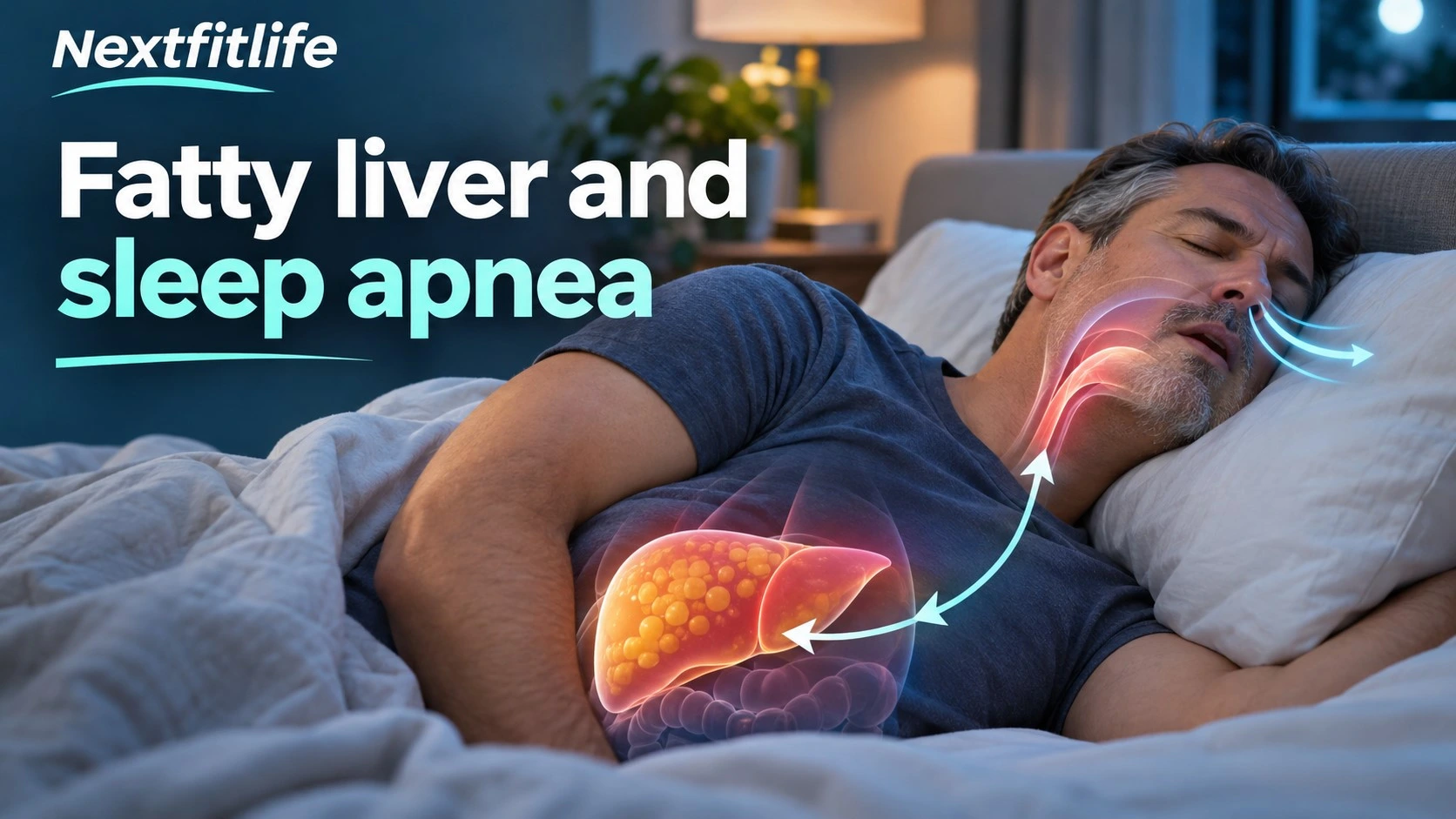
Fatty liver and sleep apnea often appear in the same person, especially when obesity, insulin resistance, type 2 diabetes, high blood pressure, or other metabolic risks are present.
The connection is real, but it is easy to oversimplify. Sleep apnea does not automatically mean liver damage, and treating sleep apnea does not automatically remove liver fat.
Quick Answer
Fatty liver and sleep apnea are closely linked because they share metabolic risks such as obesity and insulin resistance. Repeated oxygen drops during obstructive sleep apnea may add liver stress. Treating both matters, but CPAP alone has not been proven to reliably reverse liver fat or fibrosis.
The current term for much of what used to be called nonalcoholic fatty liver disease is metabolic dysfunction associated steatotic liver disease, or MASLD.
The inflammatory form is called metabolic dysfunction associated steatohepatitis, or MASH.
This article is for general information and education. It does not replace medical advice, diagnosis, or treatment.
Get urgent medical help for serious symptoms
Seek urgent care for symptoms such as:
- Severe difficulty breathing
- Blue or gray lips or skin
- Fainting or severe confusion
- Vomiting blood
- Black stool
- Rapidly increasing abdominal swelling
- Yellow skin or eyes with severe illness
- Extreme unusual sleepiness that is hard to interrupt
For the wider liver picture, see the NextFitLife Liver Health Guide and the Liver Health, Fatty Liver, Hepatitis and Detox Claims Hub.
What You Will Learn
- Why fatty liver and sleep apnea often occur together
- How repeated low oxygen may affect the liver
- Why AHI alone may not tell the whole story
- What CPAP can and cannot be expected to do
- Why liver fibrosis risk matters more than liver fat alone
- How metabolic health links both conditions
- Seven useful questions to ask a clinician
Table of Contents
- Why the Conditions Overlap
- How Low Oxygen May Affect the Liver
- AHI vs Oxygen Burden
- 1. What Type of Fatty Liver Do I Have?
- 2. Could I Have Sleep Apnea?
- 3. How Low Does My Oxygen Go?
- 4. Will CPAP Help My Liver?
- 5. Are My Metabolic Risks Treated?
- 6. Do I Need Liver Specific Treatment?
- 7. Which Condition Should Be Treated First?
- Weight and Metabolic Health
- Liver Medicines
- OSA Medicines and Weight Treatment
- Normal Liver Enzymes
- What to Bring to the Appointment
- Urgent Warning Signs
- Conclusion
- References and Sources
- Internal Links and Hub
- About the Author
- Frequently Asked Questions
Why Fatty Liver and Sleep Apnea Often Occur Together
The simplest explanation is shared metabolic risk.
People with obstructive sleep apnea, or OSA, frequently have some of the same conditions linked with MASLD:
- Obesity
- Excess abdominal fat
- Insulin resistance
- Type 2 diabetes
- High blood pressure
- High triglycerides
- Abnormal cholesterol
That overlap matters because these metabolic problems can raise the risk of liver fat and also increase the chance of OSA.
A 2026 review describes repeated low oxygen as a possible amplifier of liver injury in people who already have metabolic dysfunction, rather than a proven independent cause of MASH.
The useful way to think about it:
Sleep apnea may add stress to a liver that is already vulnerable, while obesity, diabetes, insulin resistance, and visceral fat may be driving both problems at the same time.
How Could Sleep Apnea Affect the Liver?
In OSA, the upper airway repeatedly narrows or closes while you sleep.
That can interrupt airflow and cause repeated falls in blood oxygen.
Researchers call this intermittent hypoxia.
Possible pathways that could connect OSA with liver injury include:
- Oxidative stress
- Inflammation
- Greater insulin resistance
- Changes in fat metabolism
- Sympathetic nervous system activation
- Signals involved in liver fibrosis
These mechanisms make biological sense, but they do not prove that every person with OSA will develop liver fibrosis.
How Strong Is the Link?
The newest evidence supports an association, but it also shows why caution matters.
A September 2026 systematic review and meta analysis included 22 studies examining sleep disordered breathing and steatotic liver disease.
The analysis found that sleep disordered breathing and increasing OSA severity were associated with higher odds of MASLD or liver steatosis.
However, study differences were large and the certainty of evidence was rated low to very low.
That is enough to take the connection seriously.
It is not enough to tell someone that OSA definitely caused their liver disease.
Nighttime Oxygen May Matter More Than the Apnea Count Alone
Most sleep study reports highlight the apnea hypopnea index, or AHI.
AHI counts apnea and hypopnea events per hour of sleep.
That number is useful, but it may not describe all of the oxygen stress occurring during the night.
The 2026 meta analysis found that measures of nocturnal hypoxemia appeared to track liver injury more closely than AHI alone.
| Sleep Measure | What It Tells You |
|---|---|
| AHI | How often breathing events happen per hour |
| Lowest oxygen level | How low oxygen fell during the study |
| Oxygen desaturation index | How often significant oxygen drops occurred |
| Time with low oxygen | How long the body spent below a defined oxygen threshold |
This does not mean one oxygen number can predict your liver outcome.
It means the full sleep study matters.
1. Ask: What Type of Fatty Liver Do I Actually Have?
The phrase “fatty liver” is not enough.
You need to know whether the issue is:
- Simple liver steatosis
- MASLD
- MASH
- Liver fibrosis
- Cirrhosis
- Alcohol related or mixed liver disease
- Another liver condition entirely
The treatment and long term risk can be very different.
Ask What Established the Diagnosis
Was it an ultrasound, CT scan, MRI, blood tests, elastography, or liver biopsy?
If the answer is simply “your liver enzymes were high,” ask whether more assessment is needed.
For treatment options, see the NextFitLife Fatty Liver Disease Treatments Guide.
Ask About Fibrosis Risk
A clinician may use FIB 4 as an initial fibrosis risk tool.
FIB 4 uses age, AST, ALT, and platelet count.
People who fall into an uncertain or higher risk range may need another assessment, such as transient elastography.
The practical question is:
2. Ask: Could I Have Sleep Apnea Without Knowing It?
Yes.
You are asleep when the breathing problem happens, so another person may notice the pattern first.
NHLBI lists possible OSA clues such as:
- Loud frequent snoring
- Breathing that stops and starts
- Gasping or choking during sleep
- Morning headache
- Dry mouth after waking
- Daytime sleepiness
- Fatigue
- Poor concentration
If you have MASLD plus several of these signs, ask whether a formal sleep evaluation makes sense.
A sleep study can help confirm the type and severity of sleep apnea.
For broader sleep warning signs, see the NextFitLife General Wellness and Sleep Guide.
3. Ask: How Low Does My Oxygen Go at Night?
Do not ask only for the AHI.
Ask about the oxygen pattern too.
Useful information can include:
- Lowest oxygen saturation
- Oxygen desaturation index
- How much of the night was spent with low oxygen
- Whether drops were brief or prolonged
The reason is that current research suggests oxygen desaturation may have a closer relationship with liver injury than event count alone.
That is a research signal, not a home diagnostic rule.
4. Ask: Will CPAP Improve My Fatty Liver?
This is where many online explanations become too confident.
CPAP is an established treatment for many people with obstructive sleep apnea.
It helps keep the upper airway open during sleep and can improve OSA related breathing problems.
But CPAP is not a proven stand alone treatment for MASLD.
What Current Evidence Shows
A recent systematic review involving people with both MASLD and OSA found modest and inconsistent improvements in liver enzymes after CPAP.
However, randomized trials did not show clear improvement in liver fat or fibrosis.
The larger September 2026 meta analysis reached a similar conclusion.
The practical answer:
Use prescribed CPAP because treating OSA matters. Just do not assume CPAP means your liver no longer needs separate testing, metabolic care, and follow up.
5. Ask: Are My Metabolic Risks Being Treated Too?
This may be the most useful question in the whole article.
MASLD and OSA frequently sit inside a larger metabolic picture.
Ask about:
- Body weight when medically relevant
- Waist size
- Blood pressure
- Fasting glucose
- HbA1c
- Triglycerides
- LDL cholesterol
- HDL cholesterol
- Physical activity
- Eating pattern
- Alcohol intake
- Smoking or nicotine use
Treating only the apnea or only the liver can miss part of the problem.
For wider metabolic risk management, see the Weight Management and Metabolism Hub.
Weight Loss Can Help When Excess Weight Is Part of the Problem
This topic needs care because body weight is not the only cause of either condition.
Still, when overweight or obesity is present, gradual weight reduction can improve metabolic health and may reduce liver fat.
It can also reduce OSA severity in some people.
NIDDK guidance notes that losing roughly 3% to 5% of body weight can reduce liver fat in some people with MASLD, while larger reductions may be needed for a better chance of improving inflammation and fibrosis.
Do not stop CPAP because the scale changed:
If weight loss improves OSA, your sleep clinician should reassess the condition before you change prescribed PAP treatment.
For sustainable strategies, use the NextFitLife Complete Weight Loss Guide.
6. Ask: Do I Need Liver Specific Treatment Beyond Lifestyle Changes?
The answer depends on your diagnosis and fibrosis stage.
This area has changed a lot in recent years.
Resmetirom
The FDA approved resmetirom, sold as Rezdiffra, for selected adults with noncirrhotic MASH and moderate to advanced liver fibrosis.
It is used alongside diet and exercise.
It is not a general fatty liver treatment for everyone with steatosis.
Semaglutide
In August 2025, the FDA approved semaglutide, sold as Wegovy, for adults with noncirrhotic MASH and moderate to advanced fibrosis under an accelerated approval pathway.
Again, this is a selected patient group.
A person with mild liver fat and low fibrosis risk has a very different treatment discussion from someone with F2 or F3 fibrosis.
This is another reason fibrosis staging matters.
What About Weight Loss Medicines for Sleep Apnea?
This area has also changed.
Tirzepatide now has an FDA indication for moderate to severe obstructive sleep apnea in adults with obesity.
That does not mean every person with sleep apnea should take it, and it does not automatically replace PAP therapy.
The treatment decision depends on:
- Body weight and obesity status
- OSA severity
- Other medical conditions
- Medicine contraindications
- Treatment response
- Sleep specialist and prescriber judgment
If obesity, OSA, and MASLD are all present, it is reasonable to ask whether one treatment plan can address several metabolic risks at the same time.
7. Ask: Which Condition Should We Treat First?
Usually, this is the wrong question.
Do not make the liver wait for the sleep apnea.
Do not make the sleep apnea wait for the liver.
Treat both.
| Condition | Typical Areas to Address |
|---|---|
| Obstructive sleep apnea | PAP therapy, weight management when appropriate, oral appliance therapy in selected patients, sleep positioning in selected cases, and other sleep specialist treatments |
| MASLD or MASH | Fibrosis assessment, nutrition, physical activity, weight management when appropriate, blood sugar and lipid control, alcohol review, and disease specific medicine when indicated |
The treatments overlap.
They are not interchangeable.
Does Fatty Liver Cause Sleep Apnea?
Do not think of liver fat as something physically blocking your airway.
The link is more likely to involve the shared metabolic environment.
A large 2026 cohort study found higher rates of OSA among people with MASLD.
That association does not prove that liver fat directly causes the airway to collapse.
A safer conclusion is:
Does Sleep Apnea Make Fatty Liver Worse?
Possibly, especially when nighttime oxygen drops are substantial.
The best current interpretation is that OSA may add stress to a liver already affected by metabolic dysfunction.
Repeated low oxygen may contribute to:
- Oxidative stress
- Inflammatory signaling
- Changes in fat metabolism
- Greater insulin resistance
- Fibrosis related pathways
But obesity, metabolic syndrome, age, diabetes, and other factors remain major confounders.
Normal Liver Enzymes Do Not Always Mean the Liver Is Fine
ALT and AST are useful tests.
They are not perfect fibrosis detectors.
A person can have steatotic liver disease without dramatic liver enzyme elevation.
That is why risk factors, platelet count, imaging, FIB 4, and elastography can matter.
Do not stop at “my ALT is normal”:
Ask whether your overall fibrosis risk has been assessed, especially when diabetes, obesity, or several metabolic risk factors are present.
What Should You Bring to the Appointment?
A short list makes the appointment much more useful.
- Recent ALT and AST
- Platelet count
- HbA1c or fasting glucose
- Triglycerides and cholesterol
- Blood pressure results
- Liver ultrasound or other imaging report
- FibroScan or elastography results if available
- Sleep study report
- AHI
- Nighttime oxygen results
- CPAP adherence report if you use PAP
- A complete medicine and supplement list
- An honest estimate of alcohol use
Seven Questions Worth Asking Your Clinician
- What type of fatty liver disease do I have, and is there evidence of fibrosis?
- Should we calculate FIB 4 or use another noninvasive fibrosis test?
- Do my symptoms or metabolic risks justify a sleep study?
- If I have OSA, what were my AHI and nighttime oxygen results?
- Is my CPAP treatment actually controlling the apnea?
- Which metabolic risks need treatment now?
- Do I meet criteria for liver specific, obesity related, or OSA related medication?
Those questions are more useful than trying to prove which condition came first.
When Liver Symptoms Need Urgent Attention
Early MASLD often causes few or no obvious symptoms.
Advanced liver disease is different.
Get urgent medical care for:
- Vomiting blood
- Black or tar like stool
- New confusion
- Severe unusual sleepiness
- Fainting
- Rapidly increasing abdominal swelling
- Severe weakness
- Jaundice with severe illness
When Sleep Apnea Needs Prompt Attention
Talk with a clinician when you repeatedly have:
- Loud frequent snoring
- Witnessed breathing pauses
- Gasping or choking during sleep
- Severe daytime sleepiness
- Morning headaches
- Poor concentration
- High blood pressure that is difficult to control
Do not drive when you are dangerously sleepy.
Sleep apnea is not just a snoring problem.
The Mistake I Would Avoid
Do not reduce this whole problem to:
“I just need to lose weight.”
Weight can matter a lot, but you still need to know:
- How advanced the liver disease is
- How severe the sleep apnea is
- How much nighttime hypoxemia is occurring
- Whether PAP treatment is effective
- Which metabolic risks are present
- Whether fibrosis specific treatment is appropriate
That is a much better plan than guessing.
Conclusion
If you have fatty liver and sleep apnea, treat them as two connected health problems rather than waiting for one treatment to solve both.
Ask about liver fibrosis risk, your nighttime oxygen pattern, CPAP effectiveness, blood sugar, cholesterol, blood pressure, weight management when appropriate, and whether newer liver or obesity treatments apply to you.
Your next step: bring your liver results and sleep study to the same clinical conversation if possible. The useful goal is not proving which condition came first. It is finding the risks you actually have and treating them.
References and Sources
- National Heart, Lung, and Blood Institute. Sleep Apnea Diagnosis.
https://www.nhlbi.nih.gov/health/sleep-apnea/diagnosis - National Heart, Lung, and Blood Institute. Sleep Apnea Treatment.
https://www.nhlbi.nih.gov/health/sleep-apnea/treatment - Alhajery MA, Alotay AA. Association Between Sleep Disordered Breathing and Liver Outcomes in Steatotic Liver Disease: A Systematic Review and Meta Analysis. Frontiers in Medicine. 2026.
https://pubmed.ncbi.nlm.nih.gov/42774085/ - PubMed. Does Continuous Positive Airway Pressure Improve Liver Outcomes in MASLD With Obstructive Sleep Apnea? A Systematic Review.
https://pubmed.ncbi.nlm.nih.gov/41517476/ - American Association for the Study of Liver Diseases. Noninvasive Assessment of Patients With MASLD.
https://www.aasld.org/liver-fellow-network/core-series/clinical-pearls/spare-me-jab-noninvasive-assessment-patients-masld - U.S. Food and Drug Administration. FDA Approves Treatment for Serious Liver Disease Known as MASH.
https://www.fda.gov/drugs/news-events-human-drugs/fda-approves-treatment-serious-liver-disease-known-mash - PubMed. Chronic Intermittent Hypoxia and MASLD in Obstructive Sleep Apnea: A Critical Appraisal of Mechanistic and Causal Evidence. 2026.
https://pubmed.ncbi.nlm.nih.gov/42942139/
Internal Links and NextFitLife Hub
About the Author
Adel Galal is the founder and lead writer of NextFitLife.com. He has more than 15 years of health and wellness writing experience. He is not a licensed healthcare professional. Read the About page for sources and review rules.
Adel is not a medical professional; health articles cite trusted sources and are for general information only.
Frequently Asked Questions
Are fatty liver and sleep apnea connected?
Yes. They commonly occur together because both are linked with metabolic risks such as obesity, insulin resistance, type 2 diabetes, and high blood pressure. Repeated low oxygen from sleep apnea may also add liver stress.
Can sleep apnea cause fatty liver?
Current evidence supports a strong association, but it does not prove that sleep apnea alone directly causes fatty liver in every person. Shared metabolic risks are major contributors.
Can low oxygen during sleep affect the liver?
Repeated nighttime oxygen drops may increase oxidative stress, inflammation, insulin resistance, and other pathways linked with liver injury. Current research suggests oxygen burden may matter, but it does not predict liver damage by itself.
Does CPAP reverse fatty liver?
CPAP is an important treatment for obstructive sleep apnea, but controlled studies have not shown that CPAP alone reliably reverses liver fat or fibrosis. Liver disease still needs separate assessment and treatment.
Should someone with fatty liver be checked for sleep apnea?
A sleep evaluation is worth discussing when fatty liver occurs with loud snoring, witnessed breathing pauses, gasping, major daytime sleepiness, morning headaches, obesity, or difficult to control blood pressure.
What is FIB 4?
FIB 4 is a noninvasive calculation using age, AST, ALT, and platelet count to help estimate the risk of advanced liver fibrosis. It should be interpreted in clinical context.
Can liver enzymes be normal with fatty liver?
Yes. ALT and AST can be normal or only mildly abnormal even when liver fat or fibrosis is present. Risk factors and fibrosis assessment can still matter.
Are there medicines for MASH?
Yes. Resmetirom and semaglutide have FDA indications for selected adults with noncirrhotic MASH and moderate to advanced fibrosis. They are not treatments for everyone with liver fat.
Can weight loss improve both fatty liver and sleep apnea?
When excess weight is present, gradual weight loss can reduce liver fat and may reduce sleep apnea severity. It does not replace proper liver staging or prescribed sleep apnea treatment.
Which should be treated first, fatty liver or sleep apnea?
Usually both should be managed at the same time. Sleep apnea needs appropriate sleep treatment, while fatty liver needs fibrosis assessment, metabolic risk management, and disease specific treatment when indicated.

Health & wellness writer with 30+ years of experience in nutrition, fitness, and healthy aging. Founder of NextFitLife.com — evidence-based health guidance.