
Published on: November 18, 2026
If your hips feel stiff after sitting, walking, training, or getting out of bed, you do not need to force them into a deep pigeon pose.
A better yoga for tight hips routine starts with gentle movement, adds controlled stretching, and finishes with enough active work to help you use the range you gain.
Quick answer: Yoga can help improve hip mobility by combining stretching, controlled motion, and strength through range. Start with hip circles, 90/90 hip switches, low lunge, reclined figure four, butterfly, supported pigeon, happy baby, and Warrior II. Stop if you feel sharp groin pain, a deep joint pinch, numbness, or worsening pain.
Health note: This article is for general information and education. It does not replace medical advice, diagnosis, or treatment.
Do not stretch through serious hip pain. Get medical advice for severe or worsening groin pain, a hot or swollen hip, fever with hip pain, inability to bear weight after an injury, new numbness, major weakness, or pain that keeps waking you from sleep.
If your stiffness is strongly linked with long desk hours, start with the NextFitLife Hip Mobility Routine for Desk Workers. It combines walking, rotation, stretching, and strength instead of blaming every stiff hip on one muscle.
Table of Contents
- What tight hips really mean
- Can yoga improve hip movement?
- 8 gentle yoga poses
- A simple 10 minute routine
- How long to hold hip stretches
- Hip flexors, outer hips, and inner thighs
- Why strength belongs in mobility work
- What a hip pinch may mean
- Yoga for arthritis and back pain
- A four week mobility plan
- When to stop and get medical advice
- References and Sources
- Internal Links and NextFitLife Hubs
- About the Author
- Frequently Asked Questions
What Do “Tight Hips” Actually Mean?
“Tight hips” is a feeling, not a diagnosis.
You may notice stiffness after sitting, trouble extending one leg behind you, limited rotation, a pulling feeling in the front of the hip, or difficulty sitting cross legged.
Sometimes the main issue is reduced hip flexibility.
Sometimes you have enough passive range but poor strength or control in that range.
And sometimes the problem is pain from the joint rather than a muscle that needs more stretching.
That is why I would not treat every tight feeling with a deeper stretch.
Can Yoga Really Improve Hip Mobility?
Yes, yoga can be useful for hip movement because it combines several things at once.
It can include:
- Static stretching
- Controlled rotation
- Balance
- Strength through range
- Slow repeated movement
Research on stretching shows that regular stretching can improve range of motion.
Research comparing stretching with resistance training also shows that strength work through a full range can improve range of motion too.
That matters because good mobility is not just about how far someone can push your leg.
Useful mobility means you can move into a range and control it.
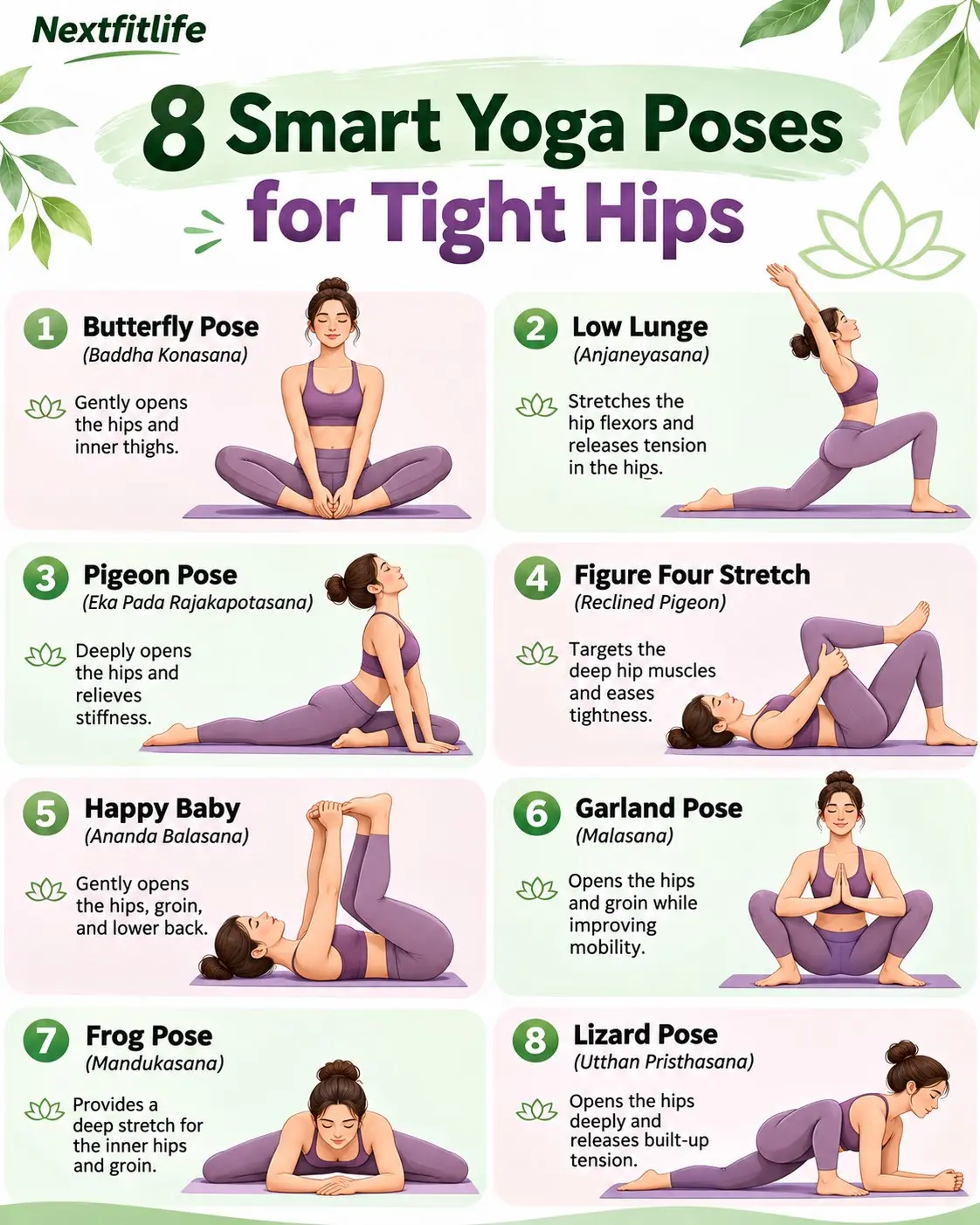
8 Smart Yoga Poses for Tight Hips
1. Start With Standing Hip Circles
Begin with movement rather than dropping straight into a long stretch.
Stand beside a wall or chair for support.
Lift one knee and draw a slow circle with it. Keep the movement smooth and stay inside a comfortable range.
Try several circles in each direction, then switch sides.
This gives you useful information before you stretch. One direction may feel easy while another feels blocked or pinchy.
Do not chase the biggest circle possible.
Control matters more.
2. Use 90/90 Hip Switches for Rotation
90/90 hip switches work internal and external hip rotation.
Sit on the floor with your knees bent and your feet wider than your hips.
Let both knees move slowly toward one side, return through the center, then move toward the other side.
Use your hands behind you if you need support.
Try 6 to 10 controlled switches.
If sitting on the floor feels awkward, sit on a cushion or use more support from your hands.
3. Low Lunge for the Front of the Hip
A low lunge can create a gentle stretch through the front of the hip.
Place one foot forward and lower the opposite knee to the floor.
Keep your torso tall, gently tuck the pelvis, and move forward only until you feel mild tension at the front of the back hip.
Do not create the stretch by arching your lower back.
A smaller clean movement usually works better than a deeper messy one.
4. Reclined Figure Four for the Outer Hip
The figure four stretch is a good beginner choice because the floor supports your body.
Lie on your back and place one ankle over the opposite thigh.
If that already creates enough tension, stay there.
For more stretch, gently draw the uncrossed leg toward your body.
You should feel tension around the buttock or outer hip.
Do not push into sharp groin pain.
5. Butterfly Pose for the Inner Thighs
Sit with the soles of your feet together and allow the knees to move outward.
Hold your feet or ankles.
If your back rounds a lot, sit on a folded blanket or cushion.
You do not need to push your knees toward the floor.
Let the position create a gentle stretch through the inner thighs.
6. Use Supported Pigeon Instead of Forcing Full Pigeon
Pigeon pose is popular, but it is not required.
If you use it, support your front hip with a cushion, folded blanket, or yoga block.
Keep the front knee comfortable and do not force your hips to look perfectly square.
If pigeon causes knee pain or a deep pinch in the front of the hip, use reclined figure four instead.
Props make the pose easier to control. That is exactly what you want.
7. Happy Baby for Gentle Hip Flexion
Lie on your back and bring the knees toward the sides of your chest.
Hold behind your thighs, lower legs, or feet, depending on what feels comfortable.
Keep your lower back relaxed.
You do not have to pull your knees toward the floor.
This pose can give the hips and inner thighs a comfortable stretch without asking you to support body weight through the joint.
8. Finish With Warrior II for Active Control
This is where the routine becomes more than passive stretching.
Step your feet apart, turn the front foot forward, and bend the front knee.
Keep the back leg active and reach your arms outward.
Stay in a range you can control.
Warrior II trains the hips while they are working through a larger range.
That is useful because mobility needs strength too.
A Simple 10 Minute Yoga Routine for Tight Hips
| Time | Movement | Main Focus |
|---|---|---|
| Minute 1 | Hip circles | Warm up and assess motion |
| Minutes 2 to 3 | 90/90 switches | Hip rotation |
| Minutes 4 to 5 | Low lunge | Front of hip |
| Minutes 6 to 7 | Figure four | Outer hip and glute area |
| Minute 8 | Butterfly | Inner thighs |
| Minute 9 | Supported pigeon or happy baby | Comfortable hip stretch |
| Minute 10 | Warrior II | Active control |
You do not need every pose to feel intense.
The session should leave the hips feeling easier to move, not irritated.
How Long Should You Hold Hip Stretches?
For many adults, 20 to 30 seconds is a simple starting point for a comfortable static stretch.
Longer is not automatically better.
If the position becomes easier, you can remain there a little longer. If it becomes painful, reduce the range or stop.
For a full breakdown of stretch timing, read the NextFitLife How Long to Hold a Stretch Guide.
Do Not Try to Stretch Harder for Faster Results
A stronger stretch can feel productive.
That does not mean you will improve faster.
Range of motion improves through repeated practice over time.
Use enough tension to feel a stretch, but do not chase pain.
If you need to hold your breath, make a face, or fight the pose, you have probably gone farther than you need.
Tight Hips May Need Strength, Not Just Stretching
This is the part many hip routines miss.
A hip may feel restricted because you do not control the end of your range well.
That is why active movements belong beside passive stretches.
Useful options include:
- 90/90 switches
- Warrior II
- Glute bridges
- Controlled sit to stands
- Side lying leg lifts
- Slow hip circles
Strength training and stretching can both improve range of motion.
You do not have to choose one forever.
What if Sitting Makes Your Hips Feel Tight?
Long periods in one position can leave the hips feeling stiff when you stand.
The answer is not always a long stretch session.
Try this first:
- Stand up.
- Walk for a minute or two.
- Do several controlled hip circles.
- Add a gentle low lunge.
- Return to your day.
For a fuller desk routine, use the 7 Smart Hip Mobility Moves for Desk Workers.
Yoga for Tight Hip Flexors
If the stiffness feels mostly at the front of the hip, try:
- Low lunge
- High lunge
- Warrior I
- Gentle bridge
- Standing hip extension
Keep your ribs and pelvis controlled.
If the lower back arches deeply, you are probably borrowing movement from the spine rather than creating more hip extension.
Yoga for Tight Outer Hips
If the main stiffness feels around the buttock or outer hip, try:
- Reclined figure four
- Supported pigeon
- 90/90 switches
- Gentle supine rotation
The stretch should stay comfortable.
If you feel knee pain, change the setup.
Yoga for Tight Inner Thighs
For the inner thigh muscles, use:
- Butterfly
- Wide knee child pose
- Side lunge
- Gentle adductor rock back
Deep frog pose can be intense.
You do not need it to improve inner thigh movement.
Start with a position that you can control.
Is Pigeon Pose Good for Tight Hips?
It can be useful for some people.
It is not a required hip stretch.
Pigeon asks for a lot of hip rotation, and different people have different available ranges.
If you cannot settle into the pose without knee pain or hip pinching, use a cushion or switch to reclined figure four.
A simpler pose that feels good is better than an advanced pose you have to force.
What Does a Pinch in the Front of the Hip Mean?
A muscle stretch usually feels like tension through soft tissue.
A sharp, deep pinch in the groin or front of the joint is different.
Stop moving deeper if a pose creates that feeling.
Some hip positions can irritate people with joint problems, including impingement type symptoms.
Change the angle, reduce the depth, or choose another movement.
If a hip pinch keeps returning during walking, squatting, getting out of a chair, or other normal activity, get it assessed rather than trying to stretch through it.
Hip Tightness vs Hip Pain
| Feeling | What It May Feel Like | What to Do |
|---|---|---|
| Normal stretch | Mild pulling or tension | Stay comfortable and breathe |
| Stiffness | Movement feels limited or rusty | Try gentle movement and reassess |
| Joint pinch | Sharp or deep pain in the groin | Reduce the range or stop |
| Nerve symptom | Tingling, numbness, burning, weakness | Stop and seek advice if persistent or significant |
Can Yoga Help Hip Arthritis?
Comfortable exercise is useful for many people with hip arthritis, but the right range depends on the person.
Some deep crossed leg poses can irritate an arthritic hip.
If you have diagnosed arthritis, keep the movement comfortable and modify any pose that causes sharp joint pain.
Do not measure progress by how low you can force your knee toward the floor.
Can Tight Hips Cause Back Pain?
Hip stiffness and back pain can occur together.
Limited hip movement can change how someone moves through the pelvis and lower back during some tasks.
But it is too simple to say that tight hips always cause back pain.
Back pain has many possible causes.
If back pain persists, keeps getting worse, travels down a leg, or comes with numbness or weakness, get it assessed.
You can also read the NextFitLife Lower Back Pain Guide for safer movement and warning signs.
Should You Stretch Before or After Exercise?
Before exercise, dynamic movement usually fits better.
Useful hip warm up options include:
- Hip circles
- Leg swings
- Walking lunges
- 90/90 switches
Longer static holds usually fit better after training or during a separate flexibility session.
The Stretching Before or After Workout Guide explains when each type fits best.
How Often Should You Do Yoga for Tight Hips?
Start with three short sessions per week.
You can also use a few gentle mobility moves on other days if they feel good.
Consistency matters more than one long session.
If ten minutes feels easy to repeat, that is better than doing forty minutes once and then avoiding the routine for two weeks.
A Simple Four Week Hip Mobility Plan
| Week | Focus | What to Watch |
|---|---|---|
| Week 1 | Hip circles, 90/90 switches, low lunge, figure four | Comfort and side to side differences |
| Week 2 | Add butterfly and Warrior II | Better control through range |
| Week 3 | Try supported pigeon only if comfortable | No knee pain or hip pinch |
| Week 4 | Keep the movements that help most | Walking, sitting, squatting, and daily comfort |
You do not need every pose.
The goal is better movement, not a longer exercise list.
Common Yoga Mistakes With Tight Hips
Forcing Pigeon Pose
Use support or switch to reclined figure four.
Pushing the Knees Down in Butterfly
Let gravity do the work.
Stretching Into a Joint Pinch
A sharp groin pinch is a reason to reduce the range, not push harder.
Doing Only Passive Stretching
Add active rotation and strength so you can control the range.
Treating Every Tight Feeling as a Short Muscle
Warm up, move, and reassess before deciding that a deeper stretch is the answer.
Comparing Your Hip Range With Someone Else
Joint shape and anatomy vary.
Your pose does not need to look like another person's pose.
When Should You Stop and Get Medical Advice?
Stop the routine and seek medical advice if you have:
- Sharp or worsening groin pain
- Severe sudden hip pain
- A hot or swollen joint
- Fever with hip pain
- Inability to bear weight after an injury
- Persistent weakness
- Numbness or tingling
- Pain that repeatedly wakes you from sleep
- Pain that keeps worsening despite reducing activity
Yoga is a movement tool.
It is not a test for every hip condition.
Conclusion
The best yoga for tight hips routine is gentle enough to repeat and active enough to build control.
Start with hip circles and 90/90 switches. Add low lunge, figure four, butterfly, and supported pigeon only as far as they feel comfortable. Finish with Warrior II or another controlled strength based pose so the hips practice using the range you created.
Your next step: try the 10 minute routine three times this week. If one pose causes a sharp pinch, replace it instead of forcing deeper.
References and Sources
- PubMed. Strength Training Versus Stretching for Improving Range of Motion: Systematic Review and Meta Analysis.
https://pubmed.ncbi.nlm.nih.gov/33917036/ - PubMed. Static Stretching and Flexibility: Systematic Review and Meta Analysis.
https://pubmed.ncbi.nlm.nih.gov/39614059/ - PubMed Central. Yoga Based Movement Research Including Hip Extension and Functional Movement.
https://pmc.ncbi.nlm.nih.gov/articles/PMC10801568/ - NHS. Hip Pain in Adults.
https://www.nhs.uk/symptoms/hip-pain/ - Harvard Health Publishing. Hip Flexor Stretches for People Who Spend Much of the Day Sitting.
https://www.health.harvard.edu/staying-healthy/do-you-spend-most-of-your-day-sitting-these-hip-flexor-stretches-are-for-you - PubMed. Prolonged Sitting, Physical Activity, and Passive Hip Extension Range of Motion.
https://pubmed.ncbi.nlm.nih.gov/33188982/
Internal Links and NextFitLife Hubs
- Hip Mobility Routine for Desk Workers
- Stretching Before or After Workout
- How Long to Hold a Stretch
- Thoracic Mobility Exercises
- Lower Back Pain Guide
- Home Workouts and Equipment Guide
- Healthy and Active Lifestyle Guide
- About NextFitLife
Frequently Asked Questions
What is the best yoga for tight hips?
A useful routine combines hip circles, 90/90 switches, low lunge, reclined figure four, butterfly, supported pigeon, happy baby, and an active pose such as Warrior II. Use a comfortable range rather than forcing a deep stretch.
How often should I do yoga for tight hips?
Start with about three short sessions per week. You can also use a few comfortable mobility moves on other days if they feel helpful.
How long should I hold a hip stretch?
About 20 to 30 seconds is a practical starting point for many adults. Use mild tension rather than pain and repeat regularly instead of forcing one long stretch.
Is pigeon pose necessary for tight hips?
No. Pigeon is optional. Reclined figure four is often easier to control and is a good alternative if pigeon causes knee pain or a deep hip pinch.
Can yoga loosen tight hip flexors?
Gentle lunge based poses can improve comfort and range at the front of the hip, but tightness is not always caused by a short muscle. Strength and controlled movement may also be useful.
Why do my hips feel tight after sitting?
Long periods in one position reduce movement variety. The hips may feel stiff when you stand and ask them to extend, rotate, and stabilize again. Walking and gentle movement can help before deeper stretching.
Should a hip stretch hurt?
No. Mild pulling or tension is expected, but sharp pain, a deep groin pinch, numbness, weakness, or worsening pain are reasons to stop.
Can tight hips cause lower back pain?
Hip stiffness and back pain can occur together, but tight hips do not explain every case of back pain. Persistent pain, leg weakness, numbness, or worsening symptoms need proper assessment.
Do tight hips need strengthening too?
Often, yes. Useful mobility includes the ability to control a range. Active movements such as 90/90 switches, Warrior II, bridges, and controlled sit to stands can complement stretching.
When should hip tightness be checked by a doctor?
Seek medical advice for severe or worsening pain, a hot swollen hip, fever with hip pain, inability to bear weight after injury, persistent numbness or weakness, or pain that repeatedly wakes you from sleep.

