
Published on:
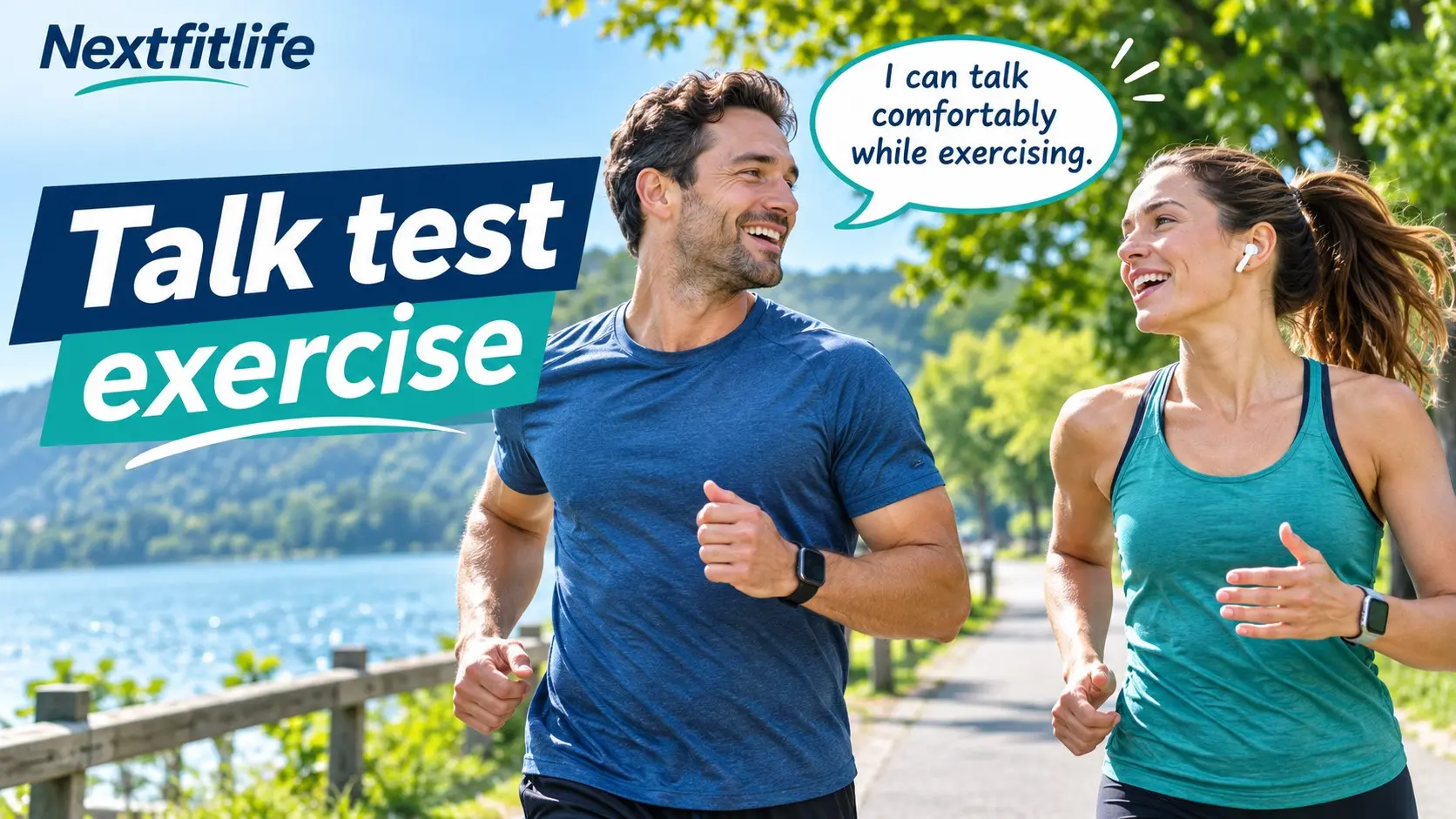
The talk test exercise is one of the simplest ways to judge cardio intensity without a watch, chest strap, or fitness test. You pay attention to how easily you can speak while walking, running, cycling, or doing another steady aerobic activity.
If you can talk comfortably but singing would be difficult, you are usually at a moderate intensity. If you can manage only a few words before needing another breath, the effort has moved closer to vigorous intensity.
Quick answer: During the talk test, notice how easily you can speak while exercising. Easy activity lets you talk freely and may let you sing. Moderate activity usually lets you speak in sentences but not sing comfortably. At vigorous intensity, you may manage only a few words before pausing for breath.
This article is for general information and education. It does not replace medical advice, diagnosis, treatment, cardiac rehabilitation, or an individualized exercise prescription.
Stop exercising and seek appropriate medical help if activity causes chest pressure or pain, fainting, severe or unusual shortness of breath, marked dizziness, new confusion, or another sudden concerning symptom. These are not simply signs that you should “push through” a harder talk-test zone.
If you are new to cardio, visit the NextFitLife Cardio and Endurance Guide. If your main goal is finding an easy running pace, see Easy Run Pace for Beginners.
Table of Contents
- What the talk test is
- Why talking changes with exercise intensity
- How to do the talk test
- Talk test intensity zones
- 9 smart ways to use the test
- Moderate intensity
- Vigorous intensity
- Talk test and heart rate
- Talk test and RPE
- Walking, running, cycling, and other cardio
- Zone 2 and the talk test
- Interval training
- Beginners and older adults
- Heart conditions and medicines
- Common mistakes
- When breathlessness needs attention
- Conclusion
- References and Sources
- Internal Links and NextFitLife Hubs
- About the Author
- Frequently Asked Questions
What Is the Talk Test Exercise?
The talk test is a way to estimate how hard your aerobic exercise feels by checking whether you can speak comfortably.
It is based on a simple idea: as exercise gets harder, your muscles need more oxygen and produce more carbon dioxide. Your breathing becomes faster and deeper.
At an easy pace, talking usually feels normal.
As the effort increases, speaking starts to compete with breathing. You may still finish a sentence, but it takes more effort.
At a hard pace, you may manage only short phrases before needing another breath.
The Centers for Disease Control and Prevention uses this idea in its public guidance. It describes moderate activity as an effort where you can talk but not sing, while vigorous activity usually allows only a few words before you need to pause for a breath.
Why Does Talking Get Harder as Exercise Gets Harder?
Talking changes the normal rhythm of breathing.
When you speak, you control how air leaves your lungs so you can form words and sentences.
That is easy at rest because breathing demand is low.
During exercise, your body needs to move more air. Once the demand becomes high enough, long sentences become uncomfortable because you need to interrupt them to breathe.
Exercise researchers compare this change with physiological points called ventilatory thresholds.
A ventilatory threshold is a stage where breathing begins changing in a more noticeable way as exercise intensity rises.
Talk-test research has found that comfortable speech and the point where speech starts becoming difficult often occur around these thresholds.
The match is useful, but not perfect for every person.
How Do You Perform the Talk Test?
You do not need laboratory equipment.
Step 1: Warm Up
Begin with several minutes of easy movement.
Walk slowly, pedal easily, or jog gently until your breathing and muscles have had time to adjust.
Step 2: Settle Into Your Exercise Pace
Increase the pace to the level you want to check.
Give your breathing some time to respond rather than testing five seconds after a sudden speed change.
Step 3: Say a Normal Sentence
You can speak to a partner or say a familiar sentence out loud.
Use more than one or two words.
A simple example is:
“This pace feels steady and I can keep going comfortably.”
Step 4: Judge Speech Comfort
Ask yourself one question:
Could I keep talking at this pace without fighting for breath?
If yes, you are likely below or around a moderate threshold.
If you are unsure, you may be near the point where the exercise is becoming harder.
If speaking comfortably is clearly difficult, your intensity is higher.
Talk Test Exercise Intensity Zones
| Effort | Speech | Practical Meaning |
|---|---|---|
| Very easy | Talking and singing are easy | Warmup, recovery, or light activity |
| Moderate | You can speak in sentences but singing is difficult | A common sustainable cardio intensity |
| Hard | You can say short phrases, but normal conversation is difficult | Vigorous exercise |
| Very hard | Only a few words or speech feels very difficult | High effort that is difficult to sustain |
This table is a practical guide, not a medical diagnostic test.
People differ in fitness, breathing patterns, speech habits, exercise mode, and health conditions.
9 Smart Ways to Use the Talk Test
1. Use It to Find a Sustainable Walking Pace
Start walking at a pace that feels purposeful but controlled.
After a few minutes, say a full sentence.
If you can talk easily and could probably sing, you may be at a light effort.
If you can talk in sentences but singing would feel difficult, you are likely closer to moderate intensity.
If you cannot finish a sentence without repeatedly stopping for breath, slow down if moderate exercise is your goal.
For more walking guidance, see Brisk Walking Heart Rate.
2. Use It to Keep Easy Runs Easy
Many beginners accidentally run every session too hard.
The talk test gives you a simple check.
If an “easy run” leaves you able to say only two or three words at a time, it probably is not very easy for you that day.
Slow your running pace or add walking breaks until speech becomes comfortable again.
This approach fits well with the Easy Run Pace for Beginners guide.
3. Use It When Your Watch Gives a Strange Heart Rate
Heart-rate monitors are useful, but they are not perfect.
Wrist sensors can occasionally read too high or too low, especially when arm movement, cold skin, poor contact, or other factors interfere.
If your watch suddenly shows an unexpected number, check how you actually feel.
If you are breathing comfortably and talking normally, the number may deserve a second look.
If you feel unusually breathless even though the watch shows a low heart rate, your symptoms matter more than the display.
4. Use It When You Do Not Know Your Maximum Heart Rate
Heart-rate training often starts with an estimated maximum heart rate.
Those formulas are useful for groups but can be inaccurate for one individual.
The talk test does not require you to know your true maximum.
You judge intensity from your own breathing and speech response that day.
5. Use It During Cycling
The talk test is not only for walking and running.
Research has used it successfully during cycling and other aerobic exercise modes.
On a stationary bike, increase resistance gradually and test whether a normal sentence still feels comfortable.
Outdoor cycling needs more care because traffic, hills, wind, and road safety should get your attention before conversation testing.
6. Use It During Low Impact Cardio
Elliptical training, water exercise, dancing, and other continuous cardio can all be judged with the same basic idea.
Ask whether you can still speak comfortably at the pace you are using.
If low-impact options suit you better, see Low Impact Cardio.
7. Use It to Control Long Cardio Sessions
A pace may feel easy in the first five minutes and much harder after thirty.
Heat, dehydration, hills, fatigue, and accumulated effort can all change your breathing.
Repeat the talk test later in the workout rather than assuming the starting pace will remain moderate forever.
8. Use It Alongside RPE
RPE stands for rating of perceived exertion.
It is simply a score for how hard the exercise feels.
Speech comfort and RPE give you two different clues.
If you can still talk comfortably but the effort feels much harder than usual, fatigue, heat, illness, poor sleep, or another factor may be affecting you.
9. Use It to Know When to Back Off
The talk test is not a challenge to see how breathless you can become.
If your goal is an easy or moderate workout and normal conversation becomes impossible, slow down.
Let your breathing settle, then continue.
What Does the Talk Test Say About Moderate Intensity?
The simplest public-health rule is:
Moderate intensity: you can talk, but singing would be difficult.
Your breathing should be faster than at rest.
You should feel that you are exercising.
Still, you can usually answer a question with a normal sentence rather than gasping between every few words.
Examples can include brisk walking, easy cycling, some steady swimming, low-impact cardio, or a slow jog for a fitter person.
The activity itself does not determine the intensity.
A brisk walk may be vigorous for one person and light for another.
What Does the Talk Test Say About Vigorous Exercise?
During vigorous aerobic activity, speech becomes noticeably harder.
The CDC describes this as being unable to say more than a few words without pausing for a breath.
Examples may include running, hard uphill walking, faster cycling, or vigorous aerobic classes.
But again, the same activity can feel different to different people.
A trained runner may chat during a pace that leaves a beginner unable to speak comfortably.
Is Being Unable to Talk Always Dangerous?
No.
Healthy people doing hard intervals or vigorous exercise may intentionally reach a pace where normal conversation is difficult.
That alone does not mean something is wrong.
Context matters.
There is a difference between expected heavy breathing during a planned hard interval and sudden severe breathlessness that feels unusual for the workload.
If you develop chest pain, faintness, severe unusual breathlessness, or other concerning symptoms, stop exercising and seek appropriate medical care.
Talk Test vs Heart Rate: Which Is Better?
Neither method wins in every situation.
| Feature | Talk Test | Heart Rate |
|---|---|---|
| Equipment | None | Pulse check or monitor |
| Personal maximum needed | No | Often estimated or tested |
| Affected by some medicines | Speech still provides a practical clue | Yes, some medicines alter heart-rate response |
| Works during short hard intervals | Less practical | Can help, though heart rate also lags behind sudden workload changes |
| Best feature | Simple measure of relative effort | Provides a numerical training measure |
The best approach is often to use both.
Your heart rate gives you a number. Your ability to talk tells you how that workload feels in your body.
If you are interested in heart-rate-based cardio, see Zone 2 Cardio for Beginners.
Talk Test vs RPE
The two methods complement each other.
RPE asks, “How hard does this feel?”
The talk test asks, “How comfortable is speaking at this pace?”
A moderate workout often feels purposeful but sustainable.
You are breathing faster, but you do not feel desperate for air.
A vigorous workout feels harder and makes speech less comfortable.
Using both can be especially helpful when a heart-rate number seems wrong for how you feel.
Does the Talk Test Work for Running?
Yes.
Running is one of the exercise modes used in talk-test research.
For an easy run, you should normally be able to speak in sentences.
If every sentence breaks into one or two words because you need another breath, the run has moved into a harder intensity.
That does not mean harder running is bad.
It means it is not an easy conversational run anymore.
This distinction is useful because beginners often judge pace by speed instead of effort.
Does the Talk Test Work for Walking?
Yes, and walking may be the easiest place to learn it.
Start at a relaxed pace and talk normally.
Increase your speed until talking is still possible but singing would feel uncomfortable.
That is a practical moderate-intensity range for many people.
Inclines change the result quickly.
A pace that feels easy on flat ground may become vigorous on a steep hill.
Does the Talk Test Work for Cycling?
Yes.
Reviews have found the talk test useful across several exercise modes, including cycling.
On an indoor bike, increase the resistance or cadence gradually.
Give yourself time to settle at each effort before judging speech.
If you are cycling outdoors, do not test your speech where traffic or road conditions need your full attention.
Can You Use the Talk Test for Zone 2?
It can help, but the talk test is not identical to a laboratory Zone 2 definition.
The phrase “Zone 2” is used in several different ways online.
Some people mean a percentage of maximum heart rate. Others mean an intensity below the first lactate or ventilatory threshold.
Comfortable conversation is often used as a practical clue that you are below a harder threshold.
That makes the talk test useful for steady aerobic training.
It does not prove your exact blood lactate level.
For a more detailed explanation, see Zone 2 Walking Workout.
Can the Talk Test Be Used for Interval Training?
Yes, but it is less convenient during very short intense intervals.
Imagine a 20-second hard sprint.
By the time you try to recite a sentence and decide whether speaking feels comfortable, the interval may already be over.
The talk test is more useful during longer intervals or during recovery periods.
For example, you can wait until speech becomes comfortable again before beginning the next moderate effort.
Research reviews specifically note that the talk test is less practical for some forms of high-intensity interval training.
Should Beginners Use the Talk Test?
Yes.
It may be more useful for a beginner than chasing an exact heart-rate target from an age-based formula.
A new exerciser can start at a pace where talking remains comfortable.
After several weeks, the same walking speed may feel easier and speech may become smoother.
That is a sign that the workload has become less demanding.
You can then increase pace, incline, or duration gradually.
For a beginner-friendly starting point, visit Low Impact Cardio.
What About Adults Over 40 or 50?
The test still works as a relative-intensity tool.
Age does not automatically determine how hard an activity feels.
A trained 60-year-old may hold a comfortable conversation while moving faster than an inactive 30-year-old.
That is one advantage of the talk test: it responds to the person rather than assigning intensity only from the exercise name.
For a broader endurance plan, see Cardio After 40.
Can People With Heart Conditions Use the Talk Test?
The talk test has been studied in people with cardiovascular disease and is used in cardiac rehabilitation settings.
A systematic review found evidence supporting it as an alternative way to help assess and prescribe exercise intensity in people with cardiovascular disease.
Newer research published in 2026 also found that talk-test stages tracked useful exercise thresholds in cardiovascular rehabilitation.
That does not mean a general online table replaces a cardiac-rehabilitation prescription.
If you have heart disease, follow the intensity guidance given by your healthcare or rehabilitation team.
What if You Take a Beta Blocker?
Beta blockers can reduce the usual rise in heart rate during exercise.
That can make simple age-based heart-rate zones less useful unless your clinician has given you a target based on your response while taking the medicine.
A symptom-based method such as the talk test or RPE may provide another useful clue.
But if you have a cardiac condition, your exercise plan should still come from your care team.
Does Heat Change the Talk Test?
It can change how exercise feels.
Hot weather places extra demand on the body and can raise cardiovascular strain.
A pace that normally feels conversational may suddenly make breathing and effort feel harder.
Do not force yourself to maintain the same speed just because it was easy last week.
Use the talk test to adjust the workload to the conditions.
Does Altitude Change It?
Yes.
At higher altitude, less oxygen is available in each breath.
A familiar walking or running pace may feel harder, especially before you acclimate.
The talk test naturally reflects this because your speech becomes less comfortable as your breathing demand rises.
Does Fitness Change the Result?
Very much.
Relative intensity depends on the person.
As your aerobic fitness improves, you may be able to move faster while maintaining comfortable speech.
That is why the talk test is more useful than labeling one fixed walking speed “moderate” for everyone.
Talk Test Examples
| Workout | Speech | Likely Intensity |
|---|---|---|
| Easy walk | Full conversation and singing possible | Light |
| Brisk walk | Conversation comfortable, singing difficult | Moderate |
| Steady jog | Short sentences require some effort | Moderate to vigorous for that person |
| Hard uphill run | Only a few words before breathing | Vigorous |
| Sprint | Conversation is impractical | Very high effort |
Common Talk Test Mistakes
Using Only One Word
Saying “yes” does not test normal conversation very well.
Use a sentence or short passage.
Testing Immediately After a Speed Change
Breathing needs time to catch up with the new workload.
Settle into the pace first.
Thinking “I Can Talk” Means the Workout Is Easy
You can still talk during meaningful moderate exercise.
The point is how comfortable the conversation feels.
Thinking Every Hard Workout Is Unsafe
Healthy adults can perform vigorous exercise when it suits their training and health status.
Speech difficulty alone does not mean danger.
Ignoring New Symptoms
Chest pressure, faintness, or severe unusual breathlessness are not just signs that you reached a harder zone.
Stop and respond appropriately.
Comparing Your Talk Test With Someone Else
Your friend may be fitter, less fit, taller, younger, more experienced, or simply more comfortable talking while exercising.
Use your own response.
When Does Breathlessness Need Medical Attention?
Getting out of breath during exercise is normal.
The question is whether it matches the workload and settles when the intensity comes down.
Stop exercising and seek appropriate medical help if you develop:
- Chest pain, pressure, squeezing, or tightness
- Fainting or near fainting
- Severe or unusual shortness of breath
- Sudden marked dizziness
- New confusion
- A new fast or irregular heartbeat with concerning symptoms
- Symptoms that feel very different from your normal exercise response
If breathlessness happens during ordinary conversation or very light daily activity, that is a different issue from failing a talk test during hard cardio.
See Shortness of Breath While Talking for more detail.
A Simple 20-Minute Talk Test Workout
Minutes 0 to 5: Easy Warmup
Walk, pedal, or use another cardio machine at an easy pace.
You should be able to talk freely.
Minutes 5 to 15: Moderate Effort
Increase the pace until you can still speak in sentences but singing would feel difficult.
Check your speech again halfway through.
Minutes 15 to 18: Optional Harder Effort
If vigorous exercise is appropriate for you, increase the pace enough that conversation becomes limited to shorter phrases.
Skip this section if you are a beginner or if your healthcare plan calls for moderate exercise only.
Minutes 18 to 20: Cool Down
Reduce the pace until normal conversation becomes easy again.
Your breathing should gradually settle.
Is the Talk Test Accurate?
It is useful, but “accurate” needs context.
Research has repeatedly found meaningful relationships between talk-test stages and physiological thresholds.
A review described it as a valid, reliable, practical, and inexpensive method for monitoring exercise intensity in several populations.
Another review found that the talk test and RPE can help distinguish exercise-intensity domains.
However, an individual person's talk-test stage does not map perfectly to one heart rate or oxygen-consumption number.
In cardiac patients, one study found useful group relationships but wide limits of agreement for individuals.
That is why the talk test is best viewed as a practical guide rather than a substitute for laboratory testing when precise thresholds are medically or competitively important.
Who Gets the Most Value From the Talk Test?
It is especially useful for:
- Beginners learning what moderate cardio feels like
- Walkers without heart-rate monitors
- Runners trying to keep easy days easy
- People whose watch readings are inconsistent
- Adults using cardio machines
- People who want a simple relative-effort check
- Some cardiac-rehabilitation patients under professional guidance
It is less useful when:
- Intervals are extremely short
- You cannot safely speak during the activity
- A breathing or speech condition changes how easily you can talk
- A clinician has given you a specific intensity limit that takes priority
Conclusion
The talk test exercise works because your ability to speak changes as breathing demand rises.
For most general cardio, the rule is easy to remember: if you can talk in sentences but singing is difficult, you are probably around moderate intensity. If you can manage only a few words before taking another breath, the workout has become vigorous.
Use the talk test with your heart rate, RPE, symptoms, and training goal rather than treating it as a perfect laboratory measurement.
Your next step: during your next walk, run, or bike session, say one full sentence after several minutes at a steady pace. If talking is comfortable, increase the pace slightly. If you are gasping when your goal is moderate cardio, slow down.
References and Sources
- Centers for Disease Control and Prevention. How to Measure Physical Activity Intensity.
https://www.cdc.gov/physical-activity-basics/measuring/index.html - Reed JL, Pipe AL. The Talk Test: A Useful Tool for Prescribing and Monitoring Exercise Intensity. Current Opinion in Cardiology. 2014.
https://pubmed.ncbi.nlm.nih.gov/25010379/ - Schneider DA, et al. An Examination and Critique of Subjective Methods to Determine Exercise Intensity: The Talk Test, Feeling Scale, and Rating of Perceived Exertion. 2022.
https://pubmed.ncbi.nlm.nih.gov/35507232/ - Systematic Review. Application and Measurement Properties of the Talk Test in Cardiopulmonary Patients.
https://pubmed.ncbi.nlm.nih.gov/39076925/ - Talk Test for the Prescription of Aerobic Exercise in Cardiovascular Disease: Which Stage Is Most Appropriate? 2026.
https://pubmed.ncbi.nlm.nih.gov/41627020/ - American Council on Exercise. ACE-Sponsored Research: Validating the Talk Test as a Measure of Exercise Intensity.
https://www.acefitness.org/certifiednewsarticle/888/ace-sponsored-research-validating-the-talk-test-as-a-measure-of-exercise-intensity/ - National Heart, Lung, and Blood Institute. Physical Activity and Your Heart: Risks.
https://www.nhlbi.nih.gov/health/heart/physical-activity/risks
Internal Links and NextFitLife Hubs
- NextFitLife Fitness Hub
- Cardio and Endurance Guide
- Easy Run Pace for Beginners
- Zone 2 Cardio for Beginners
- Zone 2 Walking Workout
- Brisk Walking Heart Rate
- Breathing Rhythm While Running
- Cardio After 40
- Low Impact Cardio
- Shortness of Breath While Talking
- About NextFitLife
Frequently Asked Questions
What is the talk test exercise?
The talk test exercise is a simple way to judge cardio intensity by checking how comfortably you can speak while moving. Comfortable conversation usually means a lower intensity, while speech becomes harder as exercise becomes vigorous.
What does the talk test say about moderate exercise?
During moderate exercise, you can usually talk in sentences but singing is difficult. Your breathing is faster than at rest, but normal conversation is still possible.
What does the talk test say about vigorous exercise?
During vigorous exercise, you may be able to say only a few words before pausing for another breath. Normal conversation becomes difficult.
Is the talk test better than heart rate?
Neither method is always better. Heart rate gives you a number, while the talk test shows how the workload feels to you. Using both can give a clearer picture of exercise intensity.
Can I use the talk test for running?
Yes. If you can speak comfortably in sentences, the run is likely at a lower or moderate relative intensity. If you can say only a few words, the effort has become more vigorous.
Can I use the talk test for walking?
Yes. Walking is one of the easiest ways to use the test. A brisk walking pace where you can talk but not sing is a practical sign of moderate intensity for many people.
Can the talk test help with Zone 2 cardio?
It can help estimate a sustainable aerobic effort, but the talk test is not the same as measuring an exact laboratory Zone 2 threshold. Comfortable conversation is a useful practical clue rather than a blood-lactate measurement.
Does the talk test work if I take a beta blocker?
It may provide a useful effort clue because beta blockers can change heart-rate responses. If you take heart medicine or have cardiovascular disease, follow the exercise limits given by your healthcare team.
Is being unable to talk during exercise dangerous?
Not always. Healthy people may have difficulty talking during planned vigorous exercise. However, chest pain, fainting, severe unusual breathlessness, marked dizziness, or other sudden concerning symptoms are reasons to stop and seek appropriate medical help.
How often should I check the talk test during cardio?
You can check it after warming up, after a meaningful pace change, and later in a longer session. This helps you notice when fatigue, hills, heat, or other factors make the same pace feel harder.