
Published on: October 24, 2026
Updated on: October 24, 2026
Low impact cardio is aerobic exercise that raises your breathing and heart rate while reducing repeated jarring through the joints.
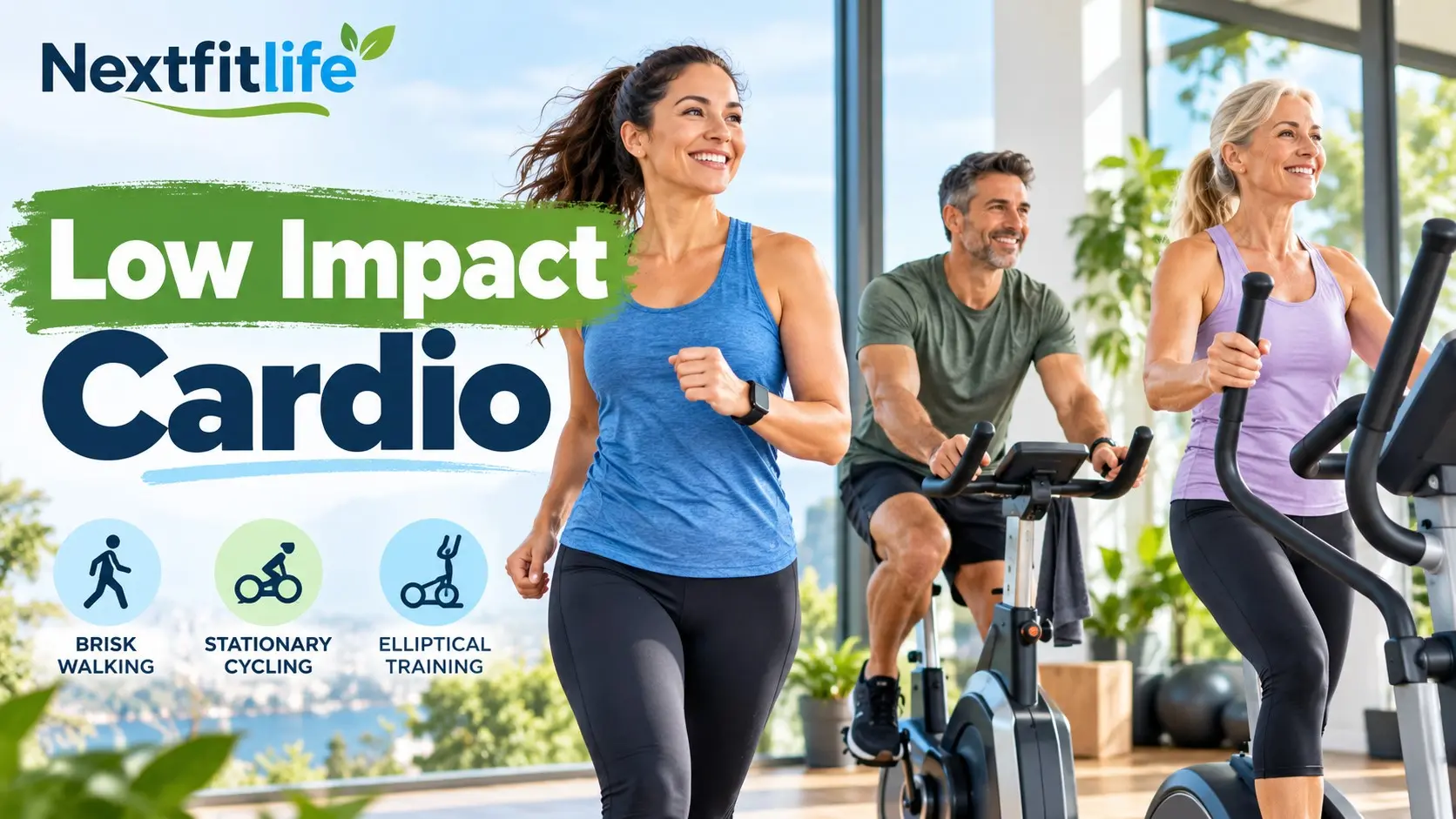
Brisk walking, cycling, swimming, rowing, elliptical training, and no jump home workouts all count. More importantly, low impact does not mean low intensity. You can work hard without running or jumping.
That distinction is what makes this style of cardio useful for beginners, older adults, people who dislike running, athletes who need lower-impact training days, and anyone whose joints tolerate walking, cycling, swimming, or rowing better.
This article is for general information and education. It does not replace medical advice, diagnosis, or treatment.
For a broader fitness plan, visit the NextFitLife Fitness Hub and How to Stay Fit.
Table of Contents
- Quick Answer
- What Low Impact Cardio Means
- Low Impact Versus Low Intensity
- 12 Smart Cardio Options
- Brisk walking
- Incline walking
- Stationary cycling
- Outdoor cycling
- Swimming
- Water aerobics
- Rowing
- Elliptical training
- Marching
- Step touches
- Shadow boxing
- Low impact dance
- Best Choice by Goal
- 20 Minute Home Workout
- 10 Minute Beginner Workout
- How to Progress
- Weight Loss and Heart Health
- Weekly Plan
- Common Mistakes
- Frequently Asked Questions
- References and Sources
Low Impact Cardio: Quick Answer
Low impact cardio means cardiovascular exercise performed with less repetitive jarring through the joints than activities such as running and repeated jumping.
The best options include brisk walking, cycling, swimming, rowing, elliptical training, and no jump home circuits.
These exercises can still reach moderate or vigorous intensity.
If you want strong cardio without making running your default, low impact training is a real fitness option rather than a watered down workout.
What Is Low Impact Cardio?
Low impact cardio is aerobic activity that keeps the heart and lungs working while reducing repeated impact forces.
Many standing low impact exercises keep at least one foot on the floor at a time.
That rule is useful, but it does not tell the whole story because swimming, cycling, rowing, and elliptical training are also low impact.
A better question is:
How much repetitive jarring and landing force does this exercise create?
Running has a repeated flight and landing phase.
Cycling does not.
Jumping jacks repeatedly leave the floor.
A step touch does not.
That is the distinction that matters.
Low Impact Does Not Mean Low Intensity
This is the most common misunderstanding.
Impact describes mechanical loading.
Intensity describes how hard your cardiovascular system is working.
You can pedal gently on a bike and barely raise your breathing rate.
You can also turn up the resistance, pedal harder, and reach vigorous cardiovascular intensity.
Both sessions remain low impact.
The same applies to rowing, swimming, elliptical exercise, and steep walking.
If you want an example of how walking can become demanding without turning into running, see Incline Walking vs Running.
How Hard Should Low Impact Cardio Feel?
Current CDC guidance separates aerobic exercise into moderate and vigorous intensity.
You can judge this without an expensive watch.
Moderate Intensity
Your breathing is clearly faster, but you can still talk.
Brisk walking is a classic example.
Vigorous Intensity
Your breathing is much harder and speaking more than a few words at once becomes difficult.
A hard cycling or rowing session can reach this level while remaining low impact.
Your current fitness changes the answer. A pace that feels moderate to a beginner may feel easy to someone with years of training.
12 Smart Low Impact Cardio Options
1. Brisk Walking
If I had to choose one starting point for most people, walking would be near the top.
It is inexpensive, simple, and easy to scale.
To make walking harder, increase:
- Pace
- Duration
- Hill frequency
- Treadmill incline
Brisk walking can count as moderate intensity aerobic activity.
For a structured aerobic plan, use the Zone 2 Walking Workout.
2. Incline Walking
Flat walking eventually becomes easy for many people.
That does not mean you need to start running.
Add incline.
A steeper walk increases oxygen demand and heart rate while keeping the movement a walk.
A recent controlled study comparing steep walking with level running found that incline walking could create similar oxygen demand under matched conditions while producing lower measured impact forces.
That makes incline walking useful when you want a stronger cardio stimulus without another normal running session.
See Incline Walking vs Running for the full comparison.
3. Stationary Cycling
A stationary bike gives you unusually good control over intensity.
You can change resistance without adding jumping or foot strike.
It also removes traffic, weather, and outdoor balance problems.
Start with a resistance level that lets you pedal smoothly.
As fitness improves, increase resistance, cadence, duration, or intervals rather than changing everything at once.
4. Outdoor Cycling
Outdoor cycling gives you the same basic low impact advantage with more variation.
Hills, wind, traffic, and surface changes make the workload less predictable than a stationary bike.
That can be enjoyable if you prefer being outside.
Use a properly fitted bicycle and wear appropriate safety equipment.
5. Swimming
Swimming is one of the best choices when you want to reduce weight bearing through the legs.
Water supports much of your body while your muscles continue to work.
Easy laps can be gentle.
Fast swimming can be extremely demanding.
That is another clear example of why low impact and low intensity are not the same thing.
6. Water Aerobics
You do not need to swim laps to use the pool for cardio.
Water walking, aqua jogging, and water aerobics provide resistance while reducing normal weight bearing.
This can be useful for people who find land based exercise uncomfortable, although individual joint problems still need individual advice.
7. Rowing
Rowing uses more of the body than many cardio machines.
The legs initiate the stroke, then the hips and upper body contribute.
Because you remain seated, there is no repeated landing phase.
Technique matters.
If your lower back hurts during rowing, do not keep increasing resistance and hoping the problem disappears.
8. Elliptical Training
An elliptical creates a running like rhythm without the repeated foot strike of running.
Most machines allow you to increase resistance and sometimes incline.
That gives you several ways to progress without adding impact.
The elliptical is especially useful when you enjoy gym cardio but do not want every session to be treadmill running.
9. Marching in Place
Do not dismiss marching because it looks simple.
Done briskly with active arm movement, marching can raise heart rate quickly.
It also works well in a small room.
Increase difficulty by using faster arm swings, slightly higher knee lifts, or longer intervals.
10. Step Touches
Step right, bring the feet together, then step left.
Add arm reaches to increase whole body movement.
This is one of the easiest replacements for jumping jacks when you want a no jump cardio circuit.
11. Shadow Boxing
Shadow boxing is a useful low impact way to raise the heart rate while keeping the feet grounded.
Stay light on your feet, keep the knees soft, and punch with control.
Move continuously rather than trying to hit as hard as possible.
12. Low Impact Dance
Dance can absolutely count as cardio.
The key is keeping the movement continuous enough to raise breathing and heart rate.
Choose step based movements rather than repeated jumps when you want to keep impact lower.
What Is the Best Low Impact Cardio for Your Goal?
| Goal | Good Starting Choice | Why It Fits |
|---|---|---|
| Beginner fitness | Walking | Simple and easy to control |
| Low joint impact | Cycling or swimming | Less repetitive landing |
| Home cardio | Marching circuit | No equipment required |
| Higher intensity | Bike, rower, elliptical | Easy to raise workload |
| Full body cardio | Rowing or swimming | Upper and lower body contribute |
| Active recovery | Easy walking or cycling | Effort is easy to control |
| Long endurance | Walking, cycling, swimming | Easy to sustain |
Is Low Impact Cardio Good for Weight Loss?
Yes, but not because low impact exercise has a special fat burning effect.
Physical activity increases energy use.
Weight loss still depends on the larger balance between energy intake and energy expenditure over time.
Low impact cardio has one practical advantage: it can be easier to repeat when high impact exercise bothers your joints or leaves you too sore to stay consistent.
A brisk walk you repeat for months is more useful than a running plan you abandon after two painful weeks.
For realistic weight management guidance, read How to Lose Weight in a Healthy Way.
Does Low Impact Cardio Burn Fewer Calories?
Not automatically.
Energy use depends on your body size, duration, intensity, resistance, speed, and fitness.
An easy walk will normally require less energy per minute than hard running.
But a longer brisk walk, hard cycling session, strong rowing workout, or demanding elliptical session can still accumulate a large amount of work.
I would not choose an exercise based on a machine's calorie number.
Choose the activity you can perform at a useful intensity and repeat consistently.
Is Low Impact Cardio Good for Heart Health?
Yes.
The cardiovascular system responds to aerobic workload, not to how loudly your shoes hit the floor.
Current CDC guidance recommends adults work toward:
- At least 150 minutes of moderate aerobic activity each week
- Or 75 minutes of vigorous activity
- Or an equivalent mixture of both
- Plus muscle strengthening on at least 2 days each week
WHO recommends 150 to 300 minutes of moderate aerobic activity, or 75 to 150 minutes vigorous, for substantial health benefits.
Your low impact workouts can provide those aerobic minutes.
For another heart focused routine, see Heart Health Workout.
Is Low Impact Cardio Good for Bad Knees?
It can reduce repetitive impact compared with running and jumping.
That does not mean every low impact exercise is comfortable for every knee.
Cycling may feel excellent for one person and uncomfortable for another if the seat position or resistance is poor.
Walking on flat ground may feel fine while steep incline walking does not.
Swimming reduces weight bearing but can still irritate an injured shoulder.
Use symptoms as information.
Sharp or worsening joint pain is not the goal.
20 Minute Low Impact Cardio Workout at Home
You do not need equipment or jumping.
Warm Up: 3 Minutes
- Easy march
- Shoulder rolls
- Slow side steps
Main Workout: 14 Minutes
Complete each movement for 45 seconds, then take 15 seconds to change position.
1. Brisk March
Move the arms naturally and keep the chest tall.
2. Step Touch With Arm Reach
Step side to side while reaching the arms forward or overhead.
3. Chair Squat
Lower toward a sturdy chair and stand back up. Use a smaller range if needed.
4. Low Impact Jack
Step one foot sideways while raising both arms. Return and switch sides.
5. Shadow Boxing
Keep your feet moving while throwing controlled punches.
6. Alternating Knee Drive
Lift one knee, lower it with control, then switch. Hold a chair if balance is uncertain.
7. Fast March
Finish the circuit with quicker controlled marching.
Repeat all seven exercises once.
Cool Down: 3 Minutes
Slow your march and let your breathing settle gradually.
That is a legitimate low impact cardio workout. Jumping is not required.
10 Minute Beginner Low Impact Cardio Workout
| Minute | Movement |
|---|---|
| 1 to 2 | Easy to brisk march |
| 3 | Step touches |
| 4 | Chair squats |
| 5 | March |
| 6 | Low impact jacks |
| 7 | Shadow boxing |
| 8 | March |
| 9 | Step touches |
| 10 | Easy walk or march |
Ten minutes counts.
You do not have to wait for minute 30 before exercise becomes useful.
How to Make Low Impact Cardio Harder Without Jumping
Do not add impact first.
Increase Pace
Move faster while keeping control.
Add Resistance
Increase bike, rower, or elliptical resistance gradually.
Add Incline
A hill or treadmill incline can increase cardiovascular demand quickly.
Increase Work Time
Move from 30 second work periods to 45 seconds, then 60 seconds.
Reduce Rest
Move gradually from longer breaks toward shorter breaks when fitness improves.
Add Duration
A 10 minute session can become 15, then 20, then 30.
That is progression.
A Simple Weekly Low Impact Cardio Plan
| Day | Workout | Purpose |
|---|---|---|
| Monday | 20 minute brisk walk | Moderate cardio |
| Tuesday | Strength training | Muscle and function |
| Wednesday | 20 minute home cardio | Aerobic fitness |
| Thursday | Easy walking | Recovery movement |
| Friday | 25 minute cycling | Moderate cardio |
| Saturday | Strength training | Full body strength |
| Sunday | Walk, swim, or rest | Flexible recovery |
The point is not to destroy yourself on Monday.
The goal is to build a week you can repeat.
What If 150 Minutes Sounds Impossible?
Do less first.
The weekly activity target is not an entry test.
If you currently do almost no intentional exercise, start with 10 minutes on three or four days this week.
Repeat that until it feels normal.
Then add time.
Current public health guidance is clear that some activity is better than none.
Low Impact Cardio Versus High Impact Cardio
| Feature | Low Impact | Higher Impact |
|---|---|---|
| Joint impact | Usually lower | Usually higher |
| Examples | Walking, cycling, swimming | Running, jumping |
| Can be vigorous? | Yes | Yes |
| Useful for beginners? | Often | Depends on fitness and movement |
| Useful for athletes? | Yes | Yes |
Higher impact exercise is not automatically bad.
Running is useful when you want running specific fitness.
Low impact cardio simply gives you another way to train your cardiovascular system.
Low Impact Cardio Versus Low Intensity Cardio
These phrases do not mean the same thing.
A relaxed walk can be low impact and low intensity.
A hard stationary bike interval can be low impact and vigorous intensity.
A gentle jog can be higher impact but moderate intensity.
Once you separate those ideas, workout planning becomes much easier.
What About LIIT?
LIIT means low intensity interval training.
LIIT describes intensity.
Low impact describes mechanical stress.
You can combine the two.
For example, alternating brisk and easy walking can be both low impact and low intensity interval training.
A hard bike interval session is low impact but not low intensity.
Is Walking Enough Cardio?
Yes, if the walking pace creates enough effort for you.
Brisk walking counts as moderate intensity activity.
If your normal walk becomes too easy, do not assume walking has stopped working.
You can:
- Walk faster
- Add hills
- Add treadmill incline
- Walk longer
If you want to understand controlled aerobic walking in more detail, read Zone 2 Walking Workout.
Should Low Impact Cardio Replace Strength Training?
No.
Cardio and strength work solve different parts of fitness.
Adults are advised to include muscle strengthening on at least 2 days each week in addition to aerobic activity.
Strength training supports muscle, bone, physical function, and daily tasks.
If you are also managing blood pressure, see Blood Pressure and Strength Training for a safer combined approach.
Is Low Impact Cardio Good After Age 50?
Yes.
Walking, cycling, swimming, rowing, and elliptical training can all fit well after 50.
Age does not remove the need for cardiovascular fitness.
Older adults also benefit from strength and balance work when appropriate.
For a broader plan, use How to Get Fit at 50.
Can Low Impact Cardio Improve Fitness as Much as Running?
It can substantially improve aerobic fitness.
The exact comparison depends on intensity, duration, training volume, and what outcome you are measuring.
Your heart and lungs respond to cardiovascular demand.
But different exercises still create different movement specific adaptations.
Cycling will not fully prepare your legs for the repeated impact of a running race.
Running will not make you an efficient swimmer.
For general cardiovascular fitness, though, low impact training can provide a serious aerobic stimulus.
8 Common Low Impact Cardio Mistakes
1. Assuming Low Impact Means Easy
If the goal is aerobic fitness, some sessions should make you breathe harder.
2. Making Every Workout Hard
You do not need vigorous intervals every day.
3. Adding Jumping Just to Progress
Increase resistance, pace, incline, or duration first.
4. Ignoring Strength Training
Aerobic fitness and muscular strength are different qualities.
5. Chasing Machine Calorie Numbers
Use machine calorie estimates as rough information, not a precise measurement.
6. Working Through Sharp Pain
Change the exercise if a joint repeatedly hurts.
7. Progressing Everything at Once
Do not sharply increase speed, resistance, duration, and frequency in the same week.
8. Choosing an Exercise You Hate
The technically perfect workout has limited value if you never repeat it.
When Should You Get Medical Advice Before Starting?
Moderate physical activity is safe for most adults, but individual health conditions matter.
Ask a healthcare professional about suitable activity if you have significant heart disease, severe arthritis, serious breathing disease, recent surgery, repeated fainting, severe dizziness, or another condition that limits safe exercise.
Stop exercising and seek urgent medical care for severe chest pain, fainting, severe unexplained breathing difficulty, or another serious new symptom.
Conclusion
Low impact cardio is not the easy version of real exercise.
Walking, cycling, swimming, rowing, elliptical training, and no jump home circuits can all improve cardiovascular fitness when the workload is high enough.
Your next step is simple: choose one activity you can tolerate, start with 10 to 20 minutes, and repeat it three or four times this week. Add a little time, resistance, pace, or incline when the current session becomes comfortable.
References and Sources
- Centers for Disease Control and Prevention. Adult Activity: An Overview.
https://www.cdc.gov/physical-activity-basics/guidelines/adults.html - Centers for Disease Control and Prevention. Adding Physical Activity as an Adult.
https://www.cdc.gov/physical-activity-basics/adding-adults/ - Centers for Disease Control and Prevention. What Counts as Physical Activity for Adults.
https://www.cdc.gov/physical-activity-basics/adding-adults/what-counts.html - World Health Organization. Physical Activity.
https://www.who.int/europe/news-room/fact-sheets/item/physical-activity - Cleveland Clinic. Low Impact Cardio Workouts.
https://health.clevelandclinic.org/low-impact-cardio - Harvard Health Publishing. A Fresh Approach to Cardio Exercises.
https://www.health.harvard.edu/exercise-and-fitness/a-fresh-approach-to-cardio-exercises - Centers for Disease Control and Prevention. Physical Activity for Adults With Chronic Health Conditions and Disabilities.
https://www.cdc.gov/physical-activity-basics/guidelines/chronic-health-conditions-and-disabilities.html
Internal Links + Hub
- NextFitLife Fitness Hub for walking, cardio, strength, mobility, and beginner fitness guidance.
- Zone 2 Walking Workout for steady low impact aerobic training.
- Incline Walking vs Running for comparing lower impact walking with running.
- How to Stay Fit for long term fitness habits.
- How to Get Fit at 50 for age specific cardio, strength, and mobility planning.
- Heart Health Workout for cardiovascular exercise ideas.
- Blood Pressure and Strength Training for balancing aerobic and resistance exercise.
- Physical Fitness and Mental Health for the wider mental and physical benefits of regular movement.
About the Author
Adel Galal is a father of four, three sons and a daughter, and a grandfather of four, with 33 years of hands on parenting experience. He is the founder of Parnthub.com, based in Cairo, Egypt, where he shares practical guidance on feeding, development and family life from newborns to teenagers.
Adel is not a medical professional. Health articles cite trusted sources and are for general information only.
On NextFitLife, Adel researches and writes about fitness, walking, cardiovascular exercise, strength training, nutrition, healthy aging, and practical wellness habits with a focus on evidence, realistic progression, and avoiding exaggerated fitness claims.
Learn more about Adel and NextFitLife on the About Us page.
Frequently Asked Questions
What is low impact cardio?
Low impact cardio is aerobic exercise that raises your breathing and heart rate while reducing repetitive jarring through the joints. Walking, cycling, swimming, rowing, and elliptical training are common examples.
What is the best low impact cardio?
There is no single best option. Walking is easy to access, cycling is simple to progress, swimming reduces weight bearing, rowing provides full body work, and elliptical training allows higher intensity with less impact than running.
Can low impact cardio be intense?
Yes. Impact and intensity are different. Hard cycling, rowing, swimming, incline walking, or elliptical exercise can reach vigorous cardiovascular intensity while remaining low impact.
Is walking low impact cardio?
Yes. Walking is a classic low impact activity, and brisk walking can count as moderate intensity aerobic exercise.
Is cycling low impact cardio?
Yes. Cycling removes repeated foot strike and lets you increase workload through resistance, cadence, hills, or duration.
Is swimming low impact cardio?
Yes. Water supports much of your body weight, reducing normal impact through the lower joints while still allowing a challenging cardiovascular workout.
Is rowing low impact cardio?
Yes. Rowing is performed seated and avoids repeated ground impact, although technique matters for comfort and efficiency.
Can I do low impact cardio at home?
Yes. Marching, step touches, chair squats, low impact jacks, knee drives, and shadow boxing can create an effective no jump home workout.
Is low impact cardio good for weight loss?
Yes. It increases physical activity and energy expenditure. Weight loss still depends on overall energy balance rather than the exercise being low impact.
How long should low impact cardio last?
Beginners can start with 10 to 20 minutes and build gradually. Adults should work toward at least 150 minutes of moderate aerobic activity per week or an equivalent amount of vigorous activity.
Can I do low impact cardio every day?
Easy and moderate low impact activity can be performed frequently when you recover well. Hard sessions still need sensible recovery.
Is low impact cardio good for bad knees?
It can reduce repetitive impact compared with running and jumping, but the best choice depends on the knee problem. Cycling, swimming, and selected walking programs are common options.
Does low impact cardio count as real cardio?
Yes. If the exercise raises your heart rate and breathing to a moderate or vigorous level, it counts as aerobic activity even if you never jump or run.
What is the difference between low impact and low intensity?
Low impact describes mechanical stress on the body. Low intensity describes effort. A hard stationary bike workout can be low impact and high intensity at the same time.

Health & wellness writer with 30+ years of experience in nutrition, fitness, and healthy aging. Founder of NextFitLife.com — evidence-based health guidance.

