Published: September 24, 2026
Last Updated: September 24, 2026
Written and Source Checked by: Adel Galal, Founder and Lead Writer at NextFitLife
Review Status: Updated using current American Academy of Dermatology guidance, DermNet clinical resources, and open peer reviewed acne scar research. This article has not been medically reviewed by a dermatologist.
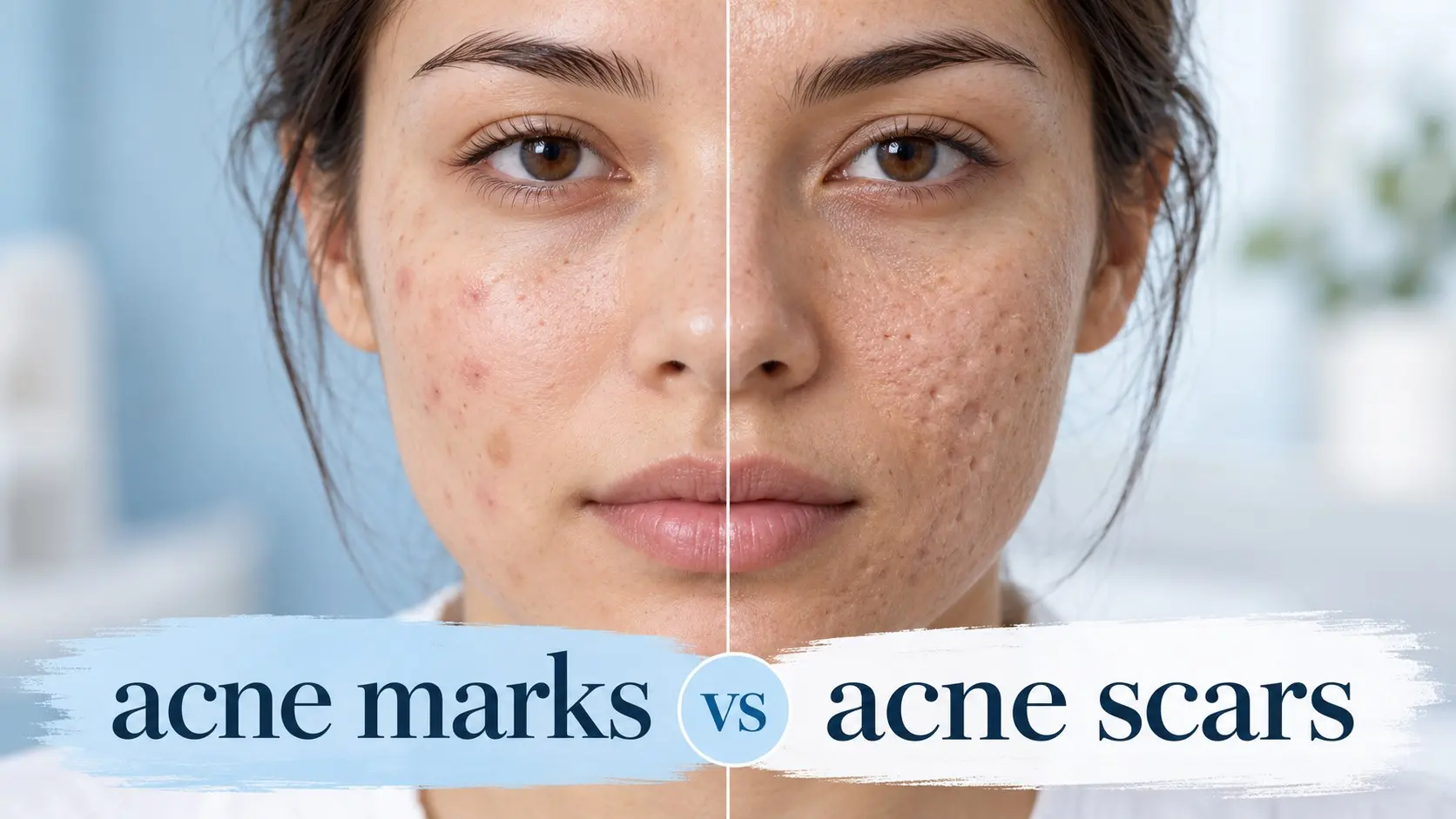
The easiest way to understand acne marks vs acne scars is to check texture before color. A flat red, pink, brown, gray, or darker area is more consistent with a post acne mark. A pit, dent, wave, or raised area points more toward true scarring.
That difference changes what is worth treating at home, what may fade with time, and what usually needs a dermatologist.
There is one more detail that many quick guides miss: you can have a mark and a scar in the same spot.
Table of Contents
- Texture changes first
- Brown and gray marks usually fit PIH
- Red and pink marks can fit PIE
- True scars change skin structure
- Marks can fade while scars usually persist
- Active acne must come first
- Skin tone changes the treatment plan
- Marks and scars can exist together
- Acne marks vs acne scars comparison table
- What helps brown acne marks
- What helps red acne marks
- What helps ice pick scars
- What helps rolling scars
- What helps boxcar scars
- What helps raised acne scars
- The three step home check
- Common treatment mistakes
- When to see a dermatologist
- References and Sources
- Frequently asked questions
1. Texture Changes First
If you remember one idea from this guide, make it this one.
Texture comes before color.
Look at the area in ordinary daylight and then from the side. If the skin surface stays level and the main difference is color, you are more likely looking at a post acne mark.
If the skin dips inward, forms a small pit, looks wavy, or rises above the surrounding skin, that points toward a scar.
The American Academy of Dermatology describes flat post acne spots as different from acne scars. Structural acne scars can be depressed or raised.
Why side lighting helps
Texture creates small shadows.
A rolling or boxcar scar may look mild under bright flat bathroom lighting but appear more clearly when light comes from one side.
A flat pigment mark changes color without creating the same contour.
This is a useful home clue, not a diagnosis. If the area is changing, painful, bleeding, or does not fit a normal post acne pattern, get it checked.
For broader skin guidance, see the NextFitLife Skin Health Guide.
2. Brown and Gray Flat Marks Usually Fit PIH
Post inflammatory hyperpigmentation, or PIH, develops when skin inflammation triggers extra melanin production.
The acne bump goes away, but pigment remains behind.
PIH is flat.
Depending on your natural skin tone and how deep the pigment sits, it can look:
- Light brown
- Dark brown
- Gray brown
- Blue gray
- Very dark brown
PIH is especially common after acne in people with medium and darker skin tones.
That does not mean lighter skin cannot develop it.
Does PIH fade?
Yes, many flat dark marks fade over time once the acne or irritation causing them stops.
Fading can be slow.
The American Academy of Dermatology notes that some dark spots only a few shades darker than normal skin may take months to fade. Deeper pigmentation can take much longer.
This is why daily sunscreen, gentle skin care, and controlling active acne matter so much.
For a simple daily routine, read Healthy Skin 101.
3. Red and Pine Flat Marks Can Fit PIE
Not every flat post acne mark is caused by extra pigment.
Post inflammatory erythema, or PIE, refers to persistent red, pink, or purplish color after inflammation settles.
It is linked more closely to vascular and healing changes than excess melanin.
DermNet notes that PIE is seen more often in lighter skin while PIH is more common in darker skin.
Neither pattern belongs to one skin tone only.
Why this distinction matters?
A product designed to reduce excess pigment does not automatically treat vascular redness.
And neither one fills a depressed scar.
That is why calling every leftover acne spot a “scar” leads to wasted products and unrealistic expectations.
4. True Acne Scars Change Skin Structure
True scars form when acne inflammation alters collagen and normal wound healing.
Most acne scars are atrophic acne scars, which sit below the surrounding skin.
The three classic types are ice pick scars, boxcar scars, and rolling scars.
Ice pick scars
Ice pick scars are narrow, deep pits.
They look deeper than they are wide and can resemble a tiny sharp hole.
Because they extend deep into the skin, simple surface treatments often do little for them.
Boxcar scars
Boxcar scars are wider depressions with clearer edges.
Some are shallow and some are deeper.
The depth matters because a shallow boxcar scar may respond differently from a deep one.
Rolling scars
Rolling scars create broad, soft depressions that make the skin look wavy.
Fibrous bands beneath the skin can pull the surface downward.
This deeper tethering is one reason a surface cream cannot simply smooth them away.
Raised scars
Acne can also leave hypertrophic scars or keloids.
These sit above the surrounding skin because excess scar tissue forms during healing.
Keloids can extend beyond the original acne lesion.
5. Marks Can Fade While Structural Scars Usually Persist
This is the difference that should change how you spend your money.
A flat acne mark can improve as pigment or redness settles.
A deep structural scar is different.
No brightening serum can release the fibrous band beneath a tethered rolling scar.
No vitamin C product can physically fill a deep ice pick scar.
No sunscreen can rebuild missing dermal structure.
Skincare can still help the skin around scars look healthier and more even, but established depressions and raised scars often need structural treatment if you want a meaningful change in contour.
6. Active Acne Must Come Before Scar Procedures
Old marks get attention because you see them every day.
But if new inflamed acne keeps forming, the skin is still making new opportunities for marks and scars.
AAD guidance says acne scar treatment plans usually begin by getting active breakouts under control.
That makes sense.
You do not want to spend money improving old scars while new ones continue to form.
What this means in practice
If you still have frequent inflammatory pimples, nodules, or cysts, the priority is acne control.
Common evidence based acne options can include:
- Topical retinoids
- Benzoyl peroxide
- Salicylic acid
- Azelaic acid
- Prescription treatment when needed
Deep, painful, or scarring acne deserves dermatologist care sooner rather than later.
If clogged pores are part of the problem, see How to Get Rid of Whiteheads.
7. Skin Tone Changes the Treatment Plan
Skin of color deserves special attention here.
First, PIH is more common and can persist longer.
Second, aggressive treatment can create new pigment changes.
A treatment that creates too much heat, inflammation, or irritation can leave darker or lighter areas afterward.
AAD advises people with darker skin tones to use care with procedures such as peels and lasers and to work with clinicians experienced in treating their skin tone.
This does not mean darker skin cannot be treated
It absolutely can.
The point is to match treatment intensity, device choice, settings, scar type, and pigment risk to the person rather than copying a generic procedure plan.
8. Marks and Scars Can Exist Together
This is the part that explains a lot of treatment disappointment.
You can have a rolling scar with brown PIH over it.
You can have a shallow boxcar scar that is also red.
You can have flat dark marks beside true depressions.
DermNet refers to mixed or hybrid patterns where pigmentation or erythema exists alongside structural scarring.
Why mixed cases confuse people
Imagine a dark spot sitting over a shallow depression.
You use pigment treatment for several months.
The brown color fades.
Now the dent looks more obvious.
The treatment did not create the scar.
The color simply stopped hiding part of the texture.
Acne Marks vs Acne Scars at a Glance
| Feature | Acne Mark | Acne Scar |
|---|---|---|
| Main change | Color | Skin structure or contour |
| Surface | Usually flat | Indented, uneven, or raised |
| Common forms | PIH and PIE | Ice pick, boxcar, rolling, hypertrophic, keloid |
| Can it fade? | Often improves over time | Texture tends to persist without structural treatment |
| Main home goal | Control acne, prevent irritation, protect from light | Prevent new scars and support skin until assessment |
| Topicals | Can help selected marks | Limited effect on deep established structure |
| Procedures | Sometimes useful | Often used for meaningful structural improvement |
What Helps Flat Brown Acne Marks?
If the area is flat and brown or gray, the main target is pigmentation.
Control active acne
New inflammation creates new PIH.
That means treating the acne is part of treating the marks.
Use sunscreen every day
Sun and visible light can make pigmentation harder to fade.
AAD recommends broad spectrum SPF 30 or higher for dark spots.
For darker skin tones, tinted sunscreen containing iron oxide can also help reduce visible light exposure that contributes to pigmentation.
Consider azelaic acid
Azelaic acid can help acne and some post inflammatory pigmentation.
That makes it a useful option when breakouts and dark marks overlap.
Retinoids can help acne and uneven tone
Topical retinoids help unclog pores and prevent acne.
Some can also improve uneven pigment and texture over time.
They can irritate, so start slowly.
Topical retinoids should be avoided during pregnancy unless a qualified clinician specifically advises otherwise.
What Helps Red Acne Marks?
Red or pink marks need a different mindset.
Do not automatically treat them like brown pigment.
Start by controlling acne, protecting the skin barrier, using sunscreen, and avoiding repeated irritation from strong acids and scrubs.
Persistent vascular redness can sometimes be treated with dermatologist directed laser or light treatment.
The right device and settings depend on diagnosis, skin tone, and pigment risk.
What Helps Ice Pick Scars?
Ice pick scars are deep and narrow, so superficial products are rarely enough.
Dermatologists may consider methods such as:
- TCA CROSS
- Punch procedures
- Selected laser resurfacing
- Combination treatment
These treatments need professional assessment because scar depth and skin tone affect the plan.
The goal is usually improvement rather than perfect removal.
What Helps Rolling Scars?
Rolling scars often involve fibrous bands beneath the skin.
That makes subcision especially relevant for selected cases.
Subcision works below the surface to release tissue that pulls the scar downward.
Dermatologists may combine it with:
- Microneedling
- Fractional resurfacing
- Fillers
- Other collagen remodeling treatments
The advantage is that treatment targets the structure.
The downside is that procedures bring cost, downtime, bruising, pigment risk, and no guarantee of perfectly smooth skin.
What Helps Boxcar Scars?
Boxcar scars need to be judged by depth.
Shallow scars may respond to resurfacing or microneedling.
Deeper scars can need more targeted procedures.
Possible options include:
- Microneedling
- Fractional laser
- Chemical resurfacing
- Punch techniques for selected scars
- Combination treatment
This is why buying a generic “acne scar package” before anyone identifies the scar type makes little sense.
What Helps Raised Acne Scars?
Raised scars require a different plan again.
Hypertrophic scars and keloids contain too much scar tissue rather than too little.
Dermatologists may use:
- Corticosteroid injections
- Other injected medicines
- Laser treatment
- Silicone-based scar care
- Freezing treatment in selected cases
- Combination treatment
Keloids can return after treatment.
Do not treat them like a simple brown spot.
What Can Skincare Realistically Do?
Skincare can do useful work.
It can control acne.
It can reduce irritation.
It can support the skin barrier.
It can help some pigmentation and redness.
It can make mild surface irregularity look less obvious.
But established deep scars are a structural problem.
A cream should not be expected to do the job of subcision, resurfacing, filler, scar surgery, or other structural procedures.
Does Vitamin C Remove Acne Scars?
Vitamin C may support a more even looking tone and provides antioxidant activity.
It does not physically release a tethered rolling scar or fill a deep ice pick scar.
If your main problem is color, vitamin C may be one part of a routine.
If the problem is a pit or depression, change the treatment goal.
Does Sunscreen Remove Acne Marks?
No.
Sunscreen is not a bleaching treatment.
Its job is to protect the skin and stop light exposure from making pigmentation harder to fade.
That makes sunscreen part of mark treatment even though it is not the ingredient doing the fading itself.
Can Microneedling Treat Marks and Scars?
Microneedling is mainly used to remodel selected scars and uneven texture by stimulating new collagen.
AAD also notes that it can help some dark spots and uneven tone.
It is not suitable for every person or every scar.
Active acne, keloid history, skin tone, current medicines, scar depth, and treatment settings all matter.
Professional microneedling is very different from aggressively puncturing your skin at home.
Can Acne Marks Turn Into Scars?
A flat mark does not slowly sink into a scar because you failed to use a brightening serum.
The color change and structural scar come from different parts of the healing response.
However, one inflammatory acne lesion can leave both.
That is why the mark may fade while a depression remains underneath.
Do Acne Scars Fade on Their Own?
The color around a scar can fade.
The structure is different.
Some scars may soften or become less obvious as the skin remodels, but an established depression or raised scar is much less likely to disappear simply because you waited.
This is why treatment is chosen by scar type rather than by color alone.
The Three Step Home Check
Step 1: Check Texture
Flat: think mark first.
Indented, uneven, or raised: think scar first.
Step 2: Check Color
Brown, gray, or darker: think PIH.
Red, pink, or purple: think PIE or persistent post inflammatory redness.
Step 3: Check for Active Acne
If you are still getting inflamed pimples, deep nodules, pustules, or cysts, controlling new acne should move to the top of the plan.
Seven Common Acne Mark and Scar Treatment Mistakes
1. Calling every dark spot a scar
A flat pigment change is not the same problem as a structural depression.
2. Expecting a serum to fill a deep scar
Topicals can help skin quality and pigment, but they do not rebuild every structural scar.
3. Treating scars while active acne is still uncontrolled
New inflammation can keep creating new marks and scars.
4. Scrubbing or peeling too aggressively
Irritation can create more redness and more pigmentation, especially in skin of color.
5. Choosing a procedure before identifying the scar type
Ice pick, rolling, boxcar, and raised scars do not all respond to the same procedure.
6. Skipping sunscreen while treating PIH
Light exposure makes pigment control harder.
7. Expecting perfect skin from one procedure
Acne scar treatment is usually about meaningful improvement, not erasing every sign that acne ever happened.
When Should You See a Dermatologist?
Get professional assessment if:
- Your acne is deep or painful
- New scars keep appearing
- You have raised scars or keloids
- You cannot tell whether an area is pigment or a scar
- Dark marks keep worsening despite gentle care
- A spot bleeds, ulcerates, grows, or changes unexpectedly
- You are considering laser, TCA CROSS, fillers, subcision, strong peels, or scar surgery
- Acne or scarring is having a major effect on confidence or mental health
Not every spot that appears after acne is caused by acne.
A changing or unusual skin lesion deserves a diagnosis, not another serum.
Conclusion: Treat the Problem You Actually Have
The smartest way to approach acne marks vs acne scars is simple: texture first, color second, active acne third.
If the skin is flat and only the color changed, focus on acne control, sunscreen, gentle care, and treatment suited to pigment or redness.
If the skin is indented or raised, stop expecting ordinary skincare to rebuild the structure. Get the scar type assessed before paying for procedures.
Your next step is simple: look at the area in side light tonight. Decide whether the main change is color, texture, or both. That one observation can save months of treating the wrong problem.
Continue Reading on NextFitLife
- Skin Health Complete Guide
- Healthy Skin 101
- How to Get Rid of Whiteheads
- NextFitLife Health Hub
- NextFitLife Home
References and Sources
- American Academy of Dermatology. Acne Scars: Signs and Symptoms. Explains the difference between flat post acne spots and true acne scars and describes depressed and raised scar patterns.
Read the AAD guide - American Academy of Dermatology. Acne Scars: Consultation and Treatment. Current public guidance on treating depressed and raised acne scars and why treatment is tailored to scar type, skin tone, and active acne.
Read the AAD treatment guide - American Academy of Dermatology. How to Fade Dark Spots in Darker Skin Tones. Guidance on post inflammatory hyperpigmentation, treating the underlying cause, sunscreen, and preventing new dark marks.
Read the AAD dark spot guide - DermNet. Acne Scarring. Clinical resource covering post inflammatory erythema, post inflammatory hyperpigmentation, ice pick scars, boxcar scars, rolling scars, hypertrophic scars, keloids, and mixed scar patterns.
Read the DermNet acne scarring guide - Advances in the Treatment of Acne Scars. Open access review covering modern scar classification and why different scar shapes require different treatment approaches.
Read the open access review
These organizations and researchers do not endorse NextFitLife. Acne mark and scar treatment must be individualized when active acne, pregnancy, darker skin tones, keloid tendency, prescription medicine, or other skin conditions affect treatment choice.
About the Author
Adel Galal is the Founder and Lead Writer of NextFitLife. He has maintained a personal interest in health, fitness, nutrition, wellness, healthy aging, and skin care for more than 30 years and has more than 15 years of health and wellness writing and research communication experience.
His work focuses on comparing common health and skincare claims with guidance from recognized medical organizations, open medical research, and practical safety information. For acne topics, he pays particular attention to the difference between active acne, pigment changes, redness, and structural scarring because those problems need different treatment goals.
Adel is not a dermatologist, doctor, pharmacist, registered dietitian, or other licensed healthcare professional.
Learn more about Adel Galal, NextFitLife, and the site's editorial approach at About NextFitLife and Founder Adel Galal.
Frequently Asked Questions About Acne Marks vs Acne Scars
What is the main difference between acne marks and acne scars?
Acne marks mainly change skin color while acne scars change skin texture or structure. Marks are usually flat. Scars may be indented, uneven, or raised.
Are dark spots after acne scars?
Usually not if they are completely flat. Flat brown, gray, or darker spots often fit post inflammatory hyperpigmentation.
Are red acne marks scars?
Flat red or pink areas can represent post inflammatory erythema rather than true structural scarring.
Can acne marks fade?
Yes. Many flat post acne color changes fade with time, especially when active acne and irritation are controlled.
Do acne scars fade on their own?
Associated color may fade, but established depressions and raised scars tend to persist and may need structural treatment for meaningful improvement.
Can acne marks turn into scars?
A flat mark does not normally turn into a scar. The same inflamed acne lesion can, however, leave both a color change and a structural scar.
How can I tell whether I have a mark or a scar?
Check texture first. A flat area with changed color suggests a mark. A pit, depression, wave, or raised area suggests scarring.
What is PIH?
PIH means post inflammatory hyperpigmentation. It is a flat area of excess pigment that remains after inflammation such as acne.
What is PIE?
PIE means post inflammatory erythema. It refers to persistent red or pink color after inflammation and is linked more to vascular changes than excess melanin.
What are the main types of depressed acne scars?
The main types are ice pick scars, boxcar scars, and rolling scars.
What is an ice pick scar?
An ice pick scar is a narrow, deep depression that looks deeper than it is wide.
What is a boxcar scar?
A boxcar scar is a wider depression with clearer edges. It can be shallow or deep.
What is a rolling scar?
A rolling scar is a broad depression with soft sloping edges that creates a wavy skin surface.
What is a hypertrophic acne scar?
A hypertrophic scar is raised because excess scar tissue formed during healing.
What is a keloid?
A keloid is a raised scar that can grow beyond the border of the original acne lesion.
Does sunscreen help acne marks?
Yes. Sunscreen helps stop light exposure from making post inflammatory pigmentation harder to fade.
Does vitamin C remove acne scars?
Vitamin C may help uneven tone, but it does not physically fill deep depressions or release tethered scars.
Can azelaic acid help acne marks?
Azelaic acid can help acne and some post inflammatory pigmentation, making it useful when breakouts and dark marks occur together.
Can retinoids help acne marks?
Topical retinoids can treat acne and may improve some uneven pigment and surface texture over time. They can also irritate skin and are avoided during pregnancy unless a clinician advises otherwise.
Can creams remove pitted acne scars?
Topical products have limited ability to change established deep structural scars. Pitted scars often need dermatologist directed procedures for a meaningful contour change.
Does microneedling work for acne scars?
Microneedling can improve selected depressed scars by stimulating collagen. It is not the best option for every scar or every person.
What is subcision used for?
Subcision is used for selected depressed scars, especially rolling scars that are tethered to deeper tissue by fibrous bands.
What works for ice pick scars?
Dermatologists may consider TCA CROSS, punch techniques, selected resurfacing treatments, or combination approaches depending on scar depth and skin type.
What works for boxcar scars?
Treatment can include microneedling, resurfacing, chemical procedures, or punch techniques depending on whether the scars are shallow or deep.
What works for raised acne scars?
Raised scars may be treated with corticosteroid injections, other injected medicines, laser treatment, freezing, silicone care, or combination therapy.
Should active acne be treated before acne scars?
Yes. Dermatology guidance usually prioritizes controlling active acne before major scar treatment so that new scars are not continually forming.
Can dark skin be treated for acne scars?
Yes. Treatment needs to account for the higher risk of post inflammatory pigment changes, so provider experience with darker skin tones matters.
Can I have an acne mark and a scar in the same place?
Yes. A scar can also have brown pigmentation or red color over it. Mixed cases are common.
When should I see a dermatologist?
See a dermatologist if acne is deep, painful, scarring, repeatedly leaving dark marks, or not improving, or if you are considering procedures such as laser, subcision, fillers, TCA CROSS, or scar surgery.

Health & wellness writer with 30+ years of experience in nutrition, fitness, and healthy aging. Founder of NextFitLife.com — evidence-based health guidance.