Published: September 24, 2026
Last Updated: September 24, 2026
Written and Source Checked by: Adel Galal, Founder and Lead Writer at NextFitLife
Review Status: Updated using current NIH, WHO, British Dietetic Association, American Thyroid Association, and peer reviewed nutrition evidence. This article has not been medically reviewed by a doctor or registered dietitian.
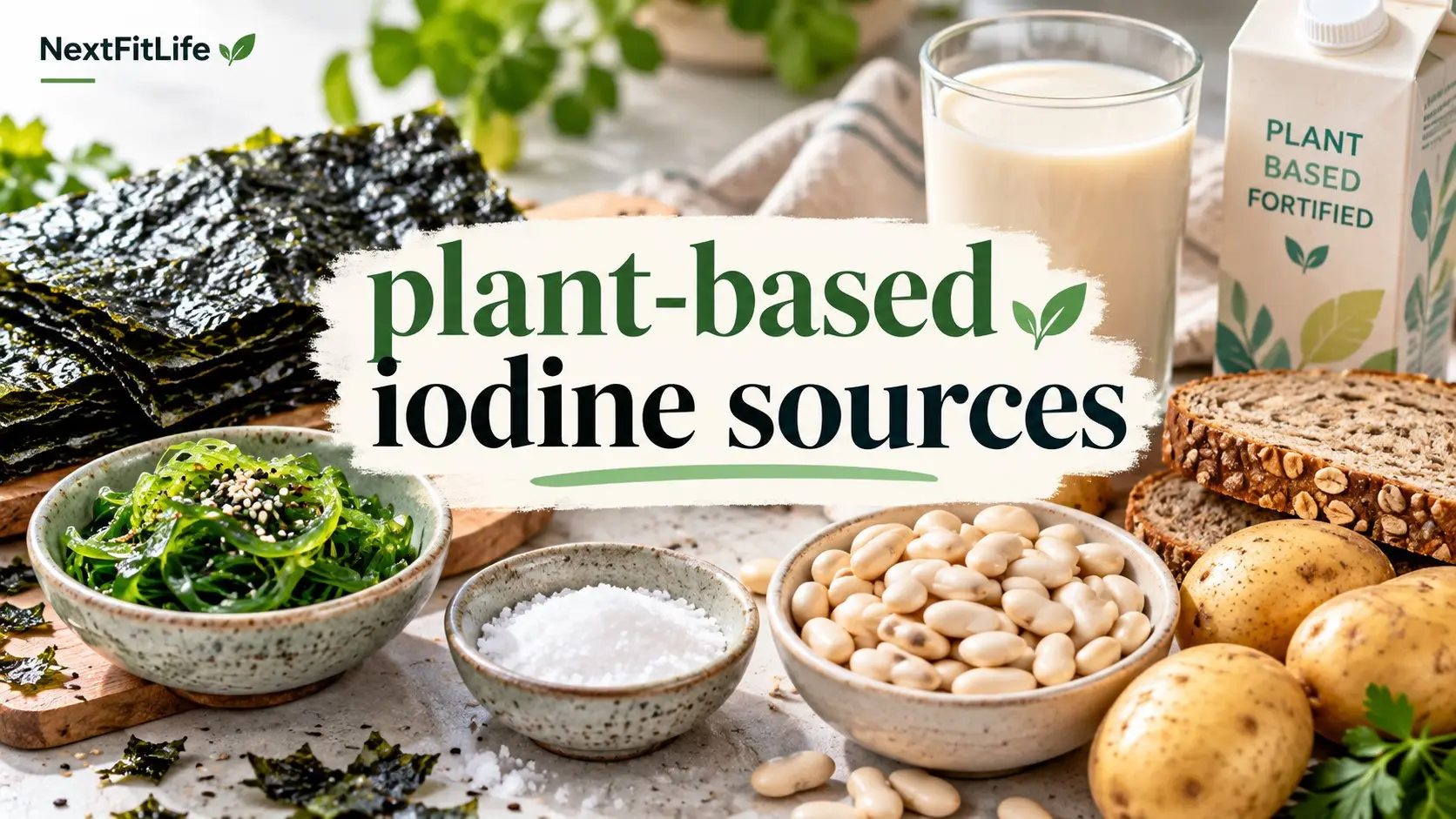
Finding dependable plant-based iodine sources is harder than finding plant protein, iron, or fiber. Most ordinary fruit, vegetables, beans, nuts, and grains provide little iodine, while seaweed can swing from modest to extremely high amounts.
The practical answer is not to eat more random “iodine foods.” It is to use sources you can actually verify.
Table of Contents
- Why iodine matters
- How much iodine do you need?
- Use iodized salt wisely
- Choose iodine fortified plant milk
- Use nori carefully
- Treat kelp and kombu with caution
- Check bread for iodate
- Know where pasta iodine comes from
- Ignore weak iodine food lists
- Do not fear soy and broccoli
- Use supplements only when needed
- A practical food first iodine plan
- Pregnancy and breastfeeding
- Thyroid disease and excess iodine
- Common iodine mistakes
- References and Sources
- Frequently asked questions
Why Does Iodine Matter?
Iodine is a trace mineral your thyroid uses to make the hormones T4 and T3.
Those hormones help regulate metabolism and support normal growth and development. Iodine is especially important during pregnancy and infancy because thyroid hormones support brain and nervous system development.
The problem for plant based eaters is simple.
Plants are unreliable iodine sources.
The iodine content of crops depends heavily on soil, water, fertilizer, and growing conditions. Two similar vegetables grown in different places can contain very different amounts.
That makes iodine different from nutrients such as protein or fiber, where ordinary food databases are much more predictable.
For more mineral and vitamin guidance, visit the NextFitLife Nutrition and Vitamins Hub.
How Much Iodine Do You Need?
In the United States, adults need about 150 micrograms of iodine per day.
Needs rise during pregnancy and breastfeeding.
| Life Stage | Recommended Iodine |
|---|---|
| Adults | 150 mcg per day |
| Pregnancy | 220 mcg per day |
| Breastfeeding | 290 mcg per day |
The U.S. adult Tolerable Upper Intake Level is 1,100 mcg per day from food and supplements combined.
That upper limit matters because excessive iodine can also disturb thyroid function.
This is why I would rather use measured, predictable sources than large servings of kelp.
1. Use Iodized Salt Wisely
Salt is not a plant, but iodized salt is one of the most practical nonanimal iodine sources for people eating vegan or plant based diets.
The NIH reference table lists about 78 mcg of iodine in 1/4 teaspoon of U.S. iodized table salt.
That is about half the adult Daily Value.
Do not eat extra salt just for iodine
This part matters.
If you already use salt, choose iodized salt instead of a noniodized version.
Do not increase your total salt intake just to raise iodine intake.
WHO treats sodium reduction and salt iodization as compatible strategies. In other words, use less salt overall when appropriate, but make the salt you do use iodized.
If you follow a sodium restricted diet, use fortified foods or professional supplement advice rather than deliberately increasing salt.
For more on sodium and heart health, read the NextFitLife DASH Diet Guide.
Is sea salt a good iodine source?
Usually not.
Many specialty salts are not iodized.
This includes many products sold as:
- Sea salt
- Himalayan pink salt
- Kosher salt
- Fleur de sel
NIH lists noniodized sea salt as providing essentially no iodine in its reference table.
Check the package for the word iodized.
2. Choose Iodine Fortified Plant Milk
This is one of the easiest daily options when the product is truly fortified.
Do not assume all soy, oat, almond, pea, or other plant milks contain iodine.
Many do not.
NIH lists an ordinary unfortified soy beverage at only around 3 mcg per cup.
That is tiny compared with an adult target of 150 mcg.
Fortification changes the answer
The Vegan Society recommends looking for a plant based dairy alternative containing about 25 mcg of iodine per 100 mL.
If a drink contains that amount, 500 mL provides around 125 mcg.
That is a useful contribution.
But the number belongs to the product label, not to plant milk as a category.
What should you look for?
Check both the nutrition panel and ingredient list.
Useful terms include:
- Iodine
- Potassium iodide
- Potassium iodate
A plant milk can be fortified with calcium, vitamin D, and vitamin B12 while still containing almost no iodine.
Read the label rather than assuming.
3. Nori Can Be Useful, but Portion It
Nori is the thin seaweed used around sushi rolls.
It can provide a useful amount of iodine without reaching the extreme levels sometimes found in kelp.
The NIH reference table lists about 116 mcg in 5 grams of dried nori.
That is roughly 77% of the adult Daily Value.
Sounds simple, right?
There is still a catch.
Natural seaweed iodine values vary with species, origin, growing conditions, processing, and testing.
Use the number as a guide, not as a guarantee that every sheet contains the same amount.
My practical nori rule
Use it as food rather than medicine.
A measured serving now and then can contribute iodine.
Do not assume that eating more sheets is automatically healthier.
4. Treat Kelp and Kombu With Caution
This is where many “best iodine foods” articles become unsafe.
Kelp and kombu can contain huge amounts of iodine.
NIH cites commercial seaweed samples ranging from about 16 to 2,984 mcg per gram.
That range is enormous.
At the high end, one gram would already exceed the U.S. adult upper limit of 1,100 mcg.
More seaweed is not better
Brown seaweeds such as kelp and kombu are especially difficult to use as precise daily iodine sources.
I would not spoon kelp powder into smoothies each morning and call that a food first plan.
The British Dietetic Association specifically warns against using seaweed or kelp supplements as routine iodine sources because the dose can be excessive and may differ from the label.
5. Some Bread Can Be Surprisingly High in Iodine
Bread is a good example of why iodine lists can look strange.
Most bread contains very little iodine.
But bread made with an iodine containing dough conditioner can provide a lot.
NIH lists about 296 mcg in two slices of white bread made with an iodate dough conditioner and about 273 mcg in two slices of whole wheat bread made with iodate.
Without iodate, the same amount of bread can contain only about 1 mcg.
That is a huge difference.
Read the ingredient list
Look for:
- Potassium iodate
- Calcium iodate
NIH notes that only a minority of U.S. bread products use iodate conditioners.
So I would never count bread toward iodine intake unless you have checked the product.
6. Pasta Only Becomes an Iodine Source When Iodine Is Added
Pasta makes the same point from another angle.
NIH lists cooked pasta prepared without iodized salt at essentially zero iodine.
Cook the pasta in water containing iodized salt, and the table lists around 30 mcg per cup.
The pasta did not suddenly become an iodine rich grain.
It absorbed iodine from the salt.
Keep this in mind whenever an online list claims that rice, pasta, potatoes, or another ordinary starch is “high in iodine.”
Ask where the iodine actually came from.
7. Stop Relying on Strawberries, Prunes, Potatoes, and Beans for Iodine
This is where I would make the biggest correction to many competing articles.
A peer reviewed British Journal of Nutrition review specifically called out inaccurate online claims about foods such as strawberries, prunes, cranberries, potato skins, and several beans being good iodine sources.
Current NIH food data tell a very different story.
| Food | NIH Reference Amount | Practical Meaning |
|---|---|---|
| Lima beans | About 0 mcg per 1/2 cup | Excellent food, poor iodine source |
| Broccoli | About 0 mcg per 1/2 cup | Nutritious, but not useful for iodine |
| Banana | About 0 mcg per large banana | Do not count it toward iodine |
| Brown rice | About 0 mcg per 3/4 cup | Healthy grain, not an iodine source |
| Apple juice | About 1 mcg per cup | Tiny contribution |
Do not misunderstand this section.
Beans, fruit, vegetables, potatoes, and whole grains still belong in a healthy diet.
They provide fiber, vitamins, minerals, carbohydrate, protein, and plant compounds.
They simply should not be given a nutritional job they are bad at.
For a broader whole food pattern, see Top Healthy Foods for Everyday Nutrition.
8. Do Not Avoid Soy or Broccoli Because of Goitrogens
Another iodine discussion goes wrong when healthy plant foods become the villain.
Soy foods, cabbage, broccoli, cauliflower, and some other plants contain compounds known as goitrogens.
These can interfere with iodine use under certain conditions.
That does not mean tofu or broccoli damages the thyroid in everyone who eats them.
NIH states that reasonable amounts of these foods are not a concern for most people who have adequate iodine intake and eat a varied diet.
The concern is greater when iodine intake is already too low.
The practical answer is simple.
Fix the iodine gap.
Do not remove nutritious foods without a good reason.
9. A Measured Supplement Can Be Safer Than Guessing With Kelp
A food first approach does not mean supplements are forbidden.
It means use food when food provides a predictable answer.
If your diet contains no iodized salt, no iodine fortified foods, and no reliable seaweed source, a measured iodine supplement can be easier to control than kelp powder.
Many multivitamin and mineral supplements contain around 150 mcg of iodine.
Common forms include:
- Potassium iodide
- Potassium iodate
- Sodium iodide
Do not assume that a kelp supplement is safer because the label says natural.
Natural does not mean accurately dosed.
Who should ask before supplementing?
Talk with a qualified healthcare professional if you:
- Have a thyroid condition
- Take thyroid medicine
- Are pregnant
- Are breastfeeding
- Are planning pregnancy
- Already use a multivitamin or prenatal product
- Use seaweed frequently
A Food First Iodine Plan That Is Actually Predictable
You do not need to calculate every bite.
You do need at least one reliable iodine strategy.
Plan A: Iodized salt
Use iodized salt instead of noniodized salt within the amount that fits your overall sodium plan.
Then eat your usual varied plant based diet.
You do not need every vegetable to provide iodine.
Plan B: Iodine fortified plant milk
Choose a product that clearly lists iodine.
Use the label to work out what your normal daily serving provides.
If a product contains 25 mcg per 100 mL, for example, 500 mL provides about 125 mcg.
That calculation is far more useful than guessing how much iodine is in a potato.
Plan C: Combine smaller reliable sources
You might use iodine fortified plant milk at breakfast, a modest amount of iodized salt during cooking, and an occasional measured portion of nori.
The exact combination depends on your products and portions.
Which Plant Based Iodine Sources Are Most Reliable?
| Source | Example Amount | Reliability | My Take |
|---|---|---|---|
| Iodized salt | About 78 mcg per 1/4 tsp in NIH table | High when labeled iodized | Practical, but do not increase total salt intake |
| Iodine fortified plant milk | Depends on label | High when clearly fortified | One of the easiest daily options |
| Nori | About 116 mcg per 5 g reference serving | Moderate | Useful, but natural variation remains |
| Kelp or kombu | Can be extremely high | Poor for precise dosing | Easy to overdo |
| Bread with iodate | Can provide hundreds of mcg per serving | High if ingredient is confirmed | Check the ingredient list |
| Unfortified plant milk | Usually very low | Poor | Do not assume it contains iodine |
| Fruit, vegetables, beans, grains | Usually low or variable | Poor for iodine planning | Eat them for their many other benefits |
Can You Meet Iodine Needs Without Seaweed?
Yes.
Seaweed is optional.
You can build a reliable pattern from iodine fortified foods, iodized salt used appropriately, and a measured supplement when needed.
That is often easier than trying to calculate the iodine content of seaweed.
Can You Meet Iodine Needs Without Iodized Salt?
Yes, but you need another predictable source.
That could be:
- Iodine fortified plant milk
- Another fortified food
- A measured iodine supplement
- A carefully quantified seaweed product
Eating more vegetables is not a dependable substitute.
Should You Use Iodized Salt If You Have High Blood Pressure?
Do not increase salt just to obtain iodine.
Use iodized salt instead of noniodized salt within your normal sodium limit.
WHO specifically describes universal salt iodization and sodium reduction as compatible strategies.
If your healthcare professional has placed you on a strict sodium plan, fortified foods or a measured supplement may be a better iodine strategy.
Read the DASH Diet Guide for broader sodium and blood pressure guidance.
Pregnancy and Breastfeeding Need Extra Attention
Iodine needs rise during pregnancy because thyroid hormone supports fetal brain and nervous system development.
In the United States, the RDA rises from 150 mcg for most adults to 220 mcg during pregnancy and 290 mcg during breastfeeding.
The American Thyroid Association recommends that women in the United States who are planning pregnancy, pregnant, or breastfeeding take a daily supplement containing 150 mcg of iodine, usually as potassium iodide.
That supplement is meant to support total intake.
It is not a reason to add high iodine kelp products on top.
Plant based pregnancy deserves planning
If you follow a vegan diet during pregnancy, iodine should sit beside vitamin B12, iron, vitamin D, calcium, protein, and other nutrients on your nutrition checklist.
Do not wait for symptoms before checking the plan.
Pregnancy is a good time to involve a registered dietitian or maternity care professional.
What If You Already Have Thyroid Disease?
Do not assume more iodine will help.
Some thyroid conditions can become worse after large or sudden iodine increases.
This is especially relevant with kelp supplements, high dose iodine drops, and repeated large seaweed servings.
If you take levothyroxine or another thyroid medicine, discuss iodine supplements with the clinician managing your thyroid condition.
The goal is steady, appropriate intake.
It is not maximum intake.
Can Too Much Iodine Cause Problems?
Yes.
Large iodine intakes can trigger thyroid dysfunction in susceptible people.
Possible effects include hypothyroidism or hyperthyroidism.
This is why the U.S. adult upper limit is 1,100 mcg per day.
The American Thyroid Association also warns against routine high dose iodine and kelp supplements.
A product providing several thousand micrograms is not automatically better because it is sold in a health shop.
What Are Signs of Iodine Deficiency?
Severe iodine deficiency can reduce thyroid hormone production and contribute to goiter and hypothyroidism.
But symptoms such as fatigue, feeling cold, weight change, dry skin, constipation, and hair changes are not specific to iodine deficiency.
They can come from many conditions.
Do not diagnose iodine deficiency from symptoms alone and start taking large iodine doses.
Can a Blood Test Tell You if You Need More Iodine?
Routine thyroid blood tests such as TSH and free T4 measure thyroid function.
They do not directly tell you how much iodine you ate yesterday.
Urinary iodine is widely used to assess iodine status in populations, but one spot urine result can vary a lot from day to day and is less useful for diagnosing one person's usual intake.
If there is a medical concern, let a clinician decide which testing makes sense.
Does Organic Food Contain More Iodine?
You cannot assume that.
Plant iodine depends on soil, water, fertilizer, and other growing conditions.
An organic label does not guarantee a useful iodine level.
Is Himalayan Salt Better for Iodine?
No.
Do not count pink color or trace minerals as meaningful iodine.
Unless the package specifically says iodized or lists iodine, treat it as a noniodized salt for iodine planning.
Seven Plant Based Iodine Mistakes to Avoid
1. Treating every seaweed as the same food
Nori, wakame, kelp, and kombu can provide very different iodine amounts.
2. Using kelp every day without knowing the dose
Some products can push iodine intake far above the adult upper limit.
3. Assuming sea salt contains enough iodine
Most specialty salt is not iodized unless the label says so.
4. Trusting old fruit and vegetable iodine lists
Strawberries, potatoes, cranberries, prunes, and beans are not dependable ways to meet iodine needs.
5. Buying plant milk without checking iodine
Calcium, vitamin D, and B12 fortification do not automatically mean iodine was added.
6. Avoiding soy and broccoli for no reason
Reasonable amounts are not a concern for most people with adequate iodine intake.
7. Using a high dose supplement because it sounds more effective
Iodine has a useful range.
More is not better.
Conclusion: Choose Predictable Plant-Based Iodine Sources
The best plant-based iodine sources are the ones you can verify.
Use iodized salt instead of noniodized salt when salt fits your diet. Choose an iodine fortified plant milk if you use one regularly. Treat nori as a measured food, and treat kelp and kombu with much more caution.
Most importantly, stop relying on potatoes, strawberries, beans, cranberries, or other ordinary plants to close an iodine gap.
Your next step takes less than a minute: check the salt and plant milk already in your kitchen. If neither provides iodine, you have found the part of your diet that needs a more reliable plan.
Continue Reading on NextFitLife
- Nutrition and Vitamins Hub
- Top Healthy Foods for Everyday Nutrition
- Nutrition Tips for Improving Your Health
- DASH Diet and Sodium Guidance
- General Wellness and Healthy Lifestyle Guide
- NextFitLife Health Hub
References and Sources
- National Institutes of Health Office of Dietary Supplements. Iodine Fact Sheet for Health Professionals. Current reference for iodine requirements, upper limits, food values, seaweed variability, iodized salt, plant beverages, bread, goitrogens, and groups at risk of inadequate intake.
Read the NIH iodine guide - British Dietetic Association. Iodine Food Fact Sheet. Dietitian guidance on vegetarian and vegan diets, fortified plant milk, seaweed, pregnancy, and why kelp supplements should not be used as routine iodine sources.
Read the BDA iodine guide - World Health Organization. Universal Salt Iodization and Sodium Intake Reduction. Explains why iodine fortification of salt and lower sodium intake are compatible public health goals.
Read the WHO policy brief - American Thyroid Association. Statement on the Potential Risks of Excess Iodine Ingestion and Exposure. Guidance on pregnancy supplementation, iodine upper limits, kelp products, and thyroid risk from excessive intake.
Read the ATA statement - Nicol K, Nugent AP, Woodside JV, Hart KH, Bath SC. Iodine and Plant Based Diets: A Narrative Review and Calculation of Iodine Content. British Journal of Nutrition. Reviews iodine risk in plant based diets and corrects unsupported online claims about several supposed plant iodine sources.
Read the peer reviewed review
These organizations and researchers do not endorse NextFitLife. Iodine needs can differ with pregnancy, breastfeeding, thyroid disease, medical treatment, country specific fortification policies, and the foods and supplements you use.
About the Author
Adel Galal is the Founder and Lead Writer of NextFitLife. He researches nutrition, vitamins, minerals, fitness, healthy aging, and general wellness using recognized medical, nutrition, and public health sources.
His approach to nutrient articles is practical: check the original food tables, separate fortified foods from naturally variable foods, compare ordinary servings with daily requirements, and flag situations where taking more can create harm rather than benefit.
For this iodine guide, the focus is especially strict because natural plant iodine values vary widely and popular online food lists often repeat claims that do not match current nutrient databases.
Adel is not a doctor, registered dietitian, endocrinologist, pharmacist, or other licensed healthcare professional.
This content is for general educational purposes and does not replace professional medical advice, diagnosis, or treatment. Consult an appropriately qualified healthcare professional for personal medical concerns. This article explains published guidance and does not provide a personal clinical assessment. Always consult qualified medical professionals for diagnosis and treatment of any health condition.
Learn more about Adel Galal and the NextFitLife editorial approach at About NextFitLife and Founder Adel Galal.
Frequently Asked Questions About Plant-Based Iodine Sources
What are the best plant-based iodine sources?
The most reliable options are iodized salt, iodine fortified plant milk and other fortified foods, and carefully portioned seaweed such as nori.
Can vegans get enough iodine?
Yes. A vegan diet can provide enough iodine when it includes reliable sources such as fortified foods, iodized salt in appropriate amounts, or a measured supplement when needed.
Is seaweed the best vegan source of iodine?
Seaweed can contain a lot of iodine, but its iodine concentration varies greatly. This makes some seaweeds less predictable than fortified foods or measured supplements.
Is nori a good iodine source?
Yes. NIH lists about 116 mcg in 5 grams of dried nori, although natural iodine content can vary between products.
Is kelp a good daily iodine source?
Kelp can contain extremely high and variable iodine levels, so it is difficult to use as a precise daily source.
Is kombu high in iodine?
Yes. Kombu is a brown seaweed and can contain very large amounts of iodine. Small servings can sometimes provide more than a full day's need.
Does plant milk contain iodine?
Only some products do. Check the nutrition information and ingredient list because iodine fortification is not standard across all plant milks.
Is soy milk high in iodine?
Unfortified soy milk is not. NIH lists an ordinary soy beverage at around 3 mcg per cup.
Is oat milk a good iodine source?
Only when it has been fortified with iodine. The oat itself does not make the drink iodine rich.
Is almond milk high in iodine?
Not unless iodine has been added. Check the label rather than assuming.
How much iodine do adults need?
The U.S. Recommended Dietary Allowance for most adults is 150 mcg per day.
How much iodine is needed during pregnancy?
The U.S. Recommended Dietary Allowance during pregnancy is 220 mcg per day.
How much iodine is needed while breastfeeding?
The U.S. Recommended Dietary Allowance while breastfeeding is 290 mcg per day.
What is the upper limit for iodine?
The U.S. adult Tolerable Upper Intake Level is 1,100 mcg per day from food and supplements combined.
Is iodized salt plant based?
Salt is a mineral rather than a plant food, but iodized salt is compatible with vegan and plant based diets and is one of the most reliable nonanimal iodine sources.
Does sea salt contain iodine?
Most noniodized sea salt provides very little iodine. Check the package for the word iodized.
Does Himalayan salt contain iodine?
Do not count on it unless iodine has specifically been added and the product is labeled iodized.
Are strawberries high in iodine?
No reliable evidence supports strawberries as a meaningful iodine source. Peer reviewed literature has identified this as a common inaccurate online claim.
Are prunes high in iodine?
Prunes should not be relied on to meet iodine needs. Popular online lists have overstated their value as an iodine source.
Are potatoes a good iodine source?
Potato iodine content is too variable to make potatoes a dependable iodine strategy.
Are beans high in iodine?
Most beans are poor iodine sources. NIH lists cooked lima beans at essentially zero iodine in the tested serving.
Are cranberries a good source of iodine?
Cranberries should not be used as a dependable iodine source. Claims presenting them as iodine rich are poorly supported.
Does broccoli block iodine?
Broccoli contains goitrogenic compounds, but reasonable amounts are not considered a concern for most people with adequate iodine intake.
Does soy interfere with the thyroid?
Soy contains compounds that can affect iodine use in some settings, but reasonable intake is not considered a problem for most iodine sufficient people.
Can you meet iodine needs without seaweed?
Yes. Iodized salt, iodine fortified foods, or an appropriate measured supplement can meet iodine needs without seaweed.
Can you get enough iodine without iodized salt?
Yes, but you need another dependable source such as fortified food, a measured supplement, or a carefully quantified seaweed product.
Can too much iodine harm the thyroid?
Yes. Excess iodine can trigger thyroid dysfunction in susceptible people, including hypothyroidism or hyperthyroidism.
Should people with thyroid disease take iodine supplements?
They should discuss iodine supplementation with the clinician managing their thyroid condition because both low and excessive intake can affect thyroid function.
Should pregnant vegans take iodine?
U.S. American Thyroid Association guidance recommends a daily supplement containing 150 mcg iodine for women planning pregnancy, pregnant, or breastfeeding. Individual needs should still be discussed with the maternity care team.
Is potassium iodide better than kelp for supplements?
Potassium iodide provides a measured iodine amount, while kelp iodine can be highly variable. Predictable dosing is one reason measured supplements are easier to manage.
What should I check first if I eat a vegan diet?
Check whether your salt is iodized and whether your plant milk or other fortified foods list iodine. If neither does, your diet may need another reliable iodine source.

Health & wellness writer with 30+ years of experience in nutrition, fitness, and healthy aging. Founder of NextFitLife.com — evidence-based health guidance.