Published: September 24, 2026
Last Updated: September 24, 2026
Written and Source Checked by: Adel Galal, Founder and Lead Writer at NextFitLife
Review Status: Updated using current resistance training research, systematic reviews, sports medicine evidence, and NextFitLife fitness safety standards. This article has not been medically reviewed by a doctor, physical therapist, or strength coach.
Eccentric training for beginners does not mean starting with enormous weights or painful negative reps. A beginner can get the major benefit simply by controlling the lowering part of familiar strength exercises, using manageable resistance, and giving the body enough time to adapt.
Start by lowering for about 2 to 4 seconds on selected exercises. Keep the lifting phase smooth, stop before your form breaks down, and do less than you think you need during the first week.
If you are completely new to exercise, start with the NextFitLife Fitness for Beginners Guide. If you already understand basic resistance exercise, the Strength Training and Muscle Building Guide gives the larger framework that eccentric work fits into.
Table of Contents
- What eccentric training means
- Start with control instead of overload
- Use a simple lowering tempo
- Reduce the weight when needed
- Expect soreness without chasing it
- Know what eccentric training can and cannot do
- Use eccentric strength in daily movement
- Do not slow every exercise
- Progress one variable at a time
- A 4 week beginner plan
- A beginner eccentric workout at home
- How to read exercise tempo
- Best beginner eccentric exercises
- Negative pull ups
- Nordic hamstring curls
- Eccentric training and muscle growth
- Eccentric training and strength
- Eccentric exercise and calorie burn
- Eccentric training for tendons
- Recovery and the repeated bout effect
- Common beginner mistakes
- When to get professional advice
- References and Sources
- Frequently asked questions
What Does Eccentric Training Mean?
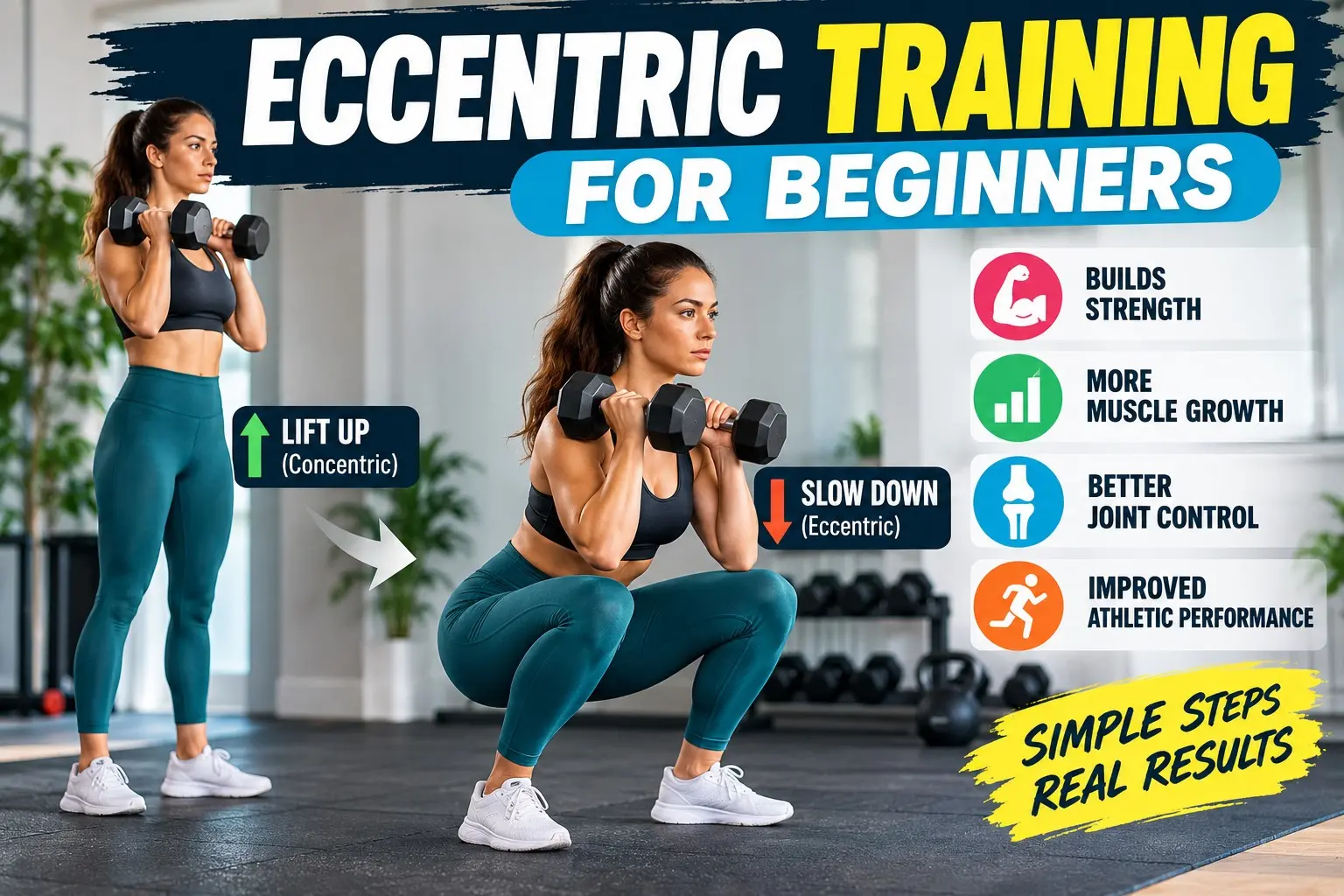
An eccentric contraction happens when a muscle keeps producing force while it lengthens.
The easiest example is a dumbbell curl.
When you lift the dumbbell toward your shoulder, the biceps shorten. That is the concentric contraction.
When you lower the dumbbell back down under control, the biceps lengthen while still producing force. That is the eccentric part.
You already perform eccentric muscle actions every day.
- Lowering into a chair
- Walking downstairs
- Lowering a bag to the floor
- Slowing your body after a step
- Lowering from the top of a calf raise
Normal strength training also includes both lifting and lowering phases. Eccentric training simply places more attention on the lowering part.
If you need a basic strength foundation first, use Strength Training Exercises at Home for Beginners before adding special tempo work.
Rule 1: Start With Control Instead of Overload
This is the first mistake I would avoid.
Advanced lifters sometimes perform eccentric overload. They lower more resistance than they could lift normally, then use a machine, partner, or other method to return the weight to the starting position.
That is advanced training.
A beginner does not need it.
Your first eccentric workout can be a normal chair squat where you take three seconds to lower instead of dropping quickly.
That is enough to learn the skill.
Do not start with
- Maximum negative repetitions
- Weights heavier than you can normally lift
- A partner forcing extra repetitions
- Very long 8 or 10 second descents
- Hard one limb eccentric variations
- Multiple eccentric exercises taken to failure
Control the exercise you already know before making it more complicated.
Rule 2: Use a 2 to 4 Second Lowering Phase
You will see many tempo recommendations online.
Some programs use five second descents. Others use eight seconds or more.
Longer is not automatically better.
For a beginner, a 2 to 4 second eccentric phase is easy to understand and slow enough to teach control.
| Exercise | Lowering Phase | Return Phase | Beginner Cue |
|---|---|---|---|
| Chair squat | About 3 seconds down | Stand normally | Count one, two, three |
| Wall push up | About 3 seconds toward wall | Push away normally | Stay straight and breathe |
| Dumbbell curl | About 3 seconds down | Curl normally | Do not drop the weight |
| Calf raise | About 3 seconds down | Rise normally | Control the heel drop |
| Band row | About 3 seconds returning | Pull normally | Do not let the band snap back |
This tempo is a practical beginner recommendation, not a magic biological cutoff.
A 2025 systematic review examining different eccentric phase durations found that the evidence does not support one universal lowering speed as clearly superior for strength or muscle growth.
The purpose of slowing the rep is control.
It is not to see who can make one squat last longest.
Rule 3: Reduce the Weight When Needed
A weight can feel easy when you move quickly and much harder when you slow the lowering phase.
That happens because each repetition keeps the muscles working for longer.
This is often described as increased time under tension.
If your normal dumbbell curl is 10 kilograms but a three second lowering phase makes your shoulder move forward or your elbow swing, use less weight.
You have not become weaker.
You changed the exercise.
Use this first week rule
Choose a resistance that feels easier than your normal training weight.
Finish each set with good form and several clean repetitions still available.
Then judge the workout again the next day.
This matters because unfamiliar eccentric training can feel surprisingly easy during the session and surprisingly demanding later.
If you train at home, the Home Workouts and Equipment Guide can help you choose simple resistance options such as bodyweight exercises, bands, and light dumbbells.
Rule 4: Expect Some Soreness Without Chasing It
Unfamiliar eccentric exercise has a strong link with delayed onset muscle soreness, or DOMS.
Soreness often appears later rather than while you are training.
This is one reason beginners should avoid testing how much eccentric work they can tolerate during the first session.
What mild soreness can feel like
- Muscle tenderness
- Mild stiffness
- Legs feeling worked when you use stairs
- Temporary tightness
What deserves more caution
- Severe pain
- Major swelling
- Dark urine
- Marked weakness
- Joint pain rather than muscle tenderness
- Pain that keeps getting worse
- Loss of normal movement
Soreness is not a score.
You do not get extra muscle because sitting down hurts for four days.
If recovery is one of your weak points, use the NextFitLife Recovery and Injury Prevention Guide for broader guidance on soreness, pain, sleep, mobility, and safer training.
What Is the Repeated Bout Effect?
The first unfamiliar eccentric workout is usually the one that gets your attention.
Repeat a similar session later, and the body usually responds with less soreness, less strength loss, and less disruption.
This adaptation is called the repeated bout effect.
A 2026 systematic review and meta analysis again found evidence that repeated eccentric exercise produces smaller signs of muscle damage and better recovery than the first exposure. The researchers also stressed that the exact neural mechanisms remain uncertain.
For you, the practical lesson is much simpler.
Do not judge eccentric training from one brutal first session.
Start low enough that your body has a chance to adapt.
Rule 5: Do Not Treat Eccentric Training as a Muscle Growth Shortcut
This is where fitness marketing can get ahead of research.
Eccentric muscle actions can produce high force.
That makes them useful.
It does not prove that eccentric only training always produces more muscle than normal resistance training.
A 2025 systematic review and meta analysis comparing eccentric and concentric training found no statistically clear overall difference in muscle hypertrophy.
A 2026 review of accentuated eccentric loading, where the lowering phase receives extra load, also found no clear superior long term gains in muscle size or several strength outcomes compared with conventional constant load training.
What does that mean for a beginner?
Use eccentric training because it teaches control and provides another way to increase training challenge.
Do not use it because someone promised twice the muscle growth.
Normal resistance exercise already contains both concentric and eccentric muscle actions.
For the larger picture, see the NextFitLife Strength Training and Muscle Building Guide.
Rule 6: Think of Eccentric Strength as Your Braking System
Muscles do more than move you forward.
They also slow you down.
Eccentric strength helps control:
- Walking downstairs
- Sitting into a chair
- Lowering groceries
- Landing from a small step
- Decelerating while running
- Lowering yourself toward the floor
This makes eccentric control useful outside the gym.
It is especially relevant when exercises involve lowering your body under gravity.
For beginners, the goal should be better control rather than extreme loading.
Rule 7: Do Not Make Every Exercise Eccentric Focused
One common mistake is slowing every rep of every exercise on the same day.
That can turn a normal strength workout into a large jump in training stress.
Start with one or two exercises.
Example session
Chair squat: three second descent.
Wall push up: three second lowering phase.
Band row: normal controlled speed.
Glute bridge: normal controlled speed.
Core exercise: normal controlled speed.
The next session, you can change which movements receive the eccentric focus.
This approach also leaves room for ordinary strength work, mobility, cardio, and recovery.
If you want a simple full routine instead of building everything from scratch, see How to Get Fit Fast Safely.
Rule 8: Progress One Variable at a Time
Eccentric training gives you many ways to progress an exercise.
You can:
- Add repetitions
- Add resistance
- Add a set
- Use a harder exercise variation
- Increase comfortable range of motion
- Slow the eccentric phase slightly
- Move from two limbs to one limb later
Do not change all of those at once.
If you changed a squat from a normal descent to a three second descent, you already made the exercise harder.
You do not also need to double the weight and add two sets.
A 4 Week Eccentric Training Plan for Beginners
This progression is deliberately conservative.
The exact sets and repetitions are examples rather than a personal training prescription.
| Week | Main Goal | Eccentric Focus | Progress Rule |
|---|---|---|---|
| Week 1 | Learn control | 2 exercises, 2 sets, 6 to 8 reps | Use about a 3 second descent |
| Week 2 | Repeat comfortably | Same exercises, 8 to 10 reps | Do not progress if soreness was excessive |
| Week 3 | Add a small challenge | Keep the same tempo | Add one set or a small amount of resistance |
| Week 4 | Expand carefully | Add one more controlled exercise | Keep recovery comfortable |
Week 1: Learn the lowering phase
Train twice.
Pick two familiar movements and lower for about three seconds.
For example:
- Chair squat, 2 sets of 6 to 8 repetitions
- Wall push up, 2 sets of 6 to 8 repetitions
Do your other exercises normally.
Week 2: Repeat before adding more
If soreness stayed mild, move toward 8 to 10 repetitions while keeping the same tempo.
The goal is to make the movement feel normal.
Week 3: Change one thing
Add a small amount of resistance, one extra set, or a slightly harder variation.
Pick one.
Week 4: Add one more eccentric movement
If recovery still feels good, add eccentric emphasis to one more exercise.
You now have enough experience to know whether a slow lowering phase fits your normal training.
A Beginner Eccentric Workout at Home
You need a stable chair, a wall, and optional light dumbbells or a resistance band.
This fits well with the routines in the Home Workouts and Equipment Guide.
Warm up
March comfortably for about two minutes.
Do a few easy squats, shoulder movements, and wall push ups.
1. Chair squat
Stand in front of a stable chair.
Lower for about three seconds.
Touch the chair gently, then stand normally.
Do 6 to 10 repetitions.
2. Wall push up
Place your hands against a wall.
Lower your chest toward the wall for about three seconds.
Push away at a comfortable speed.
Do 6 to 10 repetitions.
3. Glute bridge
Raise your hips normally.
Lower them toward the floor over about three seconds.
Do 8 to 12 repetitions.
4. Calf raise
Rise onto your toes normally.
Lower your heels slowly over about three seconds.
Hold a stable chair if needed.
Do 8 to 12 repetitions.
5. Dumbbell curl
Curl a light weight toward your shoulder.
Lower it slowly for about three seconds.
Do 6 to 10 repetitions.
6. Bird dog or dead bug
Keep this exercise at a normal controlled speed rather than turning every part of the workout into slow eccentric work.
For more core options, use Core Workouts at Home.
How many rounds?
One round is enough for a first session.
If you recover well, progress toward two rounds.
How Do You Read Exercise Tempo?
You may see strength programs written with four numbers such as:
3 0 1 0
Tempo notation is not perfectly standardized across every coach, but a common system uses the numbers to describe different parts of each repetition.
For a squat, 3 0 1 0 can mean:
- About 3 seconds lowering
- No long pause at the bottom
- About 1 second standing up
- No long pause before the next repetition
You do not need a stopwatch.
Count softly to three while lowering.
Which Exercises Work Best for Beginner Eccentrics?
The easiest choices are exercises where you can stop safely if you become tired.
Chair squat
This is one of my preferred beginner options because the chair gives you a clear end point.
If you want more lower body progression later, see Leg Exercises With Dumbbells.
Wall push up
A wall push up gives you much more control than forcing negative floor push ups before you have enough pushing strength.
Dumbbell curl
The movement is easy to understand and the weight is easy to reduce.
Calf raise
Raise normally and control the lowering phase.
Start with both legs before using more demanding single leg versions.
Glute bridge
Raise the hips smoothly, then lower under control.
Resistance band row
Pull the band toward you, then resist its return rather than letting it snap forward.
Should Beginners Do Negative Pull Ups?
Negative reps are often introduced through pull ups.
You start at the top, then lower slowly.
That sounds simple, but controlling your full body weight can be demanding.
If you cannot safely reach the top position and lower under control, start with:
- Band rows
- Machine pulldowns
- Assisted pull ups
- Other beginner pulling exercises
Build the strength first.
Then add eccentric pull ups later.
Should Beginners Do Nordic Hamstring Curls?
Full Nordic hamstring curls place a large eccentric demand on the hamstrings.
They are useful in some athletic programs, but they are not where I would start a true beginner.
Start with simpler posterior chain work such as:
- Glute bridges
- Hip hinges
- Light Romanian deadlifts
- Machine hamstring curls
- Strongly assisted Nordic variations later
For lower body strength ideas, the Strength Training and Muscle Building Hub also organizes NextFitLife guides on hamstrings, glutes, leg exercises, and progressive resistance.
Does Eccentric Training Build More Muscle?
It can build muscle.
So can ordinary resistance training.
The evidence does not support a simple claim that eccentric training always produces more muscle hypertrophy.
A 2025 meta analysis comparing eccentric and concentric muscle actions found similar overall hypertrophy results.
A 2026 analysis of accentuated eccentric loading also found no clear advantage for muscle cross sectional area over normal constant load resistance training.
Some individual muscles, protocols, and populations can respond differently.
That is different from saying everybody should use eccentric overload.
Does Eccentric Training Build More Strength?
Muscle strength improves when you train progressively.
Eccentric training is good at improving eccentric strength because training adaptations have some specificity.
For healthy older adults, a 2026 meta analysis found a small strength advantage for eccentric resistance training over traditional resistance training, but it did not find clear differences in hypertrophy, muscle power, or functional capacity.
That result is interesting.
It is not a reason for a beginner to abandon normal strength training.
Why Can You Lower More Weight Than You Can Lift?
Muscle behaves differently when it lengthens under load.
Eccentric contractions can produce high force while requiring relatively less metabolic energy than concentric contractions at the same mechanical workload.
This helps explain why you can sometimes lower a resistance that you could not lift back up.
Advanced lifters use that property for overload.
Beginners should use it first for control.
Does Eccentric Training Burn More Calories?
Do not choose it because you think it is a superior calorie burning trick.
Eccentric contractions have a relatively low metabolic cost for the amount of force they can produce.
That can actually make eccentric exercise useful for some populations who need muscular loading without extremely high cardiorespiratory demand.
But it means “more force” should not be translated into “more calories burned.”
For general cardiovascular fitness, walking, cycling, swimming, and other aerobic activities still have their own role.
Browse the NextFitLife Fitness Hub if you want to combine strength, cardio, mobility, home workouts, and recovery in one plan.
Is Eccentric Training Good for Tendons?
Eccentric loading has a long history in tendon rehabilitation.
That is true.
The mistake is turning that fact into “eccentrics fix every tendon.”
Modern rehabilitation can include:
- Eccentric exercise
- Concentric exercise
- Isometric exercise
- Heavy slow resistance
- Progressive sport specific loading
The correct choice depends on the tendon, diagnosis, symptoms, and stage of rehabilitation.
If you have Achilles, patellar, elbow, shoulder, or other tendon pain, do not copy a generic rehab protocol from a fitness article.
Use the Recovery and Injury Prevention Hub to understand warning signs, then get the painful area assessed if symptoms persist.
What If Eccentric Training Causes No Soreness?
That is completely fine.
Soreness is not required for muscle growth or strength gains.
Your training can be effective even if you wake up feeling normal.
Look for better signs of progress:
- Improved movement control
- More repetitions with good form
- A little more resistance over time
- Better range of motion
- Improved stability
- Consistent training
What If You Are Very Sore After the First Session?
Do not repeat the same hard eccentric workout immediately.
Give the muscles time to recover, then reduce the training dose next time.
You can change:
- The resistance
- The number of sets
- The number of repetitions
- The number of eccentric focused exercises
- The lowering duration
For example, change a four second descent to two or three seconds, or do one set instead of three.
The first workout should teach you something about recovery.
It should not punish you for trying a new method.
Do You Need a Separate Eccentric Training Day?
No.
Most beginners are better off adding eccentric control to a normal strength routine.
You still need to learn how to:
- Squat
- Push
- Pull
- Hinge
- Brace
- Breathe
- Recover
Eccentric training is one tool inside resistance training.
It does not need to become a separate training system.
Eight Beginner Eccentric Training Mistakes
1. Starting with advanced negative reps
Use slower normal repetitions first.
2. Keeping the same heavy weight after slowing the tempo
A longer lowering phase changes the challenge.
Reduce resistance when needed.
3. Making every exercise eccentric focused
Pick one or two movements at first.
4. Using soreness as your success measure
DOMS does not prove that a workout was better.
5. Believing slower is always better
A controlled descent helps.
An extremely slow repetition is not automatically more effective.
6. Ignoring the lifting phase
Normal movement uses both eccentric muscle action and concentric action.
7. Progressing before checking recovery
Give the first few sessions time to show how your body responds.
8. Copying a rehabilitation exercise for an undiagnosed injury
Tendon and injury rehabilitation should match the actual condition.
When Should You Get Professional Advice?
Speak with a qualified healthcare professional, physical therapist, or suitable fitness professional before specialized eccentric training if you have:
- A recent muscle injury
- A tendon injury
- Recent surgery
- Severe joint pain
- Persistent swelling
- Unexplained weakness
- A neurological condition
- A rehabilitation plan already prescribed by a clinician
- A medical condition that affects safe exercise
Stop exercising and seek appropriate medical help if you develop chest pain, fainting, severe dizziness, sudden weakness, severe shortness of breath, severe swelling, dark urine, or sharp pain.
Conclusion: Use Eccentric Training to Improve Control First
Eccentric training for beginners works best when it makes normal strength exercises more controlled, not when it turns every workout into a test of pain tolerance.
Start with two familiar movements. Use a comfortable load, lower for about three seconds, keep several good repetitions in reserve, and see how you recover before adding more.
Your next step is simple: choose one squat variation and one push or pull exercise during your next workout. Slow only the lowering phase. If you feel good the next day, repeat the same dose before progressing.
Continue Learning With NextFitLife
This guide fits inside the larger NextFitLife fitness system. Use these related hubs and articles to build a balanced plan rather than treating eccentric work as a stand alone method.
- NextFitLife Fitness Hub
- Strength Training and Muscle Building Guide
- Fitness for Beginners Guide
- Home Workouts and Equipment Guide
- Recovery and Injury Prevention Guide
- Strength Training Exercises at Home for Beginners
- Core Workouts at Home
- Leg Exercises With Dumbbells
- How to Get Fit Fast Safely
References and Sources
- Zhang X, Weakley J, Li H, and colleagues. Acute and Chronic Effects of Accentuated Eccentric Loading vs Constant Load Resistance Training: A Systematic Review and Meta Analysis. Sports Medicine, 2026. This open access review included 49 studies and found greater eccentric stimulus and perceived effort without clear superiority for long term strength or muscle architecture outcomes.
Read the open access review - Hayman O, Alsowail AT, Griffiths B, and colleagues. Neurophysiological and Neuromuscular Responses Associated With the Repeated Bout Effect Following Eccentric Exercise in Healthy Adults. European Journal of Applied Physiology, 2026. Reviews the repeated bout effect and why later exposures tend to cause less disruption than the first unfamiliar eccentric bout.
Read the open access review - da Silva LSL and colleagues. Comparison Between Eccentric vs Concentric Muscle Actions on Hypertrophy: A Systematic Review and Meta Analysis. Journal of Strength and Conditioning Research, 2025. The analysis found no clear overall hypertrophy difference between eccentric and concentric training.
Read the PubMed record - Chaabene H and colleagues. The Effects of Eccentric Versus Traditional Resistance Training on Muscle Strength, Power, Hypertrophy, and Functional Performance in Older Adults. Ageing Research Reviews, 2026. The review found a small strength advantage for eccentric training but no clear difference for hypertrophy, power, or functional capacity.
Read the PubMed record - Systematic Review of Eccentric Phase Duration. The Effect of Eccentric Phase Duration on Maximal Strength, Muscle Hypertrophy and Countermovement Jump Height. 2025. Reviews whether longer eccentric phases lead to better training outcomes and shows why one universal slow tempo should not be treated as mandatory.
Read the PubMed record - Eccentric Exercise and Muscle Damage: An Introductory Guide. 2026 review covering eccentric force production, exercise induced muscle damage, recovery, and the repeated bout effect.
Read the PubMed review
These researchers and organizations do not endorse NextFitLife. The examples in this article are educational programming examples, not individualized exercise prescriptions. Training needs can differ with age, fitness level, injury history, medical conditions, pregnancy, pain, medicine use, and rehabilitation needs.
About the Author
Adel Galal is the Founder and Lead Writer of NextFitLife. He writes educational guides about fitness, strength training, home workouts, nutrition, healthy aging, and general wellness.
For strength training topics, his approach is simple: separate beginner methods from advanced methods, check training claims against current research, focus on movement quality before heavy loading, and make recovery part of the training plan rather than an afterthought.
Adel is not a doctor, physical therapist, registered dietitian, certified athletic trainer, strength and conditioning coach, or other licensed healthcare professional.
This content is for general educational purposes and does not replace professional medical advice, diagnosis, or treatment. Consult an appropriately qualified healthcare professional for personal medical concerns. This article explains published guidance and does not provide a personal clinical assessment. Always consult qualified medical professionals for diagnosis and treatment of any health condition.
Learn more about Adel Galal, NextFitLife, and the site's editorial approach at About NextFitLife and Founder Adel Galal.
Frequently Asked Questions About Eccentric Training for Beginners
What is eccentric training?
Eccentric training emphasizes the phase of an exercise where a working muscle lengthens while still producing force, such as lowering a dumbbell during a curl.
Is eccentric training good for beginners?
Yes. Beginners can start by controlling the lowering part of familiar exercises with light or moderate resistance.
How slow should an eccentric repetition be?
A lowering phase of about 2 to 4 seconds is a practical beginner starting point. Research does not show that extremely slow repetitions are automatically better.
Is a 3 second eccentric good for beginners?
Yes. A three second lowering phase is simple to count and gives a beginner enough time to practice control.
What is an eccentric contraction?
An eccentric contraction occurs when a muscle produces force while lengthening, such as the quadriceps while you lower into a squat.
What is a concentric contraction?
A concentric contraction occurs when a muscle shortens while producing force, such as standing up from a squat.
Are negative reps the same as eccentric training?
Negative reps are one form of eccentric training, but eccentric training also includes simply controlling the lowering phase of normal exercises.
Does eccentric training build more muscle?
Eccentric training can build muscle, but systematic reviews do not show a clear universal hypertrophy advantage over concentric or traditional resistance training.
Does eccentric training increase strength?
Yes. Eccentric resistance exercise can improve strength, especially eccentric specific strength, when training is progressed appropriately.
Why does eccentric training cause soreness?
Unfamiliar eccentric exercise can produce more temporary muscle disruption, which can contribute to delayed onset muscle soreness.
What is DOMS?
DOMS means delayed onset muscle soreness. It is muscle tenderness and stiffness that appears after unfamiliar or demanding exercise.
What is the repeated bout effect?
The repeated bout effect is the adaptation where a later similar eccentric workout usually causes less soreness, strength loss, and muscle disruption than the first exposure.
Does eccentric training need heavy weights?
No. Beginners can use bodyweight exercises, resistance bands, or light dumbbells while controlling the lowering phase.
How many eccentric exercises should beginners use?
One or two eccentric focused exercises per workout is enough for many beginners to learn the method without creating too much new training stress.
How often should beginners use eccentric training?
Two weekly exposures can be a reasonable starting point when total training and recovery are manageable.
Should beginners train eccentric exercises to failure?
No. Beginners can stop while movement and breathing remain controlled and while several good repetitions still feel possible.
Can eccentric training be done at home?
Yes. Chair squats, wall push ups, glute bridges, calf raises, band rows, and light dumbbell curls can all use a controlled lowering phase.
What is the best eccentric exercise for beginners?
A chair squat with a slow controlled descent is one of the easiest options because the chair provides a clear stopping point.
Are eccentric push ups good for beginners?
Wall or incline push ups are good places to start. Lower toward the wall or raised surface slowly, then push back normally.
Are negative pull ups good for beginners?
They can be useful later, but controlling full body weight is demanding. Rows, pulldowns, and assisted pull ups are easier starting options.
Are Nordic hamstring curls beginner friendly?
Full Nordic curls are demanding. Beginners can start with glute bridges, hip hinges, light Romanian deadlifts, hamstring curls, or strongly assisted Nordic variations.
Does eccentric exercise burn more calories?
Not necessarily. Eccentric contractions can produce high force at a relatively low metabolic cost, so eccentric exercise should not be marketed as a special calorie burning method.
Is eccentric training good for tendons?
Eccentric exercise is used in some tendon rehabilitation programs, but modern tendon rehabilitation can use several loading methods. Persistent tendon pain should be assessed before following a generic protocol.
Should every exercise have a slow eccentric phase?
No. Beginners can start with one or two selected exercises instead of slowing every repetition in the whole workout.
Is slower always better?
No. Slowing the lowering phase can improve control and increase training difficulty, but extremely slow repetitions are not automatically more effective.
What should I do if I get very sore?
Allow adequate recovery, then reduce the weight, sets, repetitions, number of eccentric exercises, or lowering duration during the next session.
What if I do not get sore?
That is fine. Soreness is not required for muscle growth, strength, or a successful workout.
Do I need a separate eccentric workout day?
No. Most beginners can add controlled eccentric phases to selected exercises in a normal strength routine.
When should I stop eccentric exercise?
Stop for sharp pain, major swelling, sudden weakness, severe dizziness, fainting, chest pain, severe shortness of breath, dark urine, or symptoms that feel abnormal or dangerous.

Health & wellness writer with 30+ years of experience in nutrition, fitness, and healthy aging. Founder of NextFitLife.com — evidence-based health guidance.