Published: September 5, 2026
Last Updated: September 5, 2026
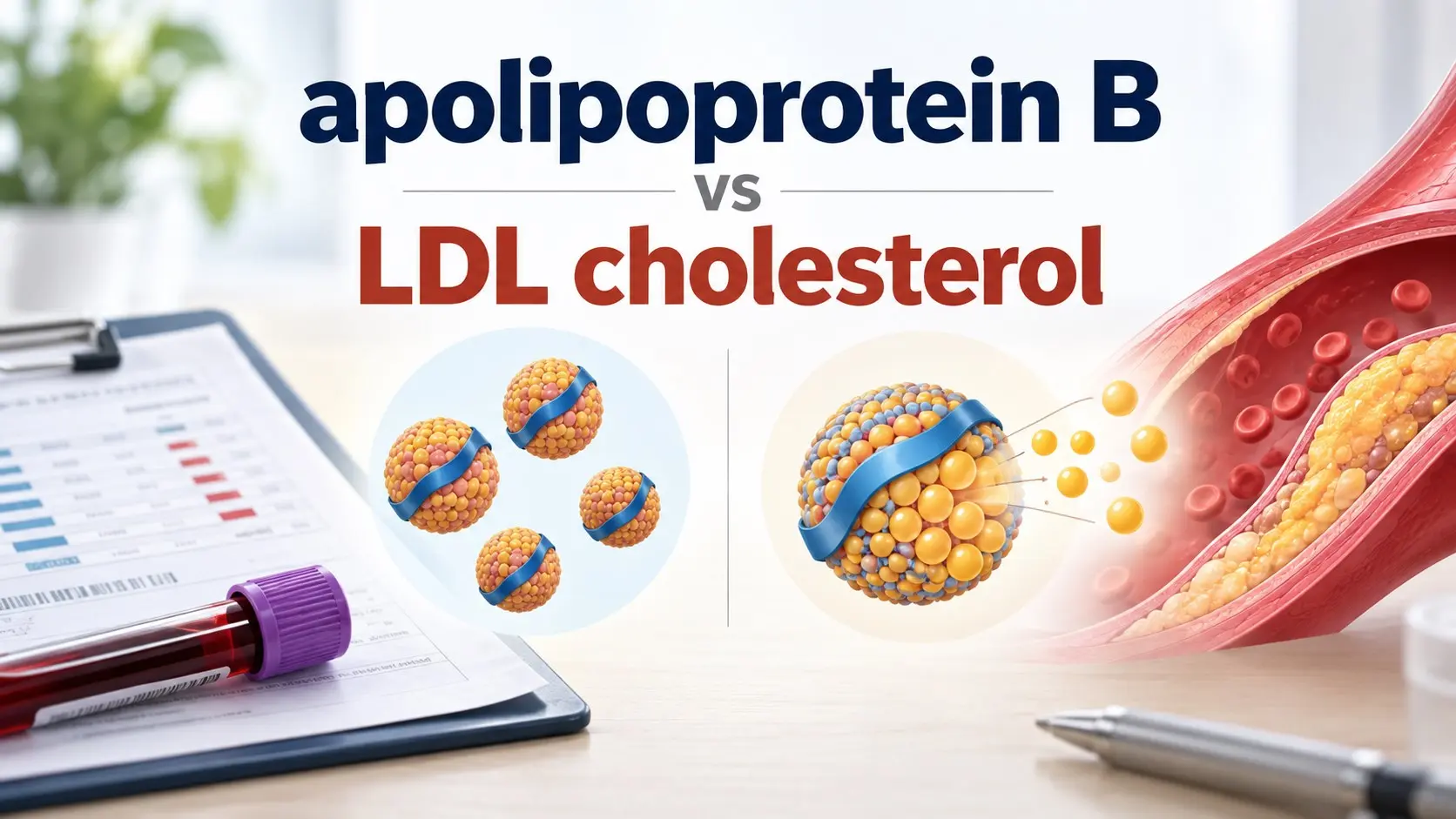
Topic: Apolipoprotein B vs LDL Cholesterol
Reading Time: About 14 minutes
Written and Source-Checked by: Adel Galal, Founder and Lead Writer at NextFitLife
Medical Review Status: This article is educational and source-checked. It has not been medically reviewed by a doctor or cardiologist.
LDL cholesterol and ApoB are connected.
But they do not measure the same thing.
That difference matters most when the two numbers do not agree.
Quick answer: In the comparison of apolipoprotein B vs LDL cholesterol, LDL cholesterol measures how much cholesterol is carried inside LDL particles. ApoB reflects the number of artery-related ApoB particles in the blood. Both matter. ApoB can add useful risk information when standard cholesterol results do not tell the full story.
For the wider picture, start with the NextFitLife Heart and Cardiovascular Health Hub.
ApoB vs LDL cholesterol at a glance
| Question | LDL cholesterol | ApoB |
|---|---|---|
| What does it tell you? | How much cholesterol is carried inside LDL particles | The amount of ApoB-containing particles in circulation |
| What is being measured? | Cholesterol mass | Particle-related protein concentration |
| Is it part of a standard lipid panel? | Usually yes | Usually ordered separately |
| Can the results disagree? | Yes | Yes |
| Main use | Core cholesterol risk and treatment marker | Extra information about atherogenic particle burden |
1. LDL cholesterol measures cholesterol, not particle number
LDL C means low-density lipoprotein cholesterol.
The key word is cholesterol.
An LDL-C result tells you how much cholesterol is being carried inside LDL particles.
It does not directly count each particle.
That does not make LDL-C weak or outdated.
Far from it.
The 2026 ACC and AHA dyslipidemia guideline still uses LDL-C as a major marker for treatment and risk management.1
Higher lifelong exposure to LDL related particles plays a major role in atherosclerotic cardiovascular disease.
This is why LDL C is still central to cholesterol care.
If you need the basics first, read the NextFitLife High Cholesterol Guide.
2. ApoB reflects the number of atherogenic particles
ApoB means apolipoprotein B.
It is a protein found on particles that can carry cholesterol into artery walls.
Each LDL particle has one ApoB molecule.
ApoB is also found on other atherogenic particles.
These include particles such as VLDL, IDL, remnants, and lipoprotein(a).2
This is why saying ApoB is only an LDL particle count is too simple.
It covers more than LDL alone.
A higher ApoB value points to a larger number of ApoB-containing particles in the blood.
The National Lipid Association describes ApoB as a measure of circulating atherogenic lipoprotein particle burden.3
3. The two numbers can disagree
This is the part worth understanding.
Two people can have the same LDL cholesterol value.
One can have fewer particles carrying more cholesterol in each particle.
The other can have more particles carrying less cholesterol in each one.
The LDL C values can look similar.
The ApoB values can look different.
This pattern is called ApoB discordance.
The American Heart Association explains this with a simple traffic idea.
Think of the particles as cars.
Think of cholesterol as the passengers or cargo.
LDL C tells you about the cargo.
ApoB gets closer to telling you how many atherogenic vehicles are on the road.2
I like the idea because it makes the difference easy to see.
But remember that ApoB includes more than LDL particles.
4. Discordance can change how risk is viewed
If LDL-C and ApoB both look high, the message is simple.
There is a lot of cholesterol and a high number of particles.
The harder case is when one looks better than the other.
LDL looks acceptable, but ApoB is higher
This can mean the blood contains more atherogenic particles than the LDL cholesterol amount suggests.
That pattern is more common in people with some metabolic risk factors.
Examples include high triglycerides, diabetes, insulin resistance, and metabolic disease.
The 2026 ACC and AHA guideline says ApoB testing can help find remaining lipoprotein related risk that a standard lipid panel may underestimate.1
A 2026 study of 15,738 adults also found that people with discordantly high ApoB had more progression of coronary artery calcium across several metabolic groups.5
That study was observational.
It does not prove that one ApoB result causes artery disease.
It adds to the evidence that discordance can matter.
LDL looks high but ApoB is lower
This can happen too.
The particles may carry more cholesterol per particle.
A lower ApoB value can change how a clinician understands the lipid pattern.
But it does not give you permission to ignore a high LDL C result.
Current guidelines still use LDL C goals.
ApoB adds information.
It does not erase the other information.
5. ApoB testing is useful for selected people
You do not need every blood test that exists.
More testing is not always better.
The useful question is this:
Will the result help explain my risk or change a care decision?
The 2026 ACC and AHA guideline says an ApoB test can be useful to improve risk assessment and guide care after LDL C and non-HDL cholesterol goals are reached.
It gives special attention to people with:
- Triglycerides above 200 mg/dL
- Diabetes
- A low treated LDL C below 70 mg/dL
- Known atherosclerotic cardiovascular disease
- Cardiometabolic risk
- A possible inherited lipid disorder
These are settings where ApoB can add information that a standard panel may not show clearly.1
If you are trying to understand a blood test, also visit the Medical Tests and Screenings Hub.
6. ApoB is not the same as non HDL cholesterol or Lp(a)
These tests overlap in what they tell us.
They are not the same.
What is non HDL cholesterol?
Non HDL cholesterol is calculated from a standard lipid panel.
It is total cholesterol minus HDL cholesterol.
It reflects cholesterol carried by several atherogenic lipoproteins.
ApoB asks a different question.
It reflects the number of ApoB containing particles instead of the cholesterol carried inside them.
The two numbers tend to move together.
But they do not always agree.
What is lipoprotein(a)?
Lipoprotein(a), also called Lp(a), is a specific lipoprotein particle.
Its level is strongly influenced by genetics.
Lp(a) has ApoB on it.
So it contributes to total ApoB.
But an ApoB result cannot tell you how much Lp(a) you have.
The 2026 guideline recommends measuring Lp(a) at least once in adulthood.1
One test cannot answer every lipid question.
7. Neither result should be interpreted alone
This is the rule I would keep.
A lab number needs context.
Your clinician may look at:
- LDL cholesterol
- ApoB
- Triglycerides
- HDL cholesterol
- Non HDL cholesterol
- Lp(a)
- Blood pressure
- Diabetes
- Kidney health
- Smoking
- Age
- Family history
- Previous heart or artery disease
- Current medicine
This creates a better view of cardiovascular risk.
ApoB is helpful.
It is not a diagnosis.
It does not tell you whether you already have blocked arteries.
It does not tell you whether you need a statin or another medicine without the rest of your health information.
What ApoB number is considered high?
This question sounds simple.
It is not as simple as it looks.
Mayo Clinic Laboratories gives these adult laboratory categories:
| ApoB result | Mayo laboratory category |
|---|---|
| Below 90 mg/dL | Desirable |
| 90 to 99 mg/dL | Above desirable |
| 100 to 119 mg/dL | Borderline high |
| 120 to 139 mg/dL | High |
| 140 mg/dL or higher | Very high |
These are laboratory reference categories.4
They are not personal treatment goals.
That difference matters.
A person with known heart disease can have a different target from a young person with no known cardiovascular disease.
The National Lipid Association has proposed ApoB thresholds for different risk groups, but ApoB treatment thresholds are less established than LDL-C and non-HDL cholesterol thresholds.3
Use the range printed by your laboratory.
Then ask how the result fits your personal risk.
Why high triglycerides make ApoB more useful
This is one of the easiest ways to understand why the test exists.
When triglycerides are high, the blood can contain many cholesterol-carrying particles that do not look obvious from LDL-C alone.
These particles can carry less cholesterol in each particle.
You can end up with a high particle count but an LDL cholesterol value that looks less concerning.
This is one reason the 2026 guideline calls out triglycerides above 200 mg/dL when discussing ApoB testing.1
If your triglycerides are high, do not focus on LDL-C alone.
Ask your clinician what the full lipid pattern means.
Why diabetes can change the picture
Diabetes and metabolic disease can change the number and type of lipoprotein particles in the blood.
This is why ApoB can add useful information in some people with diabetes.
The guideline specifically names diabetes as a setting where ApoB testing can improve risk assessment.1
If you have both diabetes and cholesterol concerns, see the NextFitLife Diabetes and Heart Disease Guide.
Does ApoB replace a standard cholesterol test?
No.
A standard lipid panel is still the starting point for most people.
It usually includes:
- Total cholesterol
- LDL cholesterol
- HDL cholesterol
- Triglycerides
ApoB is an extra test.
Think of it as another camera angle.
It can be useful when the first picture is not clear enough.
Current guidance still uses LDL-C and non-HDL cholesterol goals.1
So calling ApoB the new replacement for cholesterol testing would be wrong.
Is ApoB better than LDL cholesterol?
I would not frame it as a contest.
Each number answers a different question.
LDL-C tells you about cholesterol mass.
ApoB tells you about particle burden.
When they agree, both point in the same direction.
When they disagree, ApoB can add information about risk.
The National Lipid Association reports that when ApoB and LDL-C are discordant, cardiovascular risk often tracks more closely with ApoB and non-HDL cholesterol than LDL-C alone.3
That does not mean everyone needs advanced lipid testing.
It means ApoB has a clear role when the standard result leaves an important question unanswered.
Can food and lifestyle affect ApoB?
Yes.
Nutrition and lifestyle changes that improve the overall atherogenic lipid pattern can also lower ApoB in some people.
The National Lipid Association notes that ApoB can be reduced through nutrition, lifestyle measures, and lipid-lowering medicine.3
Do not turn that into a search for one magic ApoB food.
Your whole pattern matters.
A heart supportive eating pattern may include:
- Vegetables
- Fruit
- Beans
- Lentils
- Whole grains
- Oats
- Nuts
- Seeds
- Fish
- Lean protein
- Unsaturated fats
Limiting excess saturated fat can also help lower LDL cholesterol for many people.
For practical meal ideas, read the Heart Healthy Diet Guide and the Low Cholesterol Diet Plan.
Should you take medicine based on ApoB alone?
No.
Do not start medicine from an internet ApoB chart.
Do not stop medicine because your ApoB falls.
Do not change a statin dose because one result looks better.
Treatment depends on your full ASCVD risk, cholesterol results, medical history, age, diabetes status, kidney health, previous cardiovascular disease, family history, and other factors.
The 2026 guideline also uses modern risk assessment tools and coronary calcium in selected people when treatment decisions remain unclear.1
This is clinician-level decision-making.
Seven questions to ask about your ApoB result
Bring your full lab report.
Then ask simple questions.
1. Do my ApoB and LDL cholesterol agree?
This gets to the point quickly.
2. Does ApoB change how you see my heart risk?
You want context.
Not just another number.
3. Are my triglycerides part of the reason ApoB was ordered?
This can explain why the standard panel and particle burden look different.
4. What does my non-HDL cholesterol show?
It provides another view of cholesterol carried by atherogenic particles.
5. Should I have Lp(a) checked?
The 2026 guideline recommends at least one Lp(a) measurement in adulthood.1
6. Is this number a reference range or my treatment goal?
They are not always the same.
7. If we repeat ApoB, what change are we looking for?
A test should have a purpose.
What not to do with an ApoB result
Do not diagnose blocked arteries from it.
Do not decide that LDL cholesterol no longer matters.
Do not compare your result with another person's number.
Do not start a supplement because it claims to lower ApoB.
Do not stop a prescribed statin or other lipid medicine.
Do not assume a value inside a laboratory range means your cardiovascular risk is low.
Do not assume a high result means a heart attack is about to happen.
The result needs context.
When does an ApoB result deserve more discussion?
Talk with your healthcare professional if:
- ApoB is flagged high
- LDL C and ApoB look very different
- You have high triglycerides
- You have diabetes
- You have known cardiovascular disease
- You have a strong family history of early heart disease
- Your LDL C is already low on treatment but risk remains a concern
- You are unsure what target your clinician is using
One abnormal lab result does not diagnose a disease.
For help reading blood tests safely, visit the Medical Tests and Screenings Hub.
Conclusion
The key lesson in apolipoprotein B vs LDL cholesterol is simple.
LDL C tells you how much cholesterol is being carried.
ApoB tells you more about how many atherogenic particles are carrying it.
Sometimes those two stories match.
Sometimes they do not.
That is where ApoB becomes most useful.
Your next step: Put your LDL-C, ApoB, triglycerides, HDL, and non-HDL cholesterol results on one page. Bring that page to your next visit and ask whether the markers agree and whether the answer changes your care plan.
References and Sources
The following sources are open and accessible. They support the medical and laboratory information in this article.
- American Heart Association Professional Heart DailyPage: 2026 Guideline on the Management of DyslipidemiaUse: Current LDL-C goals, ApoB testing, triglycerides, diabetes, Lp(a), and cardiovascular risk assessment.
Website: Professional.Heart.org
URL: https://professional.heart.org/en/science-news/2026-guideline-on-the-management-of-dyslipidemia
- American Heart AssociationPage: ApoB: Another Look at Heart Disease RiskUse: ApoB explanation, cholesterol cargo, particle number, discordance, and people who may benefit from testing.
Website: Heart.org
- National Lipid AssociationPage: Role of Apolipoprotein B in the Clinical Management of Cardiovascular Risk in AdultsUse: ApoB particle biology, discordance, risk interpretation, non HDL cholesterol, and treatment thresholds.
Website: PubMed Central
- Mayo Clinic LaboratoriesPage: Apolipoprotein B SerumUse: Adult laboratory reference categories and clinical interpretation.
Website: MayoClinicLabs.com
URL: https://www.mayocliniclabs.com/test-catalog/Overview/614544
- PubMedStudy: Apolipoprotein B Low Density Lipoprotein Cholesterol Discordance Refines Cardiovascular Risk Stratification Across Metabolic PhenotypesUse: 2026 research on ApoB and LDL-C discordance and coronary artery calcium progression.
Website: PubMed.NCBI.NLM.NIH.gov
Related NextFitLife Guides and Hubs
- NextFitLife Health Hub
- Heart and Cardiovascular Health Hub
- Medical Tests and Screenings Hub
- High Cholesterol Guide
- Heart Healthy Diet Guide
- Low Cholesterol Diet Plan
- Diabetes and Heart Disease Guide
Author Bio
Adel Galal is the founder and lead writer of NextFitLife.
He researches health, fitness, food, nutrition, and healthy aging topics using recognized medical guidelines, public health sources, laboratory references, and peer-reviewed research.
His role is to compare the evidence, explain where uncertainty remains, and turn difficult health topics into simple questions readers can take to qualified healthcare professionals.
He does not diagnose disease or create personal treatment plans.
This content is for general educational purposes and does not replace professional medical advice, diagnosis, or treatment. Consult an appropriately qualified healthcare professional for personal medical concerns. This article explains published guidance and does not provide a personal clinical assessment. Always consult qualified medical professionals for diagnosis and treatment of any health condition.
For this topic, Adel is also not a cardiologist, lipid specialist, pharmacist, nurse, or licensed healthcare professional.
Learn more about NextFitLife, the author, sourcing standards, and editorial approach on the About Us page.
Frequently Asked Questions
What is the main difference between ApoB and LDL cholesterol?
LDL cholesterol measures how much cholesterol is carried inside LDL particles. ApoB reflects the number of ApoB-containing atherogenic particles in the blood.
Is ApoB better than LDL cholesterol?
They measure different things. LDL C remains a major treatment marker. ApoB can add useful risk information when LDL-C and particle burden do not appear to match.
Can LDL cholesterol be normal while ApoB is high?
Yes. This can happen when a person has a larger number of particles that each carry less cholesterol. This pattern is called discordance.
Who may benefit from an ApoB test?
Current guidance highlights people with high triglycerides, diabetes, known cardiovascular disease, cardiometabolic risk, or very low LDL-C after treatment as groups in whom ApoB may add useful information.
Is ApoB the same as LDL particle number?
No. Each LDL particle contains one ApoB molecule, but ApoB is also found on other atherogenic particles. ApoB therefore reflects a wider group of atherogenic particles than LDL alone.
What is a normal ApoB level?
Laboratory ranges vary. Mayo Clinic Laboratories lists below 90 mg/dL as desirable for adults. A laboratory reference category is not the same as an individual treatment target.
Does ApoB replace a standard lipid panel?
No. A standard lipid panel remains the starting point for most people. ApoB is an extra test used when more information about atherogenic particle burden would be useful.
Does a high ApoB mean I have blocked arteries?
No. ApoB is a risk marker. It does not diagnose blocked arteries or prove that plaque is present. Your clinician interprets it with your full health history and other tests.
Should I stop cholesterol medicine if my ApoB improves?
No. Do not stop or change prescribed cholesterol medicine based on one lab result or an online article. Discuss treatment changes with the clinician responsible for your care.
Should I also ask about lipoprotein(a)?
Yes, this is a reasonable question. The 2026 ACC and AHA guideline recommends measuring Lp(a) at least once in adulthood.

Health & wellness writer with 30+ years of experience in nutrition, fitness, and healthy aging. Founder of NextFitLife.com — evidence-based health guidance.