
Published on: April 14, 2025
Updated on: October 24, 2026
Bicep Workouts with Dumbbells can build stronger arms at home without a large gym setup. The best plan does not need 15 versions of the same curl. A few smart exercises can train the biceps brachii, brachialis, brachioradialis, and forearms from different positions.
A simple routine can use a standard curl, an incline or preacher style curl, a hammer curl, and a reverse curl. Train with control, stop before technique breaks, and gradually add reps or weight.
This guide gives you 17 useful exercises, beginner and intermediate plans, sets and reps, current 2026 research, and a clear way to choose the right curl for your goal.
This article is for general information and education. It does not replace medical advice, diagnosis, or treatment.
I am not a dermatologist or a doctor, and this content does not replace professional medical advice. What I share comes from real life experience, extensive research, and consultation with healthcare providers. Always consult qualified medical professionals for diagnosis and treatment of any health condition.
For broader strength guidance, visit the NextFitLife Fitness Hub, Strength Training and Muscle Building Guide, and Arm Workouts.
Table of Contents
- Bicep Workouts with Dumbbells: Quick Answer
- What Muscles Are You Training?
- What Current Research Says
- 17 Smart Dumbbell Bicep Exercises
- Best Exercises by Goal
- Beginner Bicep Workout
- Two Day Bicep Plan
- 10 Minute Home Workout
- Sets, Reps, and Weight
- Incline Versus Preacher Curls
- Do You Need Failure?
- Common Mistakes
- Frequently Asked Questions
- References and Sources
Bicep Workouts with Dumbbells: Quick Answer
A balanced Bicep Workouts with Dumbbells session can use four movements:
- Standing dumbbell curl
- Incline dumbbell curl
- Hammer curl
- Reverse curl
These exercises cover different elbow and forearm positions without unnecessary duplication.
Use two or three sets per exercise at first. Stop when the final repetitions become challenging but your body is still controlled.
What Muscles Do Bicep Workouts with Dumbbells Train?
Biceps Brachii
The biceps brachii sits on the front of the upper arm. It helps bend the elbow and turn the palm upward.
Brachialis
The brachialis lies beneath the biceps and is a strong elbow flexor.
Brachioradialis
The brachioradialis runs along the forearm and works strongly during neutral grip curls such as hammer curls.
A useful biceps program trains all three rather than focusing only on how much the biceps peak burns.
What Does Current Research Say About Bicep Training?
A 2026 study compared incline dumbbell curls with preacher dumbbell curls for 12 weeks.
The incline curl produced slightly greater growth of the biceps brachii, while the preacher curl produced somewhat greater growth of the brachialis and brachioradialis.
Total elbow flexor growth was similar.
The practical lesson is simple: one curl is not universally superior. Different arm positions can shift the training effect slightly.
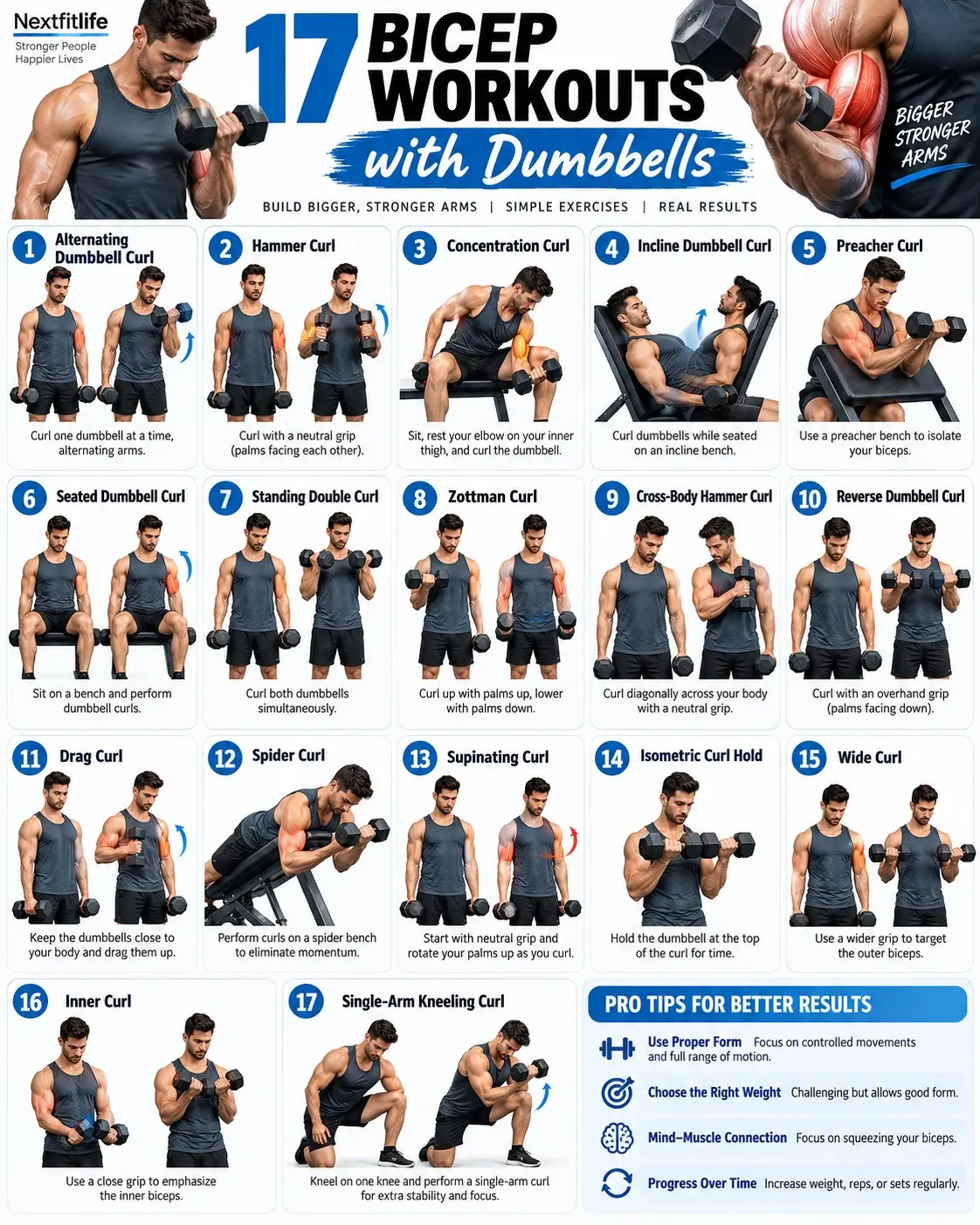
1. Standing Dumbbell Curl
This is the basic movement to learn first.
- Stand tall with a dumbbell in each hand.
- Turn your palms forward.
- Keep your elbows near your sides.
- Curl the weights upward.
- Lower with control.
Do not lean backward to move a weight that is too heavy.
2. Alternating Dumbbell Curl
Curl one arm at a time while the other remains by your side.
This makes it easier to focus on each arm and notice if one side loses control sooner.
3. Seated Dumbbell Curl
Sitting removes some opportunities to swing the hips.
Sit tall, keep your shoulders relaxed, and curl through a comfortable full range.
4. Incline Dumbbell Curl
Lie back against an incline bench with your arms hanging naturally beside you.
The shoulder extended position places the biceps in a relatively lengthened starting position.
A 2026 trial found slightly more biceps brachii growth with incline curls than preacher curls, although both exercises produced strong overall elbow flexor growth.
5. Preacher Dumbbell Curl
Rest your upper arm on a preacher pad or another properly designed support.
The fixed upper arm reduces body swing and changes the shoulder position compared with an incline curl.
Recent research found somewhat greater brachialis and brachioradialis hypertrophy with preacher curls than incline curls.
6. Hammer Curl
Hold the dumbbells with your palms facing each other.
The hammer curl trains the biceps while placing strong demand on the brachialis and brachioradialis.
This is one of the best choices when you want both upper arm and forearm development.
7. Cross Body Hammer Curl
Curl one dumbbell toward the opposite shoulder while keeping the palm facing inward.
Keep your torso still instead of twisting to help the weight upward.
8. Concentration Curl
Sit and train one arm at a time.
Brace the back of the upper arm against the inner thigh and curl the dumbbell.
The stable position makes it difficult to use momentum.
9. Reverse Dumbbell Curl
Hold the dumbbells with your palms facing downward.
Use less weight than you would during a standard curl.
The pronated grip increases the challenge to the brachioradialis and other forearm muscles.
10. Zottman Curl
Curl upward with palms facing you.
At the top, rotate your palms downward and lower slowly.
This combines a normal curl on the way up with more forearm demand on the way down.
11. Supinating Dumbbell Curl
Start with your palms facing inward.
As you curl, rotate the forearm so the palm faces upward near the top.
This combines elbow flexion with forearm supination, two important biceps functions.
12. Spider Dumbbell Curl
Lie chest down on an incline bench and let your arms hang toward the floor.
Curl without moving your upper arm much.
This removes most body swing and gives you a stable setup.
13. Supported One Arm Curl
Brace your nonworking hand on a bench or chair and curl one dumbbell with the other arm.
Support can help when balance or body movement makes strict curls difficult.
14. Slow Eccentric Curl
Curl the dumbbells normally, then lower them under control over about two to four seconds.
A controlled eccentric can make lighter dumbbells more challenging.
There is no need to make every repetition extremely slow.
15. Isometric Curl Hold
Hold the dumbbells with the elbows bent near the middle of the curl.
Keep breathing and hold for 10 to 30 seconds.
This can add variety, but it should not replace normal full range curls.
16. Single Arm Curl
Train all repetitions on one side before switching arms.
This is useful if you want to focus on control or track strength differences between sides.
Research comparing unilateral and bilateral curls has found similar muscle growth overall, so choose the style that fits your workout.
17. Dumbbell Farmer Carry
A farmer carry is not a curl, but it gives your forearms and grip useful work.
- Hold dumbbells at your sides.
- Stand tall.
- Grip the handles firmly.
- Walk under control.
Use this after your curl work rather than treating it as the main biceps exercise.
For more forearm training, visit Best Forearm Exercises.
Best Bicep Workouts with Dumbbells Exercises by Goal
| Goal | Good Choice | Why |
|---|---|---|
| Biceps brachii | Incline curl | Strong biceps stimulus in a lengthened shoulder position |
| Brachialis | Preacher or hammer curl | Useful alternative elbow flexor emphasis |
| Brachioradialis | Hammer or reverse curl | Neutral and pronated grips increase forearm involvement |
| Strict form | Concentration curl | Stable position limits body swing |
| Home beginner | Standing curl | Simple setup with no special bench |
| Grip | Farmer carry | Sustained loaded grip |
Beginner Bicep Workouts with Dumbbells Plan
Beginners do not need six curl variations in one session.
| Exercise | Sets | Target |
|---|---|---|
| Standing dumbbell curl | 2 | 8 to 15 reps |
| Hammer curl | 2 | 8 to 15 reps |
| Concentration curl | 2 | 8 to 12 each arm |
| Farmer carry | 2 | 20 to 40 seconds |
Train this once or twice each week depending on how much pulling work you already do.
Two Day Bicep Workouts with Dumbbells Plan
Day A
- Incline dumbbell curl: 3 sets
- Hammer curl: 2 sets
- Farmer carry: 2 rounds
Day B
- Preacher style dumbbell curl: 3 sets
- Reverse curl: 2 sets
- Concentration curl: 2 sets
Keep at least one recovery day between demanding direct biceps sessions.
10 Minute Bicep Workouts with Dumbbells Routine
| Time | Exercise |
|---|---|
| Minute 1 | Warm up |
| Minutes 2 and 3 | Standing curls |
| Minutes 4 and 5 | Hammer curls |
| Minutes 6 and 7 | Incline or concentration curls |
| Minutes 8 and 9 | Reverse curls |
| Minute 10 | Farmer carry or cool down |
Rest whenever your form needs it. The clock is a guide, not a reason to rush.
Incline Curl Versus Preacher Curl: Which Is Better?
Neither wins every category.
A 2026 study trained one arm with incline curls and the other with preacher curls for 12 weeks.
Incline curls produced slightly greater biceps brachii growth.
Preacher curls produced somewhat greater brachialis and brachioradialis growth.
Total elbow flexor growth was not significantly different.
You can therefore use both across your training rather than trying to find one perfect curl.
Do Partial Curls Build More Biceps?
Partial range training is not automatically better.
A recent trial comparing long length partial preacher curls with full range preacher curls found broadly similar growth, with only small regional differences.
For most people, full controlled repetitions remain a simple default.
Use partials as an optional tool rather than replacing all full range work.
How Heavy Should Your Dumbbells Be?
Choose a weight that lets you control the repetition.
The dumbbell is probably too heavy if you:
- Lean backward
- Swing your hips
- Shrug the shoulder
- Bend the wrist badly
- Cannot lower the weight under control
The weight should become challenging before your form collapses.
How Many Reps Should Bicep Workouts with Dumbbells Use?
You do not need one magic repetition range.
Moderate ranges such as 8 to 15 reps are practical, but muscle growth can occur with lighter or heavier loading when the set is challenging enough.
The 2026 ACSM position stand found that heavier loads are more useful for maximizing strength, while higher weekly training volume supports muscle growth.
How Much Weekly Biceps Volume Do You Need?
You do not need to start with a large amount of direct curl work.
The 2026 ACSM guidance uses roughly 10 weekly sets per muscle group as a useful reference when maximizing hypertrophy is the main goal.
That is not a mandatory beginner target.
Rows, chin ups, and other pulling exercises already give the biceps indirect work.
Start with fewer direct sets and increase them only when progress and recovery support it.
Do Bicep Workouts with Dumbbells Need to Reach Failure?
No.
A 2026 study compared unilateral preacher curls taken to complete failure with curls stopped at about 1 to 3 reps in reserve.
Both approaches increased muscle thickness and strength, with no clear advantage for complete failure.
Hard training matters. Total exhaustion does not need to be the goal.
Do You Need Slow Reps?
You need controlled reps, not exaggerated slow motion.
Lowering the dumbbell under control is useful because it prevents momentum and keeps the movement predictable.
There is no need to turn every repetition into a ten second curl.
Should You Train One Arm or Both Arms Together?
Both work.
Recent research comparing unilateral and bilateral biceps curl training found similar muscle size changes.
Train one arm at a time if it helps your concentration or control. Train both arms together if it saves time.
Can Bicep Workouts with Dumbbells Reduce Arm Fat?
No curl can choose where your body removes fat.
Dumbbell curls can build stronger arm muscles, which may change arm shape as muscle develops.
Fat loss depends on overall nutrition, energy balance, activity, genetics, and time.
For realistic fat loss guidance, visit Weight Loss Immediately.
9 Bicep Workouts with Dumbbells Mistakes
1. Swinging the Weight
Reduce the load if your hips start every repetition.
2. Doing Too Many Curl Variations
Three or four good movements are enough for a focused session.
3. Ignoring the Brachialis
Use hammer curls or preacher curls alongside standard supinated curls.
4. Ignoring the Forearms
Reverse curls, Zottman curls, hammer curls, and carries add forearm work.
5. Training to Failure Every Set
Stopping with a few good reps in reserve can still build strength and muscle.
6. Curling Every Day
Your biceps also work during rows and other pulling movements, so recovery still matters.
7. Bending the Wrist Back
Keep your wrist controlled instead of letting the dumbbell pull it into an uncomfortable position.
8. Chasing a Burn
A strong burn is not proof that one curl is superior.
9. Training Through Elbow Pain
Change the grip, range, load, or exercise if a curl causes sharp joint pain.
When Should You Stop a Biceps Exercise?
Stop exercising and seek appropriate medical care for:
- Sudden severe pain
- A pop followed by bruising or weakness
- Visible arm deformity
- New numbness or persistent tingling
- Major swelling
- Sudden loss of grip strength
- Chest pain
- Fainting or severe shortness of breath
Conclusion: Bicep Workouts with Dumbbells
Bicep Workouts with Dumbbells work best when you use a small group of exercises that train the elbow flexors from different positions and then progressively make those exercises harder.
Start with a standard curl, incline curl, hammer curl, and reverse curl. Keep your body still, control the lowering phase, and stop before your technique breaks.
Your next step is simple: choose four exercises from this guide and complete one controlled biceps session this week.
References and Sources
- American College of Sports Medicine. Resistance Training Prescription for Muscle Function, Hypertrophy, and Physical Performance in Healthy Adults. 2026.
https://pubmed.ncbi.nlm.nih.gov/41843416/ - Exercise Specific Preferential Hypertrophy of Individual Elbow Flexor Muscles After Incline Versus Preacher Dumbbell Curl Training. 2026.
https://pubmed.ncbi.nlm.nih.gov/42829982/ - Elbow Flexor Adaptations to Failure Versus Repetitions in Reserve Training. 2026.
https://pubmed.ncbi.nlm.nih.gov/42784046/ - Distinct Muscle Growth and Strength Adaptations After Preacher and Incline Biceps Curls.
https://pubmed.ncbi.nlm.nih.gov/39809454/ - Small Muscle Mass Exercise Enhances Muscular Adaptations? Effects of Unilateral and Bilateral Biceps Curl Training.
https://pubmed.ncbi.nlm.nih.gov/41359274/ - Partial Range, Full Gains? Long Muscle Length Partial Versus Full Range Elbow Flexor Training.
https://pubmed.ncbi.nlm.nih.gov/41247250/ - Resistance Training Load Does Not Determine Hypertrophy Across Upper and Lower Limbs in Healthy Young Males.
https://pubmed.ncbi.nlm.nih.gov/41474371/
Internal Links + Hub
- NextFitLife Fitness Hub for strength, cardio, mobility, and exercise guidance.
- Strength Training and Muscle Building for progressive resistance and muscle growth guidance.
- Home Workouts and Equipment for simple home training options.
- Arm Workouts for a complete biceps, triceps, and forearm routine.
- Arm Workouts with Weights for broader weighted arm training.
- Best Forearm Exercises for brachioradialis, wrist, and grip work.
- Chest Exercises With Dumbbells for pressing strength and upper body training.
- Rear Delt Exercises Dumbbell for posterior shoulder strength.
- Upper Body Workout for Women for balanced upper body exercise ideas.
- Effective Workout Routines at Home for full home training plans.
- Strength Training Exercises at Home for Beginners for beginner resistance training.
- Healthy and Active Lifestyle for sustainable movement, nutrition, sleep, and recovery habits.
About the Author
Adel Galal is a father of four, three sons and a daughter, and a grandfather of four, with 33 years of hands on parenting experience. He is the founder of Parnthub.com, based in Cairo, Egypt, where he shares practical guidance on feeding, development and family life from newborns to teenagers.
Adel is not a medical professional. Health articles cite trusted sources and are for general information only.
On NextFitLife, Adel researches and writes about strength training, dumbbell workouts, fitness, healthy aging, nutrition, and practical wellness habits with a focus on current evidence, safe progression, and realistic expectations.
Learn more about Adel and NextFitLife on the About Us page.
Bicep Workouts with Dumbbells: Frequently Asked Questions
What are the best Bicep Workouts with Dumbbells?
A balanced routine can include standing curls, incline curls, hammer curls, preacher curls, reverse curls, and concentration curls. You do not need all of them in one workout.
Can I build biceps at home with dumbbells?
Yes. Dumbbells can build biceps at home when the exercises are challenging enough and you gradually add reps, resistance, or training volume.
How often should I do Bicep Workouts with Dumbbells?
One or two direct biceps sessions per week work well for many people. Rows, chin ups, and other pulling exercises also train the biceps indirectly.
Are incline curls better than preacher curls?
Neither is universally better. A 2026 study found slightly greater biceps brachii growth with incline curls, while preacher curls produced somewhat greater brachialis and brachioradialis growth.
Are hammer curls good for biceps?
Yes. Hammer curls train the biceps while also placing strong demand on the brachialis and brachioradialis.
How many biceps exercises should I do?
Two to four well chosen exercises are enough for most focused biceps sessions. More exercises are not automatically better.
How many sets should I do for biceps?
Beginners can start with a few direct sets each session. Around 10 weekly sets per muscle group is a useful hypertrophy reference, but pulling exercises also contribute indirect biceps work.
Do I need 8 to 12 reps?
No. Moderate rep ranges are convenient, but muscle growth can occur across a wider range when sets are challenging and training volume is sufficient.
Do Bicep Workouts with Dumbbells need to reach failure?
No. Recent elbow flexor research found similar muscle and strength gains when sets reached failure or stopped with about 1 to 3 repetitions in reserve.
Should I use full range curls?
Full controlled repetitions are a good default. Long length partial curls can also be useful, but recent research does not show that they universally outperform full range training.
Can bicep curls reduce arm fat?
No. Curls build arm muscle but cannot choose where fat is lost. Overall nutrition, activity, energy balance, genetics, and time determine fat loss.
Should I curl one arm at a time or both together?
Both approaches can work. Recent research found similar muscle growth from unilateral and bilateral biceps curl training.
Why do my forearms work during curls?
The brachioradialis and other forearm muscles assist elbow flexion and grip the dumbbell. Hammer and reverse curls increase their involvement.
When should I stop a biceps exercise?
Stop for sharp pain, sudden weakness, a pop followed by bruising, marked swelling, new numbness, persistent tingling, chest pain, fainting, or severe shortness of breath.

Health & wellness writer with 30+ years of experience in nutrition, fitness, and healthy aging. Founder of NextFitLife.com — evidence-based health guidance.

