Originally Published: January 15, 2023
Last Updated: September 22, 2026
Written and source checked by: Adel Galal, Founder and Lead Writer at NextFitLife
Review status: Updated against current pediatric, dermatology, newborn skin, and topical human milk evidence. This article has not been medically reviewed by a pediatrician or dermatologist.
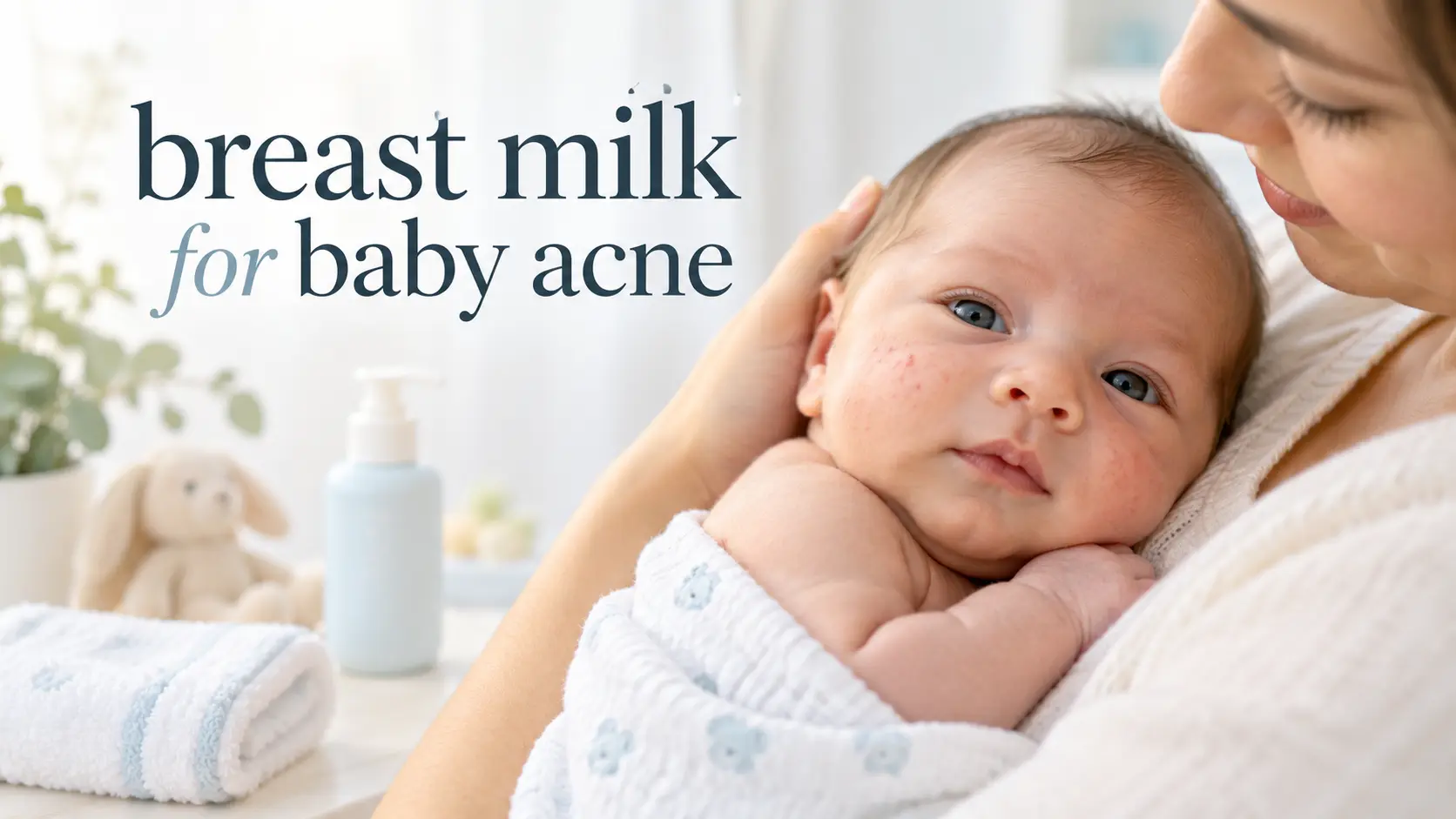
Your newborn has little red or white bumps across the cheeks. Someone tells you to dab breast milk on them.
It sounds gentle. It is already part of your baby's diet, and human milk contains immune proteins and antimicrobial compounds. That makes the idea sound reasonable.
But the evidence needs a careful read.
Breast milk for baby acne has not been proven in a good clinical trial to clear newborn acne faster. Human milk has been studied on other infant skin problems, including eczema and diaper dermatitis, but those conditions are not the same as baby acne.
Most newborn acne improves without treatment.
Table of Contents
- 1. Most baby acne clears on its own
- 2. Breast milk is not a proven acne treatment
- 3. Other breast milk studies do not prove an acne benefit
- 4. Natural does not mean medically tested
- 5. Gentle care is still the best first plan
- 6. Adult acne products can harm delicate baby skin
- 7. Not every newborn bump is acne
- 8. Breastfeeding does not need to stop
- 9. Some rashes need a doctor instead of a home remedy
- What the evidence actually shows
- Simple gentle care plan
- Common myths
- References and Sources
- Frequently asked questions
1. Most Baby Acne Clears on Its Own
Baby acne is common.
The American Academy of Dermatology says roughly one in five newborns develops neonatal acne. It often starts around 2 weeks of age and can appear any time before about 6 weeks.
Common areas include:
- Cheeks
- Nose
- Forehead
- Chin
- Scalp
- Neck
- Upper chest
- Upper back
Typical early acne rarely leaves a scar and usually fades over several weeks or months.
That natural improvement creates a problem when judging home remedies.
If you put breast milk on the face on Monday and the bumps improve the next week, you cannot automatically tell whether the milk caused the change. The acne may simply have followed its normal course.
This is one reason personal stories are weaker evidence than a controlled trial.
For a full guide to appearance, causes, care, and warning signs, read the NextFitLife Baby Acne Treatment Guide.
What Is Baby Acne, Exactly?
The language can be confusing.
Neonatal acne usually refers to acne like bumps that appear in the first 6 weeks of life.
Many newborn facial eruptions are also described as neonatal cephalic pustulosis. These can appear as small red bumps or pustules on the face and scalp, commonly around the third week of life.
Neonatal cephalic pustulosis usually has no blackheads or whiteheads.
True acne can include comedones, which are blackheads and whiteheads.
Experts do not always use these terms in exactly the same way, which helps explain why parent resources sometimes give slightly different explanations for the cause.
The practical message is simpler: most early newborn acne like eruptions are mild and temporary.
2. Breast Milk Is Not a Proven Baby Acne Treatment
This is the central answer.
Human milk contains biologically active substances such as:
- Secretory IgA
- Lactoferrin
- Lysozyme
- Human milk oligosaccharides
- Fatty acids
- Immune cells
- Cytokines
- Growth factors
Those substances have important roles when milk is consumed.
Some have also shown antimicrobial or anti inflammatory effects in laboratory research.
That creates a good research question.
It does not prove that putting milk on a newborn's face clears acne.
What direct evidence exists?
There is no strong acne specific clinical trial showing that topical breast milk clears newborn acne faster than ordinary gentle skin care and time.
That difference matters.
A treatment should ideally be tested on the condition it claims to treat.
AAP Advice and Dermatology Advice Sound Slightly Different
The American Academy of Pediatrics parent site HealthyChildren notes that drops of breast milk applied to a baby's acne may help.
The American Academy of Dermatology takes a more treatment conservative approach. It says neonatal acne usually clears without treatment and recommends gentle care, lukewarm water, no scrubbing, no oily products, and no acne medication unless a doctor recommends it.
These statements are not necessarily contradictory.
“May help” is not the same as “has been proven to work.”
The important evidence gap remains: there is no established breast milk dose, frequency, contact time, or treatment duration for baby acne.
3. Studies on Eczema and Diaper Rash Do Not Prove an Acne Benefit
This is where many online articles make a big jump.
Topical human milk has been studied for some other infant skin problems.
For example, researchers have investigated it in:
- Atopic dermatitis
- Diaper dermatitis
- Newborn skin integrity
- Umbilical cord care
A 2015 randomized trial compared human milk with hydrocortisone 1 percent ointment in infants with mild to moderate atopic dermatitis.
A newer 2026 randomized trial tested topical breast milk together with zinc oxide for diaper dermatitis.
Interesting research?
Yes.
Proof for baby acne?
No.
Why the difference matters?
Diaper dermatitis is an irritation problem in a warm, damp, high friction area.
Atopic eczema involves inflammation and skin barrier dysfunction.
Baby acne and neonatal cephalic pustulosis involve follicles, oil glands, newborn skin development, and in some cases a response involving Malassezia yeast.
A treatment that helps one skin problem does not automatically treat another.
What Does the Evidence Actually Show?
| Evidence | What Was Studied? | What It Means for Baby Acne |
|---|---|---|
| Laboratory research | Immune and antimicrobial components in human milk | Biologically interesting, but does not prove acne clearance |
| Atopic eczema trial | Human milk on mild to moderate eczema | Different diagnosis, so results cannot be assumed to apply to acne |
| Diaper dermatitis studies | Human milk on diaper area irritation | Different skin environment and disease process |
| Parent experience | Parents report trying milk on bumps | Shows the practice is common, not that it caused improvement |
| Direct baby acne trial | Breast milk versus gentle care for confirmed newborn acne | No strong direct trial identified |
4. Natural Does Not Mean Proven or Necessary
Parents are often told that breast milk must be safe for the skin because babies drink it.
Those are two different routes of exposure.
A food can be safe to swallow and still leave residue, moisture, or irritation when repeatedly placed on the skin.
Breast milk contains water, fat, sugar, proteins, immune components, and normal microbes.
That is normal.
It also means milk is not a sterile cosmetic medicine.
A few drops on intact skin are unlikely to cause a serious problem in most healthy babies. Still, “unlikely to harm” does not mean “recommended treatment.”
Do not use breast milk as a home treatment for
- Broken skin
- Open sores
- Blisters
- Bleeding areas
- Hot swollen skin
- Yellow or honey colored crust
- A rash that looks infected
- A painful eye
- A red or swollen eye
Those problems deserve the right diagnosis instead of an experiment.
Should You Try Breast Milk Anyway?
The simplest answer is that you do not need to.
Most newborn acne clears with time, and dermatology guidance recommends gentle care.
If you still want to place a small amount on intact skin, ask your baby's pediatrician first, especially if the rash is unusual or the baby is very young.
There is no medically established schedule such as “apply three times daily for seven days.”
Do not turn an unproven home remedy into a treatment course.
Stop if the skin becomes more red, swollen, crusted, uncomfortable, or irritated.
5. Gentle Skin Care Is Still the Best First Plan
Gentle baby skin care sounds almost too simple.
For ordinary newborn acne, simple is usually exactly what you want.
Wash once a day
Use lukewarm water.
A mild baby cleanser can be used when needed, but avoid harsh or heavily fragranced products.
Pat instead of rubbing
Use a clean soft cloth and gently pat the face dry.
Scrubbing does not unclog newborn pores faster.
It adds irritation.
Wipe away drool and milk after feeds
Milk sitting on the cheeks is different from milk being used as an acne treatment.
Drool, spit up, moisture, and friction can irritate the skin around the mouth and cheeks.
Wipe gently with a damp soft cloth and pat dry.
Avoid oily products
The AAD recommends stopping oily or greasy products when a baby has acne.
That includes using care with:
- Baby oil
- Heavy facial ointments
- Greasy creams
- Coconut oil on acne like bumps
A moisturizer may be useful for eczema or another dry skin problem, but that is a different diagnosis.
For general ingredient guidance, see the NextFitLife Fragrance Free Skincare Guide.
A Simple Seven Day Baby Skin Check
This is not a medicine course.
It is a way to simplify care and watch the rash.
| Day | Action | What You Are Checking |
|---|---|---|
| 1 | Stop unnecessary oils, scrubs, and adult acne products | Remove possible irritation |
| 2 | Wash gently with lukewarm water and pat dry | Keep the routine simple |
| 3 | Clean drool and milk residue after feeds | Reduce contact irritation |
| 4 | Check wet bibs, bedding, clothing, and room heat | Look for friction or overheating |
| 5 | Take one clear photo in natural light | Compare the pattern without constantly touching the skin |
| 6 | Check feeding, wet diapers, temperature, and behavior | Confirm that the baby otherwise seems well |
| 7 | Review whether the rash is stable, improving, or changing | Call the pediatrician if warning signs appear |
6. Adult Acne Products Do Not Belong on Newborn Skin
A baby's face is not a smaller version of teenage skin.
Do not use adult acne treatments unless a pediatrician or dermatologist has given specific instructions.
Avoid experimenting with
- Benzoyl peroxide
- Salicylic acid
- Retinol or other retinoids
- Acne scrubs
- Alcohol toners
- Strong exfoliating acids
- Hydrogen peroxide
- Toothpaste
- Lemon juice
- Vinegar
- Tea tree oil
- Essential oils
- Steroid cream without medical advice
Natural products can irritate newborn skin too.
The adult NextFitLife Acne Treatment Guide is for general education only. Do not use adult acne medicines on a baby based on an adult treatment article.
7. Not Every Bump on a Newborn Is Baby Acne
This is another reason to avoid treating every facial rash with breast milk.
Several common baby skin conditions can look similar.
| Condition | Typical Look | What Makes It Different |
|---|---|---|
| Baby acne | Small red or white bumps and pustules | Common on cheeks, nose, forehead, chin, scalp, chest, or back |
| Milia | Tiny firm white or yellow dots | Usually little inflammation and no treatment needed |
| Eczema | Dry, rough, itchy, flaky, or cracked skin | Often needs moisturization and sometimes medical treatment |
| Heat rash | Small red or clear bumps | Often appears in warm covered areas and improves with cooling |
| Drool irritation | Red, wet, sore, or chapped skin | Follows areas repeatedly exposed to saliva or milk |
| Infection | Pus, blisters, crust, swelling, spreading redness | Needs medical assessment |
For eczema education, see the NextFitLife Atopic Eczema Guide.
For broader skin education, visit the NextFitLife Skin Health Hub.
Baby Acne Versus Infantile Acne
Timing matters.
AAD guidance says acne that begins after about 6 weeks deserves closer medical attention.
Infantile acne often begins between about 3 and 6 months, although definitions vary slightly by source.
It can include:
- Blackheads
- Whiteheads
- Red bumps
- Pustules
- Nodules
- Cysts
Unlike ordinary newborn acne, infantile acne can sometimes scar.
If acne begins after the newborn period, contains blackheads or deep bumps, or leaves marks, ask the pediatrician or a pediatric dermatologist to check it.
8. Breastfeeding Does Not Need to Stop Because of Baby Acne
Breastfeeding and baby acne are often connected online in confusing ways.
Do not stop breastfeeding simply because a newborn has facial bumps.
Baby acne occurs in breastfed and formula fed babies.
Breastfeeding provides nutrition and immune support, and ordinary newborn acne is not a reason to wean.
Does a breastfeeding parent need to change their diet?
There is no good evidence that removing dairy, eggs, wheat, chocolate, spicy food, or another ordinary food from the breastfeeding parent's diet clears simple baby acne.
Do not begin a restrictive elimination diet for a few newborn facial bumps.
A diet review makes more sense when the baby has symptoms that suggest another problem, such as:
- Blood in the stool
- Repeated vomiting
- Poor growth
- Severe eczema
- Feeding problems
- A suspected food allergy
Does milk touching the face cause acne?
Milk or spit up left on the skin can irritate the cheeks or chin.
That is contact irritation.
It is not the same as saying breastfeeding caused acne inside the skin.
Gently wipe away residue after feeding and pat the skin dry.
What About Colostrum?
Colostrum contains high levels of immune proteins and other biologically active compounds.
That does not mean it is a stronger acne medicine.
No good evidence shows that colostrum clears baby acne better than mature breast milk or gentle care.
Use stored colostrum according to your baby's feeding plan rather than assuming it should be used on the skin.
9. Some Rashes Need a Doctor, Not a Home Remedy
Simple newborn acne usually appears in a baby who otherwise looks and behaves well.
Call your baby's healthcare professional if the skin has:
- Blisters
- Open sores
- Pus
- Yellow or honey colored crust
- Fast spreading redness
- Marked swelling
- Warm or painful skin
- A rash close to the eyes
- Deep lumps
- Blackheads
- Scarring
Also call if the baby:
- Feeds poorly
- Has fewer wet diapers
- Is unusually sleepy
- Is difficult to wake
- Seems weak or very irritable
- Has a fever
- Looks unwell to you
Parents do not need to wait until every warning sign on a list is present.
If your newborn seems different or you are worried, call.
When a Fever Changes the Situation
A newborn rash plus fever should not be treated as routine baby acne.
For babies younger than 3 months, a temperature of 38°C or 100.4°F or higher needs prompt medical evaluation.
Do not dab breast milk on the rash and wait to see what happens.
Seven Common Myths About Breast Milk and Baby Acne
Myth 1: Breast milk is a proven baby acne cure
False. Direct clinical evidence for baby acne is missing.
Myth 2: The immune proteins in milk prove it will work
False. A biologically active ingredient can be interesting without producing a useful clinical effect on acne.
Myth 3: Eczema research proves breast milk works for acne
False. Eczema and baby acne are different conditions.
Myth 4: Diaper rash research proves it works on the face
False. The disease process and skin environment are different.
Myth 5: Colostrum must work better because it has more immune factors
Unproven. There is no baby acne trial showing that.
Myth 6: Breastfeeding causes baby acne
False. Baby acne is not a reason to stop breastfeeding.
Myth 7: Natural remedies cannot irritate newborn skin
False. Newborn skin is delicate, and unnecessary products can cause irritation.
What I Would Not Put on Baby Acne
I would not use adult acne cream.
I would not use strong acids.
I would not use essential oils.
I would not use toothpaste.
I would not scrub the face.
I would not squeeze the bumps.
I would not coat the face in heavy oil.
I would not create a daily breast milk treatment schedule from social media.
And I would not use any home remedy to delay a pediatric assessment when the rash looks infected, painful, unusual, or the baby seems unwell.
How to Judge Any Baby Skin Home Remedy
Before trying something you found online, ask:
- Was it studied for this exact condition?
- Was the study performed in babies of a similar age?
- Was there a comparison group?
- Does this condition normally clear by itself?
- Is the evidence from a laboratory or from real patients?
- Could the remedy irritate fragile skin?
- Could trying it delay proper medical care?
- Do pediatric or dermatology sources actually recommend it?
This is especially useful for newborn skin remedies, where “natural” is often used as a substitute for evidence.
Conclusion: Breast Milk for Baby Acne Is Plausible, but Not Proven
The evidence does not show that breast milk for baby acne is a proven cure.
Human milk is biologically complex and has been studied on other infant skin conditions. That is interesting, but it does not establish an acne treatment.
Most newborn acne gets better on its own.
Keep the baby's face gently clean. Pat it dry. Remove milk and drool residue after feeds. Avoid oily products, adult acne medicine, squeezing, and unnecessary remedies.
If the bumps begin later, contain blackheads or deep lumps, spread quickly, become crusted or painful, or your baby seems unwell, call the pediatrician.
That is a safer next step than trying to make normal newborn skin clear faster than it needs to.
Explore More NextFitLife Baby and Skin Guides
- Baby Acne Treatment: Safe Care and Warning Signs
- Complete Skin Health Guide
- Atopic Eczema Guide
- Fragrance Free Skincare Guide
- Complete Acne Treatment Guide
- NextFitLife Health Hub
- NextFitLife Health, Fitness, Nutrition and Beauty Guides
References and Sources
- American Academy of Dermatology. Is That Acne on My Baby's Face? Covers neonatal acne, timing, gentle care, infantile acne, scar risk, and when a dermatologist should examine a baby.
- American Academy of Pediatrics, HealthyChildren.org. Your Baby's First Month: Growth and Physical Appearance. Covers newborn facial bumps, current thinking about neonatal cephalic pustulosis, gentle cleansing, and the statement that breast milk drops may help.
- Columbia Doctors, Columbia University Irving Medical Center. Everything You Need to Know About Baby Acne. Pediatric guidance states that breast milk has not been proven to get rid of baby acne and that ordinary newborn acne clears by itself.
- PubMed, Advances in Neonatal Care. Topical Use of Human Milk in the Neonatal Intensive Care Unit: An Integrative Review. Reviews research on topical human milk for newborn skin conditions, particularly diaper dermatitis and skin integrity. These findings do not establish an acne treatment.
- PubMed, Breastfeeding Medicine. Topical Breast Milk Plus Zinc Oxide Versus Zinc Oxide Alone for Diaper Rash in Infants Under 1 Year: A Randomized Clinical Trial. Published in 2026. It studied diaper dermatitis rather than baby acne, which is why its results should not be transferred directly to newborn facial acne.
These organizations do not endorse NextFitLife. Baby skin conditions can look similar, and diagnosis should be individualized when the rash is unusual, persistent, painful, infected, begins later in infancy, or appears with illness.
About the Author
Adel Galal is the Founder and Lead Writer of NextFitLife. He has more than 30 years of personal interest and experience across health, fitness, nutrition, skin care, family wellness, and healthy aging, together with more than 15 years of health and wellness writing and research.
For baby skin topics, Adel uses a more cautious standard than he would for ordinary adult wellness content. He separates common home practices from proven treatment, checks whether research studied the exact condition being discussed, and highlights warning signs that need pediatric care.
Adel is not a doctor, pediatrician, dermatologist, pharmacist, nurse, or lactation consultant.
I am not a dermatologist or a doctor, and this content does not replace professional medical advice. What I share comes from real life experience, extensive research, and consultation with healthcare providers. Always consult qualified medical professionals for diagnosis and treatment of any health condition.
Learn more about Adel, NextFitLife, and the site's editorial approach at About NextFitLife and Founder Adel Galal.
Frequently Asked Questions About Breast Milk for Baby Acne
Does breast milk help baby acne?
There is no strong direct clinical evidence showing that breast milk clears baby acne. Most newborn acne improves on its own with time and gentle skin care.
Why do people recommend breast milk for baby acne?
Human milk contains immune and antimicrobial components, and it has been studied for other infant skin conditions. Those properties make the idea plausible, but they do not prove an acne benefit.
Does the American Academy of Pediatrics recommend breast milk for baby acne?
A HealthyChildren parent resource says drops of breast milk may help. However, this is not the same as evidence from an acne specific clinical trial, and dermatology guidance still focuses on gentle care and allowing newborn acne to clear naturally.
Is breast milk safe to put on baby acne?
A small amount on healthy intact skin is unlikely to cause serious harm for most babies, but it is not a medically established treatment. Stop if irritation develops, and do not use it instead of care for an unusual or infected rash.
How often should I put breast milk on baby acne?
There is no proven medical dose, frequency, or treatment schedule because breast milk has not been established as a baby acne treatment.
Can breast milk make baby acne worse?
Milk left on the skin can create moisture and residue and may add irritation when mixed with drool, sweat, or friction. If the skin looks worse after any home remedy, stop using it.
Does breastfeeding cause baby acne?
No. Baby acne occurs in breastfed and formula fed babies. Do not stop breastfeeding because your baby develops ordinary newborn facial bumps.
Should I change my diet while breastfeeding to clear baby acne?
Simple baby acne is not a reason to remove dairy, eggs, wheat, chocolate, or other foods from your diet. Discuss diet changes with a healthcare professional when the baby has signs of allergy or another medical concern.
Can I use colostrum on baby acne?
There is no good evidence that colostrum clears baby acne or works better than mature breast milk. Its high immune protein content does not prove a topical acne effect.
What is the best home care for baby acne?
Wash gently with lukewarm water, use a mild baby cleanser only when needed, pat the skin dry, remove milk and drool residue, avoid oily products, and never squeeze or scrub the bumps.
Can I use coconut oil on baby acne?
Greasy products can make acne like bumps look worse. Avoid coconut oil on suspected baby acne unless your baby's healthcare professional recommends it for a different skin diagnosis.
Can I use benzoyl peroxide on baby acne?
Do not use benzoyl peroxide or another adult acne treatment on a newborn unless a pediatrician or dermatologist specifically prescribes it.
What is the difference between baby acne and milia?
Baby acne often causes inflamed red bumps or small pustules. Milia are usually tiny firm white or yellow bumps with little surrounding redness. Both commonly clear without treatment.
How is baby acne different from eczema?
Baby acne looks more like small pimples or pustules. Eczema is usually dry, rough, itchy, cracked, or scaly and may need moisturizing or medical treatment.
What is neonatal cephalic pustulosis?
It is a common newborn facial or scalp eruption with small bumps or pustules, often appearing around the third week. It usually has no blackheads or whiteheads and often resolves without treatment.
When does newborn acne become infantile acne?
Acne beginning after about 6 weeks deserves medical review. Infantile acne often develops between about 3 and 6 months and can include blackheads, whiteheads, nodules, or cysts.
Can infantile acne cause scars?
Yes. Deeper infantile acne can sometimes scar, which is one reason acne that begins later or contains deep bumps should be assessed by a pediatrician or dermatologist.
When should I call the pediatrician about baby acne?
Call if the rash has blisters, pus, crusting, swelling, pain, rapid spread, blackheads, deep lumps, or marks, or if your baby feeds poorly, has fewer wet diapers, has a fever, or seems unwell.
Is a fever normal with baby acne?
No. Fever is not a feature of ordinary baby acne. A baby younger than 3 months with a temperature of 38°C or 100.4°F or higher needs prompt medical assessment.
How long does baby acne last?
Many cases improve within a few weeks, though some last a few months. Typical newborn acne usually clears without scarring.

Health & wellness writer with 30+ years of experience in nutrition, fitness, and healthy aging. Founder of NextFitLife.com — evidence-based health guidance.