
Updated on: October 16, 2026
Written and source checked by: Adel Galal, Founder and Lead Writer at NextFitLife
Medical review status: This article has not been medically reviewed by a doctor, emergency physician, sports medicine specialist, registered dietitian, pharmacist, athletic trainer, or other licensed healthcare professional.
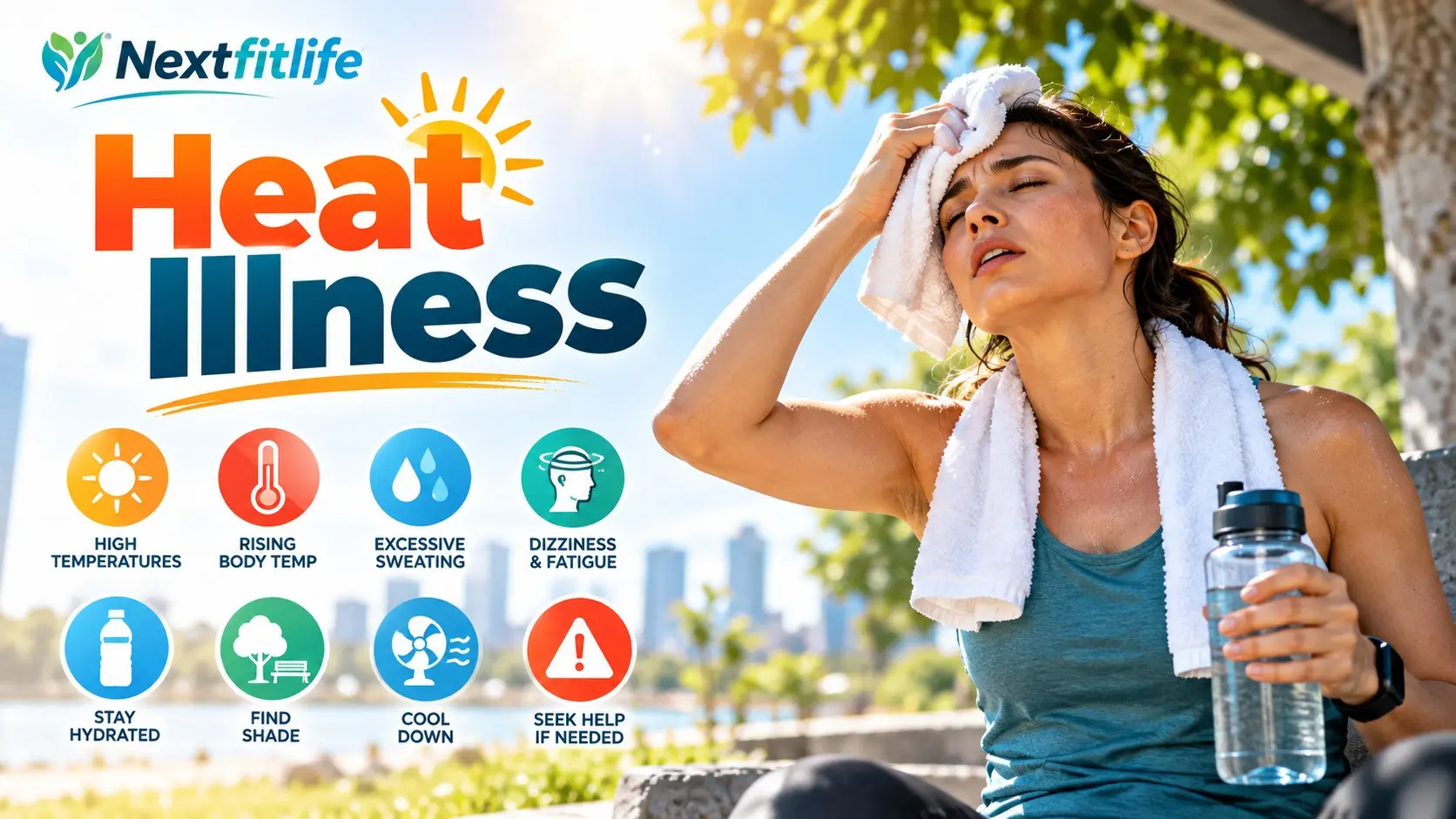
Heat illness happens when your body cannot handle the heat load placed on it. It can cause heat rash, painful muscle cramps, dizziness, fainting, heat exhaustion, or life threatening heat stroke.
The most important rule is simple: stop activity early, move to a cooler place, start cooling, and pay attention to brain symptoms such as confusion, strange behavior, slurred speech, seizure, or collapse.
This article is for general information and education. It does not replace medical advice, diagnosis, or treatment.
If painful muscle spasms are the main symptom, read Heat Cramps: Symptoms, First Aid, and Prevention. If weakness, dizziness, headache, nausea, and heavy sweating dominate, see Heat Exhaustion: Symptoms and First Aid.
Table of Contents
- What heat illness really means
- Main types of heat illness
- Heat rash
- Heat cramps
- Heat syncope
- Heat exhaustion
- Heat stroke
- Rhabdomyolysis
- 11 critical safety steps
- Recognize early symptoms
- Stop activity
- Move somewhere cool
- Cool the body quickly
- Use fluids safely
- Know the heat stroke warning signs
- Do not leave the person alone
- Acclimatize gradually
- Use work and exercise breaks
- Review medicines and health risks
- Know when to seek medical help
- Heat illness comparison table
- Hydration and electrolytes
- Who is at higher risk
- Prevention during heat waves
- Frequently asked questions
What Is Heat Illness?
Heat illness describes health problems caused by too much heat exposure, especially when the body cannot release heat fast enough.
Your body normally cools itself by sending more blood toward the skin and producing sweat. Sweat cools you when it evaporates.
That system becomes less effective when:
- The air is very hot
- Humidity is high
- Physical work is intense
- You wear heavy protective clothing
- You lose too much fluid
- You are not used to the heat
Heat illness is not one single disease.
It includes several conditions with different levels of urgency.
Heat Illness Does Not Always Progress in Five Neat Stages
This is an important correction to a common online explanation.
You may see heat illness presented as a fixed ladder:
- Heat rash
- Heat cramps
- Heat syncope
- Heat exhaustion
- Heat stroke
Those are real heat related conditions, but people do not always pass through every one in that order.
Someone can develop heat stroke without first noticing obvious heat cramps or heat exhaustion.
Do not wait for every earlier symptom before acting on a dangerous one.
What Are the Main Types of Heat Illness?
Heat rash
Heat rash, sometimes called prickly heat, is skin irritation caused when sweat remains trapped on the skin.
It often appears as clusters of small red bumps in areas such as:
- Neck
- Upper chest
- Groin
- Skin folds
Keep the area cool and dry.
Heat cramps
Heat cramps cause painful muscle spasms, often in the legs, arms, or abdomen.
They commonly occur after heavy sweating and physical work.
For detailed first aid, read Heat Cramps.
Heat syncope
Heat syncope means fainting or feeling faint in hot conditions.
It can happen when blood pools in the legs and blood pressure falls, especially after standing for a long time or suddenly standing up.
A person who faints needs assessment because fainting can have many causes besides heat.
Heat exhaustion
Heat exhaustion happens when heat strain and fluid or salt loss overwhelm the body's ability to keep up.
Common signs include:
- Heavy sweating
- Weakness
- Fatigue
- Dizziness
- Headache
- Nausea
- Thirst
- Muscle cramps
- Fast heartbeat
Read Heat Exhaustion for the full recovery and first aid guide.
Heat stroke
Heat stroke is the most dangerous heat illness.
Brain dysfunction is the warning sign that should get your attention.
Possible symptoms include:
- Confusion
- Agitation
- Strange behavior
- Slurred speech
- Seizure
- Collapse
- Loss of consciousness
A very high core body temperature is another key feature.
Heat stroke is an emergency.
See Heat Stroke: Emergency Signs and Treatment.
Rhabdomyolysis
Hard physical work in extreme heat can sometimes contribute to rhabdomyolysis, a serious breakdown of muscle tissue.
Warning signs can include:
- Severe muscle pain
- Weakness
- Muscle cramps
- Dark tea or cola colored urine
- Reduced urine output
Dark urine after severe heat exposure and hard exercise needs prompt medical evaluation.
1. Recognize the Early Signs Before They Become Severe
Heat illness often gives you a chance to act early.
Warning symptoms can include:
- Unusual thirst
- Heavy sweating
- Muscle cramps
- Headache
- Dizziness
- Weakness
- Nausea
- Feeling faint
- Unusual tiredness
If these symptoms appear during hot weather or hard activity, do not treat them as a test of toughness.
Stop and cool down.
2. Stop the Activity Immediately
Do not finish the last lap.
Do not finish the last load of bricks.
Do not keep gardening because only ten minutes remain.
Heat illness can worsen while you continue generating body heat through muscular work.
Stopping the activity is part of treatment.
3. Move to Shade or Air Conditioning
Get the person out of the hot environment.
Air conditioning is ideal when available.
If not, use:
- Deep shade
- A cooled vehicle
- A fan with wet skin
- A cooler indoor building
- A shaded rest station
Remove unnecessary heavy clothing and protective equipment when it is safe to do so.
4. Start Cooling Early
Do not wait until someone looks critically ill before cooling them.
Useful cooling methods include:
- Cool wet towels
- Cool water on the skin
- Fans
- Removing excess clothing
- Cold packs around the neck, armpits, and groin
For suspected heat stroke, faster cooling is better.
Cold water immersion is one of the fastest methods for exertional heat stroke when it can be done safely.
Call emergency services first or have someone call while cooling begins.
5. Give Fluids Only When the Person Can Drink Safely
If the person is fully awake, able to swallow normally, and has milder heat illness, cool water can help.
A sports drink or other electrolyte source can be useful after long periods of heavy sweating.
Do not force fluids into someone who is:
- Confused
- Unconscious
- Having a seizure
- Vomiting repeatedly
- Unable to swallow safely
That creates an aspiration risk.
6. Treat Confusion as a Heat Stroke Warning
This is the single most useful distinction to remember.
A hot person with muscle cramps is concerning.
A hot person with confusion is an emergency.
Other dangerous brain symptoms include:
- Slurred speech
- Agitation
- Unusual behavior
- Seizure
- Collapse
- Loss of consciousness
Call emergency services and start rapid cooling.
7. Do Not Assume Sweating Rules Out Heat Stroke
This misconception can delay treatment.
Classic heat stroke from prolonged environmental heat can produce hot, dry skin.
But exertional heat stroke, which happens during hard exercise or physical work, can occur while the person is still sweating heavily.
Look at mental status and overall condition, not just the skin.
8. Never Leave Someone With Significant Heat Illness Alone
OSHA specifically advises staying with a person who develops heat illness.
Symptoms can worsen quickly.
Watch:
- Breathing
- Alertness
- Speech
- Coordination
- Vomiting
- Ability to drink
If the condition deteriorates, escalate care immediately.
9. Acclimatize Gradually to Hot Conditions
Heat acclimatization is the process of allowing the body to adapt gradually to working or exercising in heat.
New workers and people returning after time away are at increased risk.
Do not go from a cool indoor routine straight into a full day of intense outdoor work.
Build exposure and workload gradually.
Your body becomes better at handling heat over time, but adaptation is not permanent.
10. Use Rest Breaks Before Symptoms Force You to Stop
Prevention is easier than rescue.
During extreme heat:
- Schedule demanding work earlier or later when possible
- Reduce unnecessary physical workload
- Take cooling breaks
- Rotate demanding tasks when practical
- Use shade or cooled rest areas
- Drink regularly
- Use a buddy system
Protective clothing can trap heat, so people wearing heavy gear may need more cooling time.
11. Know When Home First Aid Is No Longer Enough
Heat exhaustion should begin improving after activity stops, cooling begins, and fluids are replaced.
Mayo Clinic advises seeking medical care when symptoms worsen or do not improve within about one hour.
Get help sooner for:
- Fainting
- Confusion
- Seizure
- Severe weakness
- Repeated vomiting
- Inability to drink
- Severe shortness of breath
- Dark urine with severe muscle pain
- Rapid deterioration
Do not use the one hour rule for suspected heat stroke.
Heat stroke is an emergency immediately.
Heat Illness Symptoms Compared
| Condition | Typical Signs | Best Immediate Action |
|---|---|---|
| Heat rash | Red or prickly bumps in sweaty skin areas | Cool down and keep skin dry |
| Heat cramps | Painful muscle spasms, usually legs, arms, or abdomen | Stop, cool, hydrate, replace electrolytes when appropriate |
| Heat syncope | Fainting, dizziness, light headedness | Lie down in a cool place and seek assessment when needed |
| Heat exhaustion | Heavy sweating, headache, nausea, weakness, dizziness, thirst, fast pulse | Stop, cool, drink if alert, monitor closely |
| Heat stroke | Confusion, altered behavior, slurred speech, seizure, collapse, unconsciousness | Emergency services plus rapid cooling |
| Rhabdomyolysis | Severe muscle pain, weakness, dark urine, reduced urine | Prompt medical evaluation |
What Causes Heat Illness?
Heat illness develops when heat entering or being produced by the body exceeds the amount the body can release.
Common contributors include:
- High outdoor temperature
- High humidity
- Direct sun
- Hard physical work
- Exercise
- Heavy protective clothing
- Poor air movement
- Lack of acclimatization
- Dehydration
It can happen outdoors or indoors.
Factories, kitchens, warehouses, vehicles, attics, and poorly ventilated rooms can all become dangerous.
Why Humidity Makes Heat More Dangerous
Sweat only cools you effectively when it evaporates.
High humidity slows that evaporation.
You can therefore sweat heavily without cooling efficiently.
This is why the air temperature by itself does not tell the full story.
The heat index combines temperature and humidity to describe how hot conditions feel to the body.
Does the Heat Index Tell You Everything?
No.
Heat index is useful, but personal heat stress also depends on:
- Direct sunlight
- Physical workload
- Clothing
- Air movement
- Fitness
- Acclimatization
- Medical conditions
- Medicines
A construction worker in protective gear can have far more heat strain than someone sitting in the shade at the same air temperature.
How Much Water Should You Drink in Hot Weather?
There is no single amount that fits every person or every situation.
Your needs depend on:
- Heat
- Humidity
- Body size
- Activity level
- Sweat rate
- Clothing
- Medical conditions
During ordinary daily activity, drink regularly and respond to thirst.
During prolonged heavy work in heat, planned hydration becomes more useful.
Do not deliberately drink huge amounts of plain water in a short time.
Overdrinking can dilute blood sodium and cause hyponatremia, which can also become dangerous.
When Do Electrolytes Make Sense?
Electrolyte replacement becomes more useful when sweating is heavy and prolonged.
This can happen during:
- Long outdoor work shifts
- Endurance exercise
- Sports tournaments
- Repeated hot workouts
- Work in heavy protective gear
For short activity, water plus normal meals is often enough.
People with heart failure, kidney disease, or a prescribed sodium restriction should follow their clinician's fluid and electrolyte advice instead of using a generic sports plan.
Should You Take Salt Tablets?
Do not use salt tablets as routine heat illness prevention.
Food and balanced electrolyte drinks can replace sodium in a more controlled way when extra replacement is needed.
Salt tablets can be inappropriate for people with:
- High blood pressure
- Heart disease
- Kidney disease
- A sodium restricted diet
For specific cramp first aid, see Heat Cramps.
Who Is at Higher Risk of Heat Illness?
Anyone can become ill from heat.
Risk rises in some groups.
Older adults
Aging can reduce heat regulation, thirst sensation, cardiovascular reserve, and the ability to adapt quickly to extreme temperatures.
Babies and young children
Young children depend on adults for fluids, clothing, shade, and temperature control.
Outdoor workers
Construction workers, agricultural workers, delivery staff, landscapers, and others doing physical labor outdoors can accumulate large amounts of heat.
Athletes
Hard training creates heat inside the body even before weather conditions are considered.
New workers
People new to a hot environment have not yet fully acclimatized.
People with chronic disease
Heart, kidney, lung, metabolic, and neurological conditions can affect heat tolerance.
People taking some medicines
Some medicines affect fluid balance, sweating, blood pressure, alertness, or temperature regulation.
Which Medicines Can Affect Heat Tolerance?
Examples that may deserve discussion with a doctor or pharmacist include some:
- Diuretics
- Blood pressure medicines
- Anticholinergic medicines
- Stimulants
- Psychiatric medicines
- Sedating medicines
This does not mean the medicine is unsafe or should be stopped.
Do not stop a prescription drug because the weather gets hot.
Ask how your treatment changes your hydration, blood pressure, sweating, or heat risk.
How Do You Acclimatize to Heat?
Increase exposure gradually.
A person new to hot work should not immediately take on the same full workload as someone who has worked safely in heat for weeks.
During the adjustment period:
- Reduce workload
- Increase rest opportunities
- Use shade or air conditioning
- Monitor symptoms closely
- Use a buddy system
If you spend several days away from the heat, some adaptation can be lost.
How Can You Stay Safer During a Heat Wave?
Use air conditioning when possible
A fan can help in some conditions, but during extreme heat an air conditioned environment gives much stronger protection.
Move activity to cooler hours
Early morning or evening can reduce heat load.
Wear light clothing
Choose lightweight, loose clothing when work and safety requirements allow it.
Keep checking vulnerable people
Older relatives, young children, people living alone, and people with chronic disease may need help staying cool.
Never leave anyone in a parked car
A vehicle can heat rapidly.
Children, older adults, and pets should never be left in a parked car in warm conditions.
Should You Exercise in Extreme Heat?
If conditions are extreme, move the workout.
Exercise indoors, reduce intensity, shorten the session, or choose a cooler time.
When exercising outside:
- Start hydrated
- Use lighter clothing
- Take cooling breaks
- Reduce pace
- Watch for dizziness and headache
- Stop when symptoms begin
Fitness does not make anyone immune to heat stroke.
Can You Sleep in a Very Hot Room Safely?
Hot nights deserve attention because the body loses a chance to recover from daytime heat.
Use air conditioning when possible.
If you do not have it:
- Use the coolest room
- Improve safe ventilation
- Use light bedding
- Drink normally through the evening
- Use cool showers or damp cloths
- Spend time in an air conditioned public place during extreme heat when available
Older adults and people with chronic illness may need additional help during prolonged heat waves.
What Should You Never Do With Suspected Heat Stroke?
- Do not leave the person alone
- Do not make them walk to another location if they can be cooled where they are
- Do not wait for the skin to become dry
- Do not delay cooling while looking for a thermometer
- Do not force fluids into an unconscious or confused person
- Do not assume rest alone will fix altered mental status
Call emergency services and cool the person immediately.
Common Heat Illness Mistakes
| Mistake | Why It Is Risky | Better Action |
|---|---|---|
| Waiting for all five stages | Heat stroke can occur without a neat progression | Act on the symptoms that are present |
| Assuming sweating rules out heat stroke | Exertional heat stroke can involve heavy sweating | Use mental status and overall condition |
| Pushing through dizziness | Continued activity creates more internal heat | Stop, cool, and reassess |
| Giving fluids to an unconscious person | They can aspirate fluid into the lungs | Call emergency services and focus on cooling |
| Using water as the only solution to every heat problem | Cooling, workload, electrolytes, and medical care may also matter | Match the response to the illness |
| Sending a sick worker home alone | Heat illness can worsen rapidly | Stay with the person and arrange appropriate care |
Conclusion: Cool First and Take Brain Symptoms Seriously
Heat illness becomes dangerous when early symptoms are ignored.
Stop activity when headache, dizziness, cramps, nausea, weakness, or unusual fatigue begins. Move somewhere cooler, start cooling, and replace fluids safely.
Your most important next step is to remember the emergency line: confusion, slurred speech, seizure, collapse, or loss of consciousness after heat exposure means possible heat stroke. Call emergency services and begin rapid cooling immediately.
References and Sources
- Occupational Safety and Health Administration. Heat Related Illnesses and First Aid.
Covers heat rash, heat cramps, heat exhaustion, heat stroke, first aid, active cooling, emergency symptoms, and the need to stay with an affected person.
https://www.osha.gov/heat-exposure/illness-first-aid/ - Centers for Disease Control and Prevention, National Institute for Occupational Safety and Health. Heat Stress.
Provides guidance on heat illness, workers at risk, prevention, acclimatization, cooling, hydration, and occupational heat exposure.
https://www.cdc.gov/niosh/heat-stress/ - Mayo Clinic. Heat Exhaustion: Symptoms and Causes.
Updated June 6, 2026. Covers heat exhaustion symptoms, progression to heat stroke, high humidity, exercise, prevention, and the one hour medical review threshold.
https://www.mayoclinic.org/diseases-conditions/heat-exhaustion/symptoms-causes/syc-20373250 - Mayo Clinic. Heatstroke: First Aid.
Covers emergency symptoms, rapid cooling, altered mental status, sweating, fainting, seizure, and immediate emergency action.
https://www.mayoclinic.org/first-aid/first-aid-heatstroke/basics/art-20056655 - Mayo Clinic. Heatstroke: Symptoms and Causes.
Covers exertional and nonexertional heat stroke, brain symptoms, sweating patterns, high temperature, and emergency treatment.
https://www.mayoclinic.org/diseases-conditions/heat-stroke/symptoms-causes/syc-20353581 - MedlinePlus. Heat Illness.
Provides patient focused guidance on heat rash, cramps, exhaustion, heat stroke, risk factors, prevention, and first aid.
https://medlineplus.gov/heatillness.html - Occupational Safety and Health Administration. Heat Controls.
Covers cooler work scheduling, workload reduction, hydration, buddy systems, emergency planning, cooling equipment, and protective clothing.
https://www.osha.gov/heat-exposure/controls
Internal Links and Helpful NextFitLife Guides
- Heat Cramps: Symptoms, Causes, First Aid, and Prevention
- Heat Exhaustion: Symptoms, First Aid, Prevention, and Recovery
- Heat Stroke: Emergency Signs, Treatment, and Prevention
- Foods High in Magnesium for Leg Cramps
- Benefits of Physical Activity
- Healthy Lifestyle Roadmap
About the Author
Adel Galal is the Founder and Lead Writer at NextFitLife. He researches heat safety, exercise, hydration, environmental health, fitness, nutrition, and everyday wellness and turns current medical and public health guidance into clear practical information for everyday readers.
I am not a doctor or licensed healthcare professional, and this content does not replace professional medical advice, diagnosis, or treatment. I share information based on extensive research, real life experience, and consultation with healthcare providers. Always consult a qualified healthcare professional for diagnosis, treatment, or guidance about any health condition.
Learn more about Adel, NextFitLife, and the site's editorial approach on the About Us page.
Frequently Asked Questions
What is heat illness?
Heat illness is a group of health problems caused by excessive heat exposure or heat produced during physical activity. It ranges from heat rash and cramps to heat exhaustion and life threatening heat stroke.
What are the early signs of heat illness?
Early signs can include heavy sweating, thirst, muscle cramps, headache, dizziness, weakness, nausea, and unusual fatigue.
What are the signs of heat exhaustion?
Heat exhaustion can cause heavy sweating, dizziness, headache, nausea, weakness, thirst, muscle cramps, irritability, and a fast heartbeat.
What are the signs of heat stroke?
Danger signs include confusion, strange behavior, slurred speech, seizure, collapse, fainting, or loss of consciousness, often with a very high core body temperature.
Can you have heat stroke while still sweating?
Yes. Exertional heat stroke can occur while a person is still sweating heavily. Do not wait for dry skin before treating altered mental status as an emergency.
What is the first thing to do for heat illness?
Stop the activity and move the person to a cool place. Remove excess clothing, begin cooling, and give cool fluids only if the person is fully alert and can swallow safely.
How long should heat exhaustion last?
Symptoms should begin improving with rest, cooling, and fluids. Seek medical care if symptoms worsen or do not improve within about one hour.
Should I give water to someone with heat stroke?
Do not force fluids into a confused, unconscious, seizing, or unsafe to swallow person. Call emergency services and focus on rapid cooling.
What is the difference between heat exhaustion and heat stroke?
Heat exhaustion commonly causes sweating, weakness, headache, nausea, dizziness, and thirst. Heat stroke affects brain function and can cause confusion, slurred speech, seizure, collapse, or unconsciousness.
Can heat illness happen indoors?
Yes. Hot factories, kitchens, warehouses, vehicles, attics, and poorly ventilated rooms can all create dangerous heat exposure.
Do electrolytes prevent heat illness?
Electrolytes can help replace salts lost during long periods of heavy sweating, but they do not replace cooling, rest, workload changes, or emergency care when severe heat illness occurs.
Should I take salt tablets in hot weather?
Routine salt tablet use is not recommended. Food and balanced electrolyte drinks can replace sodium more safely when extra replacement is appropriate.
Who is most at risk from heat illness?
Higher risk groups include older adults, young children, outdoor workers, athletes, people new to hot environments, people with chronic health conditions, and people taking medicines that affect fluid balance or temperature regulation.
How can I prevent heat illness during exercise?
Exercise during cooler hours, reduce intensity when conditions are extreme, start hydrated, wear suitable clothing, take cooling breaks, build heat exposure gradually, and stop when warning symptoms appear.
When is heat illness an emergency?
Heat illness is an emergency when there is confusion, slurred speech, seizure, collapse, loss of consciousness, severe breathing difficulty, or rapid deterioration. Call emergency services and begin cooling immediately.

Health & wellness writer with 30+ years of experience in nutrition, fitness, and healthy aging. Founder of NextFitLife.com — evidence-based health guidance.

