
Published on: February 19, 2024
Updated on: October 26, 2026
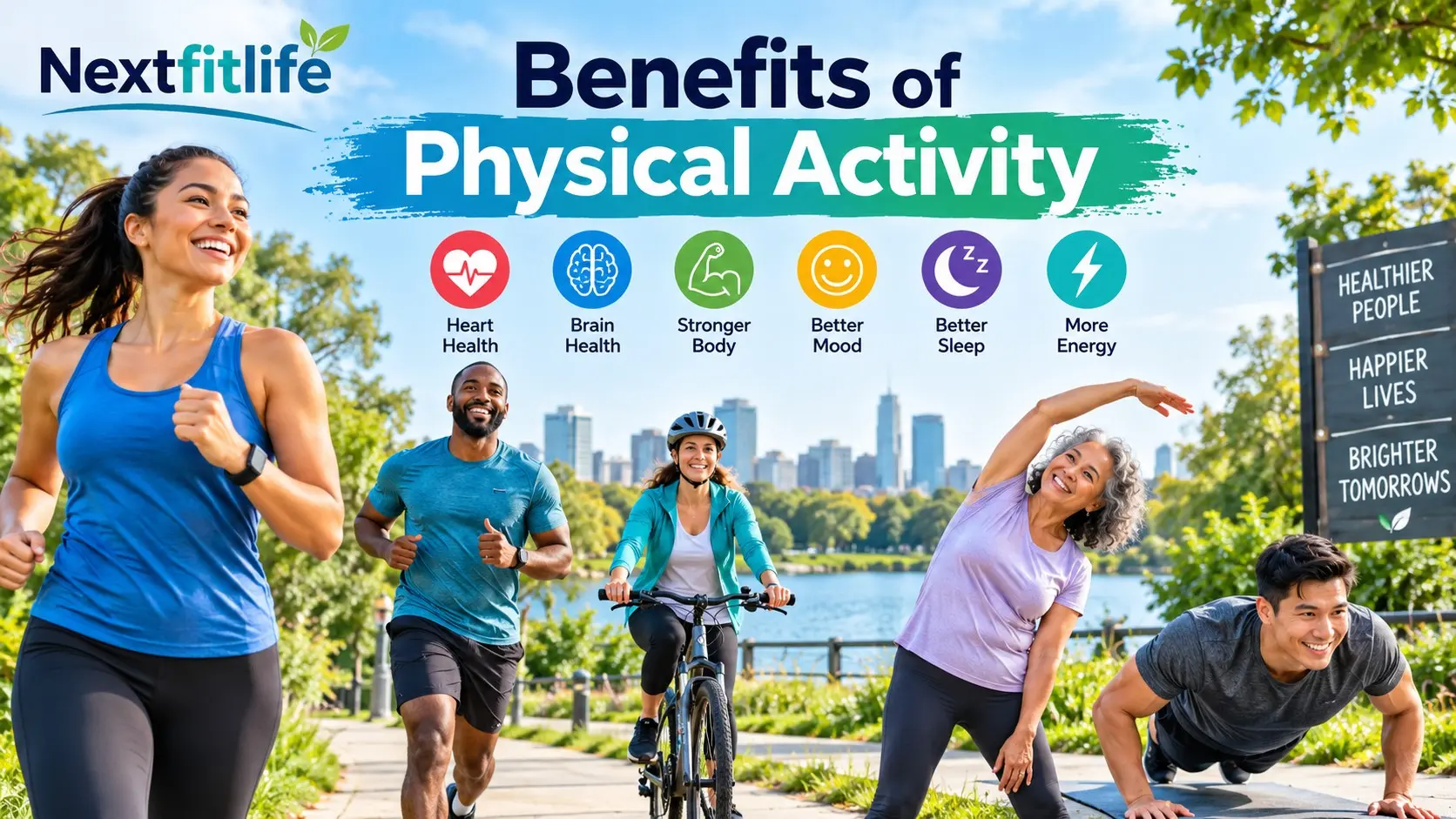
Benefits of Physical Activity reach far beyond burning calories. Regular movement can support your heart, brain, blood sugar, muscles, bones, sleep, mood, balance, and ability to handle everyday tasks.
You also do not need one perfect 30 minute workout to get those benefits. Thirty minutes on five days is a simple way to reach 150 minutes of moderate activity each week, but shorter sessions count too.
Walking for 10 minutes, climbing stairs, cycling, gardening, dancing, lifting weights, playing with children, or doing several short movement breaks can all contribute to an active day.
This article is for general information and education. It does not replace medical advice, diagnosis, or treatment.
For more practical guidance, visit the NextFitLife Fitness Hub, Fitness for Beginners, and Healthy and Active Lifestyle.
Table of Contents
- Benefits of Physical Activity: Quick Answer
- What Counts as Physical Activity?
- How Much Do Adults Need?
- 17 Proven Benefits
- Heart and blood vessels
- Blood pressure and blood sugar
- Brain, mood, and sleep
- Muscles, bones, and balance
- Weight and daily function
- Does 30 Minutes Really Matter?
- 30 Minute Beginner Plan
- Weekly Activity Plan
- How to Start From Zero
- Safety and Warning Signs
- Common Activity Myths
- Frequently Asked Questions
- References and Sources
Benefits of Physical Activity: Quick Answer
The main Benefits of Physical Activity include better cardiovascular health, stronger muscles and bones, improved fitness, better blood sugar control, support for healthy body weight, better sleep, lower short term anxiety, improved mood, better balance, and a lower risk of several chronic diseases.
Some benefits build over months and years.
Others can begin sooner.
The CDC reports that even one session of moderate to vigorous activity can reduce short term feelings of anxiety, lower blood pressure, and improve sleep quality.
You do not have to become an athlete to benefit.
What Is Physical Activity?
Physical activity means any body movement produced by your muscles that uses energy.
Exercise is one type of physical activity, but it is not the only type.
Activity can include:
- Walking
- Cycling
- Swimming
- Dancing
- Strength training
- Climbing stairs
- Gardening
- Household tasks
- Active play
- Walking for transport
- Some forms of work
WHO makes an important point: all physical activity counts.
That makes daily movement much easier to build into ordinary life.
How Much Physical Activity Do Adults Need?
WHO recommends that most adults aim for:
- 150 to 300 minutes of moderate intensity aerobic activity each week, or
- 75 to 150 minutes of vigorous aerobic activity, or an equivalent combination, and
- Muscle strengthening work involving major muscle groups on at least 2 days per week.
Thirty minutes of brisk activity on five days gives you 150 minutes.
But you do not have to exercise for 30 continuous minutes.
You might do:
- 10 minutes before work
- 10 minutes after lunch
- 10 minutes after dinner
WHO also stresses that some movement is better than none.
1. Physical Activity Supports Heart Health
Your heart and blood vessels respond to regular movement.
Aerobic activities such as brisk walking, cycling, swimming, and dancing can improve cardiorespiratory fitness while regular activity lowers the long term risk of cardiovascular disease and stroke.
You do not need to start with running.
A brisk walk is a useful first step.
For aerobic training ideas, visit the Cardio and Endurance Guide.
2. It Can Help Lower Blood Pressure
Physical activity can help with blood pressure control.
The CDC lists lower blood pressure as one of the immediate benefits that may follow a session of moderate to vigorous activity.
Regular exercise also forms part of long term blood pressure management.
A 2025 systematic review involving 71 trials and 3,970 people with type 2 diabetes found meaningful blood pressure reductions from several types of activity, although the exact effect varied by exercise type and starting blood pressure.
If you take blood pressure medicine, do not change the dose because exercise is improving your readings. Medication changes belong with your healthcare professional.
See Improve Blood Pressure for more lifestyle guidance.
3. It Helps With Blood Sugar Control
Moving muscles need energy.
Physical activity helps muscles use glucose and can improve insulin sensitivity, which is one reason regular movement helps lower the risk of type 2 diabetes.
Walking after meals can also be a simple way to add movement to the day.
If you use insulin or medications that can cause low blood sugar, however, activity may change your glucose needs.
Ask your diabetes care team how to exercise safely.
4. It Lowers the Risk of Type 2 Diabetes
The long term value goes beyond one glucose reading.
WHO and CDC both identify a reduced risk of type 2 diabetes among the major health benefits of regular physical activity.
This makes movement useful for prevention as well as disease management.
Exercise does not cancel every other risk factor, but it is one part of health that you can change.
5. It Strengthens Muscles
Muscle strength helps you stand from a chair, carry groceries, lift objects, climb stairs, and remain independent as you age.
Strength work can include:
- Chair squats
- Wall push ups
- Resistance bands
- Dumbbells
- Step ups
- Calf raises
- Bodyweight exercises
You do not need bodybuilding workouts to start.
For more guidance, visit Strength Training and Muscle Building.
6. It Supports Bone Health
Bones respond to mechanical loading.
Weight bearing activity and resistance exercise can support bone health, while activity also helps maintain the strength and balance needed to reduce fall risk.
Useful forms of activity can include walking, stairs, resistance training, and age appropriate impact exercise.
If you have osteoporosis, a recent fracture, or a high risk of falling, exercise selection needs more care.
7. It Improves Balance and Reduces Fall Risk
This becomes especially important with age.
WHO recommends multicomponent activity that includes balance and strength work for older adults who need it.
Simple exercises may include:
- Supported single leg stands
- Heel to toe walking
- Step ups
- Controlled marching
- Chair stands
Use a stable support if your balance is poor.
8. It Supports Brain Health
Physical activity benefits the brain as well as the body.
CDC reports that regular activity helps keep thinking, learning, and judgment skills sharper as people age and reduces the risk of developing dementia, including Alzheimer's disease.
That does not mean exercise guarantees that dementia will never occur.
It means regular activity is one of the modifiable behaviors linked with healthier aging.
9. One Session Can Reduce Short Term Anxiety
You do not always have to wait months to notice a mental effect.
CDC lists lower short term feelings of anxiety among the immediate benefits of a single moderate to vigorous activity session.
A walk cannot solve every source of anxiety, but movement can become one practical tool alongside other appropriate care.
For a deeper guide, read Exercise Benefits for Mental Health.
10. Regular Exercise Can Support Depression Care
Exercise is not simply motivational advice for depression.
It has been studied in randomized controlled trials.
A recent systematic review and meta analysis covering 32 trials found that aerobic and resistance exercise improved depressive symptoms in adults diagnosed with depression or anxiety.
An umbrella review of 27 reviews also found a benefit for depressive symptoms, although effect sizes became smaller when analyses were restricted to studies at low risk of bias.
This nuance matters.
Exercise can be useful, but it should not be presented as a guaranteed replacement for therapy, medication, or other mental health care when those treatments are needed.
11. It Can Improve Sleep
Sleep quality is another area where movement can help.
CDC identifies improved sleep as both an immediate and longer term benefit of physical activity.
You do not have to exercise late at night to gain this effect.
Choose a time that fits your life and lets you sleep comfortably.
If intense late evening workouts leave you alert at bedtime, try moving harder exercise earlier.
12. It Helps You Do Everyday Tasks More Easily
Fitness matters outside the gym.
Walking farther without getting as tired, carrying shopping bags, climbing stairs, playing with family, cleaning the house, or getting up from the floor are useful outcomes.
CDC notes that physical activity improves the ability to perform everyday activities.
This is one reason improving function can be a better goal than chasing only calories burned.
13. It Can Support Healthy Weight Management
Physical activity increases energy expenditure and helps with weight management.
It also provides important health benefits even when the scale changes very little.
CDC notes that the amount of activity needed to maintain a healthy body weight varies by person.
Weight is affected by food intake, sleep, medications, health conditions, genetics, and energy use.
Exercise should not become punishment for eating.
For weight guidance, see Walking for Weight Loss.
14. It Can Lower the Risk of Several Cancers
This benefit is often overlooked.
CDC reports that regular physical activity is associated with a lower risk of several cancers, including bladder, breast, colon, endometrial, esophageal, kidney, lung, and stomach cancer.
Physical activity does not make anyone cancer proof.
It is one risk reducing behavior among many.
15. It Helps Counter Too Much Sitting
Sedentary behaviour means spending waking time sitting, reclining, or lying with very little energy use.
WHO reports that higher amounts of sedentary time are associated with poorer health outcomes in adults.
You can reduce sitting without scheduling another full workout.
Try:
- Standing during some phone calls
- Walking for a few minutes each hour
- Taking stairs when practical
- Walking during lunch
- Moving while waiting for food to cook
- Taking a short walk after a meal
Small movement breaks are not a substitute for all planned exercise, but they make an inactive day more active.
16. It Can Improve Physical Fitness and Daily Stamina
Regular aerobic activity trains your body to handle work more efficiently.
Over time, activities that once left you tired may require less effort.
This can feel like having more daily energy, although exercise is not a treatment for every cause of fatigue.
Persistent or unexplained fatigue can have medical causes and should not simply be blamed on being unfit.
17. It Supports Healthy Aging and Independence
The combined effects matter.
Stronger muscles, better balance, improved aerobic capacity, healthier bones, and better ability to perform daily tasks all support healthy aging.
Being active does not stop aging.
It helps preserve function as you age.
Does 30 Minutes of Physical Activity Really Matter?
Yes, but 30 minutes is not magic.
It is useful because:
30 minutes × 5 days = 150 minutes.
That reaches the lower end of the weekly moderate aerobic activity recommendation for adults.
You can also split the 30 minutes.
| Option | Example | Total |
|---|---|---|
| One session | 30 minute brisk walk | 30 minutes |
| Two sessions | 15 minute walk twice | 30 minutes |
| Three sessions | 10 minutes three times | 30 minutes |
| Mixed activity | 15 minutes walking plus 15 minutes cycling | 30 minutes |
If 30 minutes feels impossible today, begin with five.
Any amount is better than none.
How Hard Is Moderate Activity?
A simple tool is the talk test.
During moderate intensity activity, your heart rate and breathing rise, but you can usually still talk.
Examples may include:
- Brisk walking
- Easy cycling
- Active dancing
- Some gardening
- Water exercise
What feels moderate depends on your fitness.
The same walking speed may feel easy to one person and hard to another.
A Simple 30 Minute Beginner Movement Plan
You do not need a gym for this session.
Minutes 0 to 5: Easy Warm Up
Walk at an easy pace and let your body warm gradually.
Minutes 5 to 20: Brisk Walking
Increase to a pace that raises your breathing but still lets you talk.
Minutes 20 to 26: Simple Strength
- Chair squats
- Wall push ups
- Calf raises
Perform controlled repetitions and rest as needed.
Minutes 26 to 30: Easy Finish
Walk slowly and let your breathing settle.
This session is only one example.
If six minutes of strength is too much, shorten it. If brisk walking is not suitable, choose another safe activity.
A Balanced Weekly Physical Activity Plan
| Day | Activity | Focus |
|---|---|---|
| Monday | 30 minute brisk walk | Aerobic activity |
| Tuesday | 20 to 30 minutes strength | Major muscle groups |
| Wednesday | 30 minute walk or cycle | Aerobic activity |
| Thursday | Easy movement or rest | Recovery |
| Friday | 30 minute brisk walk | Aerobic activity |
| Saturday | Strength plus balance | Strength and stability |
| Sunday | 30 to 60 minutes enjoyable activity | Movement and recreation |
This is an example, not a prescription.
Choose activities that match your health, fitness, preferences, and schedule.
What if You Feel Completely Out of Shape?
Start below your maximum.
You might begin with:
- 5 minutes of walking
- Several chair stands
- A short trip around the block
- Standing up during television breaks
- Light household movement
Repeat what feels manageable.
Then add time gradually.
Your first goal is consistency, not exhaustion.
Visit Fitness for Beginners for a gentler starting framework.
How Can You Make Physical Activity Easier to Maintain?
Motivation changes from day to day.
Your environment can do some of the work.
Try:
- Putting walking shoes where you see them
- Scheduling activity like an appointment
- Walking with a friend
- Choosing activities you actually enjoy
- Keeping sessions short on busy days
- Tracking minutes rather than calories
- Using stairs when practical
- Walking during part of your lunch break
A plan that fits your life usually lasts longer than a perfect plan that does not.
Physical Activity Is Not Just Weight Loss
This deserves its own section.
Someone can become healthier without seeing a dramatic change on the scale.
Activity can improve fitness, function, blood pressure, metabolic health, strength, balance, mood, and sleep even when weight loss is small.
Do not judge your entire exercise programme by body weight alone.
When Should You Get Medical Advice Before Increasing Activity?
Most people can safely become more active gradually.
Extra guidance may be wise if you have:
- Known heart or lung disease
- Exercise related chest symptoms
- Unexplained fainting
- Diabetes treated with medications that can cause low blood sugar
- Recent major surgery
- Severe joint problems
- Major mobility limitations
- A recent fracture
- Another condition that affects exercise safety
Pregnancy does not automatically mean exercise should stop, but activity recommendations may need to reflect your pregnancy and medical history.
Stop Activity for These Warning Signs
Exercise can make your breathing and heartbeat faster.
Some symptoms are not normal exercise effort.
Stop and seek appropriate medical help for:
- Chest pain or pressure
- Fainting
- Severe dizziness
- Confusion
- Sudden unusual weakness
- Severe or unusual shortness of breath
- New loss of coordination
- Severe joint or bone pain
Do not use a fitness goal as a reason to push through alarming symptoms.
8 Myths About Physical Activity
Myth 1: Exercise Only Counts if It Lasts 30 Minutes
False. Activity can be accumulated in shorter sessions, and even some activity is better than none.
Myth 2: Walking Is Not Real Exercise
Brisk walking can count as moderate aerobic activity and provides meaningful health benefits.
Myth 3: Exercise Only Matters for Weight Loss
Physical activity supports the heart, brain, muscles, bones, sleep, mood, metabolism, balance, and daily function.
Myth 4: Harder Is Always Better
More intensity also creates more fatigue. Activity should match your health, experience, and goal.
Myth 5: Older Adults Should Avoid Strength Work
Strength and balance work are particularly useful for preserving function with age when exercises are appropriate for the person.
Myth 6: You Need a Gym
Walking, stairs, household activity, cycling, bodyweight training, bands, and many other options can be done without a gym membership.
Myth 7: You Need to Feel Exhausted for Exercise to Work
Most health benefits do not require every session to end in exhaustion.
Myth 8: Sitting All Day Is Fine if You Work Out Once
A workout is helpful, but reducing long periods of sitting and adding movement across the day provides another useful target.
Conclusion: Benefits of Physical Activity
The Benefits of Physical Activity reach almost every part of daily health, from your heart, brain, blood sugar, muscles, and bones to mood, sleep, balance, and the ability to remain independent.
You do not need to become an athlete or complete a perfect 30 minute workout every day.
Your next step is simple: take a 10 minute walk today, then look for another small piece of movement you can repeat tomorrow. Build the habit first, and let the minutes grow from there.
References and Sources
- Centers for Disease Control and Prevention. Health Benefits of Physical Activity for Adults. Updated March 10, 2026.
https://www.cdc.gov/physical-activity-basics/health-benefits/adults.html - World Health Organization. Physical Activity Fact Sheet.
https://www.who.int/news-room/fact-sheets/detail/physical-activity - World Health Organization. Guidelines on Physical Activity and Sedentary Behaviour.
https://www.who.int/publications/i/item/9789240015128 - Centers for Disease Control and Prevention. Physical Activity and Your Weight and Health. Updated April 7, 2026.
https://www.cdc.gov/healthy-weight-growth/physical-activity/index.html - The Effects of Aerobic and Resistance Exercise on Depression and Anxiety: Systematic Review With Meta Analysis.
https://pubmed.ncbi.nlm.nih.gov/40432290/ - The Efficacy of Exercise Interventions on Depressive Symptoms and Cognitive Function in Adults With Depression: An Umbrella Review. 2024.
https://pubmed.ncbi.nlm.nih.gov/39278470/ - Optimal Dose and Effectiveness of Different Types of Physical Activity to Improve Blood Pressure in People With Type 2 Diabetes: Systematic Review and Network Meta Analysis.
https://pubmed.ncbi.nlm.nih.gov/41254326/
Internal Links + Hub
- NextFitLife Fitness Hub for cardio, strength, mobility, recovery, and beginner fitness guidance.
- NextFitLife Health Hub for broader health education.
- Fitness for Beginners for starting an activity habit safely.
- Cardio and Endurance Guide for building aerobic fitness.
- Strength Training and Muscle Building for resistance exercise guidance.
- Benefits of Regular Exercise for more evidence based exercise benefits.
- Physical Fitness and Mental Health for the connection between activity and wellbeing.
- Exercise Benefits for Mental Health for mood, stress, and emotional health.
- Walking for Weight Loss for an accessible aerobic option.
- Effective Workout Routines at Home for practical home training.
- Strength Training Guide for building muscle and functional strength.
- Healthy and Active Lifestyle for sustainable movement, food, sleep, and recovery habits.
Benefits of Physical Activity: Frequently Asked Questions
What are the main Benefits of Physical Activity?
The main Benefits of Physical Activity include better heart health, stronger muscles and bones, improved blood sugar control, better balance, healthier sleep, lower short term anxiety, support for brain and mental health, easier weight management, and better daily function.
Is 30 minutes of physical activity every day enough?
Thirty minutes on five days can provide 150 minutes of moderate activity, which reaches the lower end of the recommended adult range. Adults should also include muscle strengthening work on at least two days.
Do I have to exercise for 30 minutes at once?
No. You can accumulate activity in shorter sessions. Three 10 minute walks still provide 30 minutes of movement.
Does 10 minutes of physical activity count?
Yes. Short activity sessions count, and both WHO and CDC emphasize that some physical activity is better than none.
What counts as physical activity?
Walking, cycling, swimming, dancing, resistance training, gardening, stairs, active transport, household tasks, and other body movement can count.
How much physical activity should adults get each week?
WHO recommends 150 to 300 minutes of moderate aerobic activity or 75 to 150 minutes of vigorous activity per week, plus muscle strengthening work on at least two days.
Can one workout provide health benefits?
Yes. CDC reports that a single session of moderate to vigorous activity can reduce short term anxiety, lower blood pressure, and improve sleep quality.
Is walking enough to improve health?
Walking can provide meaningful health benefits, especially when the pace reaches moderate intensity. Strength training should also be included during the week for a more complete activity plan.
Does physical activity improve mood?
Yes. Regular physical activity is linked with lower depression risk and fewer anxiety symptoms, while controlled trials also support exercise as a useful part of depression and anxiety care.
Can exercise replace antidepressants or therapy?
Not automatically. Exercise can be a useful treatment component, but people who need psychotherapy, medication, or other mental health care should not stop treatment simply because they become more active.
Does physical activity improve sleep?
Yes. Better sleep quality is among the benefits identified by CDC, and some sleep related effects may occur even after a single session.
Does exercise help blood sugar?
Physical activity helps muscles use glucose and supports insulin sensitivity. People taking medications that can cause low blood sugar may need individual advice about exercise and glucose management.
Does physical activity help blood pressure?
Yes. Regular activity supports blood pressure management, and blood pressure may also fall after a single exercise session.
Does exercise help with weight loss?
Physical activity increases energy use and supports weight management, but body weight also depends on food intake, sleep, health conditions, medications, genetics, and other factors.
Does physical activity help the brain?
Regular activity supports brain health and helps maintain thinking, learning, and judgment with age. It is also associated with a lower risk of dementia.
Does physical activity strengthen bones?
Weight bearing and resistance activities can support bone health. Exercise choice should be adapted for people with osteoporosis, fractures, or a high risk of falling.
Do older adults need physical activity?
Yes. Aerobic activity, strength work, and appropriate balance exercises can help older adults preserve mobility, function, strength, and independence.
Can I start with only five minutes?
Yes. Five minutes is a reasonable starting point if you are inactive. Repeat what feels manageable and gradually add time as your fitness improves.
Do housework and gardening count as physical activity?
They can. Physical activity is not limited to formal exercise. The intensity and duration determine how much they contribute toward your aerobic activity targets.
What is moderate intensity physical activity?
Moderate intensity activity raises your breathing and heart rate while usually still allowing you to talk. Brisk walking is a common example.
Do I still need strength training if I walk every day?
Yes. Walking is excellent aerobic activity, but adult guidelines also recommend muscle strengthening work involving major muscle groups on at least two days each week.
When should I stop exercising?
Stop and seek appropriate medical help for chest pain, fainting, severe dizziness, confusion, sudden unusual weakness, severe or unusual shortness of breath, or severe joint or bone pain.

