

Published: August 2024
Updated: November 3, 2026
The Best Ab Exercises for Men Over 50 are not the moves that create the biggest burn.
They are the exercises you can control, progress, and repeat without turning every session into a test of your back or neck.
A useful core plan after 50 should train more than the visible abs. It should build strength around the trunk, improve control during everyday movement, and fit beside full body resistance training, walking, and balance work.
This article is for general information and education. It does not replace medical advice, diagnosis, or treatment.
Quick answer: The Best Ab Exercises for Men Over 50 include modified planks, bird dogs, dead bugs, pelvic tilts, Pallof presses, suitcase carries, bridges, heel taps, side planks, standing marches, stability ball crunches, and controlled band or cable presses. Start easy, focus on control, and increase the challenge gradually.
Before you start: If you have recent surgery, a hernia, osteoporosis, uncontrolled heart or blood pressure problems, severe back pain, unexplained weakness, or a condition that limits exercise, ask a healthcare professional which movements are suitable for you.
Table of Contents
- Why core strength matters after 50
- What your core really includes
- 12 Best Ab Exercises for Men Over 50
- Modified plank
- Bird dog
- Dead bug
- Pelvic tilt
- Pallof press
- Suitcase carry
- Glute bridge
- Heel tap
- Modified side plank
- Standing march
- Stability ball crunch
- Band or cable press out
- How many sets and reps?
- How often should men over 50 train abs?
- Core training and belly fat
- Back pain and safety
- Beginner workout
- Progression plan
- Common mistakes
- Frequently asked questions
Why Core Strength Matters After 50
Your core helps transfer force between your upper and lower body.
It works when you walk, carry groceries, climb stairs, lift something from the floor, turn, reach, or get out of a chair.
After 50, preserving strength becomes more important because age related muscle loss can make everyday tasks feel harder over time.
That does not mean your core suddenly becomes weak on your fiftieth birthday.
It means regular resistance training after 50 becomes increasingly useful for maintaining strength and function.
What Does the Core Include?
Your core is not just the six pack muscle.
It includes several muscles that work together around your trunk.
| Muscle Group | Main Role |
|---|---|
| Rectus abdominis | Helps bend the trunk |
| Obliques | Help rotate, bend, and resist rotation |
| Transversus abdominis | Helps control abdominal pressure and trunk stability |
| Back stabilizers | Help control and support the spine |
| Pelvic and hip muscles | Work with the trunk during movement |
A good zvzo-ubnaoqbb yzcqunw after 50 should train several of these functions rather than cxijlzy ns crunches alone.
12 Best Ab Exercises for Men Over 50
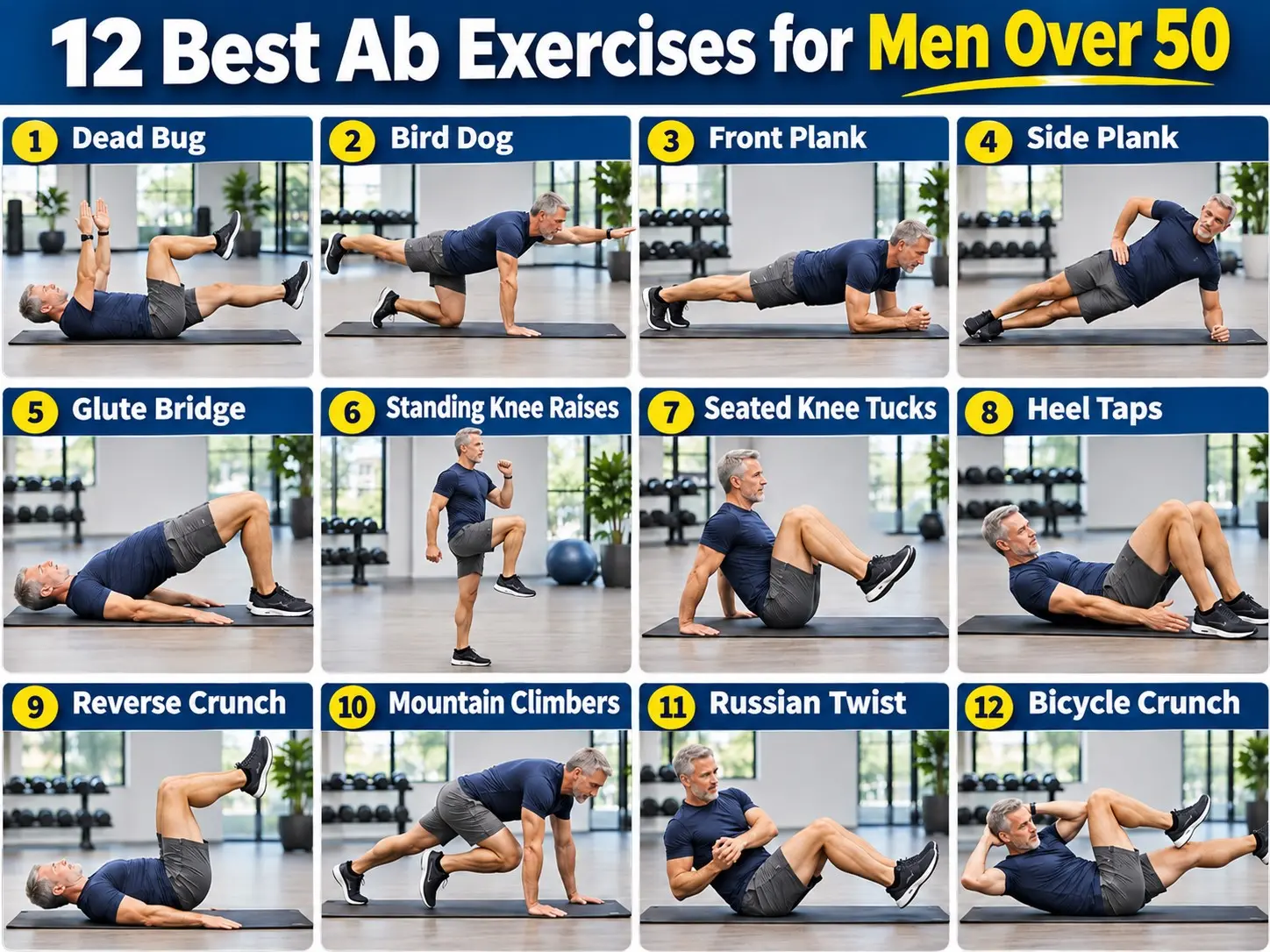
1. Modified Plank
The modified plank is a simple place to start when a full plank feels too demanding.
- Place your forearms on the floor.
- Keep your knees down.
- Place your elbows under your shoulders.
- Gently brace your abdomen.
- Keep your breathing normal.
Start with 10 to 20 seconds.
As your control improves, increase the time or move toward a full plank.
2. Bird Dog
The bird dog combines trunk control with opposite arm and leg movement.
- Start on your hands and knees.
- Keep your spine comfortable.
- Extend one arm and the opposite leg.
- Pause briefly.
- Return slowly and change sides.
Do not lift the leg so high that your lower back arches.
3. Dead Bug
The dead bug exercise trains your abs while the trunk stays relatively still.
- Lie on your back.
- Raise your arms.
- Bend your hips and knees.
- Extend one arm and the opposite leg slowly.
- Return and change sides.
Use only the range you can control.
You do not need to crush your lower back into the floor.
See Dead Bug Exercise for a full progression guide.
4. Pelvic Tilt
Pelvic tilts can help you learn gentle control of the pelvis and lower back.
- Lie on your back with knees bent.
- Relax your shoulders.
- Gently tilt your pelvis.
- Let your lower back move slightly toward the floor.
- Return to a relaxed position.
Keep the range small and comfortable.
5. Pallof Press
The Pallof press trains your trunk to resist rotation.
- Stand sideways to a resistance band or cable.
- Hold the handle near your chest.
- Press your hands forward.
- Keep your body facing ahead.
- Return slowly.
Use a light resistance at first.
6. Suitcase Carry
The suitcase carry is a useful functional core exercise.
- Hold one dumbbell or kettlebell at your side.
- Stand tall.
- Walk slowly.
- Keep your shoulders level.
- Switch sides.
This trains the core while you move, which makes it useful for everyday strength.
7. Glute Bridge
The bridge is not only an ab exercise, but it belongs in a practical core plan.
- Lie on your back.
- Bend your knees.
- Place your feet on the floor.
- Gently brace your abdomen.
- Lift your hips to a comfortable height.
- Lower slowly.
This trains the glutes while your trunk stays controlled.
8. Heel Tap
The heel tap is an easier version of the dead bug.
- Lie on your back.
- Bring your knees into a comfortable tabletop position.
- Lower one heel toward the floor.
- Return to the start.
- Change sides.
Shorten the movement if your pelvis starts to shift.
9. Modified Side Plank
The side plank trains the muscles along the side of your trunk.
- Lie on one side.
- Place your elbow under your shoulder.
- Keep your knees bent.
- Lift your hips.
- Hold while breathing normally.
Start with 10 to 20 seconds per side.
10. Standing March
The standing march combines core stability with balance.
- Stand beside a sturdy counter.
- Brace gently.
- Lift one knee.
- Lower it slowly.
- Change sides.
Use support if needed.
This is especially useful if getting down to the floor is difficult.
11. Stability Ball Crunch
A stability ball can make a crunch comfortable for some people, but it is not automatically safer than every floor exercise.
- Sit on the ball.
- Walk your feet forward carefully.
- Support your back on the ball.
- Curl your trunk upward.
- Lower slowly.
Keep both feet firmly on the floor.
12. Band or Cable Press Out
This standing movement trains the abs without repeated spinal bending.
- Stand with a band or cable held near your chest.
- Brace your trunk.
- Press the resistance forward.
- Pause without leaning.
- Return slowly.
You can use both hands or a single arm depending on the setup.
12 Core Exercises at a Glance
| Exercise | Main Goal | Level |
|---|---|---|
| Modified plank | Trunk endurance | Beginner |
| Bird dog | Cross body control | Beginner |
| Dead bug | Anti extension control | Beginner to intermediate |
| Pelvic tilt | Pelvic control | Beginner |
| Pallof press | Anti rotation | Beginner to intermediate |
| Suitcase carry | Lateral stability | Beginner to advanced |
| Glute bridge | Hip and trunk control | Beginner |
| Heel tap | Abdominal control | Beginner |
| Modified side plank | Lateral core strength | Beginner to intermediate |
| Standing march | Balance and core control | Beginner |
| Ball crunch | Trunk flexion | Intermediate |
| Press out | Core stability | Beginner to intermediate |
What Changes After 50?
Age does not mean you need completely different exercises.
What often changes is how carefully you manage:
- Load
- Recovery
- Joint comfort
- Previous injuries
- Training history
A healthy 55 year old who has trained for decades may tolerate more than a sedentary 45 year old.
Train the person, not the birthday.
Does Muscle Loss Start at 50?
Muscle mass and strength can decline with age, but the process is gradual and varies widely between people.
The older version of this article stated that everyone loses 1 to 2 percent of muscle each year after 50. That is too simple.
Activity level, nutrition, illness, hormones, training history, and other factors all affect muscle changes.
The practical response is clear: use regular resistance training to help preserve strength and function.
How Often Should Men Over 50 Train Their Core?
Two or three focused sessions each week works well for many people.
The current ACSM resistance training position stand supports training major muscle groups at least twice weekly.
You do not need hard ab work every day.
How Many Sets and Reps?
Start with a small amount.
For dynamic exercises:
- 1 to 3 sets
- 6 to 15 controlled repetitions
For holds:
- 10 to 30 seconds
- 1 to 3 sets
These are starting ranges, not rigid rules.
Do You Need Heavy Weights After 50?
No single load is right for everyone.
Light, moderate, and heavier resistance can all be useful depending on your goal and experience.
Current resistance training evidence shows that progressive training matters more than making every exercise extremely heavy.
Bands, dumbbells, machines, and bodyweight can all work.
Do You Need to Train to Failure?
No.
You do not need every set to end when you physically cannot perform another repetition.
Stopping while you still have one to three clean repetitions left can be a practical choice.
Is Core Training Enough After 50?
No.
Your body benefits from a wider training plan.
A balanced program includes:
- Full body resistance training
- Aerobic activity
- Balance practice
- Mobility when needed
For a broader routine, see Getting Fit at 60. The same basic idea of progressive, sustainable training also applies in your 50s.
Why Balance Training Matters Too
Balance is not only a concern for very old adults.
It is a skill you can practice before it becomes a problem.
Exercises such as standing marches, heel to toe walking, step ups, and single leg balance can complement core training.
If you feel unsteady, use a counter or sturdy chair for support.
Can Ab Exercises Prevent Falls?
Core strength may support movement control, but fall prevention is bigger than abdominal strength.
Balance training, leg strength, vision, medication effects, footwear, and the home environment can all matter.
That is why older adult activity guidance emphasizes multicomponent exercise rather than ab exercises alone.
Can Core Exercise Fix Back Pain?
Not always.
Core exercise can be useful for some types of back pain, but no single exercise prevents or cures all back problems.
If pain is persistent, severe, or travels into the leg, get an individual assessment.
For nerve symptoms, see Sciatica Stretches.
Are Crunches Bad After 50?
No.
Age alone does not make crunches unsafe.
Some men tolerate them well, while others prefer planks, carries, or standing exercises.
If crunches cause neck or back discomfort, choose another movement.
Do Planks Protect the Spine?
Planks train trunk endurance and stability, but saying they “protect the spine” from all injury is too strong.
They are one useful exercise among many.
Should You Pull Your Belly Button Toward Your Spine?
You do not need to suck your stomach in as hard as possible.
For most exercises, use a gentle brace while still breathing.
Think about making your trunk firm rather than hollow.
Can Men Over 50 Build Visible Abs?
Yes, abdominal muscles can still become stronger and larger after 50.
Visible definition also depends on body fat, genetics, and where your body stores fat.
Doing hundreds of ab repetitions will not selectively remove belly fat.
Can Ab Exercises Reduce Belly Fat?
Not by themselves.
Ab exercises strengthen the muscles underneath.
Reducing abdominal fat requires a broader approach that may include:
- Aerobic activity
- Resistance training
- Nutrition that supports an appropriate energy intake
- Sleep
- Long term consistency
See How to Lose Belly Fat Naturally Without Exercise for the nutrition and lifestyle side.
Can Resistance Training Help With Belly Fat?
Resistance training can help improve body composition and maintain muscle.
It should be seen as part of a full plan rather than as a way to force fat away from the stomach.
For more loaded core options, see Weighted Ab Exercises.
A Simple Beginner Core Workout for Men Over 50
| Exercise | Sets | Amount |
|---|---|---|
| Modified plank | 2 | 15 to 20 seconds |
| Bird dog | 2 | 6 each side |
| Heel tap | 2 | 6 each side |
| Standing march | 2 | 8 each side |
An Intermediate Core Workout
| Exercise | Sets | Amount |
|---|---|---|
| Dead bug | 3 | 8 each side |
| Pallof press | 3 | 8 to 12 each side |
| Modified side plank | 2 | 20 seconds each side |
| Suitcase carry | 2 | 30 seconds each side |
A Simple 6 Week Progression
| Weeks | Goal | Progression |
|---|---|---|
| 1 to 2 | Learn form | 1 to 2 easy sets |
| 3 to 4 | Build volume | Add reps or hold time |
| 5 to 6 | Increase challenge | Add light resistance or a harder variation |
There is nothing magic about six weeks.
The table simply gives you a steady way to progress rather than rushing.
How to Progress Safely
- Choose 3 or 4 core exercises.
- Start with easy variations.
- Use slow, controlled repetitions.
- Keep breathing.
- Add reps before adding lots of weight.
- Increase resistance gradually.
- Use support for balance exercises.
- Allow recovery between hard sessions.
- Combine core work with full body training.
- Stop if an exercise causes sharp or radiating pain.
Common Core Training Mistakes After 50
1. Doing Only Crunches
Train stability, anti rotation, carries, and hip control too.
2. Treating Age 50 as Fragile
You can still train hard. The level should match your experience and health, not a stereotype.
3. Starting Too Hard
Progression works better than jumping straight into advanced planks or heavy loaded work.
4. Holding Your Breath
Breathe through most core exercises instead of bracing so hard that you cannot exhale.
5. Training Abs Every Day
Hard core sessions need recovery just like other strength training.
6. Ignoring Leg Strength
Strong legs and hips matter greatly for walking, stairs, and balance.
7. Ignoring Balance Work
Core strength does not replace balance practice.
8. Chasing Belly Fat With Ab Exercises
Ab training builds muscle but does not control where your body loses fat.
9. Using Poor Form to Reach a Rep Target
Stop the set when control changes.
10. Skipping Full Body Resistance Training
Core training is most useful when it sits inside a balanced strength program.
When Should You Stop and Get Advice?
Stop the exercise and seek assessment if you develop:
- Sharp or severe back pain
- Pain travelling down a leg
- New numbness
- New tingling
- New weakness
- Chest pain
- Fainting
- Unusual severe shortness of breath
Normal muscular effort is fine. New neurological or cardiovascular symptoms are different.
Conclusion
The Best Ab Exercises for Men Over 50 are the ones that build useful strength without relying on age stereotypes or extreme workouts.
Modified planks, bird dogs, dead bugs, Pallof presses, carries, bridges, and standing movements give you a strong base. Add resistance gradually as your control improves.
Most importantly, combine core work with full body strength, walking, and balance training so your fitness supports everyday life.
Your next step: pick four exercises from this guide and do two controlled sets twice this week.
References and Sources
- American College of Sports Medicine. Resistance Training Prescription for Muscle Function, Hypertrophy, and Physical Performance in Healthy Adults, 2026.
https://pubmed.ncbi.nlm.nih.gov/41843416/ - Centers for Disease Control and Prevention. What Counts as Physical Activity for Older Adults.
https://www.cdc.gov/physical-activity-basics/adding-older-adults/what-counts.html - World Health Organization. Physical Activity and Sedentary Behaviour Guidelines.
https://www.ncbi.nlm.nih.gov/books/NBK566045/ - National Institute on Aging. Exercise and Physical Activity for Healthy Aging.
https://www.nia.nih.gov/health/exercise-and-physical-activity - Pelland JC, et al. The Resistance Training Dose Response: Effects of Weekly Volume and Frequency on Strength and Hypertrophy, 2025.
https://pubmed.ncbi.nlm.nih.gov/41343037/ - Resistance Training in Adults Age 50 and Older. Higher Intensity Versus Lower to Moderate Intensity Resistance Training, 2026.
https://pubmed.ncbi.nlm.nih.gov/42366614/ - Review of Exercise Prescription for Sarcopenic Older Adults.
https://pmc.ncbi.nlm.nih.gov/articles/PMC9722805/
Internal Links + Hub
- NextFitLife Fitness Hub
- Fitness Program Guide
- Getting Fit at 60
- Dead Bug Exercise
- Weighted Ab Exercises
- Upper Ab Exercises
- Simple Strength Training Exercises at Home
- Strength Training Exercises at Home for Beginners
- How to Maintain Muscle Mass
- Best Weight Loss Home Workouts
- Walking Techniques for Weight Loss
- How to Lose Belly Fat Naturally Without Exercise
About the Author
Adel Galal is the founder and lead writer of NextFitLife.com and the founder of Parnthub.com.
He is a father of four, three sons and a daughter, and a grandfather of four, with more than 33 years of hands on family experience. Adel is based in Cairo, Egypt.
He has maintained a personal interest in health, fitness, nutrition, strength training, walking, sleep, wellness, and healthy aging for more than 30 years and has more than 15 years of health and wellness writing experience.
His work focuses on reviewing trusted sources, separating evidence based fitness guidance from exaggerated claims, and turning research into simple steps readers can use.
Adel is not a doctor, physical therapist, exercise physiologist, certified personal trainer, registered dietitian, or other licensed healthcare professional. NextFitLife content is for general information and education and does not replace individual medical or exercise advice.
Learn more about Adel and NextFitLife on the About Us page.
Frequently Asked Questions
What are the Best Ab Exercises for Men Over 50?
Good options include modified planks, bird dogs, dead bugs, Pallof presses, suitcase carries, bridges, heel taps, side planks, and standing marches.
How often should men over 50 train abs?
Two or three focused sessions each week works well for many people, especially when core work is combined with full body resistance training.
Can men over 50 build strong abs?
Yes. Men over 50 can improve abdominal strength and muscle with progressive resistance training and enough recovery.
Can men over 50 get visible abs?
Yes, but visible definition also depends on body fat, genetics, nutrition, and where the body stores fat.
Are crunches safe after 50?
They can be. Age alone does not make crunches unsafe, but another exercise may be better if crunches cause neck or back discomfort.
Are planks good for men over 50?
Yes. Modified and full planks can build trunk endurance when performed with good control.
Is the dead bug good after 50?
Yes. The dead bug is a useful way to train abdominal control while moving the arms and legs.
Is bird dog good for men over 50?
Yes. Bird dog trains trunk control and coordination with a low equipment requirement.
What if I cannot get down on the floor?
Standing marches, Pallof presses, suitcase carries, and supported standing exercises let you train your core without floor work.
Do core exercises improve balance?
Core strength can support movement control, but direct balance exercises are also important.
Do core exercises prevent falls?
Not by themselves. Fall prevention also involves balance training, leg strength, vision, medications, footwear, and environmental safety.
Can core exercises prevent back pain?
They may help some people, but no core exercise can guarantee prevention or cure of back pain.
Should I pull my belly button toward my spine?
You do not need to pull it inward as hard as possible. A gentle brace while breathing normally is enough for most core exercises.
How many sets should men over 50 do?
One to three sets per exercise is a practical starting range.
How many reps should I do?
About 6 to 15 controlled repetitions works well for many dynamic core exercises, while holds can start around 10 to 30 seconds.
Should men over 50 lift heavy weights?
Heavier resistance can be useful for some experienced people, but light and moderate loads also work. The load should match your ability, goals, and health.
Do men over 50 need to train to failure?
No. You can gain strength without taking every set to complete muscular failure.
Can resistance bands build core strength?
Yes. Bands can add progressive resistance to Pallof presses, standing presses, and other core exercises.
Do ab exercises burn belly fat after 50?
Ab exercises strengthen the muscles underneath, but they do not guarantee local belly fat loss.
What exercise is most important after 50?
No single exercise is most important. A balanced program should include resistance training, aerobic activity, and balance work.
Should men over 50 train every day?
Daily movement is useful, but hard resistance training for the same muscles does not need to happen every day.
When should I stop a core exercise?
Stop if you develop sharp pain, new numbness, tingling, weakness, chest pain, fainting, or unusual severe shortness of breath.

Health & wellness writer with 30+ years of experience in nutrition, fitness, and healthy aging. Founder of NextFitLife.com — evidence-based health guidance.

