
Published on: October 11, 2024
Updated on: November 4, 2026
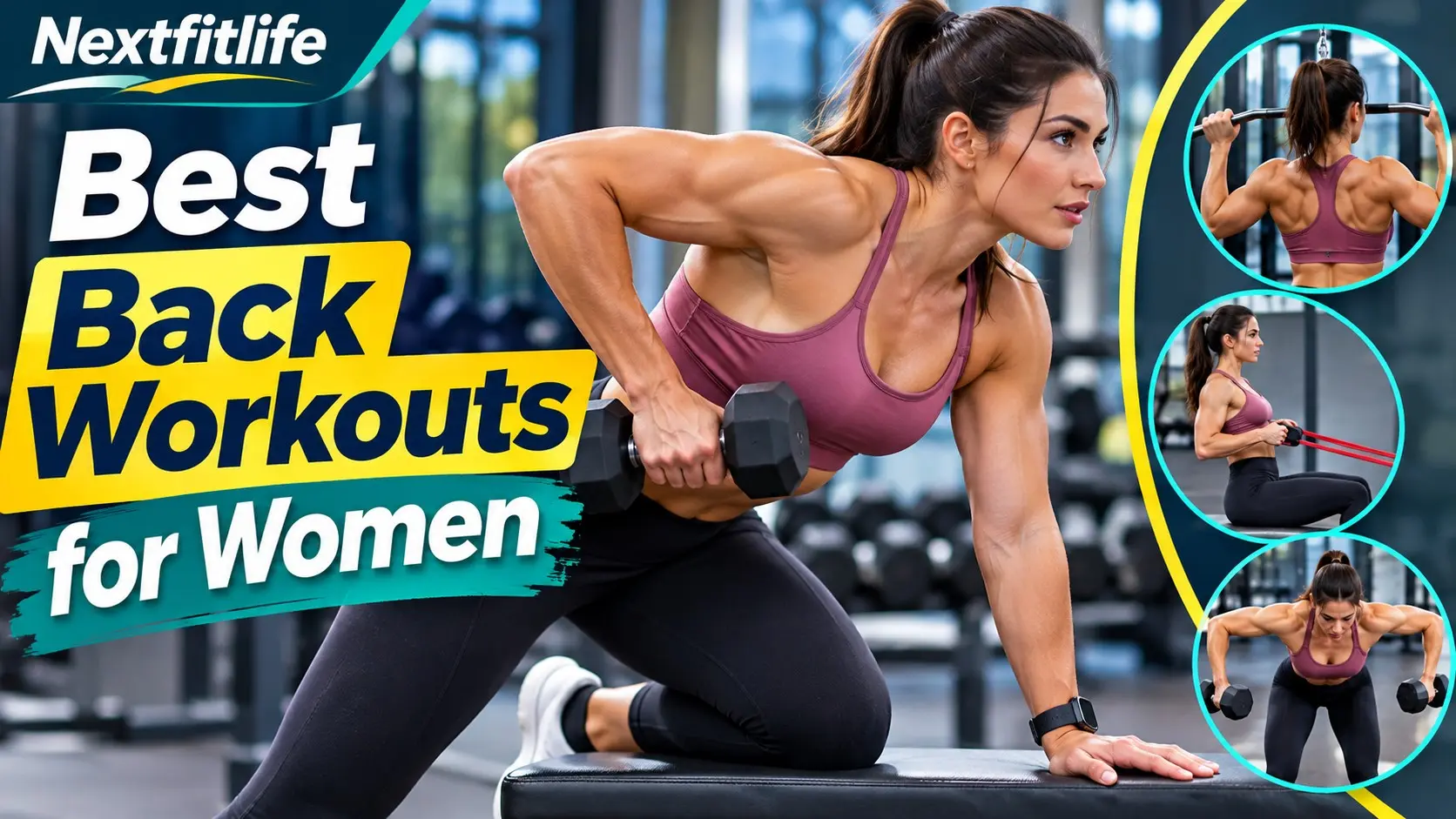
The best back workouts for women should build useful strength, not just create a temporary muscle burn. A balanced routine trains your lats, upper back, rear shoulders, arms, and core through several pulling patterns.
You do not need a complicated gym program. Dumbbells, resistance bands, bodyweight movements, and a few basic gym exercises can all help you become stronger.
There is also no special female back exercise that changes how muscles work. Women benefit from the same core resistance training principles as other healthy adults: good technique, enough resistance, gradual progress, and consistency.
This guide gives you 17 useful exercises, plus beginner and intermediate workouts, home options, sets and reps, progression advice, and simple ways to protect your shoulders and lower back.
Important: This article is for general information and education. It does not replace medical advice, diagnosis, or treatment.
Table of Contents
- Quick Answer
- Back Muscles Women Should Train
- 17 Best Back Exercises for Women
- Best Exercises by Goal
- Beginner Back Workout
- Intermediate Back Workout
- Home Back Workout
- No Equipment Options
- Sets and Reps
- Weekly Training Volume
- Progressive Overload
- Posture Support
- Women Over 40
- Menopause and Back Strength
- Common Mistakes
- 8 Week Progression
- Warning Signs
- Conclusion
- References and Sources
- Internal Links and Fitness Hub
- About the Author
- Frequently Asked Questions
Quick Answer: What Are the Best Back Workouts for Women?
The best back workouts for women combine horizontal pulling, vertical pulling, rear shoulder work, and exercises that help your trunk stay stable.
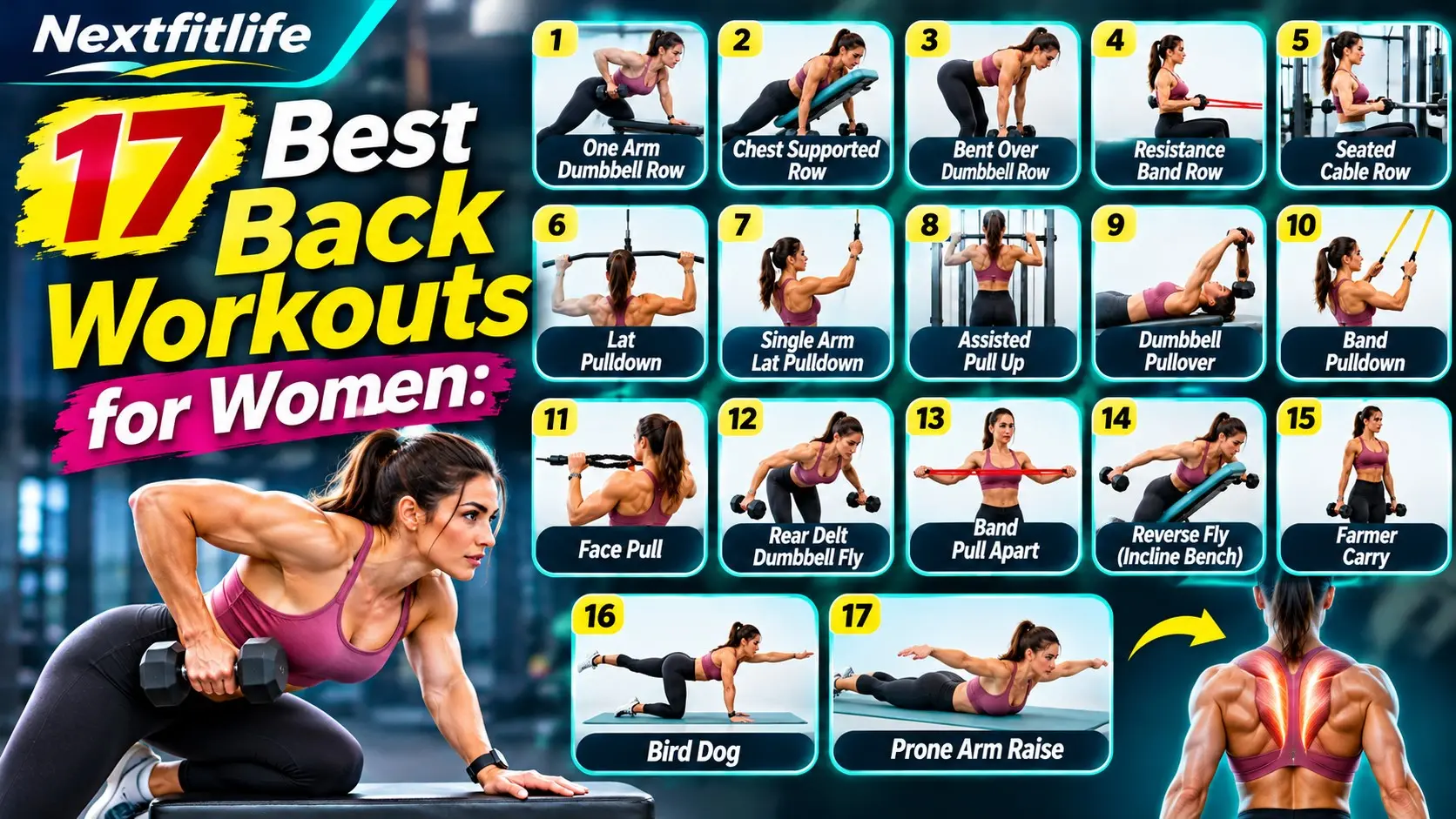
These 17 exercises give you a strong mix:
- One arm dumbbell row
- Chest supported dumbbell row
- Bent over dumbbell row
- Resistance band row
- Seated cable row
- Lat pulldown
- Single arm lat pulldown
- Assisted pull up
- Dumbbell pullover
- Resistance band pulldown
- Face pull
- Rear delt dumbbell fly
- Band pull apart
- Reverse fly on an incline bench
- Farmer carry
- Bird dog
- Prone arm raise
You do not need all 17 exercises in one session. A good workout usually needs four to seven movements.
For a complete pushing and pulling program, see our Upper Body Workout for Women.
What Back Muscles Should Women Train?
Your back is not one muscle.
Several muscle groups work together when you pull, carry, reach, and stabilize your upper body.
Latissimus Dorsi
The latissimus dorsi, usually called the lats, are large muscles along the sides of your back.
They help pull your arms toward your body and contribute strongly during pulldowns, pull ups, and rows.
Trapezius
The trapezius muscles cover a large part of your upper and middle back.
Different sections help move and control your shoulder blades.
Rhomboids
Your rhomboids sit between your shoulder blades and help control them during rows and other pulling movements.
Rear Deltoids
The rear deltoids are part of your shoulders, but they work strongly during many upper back exercises.
Spinal Muscles
Muscles around your spine help control your torso while you row, carry weights, walk, and perform many daily tasks.
Your core also plays an important role, which is why exercises such as bird dogs and carries can fit into a complete back program.
Do Women Need Different Back Exercises Than Men?
No special female exercise system is required.
Women can use rows, pulldowns, pull ups, dumbbells, cables, bands, and bodyweight exercises.
Recent research involving more than 4,000 women found that resistance training improves strength in women before and after menopause.
The program should be adapted to the person, not simply to sex.
Consider:
- Your current strength
- Your training experience
- Your available equipment
- Your shoulder comfort
- Your lower back comfort
- Your goals
- Your recovery
17 Best Back Exercises for Women
1. One Arm Dumbbell Row
The one arm dumbbell row is one of the most practical exercises for building back strength.
- Place one hand on a stable bench or chair.
- Hold a dumbbell in the other hand.
- Keep your torso steady.
- Pull the dumbbell toward your hip or lower ribs.
- Pause briefly.
- Lower it slowly.
Starting target: 8 to 15 repetitions per side.
Avoid twisting your body just to move a heavier dumbbell.
2. Chest Supported Dumbbell Row
This is an excellent row when you want to reduce the amount of work your lower back does.
- Set an adjustable bench to an incline.
- Lie chest down on the bench.
- Hold a dumbbell in each hand.
- Pull both dumbbells upward.
- Keep your chest supported.
- Lower slowly.
Starting target: 8 to 15 repetitions.
This is a strong option if unsupported bent over rows make your lower back tired before your upper back.
3. Bent Over Dumbbell Row
This exercise trains the back while your hips and trunk hold you in position.
- Hold two dumbbells.
- Bend your knees slightly.
- Push your hips backward.
- Keep your torso controlled.
- Pull the dumbbells toward your body.
- Lower them smoothly.
Starting target: 8 to 12 repetitions.
If your lower back becomes the limiting factor, switch to a supported row.
4. Resistance Band Row
A band row makes horizontal pulling easy to train at home.
- Secure your band to a safe anchor.
- Hold one end in each hand.
- Step back until there is light tension.
- Pull your hands toward your ribs.
- Control the return.
Starting target: 10 to 20 repetitions.
Inspect your band and anchor before training.
5. Seated Cable Row
The seated cable row is another useful horizontal pull.
- Sit securely at the machine.
- Take a comfortable grip.
- Keep your torso controlled.
- Pull the handle toward your body.
- Allow your shoulder blades to move naturally.
- Return slowly.
Starting target: 8 to 15 repetitions.
Avoid turning every repetition into a large backward lean.
6. Lat Pulldown
The lat pulldown gives you a clear vertical pulling exercise.
- Sit firmly under the thigh pad.
- Grip the bar comfortably.
- Pull it toward your upper chest.
- Keep your shoulders away from your ears.
- Allow the bar to rise under control.
Starting target: 8 to 15 repetitions.
You do not need an extremely wide grip.
7. Single Arm Lat Pulldown
This variation lets each side work separately.
- Attach one handle to the cable.
- Start with your arm overhead.
- Pull your elbow toward your side.
- Pause briefly.
- Return slowly.
Starting target: 8 to 15 repetitions per side.
Start with the weaker side and match the repetitions on the stronger side.
8. Assisted Pull Up
Pull ups can be challenging, so assistance is useful.
You can use an assisted pull up machine or a setup designed for safe assistance.
- Choose enough assistance to control each repetition.
- Begin with your arms overhead.
- Pull your body upward.
- Keep the movement smooth.
- Lower yourself under control.
Starting target: 4 to 10 repetitions.
There is no need to perform unassisted pull ups before you are ready.
9. Dumbbell Pullover
The dumbbell pullover trains the lats and also involves the chest and other muscles.
- Lie on a stable bench.
- Hold one dumbbell above your chest.
- Keep a gentle bend in your elbows.
- Move the dumbbell backward slowly.
- Stop at a comfortable range.
- Bring it forward again.
Starting target: 8 to 15 repetitions.
Do not force an extreme stretch behind your head.
10. Resistance Band Pulldown
This gives you a home version of a lat pulldown.
- Secure a band safely above your head.
- Hold both ends.
- Start with your arms overhead.
- Pull your elbows toward your sides.
- Return under control.
Starting target: 10 to 20 repetitions.
This works well with a door anchor designed specifically for resistance bands.
11. Face Pull
Face pulls train the upper back and rear shoulder region.
- Attach a rope around face height.
- Hold the ends securely.
- Pull the rope toward your face.
- Let your elbows travel outward comfortably.
- Return slowly.
Starting target: 10 to 20 repetitions.
Use moderate resistance and prioritize control.
12. Rear Delt Dumbbell Fly
This exercise works the rear shoulders and upper back.
- Hold light dumbbells.
- Hinge forward at your hips.
- Keep a small bend in your elbows.
- Raise your arms out to the sides.
- Lower slowly.
Starting target: 10 to 20 repetitions.
A lighter load usually works better than heavy swinging.
13. Band Pull Apart
The band pull apart is simple and easy to add to a home workout.
- Hold a light band in front of you.
- Keep your arms mostly straight.
- Pull your hands apart.
- Allow your shoulder blades to move naturally.
- Return slowly.
Starting target: 10 to 20 repetitions.
14. Incline Bench Reverse Fly
This supported variation can make rear shoulder work easier to control.
- Lie chest down on an incline bench.
- Hold light dumbbells.
- Raise your arms out to the sides.
- Keep your neck relaxed.
- Lower slowly.
Starting target: 10 to 20 repetitions.
15. Farmer Carry
The farmer carry trains grip, shoulders, upper back, and core stability.
- Hold one dumbbell in each hand.
- Stand tall without forcing your chest upward.
- Walk with controlled steps.
- Keep the weights steady.
- Turn carefully.
Starting target: 20 to 45 seconds.
16. Bird Dog
The bird dog is not a heavy muscle building exercise, but it helps you practice trunk control.
- Start on your hands and knees.
- Reach one arm forward.
- Extend the opposite leg backward.
- Keep your trunk controlled.
- Return slowly.
- Switch sides.
Starting target: 6 to 12 repetitions per side.
17. Prone Arm Raise
This light exercise trains shoulder and upper back control.
- Lie face down on a mat or incline bench.
- Position your arms comfortably.
- Lift them slightly from the floor or bench.
- Pause briefly.
- Lower them slowly.
Starting target: 8 to 15 repetitions.
No heavy dumbbells are needed.
Best Back Exercises for Women by Goal
| Goal | Best Choices | Main Focus |
|---|---|---|
| Lat Strength | Lat pulldown, assisted pull up, one arm pulldown | Vertical pulling |
| Upper Back | Rows, face pulls, reverse fly | Shoulder blade control and upper back strength |
| Home Workout | Dumbbell row, band row, band pulldown | Minimal equipment |
| Rear Shoulders | Face pull, rear delt fly, band pull apart | Rear deltoids and upper back |
| Lower Back Comfort | Chest supported row, seated cable row | Less unsupported torso holding |
| Core Support | Farmer carry, bird dog | Trunk control |
Beginner Back Workout for Women
Beginners do not need many exercises.
| Exercise | Sets | Reps |
|---|---|---|
| One Arm Dumbbell Row | 2 | 8 to 12 each side |
| Resistance Band Pulldown | 2 | 10 to 15 |
| Band Row | 2 | 10 to 15 |
| Band Pull Apart | 2 | 12 to 20 |
| Bird Dog | 2 | 6 to 10 each side |
Two sessions each week are enough to begin.
Intermediate Back Workout for Women
| Exercise | Sets | Reps |
|---|---|---|
| Chest Supported Dumbbell Row | 3 | 8 to 12 |
| Lat Pulldown | 3 | 8 to 12 |
| Single Arm Cable Row | 2 | 10 to 15 each side |
| Face Pull | 2 | 12 to 20 |
| Rear Delt Fly | 2 | 12 to 20 |
| Farmer Carry | 2 | 30 to 45 seconds |
Back Workout for Women at Home
You can build a strong back at home with dumbbells and one resistance band.
Try:
- One arm dumbbell row
- Bent over dumbbell row
- Band pulldown
- Band row
- Rear delt dumbbell fly
- Band pull apart
- Farmer carry
This gives you both horizontal and vertical pulling patterns.
For more home training ideas, visit our Home Workouts and Equipment Hub.
Can You Train Your Back With No Equipment?
You can do some useful work, but no equipment back training has limits because pulling your body against resistance is harder to create safely without equipment.
Useful movements include:
- Bird dog
- Prone arm raise
- Reverse snow angel style movements
- Scapular control exercises
A low cost resistance band makes home back training much easier because it adds rows and pulldowns.
How Many Sets and Reps Should Women Do?
A practical starting guide is:
- 6 to 10 repetitions for heavier rows and pulldowns
- 8 to 15 repetitions for most back exercises
- 12 to 20 repetitions for lighter rear shoulder work
Beginners can start with one or two sets per movement.
More experienced lifters may use two to four sets depending on the exercise and weekly program.
Current ACSM guidance suggests that about 10 weekly sets per muscle group can be a useful general target when maximizing muscle hypertrophy is the goal.
This is not a minimum requirement.
How Often Should Women Train Their Back?
Two back training exposures each week can work well for many women.
For example:
- Monday: rows plus pulldown
- Thursday: dumbbell row plus assisted pull up
You can also train your back as part of a full upper body routine.
The CDC recommends at least two days of muscle strengthening activity each week for adults, covering all major muscle groups.
How Heavy Should Women Lift?
There is no special female weight limit.
Choose a resistance that makes the final repetitions feel challenging while you can still control the exercise.
Current research shows that many resistance training approaches can build muscle. Heavier resistance becomes more important when maximizing strength is the main goal.
Do not stay with the same tiny dumbbells forever if the exercise has become easy.
How to Use Progressive Overload
Progressive overload means making training gradually more challenging as your body adapts.
You can:
- Add a repetition
- Add a small amount of weight
- Use a stronger band
- Add a set
- Improve your range of motion
- Improve exercise control
You do not need to increase everything at once.
Simple Dumbbell Row Example
- Week 1: 10, 9, 8 reps
- Week 2: 10, 10, 9 reps
- Week 3: 11, 10, 10 reps
- Week 4: 12, 12, 12 reps
If your goal range is 8 to 12, increase the dumbbell slightly after you can perform 12 controlled repetitions across your sets.
Can Back Workouts Improve Posture?
Back training can strengthen muscles involved in sitting, standing, carrying, and controlling your shoulders.
That can support comfortable movement and posture support.
However, there is no single perfect posture that you must hold all day.
Moving regularly and changing position also matter.
Rows and pulldowns are useful, but they should not be sold as a cure for every neck or back problem.
Will Back Workouts Make Women Bulky?
Resistance training does not automatically create a large bodybuilding physique.
Noticeable muscle growth takes time and depends on:
- Training volume
- Resistance
- Nutrition
- Genetics
- Recovery
- Consistency
Many women notice better strength and exercise performance before dramatic visual changes.
What Does Toning Your Back Really Mean?
“Toning” is a popular fitness word, but your muscles do not have a separate toning mode.
A more defined back usually comes from some combination of:
- Building muscle
- Maintaining muscle
- Reducing body fat when appropriate
Back exercises strengthen your muscles. They cannot selectively burn fat from your back.
For safe fat loss guidance, read our Basic Weight Loss Tips.
Back Training for Women Over 40
Resistance training becomes especially useful as you get older.
A recent large systematic review found meaningful strength improvements in both premenopausal and postmenopausal women.
You can continue using:
- Rows
- Pulldowns
- Carries
- Band exercises
- Dumbbell exercises
Your program should match your current ability rather than your age alone.
Back Training During and After Menopause
The menopause transition can involve changes in muscle, bone, sleep, recovery, and body composition.
Resistance training remains useful during this period.
Recent research supports strength training for women across the lifespan, including after menopause.
However, research on the exact best exercise prescription during perimenopause and early postmenopause remains limited.
You do not need a mysterious “menopause back workout.”
You need progressive resistance that suits your health, ability, and recovery.
How to Protect Your Lower Back During Rows
If unsupported rows make your lower back tired before your upper back, change the setup.
Try:
- A one arm supported row
- A chest supported row
- A seated cable row
- A resistance band row
Do not assume that more lower back fatigue means your back workout is better.
How to Protect Your Shoulders
Use a grip and range that feel comfortable.
Helpful rules include:
- Warm up with lighter resistance.
- Increase load gradually.
- Avoid pulling behind your neck.
- Do not force an extremely wide grip.
- Control the return phase.
- Stop exercises that cause sharp pain.
Visit our Injury Prevention Exercises for more general training guidance.
Common Back Workout Mistakes
Doing Only One Type of Row
Add a vertical pulling exercise as well.
Ignoring the Lats
Rows are useful, but pulldowns and assisted pull ups add another movement pattern.
Using Too Much Weight
If you have to swing your whole body through every repetition, reduce the load.
Pulling Behind the Neck
A normal pulldown toward the upper chest is simpler and usually more comfortable.
Shrugging Every Rep
Let your shoulders move naturally without forcing them upward toward your ears.
Using Only Tiny Weights Forever
Resistance should become more challenging as you get stronger.
Training Only for a Burn
Muscle burning is not the same thing as long term progress.
Trying to Spot Reduce Back Fat
Back exercises strengthen your muscles but cannot choose where body fat is lost.
Ignoring Pain
Muscle effort is normal. Sharp or worsening joint or spine pain needs more attention.
A Simple 8 Week Back Workout Progression
| Weeks | Focus | Goal |
|---|---|---|
| 1 and 2 | Learn the movements | Comfortable technique |
| 3 and 4 | Add repetitions | Build useful volume |
| 5 and 6 | Increase resistance slightly | Build strength |
| 7 | Beat prior performance | Add reps or resistance |
| 8 | Review progress | Adjust volume and exercise choice |
When Should You Stop and Get Medical Help?
Normal muscle fatigue is expected during exercise. Severe or unusual symptoms are different.
Stop training and seek appropriate medical care if you develop:
- Sudden severe back pain
- Chest pain or pressure
- Fainting
- Severe unusual shortness of breath
- New arm or leg weakness
- New numbness or tingling that is significant or worsening
- Loss of bladder or bowel control
- Numbness around the groin or inner thighs
- Pain after a major fall or injury
New loss of bladder or bowel control, severe weakness, or numbness around the groin can require urgent medical assessment.
Conclusion
The best back workouts for women are built around simple pulling patterns that you can progress over time. Rows train the middle and upper back, pulldowns and assisted pull ups train the lats, while rear shoulder work and carries complete the routine.
You do not need endless exercises, extremely light weights, or a special female training system. Choose a few useful movements, learn them well, and gradually make them more challenging.
Your next step: choose one row, one pulldown, one rear shoulder exercise, and one core or carry movement from this guide. Train them twice this week and record your repetitions so you have a clear starting point.
References and Sources
- American College of Sports Medicine. Resistance Training Prescription for Muscle Function, Hypertrophy, and Physical Performance in Healthy Adults. 2026 Position Stand.
https://pubmed.ncbi.nlm.nih.gov/41843416/ - Centers for Disease Control and Prevention. Adult Physical Activity Guidelines. Adults should perform muscle strengthening activity on at least two days each week and work all major muscle groups.
https://www.cdc.gov/physical-activity-basics/guidelines/adults.html - Systematic Review and Meta Analysis. It's Never Too Late: The Impact of Resistance Training on Strength and Body Composition in Females Across the Lifespan. The analysis included more than 4,000 women and found meaningful strength improvements before and after menopause.
https://pubmed.ncbi.nlm.nih.gov/41963141/ - Systematic Review and Meta Analysis. The Effect of Resistance Training in Women on Dynamic Strength and Muscular Hypertrophy. Resistance training produced large improvements in upper body and lower body strength in healthy adult women.
https://pubmed.ncbi.nlm.nih.gov/31820374/ - Systematic Review. Does Exercising During Perimenopause or Early Postmenopause Prevent Bone and Muscle Loss? Research suggests benefits from strength training in early postmenopause while noting that evidence during the menopause transition remains limited.
https://pubmed.ncbi.nlm.nih.gov/40967555/
Internal Links + Fitness Hub
- NextFitLife Fitness Hub
- Strength Training and Muscle Building Guide
- Upper Body Workout for Women
- Upper Body Workout
- Push Upper Body Exercises
- Core Workouts at Home
- Injury Prevention Exercises
- Home Workouts and Equipment Hub
- Fitness Program Guide
- Basic Weight Loss Tips
- Weight Loss Strategies
About the Author
Adel Galal is a father of four, three sons and a daughter, and a grandfather of four, with 33 years of hands on parenting experience. He is the founder of Parnthub.com, based in Cairo, Egypt, where he shares practical guidance on feeding, development and family life from newborns to teenagers.
Adel is not a medical professional. Health articles cite trusted sources and are for general information only.
Learn more on the NextFitLife About Us page.
Frequently Asked Questions
What are the best back workouts for women?
The best back workouts for women include rows, pulldowns, assisted pull ups, face pulls, rear shoulder exercises, and carries. A balanced routine should include both horizontal and vertical pulling.
How many back exercises should a woman do?
About four to seven exercises are enough for many back workouts. You do not need several versions of the same row in one session.
How often should women train their back?
Two back training exposures each week can work well for many women. Adults should also strengthen all other major muscle groups during the week.
Can women build a strong back at home?
Yes. Dumbbell rows, resistance band rows, band pulldowns, rear delt flies, pull aparts, and carries can create an effective home back workout.
What is the best back exercise for beginners?
A supported one arm dumbbell row is an excellent starting exercise because it trains the back while allowing the other hand to support the torso. A resistance band row is another simple option.
Will back workouts make women bulky?
No exercise automatically makes a woman bulky. Significant muscle growth requires time, progressive resistance, enough training volume, nutrition, recovery, and individual biological factors.
Can back exercises improve posture?
Back exercises strengthen muscles used during sitting, standing, carrying, and shoulder movement. They can support comfortable posture, although there is no single perfect posture that must be held all day.
Can back exercises remove back fat?
No. Back exercises build and strengthen muscle but cannot selectively remove fat from your back. Fat loss happens according to overall energy balance and individual biology.
Are back workouts useful for women over 40?
Yes. Resistance training can improve strength in women across adulthood, including after menopause. Exercises and resistance should be adjusted to the person's current ability, health, and recovery.
Do I need a gym to train my back?
No. Dumbbells and resistance bands provide many effective home options. A gym adds convenient cable machines, pulldowns, and assisted pull up equipment, but it is not required.

Health & wellness writer with 30+ years of experience in nutrition, fitness, and healthy aging. Founder of NextFitLife.com — evidence-based health guidance.

