
Published on: Aug 6, 2024
Updated: November 2, 2026
The Best Exercises for Osteoporosis Prevention do more than make your muscles stronger.
They place safe, useful loads on bones, improve balance, help posture, and make daily movement easier. These benefits matter because a strong body is less likely to fall, and a fall is one of the main ways a fragile bone breaks.
No exercise can make your bones “unbreakable.” Exercise also cannot replace osteoporosis medicine when treatment is needed.
This article is for general information and education. It does not replace medical advice, diagnosis, or treatment.
Quick answer: The Best Exercises for Osteoporosis Prevention combine resistance training, weight bearing activity, balance practice, posture work, and safe impact when appropriate. Squats, step ups, rows, hip strengthening, heel raises, brisk walking, and supported balance exercises can all help. If you already have osteoporosis or a vertebral fracture, exercise may need to be modified to protect your spine.
Important safety note: If you have osteoporosis, a previous fragility fracture, severe back pain, a recent fracture, major balance problems, or have been told you are at high fracture risk, ask your doctor or physical therapist about safe exercise. Deep forward bending, forceful spinal twisting, and high-impact exercise may not be suitable for everyone.
Table of Contents
- How exercise helps bones
- Which exercise types matter most?
- 14 best exercises for osteoporosis prevention
- Chair squat
- Step up
- Hip hinge
- Resistance band row
- Wall push up
- Standing hip abduction
- Heel raise
- Supported split squat
- Bridge
- Back extension
- Single leg balance
- Tandem walk
- Brisk walking
- Safe impact exercise when appropriate
- Exercises for spine health
- Exercises for hip strength
- Balance and fall prevention
- Walking and osteoporosis
- Exercises to avoid or modify
- Weekly bone health plan
- Frequently asked questions
How Does Exercise Help Prevent Osteoporosis?
Bone is living tissue.
It responds to load.
When muscles pull on bone during resistance training, and when your skeleton carries weight during walking or impact exercise, bone receives a mechanical signal.
Over time, this can help preserve or improve bone mineral density.
Exercise also helps in another way.
It strengthens the legs, hips, back, and trunk. It can also improve balance, which may lower fall risk.
Which Exercise Types Matter Most?
A strong bone health program usually includes several parts.
- Resistance training
- Weight bearing exercise
- Safe impact exercise when appropriate
- Balance training
- Posture and back extensor work
Current osteoporosis guidance recommends combining these areas rather than relying on one exercise alone.
14 Best Exercises for Osteoporosis Prevention
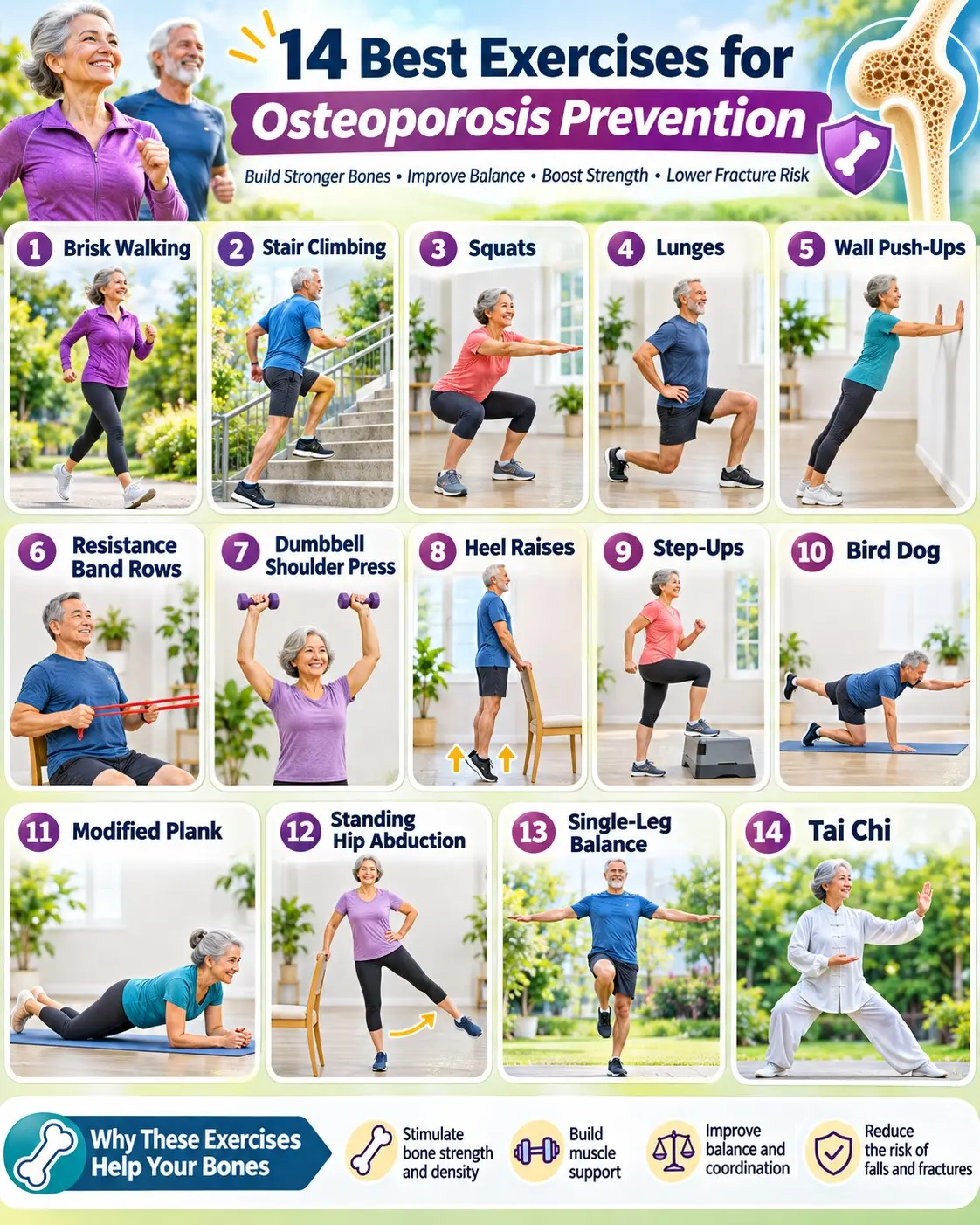
The Best Exercises for Osteoporosis Prevention combine resistance, weight bearing movement, balance, posture, and safe impact when appropriate
1. Chair Squat
A chair squat trains the hips and thighs and copies the movement used to stand from a chair.
How to do it:
- Stand in front of a sturdy chair.
- Keep your feet about hip width apart.
- Push your hips back.
- Bend your knees and lower toward the chair.
- Stand again with control.
Start with 8 to 12 repetitions.
Hold a stable support if balance is limited.
2. Step Up
Step ups strengthen the hips and legs while adding a useful weight bearing load.
- Use a low, stable step.
- Place one foot fully on it.
- Push through that leg to step up.
- Step down slowly.
- Repeat on the other side.
Use a rail when needed.
3. Hip Hinge
The hip hinge teaches you to bend from the hips while keeping the spine long.
This movement is useful for daily tasks such as picking up objects safely.
- Stand tall.
- Soften your knees.
- Push your hips backward.
- Keep your chest long and spine neutral.
- Return to standing.
Do not round deeply through your back.
4. Resistance Band Row
Rows strengthen the upper back and can support better posture.
- Anchor a resistance band securely.
- Hold one end in each hand.
- Stand tall.
- Pull your elbows back.
- Squeeze your shoulder blades gently.
- Return slowly.
Avoid rounding your spine forward.
5. Wall Push Up
Wall push ups strengthen the chest, shoulders, and arms.
- Stand facing a wall.
- Place your hands at shoulder height.
- Bend your elbows and bring your body toward the wall.
- Push back to the start.
As you get stronger, you can progress to a counter or higher resistance version.
Wall push ups are useful, but they are not automatically equal to floor push ups for loading.
6. Standing Hip Abduction
This exercise strengthens the muscles on the side of the hip.
Those muscles help control the pelvis when you walk and stand on one leg.
- Hold a chair lightly.
- Stand tall.
- Move one leg out to the side.
- Keep your toes facing forward.
- Return slowly.
Add a band only when the basic version feels easy.
7. Heel Raise
Heel raises strengthen the calves and support balance.
- Stand near a counter.
- Rise onto your toes.
- Pause briefly.
- Lower slowly.
Progress from two legs to one leg only when balance is good.
8. Supported Split Squat
A split squat strengthens the hips and thighs while challenging balance.
- Stand with one foot in front of the other.
- Hold a stable support.
- Bend both knees a small amount.
- Keep your chest upright.
- Push back to standing.
You do not need to lower deeply.
9. Bridge
Bridges strengthen the glutes and back of the hips.
- Lie on your back with knees bent.
- Keep both feet flat.
- Tighten your glutes.
- Lift your hips gently.
- Lower with control.
Do not force the back into a large arch.
10. Back Extension
Back extensor strength matters for posture and spine support.
A safe standing version is simple.
- Stand with your back near a wall.
- Keep your spine long.
- Gently draw your shoulders back.
- Think about growing tall through the top of your head.
- Hold for a few seconds.
Do not force a deep backbend.
11. Single Leg Balance
Balance training does not directly build large amounts of bone, but it can help reduce falls.
- Stand beside a counter.
- Lift one foot slightly.
- Hold for 10 to 30 seconds.
- Switch sides.
Keep support close.
Do not close your eyes unless a qualified professional has told you it is safe.
12. Tandem Walk
Tandem walking trains balance during movement.
- Stand near a wall or counter.
- Place one foot just in front of the other.
- Walk slowly in a straight line.
- Use support when needed.
13. Brisk Walking
Brisk walking is a simple weight bearing activity.
It supports general fitness and helps maintain mobility.
Walking alone may not provide enough stimulus to maximize bone density, so combine it with resistance training.
See Walking Exercise for Seniors for an easier walking plan.
14. Safe Impact Exercise When Appropriate
Impact can give bone a useful loading signal.
For people without osteoporosis or major fracture risk, this may include:
- Stair climbing
- Firm heel drops
- Small hops
- Light jumping
But impact is not appropriate for everyone.
If you have osteoporosis, vertebral fractures, multiple fragility fractures, severe balance problems, or high fracture risk, ask a qualified professional before adding hopping or jumping.
14 Exercises at a Glance
| Exercise | Main Goal | Safety Note |
|---|---|---|
| Chair squat | Hip and leg strength | Use support |
| Step up | Weight bearing strength | Use low step |
| Hip hinge | Safe bending skill | Keep spine long |
| Band row | Back strength | Avoid rounding |
| Wall push up | Upper body strength | Progress gradually |
| Hip abduction | Hip stability | Hold support |
| Heel raise | Calf strength | Stay near counter |
| Split squat | Leg strength | Small range first |
| Bridge | Glute strength | Avoid large arch |
| Back extension | Posture | Keep it gentle |
| Single leg balance | Fall prevention | Keep support close |
| Tandem walk | Dynamic balance | Use wall if needed |
| Brisk walking | Weight bearing fitness | Combine with strength |
| Safe impact | Bone loading | Only if appropriate |
Why Resistance Training Matters So Much
Resistance training is one of the strongest exercise tools for bone health.
A 2025 meta analysis of 17 randomized trials found improvements in bone mineral density at the lumbar spine, femoral neck, and total hip in postmenopausal women.
Higher training loads showed good results in some groups.
But that does not mean beginners should immediately lift very heavy weights.
Load should rise as strength, technique, and confidence improve.
Does Heavy Strength Training Help Bones?
It can.
A 2026 review found that high intensity, impact, and strength training produced small but significant improvements in bone mineral density at the femoral neck and lumbar spine in postmenopausal women.
Heavy training should be supervised when fracture risk is high or technique is uncertain.
Why Walking Alone May Not Be Enough
Walking is excellent for general health.
It is weight bearing and helps maintain mobility.
However, bones respond best to loads that are stronger or different from normal daily activity.
That is why walking works better as part of a broader plan that includes strength and, when safe, impact exercise.
What Is Weight Bearing Exercise?
Weight bearing means your bones support your body against gravity.
Examples include:
- Walking
- Stair climbing
- Dancing
- Hiking
- Standing strength exercises
Swimming and cycling are excellent for fitness, but they provide less direct weight bearing load to the skeleton.
What Is Impact Exercise?
Impact exercise gives bones a brief loading signal when the foot contacts the ground.
Examples range from brisk walking and stair climbing to hopping and jumping.
The correct level depends on your fracture risk.
People with vertebral fractures or multiple low trauma fractures may need to stay around brisk walking level rather than doing jumps or high impact exercise.
Best Exercises for Hip Bone Health
The hips are a major concern because hip fractures can have serious consequences.
Useful exercises include:
- Squats
- Step ups
- Split squats
- Hip abduction
- Walking
- Resistance training
Do not say that one of these exercises “targets bone density” by itself.
The benefit comes from the full loading pattern over time.
Best Exercises for Spine Health
Spine exercise should focus on strength, posture, and safe movement.
Useful options include:
- Rows
- Gentle back extension
- Hip hinges
- Wall push ups
- Supported strength training
Deep forward bending and repeated loaded spinal flexion may not be appropriate for people with osteoporosis.
Why Back Extensor Strength Matters
The muscles along your back help you stay upright.
Strengthening them can support posture and daily movement.
Expert osteoporosis guidance recommends spinal extension exercise as part of a safe program.
Balance Training and Fracture Prevention
Balance exercise does not make bone dramatically denser.
Its value is different.
It can help reduce the chance of a fall.
That is important because many osteoporotic fractures happen after a fall.
How Often Should You Practice Balance?
Current fracture prevention guidance supports regular balance and fall prevention work.
Short sessions can be done several times each week.
Keep support close until your balance improves.
Can Yoga Help Osteoporosis?
Some yoga poses can support balance, mobility, and strength.
But yoga needs modification when osteoporosis is present.
Avoid poses that involve deep spinal flexion or forceful twisting if you have low bone density or vertebral fracture risk.
For gentler options, see Chair Yoga for Seniors.
Can Tai Chi Help?
Tai Chi can be useful for balance and movement control.
Its main value in osteoporosis is fall prevention rather than directly creating large increases in bone density.
Exercises to Avoid or Modify With Osteoporosis
There is no universal banned exercise list.
However, people at high fracture risk often need to modify movements that place large or sudden forces on the spine.
Use caution with:
- Deep sit ups
- Toe touching with a rounded back
- Loaded spinal flexion
- Fast twisting
- Forceful yoga twists
- High impact jumping when fracture risk is high
Good technique matters as much as exercise choice.
Is Planking Safe?
A plank may be suitable for some people, but it is not necessary for bone health.
A wall plank or counter plank may be easier for beginners.
If getting down to the floor is difficult or risky, use a standing option.
Is Running Good for Osteoporosis Prevention?
Running provides impact and can support bone loading in people who are healthy enough for it.
But it is not required.
If you already have osteoporosis, fractures, severe joint problems, or high fall risk, ask whether running is appropriate.
Can Exercise Reverse Osteoporosis?
Exercise can improve strength, balance, function, and sometimes bone density.
But it should not be described as a cure.
If fracture risk is high, medicine may still be needed.
The Royal Osteoporosis Society states clearly that exercise is not a replacement for osteoporosis medication when medication is indicated.
Can Bone Density Improve After 50?
Yes, some exercise programs can improve bone density after menopause.
A 2025 resistance training meta analysis and a 2026 review of high intensity, impact, and strength training both found improvements at important bone sites in postmenopausal women.
The gains are usually modest.
Is It Too Late to Start at 60 or 70?
No.
Older adults can still improve strength, balance, posture, and mobility.
Bone response may be slower than in younger people, but staying active still matters.
See Getting Fit at 60.
A Simple Weekly Bone Health Plan
| Day | Activity |
|---|---|
| Monday | Strength training plus balance |
| Tuesday | 30 minute brisk walk |
| Wednesday | Balance and posture practice |
| Thursday | Strength training |
| Friday | Brisk walking or stairs |
| Saturday | Balance, posture and easy walk |
| Sunday | Rest or easy movement |
This is an example.
The right amount depends on your age, fracture risk, experience, health, and current strength.
How Hard Should Strength Training Be?
The weight should become challenging as you get stronger.
Very light exercise that never progresses may be less effective for bone.
Current research suggests moderate to higher resistance loads can be useful, but heavy training should be introduced safely.
How Often Should You Strength Train?
Two to three sessions each week is a common target.
Fracture prevention guidance recommends at least two weekly sessions focused on bone strength.
Allow recovery between hard sessions.
Do Calcium and Vitamin D Matter?
Yes, but supplements are not automatically needed.
Calcium, vitamin D, protein, exercise, and other health factors all affect bone.
Food is a good place to start.
For nutrition ideas, read Healthy Eating Lifestyle.
Should Everyone Take Calcium Supplements?
No.
Supplement needs depend on diet, age, health, kidney function, medicine, and your clinician's advice.
More calcium is not automatically better.
What About Protein?
Protein supports muscle.
Strong muscles help you move, train, and reduce fall risk.
Include protein foods across the day as part of a balanced diet.
Common Osteoporosis Exercise Mistakes
1. Doing Only Walking
Walking is useful, but strength training adds a different bone stimulus.
2. Using Weights That Never Progress
Muscles and bones need a growing challenge.
3. Ignoring Balance
Fall prevention is a major part of fracture prevention.
4. Doing Deep Spinal Bending
This may be risky for people with vertebral osteoporosis.
5. Starting High Impact Exercise Too Soon
Impact level should match fracture risk.
6. Treating Yoga as Automatically Safe
Some poses need modification.
7. Believing Exercise Replaces Medicine
It does not when medication is medically indicated.
8. Expecting Fast Bone Density Changes
Bone adapts slowly.
9. Training Without Good Technique
Quality matters more than rushing repetitions.
10. Using Pain as a Progress Marker
Pain is not proof that an exercise is building bone.
Bone Health Exercise Checklist
- Include resistance training.
- Use weight bearing activity.
- Add safe impact only when appropriate.
- Train balance regularly.
- Strengthen the back and hips.
- Practice a safe hip hinge.
- Avoid deep spinal flexion if fracture risk is high.
- Progress resistance slowly.
- Use support during balance work.
- Combine walking with strength training.
- Ask for professional help if you have vertebral fractures.
- Do not replace prescribed osteoporosis medicine with exercise.
Conclusion
The Best Exercises for Osteoporosis Prevention are not one magic move.
The strongest plan combines resistance training, weight bearing exercise, balance, posture, and safe impact when your fracture risk allows it.
Squats, step ups, rows, hip strengthening, heel raises, walking, and balance exercises can all play a useful role.
Most importantly, choose exercises you can perform with good form and progress over time.
Your next step: begin with two strength sessions each week plus regular walking and simple balance practice. If you already have osteoporosis or a previous fracture, ask a qualified professional which impact and spine movements are safe for you.
References and Sources
- Royal Osteoporosis Society. Exercise for Bones. Reviewed June 2026.
https://theros.org.uk/information-and-support/exercise/exercise-for-bones/ - Royal Osteoporosis Society. NICE Updates Osteoporosis Guidelines, August 2026.
https://theros.org.uk/news/nice-updates-osteoporosis-guidelines-what-you-need-to-know/ - Brooke Wavell K, et al. Strong, Steady and Straight: UK Consensus Statement on Physical Activity and Exercise for Osteoporosis.
https://pubmed.ncbi.nlm.nih.gov/35577538/ - Zhao F, et al. Optimal Resistance Training Parameters for Improving Bone Mineral Density in Postmenopausal Women: Systematic Review and Meta Analysis, 2025.
https://pubmed.ncbi.nlm.nih.gov/40420105/ - Jones E, Starrs P, Hunter B. High Intensity, Impact, and Strength Training and Bone Mineral Density in Women: Systematic Review and Meta Analysis, 2026.
https://pubmed.ncbi.nlm.nih.gov/42578477/ - Exercise for Fracture Prevention: Evidence and Consensus Based Practice Guideline, 2026.
https://pubmed.ncbi.nlm.nih.gov/41699562/ - Effects of Different Types of Exercise on Bone Mineral Density in Postmenopausal Women: Network Meta Analysis, 2026.
https://pubmed.ncbi.nlm.nih.gov/41617082/
Internal Links + Hub
- NextFitLife Fitness Hub
- Fitness Program Guide
- Healthy Eating Lifestyle
- Simple Strength Training Exercises at Home
- Strength Training Exercises at Home for Beginners
- Strength Training Exercises for Seniors
- Walking Exercise for Seniors
- Getting Fit at 60
- Chair Yoga for Seniors
- Best Yoga Moves for Beginners
- How to Maintain Muscle Mass
About the Author
Adel Galal is the founder and lead writer of NextFitLife.com and the founder of Parnthub.com.
He is a father of four, three sons and a daughter, and a grandfather of four, with more than 33 years of hands on family experience. Adel is based in Cairo, Egypt.
He has maintained a personal interest in health, fitness, nutrition, mobility, bone health, sleep, wellness, and healthy aging for more than 30 years and has more than 15 years of health and wellness writing experience.
His work focuses on reviewing trusted sources, separating established health guidance from exaggerated claims, and turning research into practical steps readers can understand and use.
Adel is not a doctor, physical therapist, exercise physiologist, registered dietitian, or osteoporosis specialist. NextFitLife content is for general information and education and does not replace individual medical advice.
Learn more about Adel and NextFitLife on the About Us page.
Frequently Asked Questions
What are the Best Exercises for Osteoporosis Prevention?
The Best Exercises for Osteoporosis Prevention combine resistance training, weight bearing exercise, balance work, posture exercises, and safe impact when appropriate.
What is the single best exercise for osteoporosis prevention?
There is no single best exercise. A combined program works better because bone strength, muscle strength, posture, and fall risk all matter.
Is strength training good for osteoporosis prevention?
Yes. Resistance training is one of the best supported exercise types for improving or maintaining bone mineral density.
Can heavy weights improve bone density?
They can in suitable people, but heavy training should be introduced gradually and may need supervision when fracture risk is high.
Is walking enough to prevent osteoporosis?
Walking is useful weight bearing activity, but adding resistance training and balance work creates a stronger overall bone health program.
Does walking increase bone density?
Walking can help maintain bone and mobility, but the effect on bone density may be smaller than with progressive resistance or appropriate impact exercise.
Can squats help bone health?
Yes. Squats strengthen the hips and legs and provide useful loading, but no single squat exercise guarantees higher bone density.
Are lunges safe with osteoporosis?
They can be for some people, but a supported split squat may be easier and safer if balance is limited.
Are wall push ups good for bone health?
They help upper body strength and are a useful beginner option, but stronger variations may provide more resistance as fitness improves.
Are balance exercises important for osteoporosis?
Yes. Balance training may reduce fall risk, which is a major part of preventing fractures.
What exercises help the spine?
Rows, back extension, hip hinges, and posture exercises can strengthen muscles that support the spine.
What exercises help the hips?
Squats, step ups, split squats, hip abduction, walking, and progressive resistance training all strengthen the hip region.
Should people with osteoporosis jump?
Not everyone. High impact exercise may be useful for some people but may be unsafe with vertebral fractures, multiple fragility fractures, or high fracture risk.
Is running safe with osteoporosis?
It depends on fracture risk, balance, joints, and previous fractures. Ask a qualified professional if you already have osteoporosis.
Is yoga safe with osteoporosis?
Some yoga is safe, but deep forward bending and forceful spinal twisting may need to be avoided or modified.
Is Tai Chi good for osteoporosis?
Tai Chi can improve balance and movement control, which may help reduce fall risk.
Can exercise reverse osteoporosis?
Exercise may improve bone density in some people and can improve strength and balance, but it should not be described as a cure.
Can bone density improve after menopause?
Yes. Recent studies show that resistance, impact, and combined exercise can produce modest improvements in bone mineral density in postmenopausal women.
Can I start bone strengthening exercise after 60?
Yes. Older adults can still improve strength, balance, posture, and mobility with appropriate training.
How often should I strength train for bone health?
Two to three sessions each week is a practical target for many adults, with progression based on fitness and safety.
How often should I do balance exercises?
Short balance sessions several times each week can be useful, especially for people with higher fall risk.
Should I avoid sit ups if I have osteoporosis?
Deep spinal flexion may not be safe for people with vertebral osteoporosis or high fracture risk, so safer core exercises may be better.
Does exercise replace osteoporosis medicine?
No. If your fracture risk is high and medicine is prescribed, exercise should support treatment rather than replace it.
Do calcium and vitamin D help bone health?
Yes, both are important, but supplement needs differ. Food intake, blood levels, health conditions, and medical advice should guide supplementation.
When should I get help before exercising?
Seek professional advice if you have a recent fracture, vertebral fracture, severe osteoporosis, major balance problems, severe back pain, or uncertainty about safe impact exercise.

Health & wellness writer with 30+ years of experience in nutrition, fitness, and healthy aging. Founder of NextFitLife.com — evidence-based health guidance.

