Published: April 2026 | Last Updated: April 14, 2026
How to Maintain Muscle Mass While Losing Fat Is the Most Important Question in Weight Loss
Everyone wants to lose weight. Very few people ask what kind of weight they are losing.
When you diet without a strategy, research shows that up to 25% of total weight loss comes from lean muscle rather than fat. That means losing muscle, trying to swing your metabolism, and making every future fat-loss attempt progressively harder. Knowing how to maintain muscle mass during a calorie deficit can change the overall quality of your results.
Preserving fat-free mass during weight loss is critical for preventing sarcopenia and maintaining metabolic health.
This guide covers every proven strategy to preserve lean muscle, protect your body composition, and ensure the weight you lose is fat, not tissue you need.
This article is part of our complete weight loss guide.
Why does maintaining muscle mass during weight loss matter so much?
What Happens to Your Metabolism When You Lose Muscle?
Each kilogram of lean muscle burns approximately 10 to 15 calories per day at rest. Lose 3 kg of lean body mass during a diet, and your resting metabolic rate drops by 30 to 45 calories per day permanently.
That sounds small today. But compounded over the years, a slower metabolism makes weight maintenance progressively harder. It is one of the primary biological drivers behind weight regain after fat loss.
Research suggests that without evidence-based muscle preservation strategies, a significant portion of weight loss, often ranging from 20 to 30 percent, comes from lean body mass rather than adipose tissue.
How much lean muscle do you actually lose without intervention?
People who diet through calorie restriction alone lose approximately 25% of their total weight from muscle tissue.
A person losing 12 kg through diet alone could lose 3 kg of that from lean muscle. That is a meaningful metabolic cost that shows up for years afterward, not just during the diet itself.
The good news is that this is almost entirely preventable. The two strategies that prevent it — resistance training and adequate protein — are covered below.
How to Maintain Muscle Mass with Resistance Training
Is resistance training the most effective way to preserve lean muscle?
Yes. The research published in January 2026 says so clearly.
A study examining the effects of resistance training, aerobic exercise, and no exercise on body composition during a calorie-restricted diet included 304 adults aged across a wide range of ages.
Resistance training participants gained an average of 1.15 kg of fat-free mass in men and 0.94 kg in women. The aerobic exercise group showed a minimal change in lean mass. The no-exercise group lost lean mass alongside fat.
Same calorie deficit for all three groups. Same diet. Different exercises. Resistance training did not just maintain muscle. It was built while fat was simultaneously lost.
How much resistance training does you need to preserve lean muscle?
Two sessions per week is the minimum effective dose confirmed by research.
More sessions are not always better. Two well-structured sessions covering the major muscle groups produce the full muscle-preserving benefit during a calorie deficit without creating excessive demand.
The core movement patterns for body composition: Squats or leg press (lower body push). Deadlifts or hip hinges (lower body pull). Rows or pull-ups (upper body pull). Press-ups or chest press (upper body push). Overhead press (shoulders). Plank or core work (stability).
Two sessions per week with these six movements cover all major muscle groups. That is 30 to 45 minutes twice per week to protect your lean body mass throughout months of fat loss.
Do You Need a Gym to maintain muscle mass?
No. And this is backed by a 2025 study.
Home-based interventions provide sufficient mechanical tension to induce hypertrophy and improve muscle function in populations with obesity, proving that access is not a physiological barrier to results.
Bodyweight squats, press-ups, resistance band rows, glute bridges, and planks performed at home with progressive difficulty increases produce the same muscle-preserving response as gym-based training.
The key principle is progressive overload. Add one extra rep or slightly more resistance every one to two weeks. Without that progressive challenge, the muscle has no reason to adapt and maintain itself.
How to Maintain Muscle Mass Through Protein Intake
How much protein do you need to preserve lean muscle in a calorie deficit?
Protein is the nutritional foundation of muscle preservation. It supplies the amino acids that muscle fibers need for repair, maintenance, and muscle protein synthesis.
The evidence-based protein target for maintaining muscle mass during weight loss is 1.2 to 1.6 grams of protein per kilogram of body weight daily for most adults. 1.6 to 2.2 grams per kilogram for people doing resistance training or those over 50.
Protein requirements are significantly higher during weight loss. “Target 30–40 grams of protein in each meal, spread across three to four meals daily. Muscle protein synthesis is maximized when protein is distributed throughout the day rather than concentrated in one sitting.
| Body Weight | Minimum Protein | Optimal With Training |
| 60 kg | 72g daily | 96 to 132g |
| 70 kg | 84g daily | 112 to 154g |
| 80 kg | 96g daily | 128 to 176g |
| 90 kg | 108g daily | 144 to 198g |
| 100 kg | 120g daily | 160 to 220g |
Why Does Protein Prevent Muscle Protein Breakdown So Effectively?
During a calorie deficit, your body looks for alternative fuel sources. If protein intake is adequate, it preferentially burns stored fat. If protein is insufficient, it breaks down muscle tissue for energy.
This is the direct mechanism behind lean body mass loss during dieting without sufficient protein. Muscle protein breakdown exceeds muscle protein synthesis when amino acid availability is low. The deficit literally cannibalizes your muscle to fuel basic functions.
Increasing protein intake helps maintain muscle by favouring synthesis over breakdown, even when overall calorie consumption is reduced.
For the best protein sources ranked by content and practicality, see our high-protein foods for weight loss guide.
How to Maintain Muscle Mass by Managing Your Calorie Deficit
Does a larger calorie deficit cause more muscle loss?
Yes. This is one of the most consistently documented findings in body composition research.
A small caloric deficit helps reduce the amount of lean body mass lost. Research recommends females reduce calories by about 300 to 400, and males by about 400 to 600 calories, to minimize lean mass loss.
Aggressive deficits of 1,000 or more calories per day accelerate muscle protein breakdown disproportionately. When energy availability drops sharply, the body does not neatly separate fat from lean tissue. It burns both.
A moderate deficit of 300 to 500 calories daily produces reliable fat loss while giving protein intake and resistance training the metabolic conditions they need to protect lean body mass effectively.
How fast should you lose weight to preserve lean muscle?
Losing weight faster than 1 kg per week consistently causes a sharp increase in the proportion of muscle lost alongside fat.
The healthy rate of 0.5 to 1 kg per week is not just about sustainability. It directly protects your body composition by giving muscle protein synthesis enough time to operate, and your training enough time to provide the mechanical stimulus muscles need.
For more on safe weight loss rates, see our healthy rate of weight loss guide.
Use our calorie deficit calculator to find your moderate daily target.
How Sleep Helps You Maintain Muscle Mass
Why is sleep so critical for muscle preservation during weight loss?
Sleep is when growth hormone is released, and muscle tissue is repaired. Both are non-negotiable for lean body mass maintenance.
Research confirms that individuals sleeping 5.5 hours versus 8.5 hours lose significantly less fat and more muscle, even when calories are identical. Sleep deprivation increases cortisol and decreases growth hormone, creating a pro-catabolic environment that accelerates muscle protein breakdown.
A person training consistently but sleeping only 5 to 6 hours loses a significant proportion of the muscle adaptation they should be gaining. The training signal is there. The recovery window is not.
Sleep targets for muscle preservation: 7 to 9 hours per night consistently. Same wake time daily to regulate growth hormone release timing. No alcohol within 3 hours of sleep suppresses overnight growth hormone production.
For the complete sleep and fitness protocol, see our best way to optimise sleep for fitness outcomes guide.
How to Maintain Muscle Mass After 50 - Special Considerations
Why is preserving lean muscle harder after 50?
After age 30, adults lose approximately 3 to 5% of muscle mass per decade. This accelerates after 50 as testosterone and estrogen decline, creating a condition called sarcopenia — age-related muscle loss that progressively impairs physical function and metabolic health.
Older adults also experience anabolic resistance. Their muscles respond less efficiently to both protein intake and training stimuli. This means protein requirements increase, and training consistency becomes more important. Not less.
Resistance exercise protects against the loss of fat-free mass and increases the loss of fat mass during dietary weight loss with high certainty evidence. Muscular strength was also significantly greater in resistance exercise groups.
For the specific approach to fat loss and muscle preservation over 50, see our weight loss tips for over 50 guide.
Common Mistakes That Cause Lean Muscle Loss During Weight Loss
What are the biggest errors people make when trying to preserve muscle mass?
Doing only cardio. Cardio burns calories but provides no mechanical stimulus for lean body mass retention. Without resistance training, any calorie deficit causes muscle protein breakdown that exceeds muscle protein synthesis. The result is a body that is lighter but proportionally fatter with a slower metabolism.
Insufficient protein. Most people in a calorie deficit unintentionally undereat protein. Cutting food volume without tracking protein specifically is the fastest path to lean muscle loss. Hit your protein target first, then fit other foods around it.
Too aggressive a deficit. A 1,000-calorie daily deficit produces faster initial weight loss but significantly more muscle loss per kilogram of total weight. The metabolic cost is not worth the speed.
No progressive overload. Doing the same resistance workout with the same weight for months provides no increasing stimulus. Muscles need progressively greater challenges to maintain and grow. Add one rep or slightly more resistance every one to two weeks.
Skipping sleep. Extended periods of dieting combined with poor sleep create a pro-catabolic environment where muscle protein breakdown consistently exceeds muscle protein synthesis.
The Complete How to Maintain Muscle Mass Action Plan
What Should You Do This Week to Start Preserving Lean Muscle?
This four-part framework starts immediately and produces measurable results within weeks.
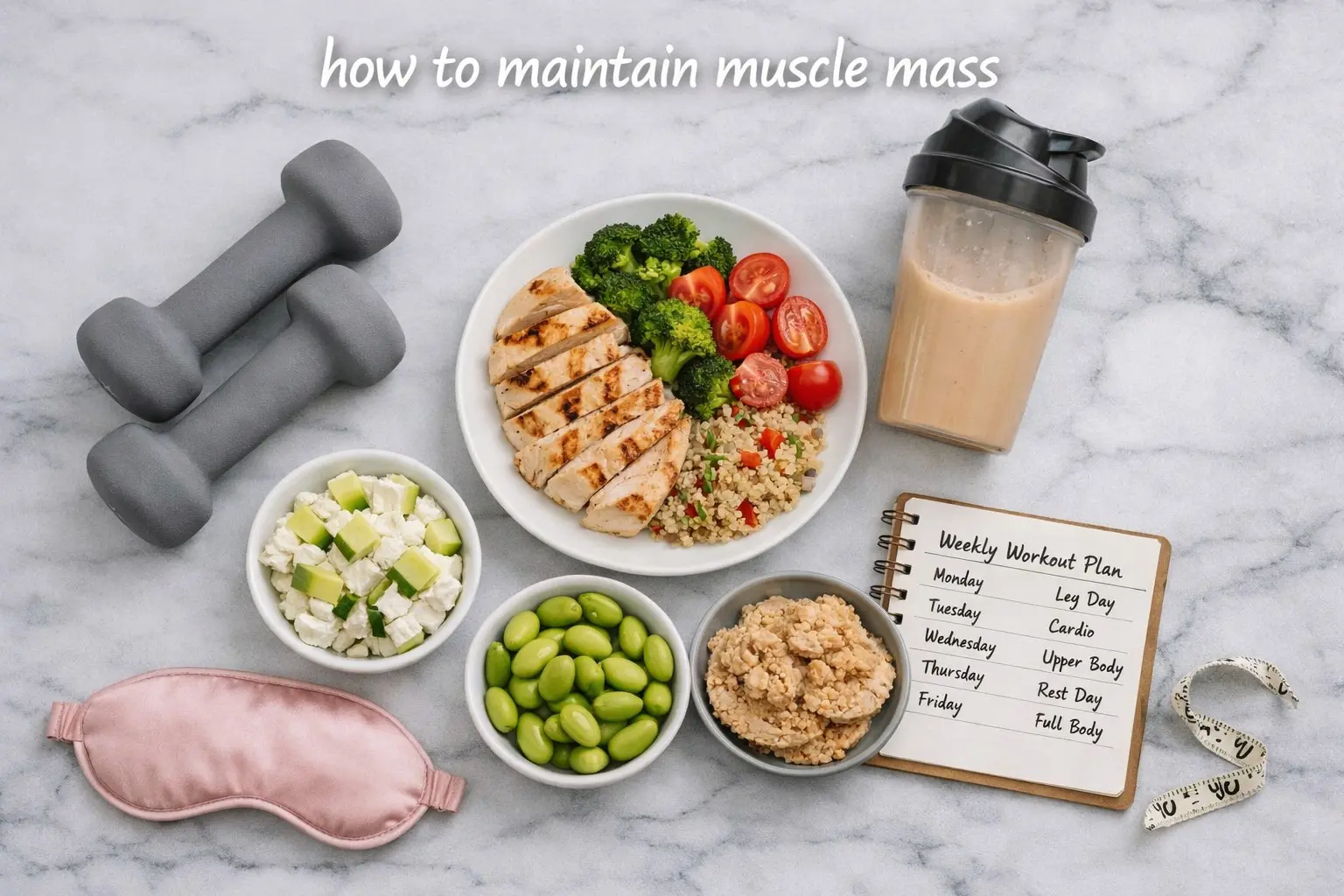
Protein - Multiply your body weight in kg by 1.4. That is your minimum daily protein gram target. Hit it every day, spread across three to four meals with 30 to 40 grams per sitting.
Resistance training - Schedule two sessions per week on fixed days. Use the six compound movements listed above. Start at a manageable level with correct form and add progressive overload every one to two weeks.
Calorie deficit - Set a moderate 300 to 500 calorie deficit. Never go below 1,200 calories daily for women or 1,500 for men. Use our calorie deficit calculator to set your precise target.
Sleep - Set a fixed wake time. Keep it every single day. Strive for 7–9 hours of steady, restorative sleep each night. This is where muscle protein synthesis does most of its work.
Measure progress by tracking waist circumference and strength performance alongside scale weight. If your lifts are holding steady or improving and your waist is shrinking, you are preserving lean muscle while losing fat. That is the goal.
Bottom Line on How to Maintain Muscle Mass
Maintaining muscle mass during weight loss is not complicated. But it does require a specific approach.
Eat enough protein. Train with resistance at least twice per week. Keep your calorie deficit moderate. Sleep consistently. Apply progressive overload.
Between 2025 and 2026, a growing body of high-quality research has reshaped our understanding of how resistance training combined with strategic nutrition enables simultaneous fat loss and preservation of lean muscle mass.
The evidence is the clearest it has ever been. Maintaining muscle mass during fat loss is not only possible — it is reliably achievable when these four pillars are applied consistently.
Lose fat. Keep your muscles. Protect your metabolism. That is high-quality weight loss.
For more on the complete approach to sustainable fat loss, read our sustainable weight loss tips and learn what the best exercises are for weight loss.
FAQs About How to Maintain Muscle Mass
Q: What is the most important factor in maintaining muscle mass during weight loss?
Resistance training twice per week is the single most important factor. A January 2026 study of 304 adults on a calorie-restricted diet confirmed that resistance training participants gained fat-free mass, while those who only did aerobic exercise or no exercise lost lean muscle alongside fat. Protein intake at 1.2 to 1.6 grams per kilogram of body weight daily is the essential nutritional complement.
Q: Can you maintain muscle mass in a calorie deficit?
Yes. You can maintain and even build lean muscle in a calorie deficit with the correct approach. The January 2026 Frontiers in Endocrinology study confirmed that resistance training participants gained lean body mass while eating in a calorie deficit. The three non-negotiable requirements are resistance training at least twice per week, adequate protein intake, and a moderate deficit of 300 to 500 calories rather than an aggressive one.
Q: How much protein do you need to preserve lean muscle?
1.2 to 1.6 grams per kilogram of body weight daily for most adults. People over 50 or those training regularly benefit from 1.6 to 2.2 grams per kilogram because of anabolic resistance. Distribute protein across three to four meals with 30 to 40 grams per meal to maximize muscle protein synthesis throughout the day.
Q: Does cardio cause lean muscle loss?
Cardio alone during a calorie deficit contributes to muscle protein breakdown because it does not provide the mechanical stimulus that lean body mass needs to maintain itself. The January 2026 study confirmed that the aerobic-only group showed a minimal change in fat-free mass, while the resistance training group gained lean mass. Adding resistance training alongside cardio fully addresses this.
Sources and References
- PMC — Effect of resistance exercise on body composition during dietary weight loss — BMJ Open Sport and Exercise Medicine, September 2025 https://pmc.ncbi.nlm.nih.gov/articles/PMC12406911/
- PMC — Saving muscle while losing weight: vital strategy during GLP-1 therapy — 2025 https://pmc.ncbi.nlm.nih.gov/articles/PMC12444289/
- Mayo Clinic — Strength training: Get stronger, leaner, healthier https://www.mayoclinic.org/healthy-lifestyle/fitness/in-depth/strength-training/art-20046670
- NHS — Strength and flexibility exercises https://www.nhs.uk/live-well/exercise/strength-and-flexibility-exercises/
- NIH NIDDK — Factors affecting weight and health https://www.niddk.nih.gov/health-information/weight-management/adult-overweight-obesity/factors-affecting-weight-health
Last Updated: April 14, 2026


Health & wellness writer with 30+ years of experience in nutrition, fitness, and healthy aging. Founder of NextFitLife.com — evidence-based health guidance.