
Updated on: October 15, 2026
Written and source-checked by: Adel Galal, Founder and Lead Writer at NextFitLife
Medical review status: This article has not been medically reviewed by a doctor, urologist, nephrologist, gynecologist, pharmacist, or other licensed healthcare professional.
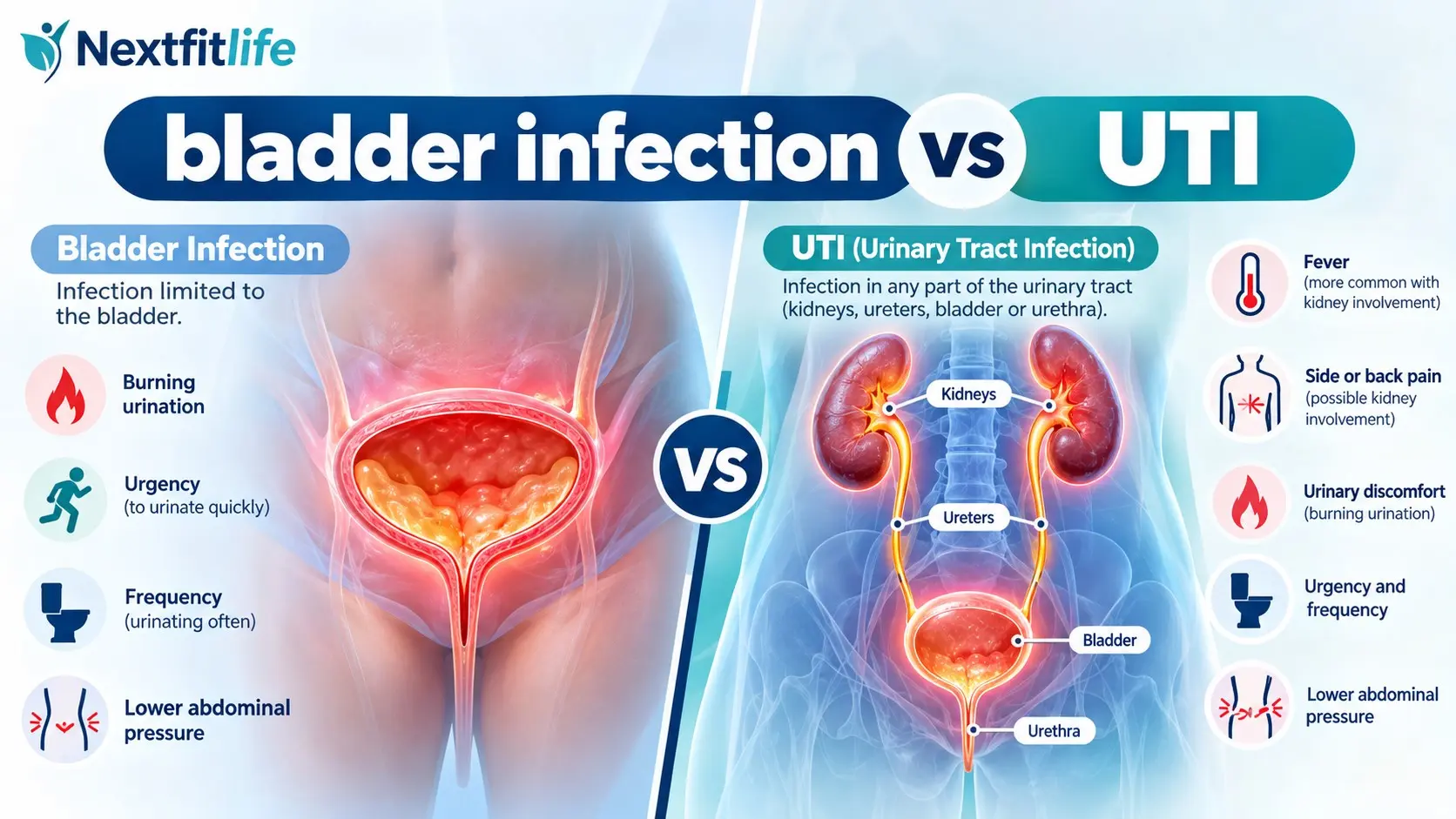
Bladder infection vs UTI sounds like a comparison between two different illnesses, but they overlap. A bladder infection is one type of urinary tract infection. A UTI can also affect the urethra or kidneys.
The key difference is location.
This article is for general information and education. It does not replace medical advice, diagnosis, or treatment.
The CDC confirms that a bladder infection is the most common form of UTI, while kidney infection is less common but more serious.
For a wider symptom guide, read UTI Symptoms: Signs, Treatment and Red Flags.
Table of Contents
- The basic difference
- What counts as a UTI
- What makes it a bladder infection?
- 9 crucial differences
- Location
- Symptoms
- Kidney warning signs
- Causes
- Testing
- Treatment
- Who needs faster care
- Recurrence
- Prevention
- Bladder infection symptoms
- Kidney infection symptoms
- How UTIs are diagnosed
- Treatment options
- What home care can and cannot do
- Cranberry and supplements
- UTIs in women, men, pregnancy, and children
- Recurring UTIs
- When to seek urgent care
- Frequently asked questions
What Is the Difference Between a Bladder Infection and a UTI?
The easiest way to understand the difference is to picture the urinary tract.
It includes:
- Kidneys
- Ureters
- Bladder
- Urethra
A urinary tract infection can occur in any part of that system.
A bladder infection means the infection is in the bladder. The medical term is cystitis.
NIDDK states that bladder infections are the most common type of UTI.
So every bacterial bladder infection is a UTI, but not every UTI is a bladder infection.
9 Crucial Differences Between a Bladder Infection and a UTI
| Feature | Bladder Infection | UTI |
|---|---|---|
| 1. Meaning | Infection of the bladder | General term for infection anywhere in the urinary tract |
| 2. Medical term | Cystitis | May include urethritis, cystitis, or pyelonephritis |
| 3. Common symptoms | Burning, urgency, frequency, lower abdominal pressure | Depends on which part of the urinary tract is infected |
| 4. Fever | Usually absent in simple lower bladder infection | More concerning for kidney infection or another serious cause |
| 5. Side or back pain | Not a typical simple bladder symptom | Can point to kidney infection |
| 6. Testing | Symptoms, urinalysis, sometimes urine culture | Testing depends on severity, location, recurrence, and patient risk |
| 7. Treatment | Antibiotics are commonly used when bacterial infection is confirmed or strongly suspected | Treatment depends on whether infection is in the bladder, kidneys, or another site |
| 8. Severity | Usually easier to treat when uncomplicated | Kidney UTI can become serious |
| 9. Main concern | Prevent spread upward | Identify location and treat before complications develop |
What Does a Bladder Infection Feel Like?
Bladder infection symptoms usually stay focused around urination and the lower abdomen.
NIDDK lists common symptoms such as:
- Burning or pain when urinating
- Frequent urges to urinate
- A strong urge even when little urine comes out
- Lower abdominal pain or pressure
- Cloudy urine
- Blood in the urine
- Strong smelling urine
One symptom alone does not prove infection.
For example, burning can also occur with vaginal irritation, sexually transmitted infections, kidney stones, dehydration, or other urinary problems.
What Symptoms Suggest the Infection Has Reached the Kidneys?
This is the distinction that matters most.
A kidney infection, also called pyelonephritis, is a more serious form of UTI.
CDC and NIDDK list warning symptoms such as:
- Fever
- Chills
- Pain in the back or side
- Nausea
- Vomiting
- Feeling very ill
A person can still have burning or urinary frequency at the same time.
For kidney protection advice, see Healthy Kidneys: 12 Smart Checks and Protection Habits.
What Causes a Bladder Infection?
Most bladder infections are caused by bacteria entering the urethra and traveling into the bladder.
CDC notes that bacteria from the skin or rectum can enter the urinary tract and cause infection.
Females are more likely to develop bladder infections because the urethra is shorter and located closer to the anus.
Common risk factors include
- Female anatomy
- Recent sexual activity
- A previous UTI
- Pregnancy
- Menopause
- Difficulty emptying the bladder
- Urinary catheter use
- Kidney stones or urinary blockage
- Enlarged prostate
- Diabetes
- Some immune problems
- Some contraceptive methods, including spermicide
A UTI is not automatically a sign of poor hygiene.
People with good hygiene can still get bladder infections.
Is a UTI a Sexually Transmitted Infection?
No.
A UTI is not classified as a sexually transmitted infection.
Sexual activity can increase UTI risk because bacteria may be moved toward the urethra.
However, burning urination can also occur with sexually transmitted infections.
If symptoms follow a new sexual contact, or you have discharge, genital sores, pelvic pain, testicular pain, or another STI concern, tell the clinician rather than assuming it is a bladder infection.
How Is a Bladder Infection Diagnosed?
Diagnosis can start with the symptom pattern.
A healthcare professional may then use:
- Medical history
- Physical examination
- Urinalysis
- Urine culture
- Blood tests in selected cases
- Imaging when needed
NIDDK explains that a urinalysis can check for blood and white blood cells, while a urine culture can identify common bacteria and help guide antibiotic choice.
When is a urine culture more useful?
A culture becomes especially useful when symptoms are severe, keep returning, treatment has failed, the diagnosis is unclear, pregnancy is involved, or there are risk factors for resistant bacteria or complicated infection.
Not every simple UTI needs the exact same testing pathway.
Can a Urine Dipstick Diagnose Every UTI?
No.
Dipstick tests can detect findings such as leukocyte esterase and nitrites that support the diagnosis, but they are not perfect.
A negative test does not always exclude infection, and a positive result does not tell the whole clinical story.
This is one reason symptoms, risk factors, and urine testing need to be interpreted together.
How Is a Bladder Infection Treated?
Bacterial bladder infections are commonly treated with antibiotics.
The specific antibiotic depends on the patient, likely bacteria, allergies, local resistance patterns, kidney function, pregnancy status, previous cultures, and whether the infection is uncomplicated or complicated.
NIDDK advises taking antibiotics exactly as prescribed and completing the treatment course given by the healthcare professional.
Why not name one “best” antibiotic?
Because there is no universal best drug for every UTI.
An antibiotic that is appropriate for one person may be unsuitable for someone who is pregnant, has reduced kidney function, takes interacting medicines, has allergies, or has resistant bacteria.
That is why copying an old prescription is a bad idea.
Can You Treat a Bladder Infection at Home?
Comfort measures can help symptoms, but they do not reliably eliminate a bacterial infection.
NIDDK suggests drinking enough liquids if this is safe for you and using suitable pain relief when recommended.
A heating pad over the lower abdomen or back can also ease discomfort.
For a full treatment overview, see How to Get Rid of a UTI Fast: Safe Relief and When to Get Care.
Water helps support recovery
Drink enough to stay hydrated.
Do not force huge amounts of water if you have heart failure, kidney disease, or another condition that limits fluid intake.
Ask your healthcare team what is safe for you.
Heat can help pain
A warm heating pad can ease lower abdominal discomfort.
It does not kill bacteria.
Pain medicine may help
Suitable over the counter pain relief may reduce discomfort.
Ask a pharmacist or clinician if you have kidney disease, stomach ulcers, take blood thinners, are pregnant, or are unsure which medicine is safe.
Does Cranberry Juice Cure a UTI?
No.
NIDDK states that cranberry juice, extracts, and pills do not treat an existing bladder infection.
Some research has looked at cranberry products for prevention in people who get recurrent UTIs, but the evidence is not strong enough to treat cranberry as a cure.
If you already have burning, urgency, or other UTI symptoms, do not delay proper assessment while waiting for cranberry juice to work.
What About Vitamin C, Baking Soda, Vinegar, or Garlic?
These are common internet suggestions, but they should not replace diagnosis and evidence based treatment.
There is no good reason to drink vinegar or baking soda to try to clear a bacterial bladder infection.
Large amounts can cause side effects or interact with health conditions and medicines.
Vitamin C and garlic are foods or supplements, not proven replacements for antibiotics when a bacterial UTI needs treatment.
Keep home care simple: hydration if safe, pain relief if suitable, warmth for comfort, and timely medical assessment.
Can a Bladder Infection Go Away Without Antibiotics?
Some mild lower urinary infections in selected nonpregnant adults may improve without immediate antibiotics.
That does not mean everyone should wait.
The decision depends on symptoms, pregnancy, sex, age, kidney health, immune status, recurrence, and whether kidney infection is possible.
If a clinician offers delayed treatment or symptom monitoring, follow the safety instructions closely.
Do not use a wait and see approach if you have fever, side pain, vomiting, pregnancy, severe illness, or another higher risk situation.
How Fast Should UTI Symptoms Improve?
Symptoms often begin improving after appropriate treatment, but the exact speed varies.
Contact your healthcare professional if symptoms get worse, do not start improving as expected, or return after treatment ends.
NIDDK advises medical review if symptoms return after kidney infection treatment and notes that repeat testing or imaging may sometimes be needed.
Who Needs Faster Medical Assessment?
Some people need a lower threshold for professional care.
Pregnant people
UTIs during pregnancy need medical assessment because they are more likely to cause complications and spread to the kidneys.
NIDDK notes that urine testing during pregnancy can identify bacteria before complications develop.
Men
UTIs are less common in younger men than in women.
When they occur, clinicians often look more carefully for prostate involvement, obstruction, stones, or another contributing problem.
Children
UTIs can look different in children, especially infants and toddlers.
NIDDK notes that fever may be the main sign in very young children.
A suspected UTI in a child deserves pediatric medical assessment.
Older adults
Older adults can have UTIs, but urinary bacteria without symptoms are also common.
A positive urine result does not automatically prove that every vague symptom is caused by a UTI.
Clinicians need to consider the full picture.
People with diabetes or reduced immunity
These conditions can raise the risk of more complicated infection.
Get medical advice earlier if symptoms appear.
Can a UTI Cause Blood in the Urine?
Yes.
Blood can occur with a bladder infection.
But visible blood in the urine also has other causes, including kidney stones, prostate problems, kidney disease, and bladder or urinary tract tumors.
Do not keep assuming repeated blood is “just another UTI.”
If blood persists after the infection clears, returns, or occurs without typical infection symptoms, get it assessed.
Can Kidney Stones Feel Like a UTI?
Yes.
Kidney stones can cause urinary urgency, blood in the urine, and pain.
The classic clue is strong pain in the side or back that may move toward the groin.
Stones can also block urine flow and increase infection risk.
For more detail, see Urinary Stones Cause: 9 Prevention Steps.
What Causes Recurring UTIs?
Recurrent UTI means infections keep coming back.
Common contributors can include:
- Sexual activity
- Spermicide use
- Menopause
- Incomplete bladder emptying
- Urinary stones
- Urinary tract abnormalities
- Catheter use
- Enlarged prostate
- Diabetes
- Previous resistant bacteria
Repeated infection should not become a permanent cycle of getting the same antibiotic without asking why it keeps happening.
A clinician may use urine cultures or further testing when the pattern suggests a structural or resistance problem.
Can Vaginal Estrogen Help Prevent Recurrent UTIs?
For some people after menopause, yes.
NIDDK notes that a healthcare professional may prescribe low dose vaginal estrogen for recurrent bladder infections in people who are in perimenopause or menopause.
This is not suitable for everyone, so the choice should be individualized.
Can You Prevent Every Bladder Infection?
No.
But some habits can reduce risk.
- Drink enough fluids. Water is usually the best choice.
- Urinate when you need to. Avoid regularly holding urine for very long periods.
- Empty the bladder fully.
- Wipe front to back.
- Review birth control if infections repeat. Spermicides and some diaphragm use can increase risk.
- Discuss vaginal estrogen after menopause when appropriate.
- Manage diabetes well.
- Address stones, obstruction, or bladder emptying problems.
- Use urinary catheters only when medically necessary and follow catheter care instructions.
Do not turn prevention into blame.
UTIs can happen even when someone follows good hygiene and healthy habits.
Bladder Infection vs Kidney Infection
| Symptom | Bladder Infection | Kidney Infection |
|---|---|---|
| Burning urination | Common | Can occur |
| Urgency and frequency | Common | Can occur |
| Lower abdominal pressure | Common | May occur |
| Fever and chills | Not typical of simple cystitis | Important warning sign |
| Side or back pain | Not typical | Common warning sign |
| Nausea or vomiting | Uncommon | Can occur |
| Urgency of care | Needs timely treatment | Needs prompt medical care |
When Should You Seek Urgent Care?
Seek prompt medical care if urinary symptoms come with:
- Fever
- Shaking chills
- Back or side pain
- Nausea or vomiting
- Rapid worsening
- Pregnancy
- Severe weakness
- Inability to keep fluids down
- Known urinary blockage
- Reduced immunity
Call emergency services or go to an emergency department for severe illness, fainting, confusion, severe breathing difficulty, signs of shock, or rapidly worsening symptoms.
Conclusion: Focus on Where the Infection Is
The most useful way to understand bladder infection vs UTI is simple: a bladder infection is one type of UTI, while a UTI can also involve the kidneys or other parts of the urinary tract.
Burning, urgency, frequency, and lower abdominal pressure fit a bladder infection. Fever, chills, vomiting, or back and side pain raise concern that the infection may have moved higher.
Your next step is to pay attention to location and severity. If symptoms are mild but persistent, arrange proper assessment. If you develop kidney warning signs, pregnancy related symptoms, severe illness, or rapidly worsening pain, get medical care promptly instead of relying on home remedies.
References and Sources
- Centers for Disease Control and Prevention. Urinary Tract Infection Basics.
Explains the difference between bladder and kidney UTIs, common symptoms, risk factors, and antibiotic treatment.
https://www.cdc.gov/uti/about/ - National Institute of Diabetes and Digestive and Kidney Diseases. Bladder Infection in Adults.
Explains that bladder infection is the most common UTI and covers symptoms, causes, diagnosis, treatment, and complications.
https://www.niddk.nih.gov/health-information/urologic-diseases/bladder-infection-uti-in-adults/ - NIDDK. Symptoms and Causes of Bladder Infection in Adults.
Covers burning urination, urgency, abdominal discomfort, urine changes, and kidney infection warning signs.
https://www.niddk.nih.gov/health-information/urologic-diseases/bladder-infection-uti-in-adults/symptoms-causes - NIDDK. Diagnosis of Bladder Infection in Adults.
Explains urinalysis, urine culture, blood tests, imaging, and when additional testing may be used.
https://www.niddk.nih.gov/health-information/urologic-diseases/bladder-infection-uti-in-adults/diagnosis - NIDDK. Treatment for Bladder Infection in Adults.
Covers antibiotics, hydration, pain relief, prevention, recurrent infection, and vaginal estrogen after menopause when appropriate.
https://www.niddk.nih.gov/health-information/urologic-diseases/bladder-infection-uti-in-adults/treatment - NIDDK. Eating, Diet, and Nutrition for Bladder Infection.
Explains that cranberry does not treat an existing bladder infection and that hydration can support urinary health.
https://www.niddk.nih.gov/health-information/urologic-diseases/bladder-infection-uti-in-adults/eating-diet-nutrition - NIDDK. Kidney Infection Treatment.
Covers antibiotic treatment, recurrence, and why worsening bladder infection symptoms need prompt medical attention.
https://www.niddk.nih.gov/health-information/urologic-diseases/kidney-infection-pyelonephritis/treatment
Internal Links and Helpful NextFitLife Guides
- UTI Symptoms: Signs, Treatment and Red Flags
- How to Get Rid of a UTI Fast: Safe Relief and Care
- Healthy Kidneys: 12 Smart Checks and Protection Habits
- Urinary Stones Cause: 9 Prevention Steps
- Renal Glycosuria: Causes, Tests and Treatment
- Kidney Disease Treatment: Tests, Medicines and Diet
About the Author
Adel Galal is the Founder and Lead Writer at NextFitLife. He researches health, fitness, urinary health, kidney health, nutrition, wellness, and healthy aging topics and turns current clinical and public health guidance into clear information for everyday readers.
I am not a dermatologist or a doctor, and this content does not replace professional medical advice. What I share comes from real life experience, extensive research, and consultation with healthcare providers. Always consult qualified medical professionals for diagnosis and treatment of any health condition.
Learn more about Adel, the NextFitLife editorial approach, and how health information is researched on the About Us page.
Frequently Asked Questions
Is a bladder infection the same as a UTI?
A bladder infection is a type of UTI. UTI is the broader term for an infection anywhere in the urinary tract, including the bladder, urethra, or kidneys.
Is cystitis the same as a bladder infection?
Cystitis means inflammation of the bladder. Bacterial bladder infection is a common cause of cystitis, but bladder inflammation can have other causes too.
What are the main symptoms of a bladder infection?
Common symptoms include burning during urination, needing to urinate often, sudden urgency, lower abdominal pressure, and cloudy, bloody, or strong smelling urine.
How do I know if a UTI has reached my kidneys?
Fever, chills, back or side pain, nausea, vomiting, and feeling very ill raise concern for a kidney infection and need prompt medical assessment.
Can a bladder infection cause fever?
A high fever is not typical of simple lower bladder infection and raises concern for kidney infection or another cause. Get medical advice if fever occurs with urinary symptoms.
Can a UTI go away on its own?
Some mild lower UTIs may improve without immediate antibiotics in selected low risk adults, but this is not appropriate for everyone. Pregnancy, fever, side pain, vomiting, severe symptoms, or other risk factors need medical assessment.
Does cranberry juice cure a bladder infection?
No. NIDDK states that cranberry products do not treat an existing bladder infection. Research on cranberry for prevention is mixed.
Does drinking water cure a UTI?
Water can help you stay hydrated and may support recovery, but drinking water alone does not reliably cure a bacterial UTI.
Can sex cause a UTI?
Sexual activity can increase UTI risk by moving bacteria toward the urethra. A UTI is not itself a sexually transmitted infection.
Why do bladder infections keep coming back?
Recurring infections can be linked with sexual activity, spermicide use, menopause, incomplete bladder emptying, urinary stones, prostate enlargement, urinary tract abnormalities, diabetes, catheters, or resistant bacteria.
Can a bladder infection cause blood in urine?
Yes. Blood can occur with bladder infection. Persistent or recurring blood still needs assessment because kidney stones and other urinary conditions can also cause it.
Are UTIs more serious during pregnancy?
Yes. UTIs during pregnancy are more likely to spread to the kidneys and can cause complications, so urinary symptoms during pregnancy should be assessed promptly.
When should I seek urgent care for a UTI?
Seek prompt medical care for fever, shaking chills, back or side pain, vomiting, pregnancy, severe weakness, rapidly worsening symptoms, or signs of serious illness.

Health & wellness writer with 30+ years of experience in nutrition, fitness, and healthy aging. Founder of NextFitLife.com — evidence-based health guidance.

