
Published on: February 14, 2025
Updated on: November 4, 2026
Cable chest exercises give you a flexible way to train your chest through presses, flies, and several movement angles. By moving the pulleys higher or lower, you can change the direction of resistance without needing a different machine for every exercise.
Cables are especially useful for controlled chest work because resistance stays connected to the handle through the movement. That does not mean cables are automatically better than dumbbells, barbells, or machines. The bigger drivers of progress are good exercise selection, enough resistance, useful weekly volume, and gradual progression.
This guide gives you 14 cable chest exercises, beginner and intermediate routines, upper and lower chest options, sets and reps, progression guidance, and simple ways to keep your shoulders comfortable.
Important: This article is for general information and education. It does not replace medical advice, diagnosis, or treatment.
Table of Contents
- Quick Answer
- Chest Anatomy
- Why Use Cables
- 14 Cable Chest Exercises
- Best Exercises by Goal
- Upper Chest Cable Exercises
- Lower Chest Cable Exercises
- Beginner Cable Chest Workout
- Intermediate Cable Chest Workout
- Sets and Reps
- Weekly Training Volume
- Progressive Overload
- Range of Motion
- Shoulder Comfort
- Cables vs Dumbbells
- Cables vs Barbells
- Common Mistakes
- 8 Week Progression
- Warning Signs
- Conclusion
- References and Sources
- Internal Links and Fitness Hub
- About the Author
- Frequently Asked Questions
Quick Answer: What Are the Best Cable Chest Exercises?
The best cable chest exercises include pressing and fly variations that train the pectoralis major through several useful movement paths.
- Standing cable chest press
- Seated cable chest press
- Standing cable fly
- Mid height cable crossover
- Low to high cable fly
- High to low cable fly
- Single arm cable chest press
- Single arm cable fly
- Split stance cable press
- Incline bench cable fly
- Flat bench cable fly
- Cable squeeze press
- Kneeling cable press
- Alternating cable press
You do not need all 14 in one workout. Two to four well chosen chest exercises are enough for many sessions.
A simple setup could include one cable press, one cable fly, and one angle specific movement.
For a wider pushing routine, see our Push Upper Body Exercises guide.
What Muscles Do Cable Chest Exercises Work?
The main muscle is the pectoralis major.
It has fibers that run in different directions, which is why exercise angle can change the emphasis.
Clavicular Region
The upper portion is often called the clavicular head.
Movements that travel upward and inward can place more emphasis on the upper chest.
Sternocostal Region
The larger middle and lower portion is often described as the sternocostal region.
Flat and downward pressing or fly paths can place more emphasis on these fibers.
Supporting Muscles
Your anterior deltoids and triceps also assist during many cable presses.
Standing variations also ask your trunk and hips to stabilize your body against the pull of the cables.
Why Use Cables for Chest Training?
Cables have several practical advantages.
Easy Angle Changes
You can move the pulley from low to high and change the direction of resistance without changing equipment.
Independent Arm Movement
Each arm can move separately, which makes single arm training simple.
Smooth Resistance
The cable stays connected to the weight stack throughout the movement, which can make flies feel smooth and controlled.
Flexible Body Position
You can train standing, seated, kneeling, or on a bench.
Research comparing cable based and selectorized machines found that cable exercises can create different joint motion and stabilization demands, so they are useful tools rather than just copies of fixed machines.
Important: Cables are useful, but current resistance training evidence does not show that one equipment type is automatically superior for muscle growth.
14 Proven Cable Chest Exercises
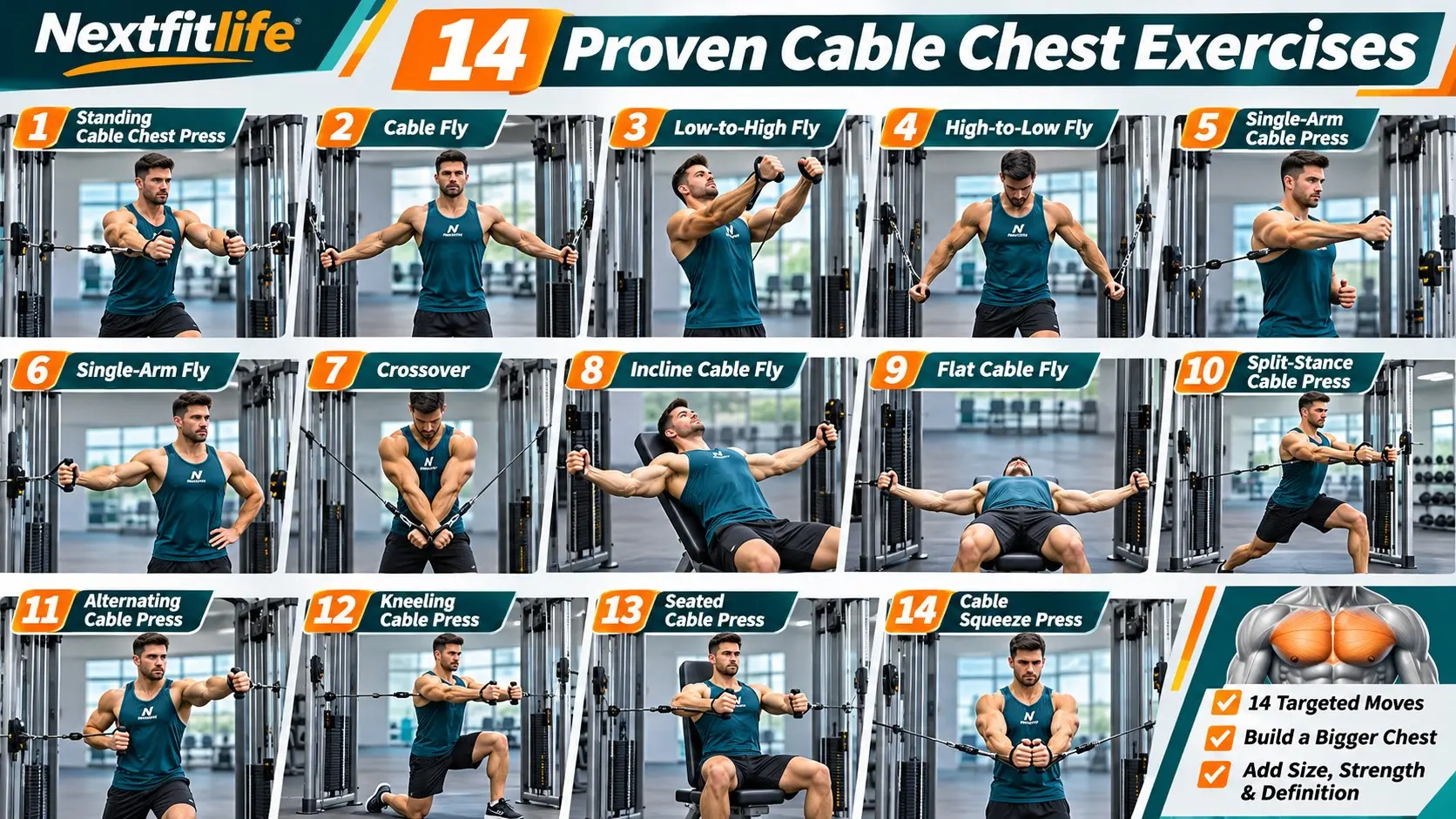
1. Standing Cable Chest Press
The standing cable chest press trains the chest while your trunk and legs keep you stable.
- Set both pulleys around chest height.
- Hold one handle in each hand.
- Step forward into a stable stance.
- Start with your elbows comfortably behind your hands.
- Press both handles forward.
- Return slowly.
Starting target: 8 to 15 repetitions.
Avoid leaning farther forward each time the weight gets difficult.
2. Seated Cable Chest Press
A seated setup reduces some of the balance demand so you can focus more on pressing.
- Place a stable bench between the cables.
- Set the pulleys around chest height.
- Sit tall with your feet planted.
- Press the handles forward.
- Bring them back under control.
Starting target: 8 to 15 repetitions.
This can be useful when standing stability limits your chest work.
3. Standing Cable Fly
The cable fly uses more shoulder horizontal movement and less elbow extension than a press.
- Set the pulleys near chest or shoulder height.
- Step forward slightly.
- Keep a soft bend in your elbows.
- Bring your arms forward and inward.
- Stop when your hands meet or nearly meet.
- Open your arms slowly.
Starting target: 10 to 15 repetitions.
Use less weight than you would for pressing.
4. Mid Height Cable Crossover
The classic cable crossover is similar to a standing fly but allows your hands to pass slightly across the midline if comfortable.
- Set both pulleys around shoulder height.
- Use a split stance.
- Keep your elbows slightly bent.
- Bring the handles inward.
- Cross one hand slightly in front of the other.
- Alternate which hand crosses on each repetition.
Starting target: 10 to 15 repetitions.
You do not need a dramatic crossover to train the chest.
5. Low to High Cable Fly
A low to high path can emphasize the clavicular or upper chest region.
- Set the pulleys near the bottom.
- Hold the handles beside your hips.
- Keep a small elbow bend.
- Bring your hands upward and inward.
- Finish around upper chest height.
- Return slowly.
Starting target: 10 to 15 repetitions.
Do not turn the movement into a front shoulder raise.
6. High to Low Cable Fly
A high to low fly creates a downward and inward path.
- Set both pulleys above shoulder height.
- Step forward into a stable stance.
- Bring the handles downward and inward.
- Finish around the lower chest or upper abdominal area.
- Return under control.
Starting target: 10 to 15 repetitions.
This is often described as a lower chest variation, but remember that the chest works as one larger muscle with regional fibers.
7. Single Arm Cable Chest Press
The single arm cable press lets each side work independently while your trunk resists rotation.
- Set one pulley at chest height.
- Face away from the machine.
- Hold the handle in one hand.
- Press forward without twisting your torso.
- Return slowly.
Starting target: 8 to 12 repetitions per side.
Use less weight than you would in a two arm press.
8. Single Arm Cable Fly
This variation lets you focus on one side and adjust the movement path more freely.
- Set one pulley near chest height.
- Stand sideways or slightly angled away from the machine.
- Keep a soft bend in your elbow.
- Bring your arm across the front of your chest.
- Return with control.
Starting target: 10 to 15 repetitions per side.
Keep your torso mostly still instead of rotating to move the weight.
9. Split Stance Cable Press
A split stance gives you a stable base and can make standing pressing feel more controlled.
- Set both pulleys near chest height.
- Step one foot forward.
- Brace your trunk.
- Press both handles forward.
- Return slowly.
Starting target: 8 to 15 repetitions.
Switch which leg is forward between sets if you want to avoid always using the same stance.
10. Incline Bench Cable Fly
Using an incline bench gives your body more support and changes the chest angle.
- Place an incline bench between low cable pulleys.
- Hold one handle in each hand.
- Lie back securely.
- Keep your elbows softly bent.
- Bring your arms upward and inward.
- Lower slowly.
Starting target: 10 to 15 repetitions.
A modest incline is usually enough. A steep angle can shift more work toward the front shoulders.
11. Flat Bench Cable Fly
A flat bench removes much of the standing stability demand and gives you a controlled chest fly setup.
- Place a flat bench between low pulleys.
- Hold both handles.
- Lie on the bench.
- Keep a gentle elbow bend.
- Bring the handles above your chest.
- Lower until you feel a comfortable stretch.
Starting target: 10 to 15 repetitions.
Do not force the handles below a comfortable shoulder range.
12. Cable Squeeze Press
This variation combines a pressing path with inward pressure.
- Set the pulleys around chest height.
- Hold the handles close together.
- Press forward while keeping them near each other.
- Return slowly.
Starting target: 10 to 15 repetitions.
Use this as an accessory exercise rather than your only chest press.
13. Kneeling Cable Chest Press
Kneeling removes some help from the legs and increases the demand on trunk control.
- Set the pulleys around shoulder or chest height.
- Kneel between the cables.
- Keep your torso tall.
- Press both handles forward.
- Return slowly.
Starting target: 8 to 15 repetitions.
Use a pad under your knees if needed.
14. Alternating Cable Chest Press
This version trains one arm at a time while the other remains controlled.
- Set both cables at chest height.
- Take a stable stance.
- Press one handle forward.
- Return it as the other arm presses.
- Keep your torso from twisting excessively.
Starting target: 8 to 12 repetitions per side.
Move slowly enough that the exercise does not become a rotation drill.
Best Cable Chest Exercises by Goal
| Goal | Best Choices | Main Focus |
|---|---|---|
| Overall Chest Strength | Standing or seated cable press | Pressing strength |
| Upper Chest | Low to high fly, incline cable fly | Clavicular emphasis |
| Lower Chest | High to low fly | Downward pressing or fly path |
| Isolation Work | Standing cable fly, crossover | Chest focused accessory work |
| Single Side Training | Single arm press, single arm fly | Independent arm work |
| More Stability | Bench supported fly or press | Less whole body stabilization |
Best Upper Chest Cable Exercises
If your goal is more upper chest emphasis, use a path that moves upward and inward.
Useful options include:
- Low to high cable fly
- Incline bench cable fly
- Low pulley cable press
Research on pressing angles has shown that incline positions can increase activity in the clavicular region of the pectoralis major.
That does not mean the lower and middle chest switch off. Regional emphasis is not complete isolation.
Best Lower Chest Cable Exercises
For more lower or sternocostal emphasis, use a downward and inward movement path.
Useful options include:
- High to low cable fly
- High pulley cable press
- Standing crossover with a slight downward path
If lower chest development is a major goal, you can also combine cable work with our Lower Chest Dumbbell Exercises.
Beginner Cable Chest Workout
| Exercise | Sets | Reps |
|---|---|---|
| Seated Cable Chest Press | 3 | 8 to 12 |
| Standing Cable Fly | 2 | 10 to 15 |
| Low to High Cable Fly | 2 | 10 to 15 |
Beginners do not need to take every set to complete failure.
Intermediate Cable Chest Workout
| Exercise | Sets | Reps |
|---|---|---|
| Standing Cable Chest Press | 3 | 6 to 10 |
| Low to High Cable Fly | 3 | 10 to 15 |
| High to Low Cable Fly | 2 | 10 to 15 |
| Single Arm Cable Press | 2 | 8 to 12 each side |
How Many Sets and Reps Should You Do?
A useful starting guide is:
- 6 to 10 repetitions for heavier cable presses
- 8 to 15 repetitions for most presses
- 10 to 20 repetitions for lighter cable fly variations
Several rep ranges can build muscle when resistance and effort are appropriate.
Current ACSM evidence also suggests that higher weekly volume can improve chest hypertrophy, with around 10 weekly sets per muscle group serving as a useful general target for people trying to maximize growth.
This is not a mandatory minimum. Beginners often progress with fewer sets.
How Often Should You Train Chest?
Two chest training sessions each week can work well for many people.
For example:
- Monday: cable press plus fly
- Thursday: dumbbell or barbell press plus cable crossover
Your weekly plan should count all chest training, not only cable exercises.
How to Use Progressive Overload
Progressive overload means gradually making your training more challenging.
You can:
- Add a repetition
- Add a small amount of weight
- Add one set when needed
- Improve your range of motion
- Improve technique
- Use a harder variation
Do not increase everything at once.
Simple Cable Press Example
- Week 1: 10, 9, 8 reps
- Week 2: 10, 10, 9 reps
- Week 3: 11, 10, 10 reps
- Week 4: 12, 12, 12 reps
If your target is 8 to 12 repetitions and you reach 12 with good control, increase the resistance slightly.
How Deep Should You Go on Cable Flies?
Use a comfortable range of motion.
More stretch is not automatically better if your shoulders become painful or unstable.
Open your arms until you feel a controlled chest stretch while keeping your shoulder position comfortable.
Current ACSM evidence supports full range resistance training when that range is safe and appropriate for the individual.
How to Keep Your Shoulders Comfortable
Cables allow you to adjust your hand position and movement path, which can make them comfortable for many people.
Use these rules:
- Warm up with lighter sets.
- Start with moderate resistance.
- Keep your elbows slightly bent during flies.
- Do not force your arms far behind your body.
- Use a comfortable hand position.
- Keep the movement controlled.
- Stop if you feel sharp pain.
Our Injury Prevention Exercises guide gives more general training advice.
Are Cables Better Than Dumbbells for Chest?
Not automatically.
Cables let you change resistance direction easily and can provide a smooth fly or press path.
Dumbbells allow each arm to move independently and are simple to use on flat or incline benches.
Current resistance training evidence does not show that equipment type consistently determines muscle growth.
You can use both.
Are Cables Better Than Barbells?
Again, neither is universally better.
A barbell makes heavy bilateral pressing simple and allows high loading.
Cables allow more freedom of movement and make single arm training easy.
One study comparing a standing cable press with a bench press found that the standing cable press required more whole body stabilization, while the bench press allowed much greater force production and chest activation under maximal loading.
This shows that the two exercises can serve different purposes rather than one replacing the other.
Do Cables Keep Constant Tension on the Chest?
Cables keep resistance connected to the handle throughout the movement, but “constant tension” can be an oversimplification.
The actual torque at your joints changes as your body position and cable angle change.
This is why pulley height and where you stand matter.
Instead of chasing a perfect constant tension claim, focus on a smooth resistance path that keeps the chest working through a comfortable range.
Can Cable Chest Exercises Build Muscle?
Yes.
Cable exercises are resistance exercises, and progressive resistance training can increase muscle size.
What matters most is whether your program gives your chest enough challenging work over time.
Current ACSM evidence indicates that muscle growth responds well to adequate weekly volume, while the specific equipment type is much less important.
Can Cable Chest Exercises Reduce Chest Fat?
No.
Cable exercises can strengthen and develop your chest muscles, but they cannot selectively remove fat from your chest.
Fat loss depends on overall energy balance and individual biology.
If fat loss is also one of your goals, use our Basic Weight Loss Tips.
Common Cable Chest Workout Mistakes
Using Too Much Weight
If the weight pulls you backward or forces your shoulders out of position, reduce it.
Turning Every Fly Into a Press
Keep a gentle elbow bend instead of repeatedly bending and straightening your elbows like a press.
Forcing Too Much Stretch
Your hands do not need to travel far behind your torso.
Using Momentum
Control the weight instead of throwing your body forward.
Choosing Too Many Angles
You do not need five fly angles in the same workout.
Ignoring Pressing
Fly variations are useful, but presses allow heavier loading and should remain part of many chest programs.
Never Progressing
If the same weight and repetitions stay easy for months, the stimulus may stop being challenging enough.
Expecting Instant Results
Muscle growth takes consistent training over time.
A Simple 8 Week Cable Chest Progression
| Weeks | Focus | Goal |
|---|---|---|
| 1 and 2 | Learn pressing and fly technique | Comfortable movement |
| 3 and 4 | Add repetitions | Increase useful volume |
| 5 and 6 | Increase resistance slightly | Progressive overload |
| 7 | Add one angle specific exercise | Broaden training stimulus |
| 8 | Review progress | Adjust volume and resistance |
When Should You Stop Exercising?
Normal muscle effort and fatigue can occur during chest training. Sudden or severe symptoms are different.
Stop exercising and seek appropriate medical care if you develop:
- Chest pain or pressure that feels different from normal muscle effort
- Fainting
- Severe unusual shortness of breath
- Sudden severe shoulder or chest pain
- A visible deformity after an injury
- New significant weakness
- New numbness
- Major swelling after an injury
If you are recovering from chest or shoulder surgery, follow the exercise plan provided by your healthcare professional.
Conclusion
The best cable chest exercises combine presses, flies, and smart changes in cable height. Standing cable presses build pressing strength, low to high flies add upper chest emphasis, and high to low flies provide another useful movement angle.
You do not need every cable variation in one workout, and cables are not magically superior to free weights. Choose a few exercises you can perform well, use enough resistance, and progress gradually.
Your next step: choose one cable press and two fly variations from this guide. Train them for the next eight weeks while recording your resistance and repetitions.
References and Sources
- American College of Sports Medicine. Resistance Training Prescription for Muscle Function, Hypertrophy, and Physical Performance in Healthy Adults. 2026 Position Stand reviewing 137 systematic reviews and more than 30,000 participants.
https://pubmed.ncbi.nlm.nih.gov/41843416/ - American College of Sports Medicine. Updated Resistance Training Guidelines, 2026. Guidance on consistency, training volume, resistance, equipment, and muscle growth.
https://acsm.org/resistance-training-guidelines-update-2026/ - PubMed. Differences in Muscle Activation and Kinematics Between Cable Based and Selectorized Weight Training. Research examining cable chest press and other cable movements.
https://pubmed.ncbi.nlm.nih.gov/28129277/ - PubMed. A Kinetic and Electromyographic Comparison of the Standing Cable Press and Bench Press. Research comparing chest, shoulder, and trunk demands between the two pressing styles.
https://pubmed.ncbi.nlm.nih.gov/18076235/ - PubMed. Non Uniform Excitation of Pectoralis Major Induced by Changes in Bench Press Inclination. Research showing that exercise angle can alter regional pectoralis major activation.
https://pubmed.ncbi.nlm.nih.gov/36334406/
Internal Links + Fitness Hub
- NextFitLife Fitness Hub
- Strength Training and Muscle Building Guide
- Upper Body Workout
- Push Upper Body Exercises
- Lower Chest Dumbbell Exercises
- Upper Body Workout for Women
- Best Triceps Exercises
- Bodyweight Triceps Exercises
- Best Back Workouts for Women
- Injury Prevention Exercises
- 5 Components of Physical Fitness
- Basic Weight Loss Tips
About the Author
Adel Galal is a father of four, three sons and a daughter, and a grandfather of four, with 33 years of hands on parenting experience. He is the founder of Parnthub.com, based in Cairo, Egypt, where he shares practical guidance on feeding, development and family life from newborns to teenagers.
Adel is not a medical professional. Health articles cite trusted sources and are for general information only.
Learn more on the NextFitLife About Us page.
Frequently Asked Questions
What are the best cable chest exercises?
Useful cable chest exercises include standing cable presses, seated cable presses, cable flies, crossovers, low to high flies, high to low flies, and single arm cable variations.
Can cable chest exercises build muscle?
Yes. Cable exercises provide resistance and can build muscle when you train progressively with enough weekly volume. Current evidence does not show that cables are automatically better than other equipment.
Which cable exercise is best for the upper chest?
A low to high cable fly is a useful upper chest option because the movement travels upward and inward. An incline bench cable fly is another choice.
Which cable exercise is best for the lower chest?
A high to low cable fly is a common lower chest variation because the resistance path travels downward and inward toward the lower chest area.
Are cables better than dumbbells for chest growth?
Neither is universally better. Cables make resistance direction easy to change, while dumbbells allow free independent arm movement. Both can build chest muscle with progressive training.
Are cables better than the bench press?
They serve different purposes. Bench pressing allows heavier loading, while standing cable presses involve more whole body stabilization and give you more freedom to change the resistance direction.
How many cable chest exercises should I do?
Two to four chest exercises are enough for many workouts. You do not need several nearly identical fly variations in one session.
How often should I train my chest?
Two chest training sessions per week can work well for many people. Your ideal schedule depends on your weekly volume, recovery, experience, and wider program.
How many sets should I do for chest growth?
Current ACSM evidence suggests that higher weekly volume can support hypertrophy, with around 10 weekly sets per muscle group serving as a useful general target for people focused on maximizing muscle growth. Beginners may progress with less.
Can cable chest exercises reduce chest fat?
No. Cable exercises strengthen chest muscles but cannot selectively remove fat from the chest. Fat loss depends on overall energy balance and individual biology.

Health & wellness writer with 30+ years of experience in nutrition, fitness, and healthy aging. Founder of NextFitLife.com — evidence-based health guidance.

