
Published on: March 2026
Updated on: November 5, 2026
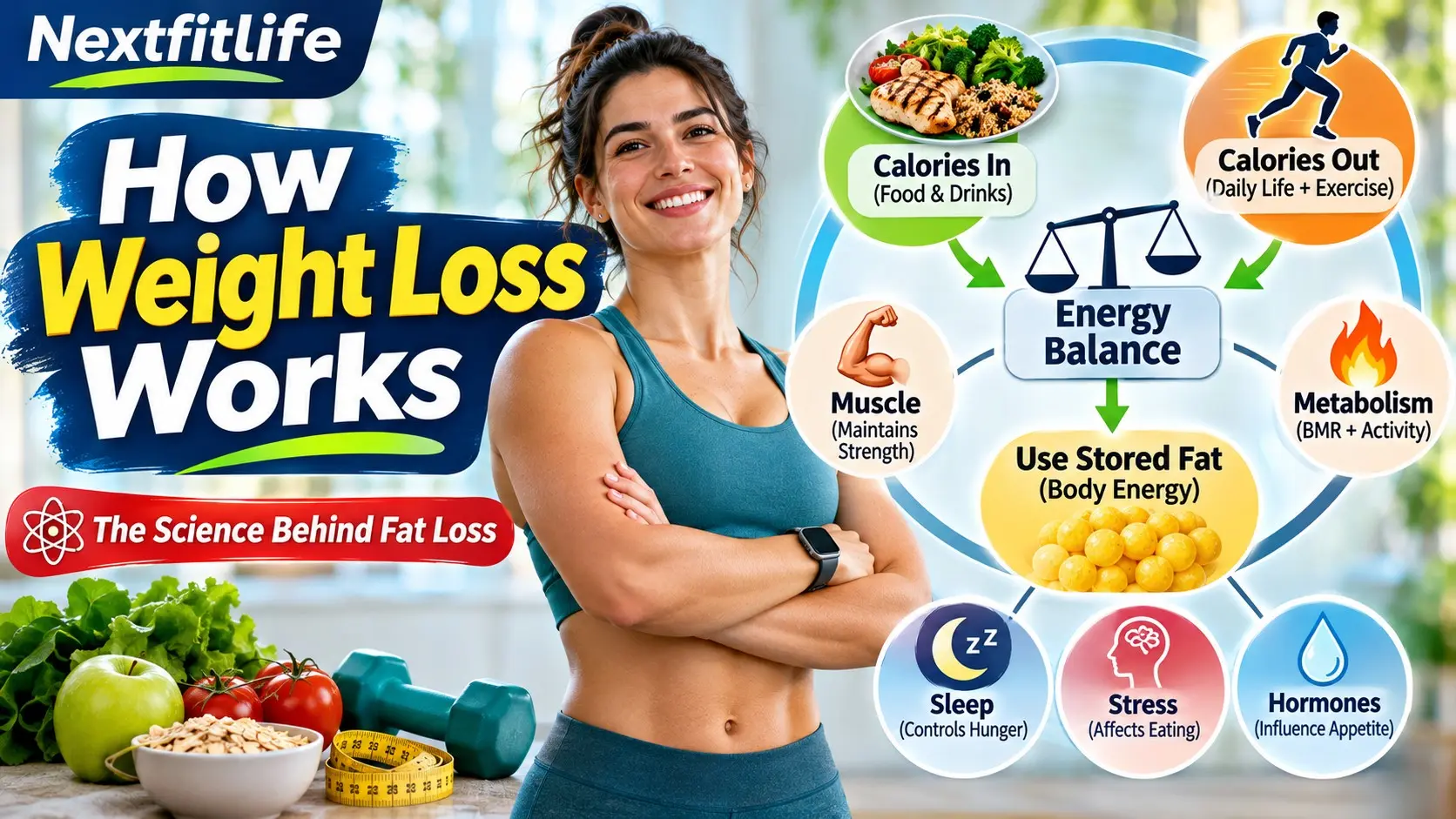
How weight loss works becomes much easier to understand once you separate the basic science from the promises made by diets, supplements, detoxes, and social media trends.
At the most basic level, body weight falls when your body uses more energy than it receives from food and drinks over time. This is called an energy deficit or calorie deficit.
That does not mean weight loss is easy. Hunger, food access, sleep, medications, hormones, movement, muscle mass, stress, habits, and metabolic adaptation can all influence how easy it is to create and maintain that deficit.
This guide explains what actually happens to body fat, why the scale moves up and down, why weight loss often slows, how exercise helps, and what makes results easier to maintain.
If you want to calculate your own estimated calorie target after reading the science, use our Calorie Deficit Calculator guide.
Important: This article is for general information and education. It does not replace medical advice, diagnosis, or treatment.
Do not use aggressive calorie restriction without professional guidance if you:
- Are under 18
- Are pregnant or breastfeeding
- Have an active or recent eating disorder
- Are underweight or medically frail
- Have unexplained weight loss
- Have kidney disease or another condition that changes nutrition needs
- Use diabetes medicines that can cause low blood sugar
- Use prescription weight management medicines and need individualized nutrition support
Table of Contents
- Quick Answer
- Truth 1: Energy Deficit Drives Weight Loss
- Truth 2: Scale Weight Is Not Body Fat
- Truth 3: Where Lost Fat Goes
- Truth 4: Metabolism Changes
- Truth 5: Food Quality Matters
- Truth 6: Exercise Helps Beyond Calories
- Truth 7: Muscle Matters During Fat Loss
- Truth 8: Hormones and Medications Matter
- Truth 9: Maintenance Is a Separate Phase
- Why Weight Loss Is Fast at First
- Why Weight Loss Slows
- Weight Loss Plateaus
- Sleep and Stress
- Does Meal Timing Matter?
- Does Low Carb Work Better?
- Does Fat Turn Into Muscle?
- How Fast Should Weight Loss Be?
- 7 Step Fat Loss Framework
- Conclusion
- References and Sources
- Explore More Weight Management Guides
- About the Author
- Frequently Asked Questions
Quick Answer: How Does Weight Loss Work?
Weight loss works when your average energy intake stays below your average energy expenditure long enough for the body to use stored energy.
Your body gets energy from food and drinks. It spends energy keeping you alive, digesting food, moving through daily life, exercising, and maintaining body tissues.
If intake and expenditure are roughly equal over time, body weight tends to remain relatively stable.
If intake repeatedly exceeds expenditure, stored energy tends to increase.
If expenditure repeatedly exceeds intake, stored energy decreases.
Fat loss requires a sustained energy deficit, but real weight management is influenced by appetite, metabolism, food quality, activity, muscle, sleep, medication, health, and behavior.
For a practical calorie example, see our Calorie Deficit Calculator. For the bigger long term picture, use Significant Weight Loss.
Truth 1: Weight Loss Requires an Energy Deficit
This is the foundation of how weight loss works.
Your total daily energy expenditure includes several parts.
| Energy Use | What It Means |
|---|---|
| Resting metabolism | Energy needed for basic body functions such as breathing, circulation, and organ activity |
| Food digestion | Energy used to digest, absorb, and process food |
| Daily movement | Walking, standing, housework, work tasks, and spontaneous movement |
| Exercise | Structured activity such as walking, running, cycling, and strength training |
Together these make up your total daily energy expenditure, often shortened to TDEE.
A deficit can come from eating fewer calories, moving more, or combining both.
This does not mean every diet must involve counting calories. A person can reduce calorie intake without tracking numbers by changing portions, food choices, meal patterns, or drinks.
Our How to Drop Pounds guide explains how everyday habits can create a deficit without turning every meal into a math problem.
Truth 2: Scale Weight Is Not the Same as Body Fat
This is one of the biggest sources of confusion.
Your bathroom scale measures total body mass. It does not know how much of that mass is fat.
Your weight includes:
- Body fat
- Muscle
- Bone
- Organs
- Body water
- Glycogen
- Food in the digestive tract
This means you can lose body fat while the scale stays the same for several days.
You can also gain one or two pounds overnight without gaining that much body fat.
Why Does Weight Change Overnight?
Short term scale changes often reflect water and food mass.
Common reasons include:
- A salty meal
- More carbohydrate than usual
- Hard training
- Menstrual cycle changes
- Constipation
- Travel
- Alcohol
- Changes in hydration
Carbohydrate is stored partly as glycogen, and glycogen is stored with water. This is one reason a sudden change in carbohydrate intake can move scale weight quickly even when body fat has changed very little.
Use a weekly trend rather than judging progress from one morning.
Truth 3: Where Does Body Fat Go When You Lose It?
Body fat does not turn into muscle. It also does not simply disappear as heat.
Fat cells store energy mainly as triglycerides.
When the body needs stored energy, triglycerides are broken down and their components can be oxidized through normal metabolism.
The atoms from stored fat ultimately leave the body mainly as:
- Carbon dioxide through your lungs
- Water through urine, sweat, breath, and other body fluids
A widely cited BMJ analysis calculated that most of the mass from oxidized triglyceride leaves as carbon dioxide, with the rest becoming water.
This does not mean breathing faster burns meaningful extra fat. You cannot hyperventilate your way to weight loss.
The body must first metabolize stored fuel because an energy deficit exists.
Truth 4: Your Metabolism Changes During Weight Loss
Your metabolism is not one single switch.
It describes all the chemical reactions that keep your body functioning.
For weight management, people usually mean how much energy the body uses.
As weight falls, calorie needs often fall too.
That happens partly because:
- A smaller body requires less energy to maintain.
- Moving a smaller body may cost less energy.
- Food intake may decrease, reducing the energy used to process food.
- Spontaneous movement can change.
- The body may adapt to prolonged energy restriction.
This helps explain why the same calorie intake can produce faster loss at the beginning and slower loss months later.
What Is Metabolic Adaptation?
Metabolic adaptation describes changes in energy expenditure that occur as the body responds to weight loss and calorie restriction.
Some reduction is simply expected because you weigh less.
Additional adaptation can also occur, which is one reason static calorie equations become less accurate over time.
The NIH Body Weight Planner uses a dynamic model because human weight change is not a fixed straight line.
If you are currently calculating a target, see our Calorie Deficit Calculator guide and treat the result as a starting estimate, not a permanent number.
Truth 5: Food Quality Matters Even Though Calories Matter
Energy balance determines whether body energy stores rise or fall, but foods are not identical in how they affect hunger, fullness, nutrition, and adherence.
Two meals with similar calories can feel very different.
A meal built around protein, vegetables, fruit, whole grains, legumes, and minimally processed foods may provide more volume, fiber, and nutrients than a smaller amount of highly processed food.
This can make a calorie deficit easier to maintain.
Useful foods often include:
- Vegetables
- Fruit
- Beans
- Lentils
- Fish
- Eggs
- Lean meats
- Greek yogurt
- Whole grains
- Potatoes
- Nuts in controlled portions
For high volume food ideas, see Best Vegetables for Weight Loss.
Do Some Foods Burn Belly Fat?
No single food selectively removes fat from the abdomen.
Overall fat loss comes from sustained energy balance over time.
Foods can support the process by helping with fullness, protein intake, nutrition, and calorie control.
Our Best Foods for Belly Fat Loss Support article explains this without relying on spot reduction claims.
Truth 6: Exercise Helps With Far More Than Burning Calories
Exercise uses energy, but that is only one reason it matters.
Regular activity can support:
- Cardiovascular fitness
- Strength
- Mobility
- Physical function
- Mood
- Sleep
- Weight maintenance
- Long term health
Walking is especially useful because it is accessible and easy to scale.
Our Walking for Weight Loss guide explains how to use pace, duration, frequency, and consistency.
If you prefer structured aerobic training, visit Best Cardiovascular Workout.
Can Exercise Alone Cause Weight Loss?
It can contribute, but results vary.
Exercise calories can be smaller than people expect, and appetite or food intake can also change.
This is why exercise should not be viewed only as a way to “earn” food.
Its health value remains high even when scale loss is modest.
Truth 7: Muscle Matters During Fat Loss
If the goal is fat loss, losing as much weight as possible is not always the best outcome.
You usually want to preserve as much lean mass and strength as practical while reducing excess fat.
Two tools can help:
- Adequate protein
- Resistance training
Protein provides amino acids needed for body tissues and can also help with fullness.
Resistance exercise gives muscles a reason to remain active and strong during calorie restriction.
ACSM’s 2026 resistance training guidance emphasizes consistency and regular training rather than unnecessarily complicated plans.
For a practical strength plan, use our Strength Training and Muscle Building guide. If you are training at home, Core Workouts at Home can add simple trunk work.
Truth 8: Hormones and Medications Can Influence Weight Loss
Energy balance still matters, but that does not mean hormones are irrelevant.
Hormones can influence:
- Hunger
- Fullness
- Blood glucose
- Fluid balance
- Energy expenditure
- Where fat tends to accumulate
Medical conditions and medications can also affect body weight.
Examples include thyroid disease, some diabetes treatments, certain psychiatric medicines, corticosteroids, menopause related changes, and other health conditions.
Modern obesity medications can also affect appetite and food intake. They do not suspend the laws of energy balance. They can make the biological process of eating less and maintaining that change more manageable for eligible patients.
The 2026 American Diabetes Association Standards emphasize individualized treatment and recognize lifestyle treatment, medication, and metabolic surgery as different tools that may be appropriate for different people.
If your weight changes unexpectedly or you suspect a medication is affecting appetite or weight, discuss it with your healthcare professional rather than stopping treatment on your own.
Truth 9: Weight Maintenance Is a Separate Phase
Reaching a goal weight does not mean the work is finished.
Your new, smaller body may require fewer calories than your previous body.
Maintenance therefore needs its own habits.
Useful maintenance behaviors can include:
- Regular activity
- Continued strength training
- Consistent meal structure
- Enough protein
- Regular weight monitoring if appropriate
- Responding early to regain
The 2026 ADA Standards emphasize ongoing support and regular physical activity for long term maintenance after intentional weight loss.
If you have already lost a substantial amount, our Significant Weight Loss guide covers maintenance and long term planning in more detail.
Why Is Weight Loss Often Fast During the First Week?
The first week of a diet can be exciting because the scale sometimes drops quickly.
Not all of that change is fat.
When calorie or carbohydrate intake falls, stored glycogen can decrease. Because glycogen is stored with water, water weight can fall too.
Food volume in the digestive tract may also decrease.
This is why early scale loss should not be projected forward as if the same rate will continue indefinitely.
Why Does Weight Loss Slow Down?
Slower weight loss does not automatically mean the diet has stopped working.
As you become lighter:
- Your maintenance calories can fall.
- Movement may use less energy.
- Your original deficit can become smaller.
- Hunger can increase.
- Tracking can become less accurate over time.
If you started at 2,500 maintenance calories and lost substantial weight, your new maintenance may no longer be 2,500.
This is why calorie targets sometimes need to be reassessed.
If you are facing this now, see Lose Stubborn Fat before making aggressive changes.
What Is a Real Weight Loss Plateau?
A few days without scale movement is not a plateau.
Water can hide fat loss temporarily.
A more useful approach is to look at several weeks of average weight.
If the trend is genuinely flat, review:
- Portion sizes
- Cooking oils
- Snacks
- Drinks
- Restaurant meals
- Weekend eating
- Daily steps
- Exercise frequency
- Sleep
- Your new body weight
Then make a small adjustment rather than immediately cutting a huge amount of food.
You can also add manageable movement using our Low Impact Exercises to Burn Fat at Home.
Does Sleep Affect Weight Loss?
Sleep does not cancel the basic rule of energy balance, but it can influence behaviors that affect energy balance.
Poor sleep can make some people feel hungrier, less energetic, and less motivated to prepare food or exercise.
It may also affect appetite regulation and food choices.
For this reason, CDC includes adequate sleep as part of healthy weight management rather than focusing only on food and exercise.
Does Stress Stop Fat Loss?
Stress does not create calories from nothing, but chronic stress can make weight management harder.
It can affect:
- Eating behavior
- Sleep
- Alcohol intake
- Activity
- Food cravings
- Meal planning
Stress management is therefore useful because it supports behaviors that make a sustainable calorie deficit easier.
Does Meal Timing Matter for Weight Loss?
Meal timing can affect hunger and adherence, but no eating window overrides energy balance.
Some people prefer three structured meals.
Others do better with smaller meals or a time restricted eating pattern.
The best pattern is one that allows adequate nutrition and helps you maintain a reasonable calorie intake.
You do not need to skip breakfast simply to burn fat.
Does Low Carb Cause More Fat Loss?
Low carbohydrate diets can work for some people because they may reduce food choices, improve appetite control, or reduce total calorie intake.
They also often create a larger initial loss of water because glycogen stores fall.
That early scale change should not be confused with an equal amount of extra body fat loss.
Long term success depends greatly on whether the diet helps a person create and sustain an energy deficit while meeting nutritional needs.
Does Eating Fat Make You Fat?
Dietary fat is energy dense, but eating fat does not automatically cause fat gain.
Fat gain occurs when average energy intake exceeds expenditure over time.
Dietary fats can be part of a healthy eating pattern.
Portions still matter because fat provides more calories per gram than protein or carbohydrate.
Can You Turn Fat Into Muscle?
No.
Fat tissue and muscle tissue are different tissues.
You can lose body fat while gaining muscle, especially if you are new to resistance training or returning after a break.
That can make body composition improve even when scale weight changes slowly.
This is another reason not to judge your entire progress by body weight alone.
Can You Choose Where Fat Comes Off First?
Not reliably.
Your genetics, sex, hormones, age, and starting fat distribution influence where fat is stored and where it is lost.
Abdominal exercises can strengthen your core, but they do not force your body to remove fat specifically from your stomach.
If belly fat is your concern, use overall fat loss strategies rather than spot reduction. See Best Foods for Belly Fat Loss Support for a practical nutrition guide without false belly fat burning claims.
How Fast Should Healthy Weight Loss Be?
CDC says gradual, steady weight loss of about 1 to 2 pounds per week is more likely to be maintained than faster loss.
This is a general guide, not a target every person must hit.
A smaller person may lose more slowly. Someone starting at a much higher body weight may see faster changes, especially early on.
What matters most is that the plan is nutritionally adequate, medically appropriate, and sustainable.
Very low calorie diets have a role in selected clinical situations, but the 2026 ADA Standards state that structured very low calorie programs should be used only for carefully selected people with trained professional supervision.
For realistic speed and strategy, see How to Burn Fat Fast.
A Simple 7 Step Fat Loss Framework
You do not need to control every biological variable.
Start with the variables you can influence.
| Step | Action | Why It Matters |
|---|---|---|
| 1 | Estimate maintenance calories | Gives you a starting point |
| 2 | Create a modest deficit | Supports gradual fat loss |
| 3 | Prioritize protein and filling foods | Supports fullness and lean tissue |
| 4 | Walk and stay active | Raises activity and supports health |
| 5 | Strength train | Supports muscle and strength |
| 6 | Track weekly trends | Filters out daily water changes |
| 7 | Adjust gradually | Keeps the plan realistic as your body changes |
Start with our Calorie Deficit Calculator, add Walking for Weight Loss, and use Strength Training and Muscle Building to protect strength and muscle.
Why Most Successful Plans Look Boring
Long term fat loss usually does not depend on one dramatic trick.
It depends on repeating enough helpful behaviors often enough.
That might mean:
- A consistent breakfast
- Protein at meals
- More vegetables
- Fewer liquid calories
- Daily walking
- Two or three strength sessions
- A regular sleep schedule
- Monitoring weight trends
These habits sound less exciting than a detox or metabolism hack, but they are easier to connect to the actual biology of weight management.
Conclusion
How weight loss works is simple at the highest level: over time, your body must use more energy than it receives if stored body energy is going to decrease.
The real world is more complex because humans are not calculators. Hunger changes. Movement changes. Sleep changes. Body weight changes. Medications and medical conditions matter. Your calorie needs also change as you get lighter.
This is why the best fat loss plan is not the most extreme one. It is a plan that creates a reasonable energy deficit while still supporting nutrition, muscle, physical activity, sleep, and daily life.
Do not panic over one scale reading, do not chase spot reduction, and do not assume a plateau means your metabolism has stopped working.
Your next step: estimate your current maintenance calories with our Calorie Deficit Calculator, choose a reasonable starting target, add regular walking and resistance training, then judge progress by several weeks of trends rather than a few days.
References and Sources
- Centers for Disease Control and Prevention. Steps for Losing Weight. Guidance on gradual weight loss, nutrition, physical activity, sleep, stress, and factors that influence weight management.
https://www.cdc.gov/healthy-weight-growth/losing-weight/ - National Institute of Diabetes and Digestive and Kidney Diseases. Body Weight Planner. A dynamic model for calorie intake, activity, weight change, goal weight, and maintenance.
https://www.niddk.nih.gov/bwp - American Diabetes Association. Obesity and Weight Management for the Prevention and Treatment of Diabetes: Standards of Care in Diabetes 2026. Includes individualized lifestyle, medication, surgery, nutrition, activity, and maintenance recommendations.
https://pmc.ncbi.nlm.nih.gov/articles/PMC12690172/ - Meerman R, Brown AJ. When Somebody Loses Weight, Where Does the Fat Go? The BMJ. Open access explanation of how oxidized triglyceride mass leaves primarily as carbon dioxide and water.
https://www.bmj.com/content/349/bmj.g7257 - American College of Sports Medicine. Resistance Training Prescription Guidance, 2026. Updated evidence based guidance emphasizing consistency, individualized resistance training, and regular training for muscle and strength.
https://www.acsm.org/wp-content/uploads/2026/03/Resistance-Training-Position-Stand-infographic.pdf
Explore More Weight Management Guides
- Calorie Deficit Calculator
- Significant Weight Loss
- How to Drop Pounds
- How to Burn Fat Fast
- Lose Stubborn Fat
- Walking for Weight Loss
- Low Impact Exercises to Burn Fat at Home
- Best Vegetables for Weight Loss
- Best Foods for Belly Fat Loss Support
- Strength Training and Muscle Building
- Core Workouts at Home
- Best Cardiovascular Workout
- NextFitLife Fitness Hub
Frequently Asked Questions
How does weight loss actually work?
Weight loss occurs when average energy expenditure exceeds average energy intake over time. The body then uses stored energy, including body fat, to help cover the difference.
Do you have to count calories to lose weight?
No. You need an energy deficit, but you do not have to count every calorie. Portion changes, food choices, meal structure, and activity can create a deficit without formal tracking.
Where does fat go when you lose weight?
When stored fat is oxidized, most of its mass ultimately leaves the body as carbon dioxide through the lungs, while the remainder becomes water.
Does fat turn into muscle?
No. Fat and muscle are different tissues. You can lose fat and build muscle at the same time under some conditions, but one does not turn into the other.
Why does weight loss slow down?
As body weight decreases, calorie needs usually fall. Movement can also use less energy, appetite may change, and metabolic adaptation can reduce the size of the original calorie deficit.
Why does my weight change every day?
Daily body weight is affected by water, glycogen, sodium, food in the digestive system, exercise, hormones, and hydration. Short term scale changes do not equal changes in body fat.
Can you lose fat without losing weight?
Yes. Fat loss can sometimes occur while muscle increases or water weight rises, which can keep scale weight stable for a period.
Can hormones stop weight loss?
Hormones and medical conditions can affect hunger, expenditure, fluid balance, and behavior, making weight loss easier or harder. They do not make energy balance irrelevant, but they can significantly affect the process.
Does sleep affect fat loss?
Sleep can affect hunger, energy, activity, food choices, and adherence. It does not replace the need for an energy deficit, but adequate sleep supports healthy weight management.
Does exercise burn enough calories to lose weight?
Exercise can contribute to an energy deficit, but its benefits go far beyond calorie burning. It supports fitness, health, strength, function, and long term weight maintenance.
Can you target belly fat?
You cannot reliably choose where your body loses fat first. Abdominal exercises strengthen the muscles, but overall fat loss depends on whole body energy balance.
How fast should healthy weight loss be?
CDC describes gradual loss of about 1 to 2 pounds per week as a general pace that is more likely to be maintained, although individual rates vary.
What is the best diet for weight loss?
There is no single diet that works best for everyone. A useful eating pattern creates a sustainable energy deficit, meets nutritional needs, controls hunger, and fits the person’s preferences and health.
Why do people regain weight after dieting?
Maintenance can be difficult because calorie needs are lower at a smaller body weight, appetite and habits may change, and old eating patterns can return. Long term support, activity, and self monitoring can help.

