
Updated on: October 13, 2026
Written by: Adel Galal, Founder and Lead Writer at NextFitLife
Medical review status: This article has not been formally reviewed by a dermatologist, physician, pharmacist, dentist, or other licensed healthcare professional.
A small spot on your lip can become painful surprisingly fast. Sometimes the first clue is not even a blister. Your lip may tingle, itch, burn, or feel unusually sensitive before anything is visible.
A cold sore on lip is usually caused by herpes simplex virus type 1, called HSV 1. Small fluid filled blisters often appear along the lip border, then break, crust, and heal.
Quick answer: If you think a cold sore is starting, act at the first tingling or burning sensation. Antiviral treatment works best when started early. Keep the area clean, avoid picking it, wash your hands after touching your mouth, avoid kissing and oral sex during an outbreak, and protect your lips from strong sunlight if sun exposure is one of your triggers.
Most uncomplicated cold sores heal without scarring, but sores near the eye, severe outbreaks, frequent recurrences, or sores in people with weak immune systems need more medical attention.
Important: This article is for general information and education. It does not replace medical advice, diagnosis, or treatment.
Get prompt medical care for eye symptoms.
Seek medical care promptly if you have a cold sore with eye pain, light sensitivity, unusual tearing, blurred vision, a gritty feeling in the eye, or a blister close to the eye. Herpes can infect the eye and may threaten vision if it is not treated.
Table of Contents
- Quick answer
- What a cold sore on the lip looks like
- What causes cold sores
- How an outbreak develops
- 15 practical treatment and prevention tips
- Cold sore versus other lip problems
- How contagious cold sores are
- Common triggers
- When medical care is needed
- Frequently asked questions
- References and Sources
What Does a Cold Sore on the Lip Look Like?
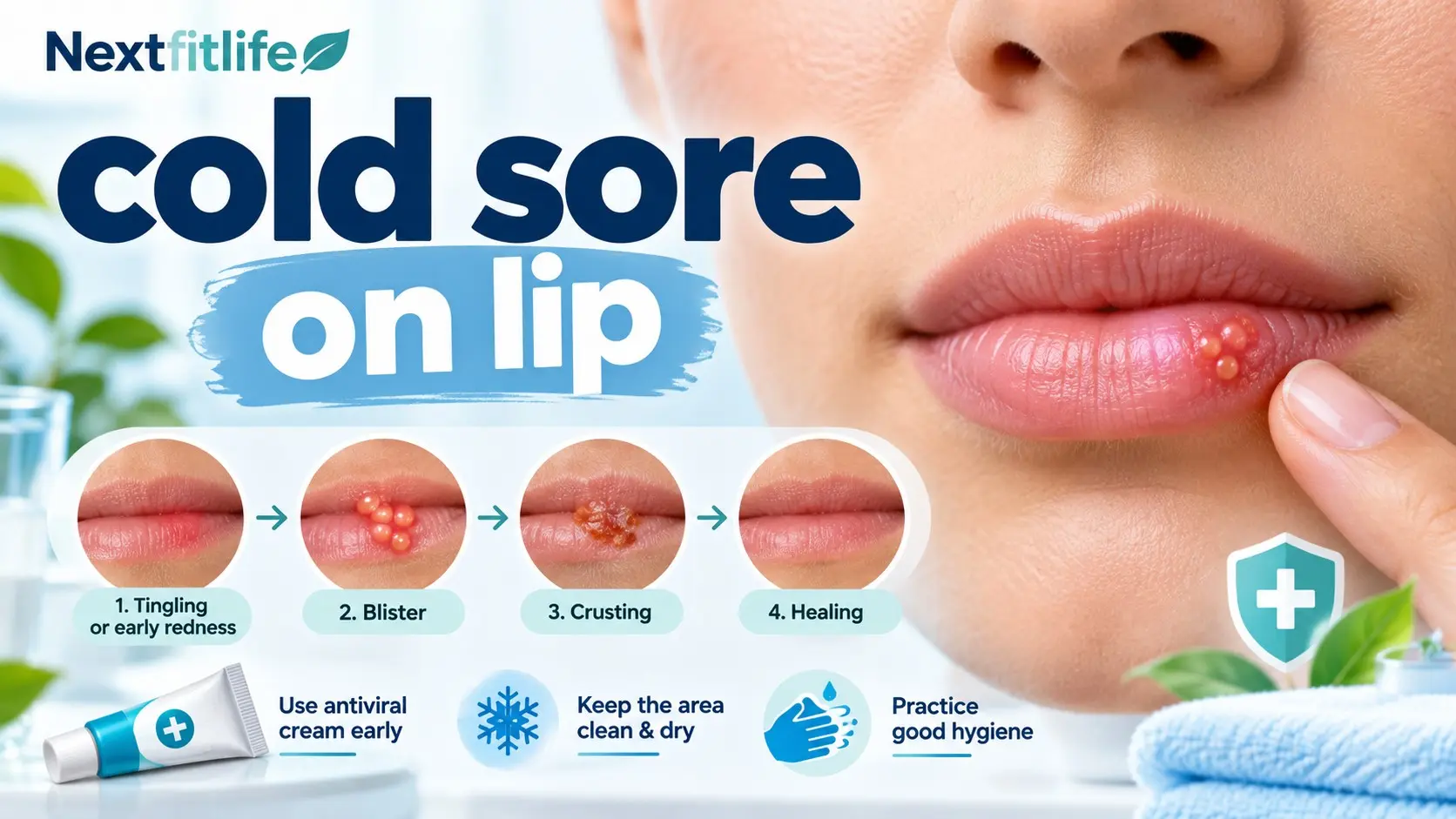
A typical cold sore on lip often starts as a small area of tingling, burning, itching, tenderness, or numbness.
Within a day or two, one or more small fluid filled blisters may appear. They often sit close together along the border between the lip and surrounding skin.
The blisters may then break. A shallow sore forms, followed by a crust or scab. As healing continues, the crust becomes smaller and the skin returns toward normal.
The medical name for this condition is herpes labialis. It is also commonly called a fever blister.
If you want the broader guide to oral HSV, read our complete cold sores guide.
What Causes a Cold Sore on the Lip?
Most cold sores around the mouth are caused by HSV 1.
HSV 2 can also infect the mouth, although HSV 1 is the more common cause of oral herpes.
After the first infection, the virus does not leave the body. It stays inactive in nerve cells and may reactivate later.
This explains why a person can have a cold sore, recover completely, and then develop another sore months or years later.
Does Having a Cold Sore Mean I Just Caught Herpes?
No.
A cold sore does not tell you when the infection began.
HSV may stay quiet for a long time before the first noticeable outbreak. Many people also acquire HSV 1 during childhood through ordinary close contact.
This is one reason it is not accurate to assume that every new cold sore represents a recent infection.
How Does a Cold Sore Develop?
| Stage | What You May Notice | Best Response |
|---|---|---|
| 1. Warning stage | Tingling, itching, burning, stinging, tenderness, or numbness | Begin your approved treatment as early as possible |
| 2. Blister stage | One or more small fluid filled blisters | Avoid touching, kissing, oral sex, and shared lip products |
| 3. Open sore stage | Blisters break and may ooze | Keep the area clean and continue precautions |
| 4. Crusting stage | A crust or scab develops | Do not pick or peel the crust |
| 5. Healing stage | Redness, tenderness, and crust gradually disappear | Continue avoiding direct oral contact until fully healed |
15 Proven Cold Sore on Lip Tips for Faster Relief
1. Treat the Tingling Stage Seriously
The best time to respond may be before the blister becomes obvious.
If you know the familiar feeling of a tingling lip, burning, or itching that usually comes before your cold sores, this is the time to begin the treatment your healthcare professional or pharmacist has recommended.
Antiviral treatment for recurrent HSV is most effective when started early.
2. Ask About Oral Antiviral Medicine
Prescription antiviral medicines used for cold sores include:
- Acyclovir
- Valacyclovir
- Famciclovir
These medicines cannot remove HSV from your body. However, they can make an outbreak shorter or less severe.
For people who recognize their symptoms early, a healthcare professional may prescribe medicine that can be started as soon as an outbreak begins.
Do not use another person's prescription or change your prescribed dose on your own.
3. Know That Tablets Often Work Better Than Creams
Both oral and topical antiviral medicines are available.
Mayo Clinic notes that oral antiviral medicines generally work better than antiviral creams.
That does not mean everyone needs prescription tablets. A mild occasional outbreak may be managed differently from frequent or severe recurrent cold sores.
Your healthcare professional can help you choose the right approach.
4. Consider Docosanol When Appropriate
Docosanol is a nonprescription treatment available for cold sores in some countries.
It may shorten healing time when started early and used according to the product directions.
Docosanol is not an antibiotic and it does not cure HSV.
The older version of this article referred to this medicine incorrectly. The correct ingredient name is docosanol.
5. Apply Topical Medicine Without Rubbing
Do not aggressively rub cream into the blister.
Gently dab it onto the affected area. A clean cotton tipped swab can reduce direct finger contact.
Wash your hands before and after treating the sore.
6. Use a Cool Compress for Comfort
A clean, cool, damp cloth may reduce discomfort and soothe irritated skin.
Use gentle pressure rather than rubbing.
A compress can improve comfort, but it does not kill HSV and should not be described as an antiviral treatment.
7. Keep Dry or Cracked Lips Comfortable
Lip skin may become dry and uncomfortable as a cold sore heals.
A simple moisturizing product such as petroleum jelly can help keep surrounding skin from becoming excessively dry or cracked.
Use clean hands or a clean applicator.
If you use a lip product directly on an active sore, do not share it with anyone.
8. Do Not Pick the Blister or Scab
Picking can reopen the skin and increase irritation.
It also puts virus on your fingers, which creates another chance to move HSV to the eye, another part of your skin, or another person.
Let the crust loosen naturally.
9. Protect Your Lips From Strong Sun
Sun exposure is a known cold sore trigger for some people.
If sunlight tends to bring on your outbreaks, use a broad spectrum SPF 30 or higher lip balm before going outside.
Reapply it according to the product directions, especially after eating, swimming, sweating, or licking your lips.
10. Do Not Kiss During an Outbreak
HSV spreads through close contact.
Avoid kissing while you have tingling, a blister, an open sore, or a healing crust.
This is especially important around babies and people whose immune systems are weakened.
11. Avoid Oral Sex While Symptoms Are Present
HSV 1 from a cold sore on lip can spread to a partner's genital area during oral sex.
Wait until the outbreak is fully healed before resuming direct oral contact.
Even without visible symptoms, HSV can sometimes spread through asymptomatic viral shedding, so no method reduces risk to zero.
12. Keep Your Hands Away From Your Eyes
This habit matters more than many people realize.
If you touch an active cold sore, wash your hands before touching your face, contact lenses, or eyes.
HSV infection of the cornea can be serious and needs prompt medical treatment.
13. Avoid Sharing Items That Touch the Mouth
During an active outbreak, keep your personal mouth products to yourself.
Examples include:
- Lip balm
- Lipstick
- Razors
- Cups
- Eating utensils
- Products applied directly to the sore
Direct skin contact is a more important route of HSV transmission than objects, but avoiding shared mouth items during an outbreak remains a sensible hygiene step.
14. Track Repeat Outbreaks
If sores keep returning, write down what happened before each outbreak.
Look for patterns involving:
- Strong sun exposure
- Illness
- Fever
- Stress
- Sleep loss
- Dry or cracked lips
- Dental work
- Lip filler or other procedures around the mouth
- Hormonal changes
Not every outbreak has an obvious trigger, but a simple record can reveal useful patterns.
15. Ask About Daily Suppressive Treatment if Outbreaks Are Frequent
People with frequent or severe outbreaks may benefit from daily antiviral medicine.
This is called suppressive treatment.
The American Academy of Dermatology advises medical evaluation for people who develop cold sores six or more times per year.
Frequency is not the only reason to seek help. Severity, eye involvement, immune status, pregnancy, and how much the outbreaks affect your life also matter.
What Can Trigger a Cold Sore on the Lip?
HSV can reactivate without a clear cause, but common triggers include:
- Sun exposure
- Fever or illness
- Emotional stress
- Sleep deprivation
- Chapped or injured lips
- Cold or very hot weather
- Menstrual periods in some people
- Dental procedures
- Cosmetic procedures around the mouth
If stress is a recurring trigger for you, our anger management guide and broader wellness resources may help you build healthier ways to lower daily tension.
How Long Does a Cold Sore on the Lip Last?
Healing time varies.
The NHS says many cold sores clear within about 10 days, while the American Academy of Dermatology notes that healthy people often clear an outbreak within about two weeks.
Mayo Clinic notes that full healing can sometimes take two to three weeks.
The important point is the direction of change. A simple cold sore should gradually improve.
If your lesion is getting larger, much more painful, spreading, or failing to heal, get it checked rather than assuming it is a normal cold sore.
Is a Cold Sore Contagious From Tingling to Healing?
Yes. It is safest to treat the entire outbreak as contagious.
The virus can be active during the early tingling stage, while blisters are present, after they break, and while the skin is healing.
HSV can also sometimes spread when no sore is visible.
Risk is greatest when active lesions are present.
Can I Cover a Cold Sore With Makeup?
It is usually better to limit products placed directly over an active blister, especially products that require repeated touching.
If you do use a cosmetic product near the area, avoid double dipping an applicator back into the container after it touches the sore.
Never share the product.
If the area becomes more irritated after a cosmetic product, stop using it.
Can I Pop a Cold Sore?
No.
Popping a cold sore does not make HSV leave the body. It can increase pain, damage the skin, contaminate your fingers, and make the area harder to care for.
Leave the blister alone and let it move through the normal healing process.
Cold Sore on Lip or Something Else?
Not every sore, bump, or crack on the lip is herpes.
This is especially important when a lesion looks different from your usual outbreak.
| Condition | Typical Clues | Contagious? |
|---|---|---|
| Cold sore | Tingling followed by grouped fluid filled blisters near the lip border | Yes |
| Canker sore | Round or oval ulcer usually inside the mouth | No |
| Lip eczema | Dryness, scaling, cracking, itching, or irritation | No |
| Impetigo | Bacterial sores that may develop honey colored crust | Yes |
| Acne or pimple | Single bump related to a pore or hair follicle | No |
| Contact reaction | Itching, burning, scaling, or swelling after a lip or skin product | No |
For persistent dry or inflamed lips, see our lip eczema guide.
If the lesion is inside your mouth rather than along the outside lip border, read our mouth ulcers guide.
Cold Sore Versus Canker Sore
This difference is worth making very clear.
A cold sore usually appears on the lip border or nearby skin. It is caused by HSV and is contagious.
A typical canker sore appears inside the mouth. It is not caused by HSV and is not contagious.
People sometimes call every mouth sore “herpes,” but that is not medically accurate.
Cold Sore Versus Lip Eczema
Lip eczema usually causes dryness, scaling, cracking, irritation, or itching rather than the classic cluster of fluid filled blisters seen with HSV.
A new toothpaste, cosmetic, lip balm, fragrance, food exposure, or another irritant may trigger contact dermatitis around the lips.
If the problem keeps returning as dry inflamed skin without the usual cold sore stages, consider whether the diagnosis might be different.
Cold Sore Versus Impetigo
Impetigo is a bacterial skin infection.
It can appear around the mouth and may form a yellow or honey colored crust, which sometimes causes confusion with a crusting cold sore.
Because impetigo needs different treatment, see a healthcare professional if the appearance is unusual, spreading, or difficult to identify.
Do Natural Remedies Heal Cold Sores Faster?
This is an area where online advice often goes too far.
Lysine
Lysine is often promoted for recurrent cold sores, but study results are mixed.
Do not replace a proven antiviral treatment plan with lysine when medical treatment is needed.
Tea Tree Oil
Laboratory findings do not prove that tea tree oil is an effective cold sore treatment in people.
Concentrated tea tree oil may also irritate already damaged lip skin.
Aloe Vera
Aloe may feel soothing to some people, but evidence that it meaningfully shortens a cold sore outbreak is limited.
Lemon Balm
Small studies have examined lemon balm products. The evidence is less established than evidence for antiviral medicines.
Ice
Cold can help with discomfort. It does not destroy the virus.
If you use something cold, wrap it rather than putting ice directly on delicate lip skin for a long period.
Should You Avoid Chocolate, Nuts, or Arginine Foods?
You may see online claims that people with cold sores must avoid nuts, chocolate, seeds, and other foods containing arginine.
Current evidence does not support giving everyone with HSV a long list of healthy foods to avoid.
Your nutrition should remain balanced unless you identify a consistent personal trigger or receive specific professional advice.
Likewise, food cannot remove HSV from the body.
Can Stress Cause a Cold Sore?
Stress may trigger an outbreak in some people who already carry HSV.
Stress does not create HSV by itself.
Think of it as a possible reactivation trigger, not the original cause of the infection.
Regular sleep, physical activity, relaxation skills, and realistic stress management may help people who notice a clear link between stressful periods and outbreaks.
Can Sunlight Trigger a Cold Sore?
Yes, for some people.
The American Academy of Dermatology recommends broad spectrum SPF 30 or higher lip protection for people whose cold sores are triggered by sunlight.
Sun protection has another benefit too. It protects lip skin from ultraviolet damage even when you are not prone to cold sores.
Cold Sores and Dental or Cosmetic Procedures
Procedures around the mouth may trigger HSV reactivation in some people.
Tell your dentist, dermatologist, or cosmetic practitioner if you have a history of recurrent cold sores before undergoing procedures such as:
- Dental treatment
- Lip fillers
- Laser treatment
- Light treatment
- Some cosmetic procedures around the mouth
Your clinician may decide that preventive antiviral treatment is appropriate in some situations.
Cold Sore on Lip During Pregnancy
If you are pregnant and develop a new herpes infection or are uncertain what a lip lesion is, tell your healthcare professional.
Oral cold sores are different from genital herpes during pregnancy, but medication choices and individual risks still deserve professional guidance.
After a baby is born, an active cold sore creates an important contact risk.
Never Kiss a Newborn With an Active Cold Sore
This rule deserves its own section.
HSV infection can be very dangerous in newborn babies.
If you have an active cold sore:
- Do not kiss a newborn
- Wash your hands before touching the baby
- Keep the sore covered when practical
- Follow advice from the baby's healthcare team
Seek urgent pediatric advice if a newborn may have been exposed and develops blisters, fever, poor feeding, unusual sleepiness, irritability, or other signs of illness.
When Should You See a Healthcare Professional?
Arrange medical care if:
- The sore is near your eye
- You develop eye pain or light sensitivity
- The lesion is very large
- Pain is severe
- The sore does not heal within about two weeks
- Cold sores keep returning
- You get six or more outbreaks per year
- You have eczema or atopic dermatitis
- You have a weakened immune system
- You receive chemotherapy
- You take medicine that suppresses your immune system
- You are unsure whether the lesion is actually a cold sore
- The rash spreads beyond the usual area
Do not wait for an ordinary cold sore to become severe before asking for help if your immune system is weakened.
Can a Doctor Test a Cold Sore?
Often, a clinician can diagnose a classic cold sore by looking at it.
If the diagnosis is uncertain, a sample can be taken from a fresh lesion and tested for HSV.
Testing may be more useful when the appearance is unusual, this is your first suspected outbreak, symptoms are severe, or the diagnosis will change treatment decisions.
How to Lower the Chance of Another Outbreak
You cannot guarantee that HSV will never reactivate, but you can reduce some avoidable triggers.
- Use SPF lip protection if sunlight triggers outbreaks.
- Keep very dry or cracked lips moisturized.
- Try to maintain regular sleep.
- Manage stress in ways that work for you.
- Tell clinicians about recurrent HSV before mouth procedures.
- Track your personal triggers.
- Discuss suppressive antiviral treatment if outbreaks are frequent.
Internal Links and Hub
- Cold Sores: Causes, Symptoms, Treatment, and Prevention
- Herpes Skin Rash: Symptoms, Treatment, and Warning Signs
- Mouth Ulcers: Causes, Relief, and Warning Signs
- Lip Eczema: Causes, Treatment, and Triggers
- General Wellness and Lifestyle Hub
- Nutrition and Vitamins Guide
Conclusion: Treat a Cold Sore on Lip Early
A cold sore on lip is usually caused by HSV 1 and often follows a familiar pattern from tingling to blistering, crusting, and healing.
The most useful action is early action. Recognize your warning symptoms, begin appropriate antiviral treatment quickly, avoid touching the lesion, protect other people from direct contact, and use sun protection if sunlight is one of your triggers.
If your sore looks unusual, appears near the eye, becomes severe, keeps returning, or does not heal as expected, contact a qualified healthcare professional instead of continuing to guess at home.
References and Sources
- World Health Organization. Herpes Simplex Virus.
https://www.who.int/news-room/fact-sheets/detail/herpes-simplex-virus - American Academy of Dermatology. Cold Sores: Diagnosis and Treatment.
https://www.aad.org/public/diseases/a-z/cold-sores-treatment - American Academy of Dermatology. Cold Sore Remedies Dermatologists Recommend.
https://www.aad.org/public/diseases/a-z/cold-sores-self-care - Mayo Clinic. Cold Sore: Symptoms and Causes.
https://www.mayoclinic.org/diseases-conditions/cold-sore/symptoms-causes/syc-20371017 - Mayo Clinic. Cold Sore: Diagnosis and Treatment.
https://www.mayoclinic.org/diseases-conditions/cold-sore/diagnosis-treatment/drc-20371023 - NHS. Cold Sores.
https://www.nhs.uk/conditions/cold-sores/ - Cleveland Clinic. Cold Sore: Symptoms, Causes and Treatment.
https://my.clevelandclinic.org/health/diseases/cold-sores
About the Author
Adel Galal is the founder and lead writer of NextFitLife. He writes consumer health, nutrition, fitness, and wellness content using information from recognized medical organizations, public health agencies, and academic sources.
His goal is to make health information easier to understand while clearly separating everyday self care from situations that deserve professional assessment.
I am not a dermatologist or a doctor, and this content does not replace professional medical advice. What I share comes from real life experience, extensive research, and consultation with healthcare providers. Always consult qualified medical professionals for diagnosis and treatment of any health condition.
Learn more about Adel Galal, NextFitLife, and the site's editorial approach at About Us.
Frequently Asked Questions
What causes a cold sore on lip?
A cold sore on the lip is usually caused by herpes simplex virus type 1, also called HSV 1. After infection, the virus remains in the body and can reactivate later.
How do I get rid of a cold sore on my lip fast?
There is no instant cure. Antiviral treatment works best when started at the first tingling, burning, or itching sensation. Prescription oral antivirals often work better than creams for shortening an outbreak.
How long does a cold sore on the lip last?
Many cold sores improve within about 10 days to two weeks, although complete healing may take longer in some people.
Is a cold sore on the lip contagious?
Yes. HSV spreads most easily when active blisters or sores are present, but it can sometimes spread before a blister appears or when no symptoms are visible.
Can I pop a cold sore?
No. Popping a cold sore can damage the skin, increase irritation, and put virus on your fingers. Let the blister and crust heal naturally.
Can I kiss someone with a healing cold sore?
It is safest to wait until the lesion has completely healed and the skin has returned to normal before kissing.
Is a cold sore the same as a canker sore?
No. Cold sores are usually caused by HSV and commonly form on or around the lips. Canker sores usually develop inside the mouth and are not contagious.
Can stress cause a cold sore?
Stress does not cause the original HSV infection, but it may trigger reactivation in some people who already carry the virus.
Does sunlight trigger cold sores?
Yes, sunlight can trigger outbreaks in some people. Broad spectrum SPF 30 or higher lip balm may help people with sun triggered cold sores.
When should I see a doctor about a cold sore?
Seek medical advice if the sore is near your eye, very painful, unusually large, lasts more than about two weeks, keeps returning, or occurs when your immune system is weakened.
Can I kiss my newborn if I have a cold sore?
No. Do not kiss a newborn while you have an active cold sore because HSV can cause a serious infection in young babies.
Can oral HSV cause genital herpes?
Yes. HSV 1 from the mouth can spread to the genital area through oral sex.

Health & wellness writer with 30+ years of experience in nutrition, fitness, and healthy aging. Founder of NextFitLife.com — evidence-based health guidance.

