Last Updated: June 2026
— Updated with 2026 AAO and Cochrane research
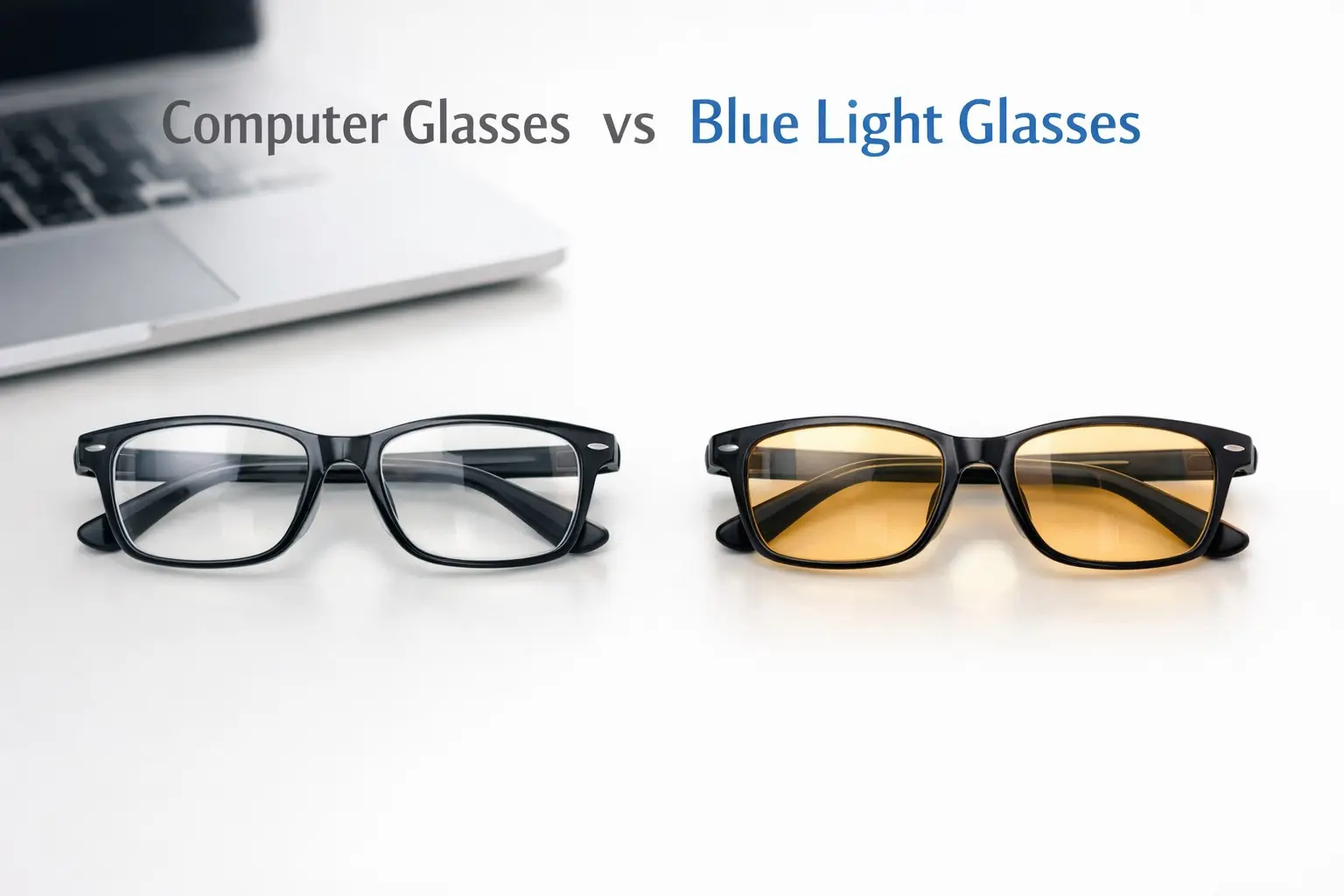
Your eyes hurt after a long day at the screen. You search for a solution. You find two products everywhere you look - Computer Glasses vs Blue Light Glasses. They sound similar. They are often marketed for the same problem. But they are very different things — and the evidence behind them is very different too.
I tested both types over several months. I read the clinical trial. I spoke to optometrists about what they actually recommend. The answer is more nuanced than most product pages will tell you. This guide gives you the honest comparison so you can decide what — if anything — is actually worth buying.
Complete eye health guide: vision care, prevention and wellness
| KEY FACTS | Digital eye strain affects 50 to 90% of people who use screens more than 2 hours daily
The primary cause of screen eye strain is reduced blinking and prolonged near focus, not blue light The American Academy of Ophthalmology does not recommend blue light glasses for eye strain A 2023 Cochrane systematic review found no convincing evidence that blue light glasses reduce eye strain Computer glasses with anti-reflective coating and correct focal distance DO reduce eye strain Blue light glasses have a genuine benefit for one specific purpose: improving sleep when used at night The 20-20-20 rule is free, takes seconds, and has stronger evidence than either type of glasses |
What Actually Causes Screen Eye Strain? Getting the Root Cause Right
Before comparing glasses, you need to understand what digital eye strain actually is. Most people blame blue light. The research tells a different story.
When you look at a screen, two things happen. First, your eyes maintain sustained near focus for long periods — the ciliary muscles that control your lens remain contracted, leading to fatigue. Second, your blink rate drops from a normal 15 to 20 times per minute to as low as 5 to 7 times per minute. Fewer blinks mean the tear film evaporates. Your eyes dry out. Dryness causes irritation, blur, and that gritty, tired feeling.
Blue light from screens plays a much smaller role in daytime eye strain than marketing suggests. Your eyes encounter blue light constantly — from sunlight, LED lighting, and even fluorescent bulbs. Screen blue light is a tiny fraction of your total daily blue light exposure.
| Cause of Screen Eye Strain | How Much Does It Contribute? | Solved By |
| Reduced blink rate — tear film evaporation | Very high — primary cause | Conscious blinking, lubricating drops, screen breaks |
| Sustained near focus — ciliary muscle fatigue | Very high — primary cause | 20-20-20 rule, screen distance, breaks |
| Screen glare and reflections | Moderate | Anti-reflective coating, matte screen, good lighting |
| Incorrect viewing distance or angle | Moderate | Screen at arm's length, top of screen at eye level |
| Blue light from screens | Low — minor contributing factor | Blue light filter or night mode — mainly for sleep |
| Uncorrected refractive error | Variable — often significant | Correct glasses prescription from an optician |
What Are Computer Glasses and How Do They Work?
Computer glasses are prescription or non-prescription lenses specifically optimized for the intermediate distance of a computer screen — typically 50 to 70 centimetres from your face. They address the actual causes of screen eye strain directly.
how to read your eye prescription: every number explained
What computer glasses actually do
- Optimized focal distance — lenses are tuned for the screen distance, reducing the accommodation effort your ciliary muscles must make to maintain clear focus
- Anti-reflective coating — reduces glare from screens, overhead lights, and window reflections that cause squinting and fatigue
- Slight magnification — many computer lenses include a mild magnification (typically +0.25 to +0.75) that relaxes the accommodation system even in people who rarely need glasses
- Wider intermediate zone — progressive lens wearers benefit from a computer-specific lens that widens the intermediate zone compared to standard progressives
Who Benefits Most From Computer Glasses
- People over 40 with beginning presbyopia who find screens harder to focus on eye health after 40 and the vision changes to expect
- Progressive lens wearers who spend long hours at a screen — the intermediate zone in progressives is relatively narrow
- People with uncorrected mild long-sightedness who notice headaches and eye fatigue during screen work
- Anyone with significant glare sensitivity or working in bright office environments with overhead lighting
What are blue light glasses, and what does the evidence actually show?
Blue light glasses use lenses with a special coating or tint that filters out part of the blue wavelength of visible light (roughly 400 to 500 nanometres). They are marketed primarily for reducing eye strain and improving sleep.
The sleep benefit has better evidence. The eye strain benefit does not.
Blue Light Glasses for Eye Strain - What the Research Says
A 2023 Cochrane systematic review — the gold standard of medical evidence — analyzed 17 randomized controlled trials on blue light glasses and eye strain. The conclusion was obvious: there is no convincing evidence that blue light filtering lenses reduce digital eye strain compared to standard lenses. The American Academy of Ophthalmology echoes this — they explicitly state blue light glasses are not recommended for reducing screen-related eye strain.
This does not mean blue light glasses are useless. It means their claimed benefit for computer vision syndrome is not supported by the evidence available. If you already have blue light glasses and find they help, that is likely because of the anti-reflective coating most of them include — not the blue light filtering itself.
Blue Light Glasses for Sleep - Where They Actually Help
This is where blue light glasses have genuine, well-supported benefits. Blue light in the evening suppresses melatonin production — the hormone that tells your brain it is time to sleep. Wearing blue light filtering glasses for 2 hours before bedtime reduces this suppression and helps maintain a healthy circadian rhythm.
how sleep and rest affect your eye health and vision
Multiple studies confirm this effect. If you use screens in the evening and struggle with sleep quality, amber-tinted blue light glasses worn from around 8 pm can genuinely improve sleep onset and quality. This is a legitimate use case — just not the one most marketing focuses on.
blue light and eye damage: what the evidence actually shows
Computer Glasses vs Blue Light Glasses: The Direct Comparison
| Feature | Computer Glasses | Blue Light Glasses |
| Primary purpose | Optimise vision for screen distance | Filter blue wavelength light |
| Reduces eye strain | Yes — directly addresses the causes | No convincing clinical evidence |
| Improves sleep | No | Yes — if worn 1 to 2 hours before bed |
| Anti-reflective coating | Usually included | Often included |
| Prescription available | Yes — from the optician | Yes — most come with or without a prescription |
| Best time to wear | During screen work | Evening screen use — 2 hours before sleep |
| Evidence quality for main claim | Strong — multiple clinical studies | Weak for eye strain. Moderate for sleep |
| Average cost | £80 to £300 from optician | £15 to £200 online or in store |
| Who needs them most? | Over 40s, progressive lens users, heavy screen users | Evening screen users with poor sleep quality |
| AAO recommendation | Supported for managing presbyopia and screen work | Not recommended for eye strain specifically |
Do you actually need either? The Honest Answer
Before spending money on specialist glasses, try the free interventions first. They work better than either type of glasses for most people.
| FREE STRATEGIES THAT OUTPERFORM BOTH PRODUCTS FOR EYE STRAIN | 20-20-20 rule — every 20 minutes look 20 feet away for 20 seconds. Set a timer. This is the most evidence-backed screen habit available
Blink consciously — aim for 15 to 20 full blinks per minute during screen use. Sounds strange, but makes a real difference Correct screen distance — keep your screen 50 to 70cm from your eyes. Top of screen at or just below eye level Preservative-free lubricating drops — use before you feel dry, not after. Apply every 1 to 2 hours during heavy screen work Reduce overhead glare — reposition your screen or add a matte screen protector to reduce reflective glare Night mode on all devices after sunset — this reduces blue light for sleep without any glasses needed Get your eyes tested — many screen strain problems are simply uncorrected refractive errors Digital eye strain: symptoms, causes and relief strategies |
When Computer Glasses Are Worth Buying
- You are over 40 and find screens harder to focus on than you used to
- You wear progressive lenses and spend more than 4 hours daily at a screen
- You have been told by an optician that you have mild, uncorrected long-sightedness
- You have significant glare sensitivity in bright office environments
When are blue light glasses worth buying?
- You regularly use screens for 2 hours before bedtime
- You have difficulty falling asleep and suspect evening light exposure is a factor
- You want a cheap basic pair (under £20) and have no specific screen strain problem
- You choose amber-tinted lenses rather than clear lenses — the amber filter blocks more blue light and has better evidence
My Personal Experience Testing Both Types
| Adel Galal | I tested both products for three months each. Here is what I actually found.
Computer glasses first. I had a pair made by my optician with a +0.50 reading addition And an anti-reflective coating. I work at a screen for 5 to 7 hours daily. The difference was noticeable within the first week. Less end-of-day eye fatigue. Fewer headaches. The anti-reflective coating made the biggest difference — my home office has overhead LED lighting that creates significant screen glare. I still use these every day. Blue light glasses, second. I bought a mid-range pair with amber tinting. I wore them from 8 pm onwards during evening reading and screen use. After two weeks, I noticed I was falling asleep faster. My sleep tracker showed Slightly better deep sleep scores. Hard to isolate cause and effect, but the timing was consistent. I still wear them in the evenings. My conclusion: both have genuine uses, but for unique problems. Computer glasses for daytime screen strain. Blue light glasses for evening sleep quality. Buying one and expecting it to do both jobs will likely disappoint you. |
Key Takeaways: Computer Glasses vs Blue Light Glasses
| SUMMARY | Screen eye strain is caused primarily by reduced blinking and sustained near focus, not blue light
Computer glasses address the actual causes of eyestrain and have strong clinical support Blue light glasses do not convincingly reduce eye strain — per the 2023 Cochrane review and AAO Blue light glasses DO help with sleep quality when worn for 1 to 2 hours before bedtime Amber-tinted blue light glasses block more blue light than clear ones — better for sleep Anti-reflective coating — present in most computer glasses — is the most practical screen aid The free 20-20-20 rule and conscious blinking outperform both products for basic eye strain If over 40 or a progressive lens wearer, computer glasses from an optician are worth it If you use screens in the evening and sleep poorly, evening blue light glasses are worth trying Always get your eyes tested first — an uncorrected prescription is the most common, overlooked cause |
References and Sources
1- Blue Light Filtering Lenses — Cochrane Systematic Review 2023
https://www.cochranelibrary.com/cdsr/doi/10.1002/14651858.CD013244.pub2/full
Cochrane gold-standard review. Use for: no convincing evidence that blue light glasses reduce eye strain.
2- Computer Vision Syndrome — American Academy of Ophthalmology
https://www.aao.org/eye-health/diseases/computer-vision-syndrome
AAO authority. Use for: digital eye strain definition, causes, and blue light glasses position statement.
3- Blue Light and Sleep — Journal of Pineal Research
https://pubmed.ncbi.nlm.nih.gov/24797447/
Research journal. Use for: blue light melatonin suppression mechanism and evening light exposure effects.
4- Anti-Reflective Coating and Visual Performance — Optometry and Vision Science
https://pubmed.ncbi.nlm.nih.gov/21057336/
Peer-reviewed optometry journal. Use for: anti-reflective coating effectiveness for glare and visual comfort.
5- Computer Glasses for Presbyopia — Clinical and Experimental Optometry
https://pubmed.ncbi.nlm.nih.gov/30887638/
Research journal. Use for: occupational progressive lenses and computer glasses benefit for over-40s.
Part of Our Eye Health Series
This article is part of our complete eye health resource.
Read all topics in our Complete Eye Health Guide or browse our
Eye Health and Vision Resource Directory.
Adel Galal
Health and Wellness Writer | 30+ Years Personal Practice | Founder, NextFitLife.com
Adel Galal has studied
health, vision care, and natural aging for over 30 years. At 58, he personally tested both
computer glasses and blue light glasses and writes from direct experience. He is not a doctor
or ophthalmologist. Everything shared reflects personal research, experience, and consultation
with healthcare providers. Always consult a qualified eye care professional for vision advice.

Health & wellness writer with 30+ years of experience in nutrition, fitness, and healthy aging. Founder of NextFitLife.com — evidence-based health guidance.