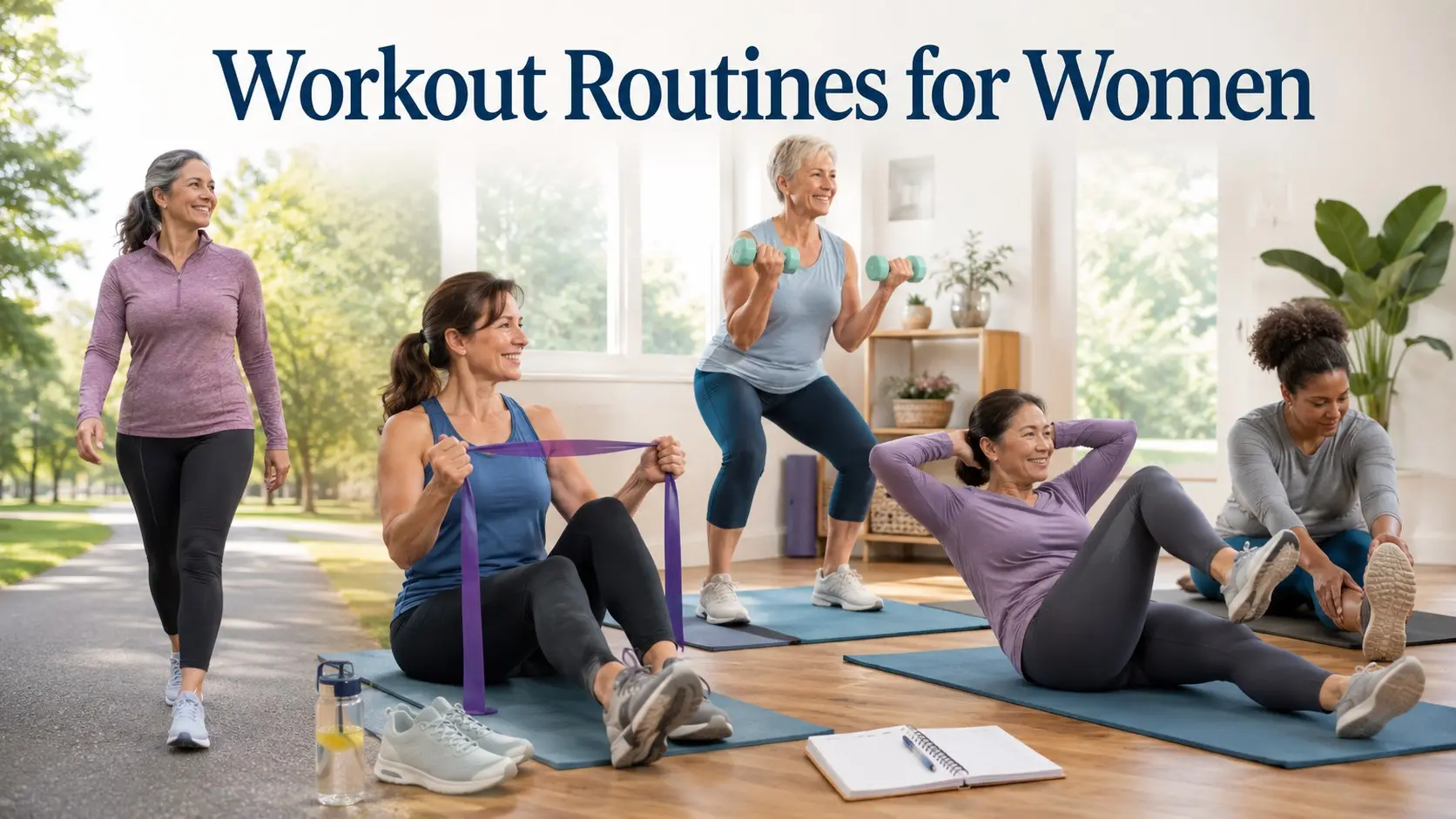
Last Updated: July 11, 2026
Topic: Workout Routines for Women
Reading Time: About 10 minutes
Content Note: This article is for education only. It does not replace medical advice.
Workout Routines for Women should not feel scary.
They should feel clear.
They should feel safe.
They should fit real life.
You do not need a perfect gym plan.
You do not need to train for hours.
You do not need to copy someone online.
You need a simple plan that you can repeat.
This guide provides a complete routine for strength, cardio, core, rest, and safe progress.
It is made for actual women with busy days, changing energy, stress, family needs, work, hormones, and normal life.
Quick answer
A good weekly workout routine for many women includes 2 or 3 strength workouts, 2 or 4 cardio sessions, gentle mobility, core work, and rest days.
Start small.
Use the suitable form.
Build slowly.
The best plan is not the hardest plan.
The best plan is the one you can keep.
Why workout routines for women should be balanced
A good plan does more than burn calories.
It helps your body move better.
It helps your heart.
It helps your muscles.
It helps your bones.
It may help mood and sleep too.
That is why **women’s fitness** should include more than one type of exercise.
A balanced plan can include:
- Strength training
- Walking or cardio
- Core exercises
- Stretching
- Balance work
- Rest
This gives your body many ways to get stronger.
Before you start
Start with your current level.
Do not punish your body.
Do not rush.
Move in a way that feels safe.
Talk with a qualified healthcare professional before starting a new workout routine if you are pregnant, recently gave birth, have chest pain, heart disease, diabetes, high blood pressure, severe joint pain, dizziness, recent surgery, eating disorder history, pelvic floor symptoms, breathing problems, or any long-term health condition.
Stop exercising and seek help if you feel chest pain, fainting, severe shortness of breath, sudden weakness, severe dizziness, sharp pain, or symptoms that feel dangerous.
Step 1: Choose your primary goal
Your goal helps shape your routine.
Pick one main goal for now.
- Build strength
- Lose weight safely
- Feel more energy
- Improve heart health
- Improve balance
- Get back into fitness
- Support bone health
- Move with less stiffness
You can have more than one goal.
But one major goal keeps the plan simple.
Step 2: Use the 3-part workout formula
A simple workout has 3 parts.
- Warm up
- Main workout
- Cool down
This helps your body prepare and recover.
It also lowers the chance of doing too much too soon.
Step 3: Warm up for 5 minutes
A warm-up does not need to be long.
Try this:
- March in place for 60 seconds.
- Roll your shoulders 10 times.
- Step side to side for 60 seconds.
- Do 10 easy bodyweight squats to a chair.
- Take 5 slow breaths.
This helps your body feel ready.
It is a simple part of **safe exercise for women**.
Step 4: Strength train 2 or 3 days each week
Strength training is important for women.
It helps muscles.
It supports bones.
It helps make daily tasks feel easier.
It may also help with body shape and long-term weight control.
Start with basic moves.
- Squat to chair
- Wall push-up
- Dumbbell row
- Glute bridge
- Step up
- Farmer carry
- Plank on knees
This is the basis of **strength training for women**.
Start light.
Use slow reps.
Rest between sets.
Step 5: Add cardio 2 to 4 days each week
Cardio helps your heart and lungs.
It can also support weight management.
Good choices include:
- Walking
- Cycling
- Swimming
- Dancing
- Low-impact aerobics
- Elliptical
If you are new, start with 10-20 minutes.
You can add time slowly.
This makes **cardio for women** easier to keep.
Step 6: Train your core without chasing a flat stomach
Core work is useful.
But it does not spot-reduce belly fat.
Your core helps with posture, balance, lifting, walking, and daily movement.
Beginner core moves include:
- Dead bug
- Bird dog
- Standing knee lift
- Side bend
- Glute bridge
- Plank on knees
This supports **core workouts for women** safely.
Move slowly.
Do not hold your breath.
Step 7: Add mobility and stretching
Stretching can help you feel less stiff.
Mobility work can help joints move better.
Try these simple moves:
- Neck turns
- Shoulder circles
- Cat cow
- Hip circles
- Calf stretch
- Hamstring stretch
- Chest opener
This can support **mobility exercises** and better movement.
Do not force a stretch.
Gentle is enough.
Step 8: Use rest days
Rest is not failure.
Rest helps your body adapt.
It helps muscles recover.
It helps your energy come back.
A rest day can include easy walking or light stretching.
This is part of **workout recovery**.
Step 9: Make a beginner's weekly routine
Use this if you are new or returning after a break.
Monday
Full-body strength for 20 minutes.
Tuesday
Walk for 20 minutes.
Wednesday
Rest or gentle stretching.
Thursday
Full-body strength for 20 minutes.
Friday
Walk or low impact cardio for 20 minutes.
Saturday
Mobility and core for 15 minutes.
Sunday
Rest.
This is a simple **weekly workout plan**.
Step 10: Try this full-body strength workout
Do this 2 days each week.
Start with 1 round.
Build to 2 or 3 rounds.
- Chair squat, 8 to 12 reps
- Wall push-up, 8 to 12 reps
- Light dumbbell row, 8 to 12 reps each side
- Glute bridge, 8 to 12 reps
- Step up, 6 to 10 reps each side
- Farmer carry, 20 to 30 seconds
Rest 30 to 60 seconds between moves.
Keep good form.
This is a strong ** full-body workout for women**.
Step 11: Try this low impact cardio plan
Low-impact cardio is gentle on the joints.
It can still help your fitness.
Option 1
Walk for 20 minutes at a pace where you can talk.
Option 2
Cycle for 15 to 25 minutes.
Option 3
Dance at home for 10 to 20 minutes.
Option 4
Swim or do water exercise if you have access.
This supports ** low-impact workout** goals.
Step 12: Adjust your workout around your cycle
Some women feel strong all month.
Some feel tired before or during their period.
Some feel cramps.
Some feel no change.
Listen to your body.
You can lower intensity when needed.
You can walk, stretch, or do lighter weights.
Then build again when energy returns.
This is one way to respect **exercise and menstrual cycle** changes.
Step 13: Support your plan with food and water
Workouts feel better when you eat enough.
Try simple habits.
- Eat protein at meals.
- Drink water.
- Add vegetables and fruit.
- Choose whole grains when they fit.
- Do not skip meals if it leads to overeating later.
This supports **fitness nutrition** without a strict diet.
Step 14: Track progress the kind way
Do not only track weight.
Track things that show strength and health.
- More reps
- Better form
- More steps
- Better sleep
- More energy
- Less stiffness
- Better balance
- Clothes feeling better
This helps you see progress without shame.
It also supports **body composition** goals in a healthier way.
Workout routines for women at home
You can build fitness at home.
You need only a small space.
Helpful tools include:
- Comfortable shoes
- Yoga mat
- Light dumbbells
- Resistance band
- Water bottle
- Workout notebook
But tools are optional.
Your body weight is enough to start.
This is the simple base of **home workouts for women**.
Workout routines for women over 40
After 40, many women care more about strength, joints, energy, sleep, and bone health.
That is a smart focus.
A good plan can include:
- Strength training 2 or 3 days weekly
- Walking most days
- Balance practice
- Gentle mobility
- Enough protein
- Rest days
Start where you are.
Build slowly.
Workout routines for women over 50
After 50, strength training becomes even more important for many women.
Muscle and bone support matter.
Balance matters too.
A good plan may include:
- Chair squats
- Step ups
- Wall push ups
- Rows
- Light carries
- Walking
- Balance work near a wall
If you have osteoporosis, joint pain, dizziness, or medical concerns, ask a qualified professional for a safe plan.
Common workout mistakes women can avoid
- Doing too much too soon
- Skipping strength training
- Training through pain
- Only doing ab workouts for belly fat
- Not eating enough protein
- Not sleeping enough
- Changing the plan every few days
- Comparing your body to others
Your routine should help your life.
It should not make you feel punished.
How to make your routine harder
Only make one change at a time.
- Add 1 more set.
- Add 2 more reps.
- Add a light weight.
- Walk 5 more minutes.
- Slow the exercise down.
- Rest a little less.
Small changes are easier to keep.
How to make your routine easier
You can always adjust.
- Use a chair.
- Use lighter weights.
- Do fewer reps.
- Take longer rest.
- Walk slower.
- Skip jumping.
- Do one round only.
This keeps your plan safe.
My simple rule
A good routine should leave you feeling better over time.
Not crushed.
Not ashamed.
Not scared.
You should feel like you can come back again.
That is how fitness grows.
Conclusion
Workout Routines for Women work best when they are simple, safe, and repeatable.
Start with strength training, walking, core work, stretching, and rest.
Use your body as the guide.
Build slowly.
Celebrate small wins.
Your next step: choose 2 strength days and 2 walking days this week. That is a strong start for Workout Routines for Women.
Related guides from NextFitLife
This article is part of our Fitness Hub. You may also want to visit our Fitness for Beginners Guide, Strength Training & Muscle Building Guide, and Home Workouts & Equipment Guide.
FAQ about Workout Routines for Women
What is the best workout routine for women?
A good routine includes strength training, cardio, core work, mobility, and rest. Many women can start with 2 strength days and 2 walking or cardio days each week.
How many days a week should women work out?
Many beginners can start with 3 or 4 days each week. This can include strength, walking, stretching, and rest days.
Should women lift weights?
Yes, many women can benefit from strength training. It can support muscles, bones, balance, daily movement, and body composition.
Can workout routines for women help with weight loss?
Yes, workouts can help with weight management, especially when paired with balanced meals, protein, sleep, water, and consistent daily movement.
What is a good beginner workout for women at home?
A simple home workout can include chair squats, wall push-ups, glute bridges, light rows, walking, and gentle stretching.
When should I talk to a doctor before exercise?
Talk with a doctor if you have chest pain, heart disease, diabetes, pregnancy, recent surgery, severe joint pain, dizziness, breathing problems, or any long-term health condition.
References and Sources

Health & wellness writer with 30+ years of experience in nutrition, fitness, and healthy aging. Founder of NextFitLife.com — evidence-based health guidance.