You can Improve Your Emotional Health without trying to feel happy every minute.
Good emotional health does not mean you never feel sad.
It does not mean you never get angry.
It does not mean stress disappears.
It means you can notice emotions.
You can understand them.
You can respond in healthier ways.
You can recover after difficult experiences.
You can ask for help when you need it.
This ability is part of emotional wellness.
It is closely linked with mental health, physical health, relationships, sleep, work, stress, and daily life.
Your environment matters too.
Money problems matter.
Work conditions matter.
Family support matters.
Safety matters.
Health conditions matter.
This means emotional health is not simply a matter of thinking positively.
It grows from personal skills, supportive relationships, healthy habits, safe environments, and access to care.
When Emotional Distress Needs Urgent Help
Self care is useful for everyday stress.
It is not enough for every mental health problem.
Seek immediate professional or emergency help if you or another person:
- Cannot stay safe
- Has thoughts of suicide or self-harm
- May seriously harm another person
- Has severe confusion
- Has hallucinations
- Has delusions
- Has extreme agitation
- Has several nights with almost no sleep plus unusually high energy or dangerous behaviour
- Cannot care for basic needs
Use local emergency services or the nearest emergency department when there is immediate danger.
How Can You Improve Your Emotional Health?
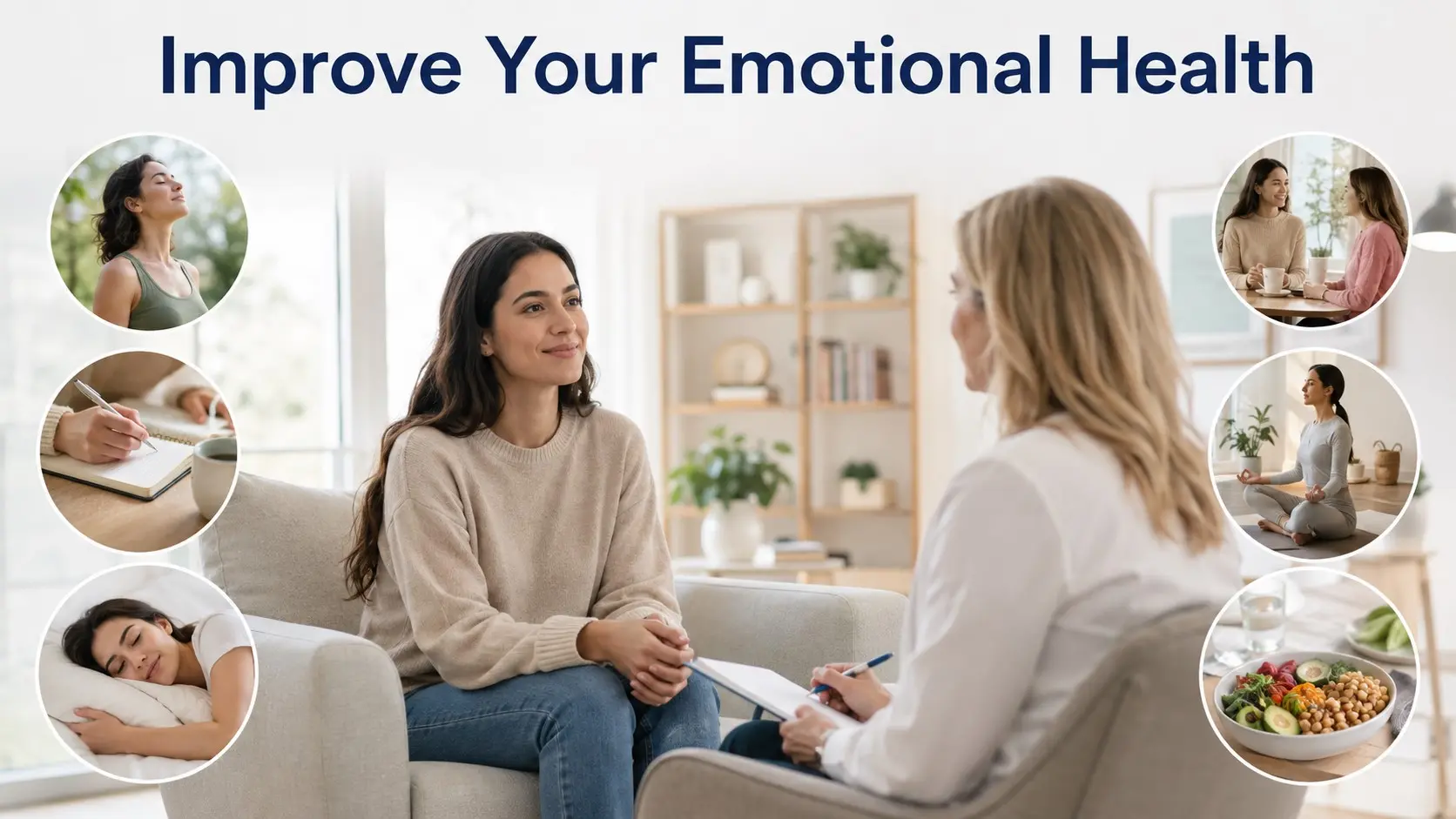
To Improve Your Emotional Health, focus on skills and habits you can repeat.
- Notice and name your emotions.
- Treat yourself with compassion.
- Learn healthy stress coping skills.
- Protect your sleep.
- Move your body regularly.
- Stay connected with supportive people.
- Practice mindfulness or another calming skill.
- Set healthy boundaries.
- Build meaning, purpose, and gratitude.
- Get professional help when self care is not enough.
You do not need to change everything today.
Choose one step.
Repeat it until it feels normal.
What Is Emotional Health?
Emotional health is the ability to understand, experience, express, and manage emotions in useful ways.
It also includes adapting when life changes.
NIH describes emotional wellness as the ability to handle life's stresses and adapt to difficult times.
Emotional Health Is Not Constant Happiness
Healthy people feel difficult emotions.
You may feel:
- Sad
- Angry
- Afraid
- Frustrated
- Jealous
- Lonely
- Disappointed
These feelings are part of being human.
The goal is not to erase them.
The goal is to understand what they are telling you and respond healthily.
Emotions Can Give You Information
Fear may tell you that you feel unsafe.
Anger may tell you that a boundary was crossed.
Sadness may follow loss.
Loneliness may signal a need for connection.
The emotion is not always the problem.
What you do next matters.
Emotional Health Versus Mental Health
The terms are related.
They are not exactly the same.
Emotional Health
This focuses strongly on how you:
- Recognize feelings
- Express feelings
- Regulate emotions
- Recover from difficult events
- Cope with stress
Mental Health
Mental health is broader.
It includes emotional, psychological, and social well being.
It affects how you:
- Think
- Feel
- Act
- Work
- Learn
- Relate to others
- Handle stress
You Can Have Difficult Emotions and Still Be Emotionally Healthy
A healthy emotional response to grief may include sadness.
A healthy response to unfair treatment may include anger.
Good emotional health means you can experience those feelings without being controlled by them all the time.
For the broader picture, visit the Mental Health and Wellness Hub.
What Are Signs of Good Emotional Health?
Good emotional health may include:
- Self awareness
- Emotional regulation
- Healthy coping
- Realistic thinking
- Supportive relationships
- Resilience
- A sense of meaning
- The ability to ask for help
- Healthy boundaries
- The ability to enjoy positive moments
You Still Have Bad Days
A bad day does not mean poor emotional health.
A difficult week does not mean you have a mental disorder.
Look at the pattern over time.
Function Matters
Ask yourself:
- Can I care for myself?
- Can I work or study?
- Can I sleep?
- Can I maintain relationships?
- Can I solve normal problems?
- Can I recover after difficult moments?
If distress begins to stop normal daily life, more support may be useful.
10 Ways to Improve Your Emotional Health
The following habits are simple.
Simple does not mean easy.
Start with the one that fits your life now.
1. Identify and Name Your Emotions
The first step in emotional regulation is knowing what you feel.
Many people say:
I feel bad.
Try to be more specific.
Do you feel:
- Angry?
- Embarrassed?
- Anxious?
- Lonely?
- Disappointed?
- Overwhelmed?
- Jealous?
- Tired?
The answer can change what you need.
Pause Before Reacting
Ask yourself three questions.
- What am I feeling?
- What happened before this feeling?
- What response would help rather than make the problem worse?
Try Writing It Down
A simple emotional journal can help you notice patterns.
Write:
- What happened
- What you felt
- What you thought
- What you did
- What happened afterward
You may begin to see repeated triggers.
2. Practice Self Compassion
Self compassion means treating yourself with the same basic respect you would offer someone you care about.
It does not mean avoiding responsibility.
It does not mean pretending mistakes do not matter.
It means learning without attacking yourself.
Change the Inner Conversation
Instead of:
I always ruin everything.
Try:
I made a mistake.
What can I learn from it?
Be Careful With All or Nothing Thinking
Words such as always and never can make problems feel larger.
Look for a more accurate statement.
Self Compassion Can Support Resilience
It is easier to recover from mistakes when you can face them without constant shame.
3. Learn Healthy Stress Management
Stress is normal.
Long lasting chronic stress is more difficult.
It can affect sleep, concentration, mood, appetite, and physical symptoms.
Find the Real Stressor
Ask:
- Is it work?
- Money?
- A relationship?
- Caregiving?
- Health?
- Lack of time?
The best coping skill depends on the problem.
Separate Control From Worry
Write down:
What can I change?
What can I plan?
What needs support?
What cannot be controlled today?
Use Healthy Coping
Useful options may include:
- Walking
- Talking with someone
- Music
- Reading
- Breathing exercises
- Time outdoors
- Creative hobbies
Read Stress Effect on Health for more about chronic stress and the body.
4. Protect Your Sleep
Sleep and emotional health are closely linked.
Poor sleep can make emotions harder to manage.
Stress and low mood can also make sleep harder.
Build a Simple Sleep Routine
Try to:
- Wake at a similar time each day
- Give yourself enough time for sleep
- Keep the bedroom dark
- Reduce late caffeine
- Reduce screens before sleep if they keep you awake
- Use a calm wind down routine
Adults Usually Need at Least Seven Hours
Individual needs vary.
Do not treat sleep as wasted time.
Persistent Sleep Trouble Deserves Attention
Long lasting insomnia may be linked with:
- Anxiety
- Depression
- Sleep apnea
- Pain
- Medicines
- Other health problems
If sleep remains poor, ask a healthcare professional.
5. Move Your Body Regularly
Physical activity can support both physical and mental health.
You do not need a hard workout.
Walking Counts
A short walk can be a useful start.
Other options include:
- Cycling
- Swimming
- Dancing
- Strength training
- Gardening
- Home exercise
Start Small
Ten minutes is better than doing nothing because one hour feels impossible.
Movement Is Support, Not a Cure
Exercise may support mood.
It does not replace psychotherapy or medical treatment when those are needed.
For more, see Exercise Benefits for Mental Health.
6. Strengthen Supportive Relationships
Social connection is a major part of emotional health.
You do not need hundreds of friends.
You need relationships that feel safe, respectful, and supportive.
Connection Can Look Different
It may come from:
- A partner
- Family
- A close friend
- A neighbor
- A hobby group
- A community group
- A faith community
- Volunteering
Ask for Support Clearly
People may not know what you need.
Try saying:
I do not need advice right now.
I just need someone to listen.
Support Should Go Both Ways
Healthy relationships allow both people to have needs and limits.
7. Practice Mindfulness or Another Calming Skill
Mindfulness means paying attention to the present moment.
It can help you notice thoughts and feelings without reacting immediately.
Simple One Minute Practice
- Sit comfortably.
- Notice your breathing.
- Notice where your body feels tense.
- Notice one thought.
- Let the thought pass.
- Bring your attention back to breathing.
Mindfulness Does Not Mean Emptying Your Mind
Thoughts will appear.
That is normal.
You simply return attention to the present.
Mindfulness Is Not Right for Everyone
Some people find meditation uncomfortable.
This can happen with trauma, panic, or other mental health conditions.
If it makes you feel worse, stop.
Try another coping method or ask a qualified professional.
8. Set Healthy Boundaries
Healthy boundaries protect time, energy, safety, and relationships.
A boundary is not about controlling another person.
It explains what you will or will not accept.
Examples
I cannot take on another project this week.
I need time before we continue this conversation.
I am not comfortable discussing that topic.
Saying No Can Protect Emotional Health
Constantly saying yes can create resentment and exhaustion.
You are allowed to have limits.
Boundaries Should Still Be Respectful
Clear does not need to mean cruel.
Use simple direct language.
9. Build Purpose, Gratitude and Enjoyment
A sense of meaning and purpose is part of emotional well being.
Purpose does not need to be one huge life mission.
Purpose Can Be Small
It may be:
- Raising a child
- Helping family
- Learning
- Work
- Faith
- Volunteering
- Creating something
- Caring for animals
- Helping your community
Practice Gratitude Without Denying Problems
Gratitude does not mean pretending everything is fine.
You can be grateful and still be sad.
You can appreciate one good thing while facing a serious problem.
Try a Simple Gratitude Habit
At the end of the day, write down one thing that mattered.
It can be small.
A good meal counts.
A useful conversation counts.
A quiet moment counts.
10. Get Professional Support When You Need It
Sometimes the best way to Improve Your Emotional Health is to stop trying to solve everything alone.
Professional Support May Include
- A primary care doctor
- A psychologist
- A psychiatrist
- A licensed therapist
- A counselor
- A clinical social worker
When Should You Consider Help?
NIMH advises seeking professional help when severe or distressing symptoms last for about two weeks or more.
Examples include:
- Persistent sleep problems
- Major appetite changes
- Difficulty concentrating
- Loss of interest
- Difficulty completing usual tasks
- Persistent irritability
- Persistent sadness
- Feeling unable to cope
You Do Not Need to Wait Until Things Become Severe
Therapy can also help with:
- Relationships
- Grief
- Stress
- Boundaries
- Life changes
- Emotional regulation
How Can Social Media Affect Emotional Health?
Social media can connect people.
It can also create pressure.
Watch How You Feel After Using It
Ask yourself:
- Do I feel connected?
- Do I feel angry?
- Do I compare myself with everyone?
- Does it keep me awake?
- Do I lose hours scrolling?
Take Breaks From Negative Content
MedlinePlus recommends limiting exposure to negative information when it harms your emotional state.
Use Social Media to Connect
Try to use it for:
- Talking with friends
- Learning
- Community
- Useful hobbies
Avoid turning every quiet moment into scrolling.
Can Food Affect Emotional Health?
Physical and emotional health are connected.
Regular meals can support energy and concentration.
Build Meals Around Basic Foods
Useful choices can include:
- Vegetables
- Fruit
- Whole grains
- Beans
- Lentils
- Fish
- Eggs
- Yogurt
- Nuts
- Seeds
Food Is Not a Treatment for Every Mental Health Condition
A healthy diet can support health.
It does not replace therapy or medicine when those are needed.
Watch Caffeine
Too much caffeine may worsen:
- Jitters
- Palpitations
- Anxiety
- Sleep problems
If you notice a pattern, reduce your intake.
Does Alcohol Help With Emotional Stress?
Alcohol may feel relaxing for a short time.
That does not make it a good emotional coping tool.
Alcohol Can Affect
- Sleep
- Mood
- Judgment
- Relationships
- Medicines
Watch for Emotional Drinking
Ask yourself:
Am I drinking because I enjoy a drink?
Or am I drinking because I cannot tolerate what I feel?
If alcohol becomes your main coping tool, talk with a qualified professional.
What Is Emotional Resilience?
Resilience means adapting and recovering after difficult experiences.
It does not mean nothing hurts you.
It does not mean you never need help.
Resilience Can Grow
NIH recommends habits such as:
- Healthy physical habits
- Regular sleep
- Physical activity
- Social connection
- Gratitude
- Learning from mistakes
- Purpose
- Self compassion
Resilience Is Not Doing Everything Alone
Asking for help can be part of resilience.
A strong person can still need therapy.
A capable person can still need support.
How Should You Handle Difficult Emotions?
Anger
Pause before speaking if you feel out of control.
Leave the situation briefly if it is safe to do so.
Return when you can communicate clearly.
Sadness
Allow yourself to feel sad.
Do not force happiness.
Seek support if sadness becomes persistent or starts affecting daily life.
Fear
Ask whether there is a real immediate danger.
If there is, respond to the danger.
If there is not, use breathing, grounding, or another calming skill.
Guilt
Ask whether you harmed someone.
If yes, take responsibility and repair what you can.
If not, ask whether the guilt is realistic.
Grief
Grief has no single timetable.
People respond differently.
Support from family, friends, community, faith, or a grief professional may help.
When Should You Seek Help for Emotional Health?
Consider talking with a qualified professional when emotional symptoms:
- Last for two weeks or longer
- Keep returning
- Are getting worse
- Make work difficult
- Damage relationships
- Change your sleep significantly
- Cause major appetite changes
- Make concentration difficult
- Cause you to avoid normal activities
- Lead to alcohol or drug use
- Make basic daily care difficult
Some Physical Problems Can Look Emotional
Low energy, poor concentration, sleep problems, and mood changes can also be linked with physical health conditions.
Examples include:
- Thyroid disease
- Anemia
- Sleep apnea
- Hormonal changes
- Medicine effects
- Chronic pain
- Other medical conditions
A healthcare professional can help decide whether medical testing is appropriate.
Use the Medical Tests and Screenings Hub for more information about testing.
Common Myths About How to Improve Your Emotional Health
Myth: Emotional Health Means Being Happy All the Time
No.
Healthy emotions include sadness, anger, disappointment, and fear.
Myth: Positive Thinking Fixes Everything
No.
Real problems may need practical action, support, therapy, medical care, or environmental change.
Myth: Strong People Do Not Need Help
No.
Asking for support is a useful coping skill.
Myth: You Should Ignore Negative Emotions
No.
Ignoring emotions can make it harder to understand what you need.
Myth: Self Care Means Expensive Spa Days
No.
Self care can mean sleep, food, walking, rest, medical care, setting limits, and calling a friend.
Myth: Social Media Always Harms Mental Health
No.
It can support connection.
Problems depend on how it is used and how it affects you.
Myth: Emotional Health Is Only an Individual Responsibility
No.
Work, money, housing, violence, discrimination, social support, education, and access to care can all influence mental and emotional health.
Myth: Therapy Is Only for Severe Mental Illness
No.
Therapy can also support coping, grief, relationships, stress, communication, and life changes.
A Simple Daily Plan to Improve Your Emotional Health
Morning
- Ask yourself how you feel
- Choose one realistic priority
- Eat a regular meal if breakfast fits your routine
- Avoid beginning the day with endless negative content
During the Day
- Move your body
- Eat regular meals
- Take a short break
- Talk with someone supportive
- Notice when stress is building
Evening
- Reduce work when possible
- Write one thing you appreciated today
- Use a calming activity
- Prepare for sleep
Each Week
- Spend time with people who matter
- Do something enjoyable
- Review your boundaries
- Notice repeated emotional triggers
- Ask for help if you need it
References and Sources
This guide was checked against current open emotional wellness, mental health, self-care, resilience, and public health guidance.
- National Institutes of Health: Emotional Wellness ToolkitUpdated July 2026 guidance about emotional wellness, resilience, stress, sleep, mindfulness, grief, social connection, self compassion, and purpose.
- National Institute of Mental Health: Caring for Your Mental HealthReviewed April 2026 guidance covering exercise, regular meals, sleep, relaxation, goals, gratitude, social support, and signs that professional care may be needed.
- Centers for Disease Control and Prevention: Improve Your Emotional Well BeingGuidance about identifying emotions, managing stress, solving problems, communication, relationships, mindfulness, gratitude, sleep, physical activity, and self care.
- World Health Organization: Mental HealthCurrent information about mental well being, resilience, individual and social risk factors, protective factors, community support, prevention, and access to mental health care.
- MedlinePlus: How to Improve Mental HealthUnited States National Library of Medicine guidance on emotional wellness, positive and negative emotions, gratitude, social connection, relaxation, purpose, physical health, and seeking help.
Conclusion
You can Improve Your Emotional Health without becoming a different person.
You do not need constant happiness.
You need useful skills.
Notice your emotions.
Treat yourself with compassion.
Manage stress in healthy ways.
Protect sleep.
Move regularly.
Stay connected.
Practice mindfulness if it helps you.
Set boundaries.
Build meaning and purpose.
Ask for professional support when self care is not enough.
Emotional health grows over time.
Small habits count.
Take action today: Choose one step from this guide to Improve Your Emotional Health and practice it this week. If your emotions are making daily life difficult or symptoms keep getting worse, talk with a qualified healthcare or mental health professional.
Continue Reading on NextFitLife
Use these related guides to build a practical emotional and mental wellness plan.
- NextFitLife Health Hub
- Mental Health and Wellness Hub
- General Wellness and Lifestyle Hub
- Stress Effect on Health
- Stress Reduction Techniques
- Exercise Benefits for Mental Health
- Mental Health Versus Physical Health
- Medical Tests and Screenings Hub
Main Health Hub: Return to the NextFitLife Health Hub for symptoms, medical conditions, prevention, nutrition, testing, and healthy living.
Mental Health: Use the Mental Health and Wellness Hub for stress, depression, sleep, brain fog, emotional wellness, self care, coping, and professional support.
Stress: Read Stress Effect on Health to understand how chronic stress can affect both body and mind.
Stress Skills: Explore Stress Reduction Techniques for practical coping tools.
Movement: Read Exercise Benefits for Mental Health for safe ways to use physical activity as one part of emotional wellbeing.
Mind and Body: Read Mental Health Versus Physical Health to understand why these areas should not be treated as completely separate.
Medical Disclaimer
This content is for general educational purposes and does not replace professional medical advice, diagnosis, or treatment. Consult an appropriately qualified healthcare professional for personal medical concerns.
This article explains published guidance and does not provide a personal clinical assessment.
Always consult qualified medical professionals for diagnosis and treatment of any health condition.
I am also not a psychologist, psychiatrist, psychotherapist, licensed counselor, clinical social worker, or other licensed mental health professional.
This article provides general education only.
It does not diagnose depression, anxiety, bipolar disorder, trauma related conditions, personality disorders, psychosis, or another mental health condition.
It does not provide psychotherapy.
It does not recommend starting, stopping, or changing psychiatric medicine.
Emotional symptoms can also be affected by medical conditions, medicines, sleep problems, hormones, trauma, substance use, pregnancy, postpartum changes, and other factors.
Persistent, severe, unusual, or rapidly worsening symptoms deserve professional assessment.
Frequently Asked Questions About How to Improve Your Emotional Health
How can I Improve Your Emotional Health in daily life?
Start with emotional awareness, enough sleep, regular movement, healthy stress coping, supportive relationships, mindfulness, realistic boundaries, purpose, and professional help when needed.
What is emotional health?
Emotional health is your ability to recognize, understand, express, and manage emotions while adapting to stress and change.
What is emotional wellness?
NIH describes emotional wellness as the ability to handle life’s stresses and adapt to change and difficult times.
Does good emotional health mean being happy all the time?
No. Healthy people still experience sadness, fear, anger, disappointment, and grief. Emotional health includes handling difficult emotions rather than eliminating them.
What is the difference between emotional health and mental health?
Emotional health focuses strongly on understanding and managing emotions. Mental health is broader and includes emotional, psychological, and social well-being.
What are signs of healthy emotional wellbeing?
Signs can include self-awareness, healthy coping, emotional regulation, resilience, supportive relationships, realistic thinking, purpose, and the ability to ask for help.
How do I become more emotionally aware?
Pause and name what you feel. Notice what happened before the emotion and how you normally respond. Journaling can help you identify patterns.
What is emotional regulation?
Emotional regulation is the ability to notice emotions and manage your response without being controlled by the feeling.
Can journaling improve emotional health?
Writing about emotions may help some people understand feelings, triggers, thoughts, and coping patterns.
What is self compassion?
Self-compassion means responding to your own mistakes and difficulties with basic kindness and realism while still taking responsibility when needed.
Can stress affect emotional health?
Yes. Long-lasting stress can affect sleep, concentration, irritability, mood, appetite, and the ability to cope with daily problems.
How does sleep affect emotional health?
Poor sleep can make emotions and stress harder to manage. Emotional distress can also make it difficult to sleep.
Does exercise help emotional health?
Regular physical activity can support mood, stress management, sleep, and physical health. It does not replace mental health treatment when treatment is needed.
Why are relationships important for emotional health?
Supportive relationships can provide belonging, practical help, emotional support, and connection during difficult periods.
Does mindfulness improve emotional health?
Mindfulness may help some people notice emotions and thoughts without reacting immediately. It does not work equally well for everyone.
What are healthy emotional boundaries?
Healthy boundaries communicate your limits around time, behaviour, privacy, safety, and emotional energy while respecting other people.
Does gratitude improve emotional health?
Gratitude can help people notice positive moments and meaning. It should not be used to deny grief, sadness, anger, or real problems.
What is emotional resilience?
Resilience is the ability to adapt and recover after difficult experiences. It can include coping skills, relationships, healthy habits, purpose, and asking for help.
Can social media harm emotional health?
It can help or hurt depending on how it is used. Constant comparison, arguments, negative content, and sleep disruption may be signs that you need limits.
Can food improve emotional health?
A balanced diet and regular meals can support general physical and mental health. Food is not a substitute for therapy or medical treatment.
Does alcohol help emotional stress?
Alcohol may feel relaxing for a short time, but it can worsen sleep, judgment, mood, relationships, and other health risks.
How can I improve emotional health at work?
Set realistic priorities, communicate needs, take breaks, build boundaries, ask for help, and address workload or conflict when possible.
When should I see a mental health professional?
Consider professional help when symptoms last about two weeks or more, keep returning, become severe, or interfere with work, sleep, eating, relationships, or usual daily activities.
Can physical illness affect emotional health?
Yes. Pain, sleep disorders, thyroid disease, anemia, hormones, medicines, chronic illness, and other medical factors can affect mood and emotional well-being.
Can you improve emotional health without therapy?
Many people benefit from self-care, relationships, movement, sleep, mindfulness, and stress skills. Therapy may be more appropriate when symptoms are persistent, severe, or interfering with daily life.
When is emotional distress an emergency?
Seek immediate help when someone cannot stay safe, has thoughts of suicide or self-harm, may harm another person, has severe confusion, hallucinations, delusions, or another rapidly worsening mental health crisis.

Health & wellness writer with 30+ years of experience in nutrition, fitness, and healthy aging. Founder of NextFitLife.com — evidence-based health guidance.