Published on: September 14, 2026
Next review: September 2027, or sooner if major resistance training guidance changes
Written and source checked by: Adel Galal, Founder and Lead Writer at NextFitLife
Medical review status: This article has not been medically reviewed by a doctor, physical therapist, sports medicine physician, certified strength professional, or other licensed healthcare professional.
If you are new to strength training and can exercise two or three days per week, I would start with full body workouts.
That is not because full body training has a secret muscle building advantage.
It does not.
The best direct research shows that full body and split routines produce similar strength and muscle growth when weekly training volume is matched.
Full body gets my beginner vote because it is simpler.
It gives you frequent practice.
And a missed workout is less likely to wipe out an entire muscle group's training for the week.
Quick answer: In the Full Body vs Split Workout comparison, neither structure automatically builds more strength or muscle. Weekly training volume, suitable resistance, progression, technique, recovery, and consistency matter more. For most beginners training two or three days weekly, full body is the simpler starting point. A split becomes useful when you have more training days or need to distribute more work.
Important health note: I am not a dermatologist or A doctor, and this content does not replace professional medical advice. What I share comes from real life experience, extensive research, and consultation with healthcare providers. Always consult qualified medical professionals for diagnosis and treatment of any health condition.
This article provides general fitness education. Stop exercise and seek urgent medical care for chest pain, fainting, severe shortness of breath, sudden weakness, severe dizziness, confusion, or a serious injury.
Speak with a qualified healthcare professional before starting or intensifying exercise if you have heart disease, uncontrolled blood pressure, diabetes, osteoporosis, significant joint disease, pregnancy, recent surgery, recurrent fainting, or another condition that can affect safe exercise.
What Is the Real Difference Between Full Body and Split Training?
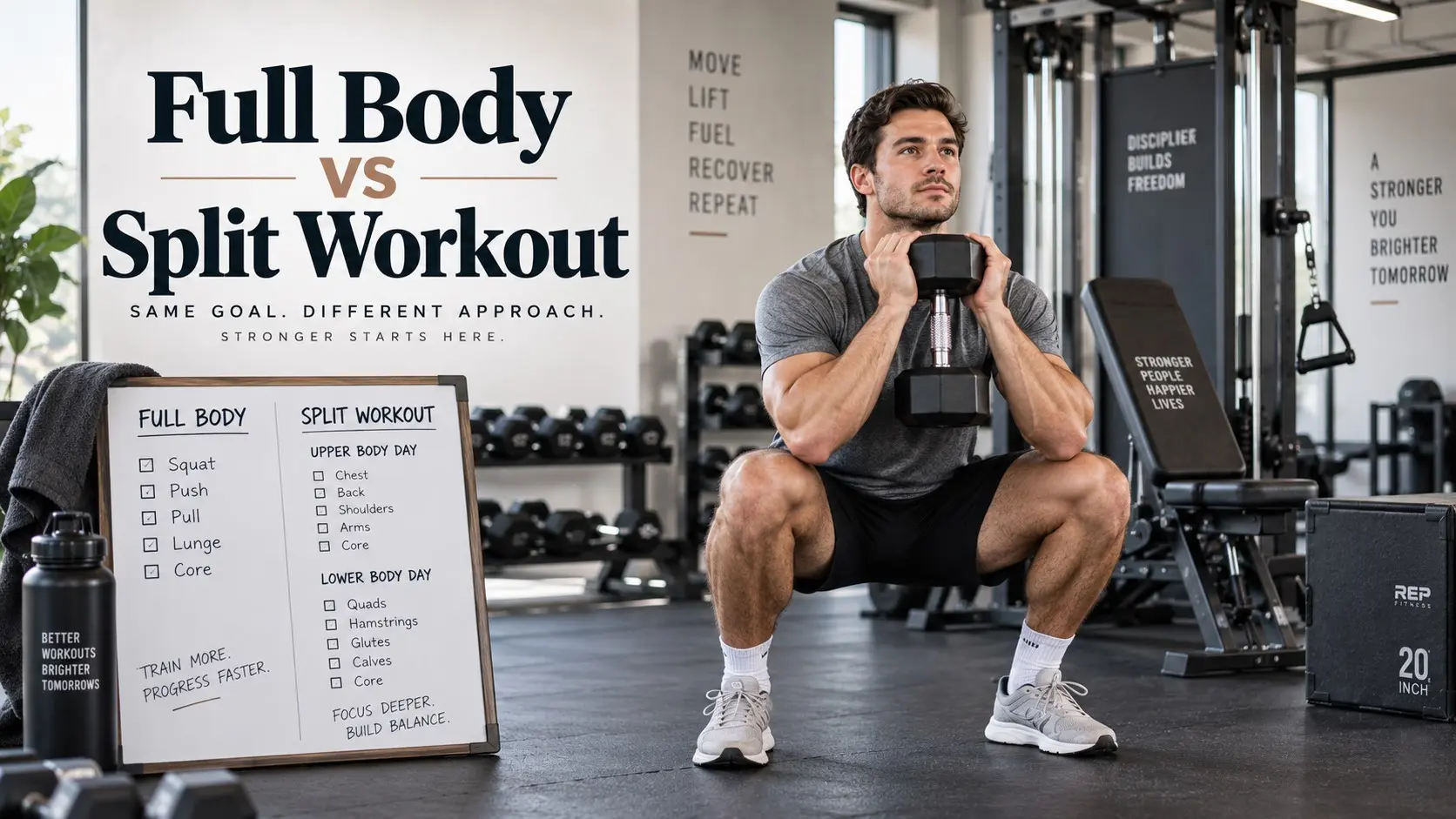
A full body routine trains most major muscle groups in the same workout.
A split routine spreads them across different days.
That is the basic difference.
A training split tells you how the week's work is organized.
It does not tell you how effective the program is.
For more beginner movement guidance, start with How to Get Fit Fast: Safe Beginner Fitness Guide.
Full Body vs Split Workout at a Glance
| Factor | Full Body | Split Workout | Beginner Verdict |
|---|---|---|---|
| Training days | Works well with 2 or 3 days | Usually easier with 4 or more days | Full body |
| Movement practice | Major patterns appear several times weekly | Some lifts may appear less often | Full body |
| Weekly volume | Spread across whole body sessions | Easier to place more sets in one muscle focused session | Either |
| Missed workout | Usually less disruptive | Can remove one body area's planned session | Full body |
| Session focus | Many body areas in one workout | Fewer body areas per workout | Personal preference |
| Strength potential | Excellent | Excellent | Similar when programming is matched |
| Muscle growth potential | Excellent | Excellent | Similar when volume is matched |
| Program complexity | Usually simple | Can become more complex | Full body |
What Does the Research Say?
This is where the debate gets easier.
A 2024 systematic review and meta analysis compared full body and split resistance training.
It included 14 studies and 392 adults.
Researchers compared strength changes and muscle growth.
When weekly training volume was matched, full body and split routines produced similar results.
Bench press strength was similar.
Lower body strength was similar.
Muscle growth was similar.
Lean body mass changes were similar.
So I would not tell a beginner that one split is physiologically superior simply because of its name.
The 2026 American College of Sports Medicine position stand strengthens that practical message.
It reviewed 137 systematic reviews involving more than 30,000 participants.
The broad lesson is simple.
Resistance training works.
Consistency matters.
Progressive resistance matters.
Complicated programming is not required for the average healthy adult.
The Evidence in One Table
| Evidence | Main Finding | Practical Meaning |
|---|---|---|
| 2024 full body versus split meta-analysis | Similar strength and muscle growth when weekly volume was matched | The routine name is not the primary driver |
| 2026 ACSM position stand | Progressive resistance training improves strength, muscle size, and physical function | Consistency and suitable progression matter more than complexity |
| 2026 volume and frequency meta-regression | Higher weekly set volume improved strength and muscle growth with diminishing returns | How much quality work you perform matters |
| 2023 network meta analysis | Many resistance training prescriptions improved strength and hypertrophy | There is more than one effective way to train |
Rule 1: Choose Your Real Number of Training Days First
Do not build your program around the week you wish you had.
Build it around the week you actually live.
If you can reliably train two days, full body makes sense.
Three days?
I still prefer full body for most beginners.
If you have four dependable training days, an upper lower split becomes very attractive.
Five or six days creates even more options.
But more days are not automatically better.
CDC currently recommends muscle strengthening activity on at least two days per week for adults.
The 2026 ACSM position stand also supports training major muscle groups at least twice weekly when the goal includes improving strength.
Which Schedule Fits Your Week?
| Available Days | Simple Structure | Why It Fits |
|---|---|---|
| 2 days | Full body | Each workout covers the major muscle groups |
| 3 days | Full body | Good movement practice with recovery days between sessions |
| 4 days | Upper lower | Allows more focused work without very long sessions |
| 5 days | Upper lower plus a focused day, or another split | Useful when extra training days are genuinely sustainable |
| 6 days | Push pull legs or another distributed split | Can spread larger weekly workloads across shorter sessions |
Rule 2: Weekly Volume Matters More Than the Split Name
This is the biggest concept to understand.
Training volume describes how much training work you perform.
A workout split only tells you when that work happens.
Two people can both say they use an upper lower routine while doing very different amounts of work.
One may perform a few challenging sets for each muscle.
The other may perform far more.
They should not expect identical results simply because their calendars have the same labels.
The 2026 meta regression involving 67 studies and 2,058 participants found that higher weekly set volume was associated with greater strength and muscle growth.
The benefit showed diminishing returns.
That last point matters.
More work can help.
Endless work is not required.
Rule 3: Use Frequency to Spread Good Training Across the Week
Training frequency means how often you train a muscle or movement.
Full body routines make higher frequency easy.
You might squat or perform another knee dominant movement several times across a week.
That repeated practice is useful for a beginner learning technique.
The newer 2026 evidence suggests training frequency has little independent effect on muscle growth when other programming variables are considered.
For strength, greater frequency showed a positive relationship, but the benefit became smaller as frequency increased.
I would not interpret that as permission to train every lift every day.
Use frequency to distribute your workload and improve practice quality.
Do not turn frequency into a contest.
Rule 4: Progress the Work Instead of Chasing Soreness
A beginner does not need a different workout every week.
You need a few movements that you can learn and progress.
That is progressive overload.
Progress can mean:
- Using slightly more resistance
- Completing another controlled repetition
- Improving range of motion
- Using better technique with the same load
- Adding a set when more volume is appropriate
Soreness is not the goal.
Progress is.
A body part split can create a huge pump and a lot of soreness because one muscle gets many exercises in one session.
That does not prove the workout produced better long term results.
Rule 5: Full Body Works Because It Is Forgiving
This is the practical advantage I think gets underestimated.
Imagine your plan is full body on Monday, Wednesday, and Friday.
Wednesday disappears because work goes badly.
You still trained your whole body Monday.
You can train it again Friday.
Now imagine Wednesday is your only planned leg session.
If you miss it and do not rearrange the week, your lower body training may disappear with it.
This is not physiology.
It is schedule design.
But schedule design determines whether the physiology ever gets a chance to work.
Rule 6: Do Not Pick a Split for Fat Loss
The phrase full body vs split workout for fat loss gets searched because people want the routine that burns more fat.
The evidence is not strong enough to crown a winner.
A 2024 randomized study in 23 well trained men found more fat loss with a very high volume full body program compared with a split routine.
The men trained five days each week.
They performed 75 total weekly sets.
That is not a beginner program.
Another 2024 study in untrained men did not find a meaningful fat mass advantage for full body over split training.
I would not choose a beginner training structure based on one small fat loss study.
Resistance training supports body composition.
Fat loss still depends heavily on the broader energy balance, food habits, activity, sleep, and consistency.
For the wider weight loss picture, use the Weight Loss and Metabolism Guide.
Rule 7: Switch to a Split When It Solves a Real Problem
Do not switch because the split sounds more advanced.
Switch because it improves the program.
A split becomes useful when:
- Your full body sessions are becoming too long
- You need more weekly training volume
- You want more focused work for specific muscle groups
- You reliably have four or more training days available
- Fatigue from training many large muscle groups in one session is reducing exercise quality
- You simply enjoy another structure more and can follow it consistently
An upper lower routine is often the first split I would consider.
It is easy to understand.
It still gives each broad body area frequent practice.
Does Full Body Build More Strength for Beginners?
Not simply because it is full body.
The direct 2024 comparison does not show a universal strength advantage.
But full body has one useful beginner feature.
You practice important movement patterns frequently.
Strength is partly a skill.
A squat becomes easier to perform well when you have repeated opportunities to practice it.
The 2023 network meta analysis included 178 studies in its strength network.
Many forms of resistance training increased strength.
Higher training loads ranked well for maximal strength.
The 2026 ACSM position stand similarly found that heavier loads support greater maximal strength gains.
This does not mean a beginner should test maximum lifts.
Technique comes first.
Use resistance that challenges you while allowing controlled repetitions.
Does a Split Build More Muscle?
No automatic advantage exists.
Muscle growth is also called hypertrophy.
The 2024 full body versus split analysis found similar hypertrophy when volume was matched.
The 2026 ACSM evidence review found higher weekly volume was one factor that supported greater muscle growth.
So if two programs provide similar quality weekly work and both progress over time, either can build muscle.
A split becomes useful when it makes that work easier to distribute.
A Simple Three Day Full Body Plan for Beginners
You do not need twenty exercises.
Start with movement patterns you can learn.
| Day | Exercise | Example Sets | Example Repetitions |
|---|---|---|---|
| Monday | Goblet squat | 2 | 6 to 10 |
| Monday | Dumbbell bench press or push-up | 2 | 6 to 12 |
| Monday | Cable row or dumbbell row | 2 | 8 to 12 |
| Monday | Romanian deadlift | 2 | 6 to 10 |
| Monday | Plank or farmer carry | 2 | Controlled effort |
| Wednesday | Split squat | 2 | 6 to 10 each side |
| Wednesday | Dumbbell overhead press | 2 | 6 to 12 |
| Wednesday | Lat pulldown | 2 | 8 to 12 |
| Wednesday | Hip thrust or glute bridge | 2 | 8 to 12 |
| Wednesday | Dead bug or carry | 2 | Controlled effort |
| Friday | Repeat Monday, then use the Wednesday plan first the following week | ||
If you prefer training at home, see Strength Training Exercises at Home for Beginners.
You can also use the Home Workouts and Equipment Guide for dumbbells, resistance bands, bodyweight training, and home setup ideas.
How Many Sets Should a Beginner Start With?
I would start lower than most social media programs suggest.
Two controlled work sets for many exercises can be enough to learn the routine.
You can add work later.
The 2026 ACSM position stand found strength was enhanced with two or three sets in many contexts.
For muscle growth, higher weekly volume can provide more growth, but returns diminish.
A beginner does not need to begin at the amount of work an experienced lifter has built up to over years.
How Hard Should the Sets Feel?
Your repetitions should require effort.
But a beginner does not need every set to end in complete muscular failure.
The 2026 ACSM position stand found that training to momentary muscle fatigue did not consistently improve outcomes for the average healthy adult.
Leave enough control to maintain form.
If the final repetitions turn into twisting, bouncing, or uncontrolled movement, the set has gone too far for the purpose of learning good technique.
How Should Progressive Overload Work?
Keep it simple.
Suppose you use two sets of eight repetitions for a dumbbell press.
Next time you may complete nine controlled repetitions.
Later you reach ten.
Once the current resistance feels manageable across your chosen range, add a small amount of weight and build again.
You do not need to change exercises every week.
You need enough stability to know whether you are actually getting stronger.
What If You Can Only Train Two Days?
Train full body twice.
Two consistent sessions beat a five day split that regularly collapses after one busy week.
CDC recommends at least two days of muscle strengthening activity for adults.
The major muscle groups should be included.
You can absolutely make progress with two well designed sessions.
What If You Can Train Four Days?
This is where I like an upper lower split.
For example:
- Monday: upper body
- Tuesday: lower body
- Thursday: upper body
- Friday: lower body
You still train each broad area twice weekly.
But you have more room for exercises.
Sessions can remain focused instead of becoming extremely long.
What About Push Pull Legs?
Push pull legs can work.
Push day trains movements such as presses.
Pull day trains rows, pulldowns, and similar movements.
Leg day focuses on lower body work.
I would use it when the person genuinely wants more weekly training days.
I would not choose it simply because it looks like a serious lifter's program.
Why I Usually Prefer Upper Lower Before a Body Part Split
A traditional body part split can dedicate one day to chest, another to back, another to legs, and so on.
That can work.
But most beginners do not need an entire training session devoted to one body part.
Upper lower keeps the program simple.
It distributes work well.
And it makes frequent practice easy.
Full Body Workouts Are Not Automatically Short
A full body workout can be efficient.
It can also become ridiculous.
If you do four chest exercises, four leg exercises, three back exercises, shoulders, arms, calves, abs, and cardio, you did not create an efficient beginner workout.
You created a very long afternoon.
Exercise selection matters.
Pick movements that cover the major patterns without unnecessary duplication.
Split Workouts Are Not Only for Advanced Lifters
A beginner is allowed to use a split.
There is no rule against it.
The question is whether the structure solves a problem.
If someone loves four shorter gym sessions and hates long full body workouts, upper lower may improve adherence from day one.
That matters.
The best program on paper does nothing if you repeatedly avoid it.
The Missed Workout Test
This is one of my favorite practical tests.
Imagine one training day disappears every second week.
What happens?
If the whole program breaks because one workout vanished, your schedule is fragile.
A full body plan usually handles missed sessions well.
That is a real advantage for beginners with work, family, study, travel, or unpredictable schedules.
Recovery Matters More Than Adding Another Gym Day
Recovery is part of the training plan.
Your strength work creates the stimulus.
Adaptation happens over time.
Pay attention to:
- Sleep
- Persistent soreness
- Joint comfort
- Performance
- Motivation
- Whether loads or repetitions are improving
Muscle soreness after a new exercise does not automatically mean something is wrong.
Sharp or severe pain is different.
Stop exercises that cause sharp pain and seek appropriate assessment when pain persists.
Nutrition Still Matters for Strength and Muscle
A good workout plan cannot replace food and recovery.
You need enough food to support your goal.
Protein matters for muscle repair and adaptation.
Carbohydrate can support training performance.
Fruit and vegetables support overall nutrition.
Hydration matters too.
Use Healthy Fitness Foods for practical meal ideas around an active lifestyle.
Common Full Body vs Split Workout Mistakes
Mistake 1: Thinking Full Body Automatically Builds More Strength
The research does not show a universal advantage when weekly volume is matched.
Mistake 2: Thinking Splits Automatically Build More Muscle
They do not.
A split is a way to distribute work.
Mistake 3: Copying an Advanced Lifter
You see their current routine.
You do not see the years that came before it.
Mistake 4: Adding Too Much Volume Too Soon
Start with enough work to improve.
Add more when it becomes useful.
Mistake 5: Changing the Program Every Week
You need enough repetition to learn exercises and measure progress.
Mistake 6: Judging a Workout by Soreness
Soreness is not the same as progress.
Mistake 7: Choosing a Routine for Fat Loss Alone
No training split is a special fat-burning switch.
How to Know Your Program Is Working
| Progress Measure | What Improvement Looks Like |
|---|---|
| Technique | Exercises feel more controlled and repeatable |
| Repetitions | You perform more good repetitions with the same resistance |
| Resistance | You gradually use a heavier load while keeping control |
| Consistency | You complete most planned sessions |
| Recovery | You recover between sessions without persistent excessive fatigue |
| Confidence | Setup, breathing, and exercise execution feel less confusing |
My Practical Beginner Recommendation
If you can train two days, use full body.
If you can train three days, full body is still my first choice.
If you can reliably train four days, consider upper lower.
If you genuinely enjoy five or six shorter sessions, a split can distribute the work well.
Then stop worrying about the label.
Track your training.
Use controlled technique.
Add resistance or repetitions gradually.
Recover.
Repeat.
That is where the results come from.
Conclusion
The Full Body vs Split Workout debate sounds more complicated than it needs to be.
Both structures can build strength and muscle.
The best current evidence does not show a meaningful universal advantage when weekly volume is matched.
For beginners, I still prefer full body on two or three weekly training days because it is simple, flexible, and gives you repeated practice of important movements.
Your next step: choose the two or three training days you can genuinely protect next week. Build a simple full body plan around those days and keep it long enough to measure progress.
References and Sources
- American College of Sports Medicine. Resistance Training Prescription for Muscle Function, Hypertrophy, and Physical Performance in Healthy Adults. 2026.This updated ACSM position stand synthesized 137 systematic reviews involving more than 30,000 participants and provides current resistance training recommendations.Read the 2026 ACSM Position Stand
- Ramos Campo DJ and colleagues. Efficacy of Split Versus Full Body Resistance Training on Strength and Muscle Growth. 2024.This systematic review and meta analysis included 14 studies and 392 participants and found similar strength and muscle growth when volume was matched.Read the Full Body Versus Split Meta-Analysis
- Pelland JC and colleagues. The Resistance Training Dose Response: Weekly Volume and Frequency. 2026.This meta regression included 67 studies and 2,058 participants and examined how weekly volume and frequency relate to strength and muscle growth.Read the 2026 Volume and Frequency Meta Analysis
- Currier BS and colleagues. Resistance Training Prescription for Muscle Strength and Hypertrophy in Healthy Adults. 2023.This network meta analysis found that many resistance training prescriptions improve strength and hypertrophy, with heavier loads ranking well for maximal strength.Read the Resistance Training Network Meta Analysis
- Centers for Disease Control and Prevention. Adult Physical Activity Guidelines.CDC recommends adults perform muscle strengthening activity involving the major muscle groups on at least two days each week.Read the CDC Adult Activity Guidelines
Continue Reading on NextFitLife
- Safe Beginner Fitness GuideBuild a realistic beginner routine using walking, strength training, cardio, mobility, sleep, and recovery.
- Strength Training Exercises at Home for BeginnersStart resistance training using bodyweight, dumbbells, and simple home exercises.
- Home Workouts and Equipment GuideExplore bodyweight training, dumbbells, resistance bands, kettlebells, home setup, and beginner workout options.
- Leg Exercises With DumbbellsLearn controlled squats, Romanian deadlifts, lunges, step ups, glute work, and beginner lower body progression.
- Healthy Fitness FoodsSupport training with practical protein foods, carbohydrates, fruit, vegetables, healthy fats, and recovery nutrition.
- Weight Loss and Metabolism GuideUnderstand how food habits, activity, strength training, sleep, and overall energy balance affect body composition.
Fitness hub: Use the NextFitLife Home Workouts and Equipment Guide as a starting point for beginner training, home workouts, strength exercises, dumbbells, resistance bands, and practical workout planning.
About the Author
Adel Galal is the Founder and Lead Writer at NextFitLife.
Adel has maintained a personal interest in health, fitness, nutrition, sleep, wellness, and healthy aging for more than 30 years.
His health and wellness writing and research communication experience spans more than 15 years.
NextFitLife launched in January 2022.
His role is to research health and fitness topics, compare current scientific and public health sources, identify limitations, and turn technical evidence into practical language for everyday readers.
For resistance training topics, he separates what research directly shows from programming judgment. In this article, the evidence does not prove that full body training is physiologically superior to split routines. The recommendation for most beginners to start with full body training is based on simplicity, repeated movement practice, schedule flexibility, and the ability to train the major muscle groups with fewer weekly sessions.
Adel is not a doctor, dermatologist, physical therapist, registered dietitian, certified athletic trainer, sports medicine physician, certified personal trainer, strength and conditioning coach, or other licensed healthcare professional.
This article provides general education only. It does not diagnose injuries, prescribe a personal exercise program, replace physical therapy, or tell you to exercise through pain or medical symptoms.
Learn more about Adel Galal, NextFitLife, and the site's editorial standards on the About Us page.
Frequently Asked Questions
Is full body or split workout better for beginners?
For most beginners training two or three days per week, full body is the simpler starting point. Research does not show that full body is automatically better for strength or muscle growth when weekly training volume is matched.
Does full body training build more strength?
Not automatically. Full body and split routines can both build strength. Beginners may benefit from the repeated movement practice that a full body schedule naturally provides.
Does a split workout build more muscle?
No automatic advantage exists. A 2024 meta analysis found similar muscle growth between split and full body routines when weekly volume was matched.
How many days should beginners strength train?
Two or three weekly strength sessions are a practical starting point for many beginners. CDC recommends muscle strengthening activity on at least two days per week for adults.
Is three day full body training enough?
Yes. Three well designed full body workouts can provide frequent practice and enough weekly training for a beginner to make progress.
Can I build muscle training only two days per week?
Yes. A well designed two day program can build strength and muscle, especially for a beginner. Progress depends on sufficient challenge, weekly training volume, nutrition, and consistency.
When should I switch from full body to a split?
Consider switching when full-body sessions become too long, you need more weekly volume, you want more focused work, or you consistently have four or more training days available.
Is upper lower good for beginners?
Yes. An upper lower split is a simple option for beginners who can reliably train four days per week.
Is push pull legs good for beginners?
It can work, especially for someone who enjoys more weekly gym sessions. It is not required to build strength or muscle.
Is full body better for fat loss?
The evidence is not strong enough to declare full body the universal winner for fat loss. Body fat change depends heavily on the overall training plan, food intake, activity, sleep, and energy balance.
Should I train every muscle three times per week?
You do not have to. Higher frequency can help distribute training and provide movement practice, but muscle growth depends more strongly on total quality weekly training volume.
How many sets should a beginner perform?
There is no universal number. Starting with about two controlled work sets for many exercises can keep the program manageable. More volume can be added as technique and recovery improve.
Should beginners train to failure?
It is not necessary to take every set to complete muscular failure. Beginners should prioritize controlled repetitions, good form, suitable effort, and gradual progression.
What is progressive overload?
Progressive overload means gradually increasing the training challenge over time. This can include more resistance, more controlled repetitions, improved range of motion, better technique, or additional training volume when appropriate.
What matters more than the workout split?
Consistency, weekly training volume, suitable resistance, exercise technique, progressive overload, recovery, and nutrition matter more than whether the calendar says full body or split.
Can I do full body workouts at home?
Yes. Squats, split squats, push ups, dumbbell presses, rows, Romanian deadlifts, glute bridges, resistance band exercises, and carries can form a practical home full body routine.
How long should I follow a beginner workout before changing it?
Keep the main structure long enough to learn the movements and measure progress. Change exercises when there is a reason, such as discomfort, equipment limits, stalled progression, or a new goal, rather than changing the whole routine every week.

Health & wellness writer with 30+ years of experience in nutrition, fitness, and healthy aging. Founder of NextFitLife.com — evidence-based health guidance.