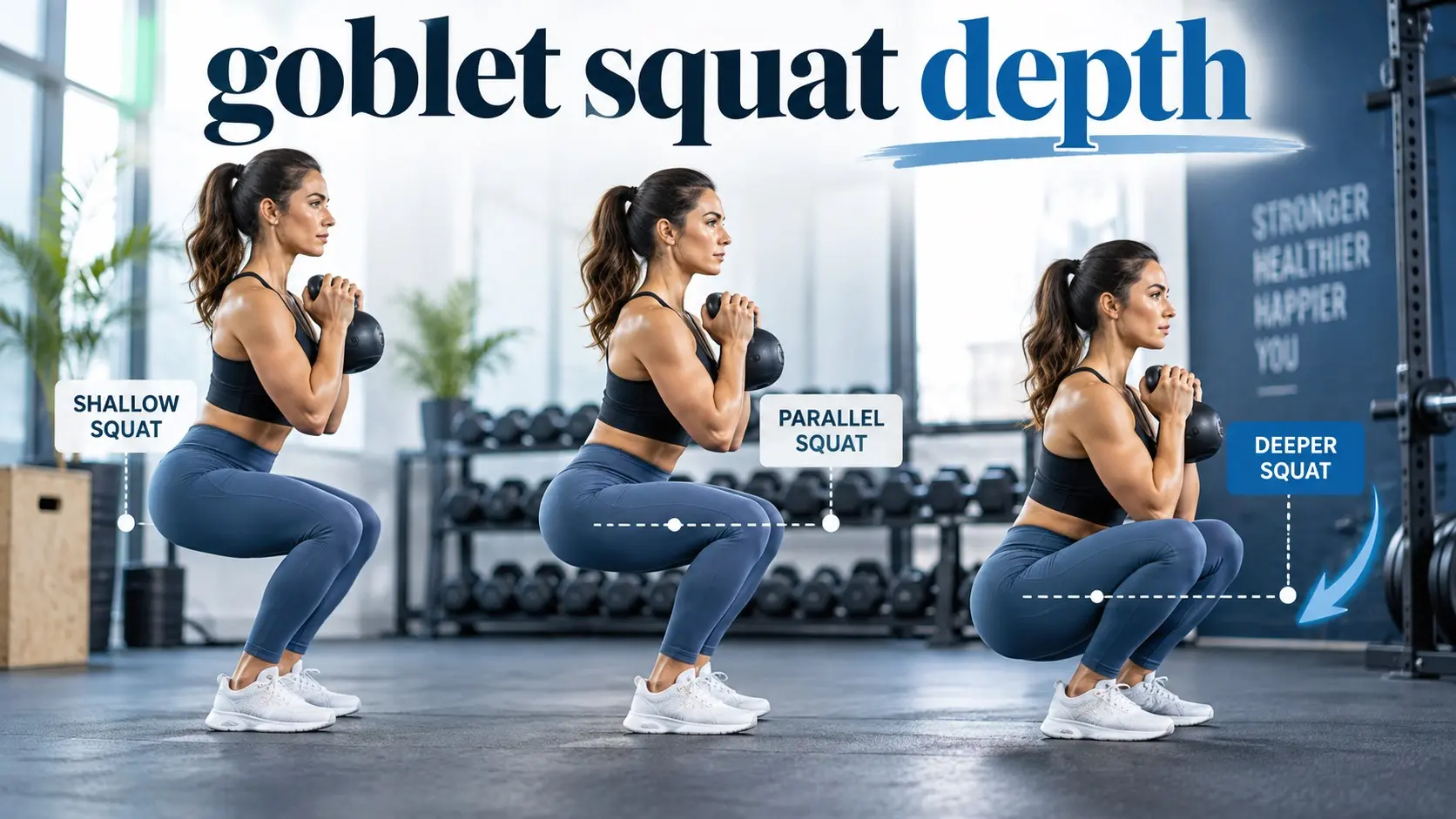
First published: September 28, 2026
Last updated: September 28, 2026
Written and source checked by: Adel Galal, Founder and Lead Writer at NextFitLife
Medical review status: This article has not been medically reviewed by a doctor, physical therapist, sports medicine specialist, or certified strength professional.
How low should you go in a goblet squat?
The best goblet squat depth is the deepest position you can control with stable feet, comfortable knee tracking, the weight close to your chest, and no sharp pain. Parallel is only a reference point. Some people can squat deeper safely, while others should stop higher because of mobility, anatomy, load, or symptoms.
Quick answer: You do not need to stop automatically when your thighs reach parallel. Go lower if your feet remain stable, your knees and hips move comfortably, your trunk stays controlled, and the deeper range feels good. Stop higher if your heels lift, balance disappears, pain starts, or your position changes sharply.
The part most people miss is that squat depth is not controlled by one joint.
Your ankles, hips, knees, stance, body proportions, balance, external load, strength, and training history all play a role.
If you need the complete setup before focusing on depth, start with our complete Goblet Squat form guide. It covers the full movement, weight position, foot pressure, knee tracking, common mistakes, and progression.
Medical notice: This content is for general educational purposes and does not replace professional medical advice, diagnosis, or treatment. Consult an appropriately qualified healthcare professional for personal medical concerns. This article explains published guidance and does not provide a personal clinical assessment. Always consult qualified medical professionals for diagnosis and treatment of any health condition.
Table of Contents
- What goblet squat depth means
- Why the goblet position helps you squat lower
- Nine smart rules for choosing depth
- Parallel versus below parallel
- Ankle mobility and heel lift
- Hip anatomy and stance
- Knees over toes
- Butt wink and pelvic movement
- Heel elevation
- Deep versus shallow squats
- Muscle growth and strength
- Knee safety
- When a box helps
- How to test your best depth
- When to stop going lower
- Common depth mistakes
- References and Sources
- Related NextFitLife guides
- About the author
- Frequently asked questions
What Does Goblet Squat Depth Actually Mean?
Squat depth describes how far you lower your hips and how much your hips, knees, and ankles bend during the movement.
You will often hear three simple descriptions:
- Shallow squat: hips stay well above knee level
- Parallel squat: thighs are around parallel with the floor
- Deep squat: hips move below the level of the knees
Those labels are useful for conversation, but they do not tell you whether a squat is good or bad.
Researchers often describe depth with joint angles rather than visual labels. A 2024 biomechanical review grouped shallow squats at roughly 0 to 90 degrees of knee flexion, medium depth around 90 to 110 degrees, and deep squats around 110 to 135 degrees.
You do not need to measure those angles in your workout.
The useful question is whether you own the range you are using.
Why Does the Goblet Squat Often Let You Go Deeper?
The weight sits in front of your chest.
That matters because the load acts as a counterbalance.
NASM describes the goblet squat as a useful teaching exercise because the front held load helps many people stay more upright and reach a deeper position than they can during an unloaded squat.
The weight is not fixing your ankle or hip mobility. It is changing your balance.
That distinction matters.
If a light goblet squat feels easier to balance than a bodyweight squat, that does not mean anything is wrong with your bodyweight squat. The front load simply moves the combined center of mass.
9 Smart Rules for Choosing Goblet Squat Depth
1. Use Control, Not Parallel, as Your Main Stopping Rule
Parallel is easy to see, so coaches use it as a reference.
It is not a universal stopping point.
If you reach parallel and can continue lower while keeping your feet stable, your load close, and your movement comfortable, going deeper is reasonable.
If your technique changes badly before parallel, stop earlier.
A controlled shallow squat is more useful than a deep squat you cannot manage.
2. Keep Your Whole Foot Stable
Your feet give you one of the clearest clues about depth.
A stable squat keeps contact through the heel and the front of the foot.
You can think about three points:
- The heel
- The base of the big toe
- The base of the little toe
If your heels suddenly rise when you cross a certain depth, do not ignore it.
That change may mean you have reached the current limit of your ankle motion, balance, or technique.
Do not force your heels down while continuing lower.
Find out why they are lifting.
3. Check Ankle Mobility if Your Heels Lift
Going deeper requires more forward movement of the shin.
This needs ankle dorsiflexion, which is the motion that lets your knee travel forward while your heel remains on the floor.
Research supports a link between ankle mobility and squat depth.
A study of 20 healthy adults found that squat depth was associated with ankle dorsiflexion measured in a weight bearing lunge test.
A separate study of 101 healthy adults also found ankle range to be one of the factors related to squat depth.
That does not mean every shallow squat is caused by tight ankles.
It means the ankle is one place worth checking.
A simple heel lift test
- Perform a bodyweight squat in your normal stance.
- Notice when your heels begin to lift.
- Repeat with your heels on a small stable wedge or weightlifting plate.
- Keep your stance and speed as similar as possible.
If the heel elevation lets you go clearly deeper and stay more upright, ankle demand was probably one part of your limit.
4. Give Your Hips Enough Room
Your hips also need room to flex as you descend.
People differ in:
- Femur length
- Pelvis shape
- Hip socket orientation
- Hip rotation
- Available hip flexion
That is why copying another person's stance can feel terrible.
If the bottom feels blocked or pinchy, try adjusting your stance before deciding that you simply cannot squat deep.
Test a slightly wider stance, a slightly narrower stance, or a small change in toe angle.
Change one thing at a time.
5. Let Your Knees Travel Forward Naturally
Your knees do not have to stay behind your toes.
Deeper squatting requires the knees to bend, and that usually brings some forward knee travel.
A 2024 review of deep squatting found no good evidence that normal knees moving beyond the toes during a full squat is inherently harmful in healthy people.
The better cue is simple:
Let your knees move naturally while they track in the same general direction as your toes.
Trying to force the shins vertical often makes the hips travel farther backward and the torso lean more.
That is a different squat strategy, not automatically a safer one.
6. Use a Lighter Weight When Testing More Depth
Mobility is not the only thing that limits depth.
Load changes the movement too.
You may squat comfortably below parallel with a light dumbbell but lose that range with a much heavier one.
That does not mean your mobility disappeared.
Your strength, balance, trunk control, and ability to keep the weight close are now under greater demand.
When testing a new depth, use a light enough load that technique rather than survival decides the result.
7. Use Heel Elevation as a Tool, Not a Requirement
A small heel wedge or weightlifting shoe can make deeper squatting easier.
It reduces the amount of ankle dorsiflexion needed for a given squat depth and usually allows more forward knee travel.
This can help you:
- Stay more upright
- Reach a deeper position
- Train with limited ankle motion
- Shift more of the movement toward the knees and quadriceps
Heel elevation is not cheating.
It is simply a change in mechanics.
It is also not the answer to every depth problem. If your limit is hip pain, poor balance, too much load, or loss of trunk control, lifting the heels may not fix it.
8. Go Deeper for a Reason, Not for a Photo
A deeper range can increase the movement demands at the hips and knees.
It can also expose your muscles to a larger range of motion.
A 2019 study followed 17 men who trained full or half squats for 10 weeks. Both groups increased quadriceps muscle volume, while full squats produced greater increases in gluteus maximus and adductor muscle volume.
That is useful evidence for squat depth.
But the study did not test goblet squats specifically.
We should not pretend it did.
The practical lesson is that larger controlled ranges can be useful for strength and muscle development, but depth still needs to match your body and training goal.
9. Stop When Symptoms Replace Training Effort
Muscle effort is expected.
A stretch sensation at the bottom can also be normal.
Sharp joint pain is different.
Reduce the depth or stop if you develop:
- Sharp knee pain
- A hard hip pinch
- Significant back pain
- Numbness or tingling
- Knee locking
- A feeling that the knee gives way
- A sudden loss of balance
- Pain that changes the way you walk afterward
Depth is supposed to improve training, not prove how flexible you are.
Is Parallel the Best Goblet Squat Depth?
Not automatically.
Parallel works well as a visible checkpoint because it is easy to coach.
For some people, it is also a useful strength range.
But there is no rule saying healthy lifters must stop there.
| Depth | Useful For | Main Consideration |
|---|---|---|
| Shallow | Beginners, rehabilitation, pain limited training, learning control | Less range does not automatically mean poor form |
| Around parallel | General strength and a clear coaching target | Useful reference, not a universal limit |
| Below parallel | Larger range, deeper hip and knee flexion, muscle development | Requires more mobility and control |
| Maximum comfortable depth | Mobility practice and full range training | Useful only if the position remains controlled |
Are Deep Goblet Squats Bad for Your Knees?
For healthy knees, current evidence does not support the idea that deep squats are automatically harmful.
A 2024 scoping review examined 15 studies on deep squatting and knee joint health. Fourteen of those studies did not find a harmful effect on knee joint health.
The authors concluded that deep squatting appears safe when technique, load, and training volume are appropriate.
That does not mean every knee should be trained deeply.
If you have:
- Recent knee surgery
- Persistent patellofemoral pain
- Significant osteoarthritis
- A meniscus injury
- A ligament injury
- Swelling
- Locking
- Repeated giving way
your training range may need to be adjusted.
The question changes from “Are deep squats safe?” to “What range fits this knee right now?”
Does Knee Stress Increase as You Squat Lower?
Knee demand changes with depth.
As the knee bends farther, muscle forces and joint forces change.
The 2024 biomechanical review reports that patellofemoral joint stress tends to increase from shallow toward medium depth, especially as knee flexion approaches about 90 degrees.
This matters for someone who already has patellofemoral pain.
It does not mean a healthy knee must avoid 90 degrees.
The same squat can be training for one person and rehabilitation for another.
Context matters.
What Is Butt Wink, and Should You Worry About It?
“Butt wink” is the gym term for the pelvis rotating backward near the bottom of a squat.
This usually comes with some change in the lower spine.
As hip flexion reaches its available limit, the pelvis can begin to rotate backward. The 2024 biomechanics review describes this relationship between deep hip flexion, pelvic motion, and lumbar movement.
A tiny amount of movement does not prove that you are injuring your back.
The more useful questions are:
- Does the movement happen suddenly?
- Does it become much larger under load?
- Do you lose control?
- Does it hurt?
If you see a large change at the bottom, test a slightly different stance or reduce depth a little.
Do not obsess over one frozen frame from a video.
Can Your Hip Anatomy Limit Goblet Squat Depth?
Yes.
Two people can have similar ankle mobility and strength yet still prefer different squat positions because their hips are built differently.
Available hip flexion and hip rotation affect how easily the thighs move toward the torso.
This is why one person may feel comfortable with a narrow stance while another needs more width and toe turn out.
You cannot stretch your way into someone else's bone structure.
What you can do is find the stance that gives your hips room to move.
Why Do Your Heels Lift at the Bottom?
Heel lift is common, but the cause is not always the same.
Possible reasons include:
- Limited ankle dorsiflexion
- Trying to squat beyond your current range
- A stance that does not suit your body
- Moving too quickly
- Shifting too far forward
- Using a load you cannot control
If a small heel wedge immediately improves your depth, ankle demand is probably part of the picture.
If nothing changes, look elsewhere.
Do not automatically spend months stretching your calves because somebody online diagnosed your ankles from one squat video.
Does a Wider Stance Help You Squat Deeper?
Sometimes.
A slightly wider stance can give the hips more room and reduce how much forward knee and ankle motion you need.
But going too wide can create a new problem if your hips or knees dislike the position.
Use this simple test:
- Perform three slow squats in your normal stance.
- Move each foot slightly wider.
- Repeat three squats.
- Compare comfort, heel contact, knee tracking, and depth.
If the wider position feels cleaner, keep it.
If it feels worse, do not force it.
Should You Turn Your Toes Out?
A small toe turn out is normal for many lifters.
Your knees should then travel in a similar direction.
The exact angle is not the goal.
The goal is to create a stance where your hips can descend comfortably and your knees stay controlled.
For the full setup, return to our Goblet Squat form guide.
Can Heel Elevated Goblet Squats Improve Depth?
Yes, for the right reason.
Raising the heels lets you reach a given depth with less ankle dorsiflexion.
It usually also lets the knees travel farther forward while the torso stays more upright.
This can make heel elevation useful when:
- Your ankle range limits depth
- You want a more quadriceps focused squat
- You are learning deeper squat positions
- You prefer a more upright torso
It is a variation, not a correction everyone needs.
Do Deeper Goblet Squats Build More Muscle?
There is some useful evidence from squat research, but we need to be accurate about what it proves.
In a 2019 study, 17 men trained full or half squats for 10 weeks.
Both groups increased knee extensor muscle volume.
The full squat group showed greater increases in gluteus maximus and adductor muscle volume.
This supports the idea that deeper controlled squatting can provide useful muscle stimulus across a larger range.
However, the study tested squat training, not goblet squats specifically.
Your goblet squat still needs enough load and effort to challenge the muscles.
An ultra deep squat with a weight that is far too light is not automatically better than a slightly shallower squat that provides a useful training stimulus.
Can Deeper Squats Make You Stronger?
You get strong in the ranges you train.
The same 2019 study found that people who trained full squats improved full squat strength more than those who trained half squats.
That is a straightforward example of training specificity.
If you want strength through a deeper range, spend some training time in that range.
If your sport or daily activity needs only a certain range, you may also have reasons to train partial positions.
There is no need to turn depth into a competition.
When Should You Use a Box?
A box gives you a repeatable stopping point.
That makes it useful when you are:
- Learning the squat
- Returning from injury
- Managing symptoms
- Working on balance
- Trying to make every rep the same depth
Place a stable box or bench behind you.
Squat until you lightly touch it, then stand.
Do not collapse onto the box.
If the movement becomes easy and controlled, lower the target gradually if deeper training fits your goal.
How to Find Your Best Goblet Squat Depth in 5 Minutes
You do not need special equipment.
Step 1: Squat With Bodyweight
Perform five slow repetitions.
Notice the deepest position that still feels balanced.
Step 2: Add a Light Goblet Weight
Hold the load close to your chest and repeat.
The counterbalance may let you sit deeper with better balance.
Step 3: Watch Your Feet
Stop where your heels begin to lift or your feet roll sharply.
Step 4: Film One Rep From the Side
Look for a major change in balance, torso position, or pelvic control near the bottom.
Step 5: Test One Change
Choose only one:
- Wider stance
- Narrower stance
- Different toe angle
- Small heel elevation
- Lighter weight
- Higher box
Then repeat the squat.
Changing one variable lets you learn something. Changing all of them just gives you a different squat.
How Deep Should a Beginner Goblet Squat?
As deep as the beginner can control.
Being new does not mean you must stop above parallel.
Some beginners have excellent natural mobility and can squat deeply on day one.
Others need a box or a reduced range while they learn balance and strength.
NASM's current guidance takes the same approach: depth should reflect the person's anatomy, mobility, training history, and movement control rather than an arbitrary standard.
If you are new to strength training, see our Beginner Fitness Guide for a broader starting plan.
Should Older Adults Squat Deep?
Age alone does not set squat depth.
Strength, balance, mobility, joint health, medical conditions, and training history matter more.
An older adult who has trained for years may squat comfortably below parallel.
Someone with limited balance or painful joints may do better with a box and a smaller range.
Use the range that supports strength and confidence without creating unsafe symptoms.
When Is a Shallower Goblet Squat the Better Choice?
A shallower squat is not a failed squat.
It may be the better choice when:
- You are learning the movement
- You are returning after an injury
- Your balance changes near the bottom
- You are managing patellofemoral pain
- Your hip pinches at deeper flexion
- Your back loses control at the bottom
- You are intentionally training a partial range
You can always build more range later if the reason for limiting depth improves.
Common Goblet Squat Depth Mistakes
Forcing Depth Because “Deep Is Better”
Depth only helps if you control it.
Do not trade stable feet and comfortable joints for a lower photo.
Stopping at Parallel for No Reason
If you can comfortably squat deeper and your goal benefits from the larger range, parallel does not need to stop you.
Keeping the Knees Behind the Toes
This often limits depth and forces more movement toward the hips and trunk.
Let the knees travel naturally.
Ignoring Heel Lift
A tiny shift is one thing.
Repeatedly rising onto the toes while adding more weight is a sign to adjust the movement.
Assuming Every Problem Is Ankle Mobility
Your squat can also be limited by hip motion, stance, strength, balance, load, or symptoms.
Changing Everything at Once
If you change your shoes, stance, toe angle, weight, heel height, and tempo at the same time, you learn very little.
Change one variable and retest.
What Most Goblet Squat Depth Advice Gets Wrong
- Parallel is not a universal safe depth. It is simply an easy visual reference.
- Deeper is not automatically dangerous. Current evidence does not support that blanket claim for healthy knees.
- Deeper is not automatically better. Extra range matters only when it supports your goal and stays controlled.
- Knees can travel past the toes. Normal forward knee movement is part of many healthy deep squats.
- Ankle mobility matters, but it is not the only limit. Hip range, anatomy, balance, and load matter too.
- A heel wedge is not cheating. It changes ankle demand and squat mechanics.
- Butt wink is not an automatic injury diagnosis. Look at the amount, load, control, and symptoms.
- A shallow squat can still be useful. Rehabilitation and beginner training often use limited ranges on purpose.
- Most depth research is not goblet specific. Much of the evidence comes from general or barbell squat studies, so claims should stay within that limitation.
Conclusion
The best goblet squat depth is the deepest range you can control while keeping your feet stable, your knees moving comfortably, your load close, and your joints free from sharp pain.
Do not chase parallel because someone told you to stop there, and do not chase maximum depth because deeper looks more advanced. Your next step is to film a light set, test one change such as stance or heel elevation, and use the range your body can control today.
References and Sources
The squat depth, mobility, muscle growth, knee safety, and biomechanics information in this article was checked against current training guidance and peer reviewed research.
- National Academy of Sports Medicine.
The Goblet Squat: A Trainer's Coaching and Programming Guide.
Updated August 2026.
Used for goblet squat setup, front load mechanics, controlled depth, coaching, and progression.
URL:
https://www.nasm.org/resource-center/blog/training/how-to-perform-goblet-squats
- National Academy of Sports Medicine.
The Biomechanics of the Squat: What Personal Trainers Need to Know.
Used for individual anatomy, mobility, squat depth, stance, movement control, and progression principles.
URL:
https://www.nasm.org/resource-center/blog/training/biomechanics-of-the-squat
- Rojas Jaramillo A, et al.
Impact of the Deep Squat on Articular Knee Joint Structures, Friend or Enemy? A Scoping Review.
Frontiers in Sports and Active Living, 2024.
Used for deep squat knee safety and the review of 15 studies examining deep squat exposure and knee health.
URL:
https://pubmed.ncbi.nlm.nih.gov/39640505/
- Slater LV, Hart JM.
A Biomechanical Review of the Squat Exercise: Implications for Clinical Practice.
Used for squat depth, hip and knee mechanics, pelvic movement, patellofemoral stress, and clinical range considerations.
URL:
https://pmc.ncbi.nlm.nih.gov/articles/PMC10987311/
- Kubo K, Ikebukuro T, Yata H.
Effects of Squat Training With Different Depths on Lower Limb Muscle Volumes.
European Journal of Applied Physiology, 2019.
Used for full versus half squat training, strength, quadriceps, gluteus maximus, and adductor muscle changes.
URL:
https://pubmed.ncbi.nlm.nih.gov/31230110/
- Macrum E, et al.
Is There a Relationship Between Back Squat Depth, Ankle Flexibility, and Achilles Tendon Stiffness?
Used for the observed relationship between weight bearing ankle dorsiflexion and squat depth.
URL:
https://pubmed.ncbi.nlm.nih.gov/32022631/
- Kim SH, Kwon OY, Park KN, Jeon IC, Weon JH.
Lower Extremity Strength and the Range of Motion in Relation to Squat Depth.
Used for evidence linking ankle dorsiflexion, hip range, and other physical factors with squat depth.
URL:
https://pubmed.ncbi.nlm.nih.gov/25964810/
Continue With NextFitLife Goblet Squat and Fitness Guides
This article is a supporting guide for the main NextFitLife goblet squat resource. Use the parent guide first if you need the complete movement, then use this page when you want to understand depth in more detail.
Parent Goblet Squat Guide
Lower Body Strength
- Leg Exercises With Dumbbells: Safe Lower Body Strength Guide
- Hamstring Exercises for Strength and Flexibility
Core and Home Training
About the Author
Adel Galal is the founder and lead writer of NextFitLife. He researches and writes educational content about health, fitness, foods and nutrition, beauty, and healthy aging.
Adel has more than 15 years of health and wellness writing experience and has maintained a personal interest in health, fitness, nutrition, sleep, wellness, and healthy aging for more than 30 years. He is not a physician, physical therapist, certified personal trainer, or other licensed healthcare professional.
His approach is to compare common fitness advice with current evidence, make uncertainty clear, and turn technical training ideas into practical information readers can understand.
For squat depth, that means avoiding two extremes. Deep squats should not be labelled dangerous simply because they are deep, but extra range should not be forced when mobility, control, pain, or training goals suggest a different stopping point.
This content is for general educational purposes and does not replace professional medical advice, diagnosis, or treatment. Consult an appropriately qualified healthcare professional for personal medical concerns. This article explains published guidance and does not provide a personal clinical assessment. Always consult qualified medical professionals for diagnosis and treatment of any health condition.
Learn more about Adel Galal, NextFitLife, and the site's editorial standards on the NextFitLife About Us page.
Frequently Asked Questions About Goblet Squat Depth
How low should you go in a goblet squat?
Go as low as you can while keeping your whole foot stable, the weight close to your chest, your knees controlled, and your movement free from sharp pain. You do not need to stop automatically at parallel.
Should a goblet squat go below parallel?
It can. If you can move below parallel with stable feet, comfortable joints, and good control, the deeper range can be useful. Below parallel is not required for every person or every training goal.
Is parallel deep enough for a goblet squat?
Yes. Parallel can provide a useful training range. It is simply not a universal minimum or maximum. Choose depth based on your control, mobility, goal, and symptoms.
Are deep goblet squats bad for the knees?
Current research does not support the idea that deep squats are automatically harmful to healthy knees. Load, technique, training volume, existing injuries, and individual tolerance still matter.
Why do my heels lift when I squat deep?
Heel lift can result from limited ankle dorsiflexion, stance choice, excessive depth, balance problems, moving too quickly, or using more weight than you can control.
Does ankle mobility affect goblet squat depth?
Yes. Research has found a relationship between ankle dorsiflexion and squat depth. However, ankle mobility is only one factor. Hip motion, anatomy, stance, balance, strength, and load also affect depth.
Does hip anatomy affect squat depth?
Yes. Differences in hip structure, femur length, pelvis shape, hip rotation, and available hip flexion can change the stance and depth that feel comfortable.
Should my knees go past my toes in a deep goblet squat?
They can. Forward knee travel is normal during many deep squats. Keep your feet stable and let your knees track in the same general direction as your toes rather than forcing them to stay behind the toes.
Does elevating the heels help squat depth?
Yes. A small heel elevation reduces the ankle dorsiflexion needed for a given depth and can allow more forward knee travel and a more upright torso.
Is heel elevation cheating?
No. It changes the mechanics of the squat. Weightlifting shoes and heel wedges are training tools, not shortcuts.
What is butt wink?
Butt wink is the common term for backward pelvic rotation near the bottom of a squat. Some pelvic movement is normal. Large or sudden movement under load, especially with pain, deserves more attention.
Do deeper squats build more glute muscle?
A 2019 study found greater gluteus maximus and adductor growth after full squat training compared with half squat training. The study used squat training rather than goblet squats specifically, so the result should not be treated as a direct goblet squat trial.
Do deeper goblet squats build more quads?
Greater depth increases the range through which the quadriceps work, but deeper is not automatically better. Load, effort, total training volume, and progression also influence muscle growth.
Should beginners goblet squat below parallel?
Beginners can squat below parallel if they can control the position comfortably. Other beginners may need a higher box or reduced range while building strength, balance, and movement skill.
Can a box help improve goblet squat depth?
Yes. A box gives you a repeatable depth target. You can begin with a higher box and gradually lower it as your control and comfortable range improve.
When should I stop trying to squat deeper?
Stop increasing depth if you develop sharp joint pain, hip pinching, significant back pain, numbness, tingling, locking, giving way, uncontrolled balance loss, or symptoms that remain after training.

Health & wellness writer with 30+ years of experience in nutrition, fitness, and healthy aging. Founder of NextFitLife.com — evidence-based health guidance.