First published: September 28, 2026
Last updated: September 28, 2026
Written and source -checked by: Adel Galal, Founder and Lead Writer at NextFitLife
Medical review status: This article has not been medically reviewed by a doctor, physical therapist, sports medicine specialist, or certified strength professional.
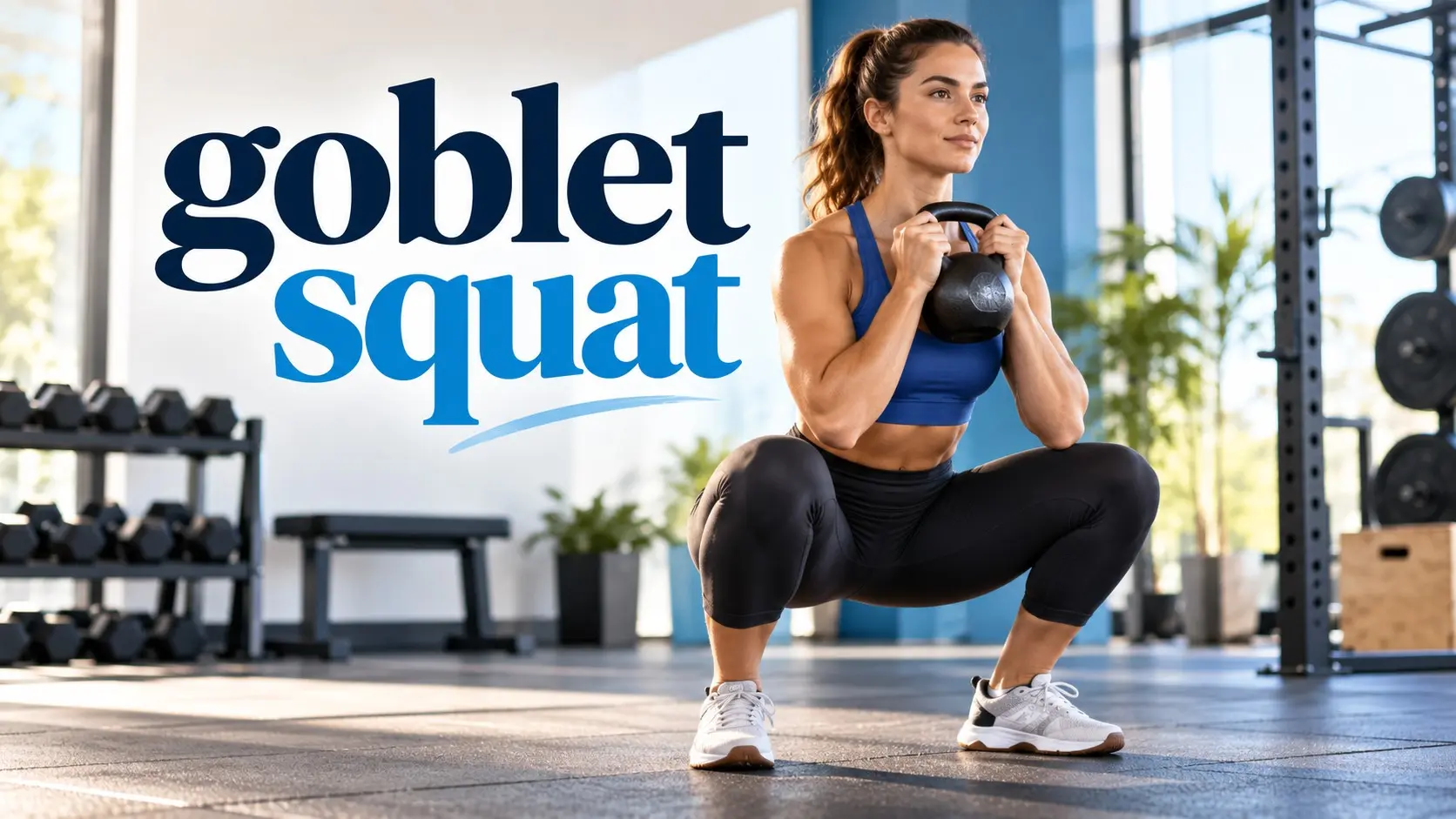
The goblet squat is one of the simplest ways to learn a loaded squat. You hold one dumbbell or kettlebell close to your chest, brace your trunk, bend at the hips and knees, lower as far as you can control, then stand back up.
Simple does not mean mindless.
Quick answer: A good goblet squat keeps the weight close to your chest, your whole foot stable, your knees tracking in the same general direction as your toes, and your spine controlled. Squat only as deep as you can maintain that position without sharp pain, then stand by pushing the floor away.
The front held weight acts as a counterbalance. That often helps beginners keep a more upright torso and reach a comfortable squat depth more easily than they can with a bodyweight or back loaded squat.
The catch is that the goblet squat is frequently taught with rules that are too rigid.
Your feet do not need to sit at one exact width. Your knees do not have to remain behind your toes. Your thighs do not have to reach the same depth as the person beside you.
Good form is a controlled movement that fits your body and your goal.
Medical notice: This content is for general educational purposes and does not replace professional medical advice, diagnosis, or treatment. Consult an appropriately qualified healthcare professional for personal medical concerns. This article explains published guidance and does not provide a personal clinical assessment. Always consult qualified medical professionals for diagnosis and treatment of any health condition.
Table of Contents
- What a goblet squat is
- 11 essential form checks
- Muscles worked
- Dumbbell versus kettlebell
- How deep you should squat
- Whether your knees can pass your toes
- Common mistakes
- Beginner programming
- How to choose the right weight
- How to progress
- Goblet squat versus bodyweight squat
- Goblet squat versus front squat
- Goblet squat versus back squat
- Useful variations
- Knee and back safety
- Weight loss and muscle building
- When to stop and get help
- References and Sources
- Related NextFitLife guides
- About the author
- Frequently asked questions
What Is a Goblet Squat?
A goblet squat is a front loaded squat performed while holding one weight close to your chest with both hands.
You can use:
- A dumbbell
- A kettlebell
- A medicine ball
- Another compact load you can hold safely
The name comes from the way the weight is held in front of the body, similar to holding a large goblet.
NASM describes the goblet squat as a fundamental compound lower body exercise that can help teach squat mechanics while developing lower body strength.
The position of the load matters.
Because the weight sits in front of you, it works as a counterbalance. This usually makes it easier to stay upright while sitting down into the squat.
That is why the goblet squat works well for beginners, but it is not only a beginner exercise.
It can also be used as:
- A lower body strength exercise
- A squat warm up
- A technique drill
- A higher repetition accessory exercise
- A bridge toward heavier front or back squats
If you want a larger collection of lower body exercises, see the NextFitLife Leg Exercises With Dumbbells Guide.
11 Essential Goblet Squat Form Checks
1. Pick a Weight You Can Actually Control
Your first goblet squat does not need to be heavy.
Use a weight that lets you learn the motion without fighting to keep the dumbbell or kettlebell in place.
NASM recommends scaling the exercise to the person's ability and choosing a load that preserves clean technique.
For a complete beginner, that might mean starting with:
- A bodyweight squat
- A squat to a chair
- A very light dumbbell
- A light kettlebell
If the weight pulls your upper body forward before your legs are tired, it is too heavy for useful technique practice.
2. Hold the Weight Close to Your Chest
Keep the load close.
With a dumbbell, hold one end vertically in both hands. With a kettlebell, hold the horns or another secure position that keeps the bell close to your chest.
Do not let the weight drift several inches forward.
The farther the load moves away from you, the harder your arms, shoulders, and trunk have to work to keep it from pulling you forward.
Your elbows can point down and stay relatively close to your body.
3. Start With a Comfortable Stance, Not a Magic Width
A useful starting position is around hip width to shoulder width.
Then adjust.
Some people squat better slightly wider. Others prefer a narrower stance.
Your hip anatomy, leg length, ankle motion, and training goal all influence what feels natural.
Your toes can point slightly outward if that lets your knees and hips move comfortably.
The goal is not to copy an exact foot angle from a fitness graphic.
4. Keep Your Whole Foot Stable
You will often hear “keep your weight on your heels.” That cue can help someone who is falling onto the toes, but it is not the whole story.
A strong squat keeps the foot connected to the floor.
Think about pressure through:
- The heel
- The base of the big toe
- The base of the little toe
This gives you a stable base without forcing you to rock backward onto your heels.
If your toes lift off the floor through the whole rep, you may be shifting too far back.
5. Brace Your Core Without Turning Into a Statue
Before you descend, create enough core bracing to keep your trunk controlled.
Your ribs and pelvis should feel stacked rather than flared apart.
Keep a comfortable neutral spine.
That does not mean your spine has to look perfectly vertical.
Some forward torso angle is normal in a squat. The goblet position usually reduces excessive forward lean, but body proportions still matter.
6. Bend the Hips and Knees Together
A squat is not just “sit your hips back.”
Your hips and knees both need to bend.
Start lowering your body by allowing your knees to move and your hips to descend between your legs.
If you push your hips far backward while trying to keep your shins vertical, the movement can turn into something closer to a hip hinge.
The goblet squat works best when your hips and knees share the work.
7. Let Your Knees Track With Your Toes
Your knees should move in roughly the same direction as your toes.
Do not force them outward as far as possible.
Do not let them collapse sharply inward either.
A simple cue is:
Keep your kneecaps moving over the middle part of your feet.
Individual knee position will still differ from person to person.
8. Lower With Control
Do not drop into the bottom position and hope your joints catch you.
Lower under control.
For learning, a descent of about two or three seconds can make it easier to notice whether:
- Your heels lift
- Your knees collapse
- The weight moves away from your chest
- Your lower back loses position
You do not need to use slow tempo forever.
It is simply a useful teaching tool.
9. Use the Deepest Position You Can Control
There is no rule saying every goblet squat must end with the thighs exactly parallel to the floor.
Your useful depth depends on:
- Your ankle motion
- Your hip structure
- Your current strength
- Your balance
- Your training goal
- Any symptoms or injury history
Go as deep as you can while keeping the foot stable, the load controlled, and the spine comfortable.
A deeper squat increases knee and hip demands. That can be useful for training, but more depth is not automatically better for every person.
10. Stand Up by Pushing the Floor Away
From the bottom, keep the weight close and drive through your whole foot.
Your hips and shoulders should rise together rather than your hips shooting upward first.
Keep your knees tracking with the feet.
Stand tall at the top, then finish the rep without aggressively leaning backward or forcing the hips far forward.
11. End the Set Before Technique Falls Apart
This is the form check people skip.
The final repetition should still look like a goblet squat.
Stop the set if:
- The weight keeps falling away from your chest
- Your heels repeatedly lift
- Your knees collapse suddenly
- Your back position changes dramatically
- You cannot stand without twisting
- You feel sharp or worsening pain
Fatigue is part of training.
Losing control is not a requirement.
What Muscles Does the Goblet Squat Work?
The main muscles are in the lower body.
Quadriceps
Your quadriceps straighten the knees as you stand.
A 2021 study comparing goblet and landmine squats at 30% of body mass found greater quadriceps activity and greater vertical forces in the goblet squat condition.
That study does not prove the goblet squat is always superior to every other squat. It does support its usefulness as a quad focused squat variation.
Glutes
Your glutes help extend the hips as you rise.
They work more as squat depth and hip demand increase.
Hamstrings and Adductors
The hamstrings contribute to lower body control, although a squat is not usually the best isolated hamstring exercise.
The adductors on the inner thigh also contribute to hip control and extension, especially through deeper squat positions.
For more direct posterior thigh training, see the NextFitLife Hamstring Exercises Guide.
Core and Upper Back
The weight in front of the body creates a trunk stability demand.
Your abdominal muscles, spinal stabilizers, lats, and upper back help you keep the load close and control your torso.
This does not turn the goblet squat into an ab exercise, but your trunk definitely has work to do.
For dedicated core training, visit the NextFitLife Core Workouts at Home Guide.
Dumbbell Goblet Squat or Kettlebell Goblet Squat?
Both work.
There is no good reason to declare one universally better.
| Option | Advantages | Possible Limitation |
|---|---|---|
| Dumbbell goblet squat | Common equipment, simple to hold vertically, easy to change loads | Heavy dumbbells can become awkward at the chest |
| Kettlebell goblet squat | Comfortable horn grip for many lifters, compact load | Available weight jumps can be large in some gyms |
Use the tool that lets you hold the weight securely and squat without fighting the grip.
How Deep Should a Goblet Squat Be?
As deep as you can control for the goal you are training.
That answer is less dramatic than “always below parallel,” but it is more useful.
Research on squat biomechanics shows that increasing squat depth changes joint demands. Greater depth generally increases knee extensor and hip extensor requirements.
That is not automatically dangerous.
It simply means depth is a training variable.
A beginner who loses balance below a chair height should not force a deep squat because a video says deeper is better.
A trained person with good mobility and no pain may comfortably squat well below parallel.
If you need a depth target, use a box or bench for feedback and gradually lower it as control improves.
Can Your Knees Pass Your Toes?
Yes.
The blanket rule that knees must never move past the toes is too simple.
A classic biomechanics study compared unrestricted squats with squats where forward knee movement was blocked. Restricting the knees reduced knee torque, but it greatly increased hip torque and caused more forward trunk lean.
The practical lesson is not “push your knees forward as far as possible.”
It is this:
Your knees can move forward naturally if your feet remain stable and the movement is controlled.
How far they travel depends on your proportions, ankle mobility, stance, and squat depth.
Should Your Knees Always Stay Out?
Another cue gets exaggerated here.
“Push your knees out” can help someone whose knees collapse inward under load.
But forcing the knees as far outward as possible is not the goal.
Your knees should track in a comfortable line with your toes.
Think alignment and control, not maximal outward pressure.
Why Do Your Heels Lift?
Common reasons include:
- Limited ankle dorsiflexion
- A stance that does not suit your body
- Dropping too quickly
- Trying to squat deeper than you can control
- Shifting your weight too far forward
Do not immediately assume your ankles are “tight.”
First try a slightly different stance and slower descent.
If heel lift remains a problem, a box squat or small heel elevation can help you train while you work on the underlying movement limitation.
Is a Heel Elevated Goblet Squat Better?
It is different, not universally better.
Elevating the heels reduces the ankle motion needed to reach a given depth and usually allows more forward knee travel.
This can make the squat feel more upright and more quad focused.
That extra knee motion also changes knee loading, so a heel elevated version is not automatically the correct choice for someone with knee pain.
Use it because it fits a specific training need, not because social media calls it the superior squat.
Seven Common Goblet Squat Mistakes
Holding the Weight Too Far Forward
Keep the load close to your torso.
A wandering dumbbell turns your arms into the weak link and makes it harder to control the trunk.
Trying to Keep the Shins Vertical
Allow normal knee movement.
Forcing your shins to remain perfectly vertical can make you lean farther forward and shift more demand toward the hips and back.
Going Deeper Than You Can Control
Depth is useful only while the movement remains stable.
Do not chase a floor level squat while your heels lift and your pelvis rolls under uncontrollably.
Letting the Knees Collapse
Keep the knees tracking in the same general direction as the toes during both the descent and ascent.
Rocking Onto the Toes
Maintain whole foot pressure.
Your heels should stay connected to the floor unless you are intentionally using a supported variation that changes the foot position.
Using the Arms to Hold an Unmanageable Weight
The goblet hold creates a natural loading limit.
If your arms, wrists, or upper back fail long before your legs, you may have reached the point where another squat variation is a better strength tool.
Holding Your Breath Without a Plan
You need trunk tension, but beginners do not need to turn every rep into an extreme breath holding contest.
Use a controlled breath and brace that keeps you stable.
If a medical condition affects blood pressure, breathing, or exercise tolerance, ask a qualified professional about appropriate lifting technique.
How Many Goblet Squats Should a Beginner Do?
There is no universal magic set and rep scheme.
NASM's updated coaching guide uses a common beginner prescription of about 3 sets of 10 to 15 repetitions with controlled technique.
That is a useful starting example, not a law.
A beginner could also start with:
- 2 sets of 8 reps
- 3 sets of 8 to 10 reps
- 2 or 3 sets of 10 to 15 reps with a lighter load
The right set ends when you are working hard but still in control.
How Often Should You Train Goblet Squats?
The goblet squat can be part of your lower body strength training on two or more days each week, depending on your complete program and recovery.
Current U.S. physical activity guidance recommends that adults perform muscle strengthening activity involving all major muscle groups on at least two days each week.
That does not mean you need goblet squats twice weekly specifically.
They are one useful way to train the lower body.
How Heavy Should a Goblet Squat Be?
Heavy enough to challenge you without changing the movement.
Ignore arbitrary rules such as “everyone should goblet squat half their body weight.”
Your useful load depends on:
- Your training experience
- Your body size
- Your equipment
- Your squat depth
- Your rep target
- Your grip and upper body strength
If you finish every set easily, increase the challenge.
You can add a small amount of weight, add repetitions within your planned range, slow the descent, add a pause, or progress to a harder squat variation.
That is progressive overload without turning every session into a maximal lift.
Where Does the Goblet Squat Hit a Loading Ceiling?
This is one area many beginner guides skip.
Your legs may eventually become strong enough to handle more load than you can comfortably hold at your chest.
The dumbbell becomes awkward.
Your forearms tire.
Your upper back starts working harder just to keep the weight in position.
At that point, you can still use goblet squats for warm ups, tempo work, pauses, or higher repetition training, but another squat may be better for adding substantial external load.
NASM describes this self limiting feature as one reason the goblet squat works well as a teaching tool.
Goblet Squat Versus Bodyweight Squat
A bodyweight squat removes the external load.
That makes it easier from a strength standpoint, but the goblet version has one interesting advantage: the front weight can act as a counterbalance.
Some people actually find it easier to reach a balanced squat position while holding a light weight.
Use bodyweight first if loading is the problem.
Use a light goblet hold if balance and torso control improve with the counterweight.
Goblet Squat Versus Front Squat
Both place the load in front of the body.
The main difference is how much load you can use and how you hold it.
| Feature | Goblet Squat | Barbell Front Squat |
|---|---|---|
| Equipment | One dumbbell or kettlebell | Barbell and usually a rack |
| Learning curve | Usually easier | More demanding rack position and setup |
| Loading potential | Limited by the goblet hold | Much higher for trained lifters |
| Best use | Teaching, general strength, home training, accessories | Heavier strength and performance training |
Goblet Squat Versus Back Squat
The back squat places the load across the upper back rather than in front of the chest.
That changes the mechanics and allows far greater loading for most experienced lifters.
The goblet squat is easier to set up and easier to abandon if a repetition goes wrong.
It also encourages a more upright posture for many people.
The back squat is usually the better long term choice when the main goal is developing maximal squat strength and the lifter has the skill and equipment to use it safely.
Neither exercise wins every category.
Useful Goblet Squat Variations
Goblet Squat to a Box
This is one of the best regressions.
Place a stable box or chair behind you and squat until you lightly touch it.
Use it to control depth and build confidence.
Pause Goblet Squat
Pause briefly at the bottom while keeping tension and balance.
This removes some momentum and gives you time to feel your position.
Tempo Goblet Squat
Lower for three seconds, pause if needed, then stand smoothly.
A slower descent can make a lighter load challenging while improving control.
Heel Elevated Goblet Squat
Raise the heels slightly on a stable surface or lifting wedge.
This reduces the ankle motion needed and can shift the movement toward greater knee flexion.
Goblet Squat With a Reduced Depth
Use a higher box or simply stop earlier if deeper squatting causes pain or loss of control.
Reduced depth is not failure.
It is a valid way to scale the exercise.
Is the Goblet Squat Safe for Your Knees?
No squat is completely free of knee load.
That would defeat part of the reason we use squats to strengthen the legs.
Research shows that knee joint demands change with load, depth, stance, and technique.
As squat depth and external load increase, knee extensor demands tend to rise.
This does not mean a deep squat damages a healthy knee.
It means you should match the range and load to your training history and symptoms.
If your knees feel good during and after goblet squats, you do not need to fear normal knee movement simply because the knees travel forward.
If you have diagnosed patellofemoral pain, ligament injury, recent surgery, significant arthritis, or persistent pain, your useful squat depth and load may need individual adjustment.
Is the Goblet Squat Safer for Your Back?
The front load often helps people stay more upright and the goblet hold limits the total weight that can be used.
Those features can reduce some of the loading demands found in heavier barbell squats.
That does not make the exercise automatically safe for every back condition.
You still need:
- Controlled trunk position
- An appropriate load
- A range you can manage
- No forceful twisting during the lift
Persistent back pain during squatting deserves assessment rather than an endless search for new form cues.
Can Goblet Squats Build Muscle?
Yes.
Goblet squats provide resistance to the quadriceps, glutes, and other lower body muscles.
They can contribute to muscle growth when the load, repetitions, effort, nutrition, and recovery create enough training stimulus.
The main limitation comes later.
Once your legs can handle more weight than you can comfortably hold in the goblet position, heavier squat variations may become more efficient for progressive strength and hypertrophy work.
Can Goblet Squats Help With Weight Loss?
They can be part of a weight management program because resistance training uses energy and helps preserve or build muscle.
They do not selectively burn belly fat or thigh fat.
Fat loss is influenced by overall energy balance, eating patterns, activity, sleep, health conditions, and other factors.
Use the goblet squat because it is a good strength exercise, not because someone promised it would melt fat from one body area.
For the wider picture, see the NextFitLife Best Exercises for Weight Loss Guide.
Can Older Adults Do Goblet Squats?
Some can.
The more useful question is whether the exercise matches the person's current strength, balance, mobility, and medical status.
A good progression might be:
- Sit to stand from a stable chair
- Bodyweight box squat
- Light goblet squat to a chair
- Free goblet squat
CDC guidance supports muscle strengthening for older adults, along with aerobic and balance activity.
If balance is limited, there is no reason to rush into an unsupported weighted squat.
Can Beginners Do Goblet Squats at Home?
Yes, if you have enough clear space and a load you can hold safely.
You do not need a gym rack.
A dumbbell is enough.
If you are new to strength training, the NextFitLife Beginner Fitness Guide gives you a broader starting plan.
A Simple Goblet Squat Beginner Workout
This is an example, not a required prescription.
Warm up
- Walk or march for 3 to 5 minutes
- Perform 8 bodyweight squats to a comfortable depth
- Perform 5 slow practice goblet squats with a very light load
Main work
- Goblet squat: 2 to 3 sets of 8 to 12 controlled reps
- Rest long enough to repeat good form
Optional lower body work
- Glute bridge
- Dumbbell Romanian deadlift
- Supported reverse lunge
- Calf raise
Increase the challenge only when the current version feels controlled.
How Should You Progress the Goblet Squat?
Do not rush straight from a light dumbbell to the heaviest bell in the gym.
Use a simple progression:
- Improve your control.
- Add repetitions within your planned range.
- Add a small amount of weight.
- Add pauses or slower tempo when useful.
- Increase depth only if you can control the deeper range.
- Move to another squat variation when the goblet hold becomes the limiting factor.
Progress should make the exercise harder for the right muscles, not simply harder to survive.
When Should You Stop?
Muscle effort is expected.
Sharp pain is different.
Stop the exercise and seek appropriate medical advice if you experience:
- Sharp or severe knee pain
- Sudden hip pain
- Significant back pain
- Loss of strength in one leg
- Numbness or tingling
- Dizziness or faintness
- Chest pain
- Severe shortness of breath
- Pain that changes the way you walk afterward
NASM similarly advises modifying the exercise and getting professional assessment when knee, hip, or back pain persists instead of pushing through it.
What Most Goblet Squat Guides Get Wrong
The exercise itself is simple. The rigid rules around it are where confusion starts.
- Your knees do not have to stay behind your toes. Restricting normal forward knee movement shifts more demand toward the hips and trunk.
- Parallel is not a universal stopping point. Your useful depth depends on control, mobility, goal, and symptoms.
- Deeper is not automatically better. Greater depth increases joint and muscular demands.
- Deeper is not automatically dangerous either. Healthy lifters can train deep ranges when prepared for them.
- “Weight on your heels” is incomplete advice. A stable whole foot gives you a better base.
- The goblet squat is not only for beginners. It works well for warm ups, tempo work, pauses, and accessory training.
- It is also not the best tool for unlimited loading. The chest hold eventually becomes the bottleneck.
- A kettlebell is not inherently better than a dumbbell. Both are valid.
- One foot width does not fit everyone. Start around hip to shoulder width and adjust.
- Squats do not spot reduce fat. Use them for strength and muscle, not targeted fat loss.
Conclusion
The goblet squat is worth learning because it gives you a simple way to practice a loaded squat while building lower body strength. Keep the weight close, use a stable whole foot, let your knees track naturally with your toes, and squat only as deep as you can control.
Your next step is simple: choose a light dumbbell or kettlebell and film five slow repetitions from the side. Check your foot pressure, knee path, weight position, and depth. Fix one problem at a time before you add more weight.
References and Sources
The technique, programming, muscle activity, biomechanics, and safety sections were checked against current exercise science resources and peer reviewed research.
- National Academy of Sports Medicine.
Goblet Squat Exercise Library.
Used for basic setup, front load position, squat mechanics, muscle groups, and coaching principles.
URL:
https://www.nasm.org/resource-center/exercise-library/goblet-squat
- National Academy of Sports Medicine.
The Goblet Squat: A Trainer's Coaching and Programming Guide.
Updated August 2026.
Used for counterbalance mechanics, beginner programming, common faults, loading limits, muscles worked, and progression toward barbell squats.
URL:
https://www.nasm.org/resource-center/blog/training/how-to-perform-goblet-squats
- Collins KS, Klawitter LA, Waldera RW, et al.
Differences in Muscle Activity and Kinetics Between the Goblet Squat and Landmine Squat in Men and Women.
Journal of Strength and Conditioning Research, 2021.
Used for the comparison of quadriceps activity and force characteristics during goblet and landmine squats.
URL:
https://pubmed.ncbi.nlm.nih.gov/34341315/
- Van den Tillaar R, et al.
A Biomechanical Review of the Squat Exercise: Implications for Clinical Practice.
Used for squat biomechanics, joint motion, trunk position, technique changes, depth, and clinical context.
URL:
https://pubmed.ncbi.nlm.nih.gov/38576836/
- Fry AC, Smith JC, Schilling BK.
Effect of Knee Position on Hip and Knee Torques During the Barbell Squat.
Journal of Strength and Conditioning Research, 2003.
Used for the explanation of unrestricted versus restricted forward knee travel and redistribution of load toward the hip and trunk.
URL:
https://pubmed.ncbi.nlm.nih.gov/14636100/
- Cotter JA, Chaudhari AMW, Jamison ST, Devor ST.
Knee Joint Kinetics in Relation to Commonly Prescribed Squat Loads and Depths.
Journal of Strength and Conditioning Research, 2013.
Used for the relationship between squat depth, external load, and knee flexion moments.
URL:
https://pubmed.ncbi.nlm.nih.gov/23085977/
- Centers for Disease Control and Prevention.
Adult Activity: An Overview.
Used for current U.S. recommendations that adults perform muscle strengthening activity on at least two days each week.
URL:
https://www.cdc.gov/physical-activity-basics/guidelines/adults.html
Continue With NextFitLife Fitness Guides
Use these related guides to turn the goblet squat into part of a complete lower body and strength program.
Dumbbell and Lower Body Training
- Leg Exercises With Dumbbells: Safe Lower Body Strength Guide
- Hamstring Exercises for Strength and Flexibility
Core and Home Training
- Core Workouts at Home: Safe Strength Moves
- Home Workouts and Equipment Guide
- How to Get Fit: Safe Beginner Fitness Guide
Weight Management and Exercise
About the Author
Adel Galal is the founder and lead writer of NextFitLife. He researches and writes about fitness, strength training, nutrition, metabolic health, healthy aging, wellness, and practical exercise.
His approach is to compare common fitness advice with exercise science, remove rigid rules that do not fit everyone, and turn technical training ideas into simple cues that readers can actually use.
For squatting, that means focusing on load control, stable feet, knee and hip coordination, useful depth, gradual progression, and symptoms rather than treating one textbook picture as the only correct human squat.
This content is for general educational purposes and does not replace professional medical advice, diagnosis, or treatment. Consult an appropriately qualified healthcare professional for personal medical concerns. This article explains published guidance and does not provide a personal clinical assessment. Always consult qualified medical professionals for diagnosis and treatment of any health condition.
Learn more about Adel Galal, NextFitLife, and the site's editorial standards on the NextFitLife About Us page.
Frequently Asked Questions About the Goblet Squat
What is a goblet squat?
A goblet squat is a squat performed while holding one dumbbell, kettlebell, or similar load close to the chest with both hands. The front held weight acts as a counterbalance and trains the lower body and trunk.
What muscles does the goblet squat work?
The goblet squat mainly trains the quadriceps and glutes. The hamstrings, adductors, calves, abdominal muscles, spinal stabilizers, lats, and upper back also contribute to the movement and load control.
Is the goblet squat good for beginners?
Yes. The front held load can help beginners stay more upright and learn the squat pattern. Start with bodyweight, a chair, or a light weight if needed.
Is a goblet squat better with a dumbbell or kettlebell?
Neither is universally better. Use the option you can hold comfortably and securely at chest level while maintaining good squat form.
How deep should a goblet squat be?
Squat as deep as you can while keeping your whole foot stable, the weight controlled, your knees tracking comfortably, and your spine in a controlled position. There is no universal depth that fits everyone.
Can your knees go past your toes in a goblet squat?
Yes. Some forward knee travel is normal during squatting and depends on body proportions, ankle mobility, stance, and squat depth. Do not force the knees behind the toes if that makes you lean excessively forward.
Should I keep my weight on my heels?
Keep your whole foot stable rather than deliberately shifting all pressure onto your heels. Maintain contact through the heel and the front of the foot.
How wide should my feet be?
Start around hip to shoulder width and adjust until your hips, knees, and feet move comfortably. A slightly wider or narrower stance may suit your body better.
How many goblet squats should a beginner do?
A practical starting point is 2 to 3 sets of about 8 to 15 controlled repetitions with a manageable weight. NASM commonly uses around 3 sets of 10 to 15 for beginners learning the pattern.
How often can I do goblet squats?
They can be included in lower body strength training several times per week if your overall program allows recovery. Adults should perform muscle strengthening activity on at least two days each week, but those sessions do not have to include goblet squats specifically.
Can goblet squats build muscle?
Yes. They provide resistance to the quadriceps, glutes, and other lower body muscles. As strength increases, the goblet hold may eventually limit how much weight you can use.
Are goblet squats good for the glutes?
Yes. The glutes help extend the hips as you stand from the squat. Deeper controlled squats usually increase hip motion and glute demand.
Are goblet squats good for quads?
Yes. The quadriceps are major contributors to knee extension during the squat. A study comparing goblet and landmine squats found greater quadriceps activity in the goblet squat condition.
Are goblet squats safe for knees?
Goblet squats load the knee as part of normal strength training. The amount of knee demand changes with depth, load, and technique. Persistent or sharp knee pain should be assessed rather than pushed through.
Are goblet squats easier on the back?
The front load usually encourages a more upright torso and limits the total weight that can be held, which can make the exercise easier to manage than heavy back squats for some people. It is not automatically safe for every back condition.
Why do my heels come up during goblet squats?
Heel lift can come from ankle mobility limits, stance choice, excessive depth, balance problems, or shifting too far forward. Try adjusting stance, reducing depth, slowing down, or using an appropriate regression.
What should I do when goblet squats become too easy?
Add a small amount of weight, increase repetitions within your planned range, use a pause or slower tempo, or progress to another squat variation when the goblet hold becomes the limiting factor.
Can goblet squats reduce belly fat?
No exercise selectively burns belly fat. Goblet squats can support strength, muscle, and overall physical activity, but fat loss depends on the wider energy balance and lifestyle pattern.
When should I stop doing goblet squats?
Stop if you develop sharp or severe joint pain, significant back pain, numbness, tingling, dizziness, chest pain, severe shortness of breath, or symptoms that change the way you move afterward.

Health & wellness writer with 30+ years of experience in nutrition, fitness, and healthy aging. Founder of NextFitLife.com — evidence-based health guidance.