Last updated: September 10, 2026
Next editorial review: September 2027 or sooner if major digestive health or nutrition guidance changes
Written and source-checked by: Adel Galal, Founder and Lead Writer at NextFitLife
Medical review status: This article is educational and source-checked. It has not been medically reviewed by a doctor, gastroenterologist, registered dietitian, or other licensed healthcare professional.
A Gut Friendly Breakfast does not need a probiotic powder, green juice, or ten special ingredients.
Start with real food.
Oats, berries, kiwi, whole grains, nuts, seeds, beans, vegetables, and fermented foods such as yogurt can all fit.
The best choice is one that gives you useful nutrition and feels good in your own digestive system.
Quick Answer: What Is a Gut Friendly Breakfast?
A gut-friendly breakfast usually combines fibre-rich plant foods with enough fluid and a source of protein or healthy fat. Oats, berries, kiwi, chia, flax, whole grains, nuts, seeds, and vegetables are useful choices. Yogurt or kefir with live cultures can also fit when dairy and fermented foods are well tolerated.
The main goal is not to eat one magic food.
It is to build a regular pattern rich in different plant fibres.
For more digestive nutrition guidance, see Foods That Can Reduce Bloating.
Medical and Nutrition Safety Notice
This content is for general educational purposes and does not replace professional medical advice, diagnosis, or treatment. Consult an appropriately qualified healthcare professional for personal medical concerns. This article explains published guidance and does not provide a personal clinical assessment. Always consult qualified medical professionals for diagnosis and treatment of any health condition.
A breakfast that feels good for one person can cause gas or pain for another.
This matters if you have irritable bowel syndrome, inflammatory bowel disease, celiac disease, lactose intolerance, food allergy, gastroparesis, or another digestive condition.
Do not start a strict elimination diet from an online article.
Why Does Breakfast Matter for Gut Health?
Breakfast is simply one chance to add useful foods to your day.
It is not magic.
You do not have to eat breakfast at a fixed hour to have a healthy gut.
What matters more is the quality of your total diet.
Your digestive tract contains a large community of microorganisms called the gut microbiome.
Diet helps shape that community.
Fibre is especially useful because some types reach the colon and are fermented by gut microbes.
This process produces compounds called short-chain fatty acids.
Whole grains, fruit, vegetables, beans, nuts, and seeds can all contribute different types of fibre.
Do You Need Probiotics at Breakfast?
No.
This is one of the biggest marketing traps in gut health.
You do not need a probiotic supplement to create a healthy breakfast.
Some fermented foods contain live microorganisms.
Examples include some yogurts and kefir.
But not every fermented food is proven probiotic food.
And different probiotic strains can have different effects.
The National Center for Complementary and Integrative Health says much remains unknown about which probiotics help, how much is needed, and who benefits most.
I would build the diet around fibre-rich foods first.
What Are Prebiotic Foods?
Prebiotic foods contain compounds that certain helpful gut microbes can use.
Some fibres act this way.
Foods that can provide fermentable fibres include:
- Oats
- Barley
- Beans
- Bananas
- Onions
- Garlic
- Asparagus
- Leeks
- Some other fruits and vegetables
But there is a catch.
Some of these foods can cause gas or bloating in people with IBS.
Healthy does not mean comfortable for everyone.
15 Delicious Gut Friendly Breakfast Ideas
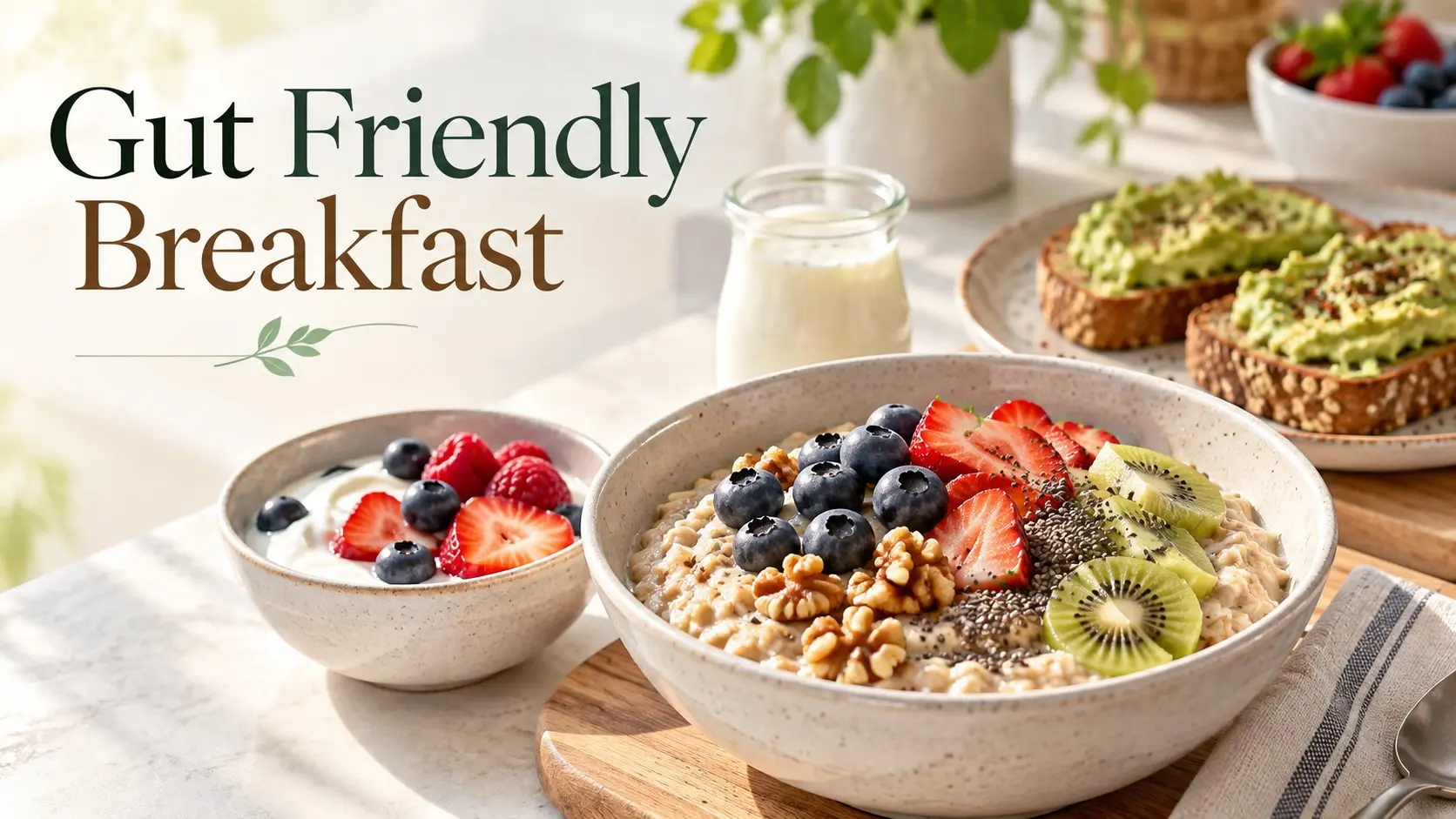
1. Oatmeal With Berries and Chia Seeds
This is my easiest starting point.
Cook plain oats.
Add blueberries, strawberries, or raspberries.
Sprinkle a small amount of chia seeds on top.
Oats provide soluble fibre, including beta-glucan.
Berries add more fibre and plant compounds.
Chia adds fibre and texture.
If your normal diet is low in fibre, start with a small amount of chia.
2. Plain Yogurt With Berries and Oats
Choose plain yogurt if dairy suits you.
Add berries and a spoonful of oats.
Some yogurts contain live active cultures.
Check the label.
Yogurt also provides protein and calcium.
If lactose causes symptoms, lactose free yogurt may be easier to tolerate.
3. Kefir With Oats and Fruit
Kefir is a fermented milk drink.
You can pour it over oats or drink a small glass beside breakfast.
Add berries or kiwi for plant fibre.
Do not assume kefir is better than yogurt.
Choose the one you enjoy and tolerate.
4. Oatmeal With Kiwi and Ground Flax
Cook oats until soft.
Add sliced kiwi.
Finish with a little ground flaxseed.
This gives you several types of plant fiber in one bowl.
Kiwi can also be a useful fruit choice for people dealing with constipation.
Add flax slowly if you do not normally eat much fiber.
5. Overnight Oats With Yogurt and Blueberries
Mix rolled oats with milk or a milk alternative.
Add a little plain yogurt if tolerated.
Refrigerate overnight.
Top with blueberries in the morning.
This is useful when you do not want to cook after waking.
6. Whole Grain Toast With Avocado and Egg
Use whole grain toast.
Add avocado.
Top with an egg.
The bread and avocado provide fiber.
The egg adds protein.
For some people with IBS, larger avocado portions can cause symptoms.
Use a portion that suits you.
7. Chia Pudding With Strawberries
Soak chia seeds in milk or a suitable milk alternative until they form a pudding.
Add strawberries.
Chia can provide a lot of fibre in a small serving.
That is useful.
It is also why I would not start with a huge portion.
Increase slowly.
8. Scrambled Eggs With Spinach and Whole Grain Toast
Not every gut breakfast needs yogurt.
Cook eggs with spinach.
Add whole grain toast.
The eggs provide protein.
The spinach and whole-grain bread add plant foods and fibre.
This is a good savoury option.
9. Savoury Oatmeal With Egg and Spinach
Oats do not have to taste sweet.
Cook them with water or milk.
Add spinach.
Top with an egg.
Use herbs for flavor.
This is a simple way to get whole grains and vegetables at breakfast.
10. Greek Yogurt With Kiwi and Walnuts
Plain Greek yogurt gives you protein.
Kiwi adds fruit and fibre.
Walnuts add healthy fats and more plant material.
If dairy does not suit you, use a suitable alternative.
Check plant-based yogurt labels because some contain little protein or no live cultures.
11. Peanut Butter Oatmeal With Banana
Cook plain oats.
Stir in a spoonful of peanut butter.
Add sliced banana.
This is easy and filling.
Banana ripeness and portion can matter for some people with IBS.
If banana causes symptoms, use berries or kiwi instead.
12. Quinoa Breakfast Bowl With Berries and Nuts
Leftover cooked quinoa can become breakfast.
Warm it with milk or a suitable alternative.
Add berries and nuts.
Quinoa adds whole-food carbohydrates, fibre, and protein.
This is useful if you want a break from oats.
13. Tofu Scramble With Spinach and Tomato
Crumble firm tofu into a pan.
Add spinach and tomato.
Use herbs or spices you tolerate.
This gives you a plant-based protein option.
If onion or garlic causes IBS symptoms, leave them out.
14. Whole Grain Toast With Nut Butter and Berries
Spread peanut or almond butter on whole grain toast.
Add strawberries or blueberries on the side.
This is fast.
It also gives you whole grains, nuts, and fruit with no need a recipe.
15. Oat Bowl With Yogurt, Kiwi, Berries, and Seeds
This is the bigger bowl for people who already tolerate fibre well.
Combine oats with plain yogurt.
Add kiwi and berries.
Finish with a small amount of chia or ground flax.
You get several plant foods in one meal.
That variety is more useful than chasing one “perfect” gut ingredient.
Gut Friendly Breakfast Chart
| Breakfast | Main Gut Friendly Feature | Easy Adjustment |
|---|---|---|
| Oats with berries | Whole grain and fruit fibre | Add chia slowly |
| Yogurt with berries | Fermented food plus fruit | Choose lactose-free yogurt if needed |
| Kefir with oats | Fermented food plus grain fibre | Start with a small kefir serving |
| Oats with kiwi | Soluble fibre and fruit | Add ground flax gradually |
| Avocado toast with egg | Whole grain fibre and protein | Reduce avocado if it causes IBS symptoms |
| Chia pudding | High fibre seeds | Start with a smaller portion |
| Eggs with spinach | Protein plus vegetables | Add whole grain toast |
| Tofu scramble | Plant protein and vegetables | Skip onion and garlic if needed |
Why Oats Are One of My First Breakfast Choices
Oats earn their place here.
They contain soluble and insoluble fibre.
The main soluble fibre in oats is beta-glucan.
Fibre supports bowel regularity.
Some oat fibres can also be fermented by intestinal microbes.
That makes oats a useful base for a high-fibre breakfast.
Then you can add fruit, nuts, seeds, or yogurt based on what you tolerate.
Do Fermented Foods Improve the Gut Microbiome?
The answer is interesting but not simple.
Fermented foods can contain live microbes.
Examples include yogurt, kefir, kimchi, and some fermented vegetables.
But fermentation does not automatically mean food contains proven probiotics.
Heating and pasteurization can kill live microorganisms.
And a microorganism being alive does not automatically prove that it provides a specific health benefit.
A Stanford study also compared high-fibre and high-fermented-food diets in healthy adults.
The work helped build interest in how different dietary patterns can change the microbiome and immune markers.
I would not turn that study into a rule saying everyone needs fermented food at breakfast.
It supports variety.
Fibre Matters More Than Probiotic Marketing
This is where I put my money.
A long term diet rich in different plant fibres gives gut microbes many substrates to work with.
Harvard's Nutrition Source recommends focusing on a pattern rich in fruits, vegetables, whole grains, legumes, nuts, and seeds rather than assuming a probiotic supplement is needed for a healthy microbiome.
That is a much more useful idea than buying a product because the front says “gut health.”
How Much Fibre Do Adults Need?
Needs differ with age and sex.
NIDDK lists an adult range of about 22 to 34 grams of fibre per day.
That is a daily total.
You do not need to eat all of it at breakfast.
If you currently eat very little fibre, do not jump to an enormous bowl of bran, chia, oats, berries, and flax tomorrow morning.
Your gut may object loudly.
Increase Fibre Slowly
This is one of the most useful digestive tips.
More fibre is not always better immediately.
NIDDK recommends adding fibre gradually.
Its IBS guidance suggests increases of around 2 to 3 grams per day can help reduce gas and bloating while the body adjusts.
Drink enough fluid too.
Fibre works better when your fluid intake is adequate.
What if Breakfast Makes You Bloated?
Do not assume breakfast itself is the problem.
Look at the ingredients and portions.
A healthy bowl can still be too much for your gut.
Possible triggers include:
- A sudden large fibre increase
- Large amounts of chia or flax
- Lactose
- Large fruit portions
- Sugar alcohols
- Large amounts of certain fermentable carbohydrates
- Very large meals
- Eating quickly
Change one thing at a time.
For gentler food ideas, see Foods That Can Reduce Bloating.
What if You Have IBS?
This changes the advice.
Foods that feed gut bacteria can also produce gas.
That does not make them unhealthy.
It means your gut may be sensitive to the fermentation.
NIDDK says people with IBS may be advised to try more fibre, gluten changes in selected cases, or a structured low FODMAP diet.
A low FODMAP diet is not supposed to remove every fermentable food forever.
The goal is to find your own triggers and tolerable portions.
A Gut Friendly Breakfast for IBS Is Personal
There is no universal IBS breakfast.
Some people tolerate oats very well.
Some tolerate lactose-free yogurt but not standard milk.
Some tolerate kiwi and berries better than apples or pears.
Others need different choices.
If symptoms are frequent, severe, or confusing, work with a gastroenterologist or registered dietitian rather than cutting more and more foods.
Do Probiotics Treat IBS?
Do not assume they do.
NCCIH says evidence for probiotics in IBS remains uncertain.
Different strains and products act differently.
The American College of Gastroenterology has recommended against routine probiotics for global IBS symptoms because the evidence quality is very low.
This is why I do not call every yogurt a treatment.
Food and medicine are different jobs.
What Is a Good Breakfast for Constipation?
Fibre-rich foods can help.
Useful breakfast choices include:
- Oatmeal
- Kiwi
- Berries
- Whole grain cereal
- Whole grain toast
- Chia in a suitable amount
- Ground flax
Drink enough fluid.
Increase fibre slowly.
Movement can help too.
See Constipation Exercises for gentle movement ideas.
Does Yogurt Help Constipation?
It depends on the person and the product.
Yogurt can provide protein and fermented cultures.
But it is not a guaranteed constipation remedy.
If constipation is your major problem, I would pay more attention to total fibre, fluid, movement, medicines, and bowel habits.
Is Greek Yogurt Better Than Regular Yogurt?
Not automatically for gut health.
Greek yogurt usually contains more protein because it is strained.
Both types can contain live cultures.
Check the label.
Choose a plain product with a taste and texture you enjoy.
If lactose causes symptoms, try lactose-free yogurt.
What About Plant-Based Yogurt?
Plant-based yogurt can work.
But products differ a lot.
Some are fermented.
Some contain live cultures.
Some contain very little protein.
Some are fortified with calcium and vitamin B12.
Others are not.
Read the Nutrition Facts label instead of assuming every plant yogurt has the same nutrition as dairy yogurt.
Is Banana Good for Gut Health?
Bananas provide fibre.
The type and amount of carbohydrate change as bananas ripen.
Many people tolerate them well.
People with IBS may respond differently depending on ripeness and portion.
If bananas repeatedly cause symptoms, choose another fruit.
Berries or kiwi are easy breakfast options.
Are Berries Good for a Gut Friendly Breakfast?
Yes.
Berries add fibre and plant compounds.
They are easy to add to oats or yogurt.
Frozen berries work too.
You do not need fresh berries all year.
Choose unsweetened frozen fruit when that is easier or cheaper.
Are Chia Seeds Good for Your Gut?
Chia seeds contain a lot of fibre for their size.
That can be useful.
It can also cause trouble if you suddenly add a large serving to a low fiber diet.
Start small.
Let chia absorb liquid before eating it in puddings.
Drink enough fluid throughout the day.
What About Flaxseed?
Ground flax is easier to mix into food than whole flaxseed.
Add a small amount to oats or yogurt.
It contributes fibre and plant fats.
Again, more is not always better.
Increase gradually.
Do You Need a Smoothie for Gut Health?
No.
Smoothies can be convenient.
They can also become enormous.
A blender can make it easy to combine several servings of fruit, yogurt, seeds, nut butter, juice, and sweeteners in one drink.
If that feels good, fine.
If it leaves you bloated, shrink the recipe.
You do not need six “gut foods” in one glass.
Should You Put Greens in a Breakfast Smoothie?
You can.
Spinach is easy to blend.
But vegetables do not become healthier because you drink them before 9 a.m.
Eat them later if you prefer.
Gut health depends on your whole dietary pattern.
Is Coffee Bad for Gut Health?
No universal rule says coffee is bad for the gut.
Some people drink coffee without digestive trouble.
Others notice reflux, urgency, stomach discomfort, or loose stools.
Your response matters.
If coffee reliably causes symptoms, reduce the amount or change when you drink it.
Do You Have to Eat Breakfast Early?
No.
There is no rule saying a gut-friendly breakfast must be eaten within one or two hours of waking.
Eat at a time that suits your schedule, hunger, medical needs, and normal eating pattern.
If you take medicine that must be taken with food, follow the medicine instructions.
Can Skipping Breakfast Damage Your Gut?
There is no good reason to claim that missing one breakfast damages your microbiome.
Some people enjoy breakfast.
Some are not hungry early.
Focus on getting enough food, protein, fibre, and micronutrients across the day.
Does Sugar Destroy Good Gut Bacteria?
That claim is too dramatic.
Your microbiome is not erased by one sweet breakfast.
But a diet dominated by low-fibre, highly processed foods gives you less room for fruit, vegetables, legumes, whole grains, nuts, and seeds.
I would focus on what your eating pattern contains rather than treating sugar like an antibiotic.
What About Artificial Sweeteners?
The microbiome research is still developing.
Different sweeteners are different compounds.
Do not assume every artificial sweetener has the same effect.
For digestive comfort, sugar alcohols such as sorbitol, mannitol, and xylitol can cause gas or diarrhea in some people.
This is especially relevant in IBS.
Do Eggs Help the Gut Microbiome?
Eggs are not a major source of fibre.
That does not make them a bad breakfast.
They provide protein and other nutrients.
Pair eggs with spinach, vegetables, avocado, or whole-grain toast if you want more plant fibre.
What Makes a Breakfast Truly Gut Friendly?
I use five questions.
- Does it contain at least one useful plant food?
- Does it provide fibre?
- Does it include enough protein or healthy fat to make the meal useful?
- Does the portion feel comfortable?
- Can you eat it regularly without turning breakfast into a project?
The last one matters more than people think.
A perfect breakfast that takes forty minutes to build every morning is not useful if you stop making it after three days.
Simple Gut Friendly Breakfast Formula
| Part | Examples |
|---|---|
| Fiber base | Oats, whole grain toast, quinoa |
| Fruit or vegetable | Berries, kiwi, banana, spinach, tomato |
| Protein | Yogurt, kefir, eggs, tofu, nut butter |
| Optional extra | Chia, ground flax, walnuts, other nuts |
You do not need every column at every meal.
This is a template.
Not a rule.
Three Fast Breakfasts for Busy Mornings
Two Minute Option
Plain yogurt, berries, and oats.
Grab and Go Option
Whole grain toast with peanut butter and a piece of fruit.
Make Ahead Option
Overnight oats with berries and a small amount of chia.
Fast food does not have to mean highly processed food.
What if You Do Not Feel Hungry in the Morning?
Do not force a giant bowl because an article says breakfast is mandatory.
Start smaller.
You could have yogurt and fruit.
Or toast and nut butter.
Or eat later.
Medical conditions and medicines can change this advice, so follow your treatment plan when meal timing matters.
When Gut Symptoms Need More Than Breakfast Advice
Do not keep redesigning breakfast if the real problem needs medical care.
Talk with a healthcare professional if digestive symptoms are persistent or keep returning.
Seek prompt medical care for warning signs such as:
- Blood in stool
- Black stool
- Unexplained weight loss
- Persistent vomiting
- Severe abdominal pain
- Fever with significant digestive symptoms
- Difficulty swallowing
- Ongoing diarrhea
- Constipation that does not improve
- A major unexplained change in bowel habits
Food should not be used to hide warning signs.
How I Approach Gut Health Food Advice
I have maintained a personal interest in nutrition, health, fitness, digestion, sleep, and healthy aging for more than 30 years.
My health and wellness writing experience spans more than 15 years.
I do not think gut health needs to be mysterious.
I look at the food first.
Then the portion.
Then tolerance.
I separate fermented food from probiotic supplement marketing.
I also separate normal digestive health from medical conditions such as IBS.
A healthy food can still cause symptoms in a sensitive gut.
That does not make the food toxic.
It means the plan needs to fit the person.
Common Gut Friendly Breakfast Myths
| Myth | What Makes More Sense |
|---|---|
| You need probiotics every morning | A varied fiber rich diet matters more than making every breakfast a probiotic product |
| All fermented foods contain probiotics | Processing and the microbial strains matter |
| More fiber is always better | Fiber should often be increased gradually |
| Everyone should eat yogurt | Dairy tolerance and personal preference differ |
| Breakfast must be eaten right after waking | There is no universal gut health timing rule |
| Healthy foods cannot cause bloating | Fermentable carbohydrates and large fiber loads can trigger symptoms in sensitive people |
| One breakfast can fix your microbiome | Gut health reflects your wider dietary and lifestyle pattern |
Conclusion: Keep Your Gut Friendly Breakfast Simple
A Gut Friendly Breakfast does not need to look like a supplement advertisement.
Start with oats or another whole grain.
Add fruit or vegetables.
Add yogurt, kefir, eggs, tofu, nuts, or seeds based on what you tolerate.
Build fibre gradually.
If you have IBS, work with your own tolerance instead of copying a generic “healthy gut” list.
Your next step is simple: choose one of the 15 breakfasts above and make it three times this week. If it feels good, keep it. Then add variety slowly.
References and Sources
- Harvard T.H. Chan School of Public Health. The Microbiome.
Explains how diet, dietary fiber, prebiotic foods, fermented foods, and intestinal microbes interact.
Harvard Nutrition Source Microbiome Guide - National Center for Complementary and Integrative Health. Probiotics: Usefulness and Safety.
NIH guidance explaining what probiotics are, differences between strains, benefits, limits in current evidence, and safety considerations.
NCCIH Probiotics Guidance - National Institute of Diabetes and Digestive and Kidney Diseases. Eating, Diet, and Nutrition for Irritable Bowel Syndrome.
Guidance on fibre, gradual fibre increases, low FODMAP diets, and digestive symptom management in IBS.
NIDDK IBS Nutrition Guidance - National Institute of Diabetes and Digestive and Kidney Diseases. Eating, Diet, and Nutrition for Constipation.
Guidance on adult fibre needs, whole grains, oats, legumes, fruit, vegetables, nuts, fluids, and gradual increases in fibre.
NIDDK Constipation Nutrition Guidance - Harvard T.H. Chan School of Public Health. Probiotics for Gut Health.
Updated guidance explaining fermented foods, probiotics, fiber rich plant foods, and why a varied long term dietary pattern matters more than relying on probiotic products alone.
Harvard Probiotics and Gut Health
Continue Reading on NextFitLife
- Foods That Can Reduce Bloating
- Constipation Exercises
- Gut Health and Weight Loss
- Top Healthy Foods for Everyday Nutrition
- NextFitLife Health Fitness and Nutrition Guides
About the Author
Frequently Asked Questions About a Gut Friendly Breakfast
What is the best gut friendly breakfast?
A simple option is oatmeal with berries and a small amount of chia or ground flax. Plain yogurt with live cultures can also be added when dairy is well tolerated.
What foods are good for gut health in the morning?
Useful choices include oats, berries, kiwi, whole grains, nuts, seeds, vegetables, yogurt, kefir, tofu, and legumes when they suit your digestion.
Are oats good for gut health?
Yes. Oats provide soluble and insoluble fibre, including beta-glucan. Fibre can support bowel regularity and provides material that some intestinal microbes can ferment.
Is yogurt good for gut health?
Yogurt can provide protein, calcium, and live cultures when the product contains them. It is not a treatment for every digestive problem, and people with lactose intolerance may prefer lactose-free yogurt.
Is kefir better than yogurt for the gut?
Neither is universally better. Both are fermented dairy foods and can contain live microorganisms. Choose based on nutrition, taste, and personal tolerance.
Do I need probiotics for a healthy gut?
No. Probiotic supplements are not required for a healthy diet. A varied eating pattern rich in fruit, vegetables, whole grains, legumes, nuts, and seeds provides different types of fiber that support the gut microbiome.
What is an excellent breakfast for constipation?
Oatmeal with kiwi, berries, chia, or ground flax can provide fiber. Increase fibre gradually and drink enough fluid. Persistent or severe constipation needs medical assessment.
Can too much fibre cause bloating?
Yes. A sudden increase in fibre can cause gas and bloating. Increase fibre gradually so your digestive system has time to adjust.
What is a gut-friendly breakfast for IBS?
There is no single IBS breakfast. Oats, kiwi, berries, eggs, and lactose-free yogurt may work for some people, but individual FODMAP tolerance and portion size matter.
Are bananas good for gut health?
Bananas provide fibre and can fit a healthy breakfast. People with IBS may respond differently depending on ripeness and portion size.
Are chia seeds good for digestion?
Chia seeds provide fibre. Start with a modest amount if your current diet is low in fibre because adding too much too quickly can cause bloating or gas.
Do I need to eat breakfast right after waking?
No. There is no universal gut health rule requiring breakfast within a set number of minutes after waking. Eat at a time that fits your hunger, schedule, and medical needs.
Is coffee bad for gut health?
Not for everyone. Some people tolerate coffee well. Others notice reflux, urgency, loose stool, or stomach discomfort. Your own response is more useful than a blanket rule.
Can one food fix the gut microbiome?
No. The gut microbiome is affected by the wider diet, lifestyle, medicines, environment, and other factors. One yogurt, seed, or fermented food cannot fix it by itself.
When should digestive symptoms be checked by a doctor?
Get medical advice for persistent symptoms or warning signs such as blood in stool, black stool, unexplained weight loss, severe pain, persistent vomiting, ongoing diarrhea, or a major unexplained change in bowel habits.

Health & wellness writer with 30+ years of experience in nutrition, fitness, and healthy aging. Founder of NextFitLife.com — evidence-based health guidance.