Published: Dec 3, 2022
Last Updated: September 18, 2026
Next Review: September 2027, or sooner if major weight management, nutrition, obesity, or physical activity guidance changes
Written and Source Checked by: Adel Galal, Founder and Lead Writer at NextFitLife
Review Status: This article is educational health and nutrition content. It has not been medically reviewed by a doctor, registered dietitian, obesity medicine specialist, endocrinologist, exercise physiologist, or other licensed healthcare professional.
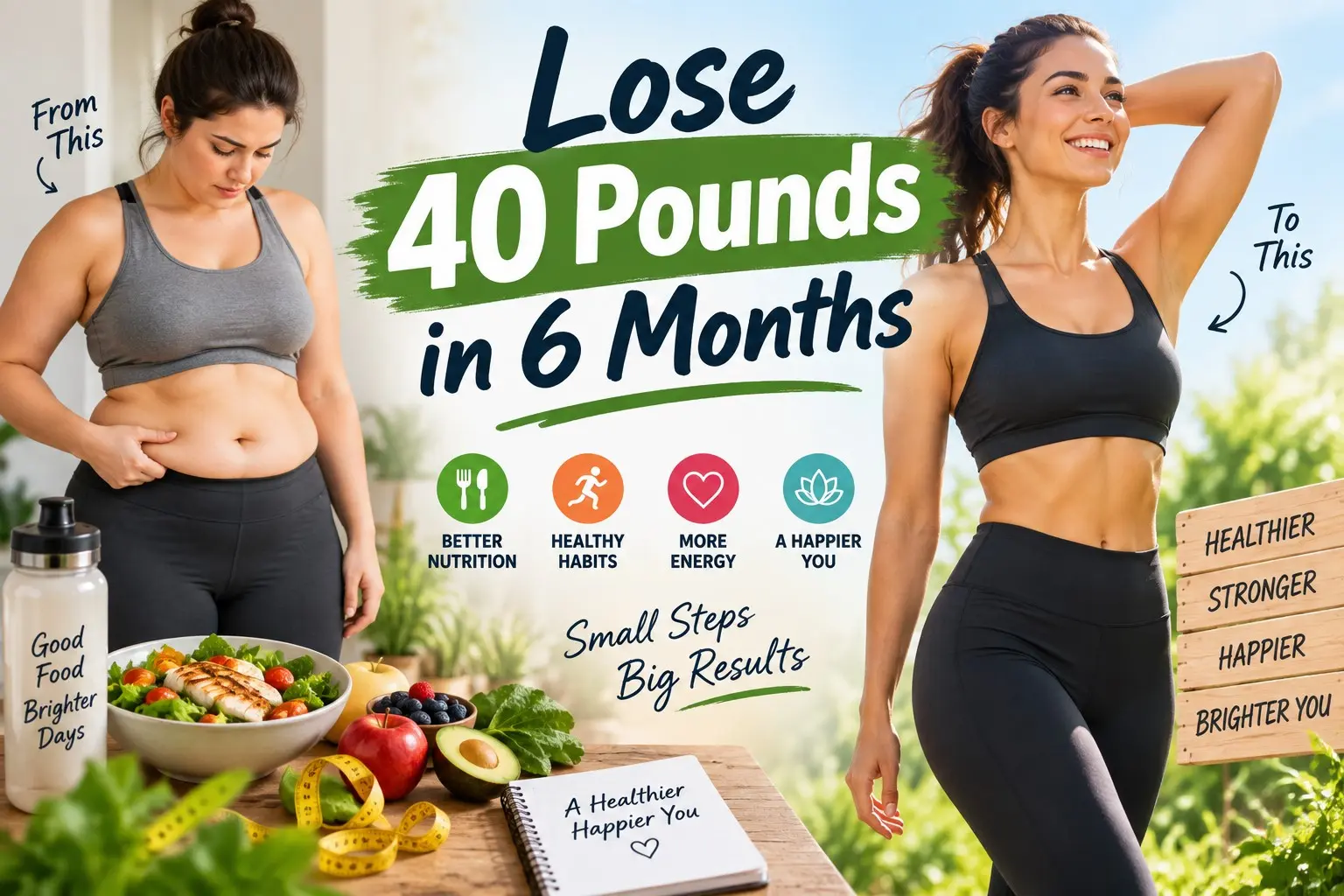
Can you lose 40 pounds in 6 months?
For some adults, yes.
But it should not be treated as a safe goal for every person.
Forty pounds over about 26 weeks works out to an average of roughly 1.5 pounds each week.
That sits inside the general 1 to 2 pound weekly range often used by the CDC for gradual weight loss.
But there is another important number.
NIDDK says an initial goal of losing around 5% to 10% of starting body weight over about six months may be useful for many adults.
That means your starting weight matters.
If someone begins at 200 pounds, losing 40 pounds means losing 20% of starting body weight.
If someone begins at 400 pounds, losing 40 pounds means losing 10%.
Those are very different situations.
So this guide does not promise that everyone should lose exactly 40 pounds.
Instead, it explains how to build a safe and practical six-month weight loss plan, how to judge whether the goal fits you, how to protect muscle, what to do when progress slows, and how to keep the weight from coming back.
If you want the full foundation first, read the NextFitLife Complete Weight Loss Guide.
Quick Answer: Is Losing 40 Pounds in 6 Months Realistic?
It can be realistic for some adults who have enough weight to lose and who can maintain a suitable calorie deficit without harming nutrition, muscle, energy, or health.
It may be too aggressive for another person.
A safe plan depends on:
- Your starting weight
- Your height
- Your age
- Your health
- Your medicines
- Your normal food intake
- Your activity
- Your sleep
- Your previous weight loss history
Do not choose 40 pounds simply because the number sounds good.
Choose a target that makes sense for your body.
What Does 40 Pounds in 6 Months Actually Mean?
| Goal | Approximate Meaning | Important Note |
|---|---|---|
| Total target | 40 pounds | Not suitable for everyone |
| Time | About 26 weeks | Progress will not be perfectly even |
| Average weekly change | About 1.5 pounds | Some weeks may show little change |
| Common CDC reference | About 1 to 2 pounds per week | This is a general range, not a prescription |
| NIDDK initial goal | Often 5% to 10% of starting weight over 6 months | Your goal should match your starting point |
Weight loss is rarely a straight line.
You may lose more scale weight in the first few weeks.
Some of that may be water.
Later progress may slow.
That is normal.
Do Not Use the Old 3,500 Calorie Rule as a Perfect Formula
You may have seen this advice:
One pound equals 3,500 calories.
So just multiply 40 by 3,500.
Then divide the result by the number of days.
Real bodies are not that simple.
Energy needs change as body weight changes.
Appetite can change.
Activity can change.
Metabolism adapts.
The NIDDK Body Weight Planner uses a dynamic model for this reason.
It estimates how food intake and activity may affect body weight over time.
A calculator is still only an estimate.
It is more useful than pretending one fixed calorie equation works perfectly for six months.
13 Smart Steps to Lose 40 Pounds in 6 Months
1. Decide Whether 40 Pounds Is an Appropriate Goal
This is the most important first step.
Do not start with the diet.
Start with the goal.
Ask:
- Would losing weight improve my health?
- Is 40 pounds an appropriate amount for my starting weight?
- Do I have a health condition that changes what is safe?
- Am I taking medicine that affects weight or blood sugar?
- Would a smaller first goal make more sense?
A common initial healthy weight loss goal may be 5% to 10% of starting body weight.
For some people, that will be far less than 40 pounds.
For others, 40 pounds may fit into a longer treatment plan.
Talk with a healthcare professional when you are unsure.
2. Focus on the Weekly Trend, Not the Deadline
Six months gives you structure.
It should not become a threat.
Your body does not know that you picked a date on the calendar.
You may lose 1.5 pounds one week.
You may lose nothing the next week.
You may temporarily gain two pounds from water.
That does not mean you gained two pounds of fat.
Look at your average trend over several weeks.
Read the Healthy Rate of Weight Loss Guide before deciding that progress is too slow.
3. Create a Sustainable Energy Deficit
Body fat decreases when average energy intake stays below average energy use over time.
This is called an energy deficit.
You do not need the biggest deficit possible.
A very aggressive deficit can cause problems.
You may feel weak.
You may become very hungry.
You may struggle to eat enough nutrients.
You may lose more lean tissue.
You may make the plan too hard to continue.
Your calorie needs change with:
- Body size
- Age
- Sex
- Muscle mass
- Daily movement
- Health
- Medicine
The NIDDK Body Weight Planner can give adults a personalized estimate.
It is not designed for children, pregnant women, or breastfeeding women.
4. Build Meals Around Protein
High protein foods can help meals feel more satisfying.
Protein also supports muscle.
This matters during weight loss.
Weight loss can include lean tissue as well as fat.
Useful protein foods include:
- Eggs
- Fish
- Chicken
- Lean meat
- Plain Greek yogurt
- Cottage cheese
- Beans
- Lentils
- Tofu
- Tempeh
- Edamame
You do not need one fixed protein amount that applies to everyone.
The right amount depends on body size, age, activity, health, and kidney function.
For meal ideas, visit High Protein Foods for Weight Loss.
5. Add Fibre and Food Volume
Dietary fibre can help meals feel filling.
It also supports bowel health.
Choose foods such as:
- Vegetables
- Whole fruit
- Beans
- Lentils
- Oats
- Whole grains
- Nuts
- Seeds
Vegetables and fruit also contain water.
This can help you build larger meals without making every meal very high in calories.
Increase fiber gradually if you currently eat very little.
6. Pay Attention to Portions
Healthy foods still contain energy.
This matters most with foods that are easy to overeat.
Examples include:
- Cooking oil
- Nut butter
- Nuts
- Seeds
- Cheese
- Avocado
- Dressings
- Rich sauces
Portion control does not mean tiny meals.
It means choosing portions that fit your needs.
One easy habit is to serve food before you sit down.
Do not eat directly from a large package when portions are hard to judge.
7. Review Your Drinks
Drinks can add many calories quickly.
Review how often you drink:
- Regular soda
- Sweet tea
- Sweet coffee drinks
- Fruit drinks
- Large juice servings
- Energy drinks with sugar
- Alcohol
Water can be your main drink.
Water does not burn fat.
It does not need to boost your metabolism.
Its main advantage for weight management is simple.
It has no calories.
8. Use Regular Movement to Support the Plan
Food changes often create a large part of the calorie deficit.
Physical activity is still important.
It supports:
- Heart health
- Blood pressure
- Blood sugar
- Mood
- Sleep
- Fitness
- Weight maintenance
Adults are generally advised to work toward at least 150 minutes of moderate aerobic activity each week.
You do not need to begin there.
Start with your current ability.
Walking is one of the simplest options.
You may begin with ten minutes.
Then build.
For more options, read Best Exercises for Weight Loss.
9. Strength Train to Protect Muscle
Strength training deserves more attention in a six-month weight loss plan.
A 2025 systematic review found that adding resistance exercise to dietary weight loss helped protect fat-free mass.
It also improved strength.
It may also improve the amount of fat lost.
This matters because the goal should not be simply to make the scale as low as possible.
You want to protect useful tissue.
Simple exercises can include:
- Chair squats
- Wall push ups
- Band rows
- Glute bridges
- Step ups
- Calf raises
- Light presses
Healthy adults are generally advised to include muscle-strengthening activity at least two days per week.
Start with less when needed.
10. Protect Sleep
Sleep and weight loss are connected.
Poor sleep can affect:
- Hunger
- Food choices
- Mood
- Energy
- Training quality
- Daily movement
Try to keep a steady sleep routine.
Limit caffeine late in the day if it affects your sleep.
Keep the bedroom comfortable.
Reduce late screen use when practical.
If you snore loudly, wake choking, or feel extremely sleepy during the day, ask a healthcare professional about sleep apnea.
11. Track Progress Without Obsession
Weight loss tracking can help you see whether your plan works.
Useful things to monitor include:
- Weekly weight trend
- Waist size
- Food habits
- Drinks
- Walking time
- Strength
- Sleep
- Energy
You do not need to weigh yourself every day.
Some people find it useful.
Others find it stressful.
Use a method that helps you make calm decisions.
Read the Weight Loss Tracking Guide for more detail.
12. Expect Plateaus and Recalculate the Plan
A weight loss plateau is normal.
Your body becomes smaller.
A smaller body usually needs less energy.
Your hunger may change.
Your activity may change.
Your original calorie target may no longer create the same deficit.
This is sometimes called metabolic adaptation.
It does not mean your metabolism is permanently broken.
When progress slows, review:
- Your weight trend
- Current portions
- Drinks
- Cooking oils
- Snacks
- Weekend eating
- Daily movement
- Sleep
- Medicine
Then adjust one or two things.
Do not respond to every slow week by severely cutting food.
13. Begin Weight Maintenance Before Month Six Ends
This step is often forgotten.
You should not wait until the goal weight appears before learning weight maintenance.
During the final weeks, ask:
- Which meals can I keep eating?
- Which activities do I actually enjoy?
- How will I handle weekends?
- How will I handle travel?
- What weight range will I monitor?
- Which habits must stay?
The habits that helped you lose weight should not all disappear the day the diet ends.
A Better Six-Month Roadmap
Do not force an exact pound target for each month.
Use each month for a different job.
| Month | Main Focus | What to Practice |
|---|---|---|
| Month 1 | Build the foundation | Track your normal pattern, improve meals, review drinks, start movement |
| Month 2 | Make food easier | Protein, fibre, meal planning, portion awareness |
| Month 3 | Build fitness | More walking or cardio, start or progress strength training |
| Month 4 | Review the trend | Check portions, weight trend, sleep, activity, and hunger |
| Month 5 | Handle plateaus | Make small adjustments and avoid crash dieting |
| Month 6 | Prepare for maintenance | Keep useful habits and create a long-term monitoring plan |
Month 1: Learn Before You Cut More
Spend the first week learning your normal pattern.
Record:
- Meals
- Snacks
- Drinks
- Restaurant food
- Cooking oil
- Sleep
- Movement
You may discover obvious changes.
Maybe soda is common.
Maybe portions are much larger on weekends.
Maybe breakfast has very little protein.
Maybe sleep is poor.
Fix the largest problems first.
Month 2: Make Meals More Filling
Focus on meal planning.
A simple meal can contain:
| Meal Part | Examples | Why It Helps |
|---|---|---|
| Protein | Eggs, fish, chicken, yogurt, beans, tofu | Supports muscle and fullness |
| Vegetables or fruit | Broccoli, salad, peppers, berries, apples | Fibre, water, vitamins, volume |
| Carbohydrate food | Oats, potatoes, rice, whole grain bread | Energy and nutrients |
| Healthy fat | Olive oil, nuts, seeds, avocado | Flavour and useful fats |
The plate is a guide.
It is not a medical diet.
Month 3: Make Movement Normal
By now, activity should feel less like a temporary challenge.
Use movement that fits your body.
Options include:
- Walking
- Cycling
- Swimming
- Dancing
- Home workouts
- Gym training
Add strength work when it is safe.
You are building body composition, fitness, and health.
You are not only burning calories.
Month 4: Review the Plan
Your current body may need less energy than your starting body.
Review what has changed.
Ask:
- Am I still losing weight?
- How hungry am I?
- Have portions changed?
- Am I moving less?
- Am I stronger?
- Am I sleeping enough?
- Do I need professional support?
Do not change the plan because of one slow week.
Look at several weeks.
Month 5: Manage the Hard Part
The beginning often feels exciting.
Month five may feel less exciting.
This is when habits matter.
Motivation does not have to be high every day.
Use routines.
Keep simple meals available.
Keep walking shoes visible.
Plan weekends.
Return after setbacks without punishment.
Month 6: Stop Thinking Like You Are Finishing a Diet
You are not reaching the end of healthy eating.
You are entering maintenance.
Practice:
- A stable meal pattern
- Regular activity
- Strength work
- Enough sleep
- Weekly or periodic weight checks
- Early action if weight begins rising outside your chosen range
Sustainable weight loss includes the plan after weight loss.
What Should You Eat to Lose 40 Pounds in 6 Months?
There is no special 40-pound diet.
A healthy eating pattern should fit:
- Your culture
- Your budget
- Your preferences
- Your health
- Your work
- Your family
WHO says healthy diets should be built around adequacy, balance, moderation, and diversity.
Useful foods include:
- Vegetables
- Whole fruit
- Whole grains
- Beans
- Lentils
- Fish
- Eggs
- Suitable lean proteins
- Nuts and seeds in suitable portions
You do not need to remove every carbohydrate.
You do not need to live on salads.
You do not need a detox.
Simple One Day Meal Example
| Meal | Example |
|---|---|
| Breakfast | Plain Greek yogurt with berries and oats |
| Lunch | Chicken, tofu, or lentils with salad and potatoes |
| Snack if hungry | Fruit with yogurt, cottage cheese, eggs, or edamame |
| Dinner | Fish, beans, chicken, or tofu with vegetables and rice |
| Drinks | Water, plain tea, or plain coffee |
This is only an example.
Your calorie and nutrient needs may be different.
How Much Exercise Do You Need?
You do not need two hours in the gym every day.
Adults are generally advised to work toward:
- At least 150 minutes of moderate aerobic activity each week
- Or an equivalent amount of vigorous activity
- Muscle strengthening activity on at least two days each week
Some movement is better than none.
Start smaller if needed.
A Simple Beginner Exercise Week
| Day | Activity |
|---|---|
| Monday | Brisk walk or other comfortable cardio |
| Tuesday | Simple strength session |
| Wednesday | Walking or easy movement |
| Thursday | Simple strength session |
| Friday | Brisk walk or other cardio |
| Saturday | Enjoyable movement |
| Sunday | Rest or gentle movement |
This is an example.
It is not an individual exercise prescription.
Can You Lose 40 Pounds With Walking?
Walking can be a major part of a weight loss plan.
But there is no magic daily step number that guarantees 40 pounds of loss.
The old article suggested 10,000 steps as though that number was required.
It is not.
Walking helps because it increases activity and can support fitness and long-term weight maintenance.
Your food intake still matters.
Do You Need 10,000 Steps Every Day?
No.
Ten thousand steps is not a universal medical requirement.
Your useful target depends on your current activity.
If you currently average 3,000 steps, moving toward 4,000 or 5,000 may already be meaningful progress.
Build gradually.
How Important Is Strength Training?
Very important if it is safe for you.
Dietary weight loss alone can reduce lean tissue.
A 2025 meta-analysis found that adding resistance training during dietary weight loss helped protect fat-free mass.
It also improved muscle strength.
This makes muscle preservation an important part of a large weight loss goal.
Will You Lose Exactly 6 or 7 Pounds Every Month?
No.
Do not create a rigid monthly schedule.
Your scale may change faster in month one.
It may slow in months four or five.
Water can hide progress.
Menstrual changes can affect scale weight.
Restaurant meals can raise water weight because of sodium.
Hard workouts can temporarily increase water around trained muscles.
Judge the trend.
What if You Have Only Lost 20 Pounds After Six Months?
Twenty pounds can still be meaningful progress.
Do not label a useful health change as failure because you missed one number.
Ask:
- Has your waist changed?
- Has blood pressure improved?
- Has blood sugar improved?
- Can you walk farther?
- Are you stronger?
- Are meals healthier?
- Can you maintain these habits?
Sometimes the best decision is to continue the plan instead of making it more extreme.
What if You Lose 40 Pounds Before Six Months?
Do not automatically keep pushing for faster loss.
Review your rate.
Ask whether you are eating enough.
Look for:
- Severe fatigue
- Dizziness
- Weakness
- Hair loss
- Menstrual changes
- Food fear
- Binge eating
- Loss of strength
Fast loss is not always better loss.
Can Intermittent Fasting Help You Lose 40 Pounds?
It may help some people control eating time.
It is not required.
Current evidence does not show that intermittent fasting consistently beats other sustainable calorie reducing diets.
If it makes your eating routine simpler, it may fit.
If it causes extreme hunger or overeating, choose another pattern.
Read Intermittent Fasting for Weight Loss for a detailed evidence review.
Can You Lose 40 Pounds Without Exercise?
Weight loss can happen through food intake alone.
But exercise provides benefits that a lower calorie intake does not replace.
Exercise supports:
- Heart health
- Fitness
- Strength
- Bone health
- Mood
- Sleep
- Weight maintenance
If you cannot exercise because of illness, pain, disability, or recovery, focus on the strategies that are safe for you.
What About Weight Loss Medicine?
Some adults with obesity or weight related health conditions may benefit from prescription weight management medicine.
These medicines are not for everyone.
They should be prescribed and monitored by a qualified healthcare professional.
They work best as part of broader care that also addresses nutrition, activity, monitoring, and long term maintenance.
Do not buy unapproved products because they claim to work like a prescription medicine.
What About Weight Loss Surgery?
Metabolic and bariatric surgery can be an effective treatment for selected people with obesity.
It is not a shortcut.
It requires specialist assessment and long term follow up.
The decision belongs with a qualified medical team.
Why Do People Regain Weight?
Weight regain is common.
Your body may need fewer calories after weight loss.
Hunger signals may become stronger.
Old habits can slowly return.
Activity may fall.
This is why maintenance needs a plan.
Do not stop:
- Meal planning
- Protein and fibre habits
- Walking
- Strength training
- Sleep care
- Monitoring
Maintenance is not failure to finish dieting.
Maintenance is the next phase of treatment.
Common Mistakes When Trying to Lose 40 Pounds
Trying to Lose the Weight Too Fast
Faster is not always safer.
Using a Fixed Calorie Deficit From the Internet
Your needs are individual.
Believing Every Pound Lost Is Body Fat
Water changes can move the scale quickly.
Skipping Protein
Protein supports muscle and fullness.
Doing Only Cardio
Strength training helps protect lean tissue.
Exercising Too Hard From Week One
Build gradually.
Ignoring Sleep
Sleep supports your daily routine and recovery.
Trying to Be Perfect
One restaurant meal does not ruin six months.
Giving Up During a Plateau
Plateaus are normal.
Stopping Every Habit After Reaching the Goal
Maintenance starts before the final weigh in.
When 40 Pounds Is Not the Right Goal
You should not intentionally pursue a 40 pound loss simply because you found this article.
Get professional advice if you:
- Are underweight
- Are pregnant
- Are breastfeeding and considering major restriction
- Are under 18
- Have an eating disorder or history of one
- Have diabetes treated with medicine
- Have kidney disease
- Have liver disease
- Have heart disease
- Are recovering from major illness or surgery
- Are losing weight without trying
Warning Signs Your Plan May Be Too Aggressive
Seek appropriate medical advice if your weight loss plan causes:
- Fainting
- Severe dizziness
- Persistent weakness
- Repeated vomiting
- Severe dehydration
- Loss of menstrual periods
- Rapid unexplained weight loss
- Food fear
- Binge eating
- Purging
- Compulsive exercise
- A major drop in physical function
A lower scale number is not worth harming your health.
How I Approach a Six Month Weight Loss Goal
I am Adel Galal, founder and lead writer of NextFitLife.
I have maintained a personal interest in health, fitness, nutrition, sleep, wellness, and healthy aging for more than 30 years.
My health and wellness writing experience spans more than 15 years.
I research topics by comparing credible medical and public health sources and looking for the limits behind popular claims.
A goal like 40 pounds can sound simple.
It is not.
Your starting weight matters.
Your health matters.
Muscle matters.
Sleep matters.
Your medicine matters.
Your ability to keep the result matters.
I do not believe a useful article should promise that every reader can reach the same number by the same date.
A better approach is to explain what the evidence says, help you build better habits, and make clear when professional care is needed.
That is how I approach the question of how to lose 40 pounds in 6 months.
Conclusion: Lose 40 Pounds in 6 Months Without Chasing Perfection
You may be able to lose 40 pounds in 6 months.
But the number should fit your starting weight and health.
Do not begin with starvation.
Do not trust one fixed calorie equation.
Do not assume every week will look the same.
Build a reasonable calorie deficit.
Eat nutritious food.
Get enough protein and fibre.
Move regularly.
Strength train when appropriate.
Sleep.
Track the trend.
Adjust when your body changes.
And begin planning maintenance before the six months are over.
Your first action today is simple.
Decide whether 40 pounds is truly the right goal for you.
Then choose one food habit and one movement habit that you can repeat this week.
References and Sources
- Centers for Disease Control and Prevention.
Steps for Losing Weight.
https://www.cdc.gov/healthy-weight-growth/losing-weight/index.html
- National Institute of Diabetes and Digestive and Kidney Diseases.
Choosing a Safe and Successful Weight Loss Program.
https://www.niddk.nih.gov/health-information/weight-management/choosing-a-safe-successful-weight-loss-program
- National Institute of Diabetes and Digestive and Kidney Diseases.
Body Weight Planner.
https://www.niddk.nih.gov/health-information/weight-management/body-weight-planner
- World Health Organization.
Healthy Diet.
Updated January 26, 2026.
https://www.who.int/news-room/fact-sheets/healthy-diet
- Binmahfoz A, Dighriri A, Gray C, Gray SR.
Effect of Resistance Exercise on Body Composition, Muscle Strength and Cardiometabolic Health During Dietary Weight Loss in People Living With Overweight or Obesity.
BMJ Open Sport and Exercise Medicine. 2025.
https://pubmed.ncbi.nlm.nih.gov/40909191/
Explore More NextFitLife Weight Loss Guides
- Complete Weight Loss Guide
- Healthy Rate of Weight Loss
- Weight Loss and Metabolism Guide
- High Protein Foods for Weight Loss
- Best Exercises for Weight Loss
- Weight Loss Tracking Guide
- Health and Fitness for Busy People
- Intermittent Fasting for Weight Loss
- Lose Fat Without Exercise
- Fruitful Weight Loss
Frequently Asked Questions About Losing 40 Pounds in 6 Months
Can you safely lose 40 pounds in 6 months?
It may be appropriate for some adults. Forty pounds over about 26 weeks averages roughly 1.5 pounds per week, which falls inside the CDC general range of about 1 to 2 pounds per week. Your starting weight, health, nutrition needs, and medical history still matter.
Is 40 pounds too much to lose in six months?
It can be too much for some people. NIDDK often uses an initial goal of about 5% to 10% of starting body weight over six months. Forty pounds represents a very different percentage depending on your starting weight.
How much weight per week is needed to lose 40 pounds in six months?
The mathematical average is about 1.5 pounds per week. Real weight loss will not happen at the same rate every week.
How much weight can you realistically lose in six months?
There is no single amount that is realistic for everyone. Starting body size, health, food intake, activity, medicine, age, and individual response all affect the result.
Do I need a 750 calorie daily deficit to lose 40 pounds?
No fixed deficit is right for every person. Energy needs change with body size and during weight loss. The NIDDK Body Weight Planner can provide a more individualized estimate for adults.
Is the 3,500 calorie rule accurate?
It is a rough simplification. Body weight changes dynamically as metabolism, body size, energy intake, and activity change. It should not be treated as a perfect prediction formula.
What should I eat to lose 40 pounds?
Build a balanced eating pattern around vegetables, whole fruit, protein foods, whole grains or other nutritious carbohydrate foods, beans, lentils, and suitable portions of healthy fats. No special food is required.
How much protein do I need during weight loss?
Protein needs vary by age, body size, activity, health, and kidney function. Include regular protein-rich foods and ask a registered dietitian or healthcare professional if you need a personal target.
Should I strength train while trying to lose 40 pounds?
Strength training can be very useful. A 2025 systematic review found that resistance exercise during dietary weight loss helped protect fat-free mass and improved strength.
Can I lose 40 pounds just by walking?
Walking can support energy use, fitness, and weight maintenance, but it does not guarantee a specific amount of weight loss. Food intake and the full lifestyle pattern also matter.
Do I need 10,000 steps a day?
No. Ten thousand steps is not a universal requirement. Start from your current activity level and gradually increase movement when appropriate.
Can I lose 40 pounds without exercise?
Weight loss can occur through changes in food intake without formal exercise. Physical activity still provides important benefits for heart health, fitness, muscle, mood, sleep, and long-term weight maintenance.
Will I lose the same amount every month?
No. Early scale changes may include water. Progress often slows as body weight falls. Look at the trend across several weeks instead of expecting the same monthly loss.
Why does weight loss slow after a few months?
A smaller body usually uses less energy. Appetite, activity, sleep, medicine, and portions may also change. This can reduce the size of your original calorie deficit.
What should I do during a weight loss plateau?
Review several weeks of data. Check portions, drinks, cooking oils, snacks, weekend eating, movement, sleep, medicine, and current energy needs. Make small changes instead of immediately using severe restriction.
What if I only lose 20 pounds in six months?
Twenty pounds may still represent important progress. Review your health, waist measurement, fitness, strength, food habits, and whether the plan is sustainable before deciding that the result was unsuccessful.
Can intermittent fasting help me lose 40 pounds?
It may help some people reduce eating opportunities, but it is not required. Current evidence does not show that intermittent fasting consistently produces more weight loss than other sustainable calorie-reducing approaches.
How do I keep 40 pounds from coming back?
Continue the habits that helped you lose weight. Keep a stable eating pattern, regular movement, strength work, enough sleep, and periodic monitoring. Maintenance should begin before the weight loss phase ends.
When should I speak with a healthcare professional?
Get personal advice if you have diabetes, kidney or liver disease, heart disease, use prescription medicine, are pregnant or breastfeeding, have an eating disorder history, are under 18, or are losing weight without trying.

Health & wellness writer with 30+ years of experience in nutrition, fitness, and healthy aging. Founder of NextFitLife.com — evidence-based health guidance.