
Updated on: October 16, 2026
Written and source checked by: Adel Galal, Founder and Lead Writer at NextFitLife
Medical review status: This article has not been medically reviewed by a doctor, emergency physician, sports medicine specialist, registered dietitian, pharmacist, athletic trainer, or other licensed healthcare professional.
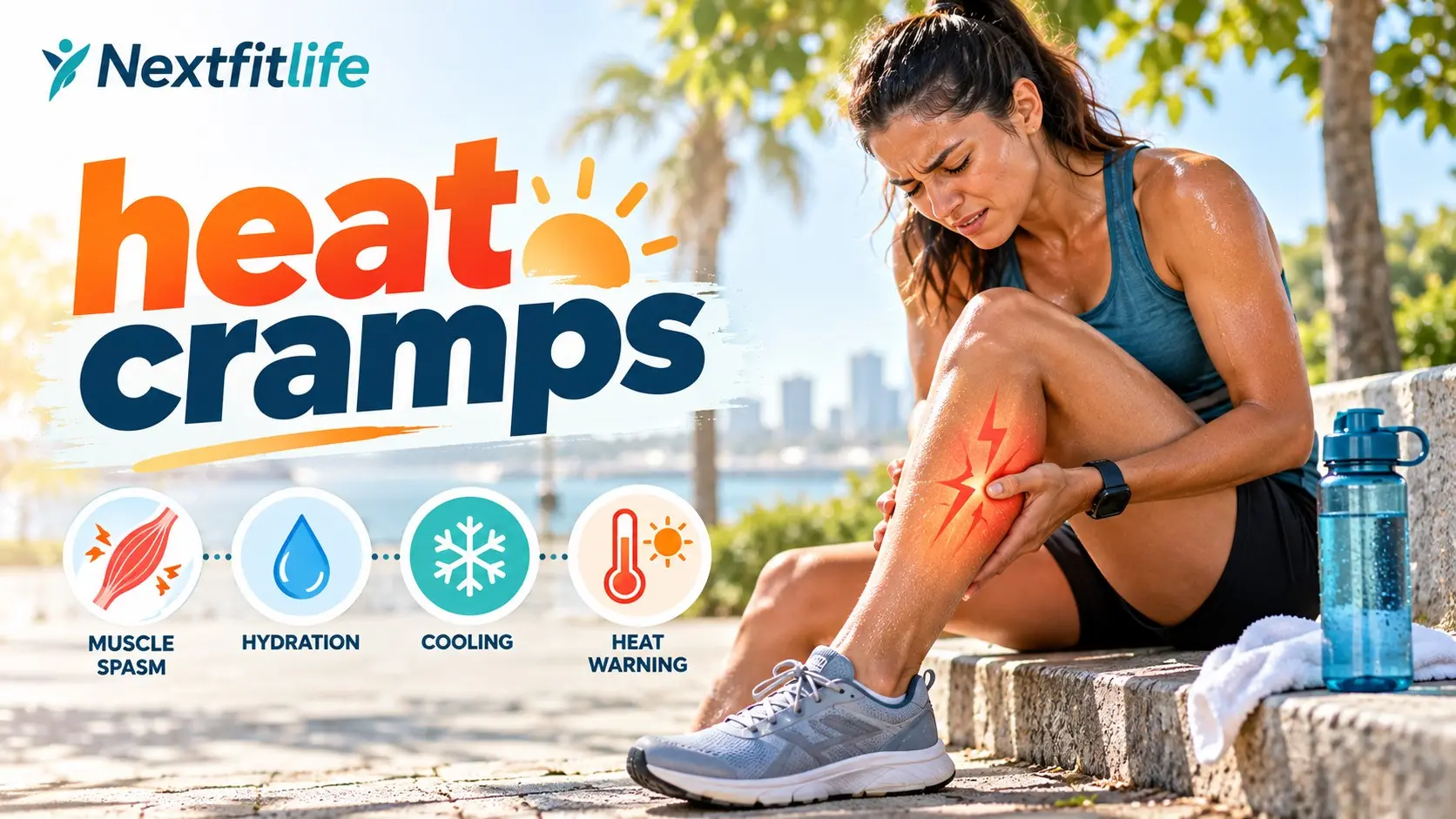
Heat cramps are painful muscle spasms that often happen during or after hard activity in hot conditions, especially after heavy sweating. They commonly affect the calves, thighs, arms, abdomen, or other working muscles.
The safest response is simple: stop the activity, move somewhere cool, rest, replace fluids, and watch for symptoms of more serious heat illness.
This article is for general information and education. It does not replace medical advice, diagnosis, or treatment.
If the person also has dizziness, headache, nausea, marked weakness, or heavy sweating, read the NextFitLife Heat Exhaustion Guide.
Table of Contents
- What heat cramps are
- 11 critical signs and clues
- Painful muscle spasm
- Calf, thigh, arm, or abdominal cramps
- Heavy sweating
- Thirst
- Cramps during or after activity
- Tight or knotted muscle
- Repeat cramping
- Symptoms after hard work
- Cramps with dizziness or weakness
- Cramps lasting too long
- Dark urine or severe weakness
- Fast first aid
- Water versus electrolytes
- Heat cramps versus heat exhaustion and heat stroke
- Causes and risk factors
- Prevention
- Frequently asked questions
What Are Heat Cramps?
Heat cramps are painful, involuntary muscle spasms linked with strenuous activity and heavy sweating in hot conditions.
NIOSH explains that sweating removes both fluid and salt from the body. Heat cramps can develop when those losses combine with tired, heavily used muscles.
They often affect:
- Calves
- Thighs
- Arms
- Abdominal muscles
- Back
- Other muscles used heavily during work or exercise
The cramps can happen during activity or after it stops.
That last point matters. You may finish work or training, sit down, and only then feel a painful muscle suddenly tighten.
1. Sudden Painful Muscle Spasms Are the Main Sign
The classic symptom is a muscle that tightens hard without you choosing to contract it.
The muscle may feel:
- Tight
- Hard
- Knotted
- Painful
- Difficult to relax
The pain can be strong even when the rest of the person feels fairly well.
That does not mean it should be ignored. Heat cramps can sometimes appear alongside or before more serious heat illness.
2. The Legs, Arms, and Abdomen Are Common Sites
OSHA and NIOSH commonly list the legs, arms, and abdomen as affected areas.
The exact muscle often reflects what you were using.
A runner may cramp in the calves or thighs. A worker lifting in the heat may feel the arms, abdomen, or back tighten.
Muscle location alone does not prove heat cramps, though.
Ordinary exercise cramps, nerve problems, circulation problems, medication effects, low calcium, and other conditions can also cause muscle pain or spasms.
3. Heavy Sweating Makes Heat Cramps More Likely
Heat cramps are strongly associated with heavy sweating.
Sweat removes water and electrolytes, including sodium.
If sweating is heavy and activity continues for a long time, fluid and electrolyte losses can become significant.
This does not mean every cramp is caused by “low electrolytes.”
Muscle fatigue, exercise intensity, heat, fitness, and individual sweat losses all matter.
4. Thirst Can Be Another Clue
Thirst often appears as fluid loss rises.
You may also notice:
- Dry mouth
- Reduced urine
- Darker urine
- Feeling unusually hot
- Reduced performance
These symptoms point toward a broader hydration problem rather than one isolated muscle spasm.
If cramps happen after walking in hot weather, see Why Do My Legs Ache at Night After Walking? for other possible causes of leg pain.
5. Heat Cramps Can Start During Exercise or After You Stop
Do not assume the danger is gone because the workout or work shift ended.
Heat cramps can appear during exertion or afterward.
This is common after:
- Running
- Sports
- Outdoor construction work
- Gardening
- Warehouse work
- Heavy lifting
- Long periods in hot protective clothing
If symptoms begin after activity, still move somewhere cool and start recovery.
6. The Muscle May Feel Hard or Knotted
A cramped muscle can feel firm under your hand.
Gentle stretching and gentle massage can help once you are out of the heat.
Do not aggressively force a painful muscle into a deep stretch.
A sharp injury, torn muscle, or severe strain needs a different approach.
7. Repeat Cramping Means You Should Stop, Not Push Harder
A common mistake is trying to “walk it off” and return immediately to hard activity.
Do not.
Heat cramps are a signal to stop the workload.
Mayo Clinic advises avoiding strenuous activity for a few hours after the cramps settle.
Your body needs time to cool and replace what was lost.
8. Hard Work in New Heat Raises the Risk
People who are not used to heat have a higher risk of heat illness.
This includes:
- New outdoor workers
- People returning after time away
- Travelers entering a much hotter climate
- Athletes starting summer training
- People suddenly increasing exercise intensity
Heat acclimatization means gradually allowing the body to adapt to hot conditions.
It helps improve sweating and circulation responses.
Going from air conditioning straight into a full day of heavy hot work is not a smart test of toughness.
9. Cramps With Dizziness, Headache, or Weakness May Mean More
This is the line people should not miss.
Heat cramps alone mainly cause muscle pain or spasms.
If you also have:
- Dizziness
- Headache
- Nausea
- Marked weakness
- Irritability
- Heavy sweating
- Very strong thirst
- A fast heartbeat
you may be moving into heat exhaustion.
Stop activity, begin cooling, and watch the symptoms closely.
Read Heat Exhaustion: Symptoms, First Aid, Prevention, and Recovery for the complete first aid plan.
10. Cramps That Last Longer Than One Hour Need Medical Advice
NIOSH and Mayo Clinic advise getting medical help when heat cramps do not settle within about one hour.
Get help sooner if symptoms are worsening.
Medical advice is also important if you have heart disease or have been told to follow a low sodium diet.
Those conditions can change what type of fluid or electrolyte replacement is safe for you.
11. Dark Urine Plus Severe Muscle Pain Is Not Just a Simple Cramp
This is an important gap in many heat cramp articles.
Heat stress plus prolonged hard exercise can contribute to rhabdomyolysis, a condition in which damaged muscle breaks down and releases substances into the blood.
NIOSH lists warning signs such as:
- Severe muscle pain or cramps
- Weakness
- Exercise intolerance
- Dark tea or cola colored urine
- Reduced urine output
This needs prompt medical care.
Do not try to treat dark urine after severe exertion with sports drinks alone.
What Is the Fastest First Aid for Heat Cramps?
Use this order.
Step 1: Stop the Activity
Do not keep running, working, lifting, or playing through the cramp.
Step 2: Move Somewhere Cool
Use air conditioning if available. Otherwise move into deep shade or the coolest safe place nearby.
Step 3: Rest
Sit or lie down comfortably.
Remove unnecessary heavy clothing or equipment when safe.
Step 4: Replace Fluids
If fully awake and able to swallow, drink cool water.
After prolonged heavy sweating, a drink or snack containing carbohydrates and electrolytes can also help replace losses.
Step 5: Gently Stretch the Muscle
Use slow, gentle range of motion stretching.
Do not bounce or force the muscle.
Step 6: Use Gentle Massage
Light massage can help a cramped muscle relax.
Step 7: Do Not Return to Strenuous Activity Immediately
Rest for several hours after the cramp settles rather than rushing back into hard exercise or work.
Should You Drink Water or an Electrolyte Drink?
Both can have a place.
For short, light activity, normal meals plus water are often enough.
When there has been prolonged exercise, very heavy sweating, or repeated cramps, replacing electrolytes and carbohydrates can be useful.
NIOSH recommends water plus a snack or a beverage that replaces carbohydrates and electrolytes during heat cramps.
| Situation | Practical Choice |
|---|---|
| Short activity with mild sweating | Water plus normal food is often enough |
| Long hard activity with heavy sweating | Water plus food or an electrolyte drink can help replace losses |
| Heart or kidney disease | Use a personal fluid and sodium plan from a clinician |
| Low sodium diet | Ask for medical advice before deliberately increasing sodium |
Should You Take Salt Tablets for Heat Cramps?
Do not use salt tablets as routine first aid.
NIOSH specifically advises avoiding them.
Salt tablets can give a concentrated sodium dose that may not be appropriate, especially for people with high blood pressure, kidney disease, heart problems, or a sodium restriction.
A normal meal, salty snack when appropriate, or balanced electrolyte drink is usually easier to manage than guessing with salt tablets.
Heat Cramps vs Heat Exhaustion vs Heat Stroke
This comparison can save time when symptoms are getting worse.
| Condition | Typical Clues | What to Do |
|---|---|---|
| Heat cramps | Painful muscle spasms, usually legs, arms, or abdomen | Stop, cool down, drink, replace electrolytes when appropriate, rest |
| Heat exhaustion | Heavy sweating, weakness, thirst, headache, nausea, dizziness, cramps, fast heartbeat | Stop activity, cool promptly, give fluids if alert, get medical help if worsening or not improving |
| Heat stroke | Confusion, strange behavior, slurred speech, seizure, collapse, unconsciousness, very high body temperature | Emergency services immediately and rapid cooling |
Do not use sweating as the deciding sign.
A person with heat stroke may still sweat.
For emergency guidance, read Heat Stroke: Symptoms, Emergency Treatment, Causes and Prevention.
What Causes Heat Cramps?
The simple answer is heat plus exertion plus sweating.
The full answer is more useful.
Heavy sweating
Sweating removes water and sodium.
Hard muscular work
Muscles that work repeatedly become fatigued and more likely to cramp.
High temperature
Hot conditions increase sweat loss and body heat.
High humidity
Humidity makes sweat evaporate less efficiently, so the body has a harder time cooling itself.
Poor acclimatization
Someone who is new to hot work or exercise is more vulnerable.
Heavy clothing or protective gear
Protective clothing can trap heat and reduce evaporation.
Not replacing fluid losses
Dehydration can add to heat strain and muscle symptoms.
Are Heat Cramps Just Dehydration?
No.
Dehydration can contribute, but heat cramps are not simply a water shortage.
They usually involve a combination of:
- Heat
- Heavy sweating
- Fluid loss
- Salt loss
- Muscle fatigue
- Exercise intensity
That is why drinking plain water after the cramp starts is useful but may not be the whole answer after prolonged heavy sweating.
Do Heat Cramps Mean You Are Low in Magnesium?
Not automatically.
Magnesium supports normal muscle and nerve function, but ordinary exercise cramps are not proof of magnesium deficiency.
Heat cramps have a much stronger connection with heat exposure, exertion, sweating, and fluid or salt loss.
Do not start high dose magnesium because one calf cramped during a hot workout.
For a food based discussion, see Foods High in Magnesium for Leg Cramps.
Who Is More Likely to Get Heat Cramps?
Anyone can develop them.
Risk can rise in:
- Outdoor workers
- Athletes
- People exercising in high humidity
- People wearing protective gear
- New workers who are not acclimatized
- People returning to heat after time away
- People who sweat heavily
- People doing prolonged hard physical work
Older adults, young children, and people with some chronic health conditions are also more vulnerable to heat illness in general.
Can Medicines Increase Heat Risk?
Yes.
Some medicines can affect:
- Sweating
- Thirst
- Blood pressure
- Kidney function
- Fluid balance
- Alertness
This can include some diuretics, blood pressure medicines, anticholinergic medicines, psychiatric medicines, stimulants, and other treatments.
Do not stop a medicine because the weather is hot.
Ask a doctor or pharmacist how your medicines affect heat safety.
How Can You Prevent Heat Cramps?
Drink before you become very thirsty
Start activity reasonably hydrated rather than trying to catch up after an hour of heavy sweating.
Replace losses during long activity
People doing prolonged hard work may need food or drinks that replace sodium and carbohydrates as well as water.
Use cooler times of day
Move demanding activity to early morning or evening when possible.
Take breaks
Rest in shade or air conditioning before symptoms start.
Acclimatize gradually
Increase heat exposure and workload over several days rather than jumping straight into a full workload.
Wear suitable clothing
Use light, breathable clothing when the activity or job permits it.
Use a buddy system
People can underestimate their own heat symptoms.
Workers and athletes should watch each other for weakness, poor coordination, confusion, and unusual behavior.
Can You Return to Exercise as Soon as the Cramp Stops?
Do not rush.
Mayo Clinic advises avoiding strenuous activity for a few hours after heat cramps resolve.
Use that time to:
- Cool down fully
- Replace fluids
- Eat when appropriate
- Rest the cramped muscle
- Watch for dizziness, weakness, or nausea
If symptoms return when you restart activity, stop again.
Your body is giving you useful information.
When Should Heat Cramps Be Checked by a Clinician?
Get medical advice if:
- Cramps do not settle within about one hour
- Cramps keep coming back
- You have heart disease
- You follow a low sodium diet
- You have kidney disease
- You develop severe weakness
- You have dark urine
- You are passing very little urine
- You have severe muscle swelling
- You have symptoms of heat exhaustion
Do not wait an hour if the person is becoming confused, fainting, having a seizure, or rapidly worsening.
Common Heat Cramp Mistakes
| Mistake | Why It Can Be a Problem | Better Move |
|---|---|---|
| Pushing through the cramp | Heat strain and muscle fatigue can worsen | Stop activity and cool down |
| Taking salt tablets automatically | They are not routine first aid and can be unsuitable for some people | Use water plus food or balanced electrolyte replacement when appropriate |
| Returning immediately to hard exercise | The body may still be overheated or depleted | Rest for several hours after symptoms settle |
| Assuming all cramps are magnesium deficiency | Heat, fatigue, fluid loss, medicines, and other problems can cause cramps | Use the full symptom pattern |
| Ignoring dizziness or nausea | These may point to heat exhaustion | Stop, cool, hydrate safely, and reassess |
| Waiting for dry skin before calling heat stroke | Heat stroke can occur while a person is still sweating | Treat altered mental status and collapse as emergencies |
Conclusion: Stop the Activity Before the Heat Illness Gets Worse
Heat cramps are painful, but the bigger concern is what they can tell you about heat strain.
Stop the activity, move somewhere cool, replace fluids, use an electrolyte source when heavy prolonged sweating makes it appropriate, gently stretch the affected muscle, and give your body several hours before hard activity resumes.
Your next step is simple: if the cramps come with dizziness, nausea, severe weakness, headache, confusion, dark urine, or symptoms that do not improve, treat the situation as more than an ordinary muscle cramp and get medical help.
References and Sources
- Centers for Disease Control and Prevention, National Institute for Occupational Safety and Health. Heat Related Illnesses.
Covers heat cramps, heat exhaustion, heat stroke, rhabdomyolysis, symptoms, first aid, electrolyte replacement, salt tablets, and the one hour medical evaluation threshold.
https://www.cdc.gov/niosh/heat-stress/about/illnesses.html - Occupational Safety and Health Administration. Heat Related Illnesses and First Aid.
Covers heat cramps, heat exhaustion, heat stroke, cooling, rest, fluids, workplace heat illness, and emergency warning signs.
https://www.osha.gov/heat-exposure/illness-first-aid/ - Mayo Clinic. Heat Cramps: First Aid.
Covers cooling, electrolyte drinks, gentle stretching, massage, avoiding strenuous activity for several hours, and when to seek medical care.
https://www.mayoclinic.org/first-aid/first-aid-heat-cramps/basics/art-20056669 - Mayo Clinic. Heat Exhaustion: Symptoms and Causes.
Explains heat cramps as part of the heat illness spectrum and covers sweating, fluid and electrolyte loss, exercise, humidity, and progression to heat exhaustion.
https://www.mayoclinic.org/diseases-conditions/heat-exhaustion/symptoms-causes/syc-20373250 - MedlinePlus. Heat Illness.
Covers heat cramps, heat exhaustion, heat stroke, fluid replacement, mineral loss, prevention, and high risk groups.
https://medlineplus.gov/heatillness.html - MedlinePlus. How to Avoid Overheating During Exercise.
Covers sweating, hydration, exercise in heat, humidity, heat cramps, warning symptoms, and emergency heat illness.
https://medlineplus.gov/ency/patientinstructions/000865.htm
Internal Links and Helpful NextFitLife Guides
- Heat Exhaustion: Symptoms, First Aid, Prevention, and Recovery
- Heat Stroke: Symptoms, Emergency Treatment, Causes and Prevention
- Heat Illness: How to Stay Safe in Extreme Temperatures
- Why Do My Legs Ache at Night After Walking?
- Foods High in Magnesium for Leg Cramps
- Calcium Deficiency: Symptoms, Causes, Foods, and Treatment
About the Author
Adel Galal is the Founder and Lead Writer at NextFitLife. He researches heat safety, exercise, hydration, muscle health, nutrition, fitness, and everyday wellness and turns current medical and public health guidance into clear practical information for everyday readers.
I am not a doctor or licensed healthcare professional, and this content does not replace professional medical advice, diagnosis, or treatment. I share information based on extensive research, real life experience, and consultation with healthcare providers. Always consult a qualified healthcare professional for diagnosis, treatment, or guidance about any health condition.
Learn more about Adel, NextFitLife, and the site's editorial approach on the About Us page.
Frequently Asked Questions
What are heat cramps?
Heat cramps are painful muscle spasms linked with hard physical activity, heat, heavy sweating, and loss of fluid and salts. They commonly affect the legs, arms, abdomen, or other heavily used muscles.
What are the main symptoms of heat cramps?
The main symptoms are painful muscle cramps, spasms, or tightness. Heavy sweating, thirst, and recent strenuous activity in hot conditions often occur with them.
What is the fastest way to stop heat cramps?
Stop activity, move to a cool place, rest, drink water, replace electrolytes when heavy sweating makes it appropriate, and gently stretch or massage the cramped muscle.
How long should heat cramps last?
They should improve with rest, cooling, and fluid replacement. Seek medical advice if cramps do not settle within about one hour or if symptoms are worsening.
Should I drink water or electrolytes for heat cramps?
Water is useful. After long, strenuous activity with heavy sweating, a snack or drink that replaces electrolytes and carbohydrates can also help.
Should I take salt tablets for heat cramps?
No routine salt tablet use is recommended for heat cramp first aid. NIOSH advises avoiding them. People with heart disease, kidney problems, or sodium restrictions need individualized advice.
Can dehydration cause heat cramps?
Dehydration can contribute, but heat cramps usually involve several factors, including heat, heavy sweating, salt loss, muscle fatigue, and exercise intensity.
Are heat cramps caused by low magnesium?
Not necessarily. Magnesium deficiency can affect muscles, but heat cramps are more closely linked with heat, exertion, heavy sweating, and fluid or salt loss.
What is the difference between heat cramps and heat exhaustion?
Heat cramps mainly cause painful muscle spasms. Heat exhaustion usually causes a wider group of symptoms such as heavy sweating, weakness, headache, dizziness, nausea, thirst, and a fast heartbeat.
How do heat cramps differ from heat stroke?
Heat stroke affects brain function and can cause confusion, strange behavior, slurred speech, seizure, collapse, or unconsciousness. It is a medical emergency that needs immediate cooling and emergency care.
Can you have heat stroke while still sweating?
Yes. A person with heat stroke can still sweat. Do not wait for sweating to stop before treating confusion, seizure, collapse, or altered mental status as an emergency.
Can I exercise again after heat cramps stop?
Do not return immediately to strenuous activity. Rest, cool down, replace fluids, and allow several hours for recovery after the cramps settle.
When should I see a doctor for heat cramps?
Get medical help if cramps last longer than about one hour, keep returning, or occur with heart disease, a low sodium diet, severe weakness, dark urine, reduced urine, dizziness, nausea, or other heat illness symptoms.
What does dark urine after heat cramps mean?
Dark tea or cola colored urine with severe muscle pain or weakness can be a sign of rhabdomyolysis, a serious muscle breakdown condition that needs prompt medical evaluation.
How can I prevent heat cramps?
Start activity well hydrated, replace fluid and electrolyte losses during prolonged heavy sweating, take cooling breaks, increase heat exposure gradually, use suitable clothing, and stop activity when early heat symptoms appear.

Health & wellness writer with 30+ years of experience in nutrition, fitness, and healthy aging. Founder of NextFitLife.com — evidence-based health guidance.

