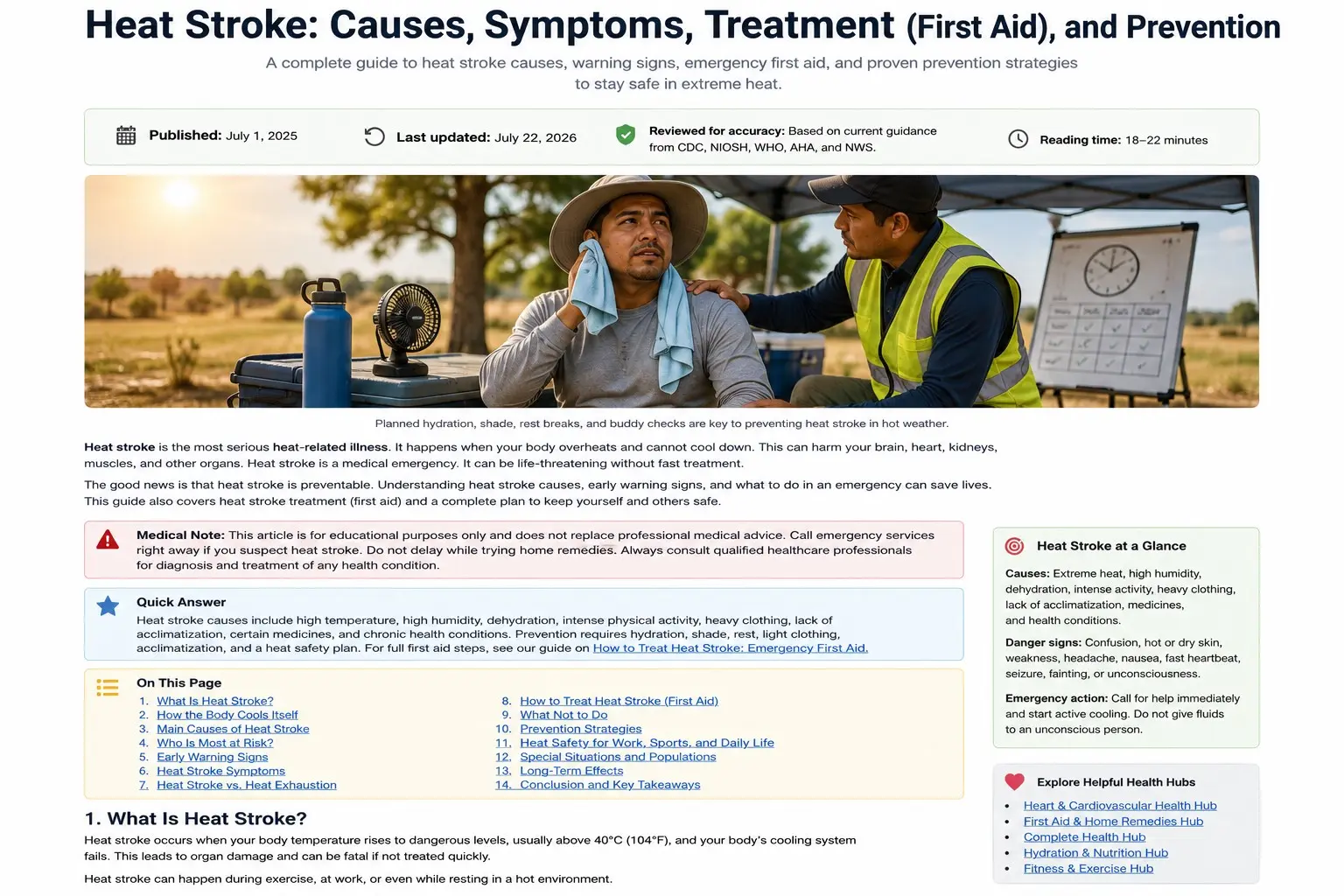
Published: July 1, 2025
Last updated: August 11, 2026
Next review: August 2027, or earlier if heat health guidance changes
Written by: Adel Galal, Founder and Lead Writer at NextFitLife
Review status: Written and source checked against current CDC, NIOSH, OSHA, WHO, and NHS heat health guidance. This article has not been medically reviewed by a doctor.
Reading time: About 20 minutes
Heat Stroke: Symptoms, Emergency Treatment, Causes and Prevention
Heat stroke is a medical emergency.
It happens when your body becomes dangerously hot and can no longer cool itself well enough.
The most important warning sign is a change in brain function after heat exposure.
A person may become confused. They may act strangely. Their speech may become unclear. They may stumble, have a seizure, faint, or become unconscious.
This can happen during outdoor work, exercise, sports, a heatwave, or even inside a very hot building.
A person with heat stroke may sweat heavily. Their skin may also become hot and dry.
Sweating does not rule out heat stroke.
If you think someone has heat stroke, call emergency services and start rapid cooling right away.
Do not wait for a thermometer reading.
Do not wait for the person to stop sweating.
Do not try to treat suspected heat stroke with fever medicine, salt tablets, alcohol, herbs, or rest alone.
In this updated guide, I bring together my research on heat stroke symptoms, heat stroke causes, emergency treatment, recovery, risk factors, and prevention into one clear resource.
For more practical safety guidance, visit the First Aid and Home Remedies Hub and the Complete Health Hub.
Medical Notice
This content is for general educational purposes and does not replace professional medical advice, diagnosis, or treatment. Consult an appropriately qualified healthcare professional for personal medical concerns. This article explains published guidance and does not provide a personal clinical assessment. Always consult qualified medical professionals for diagnosis and treatment of any health condition.
Heat stroke can cause death or permanent injury. If a person has confusion, unusual behavior, slurred speech, a seizure, fainting, collapse, or unconsciousness after heat exposure, call emergency services and start cooling immediately.
Quick Answer: What Should You Do for Heat Stroke?
If heat stroke is possible:
- Call emergency services now.
- Move the person out of the heat.
- Remove excess clothing and heavy equipment.
- Start rapid whole body cooling.
- Use cold water immersion when it is available and safe.
- If immersion is not possible, wet the skin and clothing with cool water and fan the person.
- Add cold wet towels or wrapped ice packs to the neck, armpits, trunk, and groin.
- Stay with the person.
- Watch their breathing and responsiveness.
- Follow emergency dispatcher instructions.
Do not force food or drinks into someone who is confused, very sleepy, vomiting, having a seizure, unconscious, or unable to swallow safely.
What Is Heat Stroke?
Heat stroke is the most dangerous type of heat illness.
Your body becomes dangerously hot.
Your normal cooling system can no longer keep up.
Brain function starts to change.
Core body temperature is often around 40°C or 104°F or higher.
But you do not need a thermometer reading before taking action.
If someone becomes confused, has a seizure, faints, or loses consciousness after major heat exposure, treat the situation as an emergency.
Heat stroke can damage the brain, kidneys, liver, heart, muscles, lungs, and blood clotting system.
Fast cooling can save a life.
How Does the Body Normally Cool Itself?
Your body makes heat every day.
Exercise and physical work make even more heat.
The body normally loses heat in several ways.
- Sweating
- Evaporation
- More blood flow to the skin
- Moving air across the skin
- Contact with cooler air or water
- Reducing physical effort
These systems work less well when the environment becomes very hot.
High humidity makes sweating less effective because sweat cannot evaporate as easily.
Heavy clothing can trap heat.
Protective equipment can also slow heat loss.
When your body gains and makes heat faster than it can lose heat, your core temperature can rise quickly.
Heat Stroke Symptoms and Warning Signs
The most important heat stroke symptoms involve the brain.
Watch for:
- Confusion
- Disorientation
- Strange behavior
- Slurred speech
- Poor balance
- Poor coordination
- Seizure
- Fainting
- Collapse
- Loss of consciousness
Other possible signs include:
- Very high body temperature
- Hot skin
- Heavy sweating
- Dry skin
- Fast breathing
- Rapid heartbeat
- Headache
- Nausea
- Vomiting
- Severe weakness
Do not wait for every symptom to appear.
Altered mental status after strong heat exposure is a major emergency warning sign.
Heat can also place extra strain on the heart and kidneys.
For related warning signs, read Signs of a Heart Attack and Kidney Disease Symptoms.
Can You Have Heat Stroke While Sweating?
Yes.
This is an important myth to correct.
A person with heat stroke does not always have dry skin.
Heavy sweating is common in exertional heat stroke.
This form often happens during hard exercise, sports, military training, construction work, farming, firefighting, or other intense activity.
Do not use sweating as a test for heat stroke.
Look at the person's brain function, heat exposure, activity level, and the full situation.
Heat Exhaustion Compared With Heat Stroke
Heat exhaustion is serious.
But it is not the same as heat stroke.
| Feature | Heat Exhaustion | Heat Stroke |
|---|---|---|
| Mental state | Usually alert, but may feel weak or dizzy | Confusion, seizure, fainting, or unconsciousness may occur |
| Sweating | Often heavy | May be heavy or may stop |
| Skin | Often pale or clammy | Often very hot |
| Temperature | May be raised | Often very high, but do not wait for a measurement |
| Response | Move to a cool area, cool the body, rest, and give fluids if fully alert | Call emergency services and begin rapid cooling |
Heat Exhaustion Symptoms
Possible signs include:
- Heavy sweating
- Headache
- Dizziness
- Weakness
- Nausea
- Vomiting
- Thirst
- Muscle cramps
- Irritability
- Fast heartbeat
- Reduced urine
Move the person to a cool place.
Remove unnecessary clothing.
Cool their skin.
If the person is fully awake and can swallow normally, offer cool fluids.
If the person becomes confused, faints, has a seizure, becomes less responsive, or does not improve with cooling, get urgent medical help.
Emergency Heat Stroke Treatment
People often search online for how to cure heat stroke.
But heat stroke should never be treated as a home cure problem.
It needs emergency first aid, immediate cooling, and medical care.
Step 1: Call Emergency Services
Call your local emergency number immediately.
Do not wait to see if the person gets better.
Step 2: Move the Person Out of the Heat
Move the person into deep shade, air conditioning, or another cooler location.
Get them away from hot surfaces and direct sun when possible.
Step 3: Remove Excess Clothing
Remove jackets, helmets, pads, outer uniforms, and other unnecessary layers.
This helps heat leave the body.
Step 4: Start Rapid Cooling
Do not wait for an ambulance before cooling begins.
Use the fastest safe cooling method available.
Cold water immersion is one of the most effective methods, especially for exertional heat stroke.
If immersion is not possible:
- Wet the skin and clothing with cool water
- Fan the person continuously
- Use a cool shower when practical
- Place cold wet towels on the body
- Use wrapped cold packs on the neck, armpits, trunk, and groin
Step 5: Stay With the Person
Heat illness can become worse very quickly.
Never leave the person alone.
Step 6: Watch Breathing and Responsiveness
Follow instructions from the emergency dispatcher.
If the person stops breathing normally, follow dispatcher instructions and begin CPR if you are trained and able to do so.
Is Cold Water Immersion Best for Heat Stroke?
Cold water immersion is one of the fastest ways to cool a person with exertional heat stroke.
Rapid cooling is especially important because the risk of organ damage rises when dangerous body heat continues.
If a suitable tub or container is ready and trained helpers can use it safely, immerse as much of the person's body as possible while keeping their head and airway safe.
Keep watching their breathing and responsiveness.
Emergency services must still be called.
If cold water immersion is not possible, do not waste time searching for a tub.
Start another cooling method.
Wet the person.
Fan them.
Add cold wet towels.
Use wrapped cold packs.
The key idea is simple.
Start cooling now.
What Not to Do for Heat Stroke
A few common actions can waste valuable time or cause harm.
- Do not wait for a thermometer reading
- Do not leave the person alone
- Do not use fever medicine
- Do not give acetaminophen or paracetamol for heat stroke
- Do not give aspirin to treat heat stroke
- Do not give ibuprofen to treat heat stroke
- Do not use alcohol rubs
- Do not give salt tablets
- Do not use herbal remedies
- Do not force fluids into a confused person
- Do not make a very sleepy or vomiting person drink
- Do not delay cooling while waiting for emergency help
- Do not assume sweating means the person is safe
Heat stroke is not the same as a fever caused by an infection.
Fever medicine does not correct dangerous overheating.
Main Heat Stroke Causes
Heat stroke causes often work together.
It is rarely caused by only one thing.
1. Extreme Heat
Very hot air makes it harder for the body to lose heat.
Danger can happen outdoors or indoors.
2. High Humidity
Sweat cools your body when it evaporates.
High humidity slows evaporation.
You may sweat heavily and still overheat.
3. Intense Exercise or Physical Work
Working muscles produce heat.
Running, football, construction, farming, delivery work, firefighting, and military training can raise core temperature quickly.
4. Dehydration
Dehydration can reduce blood volume and make cooling harder.
But water alone does not prevent every case.
A well hydrated person can still develop heat stroke during extreme heat or intense physical activity.
5. Heavy Clothing and Protective Equipment
Helmets, pads, uniforms, protective suits, and heavy clothing can trap body heat.
They can also slow sweat evaporation.
6. Lack of Heat Acclimatization
People who are new to hot conditions are at higher risk.
This includes new workers, travelers, athletes starting summer training, and people returning after time away.
7. Too Few Rest Breaks
Continuous work can make body heat rise faster than it can fall.
Rest and cooling breaks become more important as heat, humidity, workload, and protective clothing increase.
8. Hot Indoor Conditions
Heat stroke can happen inside homes, warehouses, kitchens, factories, vehicles, and other hot spaces.
Several hot days and nights can make indoor heat even more dangerous.
9. Alcohol and Stimulants
Alcohol can affect hydration, judgment, and normal heat control.
Stimulants may increase heart rate, activity, and heat production.
10. Health Conditions
Heart disease, kidney disease, diabetes, lung disease, neurologic disease, mental health conditions, and other chronic conditions can increase heat risk.
Why Humidity Makes Heat More Dangerous
Air temperature does not tell the whole story.
Humidity matters because sweat must evaporate to cool the body.
Direct sun matters too.
So do wind, clothing, workload, health, and time spent in the heat.
The heat index combines air temperature and humidity.
It can help you understand heat risk.
Some workplaces use wet bulb globe temperature because it can provide a fuller picture of occupational heat stress.
Do not wait for an official heatwave declaration before taking precautions.
Exertional Heat Stroke and Classic Heat Stroke
Exertional Heat Stroke
Exertional heat stroke happens during hard physical activity.
It often affects:
- Athletes
- Outdoor workers
- Military personnel
- Firefighters
- People wearing heavy protective equipment
It can develop very quickly.
Heavy sweating is common.
Classic Heat Stroke
Classic heat stroke usually develops during long exposure to environmental heat.
It is common during heatwaves.
It often affects:
- Older adults
- Infants
- People with chronic illness
- People taking medicines that affect heat tolerance
- People without access to effective cooling
Both forms are medical emergencies.
Who Is Most at Risk of Heat Stroke?
Anyone can develop heat stroke.
Some people have a higher risk.
Older Adults
Older adults may not adjust to sudden heat as well.
They may also have chronic disease or take medicines that affect sweating, thirst, circulation, or fluid balance.
Infants and Young Children
Young children depend on adults for shade, fluids, clothing, and safe activity times.
Never leave a child inside a parked vehicle.
Pregnant People
Pregnancy changes circulation and fluid needs.
Very hot conditions can place additional stress on the body.
Athletes
Hard training, competition pressure, uniforms, heavy equipment, and poor acclimatization can increase heat load.
Outdoor and Indoor Workers
Construction workers, farm workers, warehouse workers, kitchen staff, delivery workers, firefighters, and many others can face high heat stress.
People With Chronic Health Conditions
Risk can be higher with heart disease, kidney disease, diabetes, respiratory disease, neurologic conditions, mental health conditions, and obesity.
Visit the Heart and Cardiovascular Health Hub, Kidney Health and Disease Hub, and Diabetes and Blood Sugar Management Hub for related health guidance.
Medicines That May Increase Heat Risk
Heat can interact with medicines.
Some medicines can affect sweating, thirst, alertness, circulation, kidney function, or fluid balance.
Examples can include:
- Diuretics
- Some blood pressure medicines
- Anticholinergic medicines
- Some antidepressants
- Some antipsychotic medicines
- Some antihistamines
- Stimulants
- Some medicines that affect kidney function
- Some medicines that cause sedation
The risk is not the same for every medicine or every person.
Do not stop a prescribed medicine because the weather is hot.
Ask your doctor or pharmacist how your medicines may affect heat tolerance.
It can help to make a personal heat action plan before very hot weather begins.
If you take medicine for hypertension, read How to Lower Blood Pressure Safely.
Possible Heat Stroke Complications
Heat stroke can damage several organs at the same time.
Possible complications include:
- Brain injury
- Seizures
- Kidney injury
- Liver injury
- Muscle breakdown
- Abnormal heart rhythms
- Low blood pressure
- Shock
- Blood clotting problems
- Bleeding problems
- Breathing failure
- Coma
- Death
Organ damage may continue even after body temperature begins to fall.
Anyone with suspected heat stroke needs medical evaluation.
How Long Does Heat Stroke Recovery Take?
There is no single recovery time.
Some people recover quickly.
Others need days or weeks.
Severe cases can cause lasting problems.
Recovery can depend on:
- How high the body temperature became
- How long the overheating lasted
- How quickly cooling started
- Whether the brain or organs were injured
- Age
- Other health conditions
A person who has had heat stroke should not simply return to hard work or sport because they feel better.
A healthcare professional should guide the return to activity.
How to Prevent Heat Stroke
Heat stroke prevention works best when several actions are used together.
Water matters.
But water alone is not enough.
Check Heat Conditions
Check temperature and humidity before outdoor activity.
Also think about direct sunlight, wind, your activity level, clothing, and how long you will be exposed.
Move Activity to Cooler Hours
Early morning or evening may be safer than the hottest part of the day.
Take Planned Rest Breaks
Do not wait until you feel sick.
Take more breaks as heat, humidity, and physical effort increase.
Drink Regularly
Drink enough for your activity and personal medical needs.
Do not wait for severe thirst.
People with heart disease, kidney disease, or fluid restrictions need personal medical advice.
Wear Light Clothing When Possible
Loose and breathable clothing helps heat leave the body.
Required safety equipment should still be used.
Use Real Cooling
Shade can help.
Air conditioning can be especially important during extreme indoor heat.
Cool showers and baths can also help reduce body heat.
Use a Buddy System
Heat stroke can affect judgment.
A coworker, teammate, friend, or family member may notice confusion before the affected person does.
Avoid Alcohol Before Major Heat Exposure
Alcohol can affect hydration and judgment.
Review Medicines Before Hot Weather
Ask your doctor or pharmacist whether you need extra heat precautions.
Never Leave Anyone in a Parked Vehicle
A parked vehicle can become dangerously hot very quickly.
Partly open windows do not make it safe.
For broader health habits, visit the Healthy Lifestyle Roadmap.
Heat Acclimatization
Heat acclimatization means giving your body time to adapt to hot conditions.
Adaptation usually develops over about 7 to 14 days.
New workers and athletes should increase heat exposure gradually.
People returning after illness, vacation, or a long period in cooler conditions may need to adapt again.
Acclimatization can improve sweating and circulation.
But it does not make anyone immune to heat stroke.
Heat Stroke Prevention for Workers
Workplace heat safety should use more than personal responsibility.
A strong heat plan can include:
- Cool drinking water
- Planned rest breaks
- Shade
- Cooled recovery spaces
- Heat monitoring
- Workload changes
- Heat acclimatization
- Worker and supervisor training
- A buddy system
- Emergency communication
- Cooling equipment
- Extra protection for new workers
Workers should be able to report symptoms and stop work when they feel ill.
Do not pressure someone with heat illness symptoms to keep working.
Heat Stroke Prevention for Athletes
Athletes can be very fit and still develop heat stroke.
Useful prevention steps include:
- Train during cooler hours
- Increase intensity gradually
- Use a heat acclimatization plan
- Provide easy access to water
- Provide cooling areas
- Adjust activity during dangerous conditions
- Watch teammates for behavior changes
- Prepare an emergency plan
- Have rapid cooling equipment ready during high risk events
If extreme heat makes outdoor exercise unsafe, move the session indoors.
Older readers may also find our Walking Exercise for Seniors guide useful.
Heatwave Safety at Home
Heatwave safety matters indoors too.
A hot home can become dangerous over several days.
Try these steps:
- Use air conditioning when available
- Spend time in a cooled public place if your home becomes too hot
- Close blinds or curtains when strong sun hits the windows
- Open windows when outside air becomes cooler than inside air
- Sleep in the coolest safe room
- Reduce use of ovens and other heat producing appliances
- Take cool showers or baths
- Drink regularly according to your medical needs
- Check on people who live alone
Fans can improve comfort and evaporation.
But a fan alone may not make an extremely hot room safe.
Protecting Children and Older Adults
Children
- Never leave a child in a parked car
- Schedule outdoor play during cooler hours
- Provide frequent water breaks
- Use shade
- Choose light clothing
- Watch for vomiting
- Watch for unusual sleepiness
- Watch for weakness or confusion
- Do not cover a stroller in a way that blocks airflow
Older Adults
- Check in often during extreme heat
- Make sure there is access to a cool place
- Review medicine and hydration plans
- Watch for weakness
- Watch for falls
- Watch for confusion
- Watch for reduced urine
- Watch for poor appetite
- Arrange transport to a cooler location before indoor heat becomes dangerous
Common Heat Stroke Myths
Myth: Dehydration Is the Only Cause
False.
Dehydration can raise the risk.
But temperature, humidity, exercise, clothing, health conditions, medicines, and poor acclimatization matter too.
Myth: Heat Stroke Only Happens in Direct Sun
False.
Heat stroke can happen in hot homes, factories, kitchens, warehouses, and vehicles.
Myth: Sweating Means It Is Not Heat Stroke
False.
People with exertional heat stroke may sweat heavily.
Myth: Fit People Cannot Get Heat Stroke
False.
Highly trained athletes can develop heat stroke.
Myth: Drinking Water Prevents Every Case
False.
Hydration is only one part of prevention.
Myth: You Must Measure 104°F Before Calling for Help
False.
Do not wait for a thermometer when someone develops major brain symptoms after heat exposure.
Myth: Fever Medicine Treats Heat Stroke
False.
Heat stroke is not the same as an infectious fever.
Myth: Sunscreen Prevents Heat Stroke
False.
Sunscreen helps protect your skin from ultraviolet damage.
It does not stop dangerous internal overheating.
Myth: Fans Always Prevent Heat Stroke
False.
Fans can help with comfort and evaporation.
But they may not provide enough protection during extreme indoor heat.
Myth: A Person Can Return to Sport Right After Cooling Down
False.
Suspected heat stroke needs medical evaluation and a safe return plan.
Questions to Ask Your Healthcare Professional
- Do any of my medicines increase heat risk?
- How much should I drink in very hot weather?
- Do I need to limit fluids because of my heart or kidneys?
- Are electrolyte drinks safe for me?
- How should I change exercise during extreme heat?
- What symptoms mean I should stop activity?
- When can I safely return to exercise after heat illness?
- Do I need a personal heat action plan?
Conclusion
Heat stroke is one of the most serious heat emergencies.
It can happen during exercise, work, a heatwave, or extreme indoor heat.
Confusion, strange behavior, slurred speech, seizure, fainting, or unconsciousness after heat exposure are major warning signs.
Call emergency services and start rapid cooling immediately.
Prevention is also powerful.
Use shade, cooling, water, rest breaks, safer schedules, a buddy system, and heat acclimatization.
Call to action: Before your next hot day, make a simple heat safety plan for yourself, your family, or your workplace. If heat stroke is suspected, act fast and start cooling while emergency help is coming.
References and Sources
Internal Links and Related Hubs
Emergency and Heart Health Guides
- Signs of a Heart Attack
- Heart Failure Symptoms
- Kidney Disease Symptoms
- How to Lower Blood Pressure Safely
- High Cholesterol Symptoms, Causes and Treatment
Prevention and Activity Guides
- Healthy Lifestyle Roadmap
- Improve Health With a Busy Schedule
- Walking Exercise for Seniors
- How to Check Heart Health at Home
NextFitLife Health Hubs
Frequently Asked Questions About Heat Stroke
What is the first sign of heat stroke?
There is no single first sign. A change in brain function after heat exposure is especially important. Confusion, strange behavior, slurred speech, poor coordination, seizure, or fainting can signal heat stroke.
What causes heat stroke?
Heat stroke happens when environmental heat and heat made by the body become greater than the body can release. Heat, humidity, hard activity, clothing, dehydration, poor acclimatization, medicines, and health conditions can all increase risk.
Can dehydration cause heat stroke?
Dehydration can raise heat stroke risk. But a well hydrated person can still develop heat stroke during extreme heat or intense activity.
Can heat stroke happen indoors?
Yes. Hot homes, factories, warehouses, kitchens, vehicles, and other indoor spaces can become dangerous.
Can you have heat stroke while sweating?
Yes. Heavy sweating is common in exertional heat stroke. Sweating does not rule out the condition.
What is the difference between heat exhaustion and heat stroke?
Heat exhaustion can cause heavy sweating, weakness, headache, nausea, thirst, and dizziness while the person usually remains alert. Heat stroke can cause confusion, seizure, fainting, or unconsciousness and is an emergency.
How do you treat heat stroke?
Call emergency services, move the person out of the heat, remove excess clothing, and begin rapid cooling immediately. Cold water immersion is very effective when it is available and can be done safely.
Can heat stroke be cured at home?
No. Suspected heat stroke needs emergency medical care. First aid cooling should begin immediately while emergency help is coming.
Should you give water to someone with heat stroke?
Do not force drinks into anyone who is confused, very sleepy, vomiting, having a seizure, unconscious, or unable to swallow safely. Follow emergency dispatcher instructions.
Does fever medicine help heat stroke?
No. Heat stroke is not an infectious fever. Fever medicine does not correct dangerous overheating.
Is cold water immersion safe for heat stroke?
Cold water immersion is a preferred rapid cooling method for exertional heat stroke when it can be done safely while protecting the person's airway and monitoring them closely.
Who is at highest risk of heat stroke?
Older adults, infants, pregnant people, athletes, workers in hot conditions, people with chronic health problems, and people taking certain medicines can have higher risk.
How long does heat acclimatization take?
Heat acclimatization often develops gradually over about 7 to 14 days. New and returning workers or athletes should increase heat exposure slowly.
How can heat stroke be prevented?
Check heat conditions, drink regularly, use shade and cooling, take rest breaks, move activity to cooler hours, wear suitable clothing, use a buddy system, and build heat exposure gradually.
How long does heat stroke last?
There is no fixed recovery time. Some people improve in days, while severe heat stroke can require much longer recovery and medical follow up.
Can someone exercise again after heat stroke?
Not without medical guidance. A person who has had heat stroke should receive medical evaluation and a supervised plan before returning to hard work or sport.

Health & wellness writer with 30+ years of experience in nutrition, fitness, and healthy aging. Founder of NextFitLife.com — evidence-based health guidance.