Published: October 3, 2026
Written and Source Checked by: Adel Galal, Founder and Lead Writer at NextFitLife
Review Status: This article has not been medically reviewed by a doctor, physiotherapist, sports medicine physician, or certified strength professional.
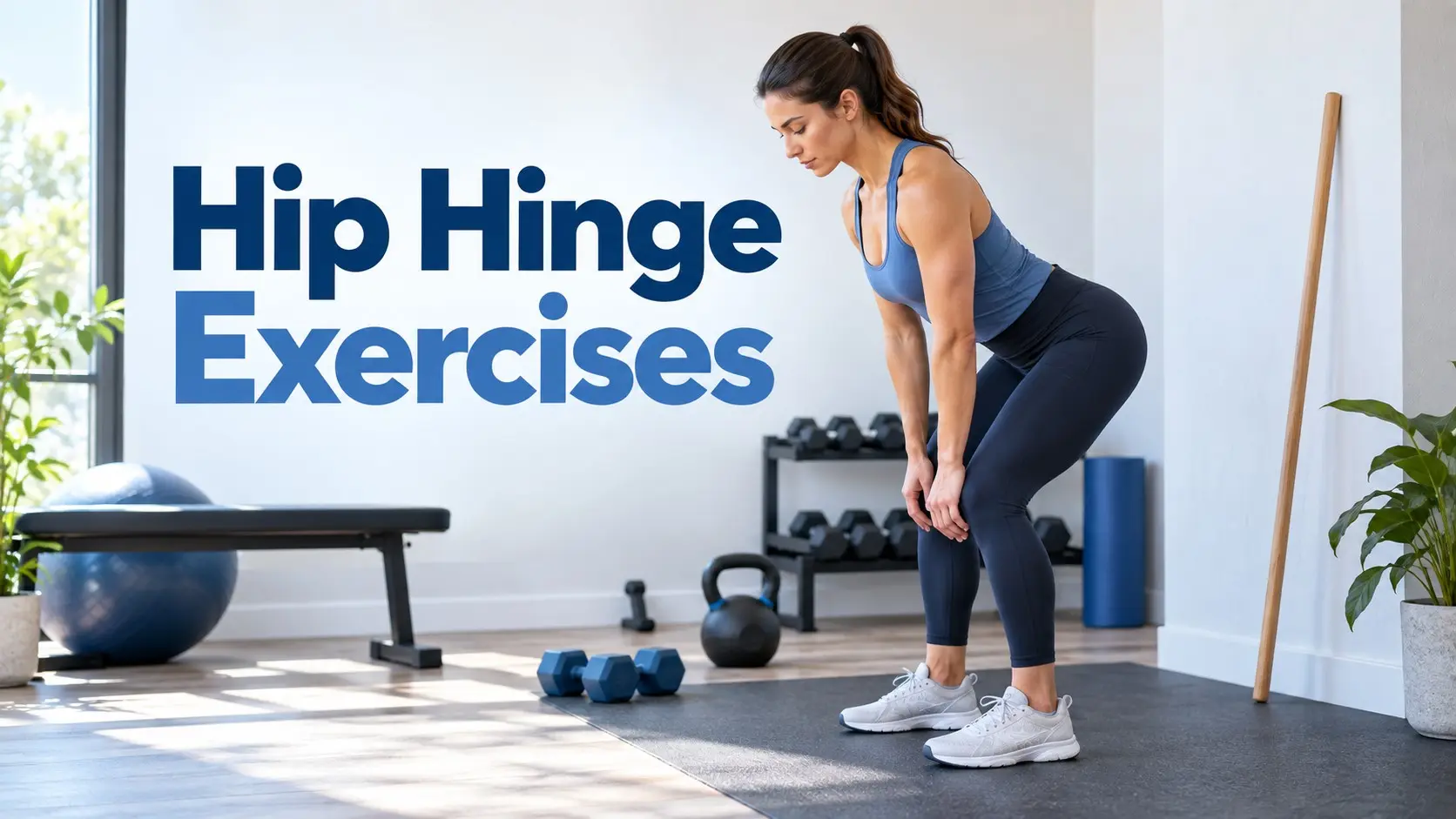
A hip hinge is not a squat, and it is not simply bending toward the floor. Push your hips backward, let your torso tip forward from the hip joints, keep your knees softly bent, and stop when you can no longer hold the movement with control.
Learn that pattern first. Then load it.
Quick answer: Hip hinge exercises teach the pattern used in Romanian deadlifts, deadlifts, cable pull throughs, and kettlebell swings. Beginners should start with wall and dowel drills, then use bodyweight and light resistance. Add more load only when the hips move backward cleanly without turning the exercise into a squat or losing control.
If you are new to strength work, start with the NextFitLife Strength Training Exercises at Home for Beginners Guide. For equipment based training, visit the Home Workouts and Equipment Hub.
Health note: This content is for general educational purposes and does not replace professional medical advice, diagnosis, or treatment. Consult an appropriately qualified healthcare professional for personal medical concerns. This article explains published guidance and does not provide a personal clinical assessment. Always consult qualified medical professionals for diagnosis and treatment of any health condition.
If you have current back or hip pain, recent surgery, a fracture, osteoporosis, unexplained weakness, persistent numbness or tingling, or movement restrictions from a healthcare professional, use individual guidance rather than a general exercise article.
Table of Contents
- What a hip hinge actually is
- Hip hinge versus squat
- Where you should feel the movement
- 7 beginner hip hinge exercises
- Wall hip hinge
- Dowel hip hinge
- Bodyweight hip hinge
- Elevated dumbbell or kettlebell deadlift
- Dumbbell Romanian deadlift
- Cable or band pull through
- Kettlebell deadlift
- The readiness test before adding weight
- Common hip hinge mistakes
- Exercises beginners should delay
- How much weight to use
- Sets and repetitions
- Lower back safety
- When pain means stop
- References and Sources
- Related NextFitLife guides
- About the author
- Frequently asked questions
What Is a Hip Hinge?
Stand up and place your fingers where the tops of your thighs meet your pelvis.
That crease is where most of the movement should happen.
During a hip hinge, the pelvis travels backward while the torso tips forward. The knees bend a little, but the hips do most of the movement.
The pattern is used in exercises such as the Romanian deadlift, many deadlift variations, good mornings, cable pull throughs, and kettlebell swings.
The University of Florida IFAS Extension teaches the same basic idea: move the hips backward first, keep the movement controlled, and use a wall or dowel when learning the pattern.
Your glutes and hamstrings produce much of the hip extension work, while muscles around the trunk help control the torso.
Together, the muscles along the back side of the body are commonly called the posterior chain.
For more focused posterior thigh work, see the NextFitLife Hamstring Exercises Guide.
Hip Hinge Versus Squat: What Is the Difference?
Beginners mix these patterns all the time.
A squat sends the hips down and back while the knees bend a lot. A hinge sends the hips mainly backward while the knees stay softly bent.
| Feature | Hip Hinge | Squat |
|---|---|---|
| Main direction | Hips move mainly backward | Hips move down and back |
| Knee bend | Small to moderate | Usually much greater |
| Shin movement | Often stays closer to vertical | Usually travels farther forward |
| Main emphasis | Hip extensors and posterior chain | Hips and knees together, with more knee extensor demand |
| Common example | Romanian deadlift | Goblet squat |
Research comparing squats and Romanian deadlifts supports this difference in joint and muscle demands.
Neither movement is better.
They train different jobs.
You can explore both patterns in our Leg Exercises With Dumbbells Guide.
The First Cue I Would Teach: Push the Hips Back
Do not begin by thinking, “bend forward.”
That cue makes many beginners fold through the waist while the hips barely move.
Think about pushing your backside toward something behind you.
Imagine closing a car door with your hips because both hands are full.
Your torso moves forward because your pelvis moves backward.
That is a much cleaner starting idea.
Where Should You Feel a Hip Hinge?
You will usually feel tension through the back of the thighs as your hips travel backward.
That is your hamstrings lengthening under the position.
Your glutes help extend the hips as you return to standing.
Your trunk muscles also work to control your torso.
Do not expect a bodyweight hinge to create a huge muscle burn. It is a movement drill first.
What if You Feel Only Your Quads?
You are probably turning the hinge into a squat.
Watch the knees.
If they keep moving forward while the hips drop downward, reduce the knee bend and reach the hips farther behind you.
What if You Feel Only Your Lower Back?
First, shorten the movement.
A common mistake is continuing downward after the hips have stopped moving backward.
Return to the wall drill and stop the range earlier.
Also avoid trying to arch your lower back as hard as possible.
A controlled hinge should not become a backbend.
What if You Barely Feel Your Hamstrings?
Slow the movement.
Check whether the knees keep bending as you descend, because that can reduce the hamstring stretch.
Then make sure the hips are actually traveling backward.
Body proportions and flexibility vary, so sensation alone is not a perfect technique test.
7 Hip Hinge Exercises for Beginners
The exercises are arranged in the order I would teach them.
Do not rush through all seven in one workout.
Progress when the earlier pattern feels repeatable.
1. Wall Hip Hinge
The wall hip hinge teaches the direction of the movement without adding weight.
How to Do It
- Stand with your back toward a wall.
- Start about 6 to 12 inches away.
- Place your feet around hip width.
- Soften your knees.
- Push your hips backward until your backside touches the wall.
- Stand tall again.
Do not sit down toward the floor.
Do not throw your chest toward your knees.
Think about reaching backward.
How to Progress It
Move a small step farther from the wall.
Reach the wall again without turning the movement into a squat.
If you have to sit much lower to touch the wall, step closer again.
2. Dowel Hip Hinge
The wall teaches your hips where to go.
The dowel hip hinge gives feedback about your trunk.
Use a broomstick, PVC pipe, or another light straight object.
Set Up Three Contact Points
- Back of the head
- Upper or middle back
- Pelvis
Hold the dowel in place and hinge slowly.
Try to keep those three contacts while the pelvis moves backward.
If the stick pulls far away from the pelvis, your trunk position is changing.
If your head pulls away, you may be lifting or dropping your head instead of letting it follow your torso.
Does Your Spine Have to Be Perfectly Neutral?
This needs more nuance than most beginner articles give it.
A comfortable, relatively stable trunk is a useful coaching goal when you are first learning a loaded hinge. It makes the pattern easier to repeat and the dowel gives simple feedback.
That does not mean the human spine becomes injured the moment it moves away from one exact visual position.
A 2026 review of deadlifting and lower back injury prevention argued that injury risk is more complex than one posture rule. Training exposure, load management, fatigue, movement control, individual capacity, and technique all matter.
So my beginner recommendation stays simple:
Learn to control your trunk before chasing heavier loads.
That is coaching advice, not a claim that your spine is fragile.
3. Bodyweight Hip Hinge
Now remove the wall and dowel.
How to Do It
- Stand tall with feet around hip width.
- Keep the knees softly bent.
- Push the hips backward.
- Let the torso tip forward as the pelvis moves back.
- Keep the feet planted.
- Stop when the hips no longer move backward comfortably.
- Extend the hips and return to standing.
Do not chase the floor.
Your range ends where your controlled hinge ends.
This becomes very important once dumbbells enter the exercise.
4. Elevated Dumbbell or Kettlebell Deadlift
This is my preferred first loaded variation for many beginners.
Instead of forcing the weight to start on the floor, place one kettlebell or dumbbell on a stable raised surface.
How to Do It
- Stand close to the weight.
- Push the hips backward.
- Bend the knees enough to reach the handle comfortably.
- Grip the weight.
- Keep it close to your body.
- Stand up under control.
- Hinge again to put it back down.
The elevated position reduces how far you need to reach.
If your pattern stays clean, the starting position can gradually become lower.
The floor is not automatically the right starting height for every beginner.
5. Dumbbell Romanian Deadlift
The dumbbell RDL is the loaded hinge I would want most beginners to learn well.
How to Do It
- Hold light dumbbells in front of your thighs.
- Stand tall with the knees softly bent.
- Push your hips backward.
- Keep the dumbbells close to your thighs and legs.
- Lower only as far as your controlled hinge allows.
- Press the floor away and extend your hips to stand.
The Romanian deadlift is a hip dominant exercise with lower knee demand than a conventional deadlift.
It places meaningful demand on the hamstrings and hip extensors.
Start light enough that the dumbbells do not change the movement you learned without weight.
For more dumbbell lower body variations, use our Dumbbell Glute Exercises Guide.
How Low Should a Romanian Deadlift Go?
Only as low as your hinge allows.
This is one of the most useful rules in the whole article.
Your hands follow your torso. If your hips stop traveling backward and the only way to lower the weights farther is to change the movement, your repetition has already reached its useful bottom.
Some people reach the upper shin.
Others stop near the knees.
Body proportions and mobility differ.
There is no prize for touching the dumbbells to the floor.
6. Cable or Band Pull Through
A cable or band pull through changes where the resistance comes from.
That can make the hip direction easier to feel.
How to Do It
- Set a cable low or attach a resistance band securely behind you.
- Face away from the anchor.
- Hold the handle or band between your legs.
- Walk forward until there is gentle tension.
- Push the hips backward toward the anchor.
- Extend the hips to stand.
- Keep the arms quiet.
The resistance should not pull you off balance.
Research comparing cable pull throughs, Romanian deadlifts, and other hinge patterns shows that they create different muscle recruitment profiles.
For a beginner, the main reason I like the pull through is simpler: the cable tells you which direction the hips should travel.
7. Kettlebell Deadlift
Once the earlier drills are repeatable, the kettlebell deadlift is a useful way to add more resistance.
How to Do It
- Place the kettlebell between your feet or slightly forward.
- Stand close enough that you do not have to reach.
- Push your hips backward.
- Bend the knees enough to reach the handle.
- Grip the kettlebell.
- Stand up with control.
- Return the kettlebell using the same hip back movement.
If the floor position changes your technique, raise the kettlebell on a stable platform.
Do not force a low start before you can control it.
Use This Readiness Check Before Adding More Weight
“Master the movement” is too vague.
I would want a beginner to perform about eight controlled bodyweight hinges and meet the following checkpoints.
| Checkpoint | Ready to Progress | Practice More |
|---|---|---|
| Hip movement | Hips clearly travel backward | Hips mostly drop downward |
| Knees | Stay softly bent | Keep moving forward into a squat |
| Feet | Stay planted | Toes or heels keep lifting |
| Trunk control | Position is repeatable | Shape changes sharply to gain more depth |
| Range | Stops where control ends | Forces extra depth to reach the floor |
| Tempo | Smooth from first rep to last | Gets faster or jerky as reps continue |
| Symptoms | Pain free | Sharp or worsening pain appears |
This is a practical coaching checklist, not a medical movement screen.
If the eighth repetition looks completely different from the first, repeat the drill before increasing resistance.
Five Hip Hinge Mistakes I Would Fix First
1. Squatting the Hinge
Your knees move forward while the hips travel down.
Go back to the wall and practice reaching backward.
2. Reaching Down Instead of Reaching Back
Your chest dives toward the floor before the pelvis moves.
Start the repetition with the hips.
3. Locking the Knees
A Romanian deadlift is not a locked knee toe touch.
Keep a small, comfortable knee bend.
4. Going Lower Than Your Hip Range
The weight keeps descending after the hips have stopped moving backward.
Stop sooner.
A shorter controlled repetition is more useful than extra depth you cannot own.
5. Loading Before the Pattern Is Repeatable
More weight makes a hinge harder.
It does not automatically teach a missing movement pattern.
Is a Glute Bridge a Hip Hinge Exercise?
Not in the same skill sense.
A glute bridge trains hip extension and strengthens muscles that matter for hinging.
That makes it a useful accessory.
But you are lying on the floor. You are not practicing the standing pattern of moving the pelvis backward while the torso tips forward.
I would not use a good bridge as proof that someone has learned a standing hinge.
Use bridges for strength. Use hinge drills to learn the hinge.
Which Hip Hinge Exercises Should Beginners Delay?
Kettlebell Swings
A swing is a fast, ballistic hinge.
Speed gives you less time to correct the pattern.
Learn a slow loaded hinge first.
Heavy Barbell Deadlifts
The barbell is not the problem.
The load is.
A beginner should be able to repeat the movement under light resistance before trying to lift heavily.
Barbell Good Mornings
Good mornings are useful, but the bar sits on the upper back.
I prefer a beginner to learn the Romanian deadlift first because the load is easier to adjust and put down.
Single Leg Romanian Deadlifts
This variation adds a large balance challenge.
That makes it harder to tell whether the problem is the hinge or the balance.
Own the two leg version first.
How Much Weight Should a Beginner Use?
Light enough that the weight does not change the movement.
There is no honest universal starting number in kilograms or pounds.
Body size, training history, equipment, coordination, previous sport experience, and current strength vary too much.
Choose a load that allows controlled repetitions from beginning to end.
The current 2026 American College of Sports Medicine position stand reinforces a simple point: progressive resistance training improves strength and physical function, and consistency matters more than complicated methods.
You can build gradually.
You do not need heavy training on day one.
How Many Sets and Reps Should You Do?
Learning drills do not need exhausting sets.
For the wall, dowel, and bodyweight hinge, try about five to eight slow repetitions at a time.
Two or three short practice sets are enough to work on the movement without letting fatigue turn it into something else.
Once you use a loaded RDL or deadlift as part of strength training, the exact prescription depends on your wider program and goal.
A beginner can start with one or two controlled sets and add work gradually.
The 2026 ACSM guidance also supports training all major muscle groups at least twice per week as a practical base for healthy adults.
A Simple Beginner Hip Hinge Practice Plan
| Stage | Exercise | Goal Before Moving On |
|---|---|---|
| 1 | Wall hip hinge | Reach backward without squatting down |
| 2 | Dowel hip hinge | Keep the three contact points comfortably |
| 3 | Bodyweight hinge | Repeat the movement without external feedback |
| 4 | Elevated deadlift | Control a light load without changing the pattern |
| 5 | Dumbbell Romanian deadlift | Control your own range and keep the weights close |
| 6 | Cable or band pull through | Handle resistance coming from behind |
| 7 | Kettlebell deadlift | Build load while keeping the pattern repeatable |
There is no rule that says each stage must last a week.
Some people understand the hinge quickly. Others need several practice sessions.
Move forward when the pattern earns it.
Can Hip Hinge Training Protect Your Lower Back?
I would not promise that.
Learning to use the hips effectively gives you another movement strategy and strengthens muscles involved in hip extension and trunk control.
That is useful.
But no single technique makes someone injury proof.
Deadlift based exercise has even been studied in selected people with mechanical lower back pain. A review found that exercise programs containing deadlifts could improve pain and function, but they were not clearly better than lower load motor control exercise.
The people who were better suited to deadlift based rehabilitation tended to have lower baseline pain and greater back extensor strength.
If you already have significant back pain, do not turn that research into a self prescribed heavy deadlift program.
Individual assessment matters.
When Should You Stop a Hip Hinge Exercise?
Muscular effort and a hamstring stretch are different from warning symptoms.
Stop the exercise and get appropriate guidance if you develop:
- Sharp or rapidly worsening back or hip pain
- New numbness or tingling
- New unexplained weakness
- Pain that travels down a leg
- Severe dizziness or faintness
- Chest pain
- Severe shortness of breath that is unusual for the effort
- Pain after a recent significant injury
If a qualified clinician has already given you lifting restrictions, those instructions take priority over this guide.
My Rule for Beginners
Remember one cue:
Push your hips back before you think about lowering the weight.
Use the wall.
Use the dowel.
Learn where your range ends, then add a light load and prove that the same pattern is still there.
Heavy lifting can wait.
For related educational guides, visit our Fitness Hub.
Conclusion
Hip hinge exercises become much easier when you treat the hinge as a skill before treating it as a strength test. Start with the wall and dowel, learn to send the hips backward, then progress through bodyweight work, light deadlifts, and Romanian deadlifts.
Your next step is simple: perform two sets of five to eight wall hinges today. If you can reach the wall without squatting down or losing balance, move to the dowel drill.
Earn the load instead of rushing to it.
References and Sources
- American College of Sports Medicine. Resistance Training Prescription for Muscle Function, Hypertrophy, and Physical Performance in Healthy Adults.
Published 2026.
https://pubmed.ncbi.nlm.nih.gov/41843416/ - University of Florida IFAS Extension. Functional Movement Series: The Hip Hinge.
Updated February 2, 2026.
https://blogs.ifas.ufl.edu/orangeco/2026/01/26/functional-movement-series-the-hip-hinge/ - Journal of Exercise Science and Fitness. An Electromyographic and Kinetic Comparison of Conventional and Romanian Deadlifts.
https://pubmed.ncbi.nlm.nih.gov/30662500/ - Sports. Beyond the Neutral Spine: A Narrative Review and Modern Framework for Low Back Injury Prevention in Deadlifting.
Published 2026.
https://pubmed.ncbi.nlm.nih.gov/42043083/ - Journal of Sport Rehabilitation. Effect of an Exercise Program That Includes Deadlifts on Low Back Pain.
https://pubmed.ncbi.nlm.nih.gov/33626500/
Continue Reading on NextFitLife
Use these guides to build the rest of your lower body and home strength program:
- Home Workouts and Equipment Hub
- Strength Training Exercises at Home for Beginners
- Leg Exercises With Dumbbells
- Hamstring Exercises
- Dumbbell Glute Exercises
- Yoga, Flexibility, Stretching and Mobility Hub
About the Author
Adel Galal is the founder and lead writer of NextFitLife. His personal study and practical interest in fitness, health, nutrition, strength training, mobility, recovery, and healthy aging spans more than 30 years.
His work focuses on turning exercise and health information into clear steps that beginners can use without extreme training claims or unnecessarily complicated routines.
Adel is not a doctor, physiotherapist, sports medicine physician, or certified strength and conditioning professional. NextFitLife content is informational and educational and does not replace individual medical or exercise care.
Learn more about Adel Galal, NextFitLife, and the site's editorial approach on the About Us page.
Frequently Asked Questions
What is a hip hinge exercise?
A hip hinge is a movement where the hips travel backward while the torso tips forward from the hip joints. The knees stay softly bent. Romanian deadlifts, deadlifts, cable pull throughs, and kettlebell swings use the pattern.
What are the best hip hinge exercises for beginners?
Start with wall hinges, dowel hinges, bodyweight hinges, elevated dumbbell or kettlebell deadlifts, light Romanian deadlifts, cable or band pull throughs, and kettlebell deadlifts.
How do I know if I am doing a hip hinge correctly?
Your hips should clearly move backward, your knees should stay softly bent, your feet should remain planted, and the movement should feel controlled. You should not need to squat deeply or force your torso toward the floor.
What is the difference between a hip hinge and a squat?
A hinge sends the hips mainly backward and uses less knee bend. A squat sends the hips down and back while the knees bend more. Romanian deadlifts are hinge dominant, while goblet squats are squat dominant.
Where should I feel a hip hinge?
You will commonly feel tension through the hamstrings as the hips move backward. The glutes work as you extend the hips and return to standing. The trunk muscles also help control your torso.
Why do I feel hip hinges in my lower back?
You may be moving farther than your controlled hip range, allowing the hips to stop while the torso keeps lowering, or using more load than you can control. Reduce the range and return to a wall or dowel drill.
Should my knees bend during a hip hinge?
Yes. Keep a small comfortable bend in the knees. A Romanian deadlift is not a locked knee toe touch, but it also should not turn into a deep squat.
How low should I go during a Romanian deadlift?
Stop when you reach the end of your controlled hip hinge. The dumbbells do not need to touch the floor. Your useful range depends on your body proportions, mobility, control, and current training level.
Is a glute bridge a hip hinge?
A glute bridge trains hip extension and useful hinge muscles, but it does not teach the standing hip back pattern. Use bridges as a strength exercise and standing drills to learn the actual hinge skill.
Should beginners do kettlebell swings?
Kettlebell swings are a fast hinge exercise. Beginners are better served learning a slow bodyweight and loaded hinge first, then adding speed after the pattern is repeatable.
How many hip hinge reps should a beginner do?
For learning drills, five to eight slow repetitions per set is a practical starting point. Two or three short practice sets let you work on the skill without excessive fatigue.
How heavy should a beginner Romanian deadlift be?
Use a load light enough that your movement looks the same as your bodyweight hinge. There is no universal starting weight because body size, experience, strength, and equipment differ.
Can hip hinge exercises help lower back pain?
Deadlift based exercise has improved pain and function in some selected people with mechanical low back pain, but it is not clearly superior to lower load exercise and is not appropriate for every person with back pain. Individual assessment matters.
When should I stop doing hip hinge exercises?
Stop and seek appropriate advice for sharp or worsening pain, new weakness, persistent numbness or tingling, pain traveling down the leg, severe dizziness, fainting, chest pain, or unusual severe shortness of breath.

Health & wellness writer with 30+ years of experience in nutrition, fitness, and healthy aging. Founder of NextFitLife.com — evidence-based health guidance.