Last Updated: May 2026 — Updated with 2026 WHO and NIH research.
Iron deficiency anemia is the most common nutritional deficiency in the world. The World Health Organization estimates it affects 1.62 billion people globally — roughly 25 percent of the entire world population. Yet despite its extraordinary prevalence, it remains one of the most commonly missed diagnoses. Most people who have it do not know it. And many who suspect it never get a blood test to confirm.
The reason is that the symptoms of iron deficiency anemia are so common and so easy to attribute to other causes — tiredness, poor concentration, feeling cold, low mood — that both patients and sometimes doctors dismiss them as normal life. They are not. They are your body's signals that one of its most fundamental biological processes is running short on fuel.
This guide explains iron deficiency anemia. You will find what iron deficiency anemia actually is, what causes it, the 8 most revealing signs, including several that most people never associate with iron, the best iron-rich foods to eat, how to maximize iron absorption, treatment options, and a practical recovery plan.
| 2026 KEY FACTS | Iron deficiency anemia affects 1.62 billion people globally — 25% of the world population (WHO) It is the most common single nutritional deficiency worldwide — more common than vitamin D deficiency. Women of reproductive age and children under 5 are at the highest risk Up to 40% of pregnant women globally are anemic — WHO Serum ferritin below 30 mcg/L indicates iron deficiency even before hemoglobin drops Iron deficiency without anemia (low ferritin, normal hemoglobin) is significantly underdiagnosed Oral iron supplementation corrects most cases within 3 to 6 months, but a diet change is needed to maintain levels |
What is iron deficiency anemia, and why does iron matter?
Iron deficiency anemia occurs when the body does not have enough iron to produce sufficient hemoglobin — the protein in red blood cells that carries oxygen from the lungs to every tissue in the body. Without adequate hemoglobin, red blood cells become smaller and paler than normal, and the oxygen supply to organs and muscles is reduced.
Iron is involved in far more than oxygen transport. It is essential for energy metabolism, immune function, cognitive development, thyroid hormone production, and the synthesis of neurotransmitters, including dopamine and serotonin. This explains why iron deficiency affects mood, thinking, energy, immune resilience, and even hair growth simultaneously.
There is an important distinction between iron deficiency and iron deficiency anemia. Iron deficiency refers to depleted iron stores (low ferritin) before hemoglobin has dropped. Many people have significant symptoms at this stage without technically having anemia. Waiting for hemoglobin to drop before treating iron deficiency means waiting for the condition to become more severe than necessary.
What causes iron deficiency anemia? The 6 Main Causes
Understanding what causes iron deficiency, the first step is to treat it correctly and prevent recurrence. The cause determines which treatment approach is most important.
Cause 1- Inadequate iron intake
Not consuming enough iron-rich foods is the most common cause globally. Vegetarian and vegan diets are particularly at risk because plant-based iron (non-haem iron) is absorbed at only 2 to 20 percent efficiency — significantly lower than the 15 to 35 percent absorption rate of haem iron from meat and fish. People following plant-based diets need approximately 1.8 times more dietary iron than meat eaters to achieve the same amount absorbed.
Cause 2- Blood Loss - The Most Common Cause in Women
Heavy menstrual bleeding is the most common single cause of iron deficiency in women of reproductive age. A woman with heavy periods can lose 80 to 120ml of blood per cycle — enough to deplete iron stores over months, even with a reasonable diet. This is why iron deficiency is dramatically more common in premenopausal women than in men of the same age.
Other sources of chronic blood loss include gastrointestinal bleeding from peptic ulcers, polyps, inflammatory bowel disease, or — importantly — regular use of NSAIDs like ibuprofen or aspirin, which can cause chronic microscopic gut bleeding. Unexplained iron deficiency in men or postmenopausal women always requires investigation for gastrointestinal bleeding before attributing it to diet alone.
Cause 3- Poor Absorption
Even with adequate dietary intake, some conditions prevent normal iron absorption. Coeliac disease damages the intestinal lining where iron is primarily absorbed. Helicobacter pylori infection reduces iron absorption. Inflammatory bowel disease impairs absorption. And chronically low stomach acid — increasingly common in older adults and in people using proton pump inhibitors long-term — significantly reduces the conversion of dietary iron to its absorbable form.
Cause 4- Increased iron demand
Pregnancy dramatically increases iron requirements — the developing fetus, placenta, and expanded maternal blood volume collectively require approximately 1,000mg of additional iron over the course of pregnancy. This is why iron supplementation is standard in pregnancy care. Rapid growth during infancy and adolescence similarly increases demands that dietary intake alone may not meet.
Cause 5- Intense physical training
Endurance athletes — particularly runners — lose iron through multiple mechanisms: foot strike hemolysis (red blood cells destroyed by impact), sweat losses, and increased gastrointestinal microbleeding from high training volumes. Iron deficiency without anemia is extremely common in distance runners and can significantly impair athletic performance before hemoglobin drops.
Cause 6- Frequent blood donation
Regular blood donors — particularly those who donate more frequently than recommended can develop iron deficiency over time. Each whole blood donation removes approximately 200 to 250mg of iron. Donors should have ferritin tested periodically rather than relying on hemoglobin alone.
8 Weird Signs of Iron Deficiency Most People Never Connect to Anemia
Most people know that fatigue and pale skin are symptoms of iron deficiency anemia. These 8 signs are less well known but equally revealing — and recognizing them can prompt earlier diagnosis.
How poor sleep compounds iron deficiency fatigue symptoms
Sign 1- Pagophagia - An intense craving to chew ice.
Pica — the compulsive craving to eat non-food substances — is a well-documented symptom of iron deficiency. Pagophagia (craving ice) is the most common form and is so strongly associated with an iron deficiency that its presence should prompt a ferritin test. A 2016 study in Medical Hypotheses found that chewing ice may stimulate the brain to redirect blood flow, temporarily compensating for the reduced cognitive performance caused by low iron. The craving typically resolves within days to weeks of starting iron treatment.
Sign 2- Restless Legs Syndrome
The uncomfortable urge to move the legs, particularly at night, is strongly associated with iron deficiency — even when hemoglobin is still normal. Iron is required for dopamine synthesis in the brain, and dopamine dysregulation is the primary neurological driver of restless legs syndrome. Multiple studies have found that correcting iron deficiency significantly reduces restless legs symptoms in affected patients.
Sign 3- Brittle Nails and Koilonychia
Koilonychia — nails that become thin, brittle, and develop a characteristic spoon shape that can hold a drop of water — is a classic sign of severe iron deficiency. Earlier and more common are nails that break easily, grow slowly, and develop longitudinal ridges. These nail changes occur because iron is required for the enzyme reactions that produce keratin, the structural protein in nails.
nutrients that support strong nails and prevent brittleness
Sign 4- Unusual hair loss.
Diffuse hair loss — hair thinning across the whole scalp rather than in patches — is associated with iron deficiency, particularly low ferritin levels. Hair follicles are among the most metabolically active cells in the body and are early casualties of iron shortage. A serum ferritin below 30 mcg/L has been proposed as a threshold below which hair loss accelerates in susceptible individuals. Hair loss from iron deficiency typically reverses within 3 to 6 months of treatment.
Sign 5- Smooth Sore Tongue and Mouth Corners
Glossitis — an inflamed, smooth tongue that has lost its normal texture, and angular cheilitis (cracks and soreness at the corners of the mouth) are both associated with iron deficiency. The mucosal cells lining the mouth and tongue have high iron requirements and show early visible signs of deficiency. A sore, smooth tongue that appears redder than normal without any other obvious cause warrants a ferritin test.
Sign 6- Difficulty Swallowing (Plummer-Vinson Syndrome)
In severe or long-standing iron deficiency, some patients develop Plummer-Vinson syndrome — a triad of iron deficiency anemia, dysphagia (difficulty swallowing), and post-cricoid esophageal webs. This is more common in women and is one of the rarer but more serious manifestations of untreated iron deficiency. Iron treatment typically resolves dysphagia in early cases.
Sign 7- Frequent infections and poor wound healing..
Iron is essential for immune function. Iron-deficient individuals have impaired neutrophil activity, reduced natural killer cell function, and decreased production of cytokines needed for immune response. The practical result is more frequent infections, slower recovery from illness, and slower wound healing. People who seem to catch every cold going around should consider whether iron deficiency is compromising their immune defence.
Sign 8- Brain Fog, poor concentration, and low mood.
Iron is required for the synthesis of dopamine and serotonin — neurotransmitters that are most directly involved in motivation, mood, and cognitive function. Iron-deficient adults show measurable impairment in attention, working memory, and processing speed. Low mood and reduced motivation that do not respond to lifestyle interventions are worth investigating with a ferritin test — particularly in women of reproductive age, where iron deficiency is common and frequently undiagnosed.
How is iron deficiency anemia diagnosed? The Tests That Actually Matter
A standard full blood count (FBC or CBC) will show anemia when hemoglobin has already fallen. To detect iron deficiency before anemia — which is where most symptomatic patients sit — you need specific iron studies.
| Test | What It Measures | Normal Range | Iron Deficiency Pattern |
| Serum Ferritin | Iron stores in the body | 20 to 200 mcg/L (women) | Below 30 mcg/L indicates deficiency |
| Serum Iron | Iron is circulating in the blood | 60 to 170 mcg/dl | Low in iron deficiency |
| TIBC | Transferring capacity to bind iron | 240 to 450 mcg/dL | Elevated in iron deficiency |
| Transferrin Saturation | % of transferring bound to iron | 20 to 50% | Below 16% in iron deficiency |
| Haemoglobin | Oxygen-carrying protein in RBCs | 12 to 16 g/dL women | Below 12 confirms anemia |
| MCV | Size of red blood cells | 80 to 100 fL | Below 80 in iron deficiency anemia |
Ferritin is the most important test for identifying iron deficiency early. Many laboratories use a lower reference range (as low as 12 mcg/L) to define deficiency, but clinical research and symptoms typically improve when ferritin is raised above 30 to 50 mcg/L. If your ferritin is between 12 and 30 and you have symptoms, the deficiency is likely clinically relevant even though labs may report it as normal.
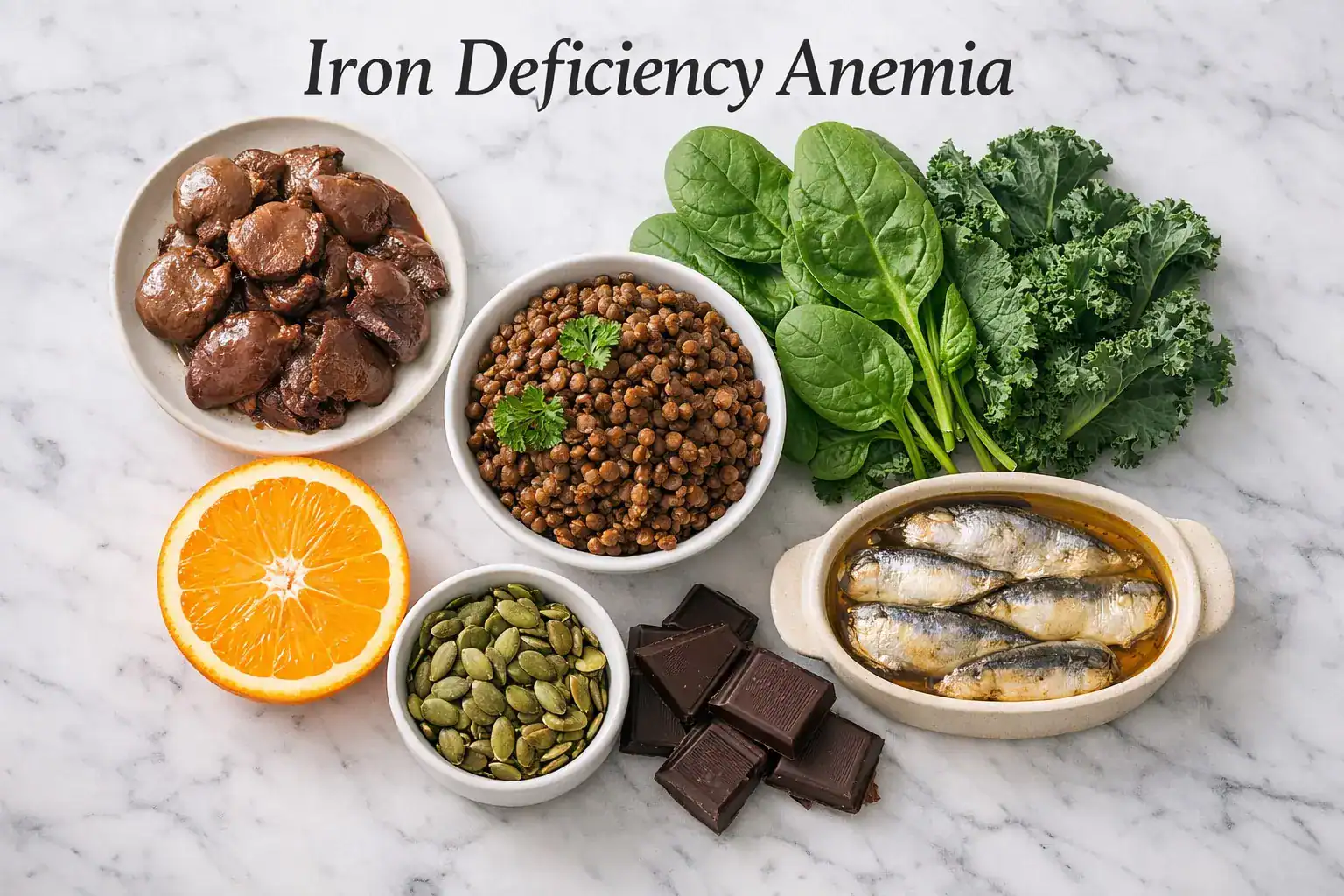
The Best Iron-Rich Foods for Treating Anemia - Haem vs Non-Haem Iron
Not all dietary iron-rich foods are equally effective. Understanding the difference between haem and non-haem iron — and how to maximize absorption from each — is essential for anyone trying to correct iron deficiency through diet.
anti-inflammatory foods that support iron absorption and overall health
Haem Iron Foods — Highest Absorption (15 to 35%)
| Food | Serving Size | Iron Content | Notes |
| Chicken liver | 85g (3oz) | 11mg | The highest haem iron source — eat 1 to 2x per week |
| Beef liver | 85g (3oz) | 5mg | Also very high in vitamin A — limit in pregnancy |
| Oysters | 85g (3oz) | 8mg | Also rich in zinc and B12 |
| Beef (lean) | 85g (3oz) | 3mg | Ground beef and chuck are the richest cuts |
| Sardines (canned) | 85g (3oz) | 2.5mg | Also provides omega-3 and calcium |
| Tuna (canned) | 85g (3oz) | 1.3mg | Convenient everyday haem iron source |
| Chicken (dark meat) | 85g (3oz) | 1.1mg | Thighs have higher iron levels than the breast |
Non-Haem Iron Foods — Plant Sources (2 to 20% absorption)
| Food | Serving Size | Iron Content | Absorption Tip |
| Lentils (cooked) | 180g (1 cup) | 6.6mg | Add lemon juice or tomatoes for vitamin C |
| Tofu (firm) | 126g (half cup) | 3.4mg | Eat with vitamin C-rich vegetables |
| Kidney beans (cooked) | 180g (1 cup) | 3.9mg | Avoid coffee or tea within 1 hour |
| Spinach (cooked) | 180g (1 cup) | 6.4mg | Cooking reduces oxalates that block absorption |
| Pumpkin seeds | 28g (1 oz) | 2.5mg | Also rich in zinc and magnesium |
| Quinoa (cooked) | 185g (1 cup) | 2.8mg | Complete protein and iron source |
| Dark chocolate (70%+) | 28g (1 oz) | 3.4mg | Genuinely iron-rich dessert option |
How to Maximize Iron Absorption - What to Eat With Iron and What to Avoid
The difference between adequate and poor iron absorption can mean the difference between correcting a deficiency and staying deficient despite eating well. These strategies significantly affect how much iron your body absorbs.
How fat-soluble vitamins work alongside iron for full health
What increases iron absorption?
- Vitamin C — the single most powerful enhancer of non-haem iron absorption. Adding 75mg of vitamin C (one medium orange, half a cup of raw bell pepper) to an iron-rich meal increases non-haem iron absorption by 2 to 3 times.
- Haem iron paired with non-haem iron — eating meat alongside plant iron sources significantly increases absorption of the plant iron through the 'meat factor' effect.
- Fermented foods — fermentation reduces phytate, which blocks absorption. Sourdough bread is absorbed significantly better than regular wheat bread.
- Cooking in cast iron measurably increases the iron content of foods, particularly acidic foods like tomato sauce.
What blocks iron absorption - avoid near iron-rich meals
- Coffee and tea - polyphenols reduce iron absorption by up to 60%. Wait at least 1 hour after iron-rich meals before drinking
- Calcium-rich foods and supplements — calcium competes directly with iron for absorption. Do not take iron and calcium supplements together
- Phytates - in raw whole grains and legumes. Soaking, sprouting, or fermenting reduces phytate content significantly
- Oxalates — in raw spinach and beetroot. Cooking significantly reduces oxalate content and improves iron availability
- Proton pump inhibitors reduce stomach acid needed to convert dietary iron to its absorbable ferrous form
How to Treat Iron Deficiency Anemia - From Food First to Supplementation
Treatment of iron deficiency anemia follows a clear hierarchy based on severity. The approach you need depends on how low your levels are and what is causing the deficiency.
Stage 1- Mild Deficiency - Food First Approach
For ferritin between 20 and 30 mcg/L with mild or no symptoms, dietary changes alone may be sufficient. Increase iron consumption to 3 to 4 servings per week, add vitamin C to every iron-containing meal, remove absorption blockers from meals, and retest ferritin in 3 months. This approach avoids supplement side effects and builds sustainable long-term iron status.
Stage 2- Moderate Deficiency - Oral Iron Supplements
For ferritin below 20 mcg/L or confirmed anemia with hemoglobin below 12 g/dL, oral iron supplementation is the standard first-line treatment. The most common forms are:
- Ferric sulphate is the most commonly prescribed, cheapest, but it commonly causes nausea and constipation at standard 325mg doses
- Ferrous gluconate — lower elemental iron per tablet, but better tolerated by most people
- Ferrous bisglycinate (gentle iron) has the highest absorption, best tolerance, most expensive; ideal for those who cannot tolerate standard forms
- Liquid iron — better tolerated and useful for those with absorption issues or difficulty swallowing capsules
A key evidence-based tip: taking iron supplements every other day rather than daily achieves comparable or better absorption with significantly fewer side effects. A 2017 study in The Lancet Hematology found that alternate-day dosing produces higher iron absorption per dose than daily supplementation due to hepcidin regulation.
Stage 3- Severe Deficiency or Malabsorption - Intravenous Iron
When oral iron fails, cannot be tolerated, or when iron deficiency is caused by malabsorption (coeliac disease, inflammatory bowel disease), intravenous iron infusion corrects the deficiency rapidly and completely. Modern IV iron preparations are safe and can restore full iron stores in a single session. This is increasingly used in pregnancy, postoperative patients, and those with chronic conditions affecting absorption.
My Personal Experience with Iron and Energy at 58
| Adel GalalGalal | I had my ferritin tested for the first time at 52 after six months of unexplained fatigue And hair thinning that I had been attributing to age and stress. My ferritin came back at 18 mcg/L — technically within the laboratory reference range but clearly symptomatic.
My doctor and I decided to try dietary optimization first before supplementation. Here is what I changed:
Added liver to my diet twice per week — chicken liver with onions and spices. Added lemon juice or bell pepper to every plant-based meal. Switched from morning coffee after breakfast rather than with it. Stopped taking my calcium supplement at the same time as iron-rich meals. Added pumpkin seeds and dark chocolate as daily snacks.
After 12 weeks, my ferritin had risen to 44 mcg/L. The fatigue had improved significantly. The hair thinning slowed visibly within 2 months and had largely stopped by month 4.
The lesson: ferritin between 12 and 30 is a grey zone where many people have real Symptoms that respond to real treatment. Do not wait for anemia to take low iron seriously. |
Related Articles
How to Get Strong Nails: Iron and Nutrients That Build Nail and Hair Strength — https://nextfitlife.com/how-to-get-strong-nails/
Sleep Deprivation: How Poor Sleep Worsens Iron Deficiency Fatigue — https://nextfitlife.com/sleep-deprivation/
Vitamin K2 Benefits: Fat-Soluble Vitamins and Nutrient Synergies — https://nextfitlife.com/vitamin-k2-benefits/
Foods for Eye Health: Anti-Inflammatory Nutrition for Whole Body Health — https://nextfitlife.com/foods-for-eye-health/
Walking Exercise for Seniors: How Exercise Supports Iron Utilization — https://nextfitlife.com/walking-exercise-for-seniors/
Adel Galal
Health and Wellness Writer | 30+ Years Personal Practice | Founder, NextFitLife.com
Adel Galal has studied and practised health, fitness, and natural aging for over 30 years. At 58, he writes from genuine lived experience — including personally managing iron deficiency through diet and testing. He is not a doctor. Everything shared reflects personal research, experience, and published health guidance. Always consult a qualified healthcare professional before starting iron supplementation or changing your diet significantly.
References and Sources
1- Worldwide Prevalence of Anaemia — WHO Global Database on Anemia
https://www.who.int/publications/i/item/9789241596657
WHO authority. Use for: 1.62 billion prevalence statistics and global anemia burden data.
2- Iron Deficiency Anemia — National Institutes of Health (NIH) NHLBI
https://www.nhlbi.nih.gov/health/anemia/iron-deficiency-anemia
US Government / NIH authority. Use for: diagnosis, treatment guidelines, symptoms, and supplement recommendations.
3- Alternate-Day vs Daily Oral Iron Supplementation — The Lancet Hematology (2017)
https://www.thelancet.com/journals/lanhae/article/PIIS2352-3026(17)30182-5/fulltext
High-impact peer-reviewed journal. Use for: alternate-day iron dosing absorption advantage claim.
4- Iron and Immune Function — Current Opinion in Clinical Nutrition and Metabolic Care
https://pubmed.ncbi.nlm.nih.gov/11399052/
Peer-reviewed clinical review. Use for: iron and immune function, neutrophil activity, and infection susceptibility claims.
5- Enhancers and Inhibitors of Iron Absorption — European Journal of Nutrition
https://pubmed.ncbi.nlm.nih.gov/10552882/
Peer-reviewed nutrition science. Use for: vitamin C enhancement, calcium and coffee inhibition, and absorption factor claims.

Health & wellness writer with 30+ years of experience in nutrition, fitness, and healthy aging. Founder of NextFitLife.com — evidence-based health guidance.