
Published on: July 17, 2025
Updated on: November 4, 2026
Knee exercises for runners should do more than strengthen the muscles right around the knee.
Running repeatedly loads one leg at a time, so strong quadriceps, hips, glutes, hamstrings, calves, feet, and trunk all help control how force moves through the lower body.
This guide gives you 15 practical exercises for runners, including strength, single leg control, balance, and optional low level plyometric work.
Important: This article is for general information and education. It does not replace medical advice, diagnosis, or treatment.
Get medical assessment promptly if: your knee becomes very swollen after injury, locks and cannot move normally, repeatedly gives way, cannot bear weight, looks deformed, or pain started after major trauma. Fever with a hot swollen joint also needs urgent assessment.
Table of Contents
- Quick Answer
- What Runners Need From Knee Training
- 15 Knee Exercises for Runners
- Beginner Strength Routine
- Intermediate Runner Routine
- Patellofemoral Pain
- How Often to Strength Train
- Running Load Management
- Return to Running
- Do Strength Exercises Prevent Injury?
- Common Mistakes
- When to Get Medical Advice
- Conclusion
- References and Sources
- Internal Links + Running Hub
- About the Author
- Frequently Asked Questions
Quick Answer: What Are the Best Knee Exercises for Runners?
The best knee exercises for runners strengthen the entire lower limb and improve control during single leg loading.
Useful exercises include:
- Wall sit
- Bodyweight squat
- Split squat
- Step up
- Controlled step down
- Glute bridge
- Single leg bridge
- Standing calf raise
- Bent knee calf raise
- Lateral band walk
- Single leg Romanian deadlift
- Hamstring curl
- Side plank
- Single leg balance
- Low pogo hops
You do not need all 15 in one session. Choose six to eight movements that cover the thighs, hips, calves, hamstrings, trunk, and single leg control.
For more running guidance, read our Running Tips for Long Distance and How to Increase Stamina for Running.
What Do Runners Actually Need From Knee Training?
Your knee does not work alone.
Running depends on coordinated strength from the:
- Quadriceps
- Glutes
- Hamstrings
- Calves
- Hip abductors
- Hip adductors
- Core
- Foot and ankle muscles
AAOS notes that stronger muscles around the knee help reduce stress on the joint and absorb shock.
For runners, this also means learning to control the leg during single leg stance, landing, stepping, and pushing off.
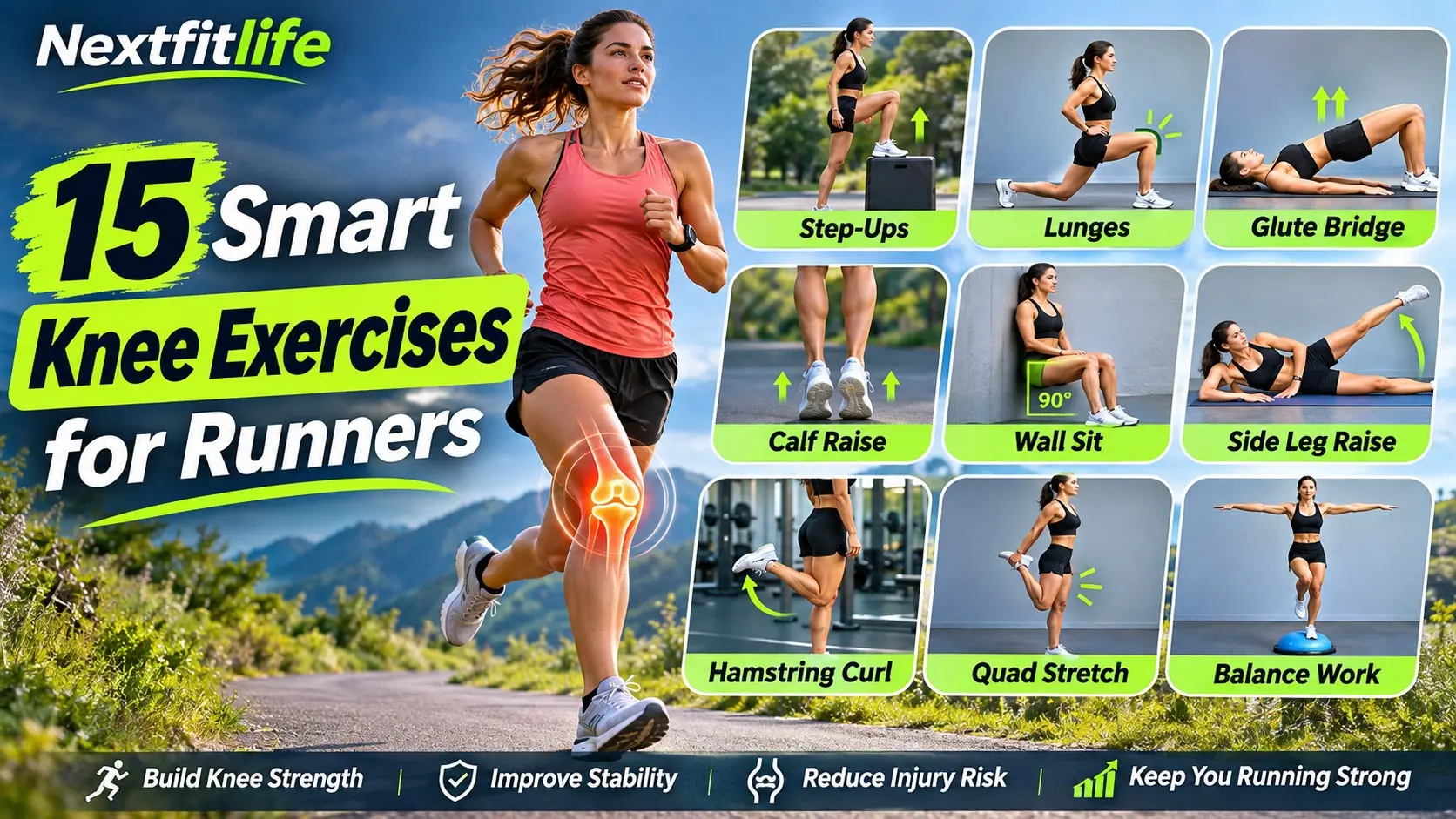
15 Smart Knee Exercises for Runners
1. Wall Sit
Main focus: quadriceps endurance.
- Place your back against a wall.
- Walk your feet forward.
- Slide down to a comfortable depth.
- Keep both feet flat.
- Hold while breathing normally.
Starting target: 20 to 30 seconds for 2 to 3 sets.
You do not need to reach a deep 90 degree position.
2. Bodyweight Squat
Main focus: quadriceps, glutes, hips, and trunk.
- Stand with your feet at a comfortable width.
- Sit your hips down and back.
- Keep your feet planted.
- Stand back up with control.
Starting target: 2 to 3 sets of 8 to 15 repetitions.
3. Split Squat
Main focus: single leg strength.
- Place one foot in front of the other.
- Lower your body straight down.
- Keep your front foot planted.
- Push back up.
Starting target: 2 sets of 6 to 12 repetitions per side.
Hold a chair or wall if balance is limiting the exercise.
4. Step Up
Main focus: functional single leg strength.
- Use a low stable step.
- Place one foot fully on it.
- Drive through that leg to stand up.
- Lower with control.
Starting target: 2 to 3 sets of 8 to 12 per side.
5. Controlled Step Down
Main focus: eccentric quadriceps control and hip stability.
- Stand on a low step.
- Slowly lower one heel toward the floor.
- Keep the stance knee controlled.
- Return to standing.
Starting target: 2 sets of 6 to 10 per side.
Use a smaller step if you lose control.
6. Glute Bridge
Main focus: glute strength.
- Lie on your back.
- Bend your knees.
- Place your feet flat.
- Lift your hips.
- Lower slowly.
Starting target: 2 to 3 sets of 10 to 15.
7. Single Leg Bridge
Main focus: unilateral glute and hip control.
Progress to this only when the normal bridge feels easy.
Starting target: 2 sets of 6 to 10 per side.
8. Standing Calf Raise
Main focus: gastrocnemius and ankle strength.
- Stand beside a stable support.
- Rise onto your toes.
- Pause briefly.
- Lower slowly.
Starting target: 2 to 3 sets of 10 to 20.
Progress toward one leg when the two leg version becomes easy.
9. Bent Knee Calf Raise
Main focus: soleus muscle.
The soleus works hard during running.
- Bend your knees slightly.
- Keep that knee angle.
- Raise your heels.
- Lower slowly.
Starting target: 2 to 3 sets of 10 to 20.
10. Lateral Band Walk
Main focus: hip abductors and glute strength.
- Place a light resistance band around your legs.
- Bend your knees slightly.
- Step sideways with control.
- Keep tension on the band.
Starting target: 8 to 12 steps each direction.
11. Single Leg Romanian Deadlift
Main focus: hamstrings, glutes, balance, and hip control.
- Stand on one leg.
- Keep a slight knee bend.
- Hinge at the hip.
- Reach the free leg backward.
- Return to standing.
Starting target: 2 sets of 6 to 10 per side.
Use a wall for balance if needed.
12. Hamstring Curl
Main focus: hamstring strength.
You can use a machine, resistance band, sliders, or a stability ball.
Starting target: 2 to 3 sets of 8 to 15 repetitions.
13. Side Plank
Main focus: trunk and lateral hip stability.
Use bent knees for an easier version.
Starting target: 15 to 30 seconds per side.
For more trunk work, see our Core Workouts at Home.
14. Single Leg Balance
Main focus: foot, ankle, hip, and single leg control.
- Stand near a chair or wall.
- Lift one foot.
- Stay tall.
- Keep the stance leg controlled.
Starting target: 20 to 30 seconds per side.
For more progression, see our Balance Exercises.
15. Low Pogo Hops
Main focus: ankle stiffness, calf capacity, and low level running specific spring.
This is an advanced option compared with the other exercises.
- Stand tall.
- Perform small gentle hops using both feet.
- Land softly.
- Keep the hops low and rhythmic.
Starting target: 2 sets of 10 to 20 seconds.
Do not start pogo hops if normal running, walking, or calf raises are painful.
Beginner Runner Strength Routine
| Exercise | Dose | Focus |
|---|---|---|
| Squat | 2 × 10 | Quads and hips |
| Glute Bridge | 2 × 12 | Glutes |
| Calf Raise | 2 × 15 | Calves |
| Step Up | 2 × 8 each side | Single leg strength |
| Single Leg Balance | 20 seconds each side | Control |
Complete this routine two times per week to start.
Intermediate Runner Strength Routine
Try:
- Split squat: 3 sets of 8 each side
- Controlled step down: 3 sets of 8 each side
- Single leg Romanian deadlift: 3 sets of 8 each side
- Single leg calf raise: 3 sets of 12
- Bent knee calf raise: 3 sets of 15
- Lateral band walk: 10 steps each direction
- Side plank: 25 seconds each side
Add pogo hops only when normal running and basic strength exercises are comfortable.
What Is Runner's Knee?
“Runner's knee” often refers to patellofemoral pain.
This usually causes pain around or behind the kneecap and may become worse during:
- Running
- Squatting
- Stairs
- Jumping
- Long periods of sitting
The term does not describe every type of knee pain.
Meniscus injuries, tendon problems, osteoarthritis, ligament injuries, bone stress injuries, and other conditions can produce different symptoms.
Are Hip Exercises Important for Runners' Knees?
Yes.
Your hip muscles influence how the thigh and pelvis are controlled during single leg tasks.
A 2024 randomized trial of novice recreational runners found that a hip and core program reduced lower extremity injury incidence compared with a control program.
The program did not prove that every runner needs the same exercises, but it strengthens the case for looking above the knee rather than training only the quadriceps.
Why Calf Strength Matters
Your calves help absorb and produce force while running.
The gastrocnemius crosses the knee, while the soleus works below it and plays a major role in controlling the ankle during stance.
That is why this program includes:
- Straight knee calf raises
- Bent knee calf raises
Strong calves also help prepare runners for faster running and plyometric work.
How Often Should Runners Strength Train?
Two strength sessions per week is a practical starting point for many recreational runners.
CDC recommends muscle strengthening on at least two days per week for adults.
Runners can adjust strength frequency around:
- Weekly mileage
- Hard running sessions
- Races
- Training history
- Recovery
Do not place a difficult new leg workout immediately before your hardest run if the resulting soreness changes your running form.
Do Knee Exercises Prevent Running Injuries?
They may reduce risk, but no exercise plan can guarantee that you will stay injury free.
A 2024 meta analysis of exercise based prevention programs in endurance runners found no significant overall reduction in injury risk across all included programs. However, supervised interventions performed better in a secondary analysis.
A separate 2024 randomized trial found a hip and core exercise program reduced lower extremity injuries in novice runners compared with a static stretching control.
A 2025 review concluded that injury risk reduction should be individualized and may involve strengthening, gradual running progression, gait considerations, footwear, recovery, and education.
The takeaway is simple: strength matters, but it is only one part of smart running.
Why Running Load Matters
Your tissues need time to adapt to running stress.
Problems often arise when training demand rises faster than your current capacity.
Changes that can increase load include:
- More weekly mileage
- Longer long runs
- More hills
- More speed work
- More races
- A sudden return after time off
There is no universal percentage increase that is safe for every runner.
Increase training gradually and monitor how your knee responds over the next day or two.
Should You Run Through Knee Pain?
It depends on the cause and severity.
Do not simply push through:
- Sharp pain
- Increasing swelling
- Limping
- Locking
- Giving way
- Pain that worsens each run
For mild symptoms, a clinician may use modified running combined with rehabilitation rather than complete rest.
The right plan depends on the diagnosis.
How to Return to Running After Knee Pain
Return gradually.
Before increasing running, it helps if you can perform basic daily and strength tasks without a major symptom increase.
A simple progression may include:
- Comfortable walking
- Brisk walking
- Short run and walk intervals
- Easy continuous running
- Longer easy runs
- Hills or faster sessions later
Increase one main training variable at a time.
Do Runners Need Heavy Strength Training?
Not every runner needs to lift very heavy weights, but strength training should become challenging enough to create adaptation.
A 2024 systematic review found that high load and combined strength training methods can improve running performance in middle and long distance runners.
Beginners can start with bodyweight and light resistance, then gradually increase difficulty.
Common Knee Training Mistakes for Runners
Training Only the Quadriceps
Runners also need hips, hamstrings, calves, trunk control, and single leg strength.
Ignoring the Soleus
Bent knee calf work complements straight knee calf raises.
Adding Plyometrics Too Soon
Build basic strength first and make sure normal running is comfortable.
Increasing Mileage and Strength at the Same Time
Large increases in several training demands can make recovery harder.
Assuming Every Knee Pain Is Runner's Knee
Knee pain has many possible causes.
Training Through Swelling or Locking
These symptoms deserve more caution than normal muscle soreness.
Never Progressing the Exercises
Add resistance, range, repetitions, or more demanding single leg versions over time.
Expecting Strength Work to Prevent Every Injury
Injury risk is influenced by training load, recovery, previous injuries, biomechanics, health, and other factors.
When Should a Runner Get Knee Pain Checked?
Seek medical assessment if you have:
- A large or rapid knee swelling
- A knee that locks
- Repeated giving way
- Inability to bear weight
- A visible deformity
- Severe pain after a fall or collision
- A hot swollen joint with fever
- Persistent pain that keeps worsening
- Pain that repeatedly stops you from running despite sensible load reduction
Conclusion
The best knee exercises for runners strengthen more than the knee itself. Strong quadriceps, glutes, hips, hamstrings, calves, and trunk muscles help your body manage the repeated single leg demands of running.
Use strength training alongside sensible running load, recovery, and gradual progression rather than expecting one exercise to prevent every injury.
Your next step: choose six exercises from this guide and complete two controlled strength sessions this week while keeping your running load steady.
References and Sources
- American Academy of Orthopaedic Surgeons. Knee Conditioning Program. Guidance on strengthening quadriceps, hamstrings, abductors, adductors, glutes, and calves to support knee function.
https://www.orthoinfo.org/recovery/knee-conditioning-program/ - Willy RW and colleagues. Patellofemoral Pain Clinical Practice Guideline. Journal of Orthopaedic & Sports Physical Therapy.
https://pubmed.ncbi.nlm.nih.gov/31475628/ - Leppänen M and colleagues. Hip and Core Exercise Programme Prevents Running Related Overuse Injuries in Adult Novice Recreational Runners. 2024 randomized controlled trial.
https://pubmed.ncbi.nlm.nih.gov/38724071/ - Wu H and colleagues. Do Exercise Based Prevention Programs Reduce Injury in Endurance Runners? 2024 systematic review and meta analysis involving 1,904 participants.
https://pubmed.ncbi.nlm.nih.gov/38261240/ - Linton L and colleagues. Running Centred Injury Prevention Support. 2025 scoping review of current injury risk reduction practices for runners.
https://pubmed.ncbi.nlm.nih.gov/40225830/
Internal Links + Running Hub
- Running Tips for Long Distance
- How to Increase Stamina for Running
- Injury Prevention Exercises
- Balance Exercises
- Core Workouts at Home
- Strength Training and Muscle Building Guide
- 5 Components of Physical Fitness
- NextFitLife Fitness Hub
About the Author
Adel Galal is a father of four (three sons and a daughter) and a grandfather of four, with 33 years of hands-on parenting experience. He is the founder of Parnthub.com, based in Cairo, Egypt, where he shares practical guidance on feeding, development and family life from newborns to teenagers. Adel is not a medical professional; health articles cite trusted sources and are for general information only.
Learn more on the NextFitLife About Us page.
Frequently Asked Questions
What are the best knee exercises for runners?
Useful exercises include squats, split squats, step ups, controlled step downs, glute bridges, calf raises, lateral band walks, single leg deadlifts, hamstring curls, and single leg balance.
How often should runners strengthen their knees?
Two strength sessions each week is a practical starting point for many recreational runners, with training adjusted around mileage, hard sessions, races, and recovery.
Should runners train their hips for knee health?
Yes. Hip and glute strength contribute to control of the thigh and pelvis during running, and research in novice runners has shown benefits from hip and core focused exercise programs.
Are squats good for runners' knees?
Squats can strengthen the quadriceps, hips, and glutes. Use a comfortable range and progress resistance gradually.
Do calf raises help runners?
Yes. Straight knee and bent knee calf raises train the gastrocnemius and soleus, which help manage force during running.
What is runner's knee?
Runner's knee commonly refers to patellofemoral pain around or behind the kneecap that may worsen with running, stairs, squatting, jumping, or prolonged sitting.
Should I run through knee pain?
Do not push through sharp pain, swelling, locking, giving way, or pain that keeps worsening. Mild symptoms may sometimes be managed with modified running and rehabilitation after appropriate assessment.
Do strength exercises prevent all running injuries?
No. Strength training can support running capacity, but injury risk also depends on running load, recovery, previous injury, biomechanics, health, and other factors.
When can I add jumping exercises?
Add low level plyometric work after basic strength is established and normal walking, calf raises, and running are comfortable.
When should a runner see a doctor for knee pain?
Seek assessment for major swelling, locking, repeated giving way, inability to bear weight, deformity, severe pain after trauma, fever with a hot swollen knee, or persistent worsening symptoms.

Health & wellness writer with 30+ years of experience in nutrition, fitness, and healthy aging. Founder of NextFitLife.com — evidence-based health guidance.

