
Published on: April 6, 2025
Updated on: November 4, 2026
Balance exercises can help you move with more control, improve coordination, build leg strength, and make everyday tasks feel safer.
Good balance is not only the ability to stand still on one leg. Your body also needs to control movement while walking, stepping, turning, reaching, and reacting when something unexpectedly shifts your position.
This guide gives you 15 practical exercises that train static balance, dynamic balance, leg strength, ankle control, gait, and coordination.
Important: This article is for general information and education. It does not replace medical advice, diagnosis, or treatment.
Safety first: Use a sturdy chair, counter, wall, or rail when needed. If you have repeated falls, new dizziness, fainting, sudden weakness, new numbness, severe vision changes, or a sudden change in walking, seek medical assessment rather than simply adding harder balance drills.
Table of Contents
- Quick Answer
- What Balance Really Means
- 15 Best Balance Exercises
- Beginner Balance Routine
- Balance Exercises for Older Adults
- How Often to Train Balance
- How to Progress Safely
- Balance and Strength
- Balance and Walking
- Tai Chi and Other Training
- Reactive Balance
- Common Mistakes
- When to Get Medical Advice
- Conclusion
- References and Sources
- Internal Links + Fitness Hub
- About the Author
- Frequently Asked Questions
Quick Answer: What Are the Best Balance Exercises?
The best balance exercises challenge your stability without making the exercise unsafe.
Start with these 15:
- Supported feet together stance
- Semi tandem stance
- Tandem stance
- Single leg stance
- Heel-to-toe walk
- Sit to stand
- Step ups
- Side steps
- Clock reach
- March with pauses
- Heel raises
- Toe raises
- Reverse step and return
- Figure eight walking
- Dual task walking
For most people, the goal is not to wobble as much as possible. The goal is controlled challenge.
For a wider exercise foundation, see our 5 Components of Physical Fitness and Strength Training and Muscle Building Guide.
What Does Balance Really Mean?
Your brain combines information from your eyes, inner ear, joints, muscles, skin, and nervous system to help keep you upright.
Your muscles then make tiny corrections to keep your center of mass under control.
Balance has several parts.
| Balance Type | What It Means | Example |
|---|---|---|
| Static | Staying steady while mostly still | Single leg stance |
| Dynamic | Controlling the body while moving | Heel to toe walk |
| Proactive | Preparing for a movement challenge | Stepping onto a curb |
| Reactive | Recovering after an unexpected disturbance | Taking a quick recovery step |
Recent research supports this broader view. A 2026 network meta analysis found that different forms of exercise can improve different domains of postural control.
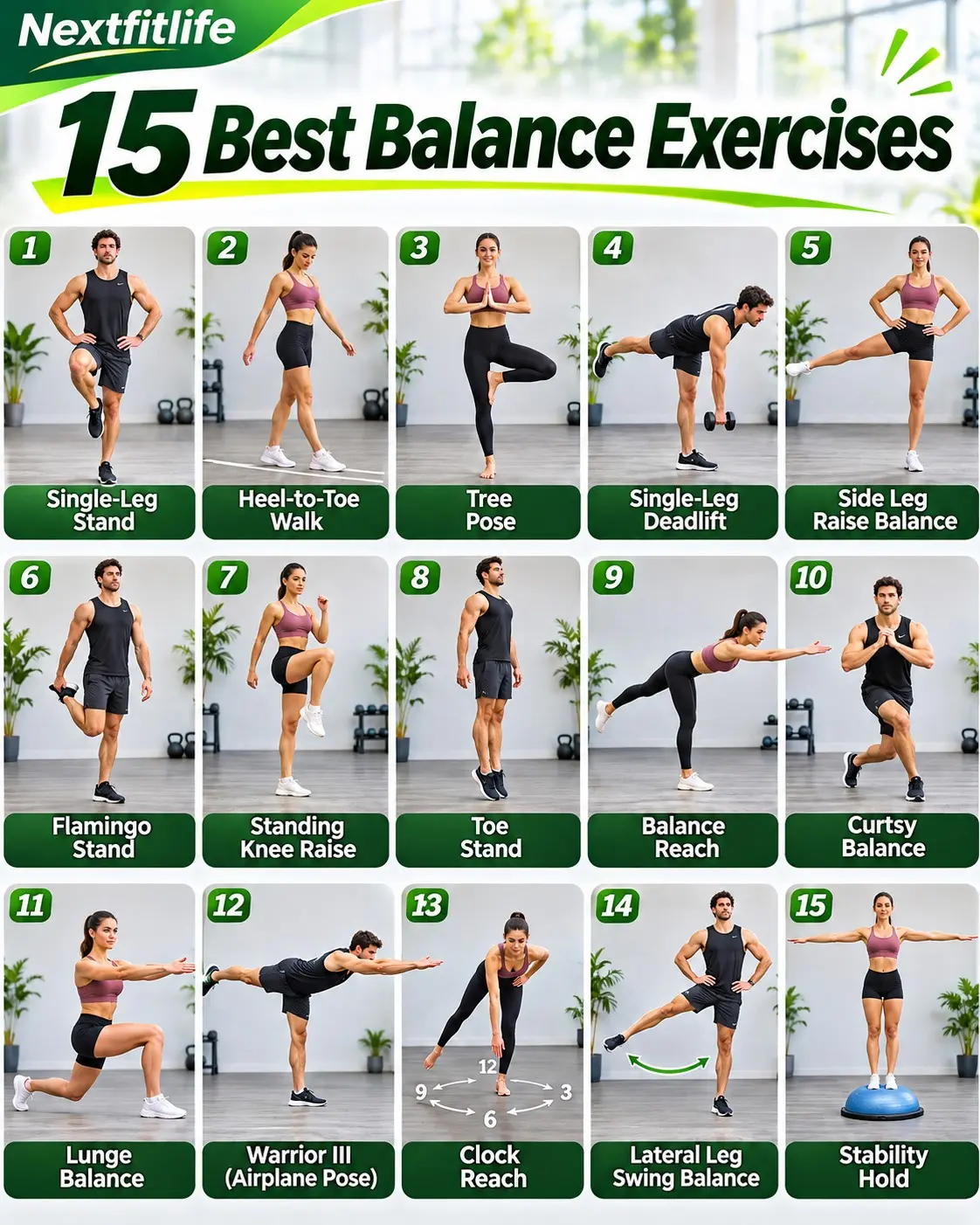
15 Best Balance Exercises for Strength and Stability
1. Supported Feet Together Stance
This is a simple starting exercise.
- Stand beside a sturdy chair or counter.
- Place your feet together.
- Stand tall and look forward.
- Hold for 20 to 30 seconds.
If this feels easy, use less hand support.
2. Semi Tandem Stance
This narrows your base without making it as difficult as a full heel to toe stance.
- Place one foot slightly ahead of the other.
- Keep the feet close together.
- Hold for 20 to 30 seconds.
- Switch sides.
3. Tandem Stance
Tandem stance places one foot directly in front of the other.
- Stand near support.
- Place the heel of one foot near the toes of the other.
- Look forward.
- Hold for 10 to 30 seconds.
- Switch foot position.
Use fingertips on the support if needed.
4. Single Leg Stance
The single leg stance is a classic balance exercise because walking requires repeated periods on one leg.
- Stand beside a chair.
- Lift one foot slightly from the floor.
- Keep your hips level.
- Hold for 5 to 20 seconds.
- Switch sides.
Do not close your eyes until the eyes open version is easy and safe.
5. Heel to Toe Walk
Heel to toe walking challenges dynamic balance.
- Stand near a wall or counter.
- Place one foot directly in front of the other.
- Bring the heel close to the toes of the front foot.
- Take 8 to 12 controlled steps.
CDC lists heel to toe walking as an example of balance activity for older adults.
6. Sit to Stand
Sit to stand combines functional strength with balance.
- Sit toward the front of a sturdy chair.
- Place your feet flat on the floor.
- Stand up with control.
- Sit down slowly.
Starting target: 2 sets of 6 to 12 repetitions.
This drill strengthens the legs for real tasks such as getting up from a chair or toilet.
7. Step Ups
Step ups train leg strength, foot placement, and proactive balance.
- Use a low stable step.
- Place one foot fully on the step.
- Step up with control.
- Step down slowly.
- Switch lead legs.
Use a rail when needed.
8. Side Steps
Side stepping trains movement that daily walking does not emphasize as much.
- Stand tall.
- Take 8 to 12 steps sideways.
- Keep your feet facing forward.
- Return in the other direction.
This can help train hip stability.
9. Clock Reach
The clock reach combines single leg control with reaching.
- Stand near support.
- Imagine numbers around you like a clock.
- Keep one foot planted.
- Reach the other foot toward different numbers.
- Return to the center each time.
Start with small reaches.
10. March With Pauses
This drill improves single leg control during a walking pattern.
- March slowly.
- Pause for one or two seconds each time a knee lifts.
- Alternate sides.
- Use support if needed.
Keep your trunk tall instead of leaning far to one side.
11. Heel Raises
Heel raises build calf strength and ankle stability.
- Hold a counter lightly.
- Rise onto your toes.
- Pause.
- Lower slowly.
Starting target: 2 sets of 8 to 15 repetitions.
12. Toe Raises
Toe raises train the muscles at the front of the lower leg.
- Stand near support.
- Keep your heels down.
- Lift your toes and front of the feet.
- Lower slowly.
These muscles help control the foot during walking.
13. Reverse Step and Return
Backward stepping trains a movement that is useful when recovering from a small loss of balance.
- Stand near a stable support.
- Step one foot backward.
- Return to the start.
- Alternate legs.
Begin with small steps.
14. Figure Eight Walking
Walking in a figure eight adds turning and direction changes.
- Place two safe markers several feet apart.
- Walk around them in a figure eight.
- Keep the turns slow at first.
- Look where you are going.
This trains dynamic balance and gait control.
15. Dual Task Walking
Daily life often asks you to walk while thinking or talking.
Once basic walking balance is safe, try walking while doing a simple mental task such as naming animals or counting aloud.
Do this in a clear, safe space.
If your walking becomes unstable, return to normal walking.
A Simple Beginner Balance Routine
| Exercise | Starting Dose | Support |
|---|---|---|
| Feet Together Stance | 20 seconds × 2 | Chair nearby |
| Semi Tandem Stance | 20 seconds each side | Light fingertip support |
| Sit to Stand | 8 repetitions × 2 | Sturdy chair |
| March With Pauses | 10 each side | Counter nearby |
| Heel Raises | 10 repetitions × 2 | Counter support |
Move slowly enough to stay in control.
Balance Exercises for Older Adults
Balance becomes especially important with age because falls can cause serious injury and loss of confidence.
CDC states that adults aged 65 and older should include aerobic activity, muscle strengthening, and balance activity every week.
WHO also recommends tailored exercises that challenge balance while improving functional strength for older adults living in the community.
Useful choices include:
- Heel to toe walking
- Sit to stand
- Step ups
- Single leg balance with support
- Tai Chi
- Side stepping
The best program is challenging enough to improve balance but safe enough to repeat.
Can Balance Exercises Prevent Falls?
They can reduce fall risk, especially when balance work is combined with strength and functional exercise.
A 2026 network meta analysis of 45 randomized trials found that multicomponent exercise and mind body exercise were associated with fewer fallers, while balance training may also reduce fall related injuries.
Another 2026 review found that exercise reduced overall fall related injuries, injuries needing medical care, severe injuries, and fall related fractures among community dwelling older adults.
No exercise program can guarantee that a person will never fall.
Why Strength Matters for Balance
You need enough strength to correct your position when your body moves away from its base of support.
That is why exercises such as:
- Sit to stand
- Step ups
- Heel raises
- Squats
- Rows
- Hip strengthening
can complement balance practice.
For a full resistance program, see our Strength Training and Muscle Building Guide.
Why Walking Is Also Balance Training
Walking is a repeated balance task.
Every step requires you to:
- Shift body weight
- Control one leg
- Place the next foot accurately
- Adapt to turns and obstacles
This is why gait based exercises belong in a complete balance training program.
See our Walking for Weight Loss guide for walking progression ideas.
Does Tai Chi Improve Balance?
Tai Chi can be a useful balance activity.
The 2026 network meta analysis of 423 trials found favorable estimates for Tai Chi in global balance, while other methods showed strengths in other balance domains.
This does not mean Tai Chi is the only effective choice.
The best method is one you can perform safely and consistently.
What Is Reactive Balance Training?
Reactive balance is your ability to recover after something unexpectedly disturbs your position.
Examples include:
- Taking a quick recovery step
- Responding to a slip
- Recovering when bumped
Specialized perturbation training deliberately creates safe, controlled disturbances so the nervous system can practice recovery.
A 2026 systematic review found that perturbation based training reduced fall rates by about 23% and injurious falls by about 24% compared with controls in community dwelling older adults, although certainty of evidence was low.
This type of training is best done under qualified supervision because deliberately disturbing balance can itself create a fall risk.
How Often Should You Do Balance Exercises?
Balance responds to practice.
Short sessions done regularly can work well.
A practical routine might include 10 to 20 minutes of balance and functional strength work several days each week.
Older adults should include balance activity as part of their weekly physical activity routine.
The exact frequency should match your fitness, fall risk, and the difficulty of the exercises.
How to Make Balance Exercises Harder Safely
Progress one factor at a time.
You can:
- Use less hand support.
- Narrow your stance.
- Hold the position longer.
- Add slow head turns.
- Add controlled reaching.
- Increase walking direction changes.
- Add a simple mental task.
Do not remove support and close your eyes at the same time.
More instability is not automatically better.
Should You Close Your Eyes During Balance Training?
Closing the eyes removes visual information, so the exercise becomes much harder.
This can be useful in selected advanced training, but it is not a beginner progression.
If you use this method, stand beside strong support and make sure another person is nearby if your balance is poor.
Do Balance Boards Work?
Balance boards can challenge ankle control and postural reactions, but they are not required.
Floor based exercises can provide plenty of challenge for many people.
A balance board can also increase fall risk when used without appropriate support.
Common Balance Training Mistakes
Practicing Too Far From Support
A sturdy support lets you challenge balance without turning each attempt into a fall risk.
Making the Exercise Too Hard Too Soon
Progress one challenge at a time.
Only Practicing Standing Still
Include walking, stepping, reaching, and turning because daily life requires dynamic balance.
Ignoring Leg Strength
Balance and functional strength work together.
Closing the Eyes Too Early
Remove visual input only when basic versions are safe and controlled.
Using Unstable Equipment Without a Reason
You can improve balance with simple floor based exercises.
Ignoring Footwear and the Environment
Clear clutter, secure rugs, and choose a safe training surface.
Training Through Dizziness
Dizziness is not a normal sign that balance training is working.
When Should Poor Balance Be Medically Evaluated?
Balance problems can come from many causes, including vision changes, inner ear problems, neurological conditions, medications, low blood pressure, weakness, pain, or foot problems.
WHO notes that fall risk can increase with impairments in balance, strength, gait, vision, cognition, mobility, and with medicines or conditions that cause dizziness or low blood pressure.
Seek medical assessment if you have:
- Repeated unexplained falls
- New persistent dizziness
- Fainting
- Sudden weakness
- New numbness
- New severe headache
- New vision changes
- A sudden change in walking
- Balance loss after a new medication
Sudden balance loss with facial weakness, trouble speaking, severe headache, or one sided weakness can be an emergency and needs urgent care.
Conclusion
The best balance exercises do more than teach you to stand on one foot. A strong program combines static balance, dynamic movement, leg strength, ankle control, stepping, walking, reaching, and safe progression.
Start with support and simple drills, then make the exercise harder only when you can stay in control.
Your next step: choose three exercises today, such as tandem stance, sit to stand, and heel to toe walking, and practice them beside a sturdy support.
References and Sources
- Centers for Disease Control and Prevention. Older Adult Activity: An Overview. Current guidance on aerobic activity, muscle strengthening, and balance activities for adults aged 65 and older.
https://www.cdc.gov/physical-activity-basics/guidelines/older-adults.html - World Health Organization. Falls. Current guidance on fall risk and prevention, including tailored exercise that challenges balance and improves functional strength.
https://www.who.int/news-room/fact-sheets/detail/falls - Exercise Modalities for Overall and Domain Specific Balance Performance in Older Adults. 2026 systematic review and Bayesian network meta analysis of 423 randomized trials involving 33,901 participants.
https://pubmed.ncbi.nlm.nih.gov/42600321/ - Perturbation Based Balance Training Reduces Falls and Fall Injuries in Older People. 2026 systematic review examining reactive balance training, falls, and fall related injuries.
https://pubmed.ncbi.nlm.nih.gov/42391766/ - Effects of Exercise Interventions on Fall Related Injuries in Community Dwelling Older Adults. 2026 updated systematic review and meta analysis of 29 randomized trials involving 6,367 participants.
https://pubmed.ncbi.nlm.nih.gov/42718525/
Internal Links + Fitness Hub
- NextFitLife Fitness Hub
- 5 Components of Physical Fitness
- Strength Training and Muscle Building Guide
- Injury Prevention Exercises
- Walking for Weight Loss
- Low Impact Exercises to Burn Fat at Home
- Best Way to Lose Weight After 40
- Upper Body Workout
About the Author
Adel Galal is a father of four, three sons and a daughter, and a grandfather of four, with 33 years of hands on parenting experience. He is the founder of Parnthub.com, based in Cairo, Egypt, where he shares practical guidance on feeding, development and family life from newborns to teenagers.
Adel is not a medical professional. Health articles cite trusted sources and are for general information only.
Learn more on the NextFitLife About Us page.
Frequently Asked Questions
What are the best balance exercises?
Useful balance exercises include tandem stance, single leg stance, heel to toe walking, sit to stand, step ups, side steps, clock reaches, marching with pauses, and figure eight walking.
How often should I do balance exercises?
Short sessions several days each week can work well. Adults aged 65 and older should include balance activity as part of their regular weekly physical activity.
Can balance exercises reduce falls?
Exercise programs that challenge balance and improve strength can reduce fall risk and fall related injuries in older adults, although no program can prevent every fall.
Is standing on one leg enough to improve balance?
It can help static balance, but a complete program should also include stepping, walking, reaching, turning, and strength exercises.
Are balance exercises good for seniors?
Yes. Balance activity is specifically recommended for older adults and works best alongside aerobic activity and muscle strengthening.
Does leg strength affect balance?
Yes. Strong legs and hips help you control your body and recover when your center of mass moves away from your base of support.
Does Tai Chi improve balance?
Tai Chi can improve balance and is one useful option. Different forms of exercise may emphasize different parts of balance, so no single method is best for everyone.
Should I close my eyes during balance exercises?
Closing your eyes makes balance much harder. It should only be used as an advanced progression when the eyes open version is safe and strong support is nearby.
What is reactive balance?
Reactive balance is your ability to recover after an unexpected disturbance, such as a slip or sudden shift. Specialized reactive balance training is best done under qualified supervision.
When should poor balance be checked by a doctor?
Seek assessment for repeated falls, persistent dizziness, fainting, sudden weakness, numbness, severe vision changes, or a sudden change in walking or balance.

Health & wellness writer with 30+ years of experience in nutrition, fitness, and healthy aging. Founder of NextFitLife.com — evidence-based health guidance.

