
Published on: July 18, 2025
Updated on: November 4, 2026
A beginner core workout should help you learn control before it makes you chase long planks, fast crunches, or difficult ab circuits.
Your core helps control your spine and pelvis while you walk, reach, carry, turn, stand, and exercise. A good beginner routine trains those jobs with simple movements that are easy to scale.
This guide gives you 13 beginner friendly exercises, a 10 minute routine, a four week progression plan, and clear ways to make each movement easier or harder.
Important: This article is for general information and education. It does not replace medical advice, diagnosis, or treatment.
Stop and get medical advice if exercise causes severe back pain, new numbness, leg weakness, loss of bladder or bowel control, chest pain, fainting, or severe abdominal pain. If you are pregnant, recently had abdominal or spinal surgery, or have a known hernia, ask your healthcare professional which exercises are suitable.
Table of Contents
- Quick Answer
- What Beginners Should Train
- 13 Beginner Core Exercises
- 10 Minute Beginner Routine
- Four Week Progression Plan
- How Often to Train
- How Long to Train
- How Hard It Should Feel
- Core Work and Belly Fat
- How to Progress Safely
- Common Beginner Mistakes
- When to Stop
- Conclusion
- References and Sources
- Internal Links + Fitness Hub
- About the Author
- Frequently Asked Questions
Quick Answer: What Is a Good Beginner Core Workout?
A good beginner core workout starts with simple exercises that teach you to brace, breathe, and control your trunk.
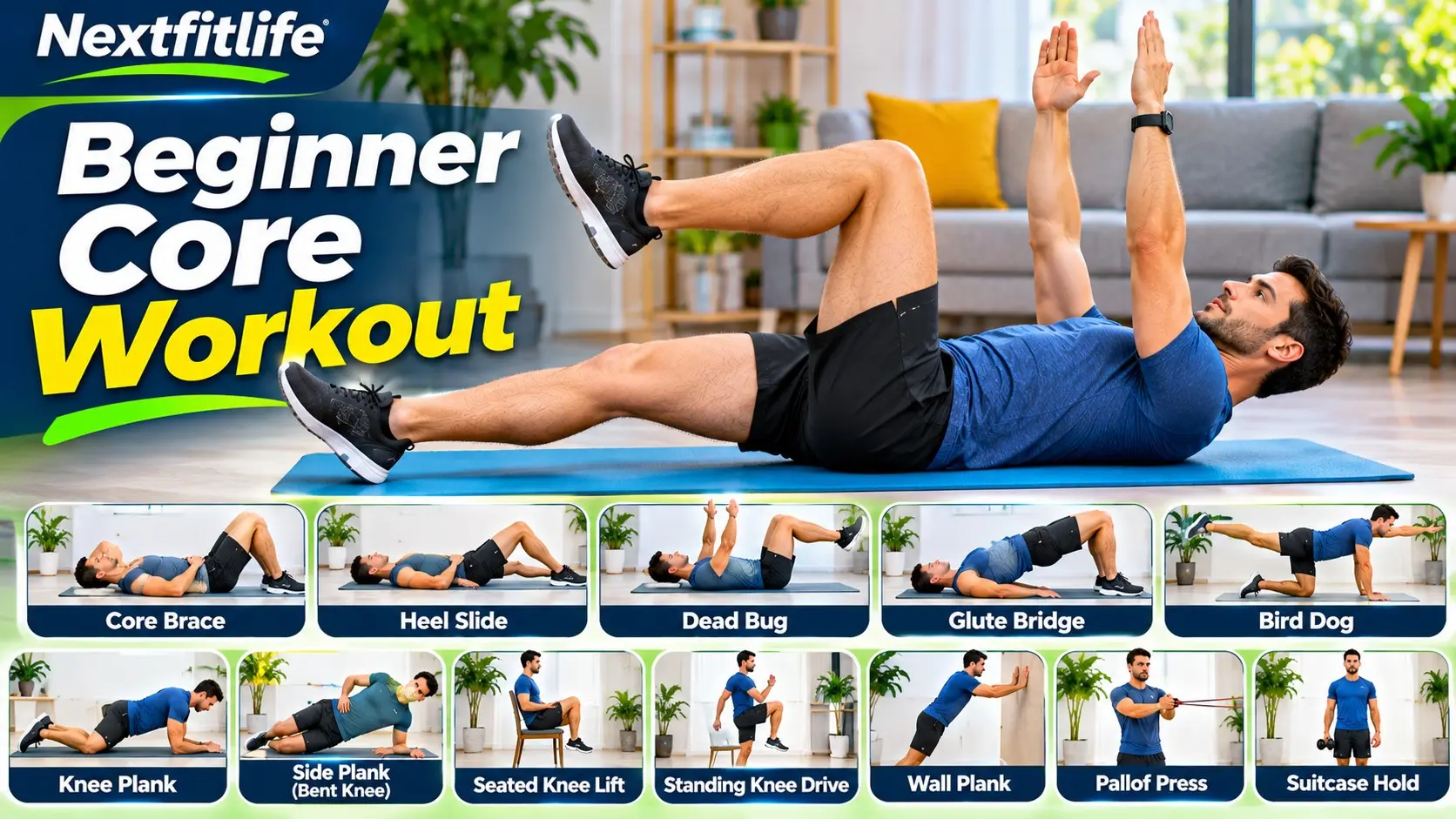
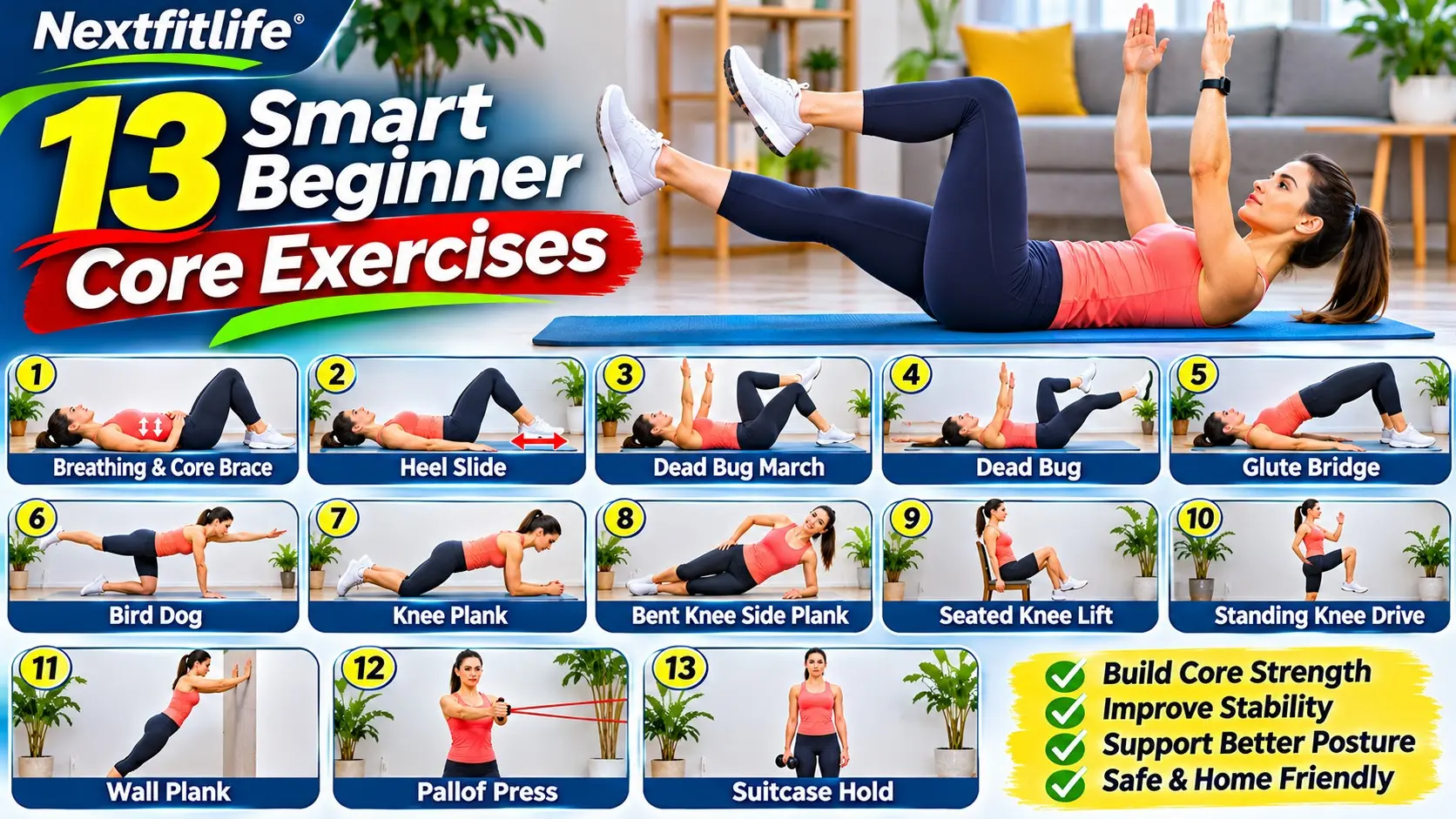
These 13 moves are a practical starting point:
- Breathing and core brace
- Heel slide
- Dead bug march
- Dead bug
- Glute bridge
- Bird dog
- Knee plank
- Bent knee side plank
- Seated knee lift
- Standing knee drive
- Wall plank
- Pallof press
- Suitcase hold
You do not need to perform all 13 in one session. Pick five or six, move slowly, and stop before your form breaks.
For a larger home routine, visit our Core Workouts at Home guide.
What Should a Beginner Core Workout Train?
Your core includes more than the muscles you can see in the mirror.
Important muscles include the:
- Rectus abdominis
- Transverse abdominis
- Obliques
- Multifidus
- Erector spinae
- Diaphragm
- Pelvic floor
Your hips and glutes also help control your pelvis during many core exercises.
For beginners, the main goals are:
- Learn to breathe without losing control.
- Keep the spine in a comfortable position.
- Control the pelvis.
- Resist unwanted arching.
- Resist unwanted twisting.
- Build basic endurance.
- Improve confidence with movement.
13 Smart Beginner Core Exercises
1. Breathing and Core Brace
Main focus: breathing, awareness, and basic trunk control.
- Lie on your back with your knees bent.
- Place one hand on your lower ribs.
- Breathe in gently.
- Breathe out slowly.
- As you breathe out, tighten your abdomen gently as if preparing for a light push.
- Keep breathing while maintaining mild tension.
Starting target: 5 slow breaths.
Do not suck your stomach in as hard as possible.
2. Heel Slide
Main focus: basic pelvic control.
- Lie on your back with both knees bent.
- Brace gently.
- Slide one heel away from you.
- Stop before your lower back begins to move a lot.
- Slide the foot back.
- Switch sides.
Starting target: 6 to 10 repetitions per side.
3. Dead Bug March
Main focus: beginner anti extension control.
- Lie on your back.
- Bring one knee above your hip.
- Lower that foot slowly.
- Lift the other knee.
- Alternate without rushing.
Starting target: 6 to 10 repetitions per side.
This is easier than the full dead bug.
4. Dead Bug
Main focus: core stability while the arms and legs move.
- Lie on your back.
- Bring your knees above your hips.
- Raise both arms.
- Extend one leg and the opposite arm slowly.
- Return to the start.
- Switch sides.
Starting target: 5 to 8 repetitions per side.
If your lower back begins to arch strongly, shorten the movement.
5. Glute Bridge
Main focus: glutes, hips, and pelvic control.
- Lie on your back.
- Bend your knees.
- Place your feet flat.
- Lift your hips slowly.
- Pause briefly.
- Lower with control.
Starting target: 8 to 12 repetitions.
6. Bird Dog
Main focus: trunk control and coordination.
- Start on hands and knees.
- Extend one arm forward.
- Extend the opposite leg behind you.
- Keep your hips level.
- Return slowly.
Starting target: 5 to 8 repetitions per side.
If this is too hard, move only one arm or one leg at a time.
7. Knee Plank
Main focus: beginner anti extension strength.
- Place your forearms on the floor.
- Keep your knees down.
- Move your hips forward until your body forms a straight line from knees to shoulders.
- Tighten your abdomen gently.
- Keep breathing.
Starting target: 10 to 20 seconds.
Progress to a full plank later.
8. Bent Knee Side Plank
Main focus: lateral stability and obliques.
- Lie on your side.
- Bend your knees.
- Place your forearm under your shoulder.
- Lift your hips.
- Hold while breathing.
Starting target: 10 to 15 seconds per side.
9. Seated Knee Lift
Main focus: simple seated core and hip control.
- Sit near the front of a sturdy chair.
- Sit tall.
- Brace gently.
- Lift one knee.
- Lower slowly.
- Switch sides.
Starting target: 8 to 12 repetitions per side.
This is useful if floor exercises are difficult.
For more seated options, see our Chair Exercise for Seniors guide.
10. Standing Knee Drive
Main focus: standing trunk control and balance.
- Stand beside a chair or counter.
- Brace gently.
- Lift one knee.
- Pause briefly.
- Lower slowly.
Starting target: 8 to 10 repetitions per side.
11. Wall Plank
Main focus: beginner plank mechanics.
- Place both forearms or hands against a wall.
- Walk your feet backward.
- Keep your body straight.
- Brace gently.
- Hold while breathing.
Starting target: 20 to 30 seconds.
This is a good first plank if floor work feels too difficult.
12. Pallof Press
Main focus: anti rotation.
You need a light resistance band and a secure anchor.
- Stand sideways to the band anchor.
- Hold the band at your chest.
- Press your hands forward.
- Do not let your body turn.
- Return slowly.
Starting target: 6 to 10 repetitions per side.
13. Suitcase Hold
Main focus: standing core control and lateral stability.
- Hold one light dumbbell or loaded bag at your side.
- Stand tall.
- Keep both shoulders level.
- Do not lean toward or away from the weight.
- Keep breathing.
Starting target: 15 to 20 seconds per side.
10 Minute Beginner Core Workout
| Exercise | Dose | Main Goal |
|---|---|---|
| Breathing and Brace | 5 breaths | Control |
| Heel Slide | 8 each side | Pelvic stability |
| Glute Bridge | 10 reps | Hips |
| Bird Dog | 6 each side | Coordination |
| Knee Plank | 15 seconds | Anti extension |
| Seated Knee Lift | 8 each side | Upright control |
Complete one or two rounds. Rest whenever you need to.
Four Week Beginner Core Progression
| Week | Focus | Goal |
|---|---|---|
| 1 | Breathing, heel slides, bridges | Learn control |
| 2 | Add bird dog and knee plank | Build endurance |
| 3 | Add dead bug and side plank | Increase challenge |
| 4 | Add Pallof press and suitcase hold | Train standing control |
You do not have to progress every week if the current level still feels challenging.
How Often Should Beginners Train Their Core?
Two or three focused sessions each week is enough for many beginners.
CDC recommends muscle strengthening on at least two days per week and includes the abdomen among the major muscle groups.
You also use your core during:
- Squats
- Walking
- Rows
- Push ups
- Carrying groceries
- Climbing stairs
Your core does not need a hard workout every day.
How Long Should a Beginner Core Workout Last?
About 10 to 15 minutes is enough to start.
A short session performed well is more useful than a long workout with poor form.
As your fitness improves, you can add:
- Another exercise
- A second or third round
- More resistance
- A harder exercise variation
How Hard Should Beginner Core Training Feel?
You should feel your muscles working, but you should still be able to breathe.
A useful beginner session should feel challenging without forcing you to hold your breath or lose control.
Some muscle shaking can happen when you are learning a new exercise or reaching fatigue.
Stop the set if your form collapses or you feel sharp pain.
Do Beginners Need Planks?
No.
Planks are useful, but they are not mandatory.
You can build core strength with:
- Heel slides
- Dead bugs
- Bird dogs
- Bridges
- Pallof presses
- Carries
If a floor plank is too hard, use a wall plank or knee plank first.
Can a Beginner Core Workout Flatten Your Stomach?
Core exercise strengthens the muscles under your stomach, but it does not choose where your body loses fat.
A flatter appearance depends on many factors, including:
- Total body fat
- Genetics
- Nutrition
- Physical activity
- Muscle development
- Posture
- Bloating
Do not judge the quality of a core workout only by how much your waist changes.
For fat loss guidance, read our How to Burn Fat Fast guide.
Why Core Control Matters More Than Burning Sensation
A strong burning feeling does not automatically mean an exercise is more effective.
Beginners should focus on:
- Slow movement
- Good breathing
- Controlled range
- Comfortable spine position
- Gradual progression
Current research shows that core stabilization training can improve deep abdominal muscle function and neuromuscular control, but these changes come from repeated training rather than one intense workout.
How to Make Beginner Core Exercises Harder
Progressive overload still matters.
When an exercise becomes easy, you can:
- Add two repetitions.
- Hold five seconds longer.
- Use a longer lever.
- Add a light resistance band.
- Add a light dumbbell.
- Move from a wall plank to a knee plank.
- Move from a knee plank to a full plank.
Change one factor at a time.
Common Beginner Core Workout Mistakes
Starting With Advanced Exercises
You do not need hanging leg raises or long planks on day one.
Holding Your Breath
Keep breathing during every exercise.
Moving Too Fast
Slow movement makes it easier to learn control.
Training Only the Rectus Abdominis
Your core also needs lateral stability, anti rotation, and control of your back and pelvis.
Doing Too Much Too Soon
Muscle soreness can make beginners abandon a routine. Start with a small dose you can repeat.
Chasing a Flat Stomach
Core strength and body fat are related to different training and nutrition factors.
Ignoring Standing Exercises
Standing knee drives, Pallof presses, and carries help connect core control to daily movement.
Training Through Sharp Pain
Muscle effort is expected. Sharp or worsening pain is not.
When Should You Stop Core Exercise?
Stop and get medical advice if you develop:
- Severe back pain
- New numbness or tingling
- Weakness in one or both legs
- Loss of bladder or bowel control
- Severe abdominal pain
- A painful new bulge that may be a hernia
- Chest pain
- Fainting
Loss of bladder or bowel control with new leg weakness or numbness needs urgent medical care.
Conclusion
A beginner core workout should help you move with more control, not leave you exhausted after your first session.
Start with breathing, heel slides, bridges, dead bugs, bird dogs, and easier plank variations. Then add side stability, anti rotation, and loaded standing exercises as your control improves.
Your next step: choose five exercises from this guide and complete one easy 10 minute session today. Repeat it two or three times this week before making it harder.
References and Sources
- Centers for Disease Control and Prevention. Adult Activity: An Overview. Guidance on aerobic activity and muscle strengthening for all major muscle groups, including the abdomen.
https://www.cdc.gov/physical-activity-basics/guidelines/adults.html - American College of Sports Medicine. Resistance Training Guidelines Update 2026. Current evidence on consistency, resistance training, bodyweight exercise, and home based workouts.
https://acsm.org/resistance-training-guidelines-update-2026/ - Lee K. Effects of Core Stability Training on Deep Stabilizing Muscle Function and Neuromuscular Control. 2025 randomized controlled trial.
https://pubmed.ncbi.nlm.nih.gov/40142175/ - Özel Aslıyüce Y and colleagues. Telerehabilitation Based and Face to Face Core Stabilization Exercises. 2025 randomized trial examining core muscle thickness and functional capacity.
https://pubmed.ncbi.nlm.nih.gov/41231170/ - Prentice CLS and colleagues. A Dose Response Analysis of Exercise Prescription Variables for Lateral Abdominal Muscle Thickness and Activation. 2024 systematic review.
https://pubmed.ncbi.nlm.nih.gov/38763566/
Internal Links + Fitness Hub
- Core Workouts at Home
- Best Abs Workout
- Best Ab Exercises
- Isometric Exercises
- Isometric Training Exercises
- Balance Exercises
- Chair Exercise for Seniors
- Strength Training and Muscle Building Guide
- Injury Prevention Exercises
- NextFitLife Fitness Hub
About the Author
Adel Galal is a father of four (three sons and a daughter) and a grandfather of four, with 33 years of hands-on parenting experience. He is the founder of Parnthub.com, based in Cairo, Egypt, where he shares practical guidance on feeding, development and family life from newborns to teenagers. Adel is not a medical professional; health articles cite trusted sources and are for general information only.
Learn more on the NextFitLife About Us page.
Frequently Asked Questions
What is a good beginner core workout?
A good beginner core workout includes simple exercises such as heel slides, dead bugs, bridges, bird dogs, knee planks, seated knee lifts, and wall planks.
How often should beginners train their core?
Two or three focused sessions per week can work well for most beginners, depending on recovery and the rest of the exercise program.
How long should a beginner core workout last?
About 10 to 15 minutes is enough to start. Exercise quality and consistency matter more than long sessions.
Should beginners do planks?
They can, but a wall plank or knee plank may be more appropriate at first. Planks are useful but not required for building a strong core.
Are dead bugs good for beginners?
Yes. Dead bugs teach trunk control while the arms and legs move. Beginners can first use a shorter range or perform a simple dead bug march.
Can beginner core workouts reduce belly fat?
Core exercise strengthens the abdominal muscles but does not selectively remove stomach fat. Overall activity, nutrition, and total fat loss affect waist size.
Is muscle shaking during core exercise normal?
Mild shaking can occur when muscles are learning a new task or becoming tired. Stop if you lose control or develop sharp pain.
Should I train my core every day?
You do not need to. Challenging core exercise still requires recovery, especially when you are new to training.
How do I make beginner core exercises harder?
Add a few repetitions, slightly longer holds, a longer lever, a light resistance band, or a more challenging exercise variation.
When should I stop a core workout?
Stop for severe back pain, new numbness, weakness, severe abdominal pain, chest pain, fainting, or loss of bladder or bowel control.

Health & wellness writer with 30+ years of experience in nutrition, fitness, and healthy aging. Founder of NextFitLife.com — evidence-based health guidance.

