

Published on: August 27, 2025
Updated on: November 5, 2026
A good heart health workout does not need extreme sprints or complicated machines. It needs regular movement that raises your breathing and heart rate, builds your fitness gradually, and is realistic enough to repeat every week.
Brisk walking, cycling, swimming, rowing, dancing, stair climbing, strength training, and controlled intervals can all support cardiovascular fitness.
The most important idea is consistency. A moderate workout that you can repeat is often more useful than one exhausting session followed by several inactive days.
This guide gives you 12 practical exercise options, a complete 25 minute workout, beginner modifications, weekly planning, heart rate guidance, progression rules, and important safety signs.
Important: This article is for general information and education. It does not replace medical advice, diagnosis, or treatment.
Heart safety: Stop exercise and seek urgent medical care if you develop chest pain or pressure, fainting, severe unusual shortness of breath, or symptoms that may signal a medical emergency. New palpitations with dizziness, weakness, or chest discomfort also need medical assessment.
Table of Contents
- Quick Answer
- What Makes a Workout Heart Healthy?
- How Much Cardio Do You Need?
- 12 Proven Heart Health Exercises
- 25 Minute Heart Health Workout
- Beginner Workout
- Weekly Training Plan
- Moderate vs Vigorous Exercise
- The Talk Test
- Heart Rate Guidance
- Strength Training and Heart Health
- HIIT vs Steady Cardio
- How to Progress Safely
- Recovery and Rest
- Common Mistakes
- When to Stop
- Conclusion
- References and Sources
- Explore More Fitness Guides
- About the Author
- Frequently Asked Questions
Quick Answer: What Is a Good Heart Health Workout?
A balanced heart health workout combines aerobic movement with strength training and uses an intensity that challenges you without pushing every session to exhaustion.
Useful exercises include:
- Brisk walking
- Low impact marching
- Step ups
- Low impact jumping jacks
- Dancing
- Cycling
- Rowing
- Swimming
- Stair climbing
- Easy jogging
- Full body strength training
- Controlled cardio intervals
You do not need to perform all 12 in one session. Pick movements that suit your health, joints, space, equipment, and current fitness.
If you want a broader list of aerobic activities, visit our Best Cardiovascular Workout guide.
What Makes a Workout Heart Healthy?
A heart healthy workout challenges your cardiorespiratory fitness. That means your heart, lungs, blood vessels, and working muscles must cooperate to deliver and use oxygen.
During aerobic activity, your breathing becomes faster and your heart rate rises. With regular training, the same walk, bike ride, or swimming session may begin to feel easier because your body has adapted.
Exercise can also support:
- Cardiovascular endurance
- Blood pressure management
- Blood glucose control
- Daily stamina
- Sleep
- Mood
- Healthy body composition
- Muscle strength
- Physical independence
The newest 2026 American College of Cardiology scientific statement emphasizes an important point: people who are inactive often have the most to gain by simply becoming more active.
You do not need to start with vigorous exercise.
How Much Cardio Do You Need?
Current physical activity guidance recommends adults aim for at least:
- 150 minutes of moderate-intensity aerobic activity each week, or
- 75 minutes of vigorous aerobic activity each week, or
- An equivalent mixture of moderate and vigorous activity.
Adults should also perform muscle strengthening exercise on at least two days each week.
You can spread those minutes across the week. Five 30-minute walks, for example, provide 150 minutes.
You can also use shorter sessions when that fits your day better.
The goal is not perfection. Moving more and sitting less is already a meaningful step.
12 Proven Moves for Your Heart Health Workout
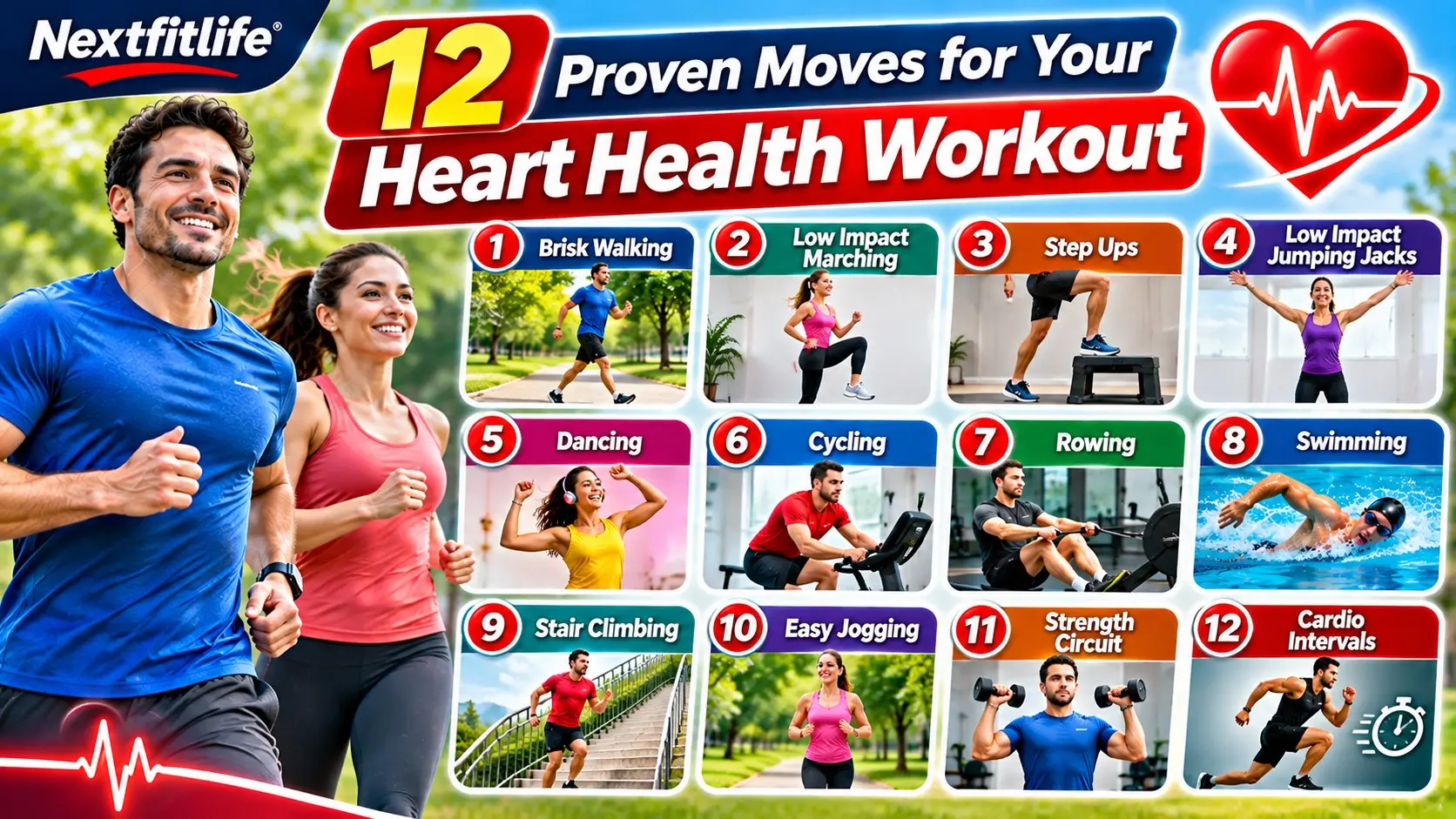
1. Brisk Walking
Brisk walking is one of the easiest forms of cardiovascular exercise to start and one of the easiest to maintain.
You need little equipment, and intensity is simple to control by changing your speed or route.
How to Do It
- Begin with several minutes of easy walking.
- Increase your pace until your breathing becomes faster.
- Keep your shoulders relaxed.
- Swing your arms naturally.
- Finish with an easier pace.
Starting target: 15 to 30 minutes.
Once walking becomes easy, add more time, a faster pace, or gentle hills.
For a structured walking plan, see Walking for Weight Loss.
2. Low Impact Marching
Marching in place is simple low impact cardio you can do at home.
Stand tall, raise one knee at a time, and move your arms naturally. Increase the pace until your breathing rises but remains controlled.
Starting target: 2 to 5 minutes at a time.
You can alternate marching with other exercises to build a home circuit.
3. Step Ups
Step ups combine leg work with aerobic demand.
Use a low, stable step and place your whole foot on the surface.
- Step up with one foot.
- Bring the other foot up.
- Step down carefully.
- Change the leading leg.
Starting target: 30 to 60 seconds followed by recovery.
If balance is uncertain, use a secure support.
4. Low Impact Jumping Jacks
You do not need to jump.
Step one foot sideways while raising your arms, return to the center, then switch sides.
This version reduces impact while still raising your heart rate.
Starting target: 30 to 60 seconds.
People who tolerate jumping comfortably can progress to regular jumping jacks.
5. Dancing
Dancing can turn cardio into an activity you actually look forward to.
The intensity can range from easy to vigorous depending on your pace and style.
Use music you enjoy and keep moving for several minutes at a time.
Starting target: 10 to 20 minutes.
Enjoyment matters because exercise only helps over time when you keep doing it.
6. Cycling
Cycling is a useful lower impact choice for building aerobic capacity.
You can use an outdoor bicycle, stationary bike, or recumbent bike.
A simple session is:
- 5 minutes easy
- 15 to 20 minutes moderate
- 5 minutes easy
Increase resistance gradually rather than starting with a heavy setting.
7. Rowing
Rowing uses the legs, hips, trunk, back, and arms, so it can raise your heart rate quickly.
The movement should feel smooth rather than rushed.
Starting target: 10 to 20 minutes at a comfortable pace.
Beginners should learn correct rowing technique before adding speed or resistance.
8. Swimming
Swimming is full body cardiovascular exercise with relatively low joint impact.
You can alternate easy swimming with brief rests, especially when starting.
Starting target: 15 to 30 minutes including recovery periods.
Always use appropriate water safety and supervision when needed.
9. Stair Climbing
Stairs quickly increase cardiovascular demand because you repeatedly lift your body upward.
Start with short bouts.
- Climb for 30 to 60 seconds.
- Walk easily for 1 to 2 minutes.
- Repeat if comfortable.
Use a railing if needed.
10. Easy Jogging
Jogging can provide vigorous aerobic exercise, but you do not need to run continuously when you begin.
Try a walk and jog approach:
- Walk for 2 minutes.
- Jog gently for 1 minute.
- Repeat for 15 to 20 minutes.
Increase the jogging periods slowly.
If you are working toward longer runs, see our How to Increase Stamina for Running guide.
11. Full Body Strength Circuit
Strength training belongs in a complete heart healthy fitness plan.
A simple circuit may include:
- 8 to 12 sit to stands
- 8 to 12 wall or incline push ups
- 8 to 12 resistance band rows
- 8 step ups per side
- 20 to 30 seconds of loaded carries
Rest as needed and repeat the circuit once or twice.
The American College of Sports Medicine's 2026 resistance training review found improvements in strength, muscular endurance, balance, walking speed, power, and physical function.
For more training ideas, see our Strength Training and Muscle Building Guide.
12. Controlled Cardio Intervals
Intervals alternate periods of harder work with easier recovery.
You can do them with walking, cycling, rowing, swimming, or another familiar cardio exercise.
For example:
- Warm up for 5 minutes.
- Work briskly for 1 minute.
- Recover easily for 2 minutes.
- Repeat four times.
- Cool down.
Intervals do not need to be maximum effort to be useful.
25 Minute Heart Health Workout
This simple home routine combines steady cardio with light strength work.
| Phase | Activity | Time |
|---|---|---|
| Warm Up | Easy march or walk | 5 minutes |
| Cardio 1 | Brisk march | 3 minutes |
| Strength | Sit to stands and wall push ups | 3 minutes |
| Cardio 2 | Step ups or low impact jacks | 3 minutes |
| Strength | Rows and supported squats | 3 minutes |
| Cardio 3 | Brisk march or dance | 3 minutes |
| Cool Down | Easy walking | 5 minutes |
Move at your own pace. Beginners can shorten each work period, while fitter adults can make the cardio sections more challenging.
Beginner Heart Health Workout
If you have been inactive, start smaller.
Try:
- Easy walking for 5 minutes.
- Brisk walking for 5 minutes.
- Easy walking for 2 minutes.
- Brisk walking for another 5 minutes.
- Cool down for 3 minutes.
This gives you about 20 minutes of movement without making the workout complicated.
Repeat two or three times during the first week if you recover comfortably.
Simple Weekly Heart Health Workout Plan
| Day | Activity | Intensity |
|---|---|---|
| Monday | Brisk walking, 30 minutes | Moderate |
| Tuesday | Strength training | Controlled |
| Wednesday | Cycling or swimming, 30 minutes | Moderate |
| Thursday | Easy walk or recovery | Easy |
| Friday | Brisk walking, rowing, or dancing, 30 minutes | Moderate |
| Saturday | Strength training plus short cardio | Mixed |
| Sunday | Easy walk, gentle activity, or rest | Easy |
Moderate vs Vigorous Cardio
Moderate intensity exercise raises your heart rate and breathing, but you remain in control.
You can usually speak in sentences, although singing would be difficult.
Examples may include:
- Brisk walking
- Comfortable cycling
- Easy swimming
- Moderate dancing
Vigorous intensity exercise feels much harder. Your breathing becomes rapid and talking in full sentences is difficult.
Examples may include:
- Running
- Fast cycling
- Hard rowing
- Fast stair climbing
- High intensity intervals
You do not need vigorous exercise every day.
Use the Talk Test
The talk test is one of the simplest ways to judge exercise intensity.
During moderate activity, you should generally be able to talk but not sing comfortably.
During vigorous activity, you may only manage a few words before taking another breath.
This is useful because heart rate formulas are only estimates.
What Heart Rate Should You Aim For?
The American Heart Association gives general target ranges based on estimated maximum heart rate.
- Moderate intensity: about 50 to 70 percent of estimated maximum heart rate
- Vigorous intensity: about 70 to 85 percent
A common rough estimate for maximum heart rate is 220 minus your age.
However, these figures are not exact.
Your exercise heart rate may change with:
- Fitness level
- Medication
- Heat
- Hydration
- Stress
- Sleep
- Caffeine
- Illness
If you take medication that changes heart rate or have a cardiovascular condition, ask your healthcare professional what exercise intensity is appropriate for you.
Why Strength Training Matters for Heart Health
A complete fitness routine should not contain cardio alone.
The 2026 American College of Sports Medicine resistance training position stand summarized evidence from 137 systematic reviews involving more than 30,000 adults.
Resistance training improved:
- Muscle strength
- Muscular endurance
- Power
- Balance
- Walking speed
- Several measures of physical function
Stronger muscles can also make daily activity feel easier, which may help you remain active over time.
Is HIIT Better Than Steady Cardio?
Not automatically.
A 2026 meta analysis of 115 trials found that high intensity interval training produced somewhat greater average improvements in maximal oxygen uptake than continuous moderate to vigorous exercise.
However, the size of this advantage changed with:
- Age
- Sex
- Training level
- Exercise type
- Interval length
- Workout design
Both methods can improve fitness.
Steady cardio may be easier for beginners, easier to recover from, and easier to fit into a regular routine.
HIIT is an option, not a requirement.
For more, read our HIIT Workouts guide.
How to Progress Your Heart Health Workout
Progress works best when it is gradual.
You can increase:
- Workout duration
- Number of exercise days
- Walking or cycling pace
- Resistance
- Incline
- Number of intervals
Change one main factor at a time.
For example, if you increase a walk from 20 minutes to 30 minutes, keep the pace similar for several sessions before also adding steep hills.
Do You Need a Rest Day?
Recovery depends on the difficulty of your workouts.
Easy walking may be comfortable on many days, but hard intervals and strength training place more stress on the body.
Signs that you may need more recovery include:
- Unusual fatigue
- Persistent muscle soreness
- Worsening performance
- Poor sleep
- Lack of motivation
More exercise is not automatically better if recovery is poor.
Can a Heart Health Workout Help With Weight Management?
Yes, regular exercise can increase energy use and support weight management.
However, exercise does not guarantee weight loss on its own.
Body weight also depends on:
- Food intake
- Daily movement
- Sleep
- Muscle mass
- Medical factors
- Medication
A balanced plan combines cardio, resistance training, good nutrition, and sustainable habits.
For more guidance, see our How to Burn Fat Fast article.
Heart Health Workout for Adults Over 60
Older adults can use many of the same exercise types, but modifications may improve comfort and safety.
Useful choices include:
- Walking
- Stationary cycling
- Swimming
- Low impact marching
- Chair assisted strength exercises
- Balance work
CDC also recommends balance activity for older adults, especially when fall risk is a concern.
For more options, see our Chair Exercise for Seniors and Balance Exercises guides.
Common Heart Health Workout Mistakes
Starting Too Hard
You do not need to finish every workout exhausted. Build duration and consistency before chasing maximum intensity.
Thinking Only Running Counts
Walking, cycling, swimming, rowing, dancing, and many other activities can improve cardiovascular fitness.
Making Every Workout Vigorous
Moderate activity offers meaningful health benefits and is easier to recover from.
Skipping Strength Work
Current exercise guidance includes both aerobic activity and muscle strengthening.
Watching the Heart Rate Monitor Too Closely
Heart rate estimates are useful guides, but they should not replace how you feel or medical advice.
Skipping the Warm Up
Begin with easier movement so your heart rate and breathing rise gradually.
Ignoring Warning Symptoms
Chest pressure, fainting, severe unusual breathlessness, or concerning palpitations should never be treated as normal signs that you need to push harder.
When Should You Stop Exercising?
Stop exercise and seek appropriate medical care if you experience:
- Chest pain or pressure
- Fainting
- Severe dizziness
- Severe unusual shortness of breath
- New palpitations with weakness or dizziness
- Sudden severe weakness
- Symptoms that feel like a medical emergency
If you think you may be having a heart attack or another serious medical emergency, seek emergency medical help immediately.
Conclusion
A good heart health workout combines regular aerobic movement, strength work, gradual progression, and enough recovery to keep you consistent.
Brisk walking, marching, step ups, cycling, swimming, rowing, dancing, stair climbing, jogging, strength circuits, and controlled intervals can all help build cardiovascular fitness.
You do not have to begin with intense training. Start with a pace you can manage, build toward current weekly activity targets, and make the routine harder only when your body is ready.
Your next step: choose one activity from this guide and complete 20 to 30 minutes at a comfortable pace this week. Then schedule your next session before the week ends.
References and Sources
- Centers for Disease Control and Prevention. Adult Activity: An Overview. Current recommendations for weekly aerobic and muscle strengthening activity.
https://www.cdc.gov/physical-activity-basics/guidelines/adults.html - American College of Cardiology. Exercise Prescriptions for Cardiovascular Health in Adults: 2026 ACC Scientific Statement. Guidance on aerobic, strength, balance, flexibility, exercise progression, and individualized cardiovascular exercise prescription.
https://www.jacc.org/doi/full/10.1016/j.jacc.2026.09.008 - American Heart Association. Target Heart Rates Chart. General heart rate ranges for moderate and vigorous exercise.
https://www.heart.org/en/healthy-living/exercise-and-physical-activity/fitness-basics/target-heart-rates - American College of Sports Medicine. Resistance Training Prescription for Muscle Function, Hypertrophy, and Physical Performance in Healthy Adults. 2026 position stand based on 137 systematic reviews involving more than 30,000 participants.
https://pubmed.ncbi.nlm.nih.gov/41843416/ - One Size Does Not Fit All. 2026 meta analysis of 115 trials comparing high intensity interval training with moderate to vigorous continuous exercise.
https://pubmed.ncbi.nlm.nih.gov/41804294/
Explore More Fitness Guides
- 5 Best Exercises to Strengthen Your Heart
- Best Cardiovascular Workout
- Walking for Weight Loss
- HIIT Workouts
- HIIT Workouts for Men
- How to Increase Stamina for Running
- Running Tips for Long Distance
- Low Impact Exercises to Burn Fat at Home
- Strength Training and Muscle Building Guide
- Balance Exercises
- Chair Exercise for Seniors
- 5 Components of Physical Fitness
- NextFitLife Fitness Hub
Frequently Asked Questions
What is the best heart health workout?
A good heart health workout combines moderate aerobic exercise with strength training. Walking, cycling, swimming, rowing, dancing, and controlled intervals are useful options.
How long should a heart health workout last?
Many adults can begin with 20 to 30 minutes. Weekly activity matters more than making every individual session long.
How many days a week should I do cardio?
Spread aerobic activity across the week in a way that helps you work toward at least 150 minutes of moderate activity or 75 minutes of vigorous activity.
Is walking enough for heart health?
Brisk walking can count as moderate aerobic activity and is an excellent starting option for many adults.
What is the best low impact cardio for heart health?
Walking, cycling, swimming, elliptical exercise, low impact marching, and dancing can all provide useful cardiovascular activity with less impact than running or jumping.
Does strength training belong in a heart health workout?
Yes. Current activity guidance recommends muscle strengthening on at least two days each week in addition to aerobic exercise.
Is HIIT necessary for heart fitness?
No. HIIT can improve aerobic fitness, but steady moderate exercise also works. HIIT is an option rather than a requirement.
What heart rate should I aim for during cardio?
A general guide is about 50 to 70 percent of estimated maximum heart rate during moderate exercise and about 70 to 85 percent during vigorous exercise. Individual responses vary.
How can a beginner start a heart health workout?
Begin with 10 to 20 minutes of comfortable walking or another low impact activity, then gradually increase duration or pace as fitness improves.
When should I stop a heart health workout?
Stop and seek medical help for chest pain or pressure, fainting, severe unusual shortness of breath, severe dizziness, or concerning new palpitations.