
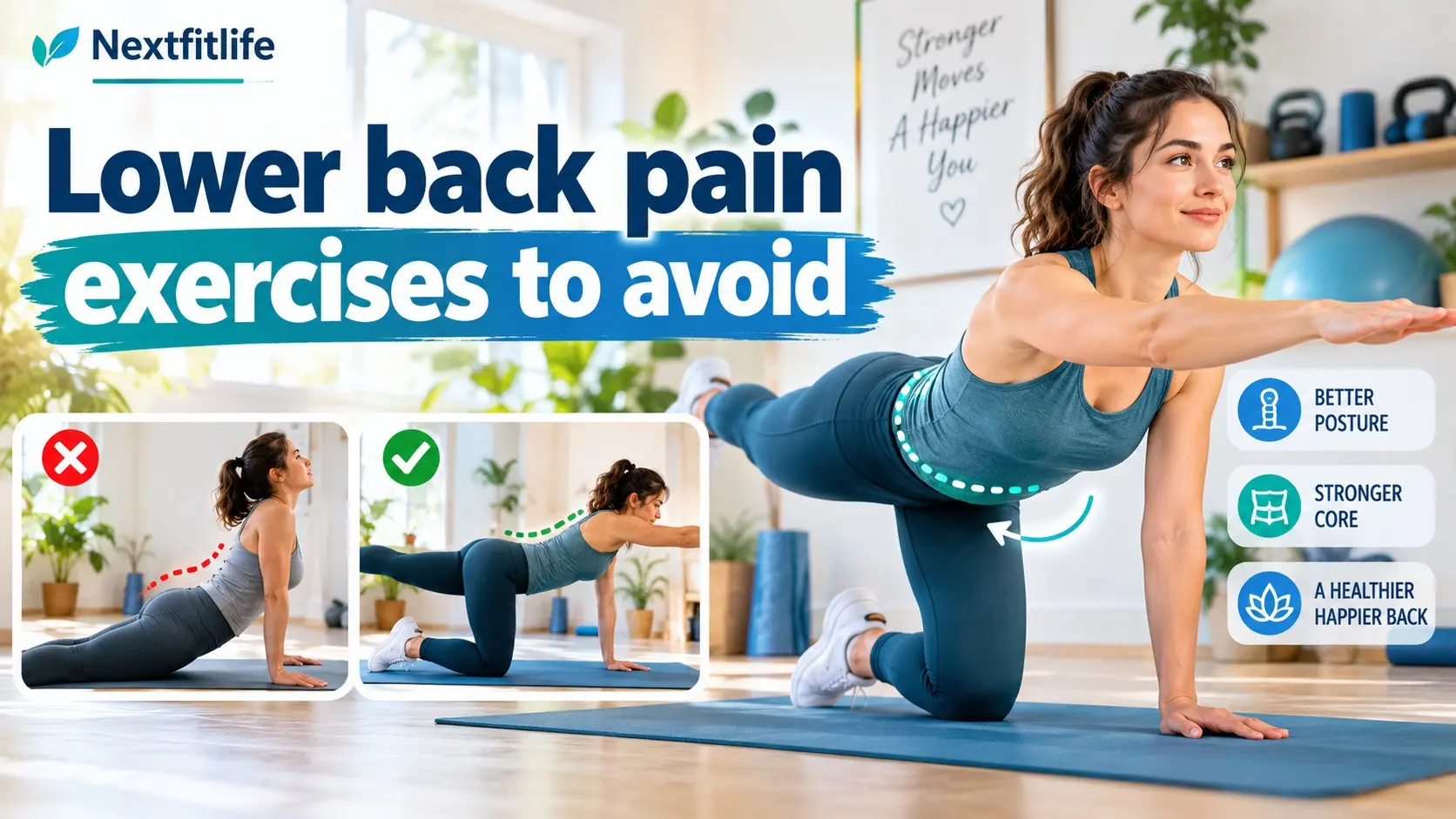
Published on: November 11, 2023
Updated on: October 23, 2026
Searching for lower back pain exercises to avoid can make it seem as if certain movements are dangerous for every aching back. That is not how current back pain guidance works.
Running, bending, twisting, squatting, deadlifting, sit ups, and other common movements are not automatically harmful. The better question is whether a specific exercise clearly makes your symptoms worse, exceeds your present ability, or has been restricted because of a diagnosed condition.
In many cases, the answer is not permanent avoidance. It is a smaller range, lighter load, slower pace, easier variation, or different exercise while symptoms settle.
Important: This article is for general information and education. It does not replace medical advice, diagnosis, or treatment.
I am not a dermatologist or a doctor, and this content does not replace professional medical advice. What I share comes from real life experience, extensive research, and consultation with healthcare providers. Always consult qualified medical professionals for diagnosis and treatment of any health condition.
For practical core exercise modifications, read Lower Back Pain During Core Exercises. You can also explore the NextFitLife Fitness Hub and NextFitLife Health Hub.
Get urgent medical help instead of exercising if serious warning signs appear.
- New inability to urinate
- New loss of bladder or bowel control
- Numbness around the genitals, buttocks, or inner thighs
- Severe or rapidly worsening leg weakness
- Severe back pain after major trauma
- Back pain with serious illness, fever, or rapidly worsening neurological symptoms
Table of Contents
- Quick Answer
- No Universal Banned Exercise List
- 9 Exercises to Modify When Painful
- Heavy poorly controlled deadlifts
- Deep loaded forward bending
- Fast loaded twisting
- Straight leg raises
- Long sit ups
- High impact exercise during a painful flare
- Long floor planks
- Aggressive back extensions
- Any exercise that spreads neurological symptoms
- Safer Exercise Swaps
- Sciatica
- Acute vs Chronic Back Pain
- How Much Pain Is Acceptable?
- When to Get Help
- Frequently Asked Questions
- References and Sources
Lower Back Pain Exercises to Avoid: Quick Answer
There is no universal list of normal exercises that every person with lower back pain must avoid forever.
Temporarily stop or modify an exercise when it:
- Clearly increases significant back pain
- Makes pain travel farther into the buttock or leg
- Triggers new numbness or tingling
- Creates weakness
- Cannot be performed with reasonable control
- Has been restricted by your healthcare professional because of a specific diagnosis
Common movements that may need modification include heavy deadlifts, loaded deep bending, forceful twisting, straight leg raises, long sit ups, high impact activity during a painful flare, long floor planks, and aggressive back extensions.
The important word is modify.
An exercise that hurts today may be completely appropriate later when the load, technique, range, or condition changes.
There Is No Universal List of Bad Back Exercises
The old version of this article treated running, deadlifts, overhead presses, twisting, forward bending, sit ups, and several other movements as exercises that people with back pain should broadly avoid.
That is too simple.
The World Health Organization states that about 90 percent of low back pain is nonspecific low back pain. This means one precise structural cause cannot be confidently identified in most cases.
WHO recommends physical activity, rehabilitation, education, and other person centered approaches.
NICE also advises people with low back pain to continue normal activities where possible and considers several forms of exercise appropriate, depending on the person's needs, preferences, and abilities.
Your back is not automatically damaged because it hurts.
At the same time, pain should not be ignored. Exercise should be scaled to what you can tolerate safely.
What Does “Avoid” Mean in This Guide?
It means one of three things:
- Pause it temporarily because it clearly aggravates your current symptoms.
- Modify it so the load, range, speed, or leverage becomes easier.
- Avoid it because a clinician has identified a condition that makes that exercise inappropriate right now.
This is very different from saying a movement is inherently harmful.
1. Heavy Deadlifts When You Cannot Control the Load
Deadlifts are not automatically dangerous for the lumbar spine.
They are a resistance exercise, and resistance training can be useful in a well designed program.
The problem comes when the load, range, fatigue, or technique exceeds what you can currently tolerate.
Consider Pausing or Modifying When:
- Each repetition sharply increases pain.
- Pain begins traveling farther down a leg.
- You cannot control the weight.
- You are using a load far beyond your recent training level.
Try Instead
- Lighter kettlebell deadlift from a raised position
- Dumbbell Romanian deadlift with a shorter range
- Unloaded hip hinge practice
- Glute bridge
The goal is to reduce demand, not become afraid of bending or lifting forever.
2. Deep Loaded Forward Bending During a Painful Flare
Your spine normally bends.
Forward flexion is part of daily activities such as tying shoes, getting dressed, and picking things up.
It does not need to be permanently removed from life.
However, a deep loaded forward bend may be poorly tolerated during some episodes of back pain.
If bending under load sharply worsens symptoms, reduce the load or range.
Try Instead
Use a smaller comfortable bend, keep the object closer to your body, or temporarily raise the object so you do not need to reach as far.
As symptoms and confidence improve, range can often be rebuilt gradually.
3. Fast or Heavy Twisting
Rotation is a normal spinal movement.
You do not need to fear twisting.
What may be irritating is combining speed, large range, and heavy resistance before you can control the movement.
For example, fast weighted Russian twists may be too demanding during an active episode of lower back pain.
Try Instead
- Slow controlled rotation through a comfortable range
- Standing cable or band press when appropriate
- Bird dog
- Side plank variation
Build rotation back gradually if it is a movement you need or enjoy.
4. Straight Leg Raises That Make Your Back Arch or Hurt
Straight leg raises create a long lever.
As the legs move farther from the trunk, the abdominal muscles have to manage a larger challenge.
If you cannot control that challenge, the pelvis and lower back may move more than intended.
That does not make leg raises universally bad.
It means the current version may be too difficult.
Try Instead
- Bent knee march
- Heel slide
- Dead bug with one leg
- Shorter leg lowering range
For a simple progression, see the 5 Minute Ab Workout.
5. Long Sit Ups When They Repeatedly Increase Symptoms
Sit ups are often described online as dangerous.
That is too broad.
They train trunk flexion and hip flexion, and many people can perform them without difficulty.
If repeated sit ups clearly increase your back pain, however, there is no reason to keep doing them when other core exercises are available.
Try Instead
- Dead bug
- Bird dog
- Modified side plank
- Incline plank
- Short comfortable crunches if those feel better
You do not need sit ups to have a strong core.
6. High Impact Exercise During a Painful Flare
Running and jumping are not automatically bad for backs.
Many healthy people run for decades without developing disabling back pain.
But if each landing clearly worsens an active painful episode, temporarily reducing impact can make sense.
Try Instead
- Walking
- Easy cycling
- Swimming if comfortable
- Elliptical training
Then rebuild impact gradually rather than deciding you can never run again.
7. Long Floor Planks That Lose Control
Planks are not automatically back friendly just because your spine does not visibly move much.
A floor plank can be very demanding.
If your back begins hurting after 15 seconds, holding the position for another minute does not prove discipline.
It may simply be more training than you currently tolerate.
Try Instead
- Wall plank
- Counter plank
- Bench plank
- Short floor plank holds
Three controlled 10 second holds can be more useful than one painful 60 second hold.
8. Aggressive Back Extensions
Back extension is a normal movement, just like flexion.
But forcing large repeated extension when it clearly increases pain is unnecessary.
This includes aggressive Roman chair extensions or repeatedly pushing into a very large arch because someone said it will “fix” the spine.
Try Instead
- Small comfortable range extension if it helps
- Bird dog
- Glute bridge
- Walking
- A therapist selected movement if symptoms are complex
The direction that feels good for one person may feel bad for another.
9. Any Exercise That Sends Symptoms Farther Down the Leg
This deserves more attention than simply asking whether your back aches.
If an exercise makes pain, numbness, or tingling move farther from the back into the buttock, thigh, calf, or foot, stop and reassess.
New or worsening neurological symptoms can involve nerve irritation and may require clinical evaluation.
This is especially important when symptoms include weakness.
Exercise Modification Guide
| If This Hurts | Try This Change | Why It May Help |
|---|---|---|
| Heavy Deadlift | Reduce load and range | Less demand while practicing the hinge |
| Straight Leg Raise | Bent knee dead bug | Shorter lever |
| Long Floor Plank | Incline plank | Less body weight challenge |
| Russian Twist | Side plank or slower rotation | Reduces speed and range |
| Running | Walking or cycling temporarily | Lower impact during a flare |
| Deep Forward Bend | Smaller comfortable range | Keeps movement without forcing symptoms |
What Exercises Are Usually Easy to Scale?
No exercise is guaranteed to feel good for every back, but some movements are simple to adjust.
Options include:
- Walking
- Dead bug
- Bird dog
- Glute bridge
- Modified side plank
- Wall plank
- Chair squat
- Supported step up
The exercise should fit your symptoms and ability rather than a generic online ranking.
For more ideas, see Lower Back Pain During Core Exercises.
Is Walking Good for Lower Back Pain?
Walking is often a practical way to remain active because pace and duration are easy to adjust.
Start with a duration that feels manageable.
You might tolerate five or ten minutes before you tolerate thirty.
There is no prize for pushing until symptoms become severe.
Several short walks can be a useful way to build activity gradually.
Should You Avoid Bending With Lower Back Pain?
Not forever.
Bending is part of normal life.
Avoiding all bending can make everyday activities difficult and may increase fear of normal movement.
During a painful flare, you can reduce how far or how often you bend if that clearly helps.
Then rebuild the movement gradually as symptoms allow.
Should You Avoid Twisting?
Not automatically.
Your spine and hips normally rotate.
Fast loaded twisting may be poorly tolerated during some episodes, but that does not mean rotation should disappear from your life.
Begin with a comfortable range and controlled speed.
Are Deadlifts Bad for Lower Back Pain?
No exercise name tells you whether it is safe for a specific person.
A deadlift can be far too demanding for someone during an acute painful episode, while a carefully selected hip hinge or deadlift variation can be part of another person's rehabilitation or strength program.
Load, range, technique, symptoms, training history, and diagnosis all matter.
Are Squats Bad for Lower Back Pain?
Not inherently.
Try changing:
- Depth
- Load
- Stance
- Exercise variation
A chair squat or goblet squat may be easier to control than a heavy barbell squat.
If all squat versions repeatedly provoke significant symptoms, professional assessment may help determine why.
Are Sit Ups Bad for Your Back?
No universal rule says everyone must avoid sit ups.
They involve spinal and hip flexion, which may feel fine for some people and irritating for others.
If they hurt, use another exercise.
You can train your core without ever performing a sit up.
Can You Run With Lower Back Pain?
It depends on the pain.
If running causes mild symptoms that remain stable and settle afterward, a healthcare professional may not necessarily tell you to stop.
If each run makes symptoms progressively worse or sends pain farther into the leg, reduce or stop the activity and get appropriate advice.
Walking, cycling, or another form of cardio can maintain activity while you reassess.
What About Yoga?
Yoga is not automatically good or bad for back pain.
A pose that feels helpful for one person may irritate another.
Deep forward folds, large backbends, or strong twists can be modified when they provoke symptoms.
NICE considers mind body exercise one possible exercise approach for low back pain when matched to individual needs and capabilities.
For a gentle general routine, see the 20 Minute Yoga Workout.
What If You Have Sciatica?
Sciatica generally refers to symptoms involving a nerve root that may cause pain, tingling, numbness, or weakness in the leg.
A generic list of stretches is not enough to determine what you need.
Be cautious when an exercise makes symptoms travel farther down the leg or creates new neurological symptoms.
Seek assessment when:
- Leg weakness appears
- Numbness worsens
- Pain is severe or progressive
- Symptoms do not improve
- Bladder, bowel, or saddle symptoms occur
Do not aggressively stretch a painful nerve because an online article calls the sensation “tight hamstrings.”
Acute Lower Back Pain vs Chronic Lower Back Pain
A short painful episode and months of persistent pain are not exactly the same situation.
During a strong acute flare, you may need to temporarily reduce certain movements and loads.
With persistent chronic low back pain, long term avoidance of activity is usually not the goal.
Exercise, education, and gradual return to meaningful activities play important roles in current care.
Does Core Exercise Help Chronic Lower Back Pain?
Yes, it can.
A 2026 meta analysis included 33 randomized trials and 1,757 people with chronic nonspecific low back pain. Core muscle training improved pain and function compared with control conditions, although the results varied greatly between studies.
Another 2026 network meta analysis found significant pain improvements with stabilization, resistance, traditional, combined, and motor control exercise programs.
This tells us something useful:
There is more than one good way to exercise with chronic back pain.
You do not need one magical movement.
How Long Should Exercise for Back Pain Last?
There is no single perfect session length.
A September 2026 systematic review in the British Journal of Sports Medicine examined exercise dose for chronic low back pain and found that benefits occur across different exercise doses.
Another 2026 network meta analysis found improvements with sessions of 15 to 20 minutes, 30 to 40 minutes, and 45 to 50 minutes.
The practical lesson is simple.
Do enough to create useful, repeatable practice without choosing a dose that causes you to quit.
How Much Pain Is Acceptable During Exercise?
There is no universal pain number that is safe for everybody.
Pay attention to the pattern.
Less Concerning
- Mild muscular effort
- Mild stiffness that stays stable
- Symptoms that settle after changing position or stopping
More Concerning
- Sharp or severe pain
- Pain that keeps increasing during the session
- Pain spreading farther down the leg
- New numbness
- New weakness
- Symptoms that remain substantially worse after the workout
If you are unsure, a physical therapist or other qualified healthcare professional can help establish an appropriate starting point.
Should You Stay in Bed Until the Pain Stops?
Usually not for ordinary nonspecific back pain.
NICE encourages people to continue normal activities where possible, while WHO also emphasizes physical activity and rehabilitation.
This does not mean forcing heavy exercise.
It means avoiding unnecessary complete inactivity when gentle activity is possible.
What About Perfect Posture?
You do not need to hold your spine in one exact position all day.
People naturally sit, stand, bend, and move in many ways.
A better goal is variety.
Change positions. Take movement breaks. Build strength. Use an exercise position you can control comfortably.
Do You Need an MRI Before Exercising?
Usually not.
NICE advises against routine imaging for low back pain in a nonspecialist setting.
Imaging may be appropriate when a clinician suspects serious pathology or when the result would change management.
A scan should answer a useful clinical question rather than simply prove that your back hurts.
When Should You See a Healthcare Professional?
Arrange an assessment if:
- Pain is severe or steadily worsening.
- Symptoms continue despite reasonable self care.
- Pain repeatedly travels down a leg.
- You have persistent numbness or tingling.
- You notice weakness.
- Pain began after significant trauma.
- You have osteoporosis or fracture risk.
- You have a history of cancer or serious infection.
- You have unexplained fever or weight loss.
The VA and Department of Defense clinical guideline recommends evaluating people with low back pain for serious neurological deficits and other red flags that could indicate fracture, infection, cancer, or other serious conditions.
When Is Lower Back Pain an Emergency?
Seek urgent medical help for:
- New urinary retention
- New urinary or fecal incontinence
- Saddle numbness
- Severe or progressive lower limb neurological deficits
- Serious trauma with severe back pain
- Other rapidly developing neurological symptoms
These symptoms need medical assessment, not exercise experimentation.
7 Mistakes to Avoid When Exercising With Back Pain
1. Treating Every Painful Back as Fragile
Pain does not automatically mean your spine is damaged or unable to tolerate normal movement.
2. Forcing an Exercise Because Someone Called It Therapeutic
Even a commonly recommended exercise can be wrong for you today.
3. Banning Bending Forever
Bending is part of normal life and can often be rebuilt gradually.
4. Training Through Increasing Leg Symptoms
Pain, numbness, or tingling spreading farther down a leg deserves more caution than simple muscle effort.
5. Adding Load Too Quickly
Rebuild weight and range gradually after time away from training.
6. Resting Completely for Too Long
Appropriate activity is usually preferred over prolonged inactivity for nonspecific back pain.
7. Assuming One Exercise Will Cure the Problem
Good care may involve exercise, education, sleep, general activity, work modification, psychological support, and medical treatment when needed.
A Simple Back Friendly Starting Session
| Exercise | Starting Dose | Adjustment |
|---|---|---|
| Walking | 5 to 10 minutes | Shorten if symptoms rise |
| Dead Bug | 5 each side | Move one heel only |
| Glute Bridge | 8 repetitions | Use a smaller lift |
| Bird Dog | 5 each side | Move one limb only |
| Wall Plank | 15 to 20 seconds | Stand closer to the wall |
This is only an example, not a treatment plan.
Stop or change any exercise that meaningfully worsens your symptoms.
Conclusion
The most useful way to think about lower back pain exercises to avoid is not to create a permanent blacklist. Instead, identify movements that clearly worsen your current symptoms, modify the load or range, and keep using forms of activity that you tolerate.
Bending, lifting, twisting, squatting, running, and core training are not automatically enemies of your lumbar spine. For many people, gradual return to meaningful movement is part of recovery.
Start by identifying one exercise that bothers your back. Reduce its load, range, speed, or leverage. If symptoms still worsen, use another movement and seek professional guidance when needed.
References and Sources
- World Health Organization. Low Back Pain.
https://www.who.int/news-room/fact-sheets/detail/low-back-pain - World Health Organization. WHO Guideline for Non Surgical Management of Chronic Primary Low Back Pain in Adults.
https://www.who.int/publications/i/item/9789240081789 - National Institute for Health and Care Excellence. Low Back Pain and Sciatica in Over 16s: Assessment and Management.
https://www.nice.org.uk/guidance/ng59/chapter/recommendations - VA and Department of Defense. Clinical Practice Guideline for the Diagnosis and Treatment of Low Back Pain.
https://www.healthquality.va.gov/guidelines/Pain/lbp/ - Meta Analysis of the Therapeutic Effects of Different Core Muscle Training on Pain and Function in Chronic Nonspecific Low Back Pain. 2026.
https://pubmed.ncbi.nlm.nih.gov/42137906/ - Comparative Effects of Exercise Modalities and Dose Parameters on Chronic Low Back Pain in Adults. 2026.
https://pubmed.ncbi.nlm.nih.gov/42222290/ - Optimal Exercise Dose in Adults With Chronic Low Back Pain Disorders. British Journal of Sports Medicine. 2026.
https://pubmed.ncbi.nlm.nih.gov/42785965/ - Pain and Disability Therapy With Stabilization Exercises in Patients With Chronic Low Back Pain. 2025.
https://pubmed.ncbi.nlm.nih.gov/40361738/
Internal Links + Hub
- NextFitLife Health Hub for health conditions, symptoms, prevention, and wellness guidance.
- NextFitLife Fitness Hub for strength, cardio, mobility, home workouts, and beginner exercise guidance.
- Lower Back Pain During Core Exercises for safer core technique and exercise modifications.
- 5 Minute Ab Workout for a short scalable core routine.
- 20 Minute Yoga Workout for gentle movement, mobility, balance, and relaxation.
- What Causes Lower Back Pain in Females? for causes and warning signs specific to women.
- Healthy and Active Lifestyle for combining movement, fitness, nutrition, sleep, and daily health habits.
- Physical Fitness and Mental Health for the wider connection between physical activity and wellbeing.
- NextFitLife Foods and Nutrition Hub for balanced eating and healthy lifestyle guidance.
About the Author
Adel Galal is a father of four, three sons and a daughter, and a grandfather of four, with 33 years of hands on parenting experience. He is the founder of Parnthub.com, based in Cairo, Egypt, where he shares practical guidance on feeding, development and family life from newborns to teenagers.
Adel is not a medical professional. Health articles cite trusted sources and are for general information only.
On NextFitLife, Adel researches and writes about fitness, nutrition, healthy aging, back health, home exercise, and practical wellness with a focus on evidence, realistic expectations, and avoiding fear based health claims.
Learn more about Adel and NextFitLife on the About Us page.
Frequently Asked Questions
What are the main lower back pain exercises to avoid?
There is no permanent list for everyone. Temporarily modify exercises that significantly increase your pain, cause symptoms to spread farther down a leg, create numbness or weakness, or exceed your current ability. Heavy lifting, deep loaded bending, forceful twisting, straight leg raises, long sit ups, and high impact activity may need modification during some painful episodes.
Should I stop exercising if my lower back hurts?
Not necessarily. Current guidance generally encourages appropriate activity rather than prolonged complete rest for nonspecific low back pain. Stop or modify movements that substantially worsen symptoms and seek assessment when pain is severe, persistent, or accompanied by warning signs.
Are deadlifts bad for lower back pain?
No. Deadlifts are not inherently bad for the back. A heavy or poorly tolerated version may need to be reduced or replaced temporarily. Load, range, symptoms, technique, training history, and diagnosis all matter.
Are squats bad for lower back pain?
No. Squats can often be modified by reducing load or depth or using a chair or goblet squat. Stop the exercise if it repeatedly causes significant or worsening symptoms.
Should I avoid bending with lower back pain?
You do not usually need to avoid bending forever. During a painful flare you may temporarily reduce painful ranges, then rebuild normal bending gradually as symptoms allow.
Should I avoid twisting with lower back pain?
Not automatically. Rotation is a normal movement. Fast or heavily loaded twisting may be difficult during some episodes, so reduce the range, load, or speed when necessary.
Are sit ups bad for lower back pain?
Sit ups are not universally dangerous. If they repeatedly worsen your symptoms, use another core exercise such as a dead bug, bird dog, side plank, or incline plank.
Can I run with lower back pain?
Some people can continue running, while others need to reduce impact temporarily. If running progressively worsens symptoms or sends pain farther down the leg, stop and seek appropriate advice.
What exercises are safer for lower back pain?
Walking, dead bugs, bird dogs, glute bridges, modified side planks, wall planks, and chair squats are easy to scale, but no exercise is automatically safe or effective for every person.
Can core strengthening help lower back pain?
Yes. Recent systematic reviews show that core training can reduce pain and improve function in many adults with chronic nonspecific low back pain. Other forms of exercise can also work, so there is no single required core program.
Is bed rest good for lower back pain?
Prolonged bed rest is generally not the goal for ordinary nonspecific low back pain. Current guidance encourages remaining appropriately active and returning to normal activity as tolerated.
When is lower back pain an emergency?
Seek urgent medical attention for new urinary retention, loss of bladder or bowel control, saddle numbness, severe or progressive leg weakness, serious neurological symptoms, or severe pain following major trauma.
Do I need an MRI for lower back pain?
Not usually. NICE advises against routine imaging in nonspecialist care. Imaging is more useful when a clinician suspects serious pathology or when the result is likely to change treatment.

Health & wellness writer with 30+ years of experience in nutrition, fitness, and healthy aging. Founder of NextFitLife.com — evidence-based health guidance.

