
Published on: January 31, 2024
Updated on: October 25, 2026
Lower Ab Exercises can build a stronger core, improve pelvic control, and make daily movement and training feel more stable. The key is knowing what these exercises really do. There is no separate lower ab muscle to isolate, but certain movements create a strong challenge through the lower part of the abdominal wall by changing leg leverage and pelvic position.
That is why reverse crunches, dead bugs, leg lowering drills, planks, and hanging knee raises can all be useful. The goal is not to race through reps. The goal is to control your trunk while your arms, legs, or pelvis move.
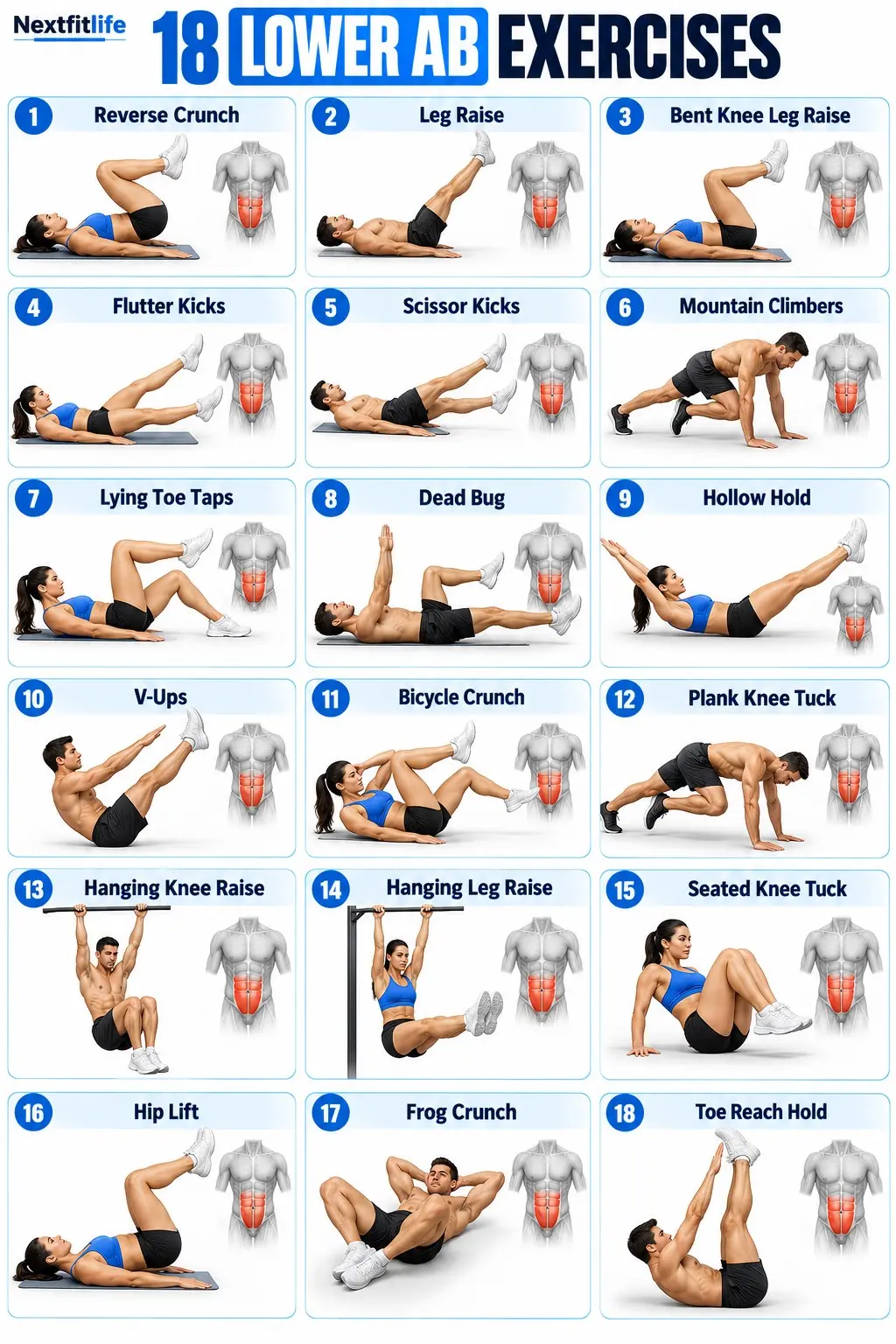
This guide gives you 18 Lower Ab Exercises, beginner options, harder progressions, a short workout, back friendly choices, and an honest answer about lower belly fat.
This article is for general information and education. It does not replace medical advice, diagnosis, or treatment.
I am not a dermatologist or a doctor, and this content does not replace professional medical advice. What I share comes from real life experience, extensive research, and consultation with healthcare providers. Always consult qualified medical professionals for diagnosis and treatment of any health condition.
For more training ideas, visit the NextFitLife Fitness Hub, Lower Abs Workout, and Effective Workout Routines at Home.
Table of Contents
- Lower Ab Exercises: Quick Answer
- Are Lower Abs a Separate Muscle?
- What Core Training Really Does
- 18 Lower Ab Exercises
- Beginner floor moves
- Intermediate core moves
- Advanced leg and hanging moves
- Best Exercises by Level
- 10 Minute Lower Core Workout
- How Often to Train
- How to Progress
- Back Friendly Options
- Lower Belly Fat
- Common Mistakes
- Frequently Asked Questions
- References and Sources
Lower Ab Exercises: Quick Answer
The best Lower Ab Exercises are movements that make your abdominal wall control the pelvis and trunk while your legs move.
Useful choices include:
- Dead bugs
- Heel taps
- Bent knee marches
- Reverse crunches
- Single leg extensions
- Plank knee drives
- Mountain climbers
- Flutter kicks
- Hanging knee raises
You do not need all 18 exercises in one session. Four to six well chosen movements are enough for most workouts.
Are the Lower Abs a Separate Muscle?
No.
The main muscle running down the front of the abdomen is the rectus abdominis. It is one continuous muscle.
Your core also includes the transverse abdominis, the internal and external obliques, back muscles, pelvic muscles, and other tissues that help control the trunk.
So why do some exercises feel much harder below the belly button?
The reason is leverage and movement.
When your legs move farther away from your body, the demand on your trunk increases. When you curl your pelvis toward your ribs, as in a reverse crunch, the movement also feels different from a standard crunch.
You are not switching on a secret lower muscle. You are changing the job your core has to perform.
What Does Core Strength Actually Do?
Core strength helps your trunk stay controlled while the rest of your body moves.
You use it when you:
- Walk
- Run
- Lift
- Carry
- Push
- Pull
- Climb stairs
- Change direction
Mayo Clinic describes the core as including abdominal, back, and pelvic muscles. Strong core muscles can make many daily and sports movements easier.
That is why a good core plan contains more than crunches.
For wider strength work, see Strength Training and Muscle Building.
1. Bent Knee March
This is one of the easiest ways to learn pelvic control.
- Lie on your back with your knees bent.
- Keep both feet on the floor.
- Brace your abdomen gently.
- Lift one foot a few inches.
- Return it slowly.
- Switch sides.
Keep the movement small enough that your pelvis stays quiet.
2. Heel Tap
Heel taps make the lever slightly longer while keeping the knees bent.
- Lie on your back with your knees above your hips.
- Lower one heel toward the floor.
- Touch lightly.
- Return.
- Repeat on the other side.
If your back begins to arch sharply, shorten the movement.
3. Dead Bug
The dead bug is a great exercise for trunk stability.
- Lie on your back.
- Raise your arms toward the ceiling.
- Bend your hips and knees.
- Slowly extend one leg and the opposite arm.
- Return to the start.
- Switch sides.
Only reach as far as you can while keeping your trunk controlled.
4. Reverse Crunch
The reverse crunch adds more pelvic movement.
- Lie on your back.
- Bend your knees.
- Bring your knees toward your hips.
- Curl your pelvis toward your ribs.
- Lower slowly.
Think about curling the pelvis rather than swinging the legs.
Start with 6 to 12 controlled reps.
5. Reverse Crunch With Slow Lowering
This is an easy way to make the reverse crunch harder without adding equipment.
Lift normally, then take about three seconds to lower.
The slower lowering phase increases the challenge while keeping the exercise simple.
6. Bent Knee Leg Lower
This exercise teaches you to control your trunk as the leg moves away.
- Start with both knees above your hips.
- Keep one knee still.
- Slowly lower the other bent leg.
- Return before your back loses control.
The floor is not a required target.
7. Single Leg Extension
This makes the lever longer.
Start in the same tabletop position, then straighten one leg away from your body.
The farther you extend it, the harder your core has to work.
Keep breathing throughout the repetition.
8. Bicycle Crunch
The bicycle crunch adds trunk rotation.
- Lie on your back.
- Bring one knee toward the body.
- Rotate the opposite side of your torso toward it.
- Extend the other leg.
- Alternate sides slowly.
Keep your hands light behind your head. Do not pull on your neck.
9. Forearm Plank
A plank teaches your trunk to resist unwanted movement.
This is called anti extension.
- Place your forearms on the floor.
- Extend your legs behind you.
- Keep your ribs and pelvis controlled.
- Keep breathing.
Start with a short hold that you can maintain cleanly.
10. Side Plank
Your core also needs to resist sideways bending.
A side plank trains that skill.
Begin with the lower knee bent if the full version is too difficult.
11. Plank Knee Drive
This adds movement to a plank position.
- Start in a high plank.
- Bring one knee slowly toward your chest.
- Pause.
- Return.
- Switch legs.
Try to keep your hips from twisting side to side.
12. Mountain Climber
Mountain climbers use a similar movement but at a faster pace.
Start slowly before adding speed.
If your hips bounce with every rep, slow down.
13. Straight Leg Lower
This is much harder than the bent knee version because your legs create a longer lever.
- Lie on your back with your legs raised.
- Brace your abdomen.
- Lower the legs slowly.
- Stop before your trunk position changes.
- Return to the top.
You do not need to lower your legs close to the floor.
14. Flutter Kick
Flutter kicks challenge the core and hip flexors over a longer period.
Use small controlled kicks.
If your lower back becomes uncomfortable, bend your knees or return to heel taps.
15. Scissor Kick
Scissor kicks use a larger alternating leg movement.
Keep the legs high enough that you can control your trunk.
Lowering them closer to the floor is not automatically better.
16. Hollow Body Tuck Hold
This is a useful bridge between beginner floor work and harder straight leg exercises.
- Lie on your back.
- Bend your knees toward your chest.
- Lift your shoulders slightly if comfortable.
- Hold the position while breathing.
Progress by moving the knees farther from the torso.
17. Hanging Knee Raise
This movement combines grip, shoulder support, hip flexion, and trunk control.
- Hang from a secure pull up bar.
- Stop your body from swinging.
- Bring your knees upward.
- Lower them slowly.
If you swing through every repetition, the exercise is too difficult or too fast.
18. Hanging Leg Raise
The hanging leg raise is an advanced progression.
Straighter legs create a much longer lever than bent knees.
Only progress to this version after hanging knee raises feel controlled.
There is no benefit in rushing to the hardest option before you can own the easier one.
Best Lower Ab Exercises by Level
| Level | Exercises | Main Focus |
|---|---|---|
| Beginner | March, heel tap, dead bug, reverse crunch | Learn pelvic and trunk control |
| Intermediate | Bicycle crunch, plank knee drive, single leg extension | Longer levers and more movement |
| Advanced | Straight leg lower, hollow hold, hanging knee raise, hanging leg raise | High trunk control demand |
| Back sensitive | March, heel tap, dead bug, short plank | Shorter lever and smaller range |
10 Minute Lower Ab Workout
This routine is short enough for a busy day but still gives you a clear progression.
| Time | Movement |
|---|---|
| 1 minute | Easy warm up and breathing |
| 1 minute | Dead bug |
| 1 minute | Heel taps |
| 1 minute | Rest or easy movement |
| 1 minute | Reverse crunch |
| 1 minute | Forearm plank |
| 1 minute | Plank knee drive |
| 1 minute | Rest |
| 1 minute | Reverse crunch with slow lowering |
| 1 minute | Easy cool down |
Do not treat each minute as a race. Rest whenever form begins to break down.
How Often Should You Train Lower Abs?
Two or three focused core sessions each week is enough for many people.
Your abs also work during squats, lunges, push ups, rows, carries, running, and many other exercises.
CDC guidance recommends muscle strengthening work on at least two days each week for the major muscle groups, including the abdomen.
Hard abdominal training every day is not required.
How Many Reps Should You Do?
For dynamic Lower Ab Exercises, 6 to 15 controlled repetitions is a practical starting range.
For planks and holds, use a duration that lets you maintain position and breathe normally.
Your set should stop because the abdominal muscles are getting tired, not because your back or neck starts hurting.
How to Progress Lower Ab Exercises
Progressive overload simply means making the exercise gradually harder as your body adapts.
You can progress by:
- Adding a few repetitions
- Adding one set
- Moving more slowly
- Increasing hold time
- Using a longer leg position
- Extending the leg farther
- Progressing from floor work to hanging exercises
The 2026 ACSM resistance training guidance emphasizes consistency and gradual progression rather than complicated methods. Bodyweight and home based training can still improve strength and function.
What If Lower Ab Exercises Hurt Your Back?
Make the exercise easier before assuming you need to quit core training completely.
Straight leg lowers, flutter kicks, and hanging movements create long levers. If your trunk cannot control that demand yet, your lower back may move more than you want.
Try:
- Bending the knees
- Using one leg at a time
- Reducing the range
- Switching to heel taps
- Switching to dead bugs
- Resting sooner
If pain is sharp, severe, persistent, or getting worse, stop and seek appropriate medical assessment.
For more guidance, see Lower Back Pain Exercises to Avoid.
Should Your Lower Back Stay Flat?
Not as a rigid rule.
The goal is good pelvic control and a trunk position you can maintain comfortably.
Some exercises use a gentle posterior pelvic tilt. Others work closer to a natural neutral position.
What you want to avoid is uncontrolled arching as the legs move farther away.
Think about controlling the movement, not forcing your spine into the floor.
Do You Need to Pull Your Belly Button In?
No single cue is required for every core exercise.
A study comparing trunk stabilization with and without abdominal hollowing found that abdominal muscles can be activated in both approaches.
A simple cue works well for many people:
Brace your abdomen gently as if someone were about to nudge your stomach, then keep breathing.
You should not need to hold your breath to keep your core active.
Can Lower Ab Exercises Burn Lower Belly Fat?
This deserves a careful answer.
Lower Ab Exercises strengthen the abdominal muscles. They should not be sold as a guaranteed way to remove fat from one exact area.
A small 2023 randomized trial involving 16 overweight adult men reported greater local trunk fat reduction when abdominal endurance work was combined with treadmill training than with treadmill exercise alone.
Another small study also reported localized changes after a combined circuit program.
Those findings are interesting, but the studies are small and do not justify promising that a few minutes of lower ab work will selectively remove lower belly fat.
For practical purposes, treat body fat loss as a whole body process influenced by energy intake, total activity, genetics, sleep, hormones, and time.
Train your abs for strength and control. Manage body composition with the whole plan.
Why Do You Feel Leg Raises in Your Hip Flexors?
Because the hip flexors help lift your legs.
That is normal.
Your abdominal muscles work at the same time to control your pelvis and trunk.
The goal is not to switch the hip flexors off. The goal is to keep the movement within a range your trunk can control.
If your back starts arching or the exercise becomes uncomfortable, bend the knees or choose a shorter lever.
Is a Glute Bridge a Lower Ab Exercise?
Not mainly.
A bridge is primarily a hip extension movement. Your glutes create most of the visible hip lift while the core helps stabilize your trunk.
It is still a useful exercise, but I would not list it as one of the main Lower Ab Exercises.
9 Common Lower Ab Exercise Mistakes
1. Moving Too Fast
Momentum can hide poor control. Slow the exercise enough to feel what your trunk is doing.
2. Lowering the Legs Too Far
The floor is not a required destination. Stop before your position breaks down.
3. Holding Your Breath
Keep breathing while you brace.
4. Pulling on Your Neck
This often happens during bicycle crunches. Keep your hands light.
5. Chasing the Burn
A burning feeling does not prove that the exercise is superior or that belly fat is disappearing.
6. Doing Only Leg Raises
A good core routine also includes stabilization and side control.
7. Ignoring Back Pain
Persistent pain is not a sign of a better workout.
8. Expecting Visible Abs From Core Training Alone
Core strength and visible abdominal definition are different goals.
9. Jumping Straight to Hanging Leg Raises
Advanced does not mean better. Use the hardest variation you can still control.
A Simple Weekly Core Plan
| Day | Exercises |
|---|---|
| Day 1 | Dead bug, reverse crunch, plank, side plank |
| Day 2 | Heel taps, single leg extension, plank knee drive, bicycle crunch |
| Optional Day 3 | Reverse crunch, mountain climber, flutter kick, hanging knee raise if ready |
You can also place two or three core exercises at the end of a full body workout rather than creating a separate ab day.
Conclusion: Lower Ab Exercises
Lower Ab Exercises work best when you focus on control rather than trying to isolate an imaginary separate muscle.
Start with dead bugs, heel taps, marches, and reverse crunches. Progress to longer leg positions, planks, and hanging variations when your trunk stays controlled.
Your next step is simple: choose four exercises from this guide, perform two controlled sets today, and write down which version lets you work hard without losing form.
References and Sources
- Mayo Clinic. Core Exercises: Why You Should Strengthen Your Core Muscles.
https://www.mayoclinic.org/healthy-lifestyle/fitness/in-depth/core-strength/art-20546851 - Centers for Disease Control and Prevention. Physical Activity Guidelines for Adults.
https://www.cdc.gov/physical-activity-basics/guidelines/adults.html - American College of Sports Medicine. Updated Resistance Training Guidelines. 2026.
https://acsm.org/resistance-training-guidelines-update-2026/ - Bjerkefors A, et al. Deep and Superficial Abdominal Muscle Activation During Trunk Stabilization Exercises With and Without Instruction to Hollow.
https://pubmed.ncbi.nlm.nih.gov/20570549/ - Brobakken MF, et al. Abdominal Aerobic Endurance Exercise Reveals Spot Reduction Exists: A Randomized Controlled Trial.
https://pubmed.ncbi.nlm.nih.gov/38010201/ - Ramírez Campillo R, et al. Effect of an Endurance and Strength Mixed Circuit Training on Regional Fat Thickness.
https://pubmed.ncbi.nlm.nih.gov/33917584/
Internal Links + Hub
- NextFitLife Fitness Hub for cardio, strength, mobility, and workout guidance.
- Lower Abs Workout for another structured core routine.
- Strength Training and Muscle Building Guide for progressive resistance training.
- Home Workouts and Equipment Guide for training without a commercial gym.
- Fitness for Beginners for simple ways to start exercising.
- Effective Workout Routines at Home for complete home training plans.
- Lower Back Pain Exercises to Avoid for people managing back symptoms.
- Single Leg Exercises for lower body stability and unilateral control.
- Shoulders and Legs Workout for full body strength work.
- Healthy and Active Lifestyle for sustainable exercise, sleep, recovery, and nutrition habits.
- Physical Fitness and Mental Health for the wider benefits of regular movement.
About the Author
Adel Galal is a father of four, three sons and a daughter, and a grandfather of four, with 33 years of hands on parenting experience. He is the founder of Parnthub.com, based in Cairo, Egypt, where he shares practical guidance on feeding, development and family life from newborns to teenagers.
Adel is not a medical professional. Health articles cite trusted sources and are for general information only.
On NextFitLife, Adel researches and writes about fitness, core strength, home workouts, nutrition, healthy aging, and practical wellness habits with a focus on current evidence, realistic expectations, and sustainable progress.
Learn more about Adel and NextFitLife on the About Us page.
Lower Ab Exercises: Frequently Asked Questions
What are the best Lower Ab Exercises?
Useful Lower Ab Exercises include dead bugs, reverse crunches, heel taps, bent knee leg lowers, planks, mountain climbers, flutter kicks, hanging knee raises, and controlled leg raises.
Can you isolate the lower abs?
Not completely. The rectus abdominis is one continuous muscle. Some exercises change pelvic motion, leverage, and trunk demand so that the lower abdominal region may feel more challenged.
What Lower Ab Exercises are best for beginners?
Bent knee marches, heel taps, dead bugs, reverse crunches, and short forearm planks are good beginner options because you can control the range easily.
Do Lower Ab Exercises burn belly fat?
They strengthen the abdominal muscles but should not be promised as a reliable way to remove fat from one exact body area. Small studies suggest localized effects may occur in some conditions, but the evidence is too limited for guaranteed spot reduction.
Are leg raises good for lower abs?
Leg raises can challenge the abdominal wall because the trunk must control the pelvis as the legs move. The hip flexors also contribute strongly.
Why do I feel leg raises in my hip flexors?
The hip flexors help lift the legs, so feeling them work is normal. If your back starts arching or the movement feels uncomfortable, bend your knees or shorten the range.
Should my lower back stay flat during Lower Ab Exercises?
The main goal is controlled trunk and pelvic position. Some exercises use a gentle posterior pelvic tilt, while others stay closer to neutral. Avoid uncontrolled arching.
How often should I train my lower abs?
Two or three focused core sessions each week is enough for many people. Your core also works during many full body exercises.
How many Lower Ab Exercises should I do in one workout?
Four to six exercises are enough for most people. Choose movements that match your level rather than trying to complete every exercise on the list.
How many reps should I do?
Six to fifteen controlled reps is a useful starting range for many dynamic core exercises. For planks, use short holds that you can maintain with good form and normal breathing.
Are hanging leg raises better than reverse crunches?
No. Hanging leg raises are simply harder and require more grip and shoulder support. Reverse crunches are easier to control and suit more beginners.
Are flutter kicks safe?
They can be appropriate when you can control your trunk without back discomfort. If your back arches or hurts, bend the knees, raise the legs, or switch to heel taps or dead bugs.
Can Lower Ab Exercises help back pain?
Core training can be part of some back pain programs, but no single lower ab exercise treats every type of back pain. Persistent pain should be assessed by a qualified healthcare professional.
Is a glute bridge a Lower Ab Exercise?
Not mainly. A glute bridge is primarily a hip extension exercise. Your abdominal muscles help stabilize the trunk, but the glutes perform most of the hip lifting work.
Should I pull my belly button toward my spine?
You do not need one rigid cue for every core exercise. A gentle abdominal brace while continuing to breathe normally works well for many people.
Which Lower Ab Exercise is hardest?
Hanging straight leg raises are among the hardest exercises in this guide because they combine grip, shoulder support, hip movement, and a long leg lever. Harder does not automatically mean better.
When should I stop a core exercise?
Stop if you feel sharp or severe pain, especially in the lower back or joints, or if you develop chest pain, fainting, unusual shortness of breath, severe dizziness, or another concerning symptom.

Health & wellness writer with 30+ years of experience in nutrition, fitness, and healthy aging. Founder of NextFitLife.com — evidence-based health guidance.

