First published: September 27, 2026
Last updated: September 27, 2026
Written and source checked by: Adel Galal, Founder and Lead Writer at NextFitLife
Review status: Educational cardiovascular content. This article has not been medically reviewed by a cardiologist, lipid specialist, doctor, pharmacist, or registered dietitian.
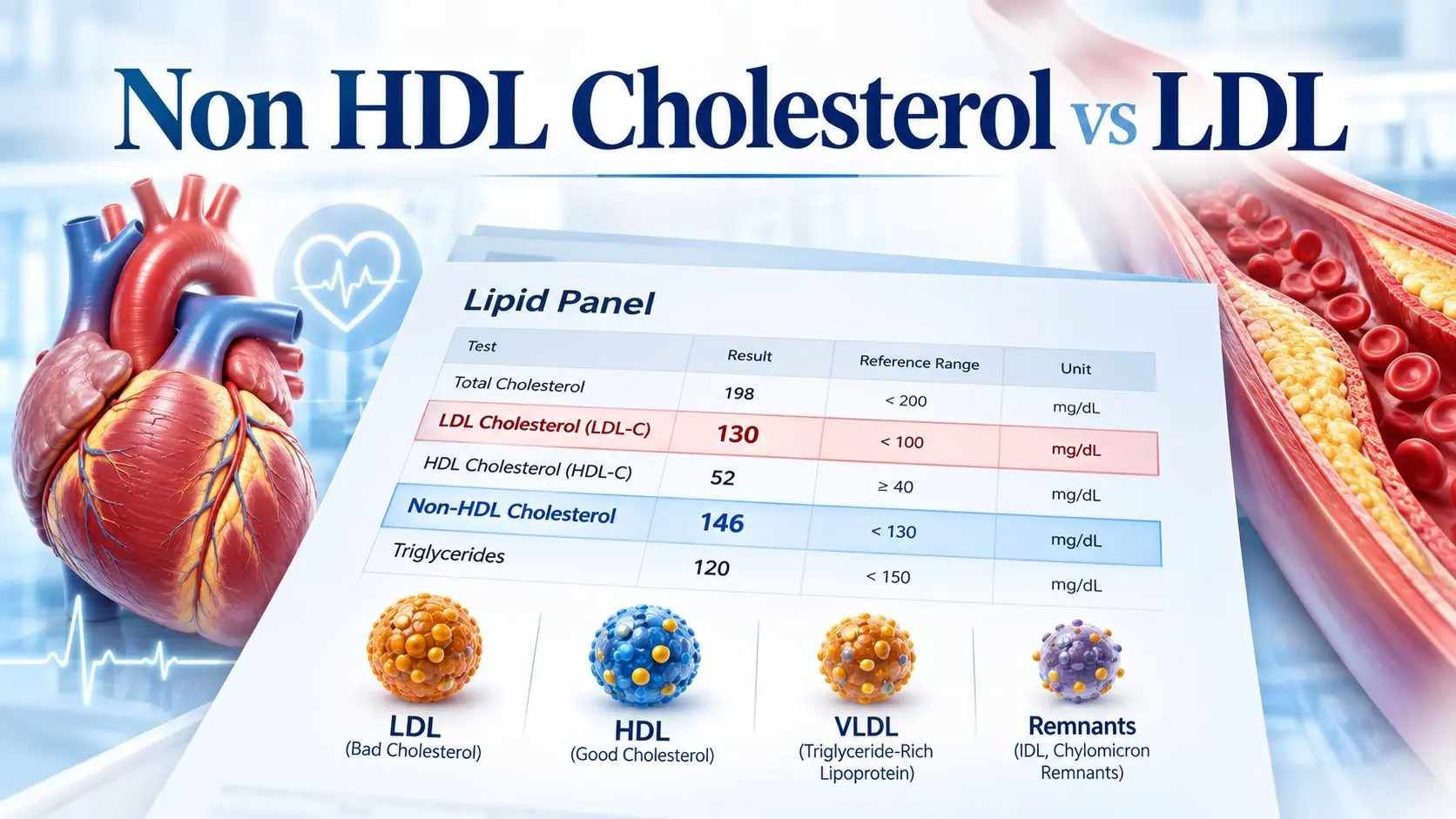
If your LDL cholesterol looks acceptable but your non HDL cholesterol is higher than expected, do not assume the second number is unimportant. LDL measures one major pool of artery related cholesterol, while non HDL captures LDL plus cholesterol carried by several other particles that can also contribute to plaque.
The useful question is not which number wins. It is what each one tells you about your atherogenic cholesterol burden and whether the two results tell the same story.
Quick answer: In the non HDL cholesterol vs LDL comparison, LDL remains a major treatment marker, but non HDL gives a wider view because it includes LDL plus cholesterol carried in VLDL, IDL, remnant particles, and lipoprotein(a). Non HDL becomes especially useful when triglycerides are elevated or LDL seems reassuring while the rest of the lipid panel does not.
Medical notice: This content is for general educational purposes and does not replace professional medical advice, diagnosis, or treatment. Consult an appropriately qualified healthcare professional for personal medical concerns. This article explains published guidance and does not provide a personal clinical assessment. Always consult qualified medical professionals for diagnosis and treatment of any health condition.
Cholesterol results can look more complicated than they really are. Once you understand what is inside each number, the panel becomes much easier to read.
Table of Contents
- LDL and non HDL explained simply
- Eight smart facts that matter
- Why the two numbers can disagree
- Triglycerides and remnant cholesterol
- ApoB and particle number
- Lipoprotein(a)
- Current cholesterol goals
- Fasting and cholesterol testing
- How LDL is calculated
- How to read a lipid panel
- Food, exercise, and treatment
- When to speak with a healthcare professional
- References and Sources
- Related NextFitLife guides
- About the author
- Frequently asked questions
What Is the Simple Difference Between LDL and Non HDL?
LDL cholesterol, usually written LDL C, describes the amount of cholesterol carried mainly inside low density lipoprotein particles.
Non HDL cholesterol, usually written non HDL C, takes total cholesterol and removes the HDL portion.
Non HDL cholesterol = Total cholesterol minus HDL cholesterol
What remains includes cholesterol carried inside LDL and several other potentially artery damaging lipoproteins.
These include VLDL, IDL, remnant cholesterol, and lipoprotein(a).
So LDL sits inside the larger non HDL category.
LDL vs Non HDL at a Glance
| Question | LDL Cholesterol | Non HDL Cholesterol |
|---|---|---|
| What does it represent? | Cholesterol carried mainly in LDL particles | Cholesterol in all major non HDL atherogenic particles |
| Includes LDL? | It is the LDL C value | Yes |
| Includes VLDL and remnants? | Not as separate cholesterol pools | Yes |
| Useful with high triglycerides? | Still important | Especially useful |
| Needs fasting? | Usually not, although some situations need fasting | Usually not |
| Used in current treatment goals? | Yes | Yes |
| Main strength | Major proven treatment target | Broader view of artery related cholesterol |
The 2026 ACC and AHA dyslipidemia guideline uses both measurements. That is more useful than trying to crown one universal winner.
8 Smart Facts That Make the Numbers Easier to Read
1. LDL Is Part of Non HDL Cholesterol
This is the starting point.
If your non HDL cholesterol is 150 mg/dL and LDL is 110 mg/dL, those are not two separate piles that should be added together. The LDL cholesterol is already included inside the non HDL result.
Non HDL simply sees more of the cholesterol carrying particles that are linked with atherosclerotic cardiovascular disease.
This is why non HDL should normally be higher than LDL.
2. Non HDL Does Not Mean LDL Plus Triglycerides
This is one of the easiest mistakes to make.
Triglycerides are a different type of lipid. Non HDL does not directly add triglyceride concentration to LDL cholesterol.
Instead, non HDL captures cholesterol that is being carried inside particles that can also be rich in triglycerides, especially VLDL and remnant particles.
Better wording: Non HDL includes cholesterol carried by triglyceride rich lipoproteins. It does not mean that triglycerides themselves are being counted as cholesterol.
That small wording change makes the biology much clearer.
3. LDL Can Look Acceptable While Non HDL Is Still High
This is where non HDL becomes especially useful.
Consider two hypothetical lipid panels.
| Marker | Example A | Example B |
|---|---|---|
| Total cholesterol | 175 mg/dL | 215 mg/dL |
| HDL | 50 mg/dL | 50 mg/dL |
| LDL | 100 mg/dL | 100 mg/dL |
| Non HDL | 125 mg/dL | 165 mg/dL |
The LDL values match, but the broader cholesterol picture does not.
In Example B, more cholesterol sits outside the reported LDL fraction. That extra amount can come from VLDL, remnant particles, and other non HDL lipoproteins.
This mismatch is called discordance.
4. High Triglycerides Make Non HDL More Informative
Triglycerides change the interpretation because triglyceride rich lipoproteins carry cholesterol too.
The 2026 ACC and AHA guideline specifically states that non HDL C or ApoB is preferred over LDL C for guiding clinical decision making in adults with hypertriglyceridemia.
Current guidance defines persistent elevated triglycerides starting at 150 mg/dL after appropriate evaluation and management.
Non HDL therefore becomes particularly useful when triglycerides are high because it catches cholesterol in atherogenic particles that LDL alone does not fully summarize.
This pattern commonly appears alongside insulin resistance, type 2 diabetes, obesity, and metabolic syndrome.
For more on the overlap between blood sugar and cardiovascular risk, read the NextFitLife Diabetes and Heart Diseases Guide.
5. ApoB Answers a Different Question
LDL C and non HDL C measure cholesterol mass.
Apolipoprotein B, usually written ApoB, gives information closer to the number of circulating atherogenic particles.
A simple analogy helps.
Imagine two delivery companies moving the same amount of cargo. One company uses 40 trucks. The other uses 80 smaller trucks.
The cargo total can be similar, but the number of vehicles is different.
Cholesterol measurements tell you about the cargo. ApoB gives a closer view of particle number.
The 2026 guideline supports selective ApoB testing when LDL and non HDL goals have been reached but residual risk is still a concern, especially with diabetes, elevated triglycerides, cardiometabolic disease, or very low treated LDL.
6. Lipoprotein(a) Can Add Risk That a Standard Panel Cannot Explain
Lipoprotein(a), usually written Lp(a), is another ApoB containing particle associated with atherosclerotic cardiovascular risk.
Your genetics largely determine its level.
Non HDL includes the cholesterol carried inside Lp(a), but a routine non HDL result cannot tell you how much of that value came specifically from Lp(a).
The 2026 ACC and AHA guideline recommends measuring Lp(a) at least once in adulthood for cardiovascular risk assessment.
This can be particularly useful when a family has premature heart disease or when the standard lipid panel seems too reassuring for the person's history.
7. LDL and Non HDL Targets Depend on Risk
A cholesterol value is not interpreted in isolation.
The right target changes with your cardiovascular risk.
A healthy young adult without diabetes, kidney disease, smoking, or previous cardiovascular disease is not managed the same way as someone who has already had a heart attack.
The current 2026 ACC and AHA guideline again uses treatment goals for both LDL C and non HDL C.
| Clinical Setting | LDL C Goal | Non HDL C Goal |
|---|---|---|
| Borderline or intermediate primary prevention risk when treatment is started | Below 100 mg/dL | Below 130 mg/dL |
| High primary prevention risk when treatment is started | Below 70 mg/dL | Below 100 mg/dL |
| Very high risk established ASCVD | Below 55 mg/dL | Below 85 mg/dL |
These are treatment goals from current U.S. guidance, not universal self treatment thresholds.
Your clinician needs the rest of the risk picture before deciding which target applies.
8. The Best Interpretation Uses the Whole Lipid Panel
Do not read LDL, non HDL, triglycerides, or HDL as though the other numbers do not exist.
I would look at a lipid report in this order:
- Review LDL C.
- Review non HDL C.
- Check triglycerides.
- Review HDL without assuming high HDL cancels high LDL.
- Compare the results with previous tests.
- Consider diabetes, blood pressure, smoking, kidney disease, weight, and family history.
- Ask whether ApoB or Lp(a) would change the risk assessment.
- Match treatment to overall cardiovascular risk.
That gives you far more useful information than simply circling whichever laboratory number appears in red.
What Counts as a Healthy LDL or Non HDL Level?
For adults without a separate personalized target, MedlinePlus lists these general desirable levels.
| Lipid Marker | General Desirable Adult Level | What It Means |
|---|---|---|
| Total cholesterol | Below 200 mg/dL | General population reference |
| LDL cholesterol | Below 100 mg/dL | General desirable level |
| Non HDL cholesterol | Below 130 mg/dL | General desirable level |
| Triglycerides | Below 150 mg/dL | General desirable level |
Do not confuse these general reference levels with the treatment targets in the previous section.
Someone with known cardiovascular disease can need a much lower LDL and non HDL level.
Why Is the Non HDL Goal Commonly 30 mg/dL Higher?
You may notice the pattern.
LDL target 100 pairs with non HDL target 130.
LDL target 70 pairs with non HDL target 100.
LDL target 55 pairs with non HDL target 85.
The reason is that non HDL covers LDL plus additional atherogenic cholesterol.
The 30 mg/dL difference is a clinical target convention rather than a law of biology. Your personal non HDL result does not need to sit exactly 30 points above your LDL on every blood test.
What Is Remnant Cholesterol?
Remnant cholesterol is cholesterol carried in triglyceride rich remnant lipoproteins.
It can be estimated from a standard panel using:
Estimated remnant cholesterol = Total cholesterol minus LDL C minus HDL C
Since non HDL equals total cholesterol minus HDL, you can also think of the difference between non HDL and LDL as an estimate of cholesterol outside the LDL fraction.
That does not mean you should diagnose yourself from the subtraction.
The LDL calculation method, triglyceride level, Lp(a), treatment, and unusual lipid disorders can all affect interpretation.
How Is LDL Cholesterol Calculated?
Many people assume the laboratory directly measures every cholesterol number.
Usually it does not.
A standard lipid panel typically measures total cholesterol, HDL cholesterol, and triglycerides. LDL C is then commonly estimated with an equation.
The older Friedewald equation was used for decades. The 2026 ACC and AHA guideline now prefers either the Martin Hopkins equation or the Sampson NIH equation because these methods are more accurate across a wider range of LDL and triglyceride values.
Non HDL is much simpler.
You only need total cholesterol and HDL cholesterol.
Do You Need to Fast for Non HDL or LDL Testing?
A fasting sample is not required for every routine cholesterol test.
Current guidance accepts either fasting or nonfasting lipid profiles for many adults and children.
A fasting sample becomes more useful when:
- Triglycerides are very high
- A nonfasting test shows triglycerides at or above 400 mg/dL
- A triglyceride metabolism disorder is suspected
- A clinician needs a more precise LDL estimate
- Your previous results were difficult to interpret
Follow the instructions from your own clinic or laboratory rather than changing preparation based on a website.
Can HDL Cancel Out High LDL?
No.
A high HDL result does not erase elevated LDL or non HDL cholesterol.
This matters because a cholesterol ratio can sometimes look reassuring when HDL is high, even though the atherogenic cholesterol remains above the person's appropriate target.
Look at the actual LDL and non HDL values rather than using HDL as a permission slip for high LDL.
What Does High Non HDL With Normal LDL Suggest?
There is no single diagnosis.
A larger difference between non HDL and LDL can reflect more cholesterol being carried in VLDL, remnant particles, Lp(a), or other non HDL particles.
This pattern deserves more attention when you also have:
- Elevated triglycerides
- Type 2 diabetes
- Metabolic syndrome
- Insulin resistance
- Obesity
- Fatty liver disease
- Chronic kidney disease
- A strong family history of cardiovascular disease
For metabolic health context, the NextFitLife Weight Loss and Metabolism Hub explains the links among body weight, glucose, activity, food, and cardiometabolic risk.
Why Does Diabetes Make the Difference More Important?
Type 2 diabetes frequently occurs with a mixed lipid pattern.
Triglycerides can be elevated, HDL can be low, and the number of ApoB containing particles can be higher than the LDL cholesterol value alone suggests.
That is one reason current guidance gives non HDL and ApoB more attention in people with diabetes.
Read the NextFitLife Diabetes and Heart Diseases Guide for the wider link between blood sugar, blood pressure, kidney health, lipids, and cardiovascular risk.
What About Heart Risk After Age 50?
Age changes the context, not the basic chemistry.
Cardiovascular risk rises as exposure to LDL cholesterol, blood pressure, diabetes, smoking, kidney disease, and other risk factors accumulates over time.
This makes the full risk picture more useful than comparing your laboratory result with the same generic target used for everyone.
For age specific screening and prevention guidance, read Heart Health After 50.
How Can You Lower LDL and Non HDL Cholesterol?
Because LDL makes up a large part of non HDL, many strategies improve both.
Food and lifestyle steps can include:
- Replacing more saturated fat with unsaturated fat
- Eating more soluble fiber from oats, barley, beans, lentils, fruit, and suitable fiber rich foods
- Eating vegetables and minimally processed plant foods regularly
- Choosing nuts, seeds, fish, and unsaturated oils when appropriate
- Being physically active
- Avoiding smoking and nicotine
- Managing diabetes and blood pressure
- Managing excess weight when weight loss is appropriate
- Reducing excess alcohol, especially when triglycerides are high
For practical food ideas, use the NextFitLife Low Cholesterol Diet Plan.
The plan focuses on oats, beans, lentils, vegetables, fruit, whole grains, fish, nuts, seeds, and unsaturated fats while reducing frequent high saturated fat choices.
Does Exercise Lower Non HDL and LDL?
Physical activity supports overall cardiovascular health and can improve several metabolic risk factors, including triglycerides, blood pressure, insulin sensitivity, fitness, and weight management when needed.
Its effect on LDL varies from person to person, so exercise should not be treated as a guaranteed replacement for medication when medication is indicated.
Regular activity works best as part of the wider cardiovascular plan.
If movement has been limited, the NextFitLife Blood Circulation Guide explains safe ways to build daily movement while recognizing symptoms that need medical care.
What About Cholesterol Supplements?
Be careful with products sold as natural cholesterol cures.
The 2026 ACC and AHA guideline does not recommend dietary supplements as substitutes for evidence based lipid lowering therapy.
That does not mean food is unimportant. It means capsules, powders, detox drinks, and unregulated products should not replace an appropriate eating pattern or prescribed medication.
Some foods and specific food components can help lower LDL as part of a healthy diet. That is different from claiming a supplement can replace a statin or another treatment in someone who needs medication.
When Is Medicine Used?
Medication decisions depend on cardiovascular risk rather than one cholesterol number alone.
Statins remain the foundation of cholesterol lowering drug treatment for many people at elevated ASCVD risk.
Other medicines can be added or used when appropriate, including ezetimibe, PCSK9 directed therapies, bempedoic acid, and other treatments in selected situations.
Do not start, stop, reduce, or replace cholesterol medicine based on an online article.
If your results improve while taking medication, that may mean the treatment is working.
A Simple Way to Read Your Next Lipid Panel
When your next result arrives, do not look only at the bold red number.
Work through the panel in this order:
- LDL C: Is it at the goal that fits your cardiovascular risk?
- Non HDL C: Does the wider atherogenic cholesterol picture look similar?
- Triglycerides: Are they elevated enough to make remnant particles more important?
- HDL C: Review it as context, not as protection that cancels high LDL.
- Previous results: Is the trend improving, stable, or getting worse?
- Risk conditions: Consider diabetes, kidney disease, blood pressure, smoking, age, and known cardiovascular disease.
- Family history: Early heart disease can change how aggressive prevention needs to be.
- Advanced markers: Ask whether ApoB or Lp(a) would add useful information.
This approach gives the laboratory numbers a clinical context instead of turning them into isolated scores.
When Should You Speak With a Healthcare Professional?
Discuss your lipid panel with a qualified healthcare professional if:
- Your LDL is high
- Your non HDL is high
- Triglycerides are elevated
- LDL and non HDL look unusually different
- You have diabetes
- You have chronic kidney disease
- You have known heart, brain, or peripheral artery disease
- You have a strong family history of early cardiovascular disease
- You have very high cholesterol at a young age
- You want to know whether ApoB or Lp(a) testing would help
- You take cholesterol medicine but are unsure whether your treatment goal has been reached
Seek urgent medical care for chest pressure or pain, severe shortness of breath, fainting, sudden facial droop, sudden arm weakness, new speech difficulty, or other possible heart attack or stroke symptoms.
A cholesterol test estimates future risk. It does not diagnose an acute heart attack or stroke.
Conclusion
The most useful way to think about non HDL cholesterol vs LDL is not as a contest. LDL shows one major cholesterol carrying fraction, while non HDL widens the view to include LDL plus other atherogenic particles that can matter when triglycerides, diabetes, or metabolic problems complicate the picture.
At your next lipid review, ask for both numbers, look at the triglycerides beside them, and ask what targets fit your actual cardiovascular risk. If the results disagree, discuss whether ApoB, Lp(a), or a closer review of your metabolic health would add useful information.
References and Sources
The clinical and laboratory information in this article was checked against current cardiovascular guidance and publicly accessible medical references. Full URLs are included for direct verification.
- American Heart Association and American College of Cardiology.
2026 Guideline on the Management of Dyslipidemia: Top Things to Know.
Used for current LDL C and non HDL C goals, PREVENT risk assessment, triglycerides, ApoB, Lp(a), and treatment context.
URL:
https://professional.heart.org/en/science-news/2026-guideline-on-the-management-of-dyslipidemia/top-things-to-know
- American College of Cardiology and American Heart Association.
2026 Guideline on the Management of Dyslipidemia.
Used for LDL estimation methods, non HDL interpretation, treatment goals, hypertriglyceridemia, ApoB testing, and lipid lowering recommendations.
URL:
https://www.jacc.org/doi/10.1016/j.jacc.2025.11.016
- MedlinePlus, U.S. National Library of Medicine.
Cholesterol Levels: What You Need to Know.
Used for general adult cholesterol reference levels and patient friendly explanations of LDL, HDL, non HDL, and triglycerides.
URL:
https://medlineplus.gov/cholesterollevelswhatyouneedtoknow.html
- Cleveland Clinic.
Non HDL Cholesterol.
Used for the non HDL calculation, its included lipoproteins, and its usefulness when triglycerides, diabetes, obesity, or metabolic syndrome are present.
URL:
https://my.clevelandclinic.org/health/articles/non-hdl-cholesterol
- Endotext, National Center for Biotechnology Information.
Utility of Advanced Lipoprotein Testing in Clinical Practice.
Updated April 27, 2026.
Used for non HDL cholesterol, LDL estimation, remnant cholesterol, ApoB, lipid discordance, and cardiovascular risk interpretation.
URL:
https://www.ncbi.nlm.nih.gov/books/NBK355893/
Continue With NextFitLife Heart Health Guides
Use these related guides to connect your cholesterol numbers with food, diabetes risk, circulation, weight, and age related cardiovascular prevention.
Cholesterol and Heart Health
Metabolic Health
About the Author
Adel Galal is the founder and lead writer of NextFitLife. He researches and writes about cardiovascular health, nutrition, fitness, healthy aging, sleep, weight management, and practical preventive health.
His approach is to compare current medical guidelines with public health guidance and peer reviewed research, then explain the useful part in plain language. For cholesterol topics, that means separating laboratory measurements from marketing language and showing readers why the whole cardiovascular risk picture matters more than one isolated number.
This content is for general educational purposes and does not replace professional medical advice, diagnosis, or treatment. Consult an appropriately qualified healthcare professional for personal medical concerns. This article explains published guidance and does not provide a personal clinical assessment. Always consult qualified medical professionals for diagnosis and treatment of any health condition.
Learn more about Adel Galal, NextFitLife, and the site's editorial approach on the NextFitLife About Us page.
Frequently Asked Questions About Non HDL Cholesterol vs LDL
What is the difference between non HDL cholesterol and LDL?
LDL cholesterol measures cholesterol carried mainly in LDL particles. Non HDL cholesterol is broader because it includes LDL plus cholesterol carried in VLDL, IDL, remnants, lipoprotein(a), and other non HDL particles.
Is non HDL cholesterol more important than LDL?
Neither should automatically replace the other. LDL remains a major treatment marker, while non HDL can give a broader view of atherogenic cholesterol and becomes especially useful when triglycerides are elevated or metabolic conditions are present.
How do I calculate non HDL cholesterol?
Subtract HDL cholesterol from total cholesterol. For example, total cholesterol of 210 mg/dL minus HDL of 50 mg/dL gives non HDL cholesterol of 160 mg/dL.
Does non HDL cholesterol include triglycerides?
No. Triglycerides are a different lipid. Non HDL includes cholesterol carried inside lipoproteins that can also carry triglycerides, including VLDL and remnant particles.
Why is my non HDL high if my LDL is normal?
More cholesterol may be circulating in VLDL, remnants, lipoprotein(a), or other particles outside the LDL fraction. Elevated triglycerides, diabetes, insulin resistance, obesity, and metabolic syndrome can make this pattern more relevant.
What is a normal non HDL cholesterol level?
For many adults, a general desirable non HDL level is below 130 mg/dL, but personal treatment goals can be lower when cardiovascular risk is high or established cardiovascular disease is present.
What is a normal LDL cholesterol level?
A general desirable LDL level for many adults is below 100 mg/dL. People at high or very high cardiovascular risk can have treatment goals below 70 mg/dL or below 55 mg/dL depending on their clinical situation.
Why is non HDL especially useful when triglycerides are high?
High triglycerides often come with more triglyceride rich lipoproteins such as VLDL and remnant particles. Non HDL captures the cholesterol in these particles as well as LDL cholesterol.
What is ApoB?
ApoB is a protein found on major atherogenic lipoprotein particles. Measuring ApoB provides information related to the number of these particles and can add useful risk information when LDL and non HDL do not tell the whole story.
What is remnant cholesterol?
Remnant cholesterol refers to cholesterol carried in triglyceride rich remnant particles. It can be estimated from a standard lipid panel by subtracting LDL and HDL cholesterol from total cholesterol.
Do I need to fast for a cholesterol test?
Not always. Fasting and nonfasting lipid profiles are both used. Fasting becomes more useful when triglycerides are very high, a triglyceride metabolism disorder is suspected, or a clinician needs a more precise interpretation.
Should I ask for an Lp(a) test?
The 2026 ACC and AHA guideline recommends measuring lipoprotein(a) at least once in adulthood as part of cardiovascular risk assessment. Your healthcare professional can help interpret the result in the context of your other risk factors.

Health & wellness writer with 30+ years of experience in nutrition, fitness, and healthy aging. Founder of NextFitLife.com — evidence-based health guidance.