
Last Updated: September 14, 2026
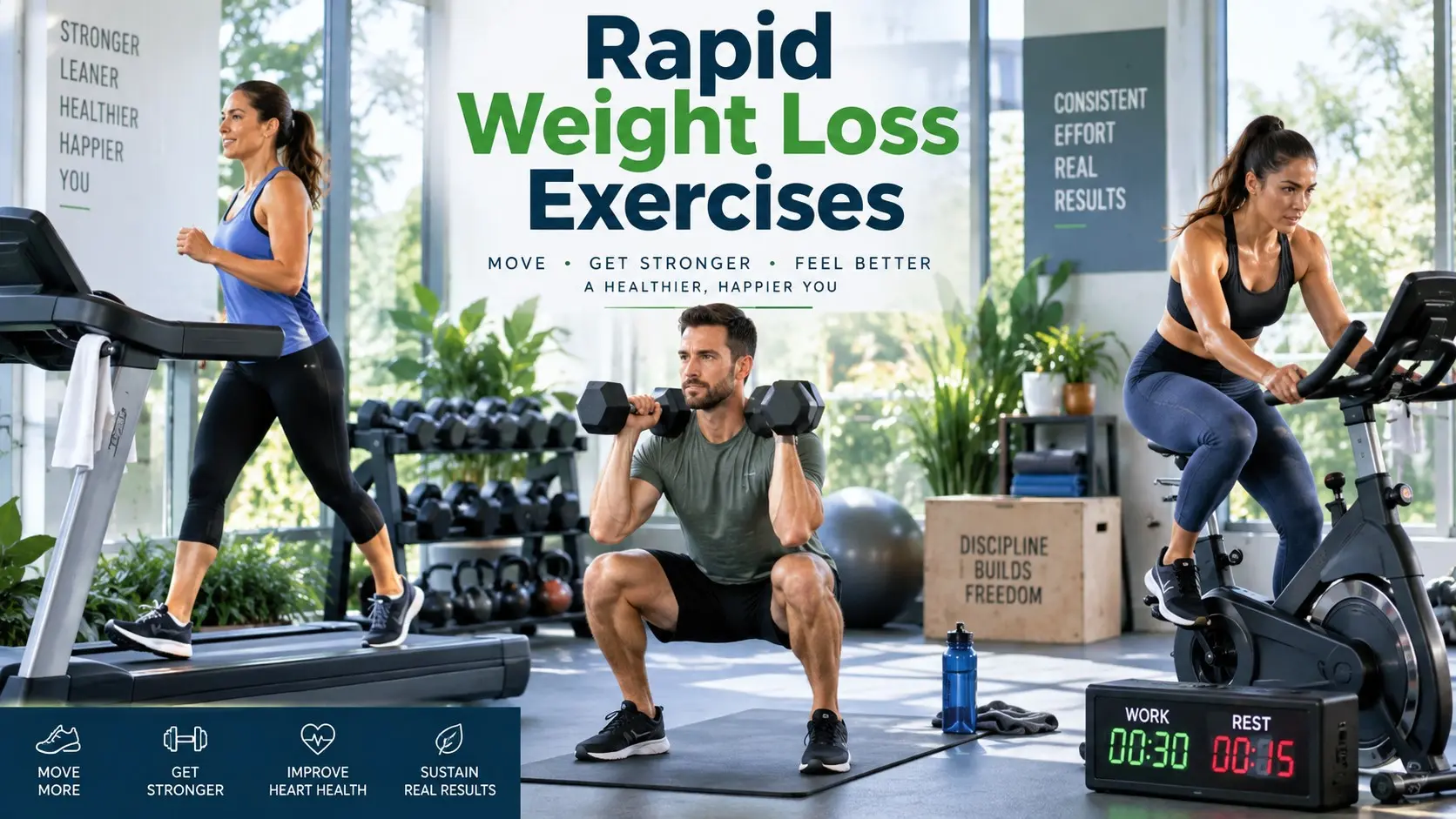
Topic: Rapid Weight Loss Exercises
Written and Source-Checked by: Adel Galal, Founder and Lead Writer at NextFitLife
Medical Review Status: This article is educational and source-checked. It has not been independently reviewed by a licensed healthcare professional.
Reading Time: About 18 minutesRapid weight loss exercises sound attractive.
Who would not want faster results?
But exercise cannot safely melt large amounts of body fat in a few days.
And the hardest workout is not always the best workout.
A useful weight loss plan needs three things.
Movement you can repeat.
Enough effort to improve fitness.
And food intake that supports a healthy calorie deficit.
I have maintained a personal interest in health, fitness, nutrition, weight management, sleep, wellness, and healthy aging for more than 30 years.
One lesson has stayed consistent.
Extreme workouts are easy to start.
They are much harder to sustain.
This guide focuses on three exercise styles that can support fat loss while protecting fitness, strength, and long-term consistency.
The three are:
- Brisk walking and low-impact intervals
- Full body strength circuits
- High intensity intervals for people who are ready for them
For a wider look at exercise choices, visit the NextFitLife Best Exercises for Weight Loss Guide.
Quick Answer: What Are the Best Rapid Weight Loss Exercises?
No exercise guarantees rapid weight loss.
But three useful workout styles are:
- Brisk walking or moderate cardio for repeatable calorie use and cardiovascular fitness.
- Strength training to build or protect muscle and improve physical function.
- Interval training for people who already have enough fitness to exercise hard safely.
The best plan often combines aerobic exercise and resistance work.
Exercise also works better for weight management when it is paired with an eating pattern that creates a suitable calorie deficit.
Most importantly, the workout must be something you can keep doing.
Can Exercise Really Cause Rapid Weight Loss?
Exercise helps.
But it is not magic.
The CDC explains that most weight loss comes from reducing calorie intake.
Physical activity adds to the calories your body uses.
That can help create a calorie deficit.
Exercise also gives benefits that go far beyond the scale.
It supports:
- Heart health
- Blood sugar control
- Muscle strength
- Bone health
- Sleep
- Mood
- Physical function
- Long term weight maintenance
This is why exercise matters even when weight loss is slower than you hoped.
What Is a Realistic Weight Loss Rate?
The CDC says gradual weight loss of about 1 to 2 pounds per week is more likely to stay off than faster loss.
This is a general guide.
It is not a guarantee.
Your rate can vary because of:
- Starting weight
- Food intake
- Activity
- Age
- Medicine
- Health conditions
- Water changes
- Hormones
A large drop on the scale during the first week may include water.
It is not always body fat.
For more detail, read Healthy Rate of Weight Loss.
Workout 1: Brisk Walking and Low Impact Intervals
Brisk walking is one of the most useful weight loss exercises because many people can repeat it often.
It needs little equipment.
It is easy to adjust.
It can be done outside or on a treadmill.
Walking may not burn the most calories per minute.
But exercise consistency matters more than choosing a workout that you avoid.
Who Is This Workout Best For?
This workout can suit:
- Beginners
- People returning to exercise
- People who dislike running
- People who want lower impact cardio
- People who need a workout they can repeat often
20 Minute Beginner Walking Workout
| Time | Activity | Effort | Goal |
|---|---|---|---|
| Minutes 0 to 4 | Easy walking | Light | Warm up |
| Minutes 4 to 7 | Brisk walking | Moderate | Raise heart rate |
| Minutes 7 to 8 | Faster walking | Moderate to hard | Short challenge |
| Minutes 8 to 11 | Brisk walking | Moderate | Recover while moving |
| Minutes 11 to 12 | Faster walking | Moderate to hard | Short challenge |
| Minutes 12 to 16 | Brisk walking | Moderate | Steady cardio |
| Minutes 16 to 17 | Faster walking | Moderate to hard | Final challenge |
| Minutes 17 to 20 | Easy walking | Light | Cool down |
How Hard Should Brisk Walking Feel?
Use the talk test.
At moderate intensity, you should breathe faster.
You should still be able to talk.
You should not be able to sing comfortably.
If you cannot speak more than a few words, you are probably working at vigorous intensity.
How to Make Walking Harder Without Running
You can slowly increase:
- Walking speed
- Walking time
- Treadmill incline
- Outdoor hills
- Number of weekly sessions
Change one thing at a time.
You do not need to increase speed, incline, and duration in the same week.
Workout 2: Full Body Strength Circuit
Strength training matters during weight loss.
It helps you build or maintain useful muscle.
It also supports bones and everyday movement.
Strength work is especially useful when weight loss includes a calorie deficit.
Your goal should not be to make every strength workout into a breathless cardio session.
Your goal is to train the muscles with good form.
Who Is This Workout Best For?
This workout can suit:
- Beginners
- People exercising at home
- People who want to protect muscle
- Adults over 40 or 50
- People who want better body composition
Simple Full Body Strength Workout
| Exercise | Beginner Target | Main Muscles | Simple Modification |
|---|---|---|---|
| Chair squat | 8 to 12 repetitions | Legs and hips | Use a higher chair |
| Wall push-up | 8 to 12 repetitions | Chest, shoulders, arms | Stand closer to the wall |
| Resistance band row | 8 to 12 repetitions | Back and arms | Use lighter resistance |
| Glute bridge | 10 to 15 repetitions | Hips and legs | Use a smaller range of motion |
| Supported step-up | 6 to 10 each leg | Legs and hips | Use a lower step |
| Standing press with light weights | 8 to 12 repetitions | Shoulders and arms | Use very light weights |
How to Perform the Circuit
Do each exercise once.
Rest when you need to.
Then repeat the circuit.
A beginner can start with one or two rounds.
More experienced people may use two or three rounds.
Good form matters more than speed.
How Much Rest Should You Take?
Rest long enough to keep good technique.
That may be 30 seconds.
It may be 90 seconds.
It may be longer.
There is no prize for rushing.
How Often Should You Strength Train?
Adults are generally advised to do muscle strengthening activity on at least two days each week.
Train all major muscle groups over the week.
If you are sore, tired, or new to training, give the muscles time to recover.
For more guidance, visit the Strength Training and Muscle Building Guide.
Workout 3: High-Intensity Intervals for Ready Exercisers
Interval training alternates harder work with easier recovery.
HIIT workout sessions can be time-efficient.
They can also improve cardiovascular fitness.
Some research suggests interval training can reduce body fat.
But the difference compared with moderate cardio is often small.
Recent research in inactive adults found that HIIT may improve body composition and fitness, but the certainty of many weight related findings remains low.
HIIT is an option.
It is not a requirement.
Who Should Not Start With HIIT?
Do not make HIIT your first workout after months or years of inactivity.
ACSM recommends building a basic fitness foundation first.
Get professional guidance before hard intervals if you have:
- Heart disease
- Chest pain
- High blood pressure that is not controlled
- Diabetes complications
- Severe obesity with major mobility limits
- A recent injury
- A recent operation
- Severe joint problems
- Unexplained fainting
- Serious breathing problems
Beginner-Friendly Bike Interval Session
A stationary bike can reduce impact compared with running.
| Time | Activity | Effort |
|---|---|---|
| Minutes 0 to 5 | Easy cycling | Light |
| Minute 5 to 6 | Faster cycling | Hard but controlled |
| Minutes 6 to 8 | Easy cycling | Light to moderate |
| Minute 8 to 9 | Faster cycling | Hard but controlled |
| Minutes 9 to 11 | Easy cycling | Light to moderate |
| Minute 11 to 12 | Faster cycling | Hard but controlled |
| Minutes 12 to 14 | Easy cycling | Light to moderate |
| Minute 14 to 15 | Faster cycling | Hard but controlled |
| Minutes 15 to 20 | Easy cycling | Cool down |
This is not an all out sprint session.
You should still feel in control.
Stop if you feel chest pain, faintness, severe shortness of breath, or another unusual symptom.
Is HIIT Better Than Normal Cardio for Fat Loss?
Not clearly enough to call it a magic solution.
Studies show both interval training and moderate continuous cardio can reduce body fat.
Some analyses find a small advantage for interval training.
Others find similar changes when the total work is comparable.
One recent review found that HIIT and moderate cardio produced similar changes in weight, BMI, waist size, and fat mass in adults with overweight or obesity.
This means the best choice may depend on:
- Your fitness
- Your age
- Your joints
- Your health
- Your schedule
- Which workout you will keep doing
Do not choose HIIT because someone says it burns fat for hours afterward.
The extra calorie use after a workout exists.
It is not a magic fat loss effect.
Which of the 3 Workouts Burns the Most Fat?
There is no useful answer without knowing the person.
Running may use more calories per minute than walking.
But someone may walk five days each week and only tolerate running once.
Strength training may use fewer calories during the session than hard cardio.
But it helps protect muscle.
HIIT may save time.
But it is harder to recover from.
The best weight loss workout is often a mix.
Best Weekly Exercise Mix for Weight Loss
This is a general example.
It is not a personal prescription.
| Day | Workout | Duration | Main Goal |
|---|---|---|---|
| Monday | Brisk walking | 30 minutes | Moderate cardio |
| Tuesday | Full body strength | 25 to 40 minutes | Muscle and strength |
| Wednesday | Easy walking | 20 to 30 minutes | Movement and recovery |
| Thursday | Full body strength | 25 to 40 minutes | Muscle and strength |
| Friday | Brisk walking or cycling | 30 minutes | Moderate cardio |
| Saturday | Walking intervals or optional HIIT | 15 to 25 minutes | Cardiovascular challenge |
| Sunday | Rest or easy walking | Optional | Recovery |
A beginner may need less.
An active person may do more.
Start at your level.
How Much Exercise Do You Need Each Week?
Current public health guidance says adults should aim for:
- At least 150 minutes of moderate intensity aerobic activity each week
- Or at least 75 minutes of vigorous activity
- Or a mix of both
- And muscle strengthening activity on at least two days
You can divide activity across the week.
Small blocks count.
You do not need to complete all 150 minutes at once.
Some people may need closer to 300 minutes or more for weight management.
Your exact needs vary.
Does More Exercise Always Mean Faster Weight Loss?
No.
More exercise can use more energy.
But there are limits.
Too much too soon can lead to:
- Injury
- Excess soreness
- Fatigue
- Poor sleep
- Loss of motivation
- Missed workouts
A workout only works when you can recover from it.
Progress slowly.
Exercise and the Calorie Deficit
Weight loss happens when your body uses more energy than you take in over time.
This is called a calorie deficit.
Exercise can add to the energy your body uses.
But exercise does not cancel unlimited food intake.
CDC guidance explains that most weight loss occurs from reducing calories.
Physical activity is still important.
It supports health.
It helps with weight maintenance.
It helps protect fitness while you lose weight.
For the full picture, read How Weight Loss Works.
Can You Target Belly Fat With Exercise?
You can strengthen your abdominal muscles.
You cannot choose where your body removes fat first.
Crunches can train abdominal muscles.
They do not force fat to leave only the stomach.
Overall body fat reduction depends on your total energy balance, genetics, hormones, age, activity, and other factors.
Core training is still useful.
It can improve strength and stability.
Just do not confuse muscle training with spot fat loss.
Do Squats Burn Belly Fat?
Squats train the legs and hips.
They also use the core.
They can be part of a good full-body workout.
But squats do not target belly fat.
The same is true for:
- Planks
- Push ups
- Burpees
- Mountain climbers
- Crunches
These exercises can improve fitness.
They do not choose where fat comes off.
Should Beginners Do Burpees for Weight Loss?
They do not need to.
Burpees can be hard on beginners.
They demand strength, balance, mobility, and cardiovascular fitness.
A beginner can get excellent results from:
- Walking
- Chair squats
- Wall push-ups
- Resistance band rows
- Step ups
- Stationary cycling
You do not need the hardest exercise to make progress.
What Is Better for Weight Loss: Cardio or Strength?
Both help in different ways.
| Training Type | Main Benefit | Weight Management Role |
|---|---|---|
| Aerobic exercise | Improves cardiovascular fitness and uses energy during activity | Supports calorie expenditure and fat loss |
| Strength training | Builds or protects muscle and strength | Supports body composition and physical function |
| Combined training | Provides both aerobic and strength benefits | Offers a balanced approach |
A combination is useful for many adults.
How to Progress Without Getting Hurt
Change one thing at a time.
You can increase:
- Time
- Speed
- Resistance
- Repetitions
- Sets
- Weekly frequency
Do not increase all of them together.
Give your body time to adapt.
Warm Up Before Harder Exercise
A warm up prepares you to move.
It can include:
- Easy walking
- Gentle cycling
- Arm circles
- Easy squats
- Controlled mobility movements
A warm up does not need to be long.
Five to ten minutes may be enough for many workouts.
Cool Down After Exercise
You can finish hard activity with a few minutes of easy movement.
This lets breathing and heart rate slow down.
Stretching is optional.
Do not force painful stretches.
How Do You Know if Exercise Intensity Is Too High?
Normal exercise can make you breathe harder.
But stop and get medical help if you develop concerning symptoms.
These include:
- Chest pain
- Fainting
- Severe dizziness
- Unusual severe shortness of breath
- Sudden weakness
- Confusion
Exercise discomfort and a medical warning sign are not the same thing.
Who Should Ask a Healthcare Professional Before Hard Exercise?
Professional advice is especially important if you:
- Have heart disease
- Have uncontrolled high blood pressure
- Have diabetes complications
- Have major joint problems
- Have severe breathing disease
- Had recent surgery
- Have a recent serious injury
- Have repeated fainting
- Are pregnant and unsure about exercise
- Have been inactive for a long time and plan to start intense training
Can You Do These Workouts at Home?
Yes.
You can walk outside.
You can march at home.
You can use stairs when safe.
You can do chair squats.
You can use resistance bands.
You can use light dumbbells.
You do not need an expensive gym.
For more ideas, visit the Home Workouts and Equipment Guide.
Common Rapid Weight Loss Exercise Mistakes
Trying to Sweat Off Fat
Sweat is mainly water.
It does not show how much fat you lost.
Doing HIIT Every Day
Hard workouts need recovery.
Skipping Strength Training
Muscle preservation matters during weight loss.
Eating More Because You Exercised
Exercise calories can be easy to overestimate.
Starting Too Hard
A workout that injures you does not speed progress.
Ignoring Sleep
Recovery needs sleep.
Expecting Spot Fat Loss
You cannot choose where body fat leaves first.
Copying Advanced Athletes
Your workout should match your fitness.
How to Know if Your Workout Plan Is Working
Do not only watch the scale.
Look for:
- Longer walking time
- Faster walking at the same effort
- More controlled repetitions
- Better strength
- Better balance
- Lower resting effort during daily tasks
- Better exercise confidence
- Better consistency
Fitness progress matters even before large weight changes appear.
Rapid Weight Loss Exercises Versus Sustainable Exercise
| Rapid Approach | Sustainable Approach |
|---|---|
| Starts very hard | Builds slowly |
| Focuses only on calorie burn | Builds fitness and strength |
| Uses pain as proof | Uses controlled progress |
| Depends on motivation | Builds routine |
| Often skips recovery | Includes recovery |
| Chases fast scale changes | Tracks fitness and health too |
Conclusion: Use Rapid Weight Loss Exercises the Smart Way
Rapid weight loss exercises should not mean extreme workouts.
They should mean using your exercise time well.
Walk briskly.
Train your muscles.
Add intervals only when your fitness allows them.
Build toward the weekly activity guidelines.
Use healthy eating to support a suitable calorie deficit.
Recover.
Sleep.
Then repeat the plan.
Your next step: choose one of the three workouts in this guide and start at the easiest level you can repeat this week.
A workout you can repeat is more useful than a brutal workout you only do once.
References and Sources
- Centers for Disease Control and Prevention, Physical Activity and Your Weight and HealthCurrent 2026 CDC guidance explains how physical activity affects calorie use, weight management, fitness, and long-term health.CDC Physical Activity and Weight Guidance
- Centers for Disease Control and Prevention, Adult Physical Activity RecommendationsAdults should generally get at least 150 minutes of moderate activity or 75 minutes of vigorous activity each week and at least two days of muscle strengthening work.CDC Adult Activity Guidelines
- National Institute of Diabetes and Digestive and Kidney Diseases, Choosing a Safe and Successful Weight Loss ProgramNIDDK explains that successful weight management combines a reduced-calorie eating pattern, physical activity, behaviour support, monitoring, and a plan for maintaining results.NIDDK Weight Loss Program Guidance
- American College of Sports Medicine, High-Intensity Interval TrainingACSM explains HIIT basics and recommends a fitness foundation before hard interval training, especially for people who have been inactive or have cardiovascular risk factors.ACSM HIIT Guidance
- Sports Medicine, Interval Training and Body CompositionThis open-access umbrella review analyzed 16 systematic reviews covering 79 randomized trials and found interval training can reduce body fat, but effects are generally modest, and study quality varies.Open Access Interval Training Review
Explore More NextFitLife Weight Loss and Fitness Guides
- Weight Loss and Metabolism Hub
- Best Exercises for Weight Loss
- Successful Weight Loss
- Weight Loss Options
- Healthy Rate of Weight Loss
- How Weight Loss Works
- Weight Loss Tracking
- NextFitLife Fitness Hub
- Strength Training and Muscle Building Guide
- Cardio and Endurance Guide
- Home Workouts and Equipment Guide
About the Author
Adel Galal is the founder and lead writer of NextFitLife.com.
Adel has maintained a personal interest in health, fitness, nutrition, weight management, sleep, wellness, and healthy aging for more than 30 years.
His health and wellness writing and research communication experience spans more than 15 years.
At NextFitLife, Adel researches fitness and weight management topics, compares reputable public health and scientific sources, checks exaggerated claims, and turns complex guidance into practical steps for everyday readers.
His fitness work focuses on walking, cardiovascular exercise, strength training, home workouts, recovery, healthy weight management, and long-term habits.
Before focusing on NextFitLife, Adel spent 29 years working as an IT Manager for the Nestlé Egypt Region.
That career involved data, planning, research organization, information management, structured review, and problem solving.
These skills support his research and publishing work.
They are not medical or fitness credentials.
Adel is not a doctor, physiotherapist, registered dietitian, certified personal trainer, psychologist, or other licensed healthcare professional.
This content is for general educational purposes and does not replace professional medical advice, diagnosis, or treatment. Consult an appropriately qualified healthcare professional for personal medical concerns. This article explains published guidance and does not provide a personal clinical assessment. Always consult qualified medical professionals for diagnosis and treatment of any health condition.
Learn more about Adel Galal, NextFitLife, source checking, editorial practices, medical review standards, and corrections on the About Us page.
Frequently Asked Questions About Rapid Weight Loss Exercises
What are the best rapid weight loss exercises?
Useful options include brisk walking or other aerobic exercise, full-body strength training, and interval training when your fitness level allows it. No exercise guarantees rapid weight loss.
Can exercise make you lose weight quickly?
Exercise can support weight loss by increasing energy use, but most weight loss usually comes from changes in calorie intake. A healthy eating pattern and physical activity work best together.
How much exercise should I do to lose weight?
Adults should generally aim for at least 150 minutes of moderate aerobic activity each week or 75 minutes of vigorous activity, plus muscle strengthening activity on at least two days. Some people may need more activity for weight management.
Is walking good for weight loss?
Yes. Brisk walking is moderate-intensity aerobic exercise. It can support a calorie deficit, improve cardiovascular health, and be easier to maintain than harder exercise.
Is HIIT better than walking for weight loss?
HIIT is more intense and can be time-efficient, but it is not clearly better for everyone. Walking is easier to recover from and may be easier to repeat consistently.
Does HIIT burn more fat than normal cardio?
Some studies show small advantages for interval training, while other studies find similar weight and fat changes compared with moderate continuous exercise. Both can be useful.
Is strength training good for weight loss?
Yes. Strength training supports muscle, physical function, and body composition. It works well when combined with aerobic activity and a healthy eating plan.
Can I lose belly fat with crunches?
No exercise can force fat to leave only one body area. Crunches strengthen abdominal muscles, but overall fat loss depends on your total energy balance and other factors.
How often should I do strength training?
Adults are generally advised to do muscle strengthening activity on at least two days each week and train all major muscle groups.
Should beginners do HIIT?
Beginners should first build basic fitness with easier aerobic activity and strength work. ACSM recommends establishing a fitness foundation before high-intensity interval training.
What is the safest exercise for weight loss beginners?
Walking is a useful starting point for many people because the intensity can be adjusted easily. Simple strength exercises such as chair squats and wall push-ups can also be added.
How fast should I lose weight?
The CDC says people who lose weight gradually, at about 1 to 2 pounds per week, are more likely to keep it off than people who lose weight faster. Individual results vary.

Health & wellness writer with 30+ years of experience in nutrition, fitness, and healthy aging. Founder of NextFitLife.com — evidence-based health guidance.