Last updated: September 10, 2026
Next editorial review: September 2027 or sooner if major sports nutrition guidance changes
Written and source-checked by: Adel Galal, Founder and Lead Writer at NextFitLife
Review status: This article is educational and source-checked. It has not been medically reviewed by a doctor, registered dietitian, sports dietitian, physiotherapist, or certified personal trainer.
Foods to Avoid When Building Muscle is a useful search phrase.
But I would change the question slightly.
Very few normal foods destroy muscle growth by themselves.
The bigger problem is eating too many foods that leave little room for protein, useful carbohydrates, vitamins, minerals, fibre, and enough total nutrition.
So this is not a forbidden food list.
It is a list of foods and eating habits I would limit, replace, or time better.
Quick Answer: What Foods Should You Avoid When Building Muscle?
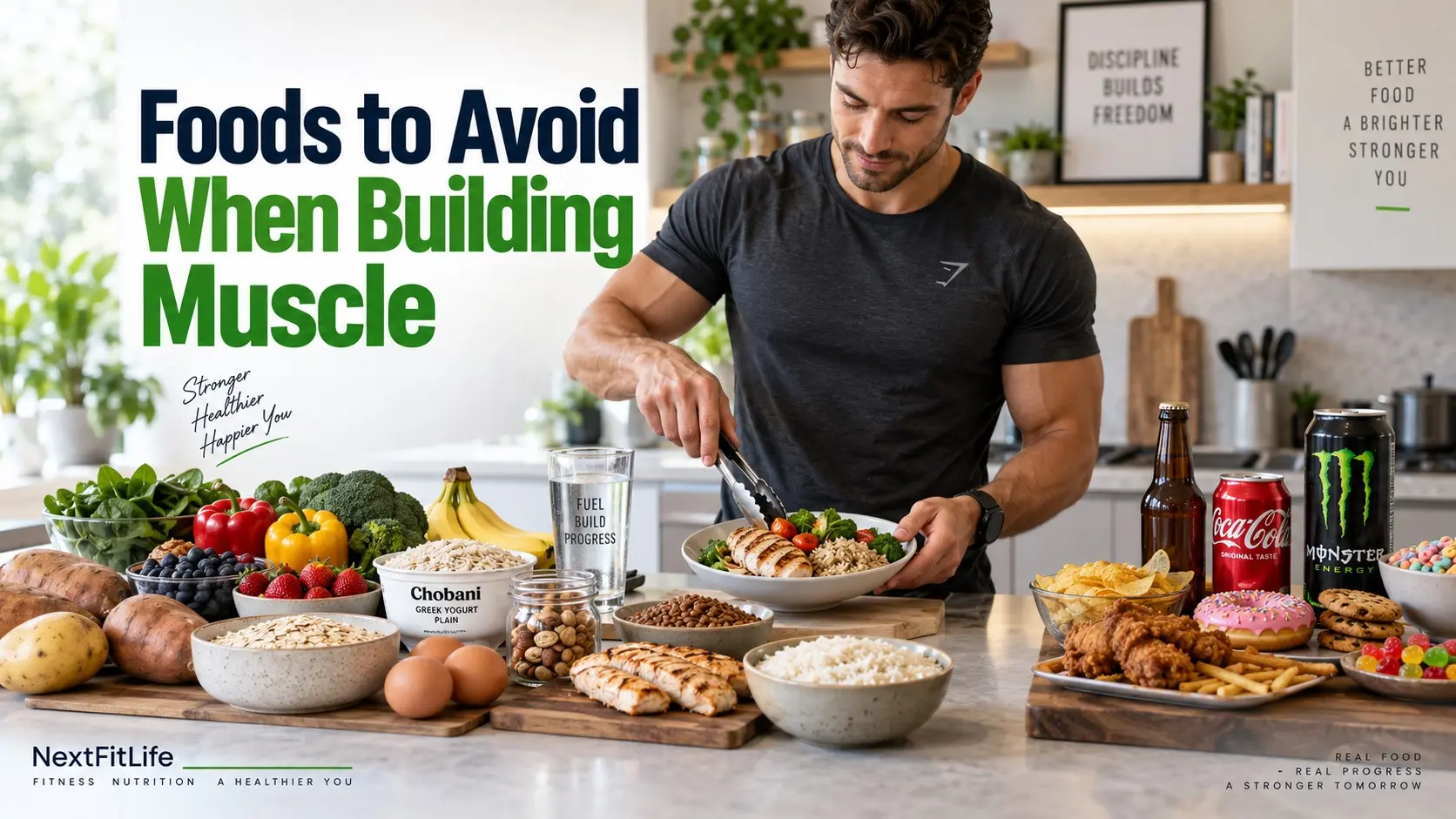
Limit heavy alcohol intake, sugary drinks, frequent fried fast food, candy heavy snacks, pastries, low protein breakfasts, highly processed snack foods, and products that look like fitness foods but provide little protein or nutrition.
Also avoid raw egg shakes and very large greasy meals right before training.
The goal is simple.
Make most of your muscle-building diet useful.
Include enough protein.
Eat enough food to support training.
Use carbohydrates to fuel hard sessions.
Include vegetables, fruit, whole grains, beans, nuts, seeds, and suitable healthy fats.
For a broader food guide, visit the NextFitLife Healthy Fitness Foods Guide.
Exercise and Nutrition Safety Notice
This content is for general educational purposes and does not replace professional medical advice, diagnosis, or treatment. Consult an appropriately qualified healthcare professional for personal medical concerns. This article explains published guidance and does not provide a personal clinical assessment. Always consult qualified medical professionals for diagnosis and treatment of any health condition.
Nutrition needs change with age, body size, training load, pregnancy, medical conditions, medicines, kidney function, digestive health, and eating disorder history.
If you have kidney disease, liver disease, diabetes, severe digestive disease, food allergies, an eating disorder, or another condition that affects nutrition, ask a qualified healthcare professional or registered dietitian before making a major diet change.
Muscle Growth Needs More Than Protein
Protein matters.
It is not the whole plan.
Resistance training gives the muscle a reason to adapt.
Food gives your body the energy and raw materials needed to support that process.
The NIH Office of Dietary Supplements says athletes need enough calories, fluids, carbohydrates, protein, fat, vitamins, and minerals.
That is the foundation.
Supplements come later.
For many active adults, sports nutrition guidance places protein needs around 1.2 to 2.0 grams per kilogram of body weight each day.
A large meta-analysis of resistance training studies found that increases in protein intake supported gains in muscle and strength, with little extra fat-free mass benefit above roughly 1.6 grams per kilogram per day on average.
That does not make 1.6 a perfect target for every person.
It gives us useful context.
This supports **protein intake for muscle growth**.
19 Foods and Food Mistakes I Would Limit
1. Heavy Alcohol Intake
This belongs first.
Alcohol provides energy.
It does not provide the protein or training fuel I would choose for muscle recovery.
More importantly, large alcohol doses after exercise can interfere with muscle protein synthesis.
One controlled study used a very large alcohol dose after exercise.
Muscle protein synthesis was lower even when protein was consumed.
Do not misread that study.
It does not prove that one small drink destroys muscle.
The dose in the study was very high.
The useful message is that heavy post-exercise drinking and serious recovery do not work well together.
This supports **alcohol and muscle growth**.
2. Sugary Soft Drinks as a Daily Calorie Source
A soda does not erase a workout.
But soft drinks are poor muscle-building staples.
They can add a lot of energy without protein, fibre, or much micronutrient value.
If you need more calories for growth, there are easier ways to make those calories useful.
Milk, yogurt, oats, rice, potatoes, fruit, beans, nuts, and normal meals give you more nutrition.
Water should still handle most normal hydration needs.
3. Large Energy Drinks Used to Cover Poor Sleep
Caffeine can be useful.
It is not sleep.
High caffeine intake can cause insomnia, restlessness, anxiety, and other side effects.
NIH also notes that very high caffeine intake can reduce rather than improve performance.
If an energy drink keeps you awake late at night, the drink may be solving today's fatigue while creating tomorrow's fatigue.
Recovery happens outside the gym too.
4. Candy as Your Main Bulking Strategy
Building muscle needs enough food.
That does not turn candy into a muscle food.
Candy can fit occasionally.
But using large amounts simply because you need calories crowds out protein, fiber, vitamins, and minerals.
A useful **calorie surplus** should still contain useful food.
More calories are not automatically better calories.
5. Doughnuts and Sweet Pastries as a Daily Breakfast
A pastry now and then is just food.
A pastry every morning as your whole breakfast is a weak muscle building setup.
Most give you little protein compared with a breakfast built from eggs, yogurt, milk, oats, cottage cheese, tofu, or another protein source.
If you love pastries, eat one beside a proper meal instead of asking it to be the meal.
6. Frequent Deep-Fried Fast Food
One burger does not stop hypertrophy.
One order of fries does not delete your squat session.
Frequency is the issue.
A diet based heavily on fried and highly processed foods can crowd out vegetables, fruit, whole grains, legumes, and more nutrient-dense protein foods.
The current 2025 to 2030 Dietary Guidelines for Americans put the focus on whole, nutrient-dense foods and recommend reducing highly processed foods.
I would apply the same principle to a muscle building diet.
7. Chips as a Main Snack
Chips are easy to eat.
They are not very useful for muscle building.
Most provide little protein.
If your snack needs to help you reach your protein target, choose something that does that job.
Examples include:
- Greek yogurt
- Cottage cheese
- Milk
- Eggs
- Edamame
- Roasted chickpeas
- A protein rich sandwich
You can still eat chips.
Just do not count them as recovery food.
8. Processed Meat as Your Main Protein Every Day
Sausage, bacon, salami, and similar meats contain protein.
That does not make them my first daily choice.
The full diet matters.
I would build most meals around less processed protein sources such as fish, poultry, lean meat, eggs, yogurt, milk, tofu, tempeh, beans, and lentils.
You get protein either way.
The rest of the nutrition package is different.
9. Sugary Breakfast Cereal With Almost No Protein
Cereal is not automatically bad.
Look at the label.
Some cereals provide whole grains and useful nutrients.
Others are closer to dessert.
If your cereal provides almost no protein, pair it with a useful protein food.
Milk or fortified soy milk can help.
Greek yogurt works too.
You can also add nuts or seeds.
10. Protein Bars That Barely Contain Protein
The word protein on the wrapper is marketing.
The Nutrition Facts panel gives you the answer.
Some bars provide a useful amount of protein.
Others are mainly candy bars with a fitness label.
Compare:
Protein.
Calories.
Added sugar.
Fiber.
Serving size.
If the bar contains very little protein, do not rely on it to meet your **daily protein intake**.
11. Giant Sugary Coffee Drinks
Coffee itself is not the issue.
A very large drink loaded with syrup, whipped cream, sugar, and cream can become a dessert.
Again, that does not make it forbidden.
Just count it honestly.
If you need more muscle building calories, I would rather get many of them from meals that also supply protein and useful nutrients.
12. Sauces That Quietly Turn Every Meal Into a Huge Meal
Oil-based sauces, creamy dressings, mayonnaise, and sweet sauces can add a lot of calories quickly.
That can be useful when you struggle to eat enough.
It can also make a controlled muscle gain phase turn into rapid, unwanted fat gain.
You do not need dry chicken and rice.
Use sauce.
Just know it is part of the meal.
13. Raw Egg Protein Shakes
This is an old bodybuilding habit I would skip.
Raw eggs can carry Salmonella.
The CDC recommends cooked eggs or pasteurized egg products when the egg will not be cooked.
There is another reason.
A human digestion study found that cooked egg protein was absorbed much better than raw egg protein.
So the Rocky style raw egg shake gives you more food safety risk and less efficient protein digestion.
Cook your eggs.
14. A Huge Greasy Meal Right Before Training
Fat is not bad for muscle.
You need dietary fat.
Timing is the issue here.
A giant greasy meal just before a hard workout can leave some people feeling heavy, full, or uncomfortable.
That can make training worse.
Your **pre workout meal** should help you train.
If pizza and fries sit well before squats, that is your experience.
Many people prefer a meal that is easier to digest.
15. A Huge Fibre Bomb Immediately Before Lifting
Fibre is healthy.
Do not remove it from your diet.
But timing matters.
A giant bowl of beans, bran, raw vegetables, chia, and lentils immediately before a hard workout may cause gas or stomach discomfort in some people.
This is not a reason to fear fibre.
Move the large fibre meal farther from training if your stomach complains.
16. Low Protein Plant Drinks Used as a Protein Replacement
Plant drinks are not all nutritionally equal.
Some fortified soy milks provide meaningful protein.
Many almonds, coconut, or rice drinks provide much less.
If you enjoy them, fine.
Just do not assume every white liquid has the protein of dairy milk or soy milk.
Check the label.
17. Fruit Juice Used Instead of a Real Deal
Fruit juice can provide carbohydrate.
That can be useful around training.
But juice alone is not a muscle recovery meal.
It provides little or no protein.
Whole fruit also gives you fibre.
If you enjoy juice after training, pair it with protein.
This improves your ** post-workout nutrition** without turning juice into something it is not.
18. A Carbohydrate-Only Post-Workout Meal
Carbohydrate is not the enemy.
Hard training uses carbohydrate.
NIH sports nutrition guidance includes carbohydrate as an important part of an athlete's diet.
The mistake is eating only carbohydrate when your day is already low in protein.
Rice is fine.
Potatoes are fine.
Bread is fine.
Fruit is fine.
Add protein.
A chicken and rice meal tells a different nutritional story from rice by itself.
19. Tiny Clean Eating Meals That Leave You Underfed
This one surprises people.
Sometimes the food that hurts a muscle-building plan is not junk food.
It is a tiny salad.
Lettuce, cucumber, and tomato are healthy foods.
But if you are training hard and trying to gain muscle, that meal may need protein, carbohydrates, and enough total energy.
Add chicken.
Or tofu.
Or beans.
Add rice, potatoes, bread, quinoa, or another useful carbohydrate.
Add some healthy fat when needed.
Clean eating should not mean chronic under-eating.
The Foods I Would Eat More Often Instead
| If You Often Eat | Try More Often |
|---|---|
| Pastry-only breakfast | Eggs and toast or yogurt with oats and fruit |
| Chips for snacks | Greek yogurt, milk, eggs, edamame, or a protein-rich sandwich |
| with every meal | Water, milk, or another drink that fits your goals |
| Candy for bulking calories | Oats, rice, potatoes, whole grains, fruit, nuts, yogurt |
| Processed meat every day | Fish, poultry, eggs, lean meat, beans, tofu, lentils |
| Raw egg shake | Cooked eggs or pasteurized egg products |
| Juice only after training | Juice or fruit plus a protein rich meal or snack |
| Huge fried meal before lifting | A smaller balanced meal that you digest comfortably |
What Should a Muscle-Building Meal Contain?
I keep this simple.
Start with protein.
Add a useful carbohydrate.
Add vegetables or fruit.
Add fat as needed.
For example:
Chicken, rice, vegetables, and olive oil.
Eggs, whole-grain toast, fruit, and yogurt.
Salmon, potatoes, and vegetables.
Lentils, rice, vegetables, and yogurt.
Tofu, noodles, and mixed vegetables.
You do not need a bodybuilder meal.
You need a balanced meal that supports training.
How much protein do you need to build muscle?
There is no perfect number for everyone.
The NIH sports nutrition fact sheet lists about 1.2 to 2.0 grams of protein per kilogram of body weight per day for athletes.
A major resistance training meta-analysis found that increases in protein supported gains in muscle mass and strength.
In that analysis, average gains in fat-free mass did not continue increasing beyond about 1.62 grams per kilogram per day.
That makes around 1.6 grams per kilogram a useful reference point for many people who lift.
It is not a medical prescription.
Protein needs can change with age, energy intake, training, health, and other factors.
If you have kidney disease or another condition that affects protein intake, get personal advice.
For protein food ideas, read High Protein Foods for Weight Loss.
Do you need protein immediately after training?
No stopwatch starts when you rack the last weight.
Protein around training is useful.
Total daily protein still matters greatly.
NIH notes that high-quality protein during the early recovery period supports muscle protein synthesis.
You do not need to panic if you cannot drink a shake within five minutes.
Eat a normal protein rich meal or snack when practical.
Are carbohydrates bad when building muscle?
No.
This myth needs to go.
Carbohydrates help provide energy for training.
They also help replenish muscle glycogen.
Foods such as:
- Rice
- Oats
- Potatoes
- Sweet potatoes
- Whole grains
- Fruit
- Beans
- Bread
- Pasta
can all fit a muscle-building plan?
The whole diet matters more than pretending one carbohydrate food is good and another is evil.
Is White Rice Bad for Muscle Building?
No.
White rice provides carbohydrates.
It is easy to digest for many people.
It can fit before or after training.
Whole grains provide more fibre and often more micronutrients.
You can use both.
Muscle does not stop growing because your rice is white.
Is Bread Bad for Muscle Growth?
No.
Bread can provide carbohydrate.
Whole grain bread gives you more fibre.
White bread can also fit.
The protein, calories, vegetables, fruit, and rest of your diet still matter.
Should You Avoid Fat When Building Muscle?
No.
Dietary fat is part of a healthy eating pattern.
The NIH sports nutrition guidance lists fat as part of an athlete's nutrition needs.
Useful sources include:
- Olive oil
- Nuts
- Seeds
- Avocado
- Fish
- Other foods containing unsaturated fats
The problem is not fat.
The problem can be letting very high-calorie foods push total intake far beyond what you intended.
Do you need a huge calorie surplus?
No.
Eating as much as possible is not the same as building muscle as efficiently as possible.
Your body can gain fat too.
A muscle-building phase should give you enough energy to train and recover without turning eating into a contest.
If body weight rises far faster than expected, review portions.
Do not automatically remove carbohydrates.
Look at total food intake.
Can you build muscle while losing fat?
Sometimes.
This is called body recomposition.
It is more realistic for some people than others.
Beginners, people returning after a break, and some people with higher body fat can sometimes gain muscle while losing fat.
More experienced lifters may find the process slower.
Protein intake and resistance training matter.
Do not crash diet.
For more balanced advice, see Why Am I Not Losing Weight in a Calorie Deficit?
Is Sugar Bad for Building Muscle?
Sugar does not directly switch muscle growth off.
Carbohydrates can support training.
The problem is dietary quality.
A diet with huge amounts of added sugar can leave less room for protein, vegetables, fruit, whole grains, healthy fats, vitamins, and minerals.
The current Dietary Guidelines recommend reducing highly processed foods with added sugars.
You do not need zero sugar.
You need perspective.
Does fast food kill muscle gains?
No.
One fast food meal does not undo months of training.
If fast food becomes most of the diet, another problem appears.
Your diet becomes harder to balance.
You may eat too little fibre.
You may get fewer fruits and vegetables.
Calories can become very high, while protein needs much help.
Use fast food when needed.
Do not build your entire bulking plan around it.
Does alcohol stop muscle growth?
Do not make this claim too broad.
Large alcohol intake after training can reduce muscle protein synthesis.
One human trial found that a very high alcohol dose reduced post-exercise muscle protein synthesis even when protein was consumed.
The alcohol dose was about 1.5 grams per kilogram of body weight.
That was roughly 12 standard drinks for the study participants.
This was a binge drinking model.
It does not tell us that one drink causes the same effect.
The practical lesson is still clear.
Heavy drinking is a poor recovery habit.
Are protein shakes bad?
No.
A protein shake can be useful.
It is easy.
It can help when normal food is not practical.
The NIH states that supplements should add to a sound diet rather than replace its foundation.
That is how I look at protein powder.
Food first when practical.
A shake when useful.
Are BCAA Drinks Needed for Muscle Growth?
Usually not if you already eat enough complete protein.
NIH says there is little evidence that BCAA supplements improve performance, muscle gain, or recovery beyond what you get from normal protein-containing foods.
Protein foods already contain branched-chain amino acids.
If your diet is low in protein, fix the protein first.
What About Creatine?
Creatine differs from most muscle supplements.
It has a much stronger evidence base.
But creatine cannot rescue a poor diet or inconsistent training.
Use supplements after the basics are working.
That order saves money and confusion.
Does Meal Timing Matter More Than Total Protein?
I would not obsess over the clock.
Protein around exercise is useful.
But a perfectly timed shake does not fix a full day with too little protein.
Start with your total daily intake.
Then spread protein across meals in a way that suits your schedule.
Precision comes after consistency.
What Should You Eat Before Lifting?
A good ** pre-workout meal** should feel comfortable.
It should provide useful fuel.
A simple meal might include:
- Rice with chicken
- Oats with yogurt and fruit
- Toast with eggs
- Potatoes with fish
- A sandwich with lean protein
- Banana with yogurt
The closer you eat to training, the more useful it can be to keep the meal smaller and easier to digest.
Your stomach gets a vote.
What Should You Eat After Lifting?
Your **post workout nutrition** can be simple.
Eat protein.
Include carbohydrate.
Drink enough fluid.
Then continue eating normally throughout the day.
Examples include:
- Greek yogurt with oats and fruit
- Chicken with rice
- Eggs with bread and fruit
- Fish with potatoes
- Lentils with rice
- Tofu with noodles or rice
You do not need a branded recovery food.
What are the best foods for building muscle?
I would build most meals from familiar foods.
| Food Group | Useful Choices |
|---|---|
| Protein | Eggs, fish, poultry, lean meat, Greek yogurt, cottage cheese, milk, tofu, tempeh, beans, lentils |
| Carbohydrate | Rice, oats, potatoes, whole grains, pasta, bread, fruit, beans |
| Vegetables | Spinach, broccoli, peppers, carrots, tomatoes, mixed vegetables |
| Healthy fats | Olive oil, avocado, nuts, seeds, fatty fish |
| Fluids | Water and other suitable drinks |
For more examples, read 21 Healthy Fitness Foods.
How the 2026 Resistance Training Guidance Changes the Conversation
Food cannot replace training.
The American College of Sports Medicine released a major resistance training position stand in 2026.
It reviewed 137 systematic reviews involving more than 30,000 participants.
The big message was simple.
Consistency matters.
For muscle growth, the review highlighted sufficient weekly resistance training volume.
Complicated training methods were not required for most healthy adults.
That applies to nutrition thinking too.
A perfect protein snack cannot compensate for a program you rarely perform.
Train consistently.
Eat well enough to support it.
Muscle Building Foods Versus Fitness Marketing
Be careful with labels.
Words such as:
- Protein
- Fitness
- Anabolic
- Performance
- Muscle
- Recovery
do not prove a food is useful.
Turn the package around.
Read the actual nutrition.
How much protein?
How many calories?
How much added sugar?
What size is one serving?
That is more useful than the picture of a dumbbell on the front.
My Rule for Foods That Hinder Muscle Growth
I do not divide foods into muscle-building and muscle-destroying boxes.
I ask a better question.
What job is this food doing?
Does it help me reach protein needs?
Does it provide training fuel?
Does it give me vitamins, minerals, fiber, or useful fats?
Does it help me eat enough?
Does it fit my health?
Does it taste good enough that I can keep eating this way?
Some foods answer one question.
Some answer several.
Dessert does not need to pass every test.
It just should not become most of the diet.
Common Muscle Building Nutrition Myths
| Myth | What Makes More Sense |
|---|---|
| Sugar stops muscle growth | Total diet quality matters more than one sugary food |
| Carbs make you fat | Total energy intake matters, and carbohydrates can support hard training |
| You must eat only clean foods | Build most meals from nutrient-dense foods and leave room for flexibility |
| You need protein every two hours | Total daily intake and a practical meal pattern matter more |
| Raw eggs build more muscle | Cooked egg protein is better digested, and raw eggs bring food safety risk |
| Fast food ruins gains | Frequency and the full diet matter |
| A huge calorie surplus builds muscle faster | Excess energy can also increase fat gain |
| Protein powder is required | Normal food can meet protein needs for many people |
| Alcohol never matters | Large alcohol doses can interfere with post-exercise muscle protein synthesis |
How I Approach Muscle Building Nutrition
I have maintained a personal interest in health, fitness, nutrition, sleep, wellness, and healthy aging for more than 30 years.
My health and wellness writing experience spans more than 15 years.
I am not a sports dietitian.
I am not a certified personal trainer.
So I do not turn opinion into a sports nutrition prescription.
For NextFitLife, I compare current sports nutrition guidance, resistance training research, public health nutrition guidance, and food safety advice.
I also look for claims that sound stronger than the evidence.
“Never eat sugar” is too strong.
“Alcohol kills all gains” is too strong.
“You need supplements” is too strong.
The useful advice is usually simpler.
Train consistently.
Eat enough protein.
Fuel your sessions.
Build most meals from useful foods.
Then stop treating one imperfect meal like a disaster.
Conclusion: Foods to Avoid When Building Muscle Need Context
Foods to avoid when building muscle should not become a fear list.
You do not need to ban rice.
You do not need to fear bread.
You do not need to remove every dessert.
You do not need a perfect bodybuilding diet.
Limit the choices that repeatedly crowd out protein, useful carbohydrates, vegetables, fruit, healthy fats, and recovery.
Be especially cautious with heavy alcohol intake and raw egg shakes.
Your next step is simple: look at the meals you eat most often. Fix the meal that gives you the least protein and useful nutrition first. One repeatable change beats a long forbidden food list.
References and Sources
- National Institutes of Health, Office of Dietary Supplements. Dietary Supplements for Exercise and Athletic Performance.
Detailed sports nutrition guidance covering protein, carbohydrate, hydration, caffeine, supplements, and the importance of a nutritionally adequate diet.
NIH Exercise and Athletic Performance Fact Sheet - American College of Sports Medicine. Resistance Training Prescription for Muscle Function, Hypertrophy, and Physical Performance in Healthy Adults.
The 2026 position stand summarizes 137 systematic reviews representing more than 30,000 participants and provides current resistance training guidance for muscle growth and strength.
ACSM 2026 Resistance Training Guidance - U.S. Department of Health and Human Services and U.S. Department of Agriculture. Dietary Guidelines for Americans 2025 to 2030.
Current U.S. nutrition guidance emphasizing whole nutrient dense foods and reducing reliance on highly processed foods with added sugars, excess sodium, and less healthy fats.
Current Dietary Guidelines for Americans - Centers for Disease Control and Prevention. Safer Food Choices.
Current food safety guidance covering raw and undercooked eggs and the use of pasteurized eggs when foods will not be fully cooked.
CDC Safer Food Choices - Parr EB and colleagues. Alcohol ingestion impairs maximal post-exercise rates of myofibrillar protein synthesis.
Open access human study showing that a very large post-exercise alcohol dose reduced muscle protein synthesis even when protein was consumed. The study used a binge-drinking-level dose and should not be generalized to one drink.
Open Access Alcohol and Muscle Protein Synthesis Study
Continue Reading on NextFitLife
- 21 Healthy Fitness Foods for an Active Lifestyle
- High Protein Foods for Weight Loss
- Nutrition and Vitamins Hub
- Top Healthy Foods for Everyday Nutrition
- How to Get Fit Fast Safely
- Why Am I Not Losing Weight in a Calorie Deficit?
About the Author
Frequently Asked Questions About Foods to Avoid When Building Muscle
What foods should you avoid when building muscle?
You do not need to ban most foods. Limit heavy alcohol intake, sugary drinks, frequent fried fast food, low protein snacks, excessive sweets, and meals that regularly crowd out protein and nutritious whole foods.
What is the worst thing to eat when trying to build muscle?
There is no single worst food. A repeated eating pattern that leaves you short on protein, energy, vitamins, minerals, or useful training fuel is more important than one individual food.
Does sugar stop muscle growth?
No. Sugar does not switch muscle growth off. The problem is relying on large amounts of sugary foods while leaving too little room for protein, fibre, vitamins, minerals, and other useful foods.
Is fast food bad for muscle growth?
An occasional fast food meal does not ruin muscle gains. A diet built mainly around fast food can make it harder to maintain good overall nutrition and control energy intake.
Does alcohol affect muscle growth?
Large doses of alcohol after exercise can reduce muscle protein synthesis. One human study used a binge drinking level dose, so its results should not be interpreted as proof that one drink has the same effect.
Are carbohydrates bad when building muscle?
No. Carbohydrates provide useful training fuel and help restore muscle glycogen. Rice, oats, potatoes, bread, pasta, fruit, and whole grains can all fit a muscle building diet.
Is white rice bad for muscle building?
No. White rice provides carbohydrate and is easy for many people to digest. Pair it with protein and other nutritious foods as part of a balanced meal.
Should I avoid fat while building muscle?
No. Dietary fat is part of a healthy diet. Useful sources include olive oil, nuts, seeds, avocado, and fish. Total intake and food quality matter more than eliminating fat.
Are raw eggs better for building muscle?
No. Raw eggs carry food safety risk, and human research has found cooked egg protein is digested more efficiently than raw egg protein.
How much protein is useful for building muscle?
Sports nutrition guidance commonly places active adults around 1.2 to 2.0 grams per kilogram per day. Research suggests about 1.6 grams per kilogram is a useful reference point for many resistance trained adults, but individual needs vary.
Do I need protein immediately after a workout?
No. You do not need to consume protein within a few minutes of finishing. Protein during the recovery period is useful, but total daily protein and regular protein rich meals remain very important.
Are protein shakes necessary for muscle gain?
No. Protein shakes are convenient but not required. Eggs, dairy foods, fish, poultry, meat, tofu, beans, lentils, and other foods can provide protein.
Should I avoid fruit when building muscle?
No. Fruit provides carbohydrate, vitamins, minerals, water, and fibre. It can fit before or after training and as part of normal meals.
Can I eat dessert while trying to gain muscle?
Yes. Dessert can fit. Keep most of the diet focused on foods that help meet protein, energy, fiber, vitamin, and mineral needs.
Do I need a huge calorie surplus to gain muscle?
No. Eating far more than your body needs can increase fat gain. Aim for enough nutrition to support training and recovery rather than treating a muscle-building phase as permission to eat without limits.

Health & wellness writer with 30+ years of experience in nutrition, fitness, and healthy aging. Founder of NextFitLife.com — evidence-based health guidance.