First published: September 28, 2026
Last updated: September 28, 2026
Written and source- checked by: Adel Galal, Founder and Lead Writer at NextFitLife
Medical review status: This article has not been medically reviewed by a dermatologist or doctor.
Those tiny dots across your nose are not automatically blackheads.
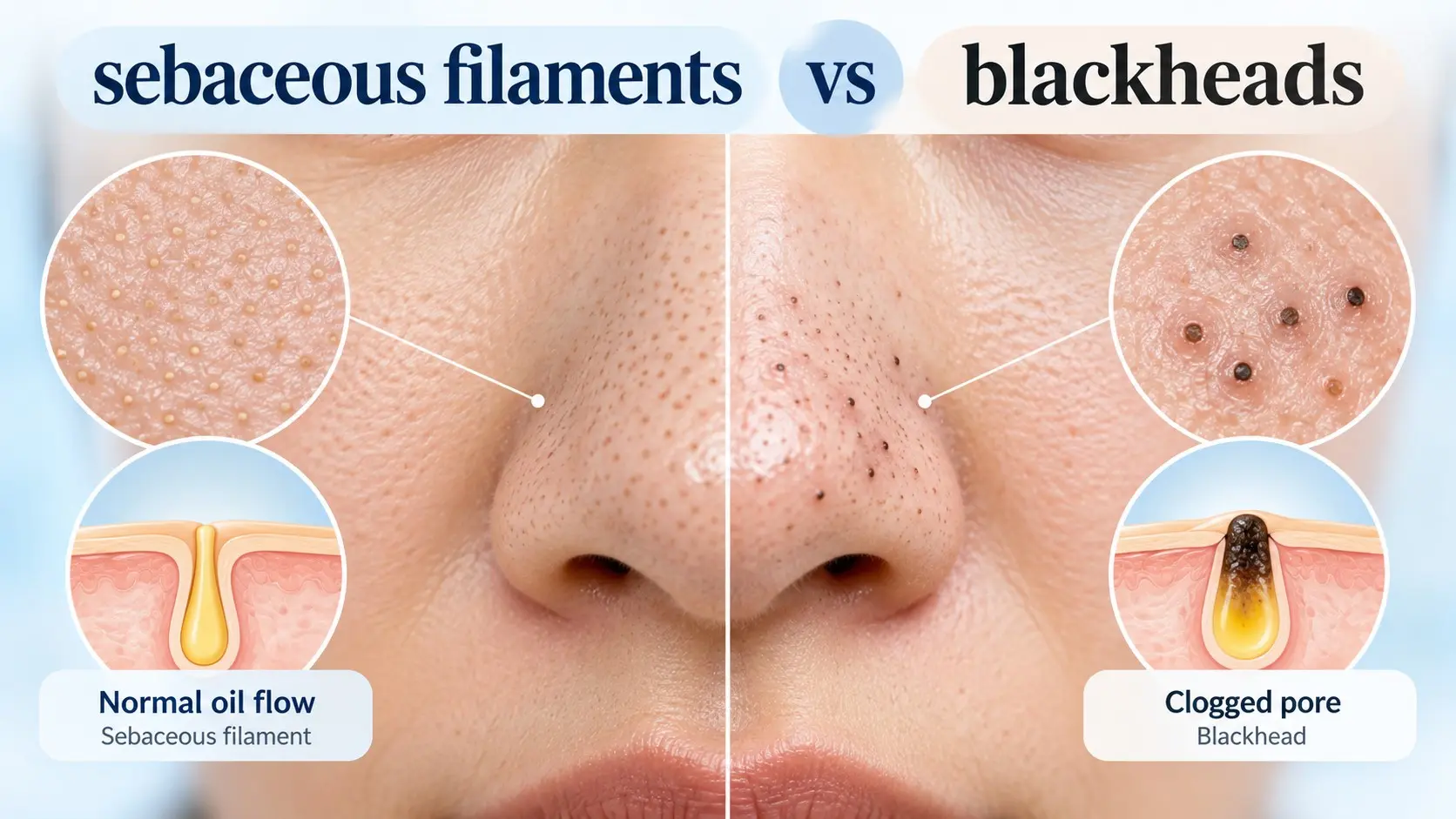
Sebaceous filaments are normal structures that help move oil through your pores. Blackheads are clogged open follicles and acne. Filaments usually appear as many small, flat, similar dots, while blackheads tend to look darker, more irregular, and more like individual plugs.
Quick answer: In the sebaceous filaments vs blackheads comparison, sebaceous filaments are normal parts of oil producing follicles and cannot be permanently removed. Blackheads are open comedones caused by clogged follicles. Uniform flat dots across the nose suggest filaments, while distinct dark plugs are more likely blackheads.
The difference matters because the treatment goal changes.
A true blackhead can be treated as acne. A sebaceous filament does not need to be “cured.” You can reduce how noticeable it looks, but trying to empty every pore over and over usually creates more irritation than improvement.
Medical notice: This content is for general educational purposes and does not replace professional medical advice, diagnosis, or treatment. Consult an appropriately qualified healthcare professional for personal medical concerns.
Table of Contents
- The fastest way to tell them apart
- What sebaceous filaments really are
- What a blackhead really is
- 11 clear differences
- Why blackheads turn dark
- Why sebaceous filaments keep returning
- Best treatment for sebaceous filaments
- Best treatment for blackheads
- Salicylic acid pros and cons
- Retinoid pros and cons
- Pore strips and extraction
- Oil cleansing and niacinamide
- Which routine fits your skin
- Pregnancy and retinoid safety
- When to see a dermatologist
- References and Sources
- Related NextFitLife guides
- About the author
- Frequently asked questions
How Can You Quickly Tell Sebaceous Filaments From Blackheads?
Do not judge the spot by color alone.
Look at the whole pattern.
If your nose has many tiny dots that are almost the same size and sit in a regular pattern, sebaceous filaments are more likely.
If you see fewer, darker spots that look like separate clogged openings, blackheads are more likely.
| Feature | Sebaceous Filaments | Blackheads |
|---|---|---|
| What they are | Normal structures inside oil producing follicles | Clogged open follicles |
| Acne? | No | Yes |
| Typical appearance | Small, flat, gray, pale brown, yellow, or skin toned dots | Distinct darker open plugs |
| Pattern | Many similar dots with regular spacing | More scattered and irregular |
| Texture | Usually flat and smooth | May feel more like a distinct plug or bump |
| Common location | Especially the nose, chin, forehead, and central face | Face, chest, back, and other acne prone areas |
| Can it return? | Yes, because it is part of normal follicle function | New blackheads can develop if follicles clog again |
| Main goal | Reduce visibility without damaging the skin | Clear and prevent clogged pores |
You can also have both at the same time.
That is common enough that you do not need to identify every dot before building a sensible routine.
For a wider guide to healthy pores and acne care, visit the NextFitLife Skin Health Guide.
What Is a Sebaceous Filament?
A sebaceous filament is associated with a normal oil producing follicle.
Your sebaceous glands produce sebum, an oily substance that helps protect and lubricate the skin.
Sebaceous filaments help this material move toward the skin surface.
Cleveland Clinic describes them as normal, healthy parts of the skin rather than acne lesions.
They become easier to see when:
- Your skin produces more oil
- Your pores are naturally more visible
- The follicle contains more sebum
- You look closely at an oil rich area such as the nose
You have sebaceous filaments whether you can see them or not.
What Is a Blackhead?
A blackhead is different.
The medical term is an open comedo.
A hair follicle becomes clogged with a mixture of sebum, keratin, and shed skin cells while the surface remains open.
DermNet defines a comedo as a plugged follicular opening.
Blackheads are therefore a form of comedonal acne, even when they are not red or painful.
If you also have closed pale bumps, read the NextFitLife Whiteheads Guide.
11 Clear Differences Between Sebaceous Filaments and Blackheads
1. Sebaceous Filaments Are Normal Skin
This is the most important distinction.
Sebaceous filaments are part of normal follicle function.
They do not mean your face is dirty, unhealthy, or badly cared for.
A blackhead is an acne lesion caused by a clogged follicle.
2. Blackheads Have a Real Follicular Plug
A blackhead develops when material blocks the follicle.
The opening remains exposed, so the plug can be seen at the surface.
Sebaceous filaments contain oil and cellular material too, but they are not the same obstructive acne plug.
3. Sebaceous Filaments Usually Repeat in a Regular Pattern
Look at a nose with obvious sebaceous filaments and you often see many tiny dots that are similar in size.
They follow the distribution of the follicles.
Blackheads tend to look more random.
You might have one larger blackhead beside several smaller ones, with clear skin between them.
4. Filaments Are Usually Flatter
Visible sebaceous filaments often sit flat with the surrounding skin.
Blackheads can look or feel more like individual plugged openings.
This is a clue, not a diagnostic test. Some blackheads are small and fairly flat.
5. Filaments Tend to Be Lighter
Visible filaments may look:
- Gray
- Light brown
- Tan
- Yellowish
- Skin toned
Blackheads are more likely to look dark brown or black.
Color by itself is still not enough. Lighting, skin tone, oil, makeup, and magnification can all change what you see.
6. Blackheads Can Appear Far Beyond the Nose
Sebaceous filaments are most noticeable where oil glands are prominent, especially the nose and central face.
Blackheads can occur anywhere acne develops, including:
- Nose
- Chin
- Forehead
- Cheeks
- Chest
- Back
7. Sebaceous Filaments Refill Because They Are Normal
This is the reason extraction becomes frustrating.
You can temporarily remove material from a sebaceous filament, but the follicle continues producing and transporting sebum.
The visible material returns.
That is normal biology, not proof that you failed to clean your face properly.
8. Blackheads Have Stronger Treatment Evidence
Modern acne guidelines directly address open comedones.
The American Academy of Dermatology recommends topical retinoids for acne and also supports treatments including salicylic acid.
No comparable guideline exists for permanently removing normal sebaceous filaments because they are not a disease.
9. Professional Extraction Makes More Sense for Blackheads
A trained professional can extract selected comedones.
That can physically clear a stubborn blackhead.
Repeatedly extracting normal filaments has much less value because they refill.
10. Squeezing Creates More Risk Than Information
Do not use squeezing as your diagnostic test.
Cleveland Clinic advises against squeezing sebaceous filaments because pressure from fingernails can irritate or damage the skin.
Picking blackheads can also lead to inflammation, marks, or scars.
11. The Right Goal Is Different
With blackheads, the goal is to prevent the pore from becoming clogged again.
With sebaceous filaments, the goal is simply to keep excess oil and visible buildup controlled while accepting that the structure itself belongs in your skin.
Why are blackheads dark if they are not dirt?
Blackheads are not proof of poor hygiene.
The plug sits in an open follicle.
Material at the surface becomes darker after exposure to air and because of pigment within the comedo.
That is why scrubbing the spot harder does not solve the problem.
The blockage forms inside the follicle.
Hard scrubbing mainly adds irritation.
Why do sebaceous filaments keep coming back?
Your sebaceous glands do not stop working because you used a pore strip or extractor.
They keep producing oil.
That oil keeps moving through the follicle, so material becomes visible again.
This is the point many social media routines miss.
If a method promises to remove sebaceous filaments forever, the promise does not match normal skin anatomy.
What Is the Best Routine for Sebaceous Filaments?
Keep it gentle.
Morning
- Use a gentle cleanser if you need one.
- Apply a light moisturizer.
- Use broad spectrum SPF 30 or higher.
Evening
- Remove makeup and sunscreen.
- Cleanse gently.
- Use salicylic acid on planned nights if your skin tolerates it.
- Moisturize.
You do not need to strip every trace of oil from your face.
If your cheeks are dry while your nose is oily, see the NextFitLife Combination Skin Routine.
What Is the Best Routine for Blackheads?
For true blackheads, I would give a proven comedonal acne treatment more weight than extraction gadgets.
Morning
- Cleanse gently.
- Use salicylic acid if it fits your routine.
- Apply a noncomedogenic moisturizer.
- Use broad spectrum SPF 30 or higher.
Evening
- Remove makeup and sunscreen.
- Wash with a gentle cleanser.
- Use a suitable topical retinoid if appropriate.
- Apply moisturizer.
Do not start every active ingredient on the same night.
One proven treatment used consistently is easier to judge and usually easier on your skin barrier.
If you shop for acne prone skin, the NextFitLife Noncomedogenic Skincare Guide explains what that label does and does not promise.
Salicylic Acid: Pros and Cons
| Pros | Cons |
|---|---|
| Helps unclog pores | Can cause dryness or stinging |
| Useful for blackheads and other clogged pores | Too many salicylic products can irritate the skin barrier |
| Available in cleansers and leave on treatments | Cannot permanently remove normal sebaceous filaments |
AAD acne guidance includes salicylic acid among recommended topical acne therapies.
I would use it as a controlled pore treatment, not as an excuse to combine a salicylic cleanser, toner, serum, mask, and scrub in one routine.
Topical Retinoids: Pros and Cons
Topical retinoids have stronger guideline support for acne than most cosmetic pore treatments.
| Pros | Cons |
|---|---|
| Help clear and prevent clogged pores | Dryness and peeling can occur |
| Strong evidence for acne treatment | Irritation can occur if introduced too quickly |
| Useful when blackheads keep returning | Topical retinoids should be avoided during pregnancy |
Adapalene is one topical retinoid used for acne.
Apply acne medicine according to the product instructions or your clinician's advice. Do not assume more product means faster clearing.
What if You Have Both Blackheads and Sebaceous Filaments?
This is probably the most common real life scenario.
You do not need two completely separate routines.
Treat the acne component while keeping the rest of the routine gentle.
A simple plan with a gentle cleanser, moisturizer, sunscreen, and one appropriate pore treatment can reduce blackheads while also making visible filaments look less obvious.
Accept the structures that are normal.
Treat the lesions that are acne.
Do pore strips remove sebaceous filaments?
They can pull surface material from pores.
That means a strip may temporarily remove material from both blackheads and sebaceous filaments.
The problem is what happens next.
A strip does not change why the follicle contains oil, and it does not prevent the next blackhead from forming.
For sebaceous filaments, the material will naturally build up again.
If strips leave your nose sore, red, or dry, the cosmetic result is not worth the irritation.
Should You Squeeze Sebaceous Filaments?
No routine needs this step.
Squeezing can temporarily empty visible material, but the follicle fills again.
Your fingernails can also create:
- Redness
- Broken skin
- Inflammation
- Dark marks
- Infection risk
If the dots are harmless, flat, and uniform, repeated squeezing creates a bigger skin problem than the one you started with.
Should You Squeeze Blackheads?
I would still avoid home squeezing.
True blackheads are removable plugs, but that does not make fingernails the ideal extraction tool.
Too much pressure can injure the follicle and surrounding skin.
A dermatologist can perform professional extraction when a stubborn comedone really needs it.
Does oil cleansing remove sebaceous filaments?
Oil cleansing is useful for removing makeup, sunscreen, and oily residue if your skin tolerates the cleanser.
That does not prove it permanently removes sebaceous filaments.
If an oil cleanser leaves your skin clean and comfortable, you can use it.
If you are rubbing your nose for ten minutes hoping to pull every filament out, the routine has drifted away from gentle skin care.
Does Niacinamide Get Rid of Sebaceous Filaments?
Niacinamide can be a useful supporting skincare ingredient.
It may help with oiliness and can support the skin barrier.
But I would not put it in the same evidence category as a topical retinoid for true comedonal acne.
Use niacinamide if your skin likes it.
Do not expect it to erase normal follicles.
Do Clay Masks Remove Blackheads?
A clay mask can absorb some surface oil and make oily skin feel cleaner for a short time.
It does not replace treatment that prevents follicular plugging.
If clay leaves your skin tight, flaky, or irritated, use it less often or stop.
Do facial scrubs clear blackheads?
Blackheads are not dirt sitting on top of your face.
Strong scrubbing does not clean the plug from inside the follicle.
It can instead irritate the skin and make pores look more noticeable.
AAD recommends gentle cleansing rather than aggressive scrubbing for acne prone skin.
Can you permanently shrink pores?
You cannot erase normal pores.
You can reduce how noticeable they look.
Pores may stand out more when they contain oil and debris or when the surrounding skin is irritated.
Gentle cleansing, acne treatment when needed, moisturizer, sun protection, and avoiding repeated picking are more realistic than trying to “close” pores.
For the basics, use the NextFitLife Healthy Skin 101 Guide.
Which routine fits you?
| What You See | Most Likely Pattern | Practical Approach |
|---|---|---|
| Many tiny, flat, evenly spaced nose dots | Sebaceous filaments | Gentle cleanser, moisturizer, sunscreen, optional salicylic acid |
| Distinct dark plugs mixed with whiteheads | Comedonal acne | Consider a topical retinoid or salicylic acid as appropriate |
| Filaments plus several true blackheads | Mixed pattern | Treat the acne while keeping expectations realistic for normal filaments |
| Burning, peeling, redness after acids and retinoids | Irritated skin barrier | Reduce active products and simplify the routine |
| Deep, painful, inflamed acne or scarring | More than simple blackheads | See a dermatologist |
How long should you give a blackhead treatment?
Do not judge an acne routine after three nights.
Acne treatment takes time because the goal is to change what happens inside acne prone follicles, not simply wipe the surface clean.
AAD advises giving acne treatment several weeks before deciding whether it is helping.
During that time:
- Use the treatment consistently
- Do not add several new actives at once
- Keep moisturizing
- Use sunscreen
- Stop if you develop a severe reaction
A useful comparison is a photo taken every few weeks, not checking your pores under a magnifying mirror several times a day.
What if your skin is sensitive?
Do less.
Start with:
- A gentle cleanser
- A simple moisturizer
- Broad spectrum sunscreen
Then add one active treatment if you actually need one.
Starting salicylic acid, a retinoid, a scrub, an exfoliating toner, and a clay mask together makes it hard to know which product caused irritation.
If your skin burns, swells, cracks, or becomes raw, stop the irritating products and seek professional advice if it does not settle.
What if you are pregnant?
Pregnancy changes acne treatment choices.
The American Academy of Dermatology advises avoiding topical retinoids during pregnancy, including retinoid skin care products such as adapalene, tretinoin, and retinol.
If you are pregnant, planning pregnancy, or unsure whether a treatment is appropriate, show the ingredient list to your obstetrician or dermatologist before using it.
Do not assume that an over the counter skincare product is automatically safe during pregnancy.
What if a Spot Does Not Look Like Either One?
Not every dark pore is a simple blackhead.
Other follicular conditions and skin lesions can sometimes look similar at home.
Get a dermatologist to check the area if:
- One spot looks very different from the rest
- The spot is growing or changing
- It bleeds
- It is painful
- It becomes repeatedly inflamed
- You cannot tell what it is
Do not repeatedly extract an unusual spot while hoping the diagnosis becomes clearer.
What needed correcting from typical online advice?
The biggest problem with many sebaceous filaments vs blackheads guides is that every method gets presented as if it has the same evidence.
- Sebaceous filaments are not acne. They are normal structures associated with sebaceous follicles.
- Blackheads are acne. They are open comedones.
- Retinoids have strong acne guideline support. They make sense for persistent blackheads.
- Salicylic acid has a useful role. It can help unclog pores but can also irritate skin when overused.
- Oil cleansing is optional. It is not a proven permanent filament remover.
- Niacinamide is supportive care. It should not be sold as the main treatment for blackheads.
- Pore strips are temporary. They do not prevent follicles from filling again.
- Squeezing is not a diagnostic test. You can tell far more from the overall pattern without damaging the skin.
- Blackheads are not dirt. Hard scrubbing does not fix follicular plugging.
- Pores cannot be erased. The realistic goal is healthy, less congested skin rather than a poreless face.
Conclusion
The simplest way to approach sebaceous filaments vs blackheads is to stop treating every visible pore as acne.
If the dots are tiny, flat, and evenly spread across the nose, accept that sebaceous filaments are normal and focus on gentle oil and pore care. If you have distinct clogged blackheads, use a proven comedonal acne treatment such as an appropriate topical retinoid or salicylic acid instead of repeatedly squeezing them.
Your next step is to simplify your routine. Identify whether the overall pattern looks like normal filaments, blackheads, or both, then choose one treatment goal and give your skin time to respond.
References and Sources
This article was checked against current dermatology guidance and recognized medical sources available in September 2026.
- American Academy of Dermatology.
Acne Clinical Guideline.
Used for current evidence based acne treatment recommendations, including topical retinoids and salicylic acid.
URL:
https://www.aad.org/member/clinical-quality/guidelines/acne
- American Academy of Dermatology.
Acne: Diagnosis and Treatment.
Used for blackheads, clogged pores, adapalene, topical retinoids, salicylic acid, and professional acne treatment.
URL:
https://www.aad.org/public/diseases/acne/derm-treat/treat
- Cleveland Clinic.
Sebaceous Filaments: Difference From Blackheads and Treatment.
Used for sebaceous filament anatomy, appearance, recurrence, squeezing, pore strips, and the distinction from blackheads.
URL:
https://my.clevelandclinic.org/health/diseases/24571-sebaceous-filaments
- DermNet New Zealand.
Comedo.
Used for the definition of an open comedo and the distinction between blackheads and closed comedones.
URL:
https://dermnetnz.org/topics/comedones
- American Academy of Dermatology.
Dermatologist Approved Pregnancy Skin Care.
Used for pregnancy safety guidance and the recommendation to avoid topical retinoids during pregnancy.
URL:
https://www.aad.org/public/everyday-care/skin-care-secrets/routine/pregnancy-skin-care
Continue With NextFitLife Skin and Acne Guides
These related guides can help you build a simpler routine, identify other clogged pore problems, and avoid making acne prone skin more irritated.
Skin Health Hub
Acne and Clogged Pores
Skin Care Routines
About the Author
Adel Galal is the founder and lead writer of NextFitLife. He researches and writes about skin health, nutrition, fitness, digestive health, metabolic health, wellness, and healthy aging.
His approach is to compare common skincare claims with current dermatology guidance, separate normal skin anatomy from conditions that need treatment, and avoid promising perfect or poreless skin.
For clogged pores, this means distinguishing evidence based acne treatment from temporary cosmetic techniques. A blackhead is acne. A sebaceous filament is normal. Treating them as the same thing can lead to unnecessary squeezing, scrubbing, and irritation.
This content is for general educational purposes and does not replace professional medical advice, diagnosis, or treatment. Consult an appropriately qualified healthcare professional for personal medical concerns.
Learn more about Adel Galal, NextFitLife, and the site's editorial approach on the NextFitLife About Us page.
Frequently Asked Questions About Sebaceous Filaments vs Blackheads
What is the main difference between sebaceous filaments and blackheads?
Sebaceous filaments are normal structures associated with oil producing follicles. Blackheads are clogged open follicles, also called open comedones, and are a form of acne.
How can I tell if the dots on my nose are sebaceous filaments?
Sebaceous filaments usually appear as many tiny, flat, similar dots that are evenly distributed across the nose. They may look gray, tan, pale brown, yellowish, or skin toned.
How do blackheads look?
Blackheads usually look like distinct dark plugs in open pores. They tend to be more irregular in size and spacing than sebaceous filaments.
Are sebaceous filaments acne?
No. Sebaceous filaments are normal structures involved in moving sebum through follicles. They can become more noticeable on oily or visible pores, but they are not acne lesions.
Are blackheads acne?
Yes. Blackheads are open comedones and are part of comedonal acne.
Why are blackheads black?
The dark appearance is not dirt. Material in the open follicle is exposed at the skin surface, where chemical changes and pigment contribute to its darker color.
Can sebaceous filaments be permanently removed?
No. They are normal structures associated with sebaceous follicles. Their contents can be temporarily reduced, but oil and cellular material build up again.
Can salicylic acid help sebaceous filaments?
Salicylic acid can help reduce oil and dead skin buildup inside pores, so visible filaments may look less obvious. It does not permanently remove the normal follicular structure.
Is salicylic acid good for blackheads?
Yes. Salicylic acid helps unclog pores and is included in current dermatology acne treatment recommendations.
Is adapalene good for blackheads?
Adapalene is a topical retinoid that helps prevent clogged pores and can treat comedonal acne, including blackheads. It can irritate the skin at first and should not be used during pregnancy.
Should I squeeze sebaceous filaments?
No. Squeezing may temporarily remove some material, but the follicle fills again. Repeated pressure can irritate or damage the skin.
Should I squeeze blackheads?
Home squeezing is best avoided because too much pressure can damage the follicle and increase inflammation, marks, or scarring. A dermatologist can perform professional comedone extraction when appropriate.
Do pore strips remove blackheads?
Pore strips can remove some material near the skin surface and create a temporary cosmetic change. They do not prevent follicles from becoming clogged again.
Do pore strips remove sebaceous filaments?
They can pull material from sebaceous filaments, but the result is temporary because the follicles continue producing and transporting sebum.
Does oil cleansing get rid of sebaceous filaments?
Oil cleansing can remove makeup, sunscreen, and surface oil, but there is not strong evidence that it permanently removes sebaceous filaments. They are normal structures and will remain part of the skin.
Does niacinamide remove blackheads?
Niacinamide can support the skin barrier and may help oily skin, but it is not one of the main guideline supported treatments for clearing comedonal acne. Topical retinoids and salicylic acid have stronger acne treatment support.
Can I have blackheads and sebaceous filaments at the same time?
Yes. A person may have normal sebaceous filaments across the nose along with several true blackheads. Treat the acne while keeping the rest of the routine gentle.
When should I see a dermatologist?
See a dermatologist if acne is painful, deep, scarring, spreading, or not improving with a consistent routine. Professional evaluation is also useful if a spot looks unusual, changes, bleeds, or does not resemble the surrounding pores.

Health & wellness writer with 30+ years of experience in nutrition, fitness, and healthy aging. Founder of NextFitLife.com — evidence-based health guidance.