Last Updated: January 14, 2026
Published: January 14, 2026
Key Takeaways
✓ Somatic yoga focuses on internal sensations rather than external appearance
✓ Slow, mindful movement retains your nervous system
✓ This practice is ideal for trauma healing, chronic tension, and stress
✓ Emotional release during practice is normal and healthy
✓ Start slowly and honor your body’s pace
✓ Body awareness is more important than flexibility or strength
✓ Works best when combined with patience and self-compassion
✓ Professional guidance is recommended for trauma work
Somatic yoga helps you reconnect with your body through slow, mindful movements that calm your nervous system. If you’re dealing with chronic tension, unresolved stress, or emotional pain stored in your body, this gentle practice teaches you to listen to your body’s signals and move in ways that promote natural healing. I’ve seen people transform their relationship with movement through this approach, and I’m eager to share what makes it so powerful.
What Is Somatic Yoga?
It combines traditional yoga poses with principles from somatic movement therapy. Somatic is derived from the Greek term ‘soma,’ which refers to the body felt from the inside.
Unlike regular yoga, which focuses on achieving perfect poses, this practice emphasizes:
- Body awareness and internal sensations
- Slow, deliberate movements
- Releasing stored tension patterns
- Connecting breath with movement
- Listening to your body’s wisdom
I like this approach because it removes the pressure to perform. You’re not trying to look a certain way or stretch further than your neighbours. You’re simply exploring how your body feels and what it needs.
The Science Behind Body-Mind Connection
Research from the National Center for Biotechnology Information shows that body-minded yoga practices can significantly reduce cortisol levels and regulate the autonomic nervous system. When we experience trauma or chronic stress, our bodies hold on to these patterns even after the threat has passed.
Somatic experiencing yoga helps release these patterns by:
- Increasing interoceptive awareness (sensing what’s happening inside your body)
- Activating the parasympathetic nervous system (rest and digest mode)
- Processing unfinished stress responses
- Building new neural pathways for safety and calm
How Somatic Yoga Differs from Traditional Yoga
| Traditional Yoga | Somatic Yoga |
| Focus on external alignment | Focus on internal sensation |
| Achieving specific poses | Exploring comfortable movement |
| Building strength and flexibility | Releasing tension patterns |
| Following the instructor’s cues | Listening to your body |
| Often fast-paced | Always slow and mindful |
I’ve tested both approaches extensively. Traditional yoga helped me build physical strength, but gentle somatic exercises taught me how to feel safe in my body again.
The Healing Power of Nervous System Regulation
Understanding Your Nervous System
Your nervous system has two dominant modes:
Sympathetic (Fight or Flight)
- Activated during stress
- Increases heart rate
- Tense muscles
- Prepares for action
Parasympathetic (Rest and Digest)
- Activated during safety
- Slows heart rate
- Relax muscles
- Promote healing
The nervous system regulations specifically target the vagus nerve, which connects your brain to your digestive system, heart, and lungs. When this nerve functions well, you feel calmer, sleep better, and digest food more easily.
Important Note – If you’re dealing with severe trauma, consider working with a trauma-informed yoga instructor who understands how stored trauma manifests in the body.
Benefits of Somatic Yoga for Healing
Physical Benefits
Through gentle yoga for healing, I’ve witnessed remarkable changes:
- Chronic tension relief in the shoulders, neck, and back
- Improved posture without forced corrections
- Better sleep quality
- Reduced pain levels
- Enhanced flexibility through relaxation (not force)
Emotional Benefits
Yoga for emotional healing works because emotions get trapped in our tissues. When you crawl and mindfully, you give these emotions permission to surface and release.
People often experience:
- Reduced Anxiety and depression symptoms
- Better emotional regulation
- Increased self-compassion
- Feeling more grounded and present
- Release of old emotional patterns
Mental Benefits
Mindful body awareness cultivates mental clarity:
- Improved focus and concentration
- Reduced racing thoughts
- Better decision-making
- Enhanced creativity
- Stronger mind-body connection
Essential Somatic Yoga Poses
Somatic Cat-Cow (Spinal Waves)
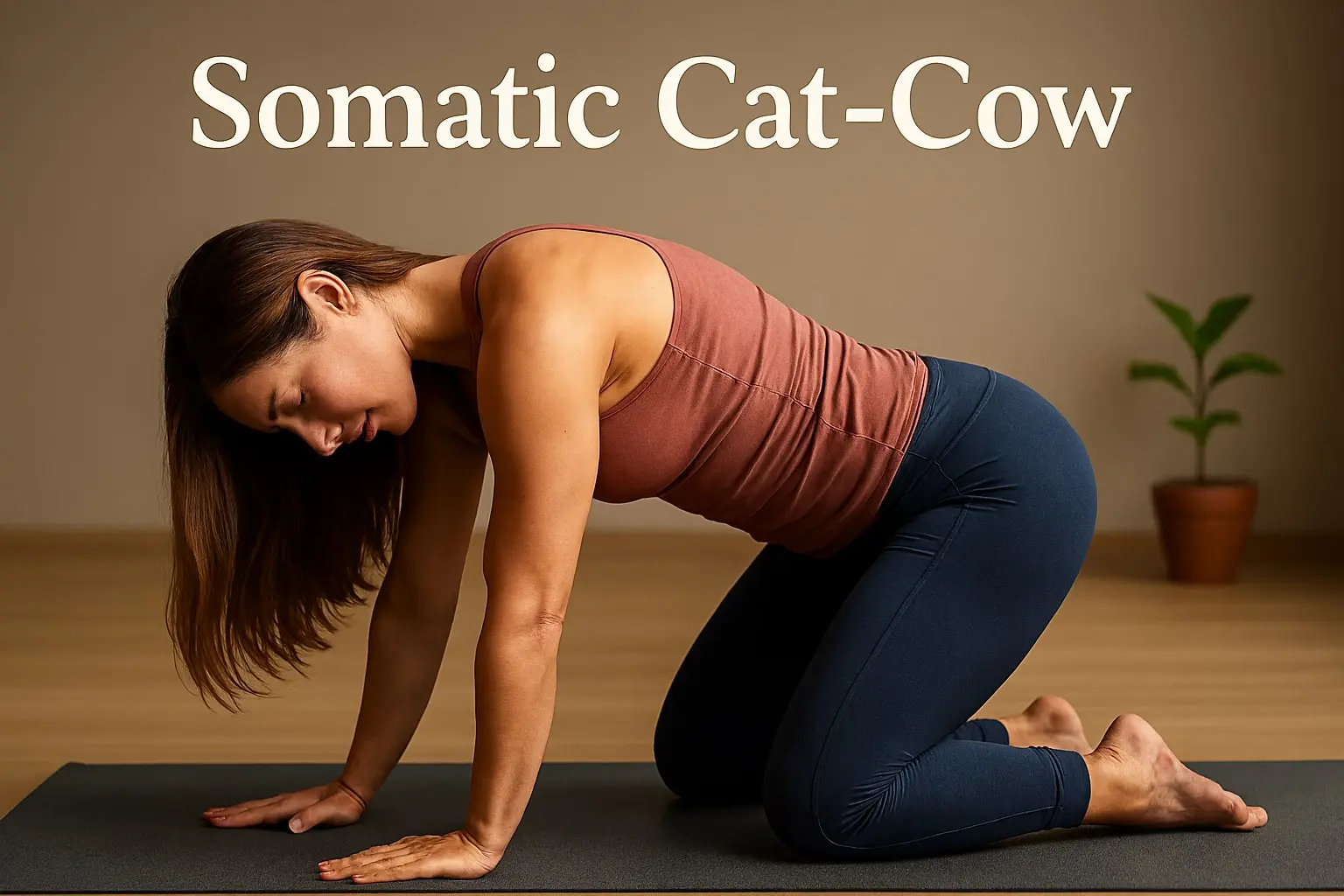
Unlike traditional cat-cow, you move incredibly slowly, focusing on each vertebra.
How to practice –
- Start on hands and knees
- Take 30 seconds to arch your back
- Pause and notice sensations
- Take 30 seconds to round your spine
- Notice where you feel movement and where you don’t
This embodied yoga practice helps you map your spine and release locked segments.
Constructive Rest Position
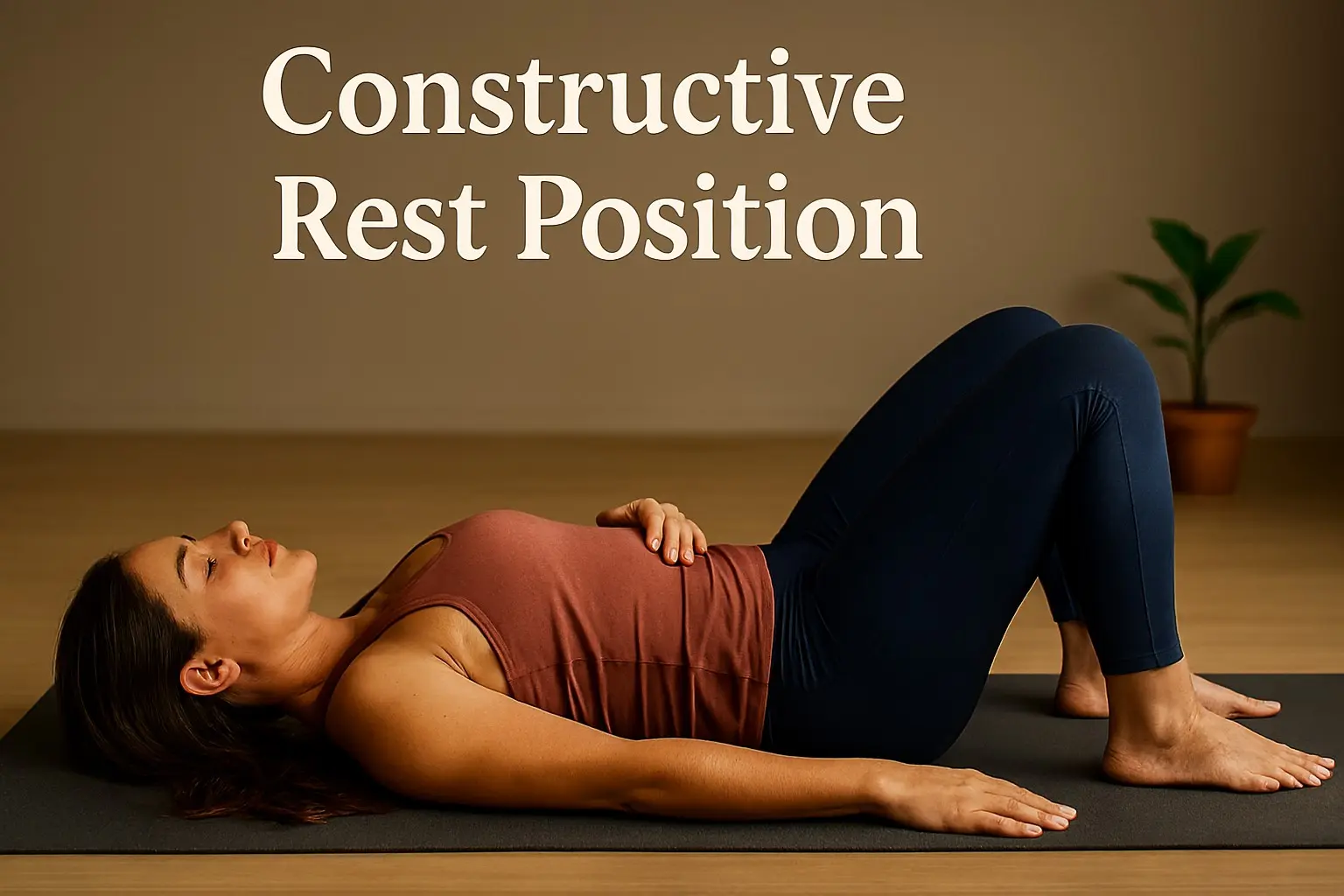
This is my go-to yoga for stress release.
How to practice –
- Lie on your back
- Bend knees, feet flat on floor, hip-width apart
- Rest your arms on your belly or by your sides
- Stay for 10-20 minutes
- Focus on your breath and body sensations
This position allows your psoas muscle (hip flexor) to release, which often holds trauma and stress.
Somatic Twist

Restorative somatic practices like this gentle twist release tension without force.
How to practice –
- Lie on your back
- Draw the right knee toward the chest
- Slowly guide the knee across the body to the left
- Take 2-3 minutes per side
- Move only as far as feels comfortable
Somatic Bridge
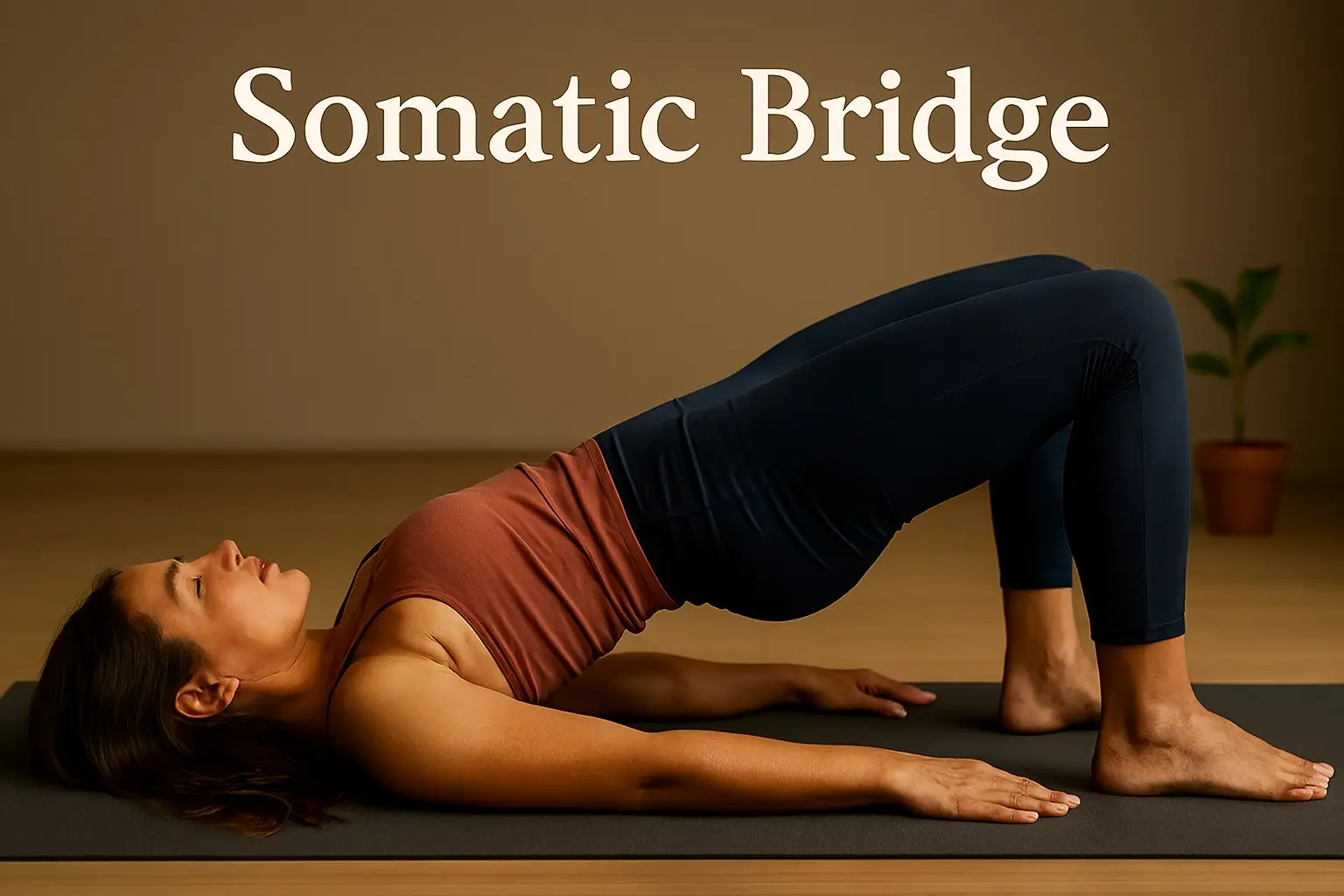
This addresses chronic tension relief in the lower back.
How to practice –
- Lie on your back, knees bent
- Very slowly lift your pelvis
- Take 20 seconds to come up
- Pause at the top
- Take 20 seconds to lower down
- Repeat 3-5 times
The slow movement retains its nervous system.
Somatic Exercises for Trauma Release
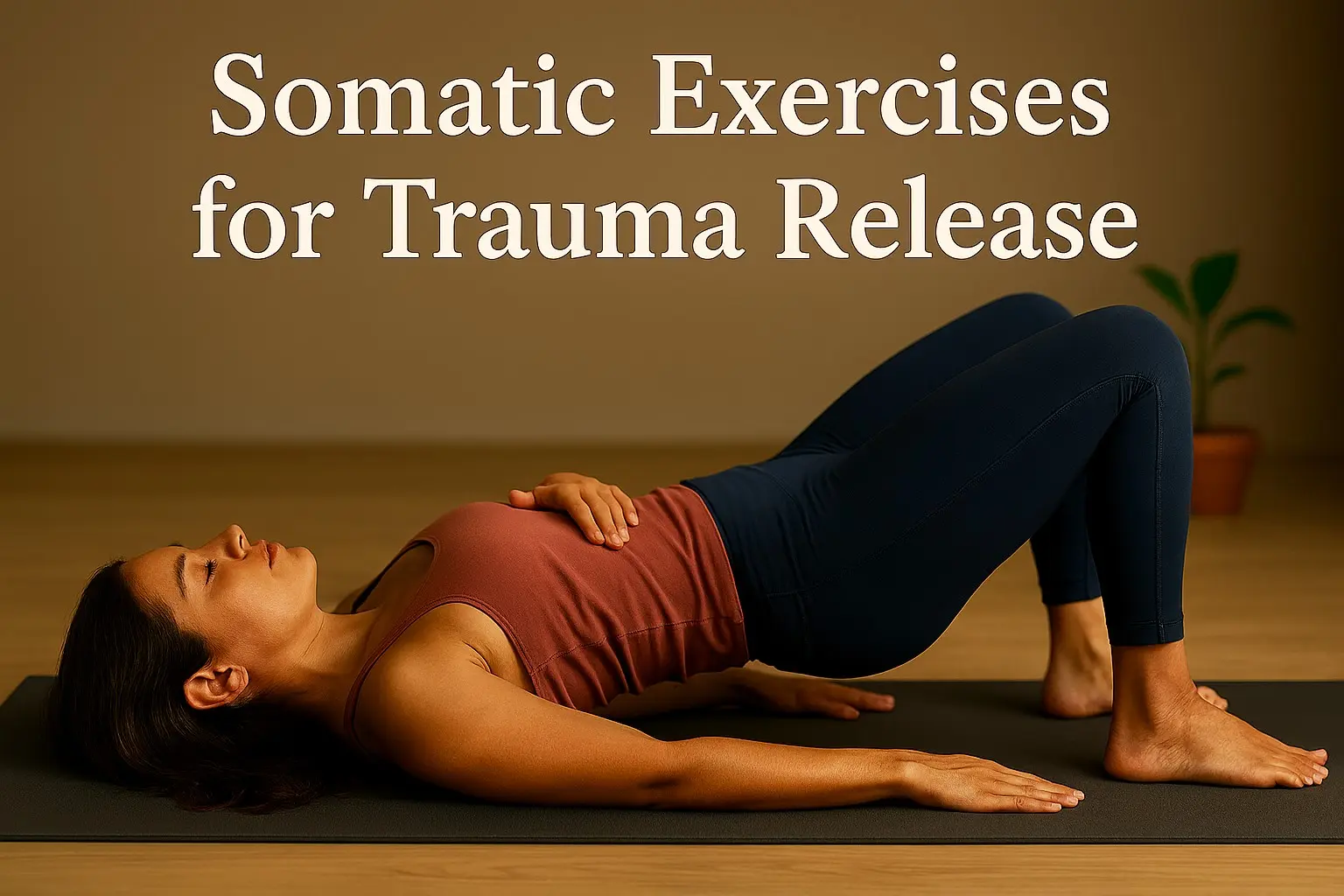
Trauma-informed yoga recognizes that trauma lives in the body, not just the mind. According to trauma expert Dr. Peter Levine’s research on Somatic Experiencing, incomplete stress responses get stored in our nervous system.
Key Principles for Trauma-Sensitive Practice
Choice and Control
- You decide how deep to move
- You can stop anytime
- There’s no “correct” way to do poses
Pendulation
- Move between areas of ease and tension
- Don’t stay in discomfort too long
- Always return to a sense of safety
Titration
- Work with small amounts of sensation
- Don’t overwhelm your system
- Progress gradually
Safety Note – Trauma work should ideally be done with professional guidance. These practices complement, but don’t replace, therapy.
Creating Your Somatic Yoga Practice
For Beginners: Starting Slow
I’ve seen many people dive into complex practices too quickly. Start here:
Week 1-2: Awareness
- Lie down for 5 minutes daily
- Notice your breath
- Observe body sensations without judgment
Week 3-4: Gentle Movement
- Add 2-3 simple, slow, mindful movement yoga exercises
- Move for 10-15 minutes
- Focus on comfort, not achievement
Week 5-6: Building Practice
- Extend sessions to 20-30 minutes
- Explore more poses
- Notice patterns in your body
Daily Practice Routine
Here’s a simple 20-minute sequence I use:
| Time | Activity | Focus |
| 0-5 min | Constructive Rest | Body scan and breath |
| 5-10 min | Gentle Spinal Movements | Somatic movement therapy |
| 10-15 min | Somatic Yoga Poses | Listening to your body |
| 15-20 min | Final Relaxation | Integration |
Understanding Emotional Release
Why People Cry During Somatic Workouts
I’ve experienced this myself, and it’s completely normal. Here’s what happens:
Physical Explanation
- Muscles store emotional memories
- Slow movement accesses the limbic system (emotional brain)
- Release of tension triggers emotional release
- The vagus nerve activates tear production
What to Do When Emotions Surface
- Let them come without judgment
- Keep breathing slowly
- Place your hands on your heart or belly
- Remember: this is an old emotion leaving your body
- Be gentle with yourself afterward
This is a sign that interoceptive yoga flows are working.
Personal Experience – During one practice, I started crying during a simple hip opener. I wasn’t sad at that moment, but my body was releasing something old. I let it happen and afterward felt lighter than I had in years.
Somatic Yoga for Specific Conditions
Chronic Pain Management
Somatic exercises for trauma can be particularly helpful for chronic pain, which often has a nervous system component.
Approach –
- Move very slowly through pain-free ranges
- Use micro-movements (barely visible)
- Focus on areas that feel good
- Gradually expand comfortable movement
Anxiety and PTSD
Nervous system regulation is crucial for anxiety management.
Helpful practices –
- Grounding exercises (feeling feet on the floor)
- Butterfly hug (crossing arms over chest)
- Humming or toning to activate the vagus nerve
- Very slow movements with long exhales
Sleep Issues
My sleep improved dramatically with evening restorative somatic practices.
Before-bed sequence –
- 5 minutes of constructive rest
- Gentle spinal twists
- Legs up the wall (with slow breath)
- Final body scan
Common Mistakes to Avoid
Rushing the Process
This is the biggest mistake I see. Slow mindful movement yoga must be slow. If you’re moving at traditional yoga speed, you’re missing the point.
Forcing or Pushing
Unlike traditional yoga, we never push through resistance. If you feel:
- Sharp pain
- Holding your breath
- Tension increasing
Stop and find a gentler option.
Skipping the Awareness Phase
You can’t fix what you can’t feel. Spend time just noticing before trying to change anything.
Practicing When Dysregulated
If you’re in fight-or-flight mode, start with calming breathwork before movement.
Building Body Awareness
Mindful body awareness is the foundation of this practice. Here’s how to develop it:
Interoception Exercises
- Temperature Scanning
- Notice warm and cool areas
- Don’t change anything
- Just observe
- Weight Sensing
- Feel which body parts press into the floor
- Notice the quality of that contact
- Heavy or light? Soft or tense?
- Breath Tracking
- Where do you feel your breath?
- Chest? Belly? Back?
- Does it flow smoothly or catch anywhere?
These simple exercises strengthen your interoceptive yoga flows and help you tune into your body’s signals.
My Personal Journey with Somatic Yoga
I discovered Somatic movement therapy after years of pushing through traditional fitness and yoga. My body was strong but tight, and I carried stress like a backpack I couldn’t remove.
The first time I tried crawling and paying attention, I realized I’d been disconnected from my body for years. I was living in my head, ignoring signals of pain, fatigue, and tension.
What changed –
- I stopped forcing my body into shapes
- I learned to feel the difference between “good” stretch and strain
- I processed emotions I didn’t know I was carrying
- My chronic shoulder tension finally released
This isn’t about becoming flexible or strong (though those might happen). It’s about coming home to your body.
Finding the Right Teacher
Not all yoga teachers understand trauma-informed yoga. Look for:
- Training in somatic practices or Somatic Experiencing
- Emphasis on student choice and body autonomy
- Slow-paced classes
- Invitation language (“you might try…” vs “do this”)
- Understanding of nervous system regulation
Many practitioners now offer online classes, making it easier to find qualified instruction.
Combining Somatic Yoga with Other Practices
The nervous system regulation yoga works beautifully with:
Therapy
- Helps process what comes up in talk therapy
- Gives you tools to regulate between sessions
- Addresses the body component of psychological healing
Meditation
- Builds the awareness needed for meditation
- Releases physical restlessness
- Creates a calm baseline state
Traditional Yoga
- You can practice both
- Somatic work enhances traditional practice
- Help prevent injury by increasing body awareness
Frequently Asked Questions
What is somatic yoga?
It is a mindfulness-based movement practice that combines traditional yoga with principles of somatic therapy. It emphasizes slow, deliberate movements and internal body awareness to release tension, regulate the nervous system, and promote healing. Unlike regular yoga, the goal isn’t achieving specific poses but exploring how your body feels and responding to its needs.
What’s the difference between somatic yoga and normal yoga?
The major difference is focus and speed. Traditional yoga emphasizes proper alignment, building strength, and achieving poses, often moving at a moderate to fast pace. Body awareness yoga moves very slowly, prioritizes internal sensations over external form, and focuses on releasing stored tension rather than building fitness. There’s no goal to push yourself or look a certain way; you simply move in ways that feel good to your body.
Can I lose weight with somatic yoga?
It isn’t designed for weight loss, as it’s a gentle, slow-moving practice focused on nervous system healing and body awareness. However, by reducing stress and regulating cortisol levels, it may support overall health and potentially aid weight management as part of a broader wellness approach. If weight loss is your primary goal, combining somatic practices with more active exercise and nutrition changes would be more effective.
What are examples of somatic exercises?
Common somatic exercises include:
- Pandiculation (slow, conscious contraction and release)
- Constructive rest position
- Slow spinal movements
- Body scanning
- Micro-movements in joints
- Gentle rocking motions
- Breath-focused movements
- Progressive muscle release
These exercises focus on retraining movement patterns and releasing chronic muscle tension.
What are some somatic yoga poses?
Key body awareness yoga poses include:
- Somatic Cat-Cow (very slow spinal waves)
- Constructive Rest Position
- Gentle Somatic Twist
- Somatic Bridge
- Side-lying Release
- Supported Child’s Pose
- Slow Warrior Flow
- Restorative Forward Fold
The poses themselves may look familiar, but they’re practiced much more slowly with emphasis on sensation.
Why do people cry during somatic workouts?
Crying during somatic workouts happens because emotions get stored in muscle tissue and fascia. When you crawl and mindfully, you access deeper layers of tension where these emotions are held. As chronic tension releases, so do the emotions attached to it. This is a healthy sign that your nervous system feels safe enough to let go of old patterns. The slow movements also activate the vagus nerve and limbic system, which can trigger emotional release.
Conclusion
Somatic yoga offers a gentle, effective path to healing that honours your body’s wisdom. Through slow mindful movement, nervous system regulation, and deep body awareness, you can release patterns of tension and trauma that traditional approaches may not reach.
This practice taught me that healing isn’t about pushing harder or achieving more. It’s about slowing down, listening, and trusting your body’s innate ability to return to balance.
Start where you are. Crawl. Be patient with yourself. Your body has been waiting for this kind of attention.
Disclaimer: I am not a doctor, and this content does not replace medical advice. What I share comes from real-life experience and careful learning. Always consult healthcare professionals for medical concerns, especially when dealing with trauma, chronic pain, or serious health conditions.
References
- What Is Somatic Yoga and Its Benefits? – Cleveland Clinic Health Essentials – https://health.clevelandclinic.org/somatic-yoga
- Somatic Yoga Exercises for Beginners – Yoga with Rachel Marie – https://www.yogawithrachelmarie.com/post/somatic-yoga-exercises-for-beginners
- Somatic Yoga: Benefits, Practices, and Tips – Health.com – https://www.health.com/somatic-yoga-8731678

Adel Galal is a health and wellness writer with over 30 years of experience studying and writing about health, fitness, nutrition, and healthy living. He is the founder of NextFitLife.com, where he shares practical, evidence-based guidance to support long-term health at any age. Adel’s mission is simple:
to help people make smarter health choices that fit real life, at any age.